


Abstract
A highly regioselective reaction of 2-indolylmethanols with enamides has been developed at room temperature by using AlCl3 as a catalyst. A wide range of hybrids (40 examples) of indoles and enamides were obtained in moderate to good yields (up to 98% yield). This transformation represents the efficient way to introduce biologically important indoles and enamides skeleton into structurally complex hybrids.
1. Introduction
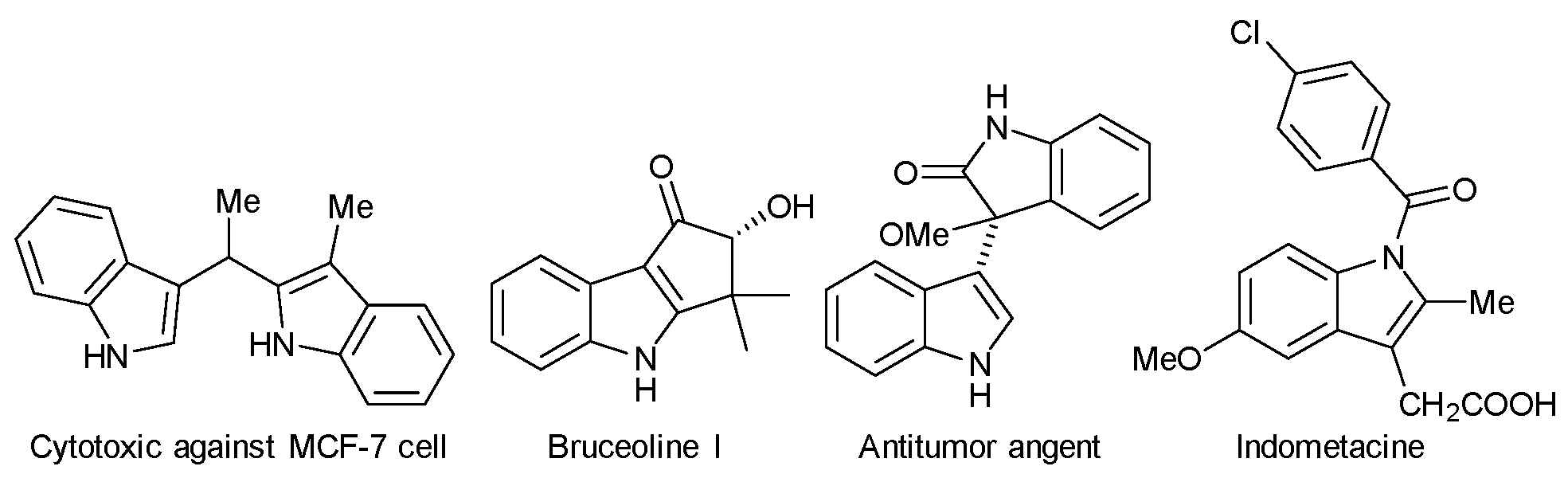
Indole scaffold represents one of the most important heterocyclic frameworks, and it is found in the cores of many natural alkaloids, pharmaceuticals and functional materials (Figure 1) [1,2,3,4,5]. The synthesis of indole-containing derivatives has therefore remained an attractive research field. Among the established approaches, indolylmethanol-involved reactions have been proven to be straightforward methods for the synthesis of diverse indole derivatives through cycloadditions and substitution reactions [6,7,8,9,10,11,12,13,14,15,16,17,18,19]. In particular, 2-indolylmethanols that serve as three-carbon building blocks have been extensively explored to synthesize indole-fused scaffolds via [3 + 2] [20,21], [3 + 3] [22,23,24,25] and [4 + 3] [26,27,28] cyclizations. On the other hand, 2-indolylmethanols can also transform into carbocations, vinyliminium and delocalized cations in the presence of a Lewis or Brønsted acid to participate in various substitution reactions. In this context, various nucleophiles include indoles and electron-rich heterocycles [29,30,31,32], naphthol [33], phosphines [34,35], thiophenols [36], tryptamines and tryptophols [37], sodium sulfinates [38], aldehydes [39], vinyl silyl ethers [40], 2-alkyazaarenes [41], azlactones [42], prazol-5-ones [43], anhydrides and cyclic enaminoes [44,45] and guaiazulenes [46] and have been applied in the substitution of 2-indolylmethanols either at the C3 position or benzyl position. Nevertheless, the design and development of efficient, atom-economical and practical approaches are still needed to generate biologically important indole-containing compounds.
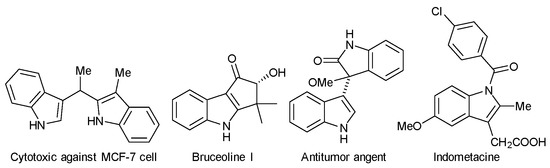
Figure 1.
Representative drugs and biologically active compounds bearing indole unit.
Nitrogen-containing heterocyclic compounds constitute important building blocks in biologically active compounds [47,48,49]. Enamides are versatile synthons in cycloadditions [50,51,52,53,54,55] and various functionalization reactions [56,57,58,59,60,61,62,63] to construct nitrogen-containing compounds. Because of our continual research interest in biologically important nitrogen-containing heterocycles synthesis and enamides chemistry [50,51,52,53,54,55], we envisioned that the hybrids of indoles and enamides would be obtained because of the nucleophilicity of enamides and the electrophilicity of 2-indolylmethanols under acidic conditions. Shi et al. reported the Brønsted acid-catalyzed reaction of 2-indolylmethanols with cyclic enaminones for the synthesis of 3-functionalized indole derivatives under elevated temperature [64,65]. Han developed the chiral phosphoramide-catalyzed asymmetric C2 alkylation of 2-indolylmethanols with acyclic enamides [65]. Herein, we report the highly regioselective C3 alkylation reaction of 2-indolylmethanols with cyclic enamides for the construction of hybrids of indoles and cyclic enamides under mild reaction conditions.
2. Results
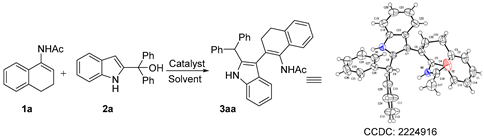
Initially, the reaction of cyclic enamide 1a and 2-indolylmethanol 2a was employed as a model reaction to testify the feasibility of this reaction under the catalysis of a chiral phosphoric acid (CPA) at room temperature in toluene (Table 1, entry 1). The anticipated product could be obtained in 35% yield albeit with no atroposelectivity. The product was unambiguously determined by X-ray crystallographic analysis (CCDC 2224916). To improve the atroposelectivity of the reaction, a series of CPAs were screened. Unfortunately, further screening of CPAs did not give improved atroposelectivity for the reaction. Then, we turned to the racemic version of this transformation. No reaction occurred under other Brønsted acids, such as trifluoroacetic acid, AcOH, even at elevated temperatures (Table 1, entries 2–3). Therefore, the stronger acids were examined and found that TsOH catalyzed the C3 alkylation reaction smoothly and generated the product in 38% yield (Table 1, entry 4). Then, a variety of Lewis acids were screened to improve the reaction efficiency. However, Sc(OTf)3 and Cu(OTf)2 did not work at all. No desired product was detected, and the starting material was decomposed (Table 1, entries 5–6). Gratifyingly, AlCl3 gave the product in 40% yield within 2 h (Table 1, entry 7). AlCl3 was then selected as the optimal catalyst for further evaluation of the solvents (entries 8–12), which disclosed that DCM was most suitable in terms of yield and time, giving product 3a in 88% yield within 2 h.

Table 1.
Optimization of the reaction conditions a.
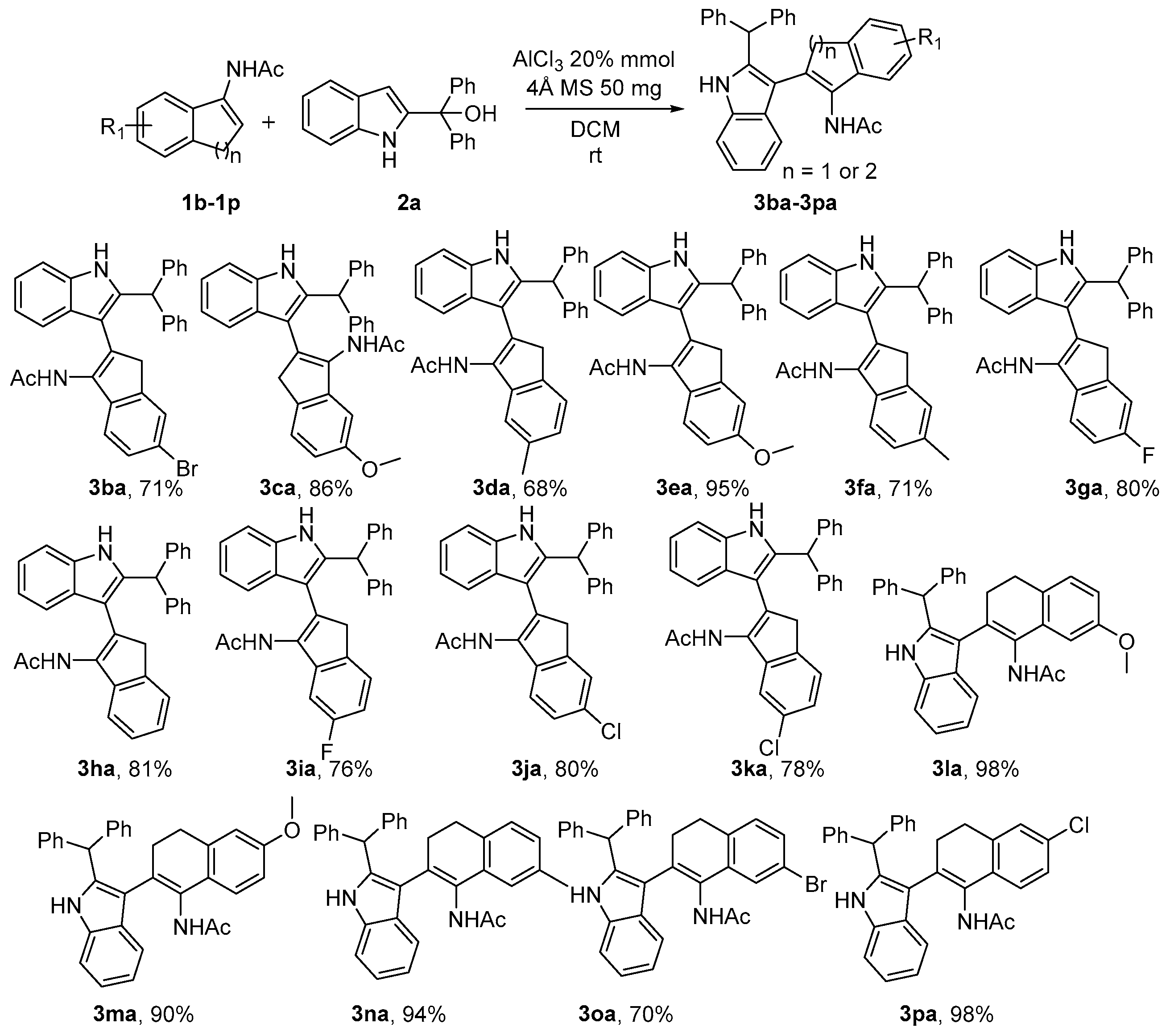
Having established the optimal reaction conditions, we thereby examined the substrate scope of this protocol by employing a variety of enamides 1, and the results are summarized in Figure 2. Various cyclic enamides tested could smoothly furnish the corresponding C3 alkylation product in good to excellent yields (68–98%) under the optimal reaction conditions (Figure 2, 3ba–3pa). The alkylation can be extended to a variety of five-membered (Figure 2, 3ba–3ka) and six-membered enamides (Figure 2, 3la–3pa) bearing either electron-rich (Figure 2, 3ca–3fa, 3la–3na) or electron-deficient (Figure 2, 3ga–3ka, 3oa–3pa) substituents on the phenyl ring, giving the corresponding C3 alkylation products in good yields. It is worth noting that when changing the acyl group with a benzoyl group on enamines, no reaction was observed probably due to the hindrance and the electron-deficient effect.
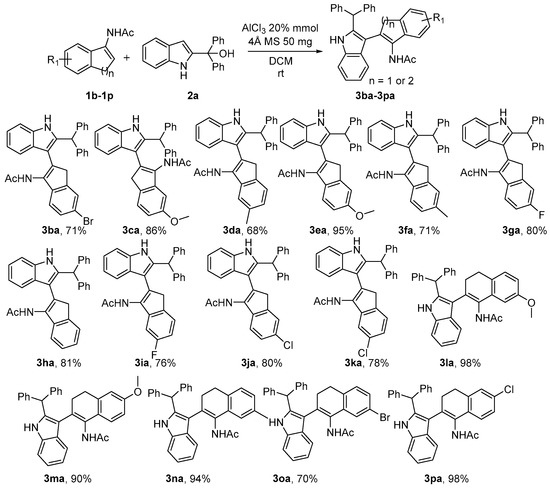
Figure 2.
Scope of enamines.
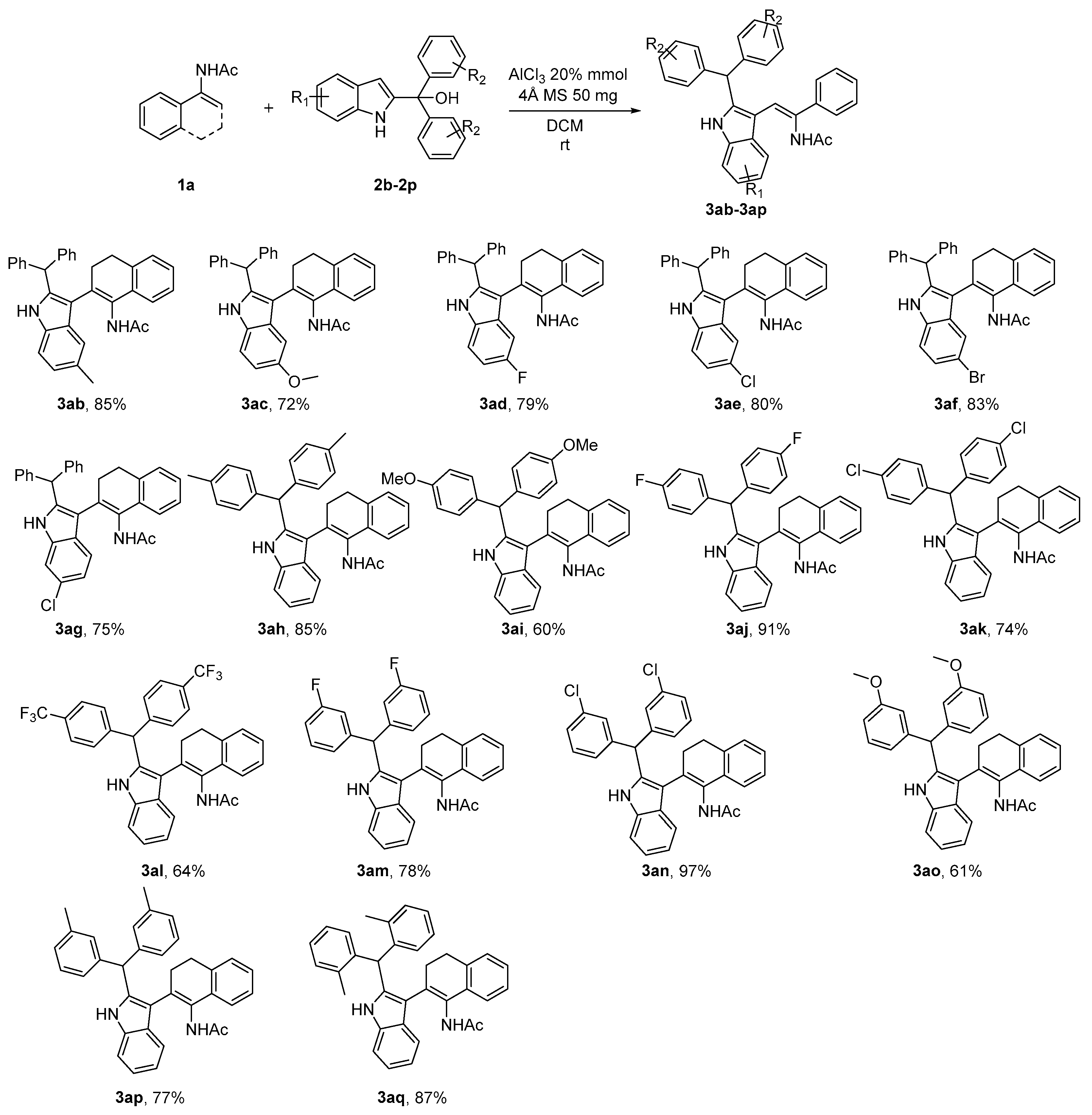
To further examine the generality of the reaction, we next investigated the scope of different 2-indolylmethanols with six-membered enamides under the established conditions. First, the substituent effect on the indole ring was examined. The electronic effect on the indole ring seems to have no obvious effect on the reaction efficiency (Figure 3, 3ab and 3ac vs. 3ad–3af). Then, 2-indolylmethanols derived from different Grignard reagents were applied in this reaction. The substrates with electron-donating groups such as methyl and methoxyl at the meta- and para-position of the benzene resulted in relatively lower yields compared to the electron-withdrawing ones (Figure 3, 3ah, 3ai, 3ao and 3ap vs. 3aj, 3ak, 3al, 3am and 3an). These results showed that electron-donating substituents on the phenyl ring may reduce the electrophilicity of the in-site formed cation. It is worth noting that the ortho-position-substituted substrate was also compatible and afforded the 3aq in 87% yield.
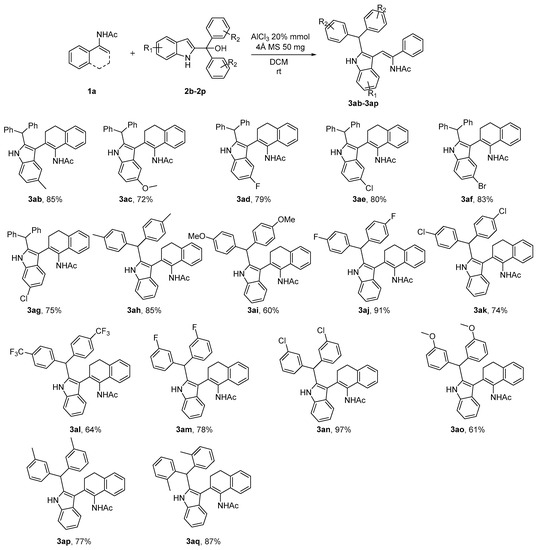
Figure 3.
Scope of 2-indolemethanols.
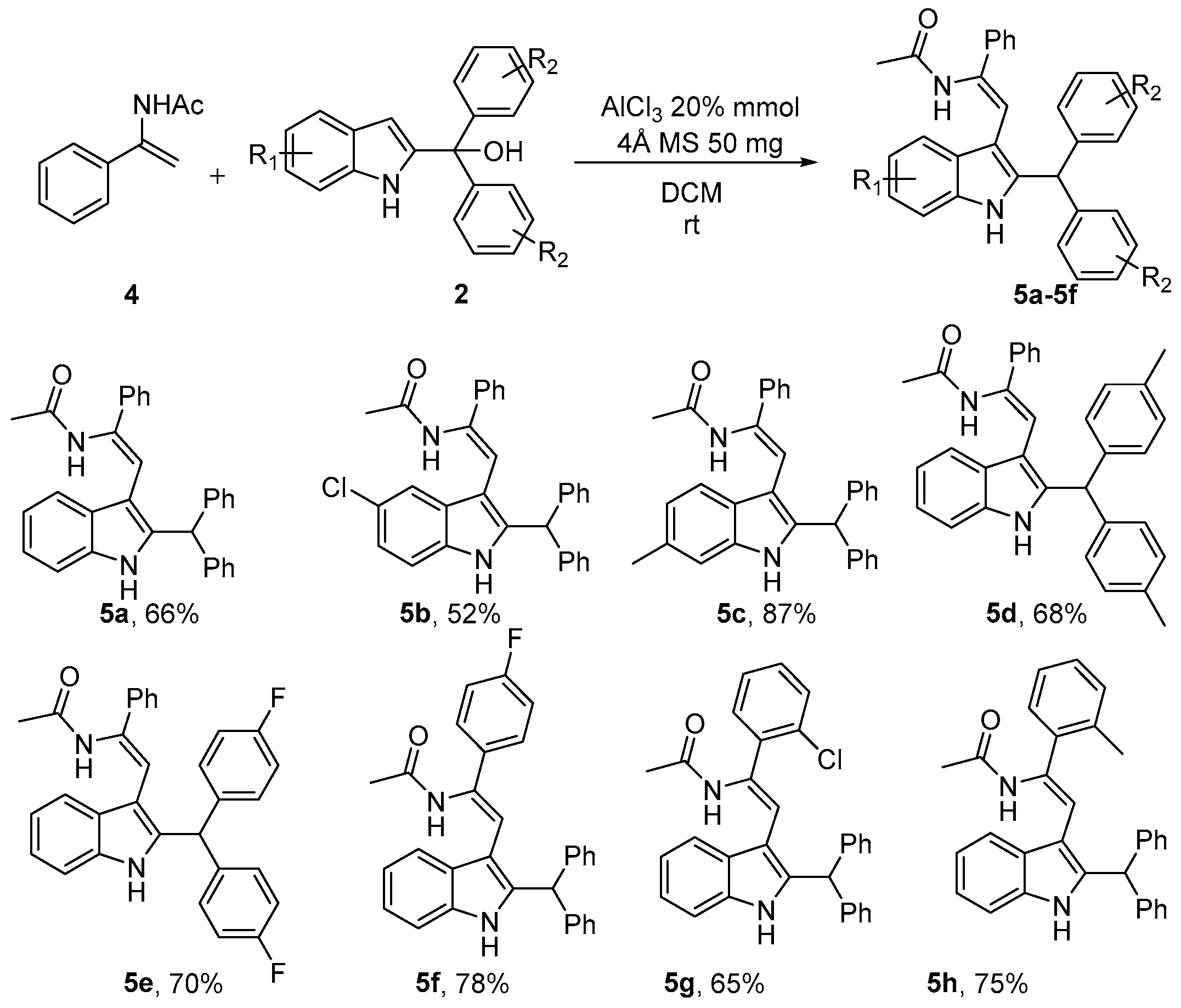
To obtain the structure-diverse indole-containing compounds and further expand the scope of this reaction, acyclic enamides were used to couple with the 2-indolylmethanols. As shown in Figure 4, a series of highly functionalized enamides-containing indoles were obtained in 52–87% yield.
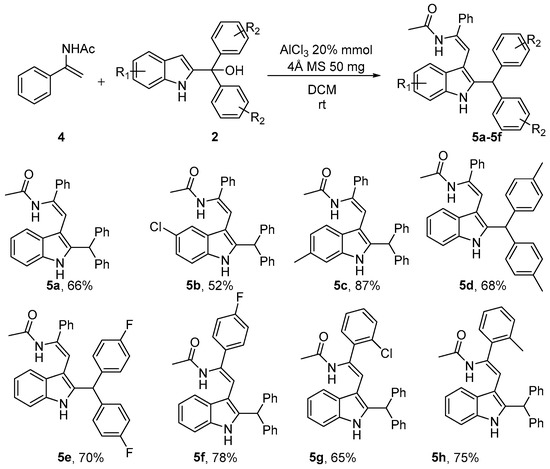
Figure 4.
Scope of 2-indolemethanols with acyclic enamide 4.
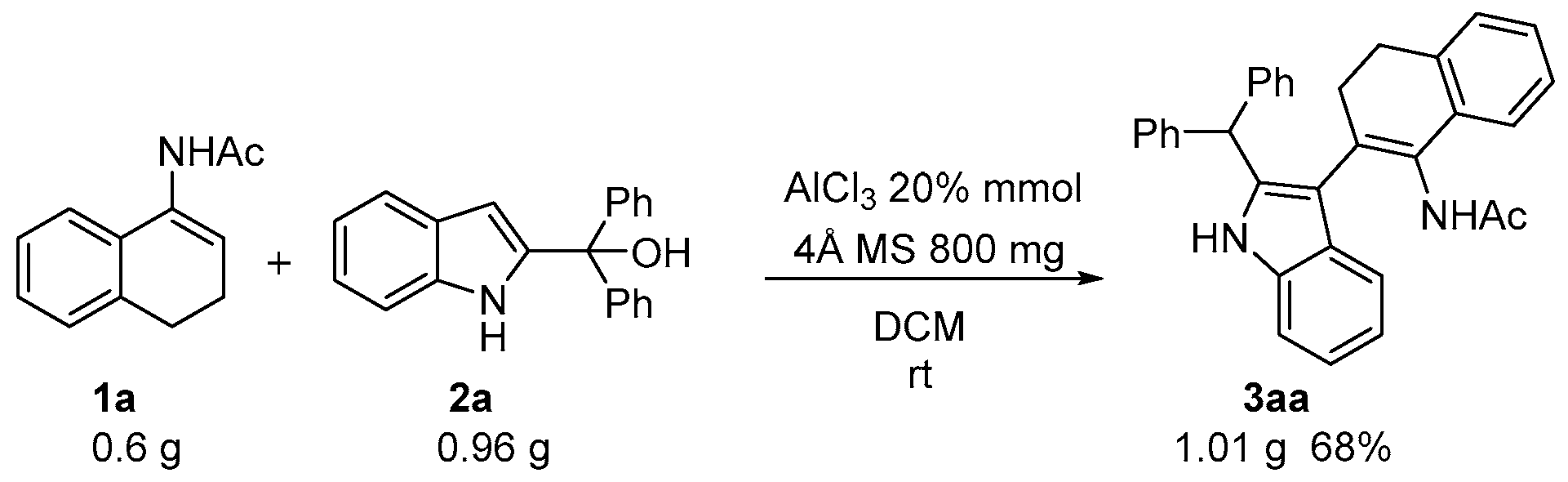
To demonstrate the practical utility of this reaction, a gram-scale synthesis of 3aa was performed with 3.2 mmol of 1a with 3.2 mmol of 2a, affording 1.01 g of 3aa in 68% yield, without significant losses of yield compared with the small-scale reaction (Scheme 1).
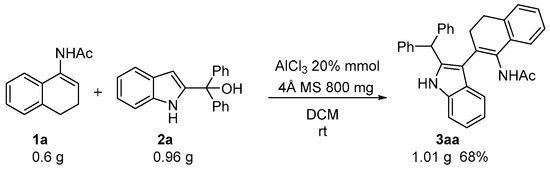
Scheme 1.
Gram-scale experiment for the synthesis of 3aa.
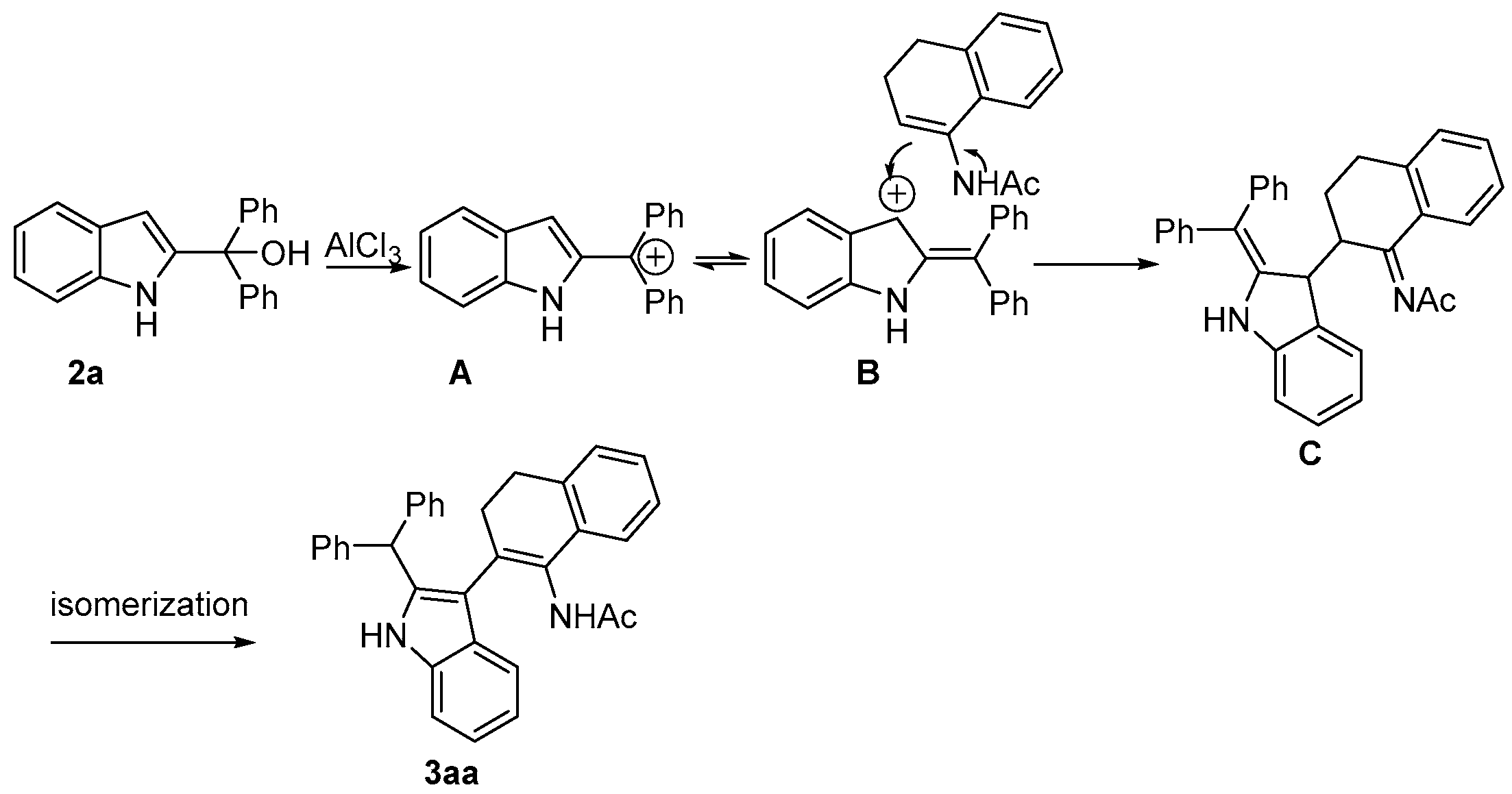
Based on the literature information [6,7,8,9], a plausible mechanism was proposed. As depicted in Scheme 2. Cations A and B were generated in the presence of Lewis acid. Next, enamide attacked the C3 position of the indole unit. The subsequent isomerization processes of the imine and indole gave the final product 3aa.
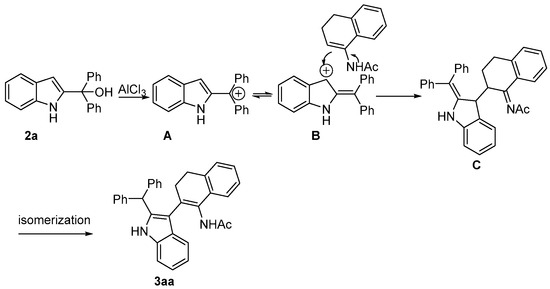
Scheme 2.
Proposed mechanism.
3. Experimental Section
3.1. General Procedures
Unless otherwise specified, all reactions were carried out under nitrogen atmosphere in anhydrous conditions. All chemicals that are commercially available were used without further purification unless otherwise noted. All the solvents were purified according to the standard procedures. Analytical thin-layer chromatography (TLC) was performed on silica gel plates (GF-254) using UV light (254 and 365 nm). Flash chromatography was conducted on silica gel (200–300 mesh). NMR spectra were recorded at ambient temperature in CDCl3 and DMSO on a Bruker AMX 500 (1H NMR at 500 MHz and 13C NMR at 125 MHz) or on an AVANCE III (1H NMR at 400 MHz and 13C NMR at 100 MHz) spectrometer. Chemical shifts were reported in parts per million (ppm) downfield from an internal standard, tetramethylsilane (0 ppm). High-resolution mass spectra were obtained on an Agilent 6200 Q-TOF MS and Waters G2-S QTOF.
3.2. Typical Procedure for Synthesis of 3aa
To a dried test tube with a magnetic stirring bar under N2 atmosphere at room temperature, 1a (37.4 mg, 0.2 mmol, 1.00 eq.) and 2a (93.6 mg, 0.2 mmol, 1.00 eq.) were added, followed by the addition of AlCl3 (0.04 mmol, 5.4 mg) and 4Å MS (50 mg). Then DCM (2.0 mL) was introduced by a syringe and the mixture was stirred at room temperature for 2 h. After completion of TLC analysis, the solvent was removed by rotary evaporation, and the residue was purified by column chromatography on silica gel (petroleum ether/ethyl acetate = 4:1) to afford the product 3aa as a green solid.
- 2-(2-benzhydryl-1H-indol-3-yl)-3,4-dihydronaphthalen-1-amine (3aa). The product 3aa was obtained by column chromatography on silica gel (eluent: petroleum ether/ethyl acetate = 4:1) as a green solid (82.4 mg, yield: 88%); mp 289–290 °C; 1H NMR (500 MHz, CDCl3) δ 7.92 (s, 1H), 7.41 (d, J = 7.8 Hz, 1H), 7.35 (t, J = 7.4 Hz, 2H), 7.31–7.21 (m, 8H), 7.19–7.14 (m, 3H), 7.13–7.03 (m, 4H), 6.37 (s, 1H), 5.71 (s, 1H), 2.93–2.82 (m, 1H), 2.77–2.67 (m, 1H), 2.66–2.56 (m, 1H), 2.42–2.32 (m, 1H), 1.61 (s, 3H); 13C NMR (125 MHz, CDCl3) δ 168.9, 142.4, 141.6, 136.5, 136.0, 135.8, 131.8, 131.6, 129.2, 129.1, 128.8, 127.5, 127.3, 127.2, 127.2, 127.0, 126.9, 126.5, 126.3, 123.5, 122.2, 120.4, 119.6, 113.0, 111.2, 48.7, 29.7, 28.2, 23.3; HRMS (ESI) m/z: [M + H]+ calculated for C33H29ON2, 469.2274; found, 469.2275.
- N-(2-(2-benzhydryl-1H-indol-3-yl)-1H-inden-3-yl)acetamide (3ba). The product 3ba was obtained by column chromatography on silica gel (eluent: petroleum ether/ethyl acetate = 2:1) as a white solid (73.6 mg, yield: 81%); mp 306–307 °C; 1H NMR (500 MHz, DMSO-d6) δ 11.04 (s, 1H), 9.34 (s, 1H), 7.49 (d, J = 7.9 Hz, 1H), 7.43 (d, J = 7.3 Hz, 1H), 7.36 (d, J = 8.1 Hz, 1H), 7.31 (t, J = 7.5 Hz, 4H), 7.25–7.20 (m, 3H), 7.20–7.14 (m, 6H), 7.10–7.04 (m, 1H), 7.00–6.95 (m, 1H), 5.72 (s, 1H), 3.72 (s, 2H), 1.48 (s, 3H); 13C NMR (125 MHz, DMSO-d6) δ 169.0, 142.8, 142.6, 141.6, 137.8, 136.7, 134.3, 130.0, 128.9, 128.3, 127.2, 126.4, 125.7, 124.1, 123.4, 121.1, 120.3, 119.2, 119.0, 111.4, 108.3, 47.8, 40.1, 22.0; HRMS (ESI) m/z: [M + H]+ calculated for C32H26BrON2, 533.1223; found, 533.1224.
- N-(2-(2-benzhydryl-1H-indol-3-yl)-5-methoxy-1H-inden-3-yl)acetamide (3ca). The product 3ca was obtained by column chromatography on silica gel (eluent: petroleum ether/ethyl acetate = 3:1) as a gray solid (83.4 mg, yield: 86%); mp 314–315 °C; 1H NMR (500 MHz, CDCl3) δ 8.05 (s, 1H), 7.49 (d, J = 7.8 Hz, 1H), 7.35–7.26 (m, 8H), 7.20 (t, J = 7.5 Hz, 1H), 7.18–7.10 (m, 5H), 7.02 (d, J = 2.4 Hz, 1H), 6.82 (dd, J = 8.2, 2.3 Hz, 1H), 6.66 (s, 1H), 5.74 (s, 1H), 3.84 (s, 3H), 3.64 (s, 2H), 1.57 (s, 3H); 13C NMR (125 MHz, CDCl3) δ 169.1, 158.9, 142.8, 142.2, 137.4, 136.1, 135.6, 134.6, 129.3, 129.0, 128.9, 128.0, 127.2, 124.0, 122.4, 120.5, 119.8, 112.0, 111.3, 108.6, 106.8, 55.8, 48.5, 40.0, 23.0; HRMS (ESI) m/z: [M + H]+ calculated for C33H29O2N2, 485.2224; found, 485.2223.
- N-(2-(2-benzhydryl-1H-indol-3-yl)-5-methyl-1H-inden-3-yl)acetamide (3da). The product 3da was obtained by column chromatography on silica gel (eluent: petroleum ether/ethyl acetate = 3:1) as a white solid (63.7 mg, yield: 68%); mp 306–307 °C; 1H NMR (600 MHz, DMSO-d6) δ 11.04 (s, 1H), 9.32 (s, 1H), 7.49 (d, J = 8.0 Hz, 1H), 7.37 (d, J = 8.1 Hz, 1H), 7.34–7.28 (m, 5H), 7.23 (t, J = 7.3 Hz, 2H), 7.19 (d, J = 7.5 Hz, 4H), 7.10–7.05 (m, 1H), 7.01–6.96 (m, 3H), 5.73 (s, 1H), 3.66 (s, 2H), 2.35 (s, 3H), 1.51 (s, 3H); 13C NMR (150 MHz, DMSO-d6) δ 168.9, 143.0, 142.6, 138.7, 137.7, 136.6, 134.6, 134.2, 130.4, 128.9, 128.3, 127.3, 126.4, 124.9, 123.1, 121.1, 120.7, 119.2, 119.0, 111.4, 108.4, 47.8, 22.1, 21.3; HRMS (ESI) m/z: [M + H]+ calculated for C33H29ON2, 469.2274; found, 469.2275.
- N-(2-(2-benzhydryl-1H-indol-3-yl)-6-methoxy-1H-inden-3-yl)acetamide (3ea). The product 3ea was obtained by column chromatography on silica gel (eluent: petroleum ether/ethyl acetate = 3:1) as a brown solid (92.1 mg, yield: 95%); mp 306–307 °C; 1H NMR (500 MHz, CDCl3) δ 8.01 (s, 1H), 7.48 (d, J = 7.9 Hz, 1H), 7.36 (d, J = 8.5 Hz, 1H), 7.32 (t, J = 7.4 Hz, 5H), 7.27 (d, J = 7.3 Hz, 2H), 7.19 (t, J = 7.4 Hz, 1H), 7.17–7.09 (m, 5H), 7.01 (d, J = 1.8 Hz, 1H), 6.88 (dd, J = 8.4, 2.1 Hz, 1H), 6.66 (s, 1H), 5.74 (s, 1H), 3.84 (s, 3H), 3.65 (s, 2H), 1.57 (s, 3H); 13C NMR (125 MHz, CDCl3) δ 169.0, 158.2, 144.3, 142.3, 137.3, 136.1, 135.4, 134.5, 129.0, 128.9, 128.1, 127.2, 125.0, 122.4, 122.3, 120.5, 119.8, 112.2, 111.2, 110.0, 108.6, 55.8, 48.5, 40.6, 23.0; HRMS (ESI) m/z: [M + H]+ calculated for C33H29O2N2, 485.2224; found, 485.2223.
- N-(2-(2-benzhydryl-1H-indol-3-yl)-6-methyl-1H-inden-3-yl)acetamide (3fa). The product 3fa was obtained by column chromatography on silica gel (eluent: petroleum ether/ethyl acetate = 3:1) as a brown solid (66.2 mg, yield: 71%); mp 296–297 °C; 1H NMR (400 MHz, CDCl3) δ 7.97 (s, 1H), 7.48 (d, J = 7.9 Hz, 1H), 7.35–7.27 (m, 8H), 7.24 (s, 1H), 7.19 (t, J = 7.5 Hz, 1H), 7.16–7.10 (m, 6H), 6.64 (s, 1H), 5.73 (s, 1H), 3.65 (s, 2H), 2.41 (s, 3H), 1.58 (s, 3H); 13C NMR (100 MHz, CDCl3) δ 169.0, 142.7, 142.3, 138.8, 137.4, 136.1, 135.7, 134.9, 129.1, 128.9, 128.1, 127.2, 127.2, 126.4, 124.5, 122.4, 121.4, 120.5, 119.9, 111.2, 108.7, 48.5, 40.5, 23.1, 21.6; HRMS (ESI) m/z: [M + H]+ calculated for C33H29ON2, 469.2274; found, 469.2273.
- N-(2-(2-benzhydryl-1H-indol-3-yl)-6-fluoro-1H-inden-3-yl)acetamide (3ga). The product 3ga was obtained by column chromatography on silica gel (eluent: petroleum ether/ethyl acetate = 3:1) as a white solid (75.4 mg, yield: 80%); mp 356–357 °C; 1H NMR (600 MHz, DMSO-d6) δ 11.06 (s, 1H), 9.38 (s, 1H), 7.50 (dd, J = 7.7, 3.0 Hz, 1H), 7.38 (dd, J = 7.7, 4.7 Hz, 1H), 7.34–7.28 (m, 5H), 7.26–7.18 (m, 6H), 7.17–7.13 (m, 1H), 7.12–7.06 (m, 2H), 7.02–6.96 (m, 1H), 5.72 (s, 1H), 3.75 (s, 2H), 1.50 (s, 3H); 13C NMR (150 MHz, DMSO-d6) δ 169.0, 161.2, 159.6, 143.9 (d, J = 8.8 Hz), 142.6, 139.0, 137.8, 136.7, 133.6, 129.7 (d, J = 3.5 Hz), 128.9, 128.3, 127.2, 126.4, 121.2, 121.2, 119.1 (d, J = 17.0 Hz), 112.5 (d, J = 22.6 Hz), 111.4, 110.9 (d, J = 23.0 Hz), 108.1, 47.8, 40.1, 22.0; 19F NMR (471 MHz, DMSO-d6) δ −119.15–−119.20 (m, 1F); HRMS (ESI) m/z: [M + H]+ calculated for C32H26ON2F, 473.2024; found, 473.2024.
- N-(2-(2-benzhydryl-1H-indol-3-yl)-6-chloro-1H-inden-3-yl)acetamide (3ha). The product 3ha was obtained by column chromatography on silica gel (eluent: petroleum ether/ethyl acetate = 3:1) as a white solid (78.2 mg, yield: 80%); mp 334–335 °C; 1H NMR (500 MHz, DMSO-d6) δ 11.09 (s, 1H), 9.41 (s, 1H), 7.51–7.46 (m, 2H), 7.37 (d, J = 8.1 Hz, 1H), 7.34–7.28 (m, 5H), 7.25–7.21 (m, 2H), 7.18 (d, J = 7.4 Hz, 4H), 7.14 (d, J = 8.2 Hz, 1H), 7.11–7.05 (m, 1H), 7.02–6.96 (m, 1H), 5.70 (s, 1H), 3.77 (s, 2H), 1.48 (s, 3H); 13C NMR (125 MHz, DMSO-d6) δ 169.1, 143.8, 142.5, 141.7, 138.0, 136.7, 133.6, 130.8, 129.0, 128.9, 128.4, 127.1, 126.4, 125.8, 123.6, 121.6, 121.2, 119.2, 119.2, 111.5, 108.0, 47.9, 40.0, 22.0; HRMS (ESI) m/z: [M + H]+ calculated for C32H27ON2, 455.2118; found, 455.2116.
- N-(2-(2-benzhydryl-1H-indol-3-yl)-6-bromo-1H-inden-3-yl)acetamide (3ia). The product 3ia was obtained by column chromatography on silica gel (eluent: petroleum ether/ethyl acetate = 3:1) as a yellow solid (75.2 mg, yield: 71%); mp 296–297 °C; 1H NMR (600 MHz, DMSO-d6) δ 11.09 (s, 1H), 9.41 (s, 1H), 7.63 (s, 1H), 7.49 (dd, J = 7.9, 2.3 Hz, 1H), 7.45 (d, J = 8.1 Hz, 1H), 7.38 (dd, J = 7.8, 4.0 Hz, 1H), 7.31 (t, J = 7.4 Hz, 4H), 7.23 (t, J = 7.3 Hz, 2H), 7.20–7.17 (m, 4H), 7.12–7.06 (m, 2H), 7.03–6.92 (m, 1H), 5.71 (s, 1H), 3.76 (s, 2H), 1.50 (s, 3H); 13C NMR (150 MHz, DMSO-d6) δ 169.1, 144.1, 142.5, 142.0, 138.0, 136.7, 133.6, 130.8, 128.9, 128.5, 128.3, 127.1, 126.4, 126.4, 122.0, 121.2, 119.2, 117.4, 111.5, 107.9, 47.8, 40.0, 22.0; HRMS (ESI) m/z: [M + H]+ calculated for C32H26ON2F, 473.2024; found, 473.2023.
- N-(2-(2-benzhydryl-1H-indol-3-yl)-5-fluoro-1H-inden-3-yl)acetamide (3ja). The product 3ja was obtained by column chromatography on silica gel (eluent: petroleum ether/ethyl acetate = 3:1) as a brown solid (71.2 mg, yield: 76%); mp 331–332 °C; 1H NMR (600 MHz, DMSO-d6) δ 11.08 (s, 1H), 9.40 (s, 1H), 7.49 (d, J = 8.0 Hz, 1H), 7.42 (dd, J = 8.1, 5.2 Hz, 1H), 7.37 (d, J = 8.1 Hz, 1H), 7.31 (t, J = 7.6 Hz, 4H), 7.23 (t, J = 7.3 Hz, 2H), 7.19 (d, J = 7.5 Hz, 4H), 7.10–7.05 (m, 1H), 7.01–6.95 (m, 2H), 6.91 (dd, J = 9.5, 2.4 Hz, 1H), 5.71 (s, 1H), 3.72 (s, 2H), 1.50 (s, 3H); 13C NMR (150 MHz, DMSO-d6) δ 169.1, 162.2, 160.6, 144.9 (d, J = 9.4 Hz), 142.5, 137.9, 137.3 (d, J = 1.5 Hz), 136.6, 133.7 (d, J = 2.9 Hz), 132.6, 128.9, 128.3, 127.1, 126.4, 124.4 (d, J = 9.0 Hz), 121.2, 119.2 (d, J = 8.5 Hz), 111.4, 110.6 (d, J = 22.8 Hz), 108.0, 107.1 (d, J = 23.9 Hz), 47.8, 40.1, 22.0; 19F NMR (471 MHz, DMSO-d6) δ −117.67–−117.72 (m, 1F); HRMS (ESI) m/z: [M + H]+ calculated for C32H26ON2Cl, 489.1728; found, 489.1727.
- N-(2-(2-benzhydryl-1H-indol-3-yl)-5-chloro-1H-inden-3-yl)acetamide (3ka). The product 3ka was obtained by column chromatography on silica gel (eluent: petroleum ether/ethyl acetate = 3:1) as a white solid (75.9 mg, yield: 78%); mp 327–328 °C; 1H NMR (500 MHz, DMSO-d6) δ 11.11 (s, 1H), 9.45 (s, 1H), 7.50 (d, J = 8.0 Hz, 1H), 7.44 (d, J = 8.0 Hz, 1H), 7.39 (d, J = 8.1 Hz, 1H), 7.33–7.29 (m, 4H), 7.25–7.18 (m, 7H), 7.17 (d, J = 2.0 Hz, 1H), 7.12–7.07 (m, 1H), 7.03–6.97 (m, 1H), 5.72 (s, 1H), 3.76 (s, 2H), 1.52 (s, 3H); 13C NMR (125 MHz, DMSO-d6) δ 169.3, 144.8, 142.5, 140.4, 138.1, 136.7, 133.3, 132.3, 130.8, 128.9, 128.4, 127.1, 126.5, 124.8, 123.8, 121.3, 120.1, 119.2, 111.5, 108.0, 47.9, 39.8, 22.0; HRMS (ESI) m/z: [M + H]+ calculated for C32H26ON2Cl, 489.1728; found, 489.1727.
- N-(2-(2-benzhydryl-1H-indol-3-yl)-7-methoxy-3,4-dihydronaphthalen-1-yl)acetamide (3la). The product 3la was obtained by column chromatography on silica gel (eluent: petroleum ether/ethyl acetate = 3:1) as a white solid (97.5 mg, yield: 98%); mp 324–325 °C; 1H NMR (500 MHz, DMSO-d6) δ 10.91 (s, 1H), 8.93 (s, 1H), 7.38–7.27 (m, 6H), 7.29–7.22 (m, 3H), 7.22–7.18 (m, 3H), 7.11 (d, J = 8.2 Hz, 1H), 7.08–7.02 (m, 1H), 6.97–6.92 (m, 1H), 6.74 (dd, J = 8.2, 2.6 Hz, 1H), 6.58 (d, J = 2.6 Hz, 1H), 5.72 (s, 1H), 3.71 (s, 3H), 2.78–2.57 (m, 3H), 2.23–2.15 (m, 1H), 1.46 (s, 3H); 13C NMR (125 MHz, DMSO-d6) δ 168.8, 157.9, 143.5, 142.1, 136.8, 136.6, 134.2, 129.9, 129.1, 128.8, 128.7, 128.5, 128.1, 127.9, 127.7, 126.4, 126.3, 126.3, 120.8, 119.5, 118.7, 112.9, 111.4, 111.0, 109.6, 55.0, 47.8, 30.2, 26.9, 22.2; HRMS (ESI) m/z: [M + H]+ calculated for C34H31O2N2F, 499.2380; found, 499.2376.
- N-(2-(2-benzhydryl-1H-indol-3-yl)-6-methoxy-3,4-dihydronaphthalen-1-yl)acetamide (3ma). The product 3ma was obtained by column chromatography on silica gel (eluent: petroleum ether/ethyl acetate = 3:1) as a brown solid (89.7 mg, yield: 90%); mp 321–322 °C; 1H NMR (500 MHz, DMSO-d6) δ 10.86 (s, 1H), 8.87 (s, 1H), 7.37–7.23 (m, 9H), 7.20 (t, J = 8.7 Hz, 3H), 7.04 (t, J = 7.6 Hz, 1H), 6.97–6.91 (m, 2H), 6.81 (d, J = 2.3 Hz, 1H), 6.73 (dd, J = 8.5, 2.5 Hz, 1H), 5.72 (s, 1H), 3.76 (s, 3H), 2.76–2.67 (m, 3H), 2.23–2.11 (m, 1H), 1.44 (s, 3H); 13C NMR (125 MHz, DMSO-d6) δ 168.8, 158.0, 143.6, 142.2, 137.4, 136.6, 136.5, 129.7, 129.1, 128.8, 128.5, 128.1, 126.5, 126.4, 126.3, 126.0, 125.1, 124.5, 120.8, 119.5, 118.6, 113.0, 112.9, 111.4, 111.1, 55.1, 47.8, 29.7, 28.2, 22.2; HRMS (ESI) m/z: [M + H]+ calculated for C34H31O2N2, 499.2380; found, 499.2377.
- N-(2-(2-benzhydryl-1H-indol-3-yl)-7-methyl-3,4-dihydronaphthalen-1-yl)acetamide (3na). The product 3na was obtained by column chromatography on silica gel (eluent: petroleum ether/ethyl acetate = 3:1) as a black solid (90.5 mg, yield: 94%); mp 316–317 °C; 1H NMR (500 MHz, DMSO-d6) δ 10.88 (s, 1H), 8.91 (s, 1H), 7.36–7.31 (m, 4H), 7.32–7.26 (m, 2H), 7.27–7.22 (m, 3H), 7.22–7.17 (m, 3H), 7.10–7.01 (m, 2H), 6.98–6.91 (m, 2H), 6.84 (s, 1H), 5.72 (s, 1H), 2.72–2.64 (m, 3H), 2.25 (s, 3H), 2.21–2.12 (m, 1H), 1.47 (s, 3H); 13C NMR (125 MHz, DMSO-d6) δ 168.8, 143.5, 142.1, 136.7, 136.6, 134.7, 133.0, 132.7, 130.0, 129.1, 128.8, 128.5, 128.1, 128.1, 127.0, 126.9, 126.4, 126.4, 126.3, 123.6, 120.8, 119.5, 118.7, 112.9, 111.4, 47.8, 30.0, 27.4, 22.2, 21.1; HRMS (ESI) m/z: [M + H]+ calculated for C34H31ON2, 483.2431; found, 483.2425.
- N-(2-(2-benzhydryl-1H-indol-3-yl)-7-bromo-3,4-dihydronaphthalen-1-yl)acetamide (3oa). The product 3oa was obtained by column chromatography on silica gel (eluent: petroleum ether/ethyl acetate = 3:1) as a yellow solid (76.5 mg, yield: 70%); mp 301–302 °C; 1H NMR (500 MHz, DMSO-d6) δ 10.95 (s, 1H), 9.03 (s, 1H), 7.38–7.31 (m, 5H), 7.29 (d, J = 7.4 Hz, 2H), 7.25 (t, J = 8.0 Hz, 3H), 7.20 (t, J = 7.3 Hz, 3H), 7.16 (d, J = 8.0 Hz, 1H), 7.10 (d, J = 2.0 Hz, 1H), 7.09–7.03 (m, 1H), 6.98–6.93 (m, 1H), 5.68 (s, 1H), 2.78–2.60 (m, 3H), 2.27–2.17 (m, 1H), 1.46 (s, 3H); 13C NMR (125 MHz, DMSO-d6) δ 169.0, 143.4, 142.0, 136.9, 136.6, 135.4, 134.9, 130.0, 129.2, 129.1, 128.8, 128.8, 128.5, 128.2, 126.5, 126.4, 126.2, 125.4, 121.0, 119.5, 119.2, 118.8, 112.4, 111.5, 47.9, 29.5, 27.1, 22.1; HRMS (ESI) m/z: [M + H]+ calculated for C33H28ON2Br, 547.1380; found, 547.1379.
- N-(2-(2-benzhydryl-1H-indol-3-yl)-6-chloro-3,4-dihydronaphthalen-1-yl)acetamide (3pa). The product 3pa was obtained by column chromatography on silica gel (eluent: petroleum ether/ethyl acetate = 3:1) as a yellow solid (98.6 mg, yield: 98%); mp 301–302 °C. 1H NMR (500 MHz, DMSO-d6) δ 10.92 (s, 1H), 9.00 (s, 1H), 7.36–7.31 (m, 4H), 7.31–7.25 (m, 3H), 7.24 (d, J = 10.5 Hz, 2H), 7.24–7.15 (m, 5H), 7.08–7.01 (m, 1H), 6.98 (d, J = 8.3 Hz, 1H), 6.97–6.91 (m, 1H), 5.67 (s, 1H), 2.79–2.68 (m, 3H), 2.24–2.15 (m, 1H), 1.43 (s, 3H); 13C NMR (125 MHz, DMSO-d6) δ 169.0, 143.5, 142.0, 138.0, 136.9, 136.6, 131.9, 130.5, 129.2, 129.1, 128.8, 128.6, 128.5, 128.2, 126.8, 126.5, 126.3, 126.3, 125.8, 124.9, 120.9, 119.5, 118.8, 112.5, 111.5, 47.9, 29.4, 27.4, 22.1; HRMS (ESI) m/z: [M + H]+ calculated for C33H28ON2Cl, 503.1885; found, 503.1883.
- N-(2-(2-benzhydryl-5-methyl-1H-indol-3-yl)-3,4-dihydronaphthalen-1-yl)acetamide (3ab). The product 3ab was obtained by column chromatography on silica gel (eluent: petroleum ether/ethyl acetate = 3:1) as a yellow solid (81.9 mg, yield: 85%); mp 303–304 °C; 1H NMR (500 MHz, DMSO-d6) δ 10.73 (s, 1H), 8.88 (s, 1H), 7.34–7.27 (m, 4H), 7.24–7.18 (m, 5H), 7.18–7.10 (m, 6H), 7.00 (dd, J = 7.2, 1.6 Hz, 1H), 6.86 (dd, J = 8.3, 1.2 Hz, 1H), 5.68 (s, 1H), 2.76–2.68 (m, 3H), 2.31 (s, 3H), 2.23–2.12 (m, 1H), 1.45 (s, 3H); 13C NMR (125 MHz, DMSO-d6) δ 168.8, 143.6, 142.2, 136.7, 135.6, 134.9, 133.0, 129.9, 129.1, 128.8, 128.4, 128.1, 128.1, 127.1, 127.0, 126.5, 126.4, 126.3, 126.2, 126.0, 123.0, 122.2, 119.2, 112.3, 111.1, 47.8, 29.7, 27.7, 22.1, 21.2; HRMS (ESI) m/z: [M + H]+ calculated for C34H31ON2, 483.2431; found, 483.2430.
- N-(2-(2-benzhydryl-5-methoxy-1H-indol-3-yl)-3,4-dihydronaphthalen-1-yl)acetamide (3ac). The product 3ac was obtained by column chromatography on silica gel (eluent: petroleum ether/ethyl acetate = 5:1) as a yellow solid (71.2 mg, yield: 72%); mp 313–314 °C; 1H NMR (500 MHz, DMSO-d6) δ 10.70 (s, 1H), 8.90 (s, 1H), 7.31 (q, J = 7.8 Hz, 4H), 7.25–7.20 (m, 4H), 7.18 (d, J = 7.9 Hz, 4H), 7.16–7.12 (m, 2H), 7.03–7.00 (m, 1H), 6.80 (d, J = 2.4 Hz, 1H), 6.68 (dd, J = 8.7, 2.4 Hz, 1H), 5.69 (s, 1H), 3.69 (s, 3H), 2.92–2.80 (m, 1H), 2.77–2.63 (m, 3H), 1.52 (s, 3H); 13C NMR (125 MHz, DMSO-d6) δ 169.0, 153.3, 143.4, 142.3, 137.4, 135.7, 133.1, 131.5, 129.9, 129.1, 128.8, 128.5, 128.2, 127.9, 127.1, 126.6, 126.5, 126.4, 126.3, 126.0, 123.1, 112.8, 112.1, 111.0, 101.3, 55.4, 48.0, 29.6, 27.8, 22.4; HRMS (ESI) m/z: [M + H]+ calculated for C34H31O2N2, 499.2380; found, 499.2378.
- N-(2-(2-benzhydryl-5-fluoro-1H-indol-3-yl)-3,4-dihydronaphthalen-1-yl)acetamide (3ad). The product 3ad was obtained by column chromatography on silica gel (eluent: petroleum ether/ethyl acetate = 5:1) as a yellow solid (76.7 mg, yield: 79%); mp 313–314 °C; 1H NMR (500 MHz, DMSO-d6) δ 10.96 (s, 1H), 8.96 (s, 1H), 7.37–7.29 (m, 5H), 7.28–7.13 (m, 9H), 7.09–7.01 (m, 2H), 6.93–6.84 (m, 1H), 5.72 (s, 1H), 2.78–2.57 (m, 3H), 2.25–2.06 (m, 1H), 1.52 (s, 3H); 13C NMR (125 MHz, DMSO-d6) δ 168.8, 157.8, 156.0, 143.1, 142.0, 138.9, 135.7, 133.0 (d, J = 13.3 Hz), 130.2, 129.1, 128.8, 128.5, 128.2, 127.5, 127.1, 126.6, 126.5, 126.5, 126.4, 126.0, 123.1, 113.2 (d, J = 4.4 Hz), 112.2 (d, J = 9.6 Hz), 108.7 (d, J = 25.8 Hz), 104.2 (d, J = 23.4 Hz), 47.9, 29.4, 27.7, 22.2; 19F NMR (471 MHz, CDCl3) δ −124.89–−124.94 (m, 1F); HRMS (ESI) m/z: [M + H]+ calculated for C33H28ON2F, 487.2180; found, 487.2177.
- N-(2-(2-benzhydryl-5-chloro-1H-indol-3-yl)-3,4-dihydronaphthalen-1-yl)acetamide (3ae). The product 3ae was obtained by column chromatography on silica gel (eluent: petroleum ether/ethyl acetate = 5:1) as a yellow solid (79.8 mg, yield: 80%); mp 314–315 °C; 1H NMR (500 MHz, DMSO-d6) δ 11.07 (s, 1H), 8.97 (s, 1H), 7.40–7.29 (m, 6H), 7.28–7.21 (m, 4H), 7.20–7.12 (m, 5H), 5.74 (s, 1H), 2.81–2.58 (m, 3H), 2.28–2.12 (m, 1H), 1.55 (s, 3H); 13C NMR (125 MHz, DMSO-d6) δ 168.8, 143.0, 141.9, 138.6, 135.7, 134.9, 132.9, 130.5, 129.1, 128.8, 128.5, 128.2, 127.4, 127.2, 127.1, 126.6, 126.4, 126.0, 123.4, 123.1, 120.7, 118.6, 112.9, 112.8, 47.9, 29.5, 27.7, 22.3; HRMS (ESI) m/z: [M + H]+ calculated for C33H28ON2Cl, 503.1885; found, 503.1886.
- N-(2-(2-benzhydryl-5-bromo-1H-indol-3-yl)-3,4-dihydronaphthalen-1-yl)acetamide (3af). The product 3af was obtained by column chromatography on silica gel (eluent: petroleum ether/ethyl acetate = 5:1) as a yellow solid (90.5 mg, yield: 83%); mp 326–327 °C; 1H NMR (500 MHz, DMSO-d6) δ 11.06 (s, 1H), 8.95 (s, 1H), 7.46 (d, J = 1.4 Hz, 1H), 7.37–7.28 (m, 5H), 7.27 (d, J = 7.2 Hz, 1H), 7.25–7.19 (m, 3H), 7.19–7.13 (m, 6H), 7.05 (d, J = 7.5 Hz, 1H), 5.72 (s, 1H), 2.78–2.56 (m, 3H), 2.25–2.15 (m, 1H), 1.54 (s, 3H); 13C NMR (125 MHz, DMSO-d6) δ 168.8, 142.9, 141.9, 138.4, 135.7, 135.1, 132.9, 130.5, 129.0, 128.7, 128.6, 128.2, 128.1, 127.1, 126.6, 126.4, 126.0, 123.2, 123.1, 121.5, 113.4, 112.7, 111.4, 47.9, 29.5, 27.6, 22.3; HRMS (ESI) m/z: [M + H]+ calculated for C33H28ON2Br, 547.1380; found, 547.1381.
- N-(2-(2-benzhydryl-6-chloro-1H-indol-3-yl)-3,4-dihydronaphthalen-1-yl)acetamide (3ag). The product 3ag was obtained by column chromatography on silica gel (eluent: petroleum ether/ethyl acetate = 4:1) as a yellow solid (75.4 mg, yield: 75%); mp 316–317 °C; 1H NMR (500 MHz, DMSO-d6) δ 11.01 (s, 1H), 8.96 (s, 1H), 7.36–7.29 (m, 6H), 7.26 (t, J = 7.3 Hz, 1H), 7.24–7.20 (m, 3H), 7.19–7.13 (m, 5H), 7.03 (dd, J = 7.2, 1.5 Hz, 1H), 6.95 (dd, J = 8.4, 2.0 Hz, 1H), 5.71 (s, 1H), 2.76–2.62 (m, 3H), 2.21–2.12 (m, 1H), 1.49 (s, 3H); 13C NMR (125 MHz, DMSO-d6) δ 168.8, 143.1, 141.8, 137.9, 136.9, 135.7, 132.9, 130.3, 129.0, 128.7, 128.6, 128.2, 127.3, 127.1, 126.6, 126.4, 126.1, 125.5, 125.1, 123.1, 120.8, 118.9, 113.1, 110.9, 47.8, 29.5, 27.7, 22.2; HRMS (ESI) m/z: [M + H]+ calculated for C33H28ON2Cl, 503.1885; found, 503.1886.
- N-(2-(2-(di-p-tolylmethyl)-1H-indol-3-yl)-3,4-dihydronaphthalen-1-yl)acetamide (3ah). The product 3ah was obtained by column chromatography on silica gel (eluent: petroleum ether/ethyl acetate = 5:1) as a yellow solid (64.5 mg, yield: 65%); mp 327–328 °C; 1H NMR (500 MHz, DMSO-d6) δ 10.87 (s, 1H), 8.91 (s, 1H), 7.34 (dd, J = 8.0, 3.6 Hz, 2H), 7.24–7.15 (m, 3H), 7.16–7.12 (m, 2H), 7.09–6.98 (m, 7H), 6.98–6.90 (m, 2H), 5.62 (s, 1H), 2.79–2.72 (m, 3H), 2.26 (s, 3H), 2.23 (s, 3H), 2.18–2.13 (m, 1H), 1.44 (s, 3H); 13C NMR (125 MHz, DMSO-d6) δ 168.8, 140.6, 139.3, 137.3, 136.5, 135.6, 135.3, 135.2, 133.0, 129.9, 129.0, 128.6, 128.6, 128.0, 127.0, 126.3, 126.3, 126.0, 123.1, 120.7, 119.4, 118.6, 112.5, 111.3, 47.1, 29.7, 27.7, 22.2, 20.6; HRMS (ESI) m/z: [M + H]+ calculated for C35H33ON2, 497.2587; found, 497.2586.
- N-(2-(2-(bis(4-methoxyphenyl)methyl)-1H-indol-3-yl)-3,4-dihydronaphthalen-1-yl)acetamide (3ai). The product 3ai was obtained by column chromatography on silica gel (eluent: petroleum ether/ethyl acetate = 5:1) as a yellow solid (63.2 mg, yield: 60%); mp 311–312 °C;1H NMR (500 MHz, DMSO-d6) δ 10.81 (s, 1H), 8.91 (s, 1H), 7.34 (dd, J = 7.9, 3.7 Hz, 2H), 7.21–7.12 (m, 5H), 7.09 (d, J = 8.6 Hz, 2H), 7.06–7.01 (m, 2H), 6.93 (t, J = 7.5 Hz, 1H), 6.88 (dd, J = 17.5, 8.7 Hz, 4H), 5.60 (s, 1H), 3.74 (s, 3H), 3.70 (s, 3H), 2.76–2.66 (m, 3H), 2.25–2.16 (m, 1H), 1.51 (s, 3H);13C NMR (125 MHz, DMSO-d6) δ 168.8, 157.8, 137.7, 136.5, 135.8, 135.6, 134.4, 133.1, 130.1, 129.8, 129.7, 128.0, 127.0, 126.4, 126.3, 126.0, 123.1, 120.7, 119.4, 118.6, 113.8, 113.5, 112.3, 111.3, 55.1, 55.0, 46.2, 29.7, 27.8, 22.3; HRMS (ESI) m/z: [M + H]+ calculated for C35H33O3N2, 529.2486; found, 529.2483.
- N-(2-(2-(bis(4-fluorophenyl)methyl)-1H-indol-3-yl)-3,4-dihydronaphthalen-1-yl)acetamide (3aj). The product 3aj was obtained by column chromatography on silica gel (eluent: petroleum ether/ethyl acetate = 7:1) as a yellow solid (91.2 mg, yield: 91%); mp 333–334 °C; 1H NMR (500 MHz, DMSO-d6) δ 11.04 (s, 1H), 9.04 (s, 1H), 7.38 (q, J = 7.0 Hz, 4H), 7.28–6.84 (m, 12H), 5.77 (s, 1H), 2.76 (s, 3H), 2.24 (s, 1H), 1.49 (s, 3H); 13C NMR (125 MHz, DMSO-d6) δ 168.9, 163.2 (d, J = 6.8 Hz), 161.3 (d, J = 5.8 Hz), 145.6 (d, J = 6.8 Hz), 144.4 (d, J = 6.9 Hz), 136.6, 135.7, 135.3, 132.9, 130.6 (d, J = 8.3 Hz), 130.2, 130.1, 130.1, 127.6, 127.1, 126.5, 126.1 (d, J = 13.7 Hz), 125.2 (d, J = 2.6 Hz), 125.0 (d, J = 2.4 Hz), 123.1, 121.2, 119.7, 118.9, 115.9 (d, J = 22.1 Hz), 115.3 (d, J = 21.6 Hz), 113.7 (d, J = 20.8 Hz), 113.4, 113.3, 111.4, 47.2, 29.7, 27.8, 22.1; 19F NMR (471 MHz, DMSO-d6) δ −112.64–−112.70 (m, 1F), −113.50–−113.56 (m, 1F); HRMS (ESI) m/z: [M + H]+ calculated for C33H27ON2F2, 505.2086; found, 505.2084.
- N-(2-(2-(bis(4-chlorophenyl)methyl)-1H-indol-3-yl)-3,4-dihydronaphthalen-1-yl)acetamide (3ak). The product 3ak was obtained by column chromatography on silica gel (eluent: petroleum ether/ethyl acetate = 7:1) as a yellow solid (79.5 mg, yield: 74%); mp 315–316 °C; 1H NMR (600 MHz, DMSO-d6) δ 10.91 (s, 1H), 8.99 (s, 1H), 7.41 (dd, J = 16.9, 8.5 Hz, 4H), 7.38–7.32 (m, 2H), 7.24 (d, J = 8.5 Hz, 2H), 7.21–7.13 (m, 5H), 7.08–7.01 (m, 2H), 6.96 (t, J = 7.4 Hz, 1H), 5.74 (s, 1H), 2.77–2.66 (m, 3H), 2.24–2.16 (m, 1H), 1.53 (s, 3H); 13C NMR (150 MHz, DMSO-d6) δ 168.9, 141.9, 140.7, 136.6, 135.7, 135.6, 133.0, 131.3, 131.3, 130.9, 130.5, 130.1, 128.6, 128.2, 127.8, 127.1, 126.5, 126.3, 126.0, 123.0, 121.1, 119.6, 118.8, 113.2, 111.4, 46.6, 29.6, 27.7, 22.2; HRMS (ESI) m/z: [M + H]+ calculated for C33H27ON2Cl2, 537.1495; found, 537.1496.
- N-(2-(2-(bis(4-(trifluoromethyl)phenyl)methyl)-1H-indol-3-yl)-3,4-dihydronaphthalen-1-yl)acetamide (3al). The product 3al was obtained by column chromatography on silica gel (eluent: petroleum ether/ethyl acetate = 5:1) as a yellow solid (77.3 mg, yield: 64%); mp 313–314 °C; 1H NMR (500 MHz, DMSO-d6) δ 11.05 (s, 1H), 9.04 (s, 1H), 7.74 (t, J = 8.4 Hz, 4H), 7.47 (d, J = 8.2 Hz, 2H), 7.43–7.28 (m, 4H), 7.22–7.12 (m, 3H), 7.11–7.05 (m, 1H), 7.04–7.01 (m, 1H), 6.99–6.94 (m, 1H), 5.93 (s, 1H), 2.79–2.70 (m, 3H), 2.31–2.13 (m, 1H), 1.46 (s, 3H); 13C NMR (125 MHz, DMSO-d6) δ 169.0, 147.3, 146.1, 136.7, 135.7, 134.8, 132.9, 130.2, 129.9, 129.6, 127.8, 127.6, 127.5, 127.4, 127.3, 127.1, 126.6, 126.2, 126.1, 125.7 (q, J = 3.7 Hz), 125.5, 125.4, 125.2 (q, J = 3.8 Hz), 123.3, 123.2, 123.1, 121.3, 119.7, 119.0, 113.8, 111.5, 47.5, 29.6, 27.7, 22.1; 19F NMR (471 MHz, DMSO-d6) δ −60.82 (s, 3F), −60.86 (s, 3F); HRMS (ESI) m/z: [M + H]+ calculated for C35H27ON2F6, 605.2022; found, 605.2015.
- N-(2-(2-(bis(3-fluorophenyl)methyl)-1H-indol-3-yl)-3,4-dihydronaphthalen-1-yl)acetamide (3am). The product 3am was obtained by column chromatography on silica gel (eluent: petroleum ether/ethyl acetate = 7:1) as a yellow solid (78.6 mg, yield: 78%); mp 325–326 °C; 1H NMR (500 MHz, DMSO-d6) δ 11.03 (s, 1H), 9.03 (s, 1H), 7.43–7.34 (m, 4H), 7.21–7.18 (m, 1H), 7.17–7.14 (m, 2H), 7.12 (s, 1H), 7.11–7.02 (m, 5H), 7.01–6.94 (m, 3H), 5.76 (s, 1H), 2.81–2.65 (m, 3H), 2.34–2.12 (m, 1H), 1.48 (s, 3H);13C NMR (125 MHz, DMSO-d6) δ 168.9, 163.2 (d, J = 6.7 Hz), 161.3 (d, J = 5.8 Hz), 145.6 (d, J = 6.8 Hz), 144.4 (d, J = 7.0 Hz), 136.6, 135.7, 135.3, 132.9, 130.7 (d, J = 8.3 Hz), 130.2, 130.1, 130.1, 127.7, 127.1, 126.5, 126.1 (d, J = 12.1 Hz), 125.2 (d, J = 2.2 Hz), 125.0 (d, J = 2.2 Hz), 123.1, 121.2, 119.7, 118.9, 115.9 (d, J = 22.1 Hz), 115.3 (d, J = 21.6 Hz), 113.7 (d, J = 20.9 Hz), 113.5, 113.3, 111.4, 47.2, 29.7, 27.8, 22.1; 19F NMR (471 MHz, DMSO-d6) δ −112.65–−112.71 (m, 1F), −113.51–−113.56 (m, 1F); HRMS (ESI) m/z: [M + H]+ calculated for C33H27ON2F2, 505.2086; found, 505.2084.
- N-(2-(2-(bis(3-chlorophenyl)methyl)-1H-indol-3-yl)-3,4-dihydronaphthalen-1-yl)acetamide (3an). The product 3an was obtained by column chromatography on silica gel (eluent: petroleum ether/ethyl acetate = 6:1) as a yellow solid (104.2 mg, yield: 97%); mp 313–314 °C; 1H NMR (500 MHz, DMSO-d6) δ 11.09 (s, 1H), 9.10 (s, 1H), 7.41–7.34 (m, 5H), 7.34–7.28 (m, 2H), 7.27–7.21 (m, 1H), 7.22–7.19 (m, 2H), 7.19–7.13 (m, 2H), 7.12–7.04 (m, 2H), 7.06–7.00 (m, 1H), 7.01–6.94 (m, 1H), 5.76 (s, 1H), 2.82–2.73 (m, 3H), 2.24–2.14 (m, 1H), 1.49 (s, 3H); 13C NMR (125 MHz, DMSO-d6) δ 168.9, 145.1, 143.9, 136.6, 135.6, 135.1, 133.2, 133.1, 132.9, 130.6, 130.1, 128.7, 128.3, 127.8, 127.7, 127.5, 127.1, 126.8, 126.6, 126.5, 126.2, 126.1, 123.1, 121.3, 119.7, 118.9, 113.5, 111.5, 47.1, 29.6, 27.7, 22.1; HRMS (ESI) m/z: [M + H]+ calculated for C33H27ON2Cl2, 537.1495; found, 537.1494.
- N-(2-(2-(bis(3-methoxyphenyl)methyl)-1H-indol-3-yl)-3,4-dihydronaphthalen-1-yl)acetamide (3ao). The product 3ao was obtained by column chromatography on silica gel (eluent: petroleum ether/ethyl acetate = 5:1) as a yellow solid (64.4 mg, yield: 61%); mp 313–314 °C; 1H NMR (500 MHz, DMSO-d6) δ 10.91 (s, 1H), 8.94 (s, 1H), 7.37–7.32 (m, 2H), 7.28–7.22 (m, 1H), 7.24–7.17 (m, 2H), 7.18–7.11 (m, 2H), 7.08–7.01 (m, 1H), 7.04–6.98 (m, 1H), 6.97–6.91 (m, 1H), 6.87–6.79 (m, 2H), 6.81–6.73 (m, 3H), 6.75 (d, J = 8.2 Hz, 1H), 5.63 (s, 1H), 3.70 (s, 3H), 3.67 (s, 3H), 2.80–2.67 (m, 3H), 2.26–2.15 (m, 1H), 1.44 (s, 3H); 13C NMR (125 MHz, DMSO-d6) δ 168.8, 159.3, 159.1, 145.0, 143.4, 136.6, 136.5, 135.6, 133.0, 130.0, 129.5, 129.1, 127.9, 127.1, 126.4, 126.3, 126.0, 123.1, 121.6, 121.1, 120.9, 119.5, 118.7, 115.7, 114.8, 112.8, 111.4, 111.0, 55.0, 47.8, 29.7, 27.8, 22.1; HRMS (ESI) m/z: [M + H]+ calculated for C35H33O3N2, 529.2486; found, 529.2481.
- N-(2-(2-(di-m-tolylmethyl)-1H-indol-3-yl)-3,4-dihydronaphthalen-1-yl)acetamide (3ap). The product 3ap was obtained by column chromatography on silica gel (eluent: petroleum ether/ethyl acetate = 5:1) as a yellow solid (70.5 mg, yield: 71%); mp 321–322 °C; 1H NMR (500 MHz, DMSO-d6) δ 10.81 (s, 1H), 8.90 (s, 1H), 7.33 (dd, J = 8.0, 3.9 Hz, 2H), 7.20–7.16 (m, 1H), 7.17–7.08 (m, 8H), 7.06 (d, J = 8.5 Hz, 2H), 7.04–7.00 (m, 2H), 6.95–6.90 (m, 1H), 5.62 (s, 1H), 2.76–2.66 (m, 3H), 2.29 (s, 3H), 2.25 (s, 3H), 2.23–2.16 (m, 1H), 1.48 (s, 3H); 13C NMR (125 MHz, DMSO-d6) δ 168.8, 140.6, 139.3, 137.3, 136.5, 135.6, 135.3, 135.2, 133.0, 129.9, 129.0, 128.6, 128.0, 127.0, 126.3, 126.3, 126.0, 123.1, 120.7, 119.4, 118.6, 112.5, 111.4, 47.1, 29.7, 27.8, 22.2, 20.6; HRMS (ESI) m/z: [M + H]+ calculated for C35H33ON2, 497.2587; found, 497.2587.
- N-(2-(2-(di-o-tolylmethyl)-1H-indol-3-yl)-3,4-dihydronaphthalen-1-yl)acetamide (3aq). The product 3aq was obtained by column chromatography on silica gel (eluent: petroleum ether/ethyl acetate = 5:1) as a yellow solid (86.3 mg, yield: 87%); mp 321–322 °C; 1H NMR (600 MHz, DMSO-d6) δ 10.52 (s, 1H), 8.54 (s, 1H), 7.39–7.33 (m, 2H), 7.22–7.13 (m, 5H), 7.12–7.07 (m, 5H), 7.04 (t, J = 7.5 Hz, 1H), 6.93 (t, J = 7.4 Hz, 1H), 6.91–6.87 (m, 1H), 6.86–6.83 (m, 1H), 5.67 (s, 1H), 2.86–2.77 (m, 1H), 2.72–2.65 (m, 1H), 2.64–2.55 (m, 1H), 2.27–2.23 (m, 1H), 2.22 (s, 3H), 1.95 (s, 3H); 13C NMR (150 MHz, DMSO-d6) δ 168.7, 141.9, 140.3, 137.3, 136.5, 135.7, 135.6, 134.5, 132.7, 130.5, 130.4, 130.0, 128.4, 128.0, 127.3, 127.0, 126.6, 126.5, 126.3, 126.2, 126.0, 125.8, 125.7, 123.2, 120.7, 119.7, 118.6, 112.6, 111.4, 42.7, 29.7, 27.6, 21.4, 19.0; HRMS (ESI) m/z: [M + Na]+ calculated for C35H32N2ONa, 519.2407; found, 519.2415.
- N-(2-(2-benzhydryl-1H-indol-3-yl)-1-phenylvinyl)acetamide (5a). The product 5a was obtained by column chromatography on silica gel (eluent: petroleum ether/ethyl acetate = 5:1) as a white solid (58.6 mg, yield: 66%); mp 321–322 °C; 1H NMR (500 MHz, DMSO-d6) δ 11.01 (s, 1H), 9.22 (s, 1H), 7.37–7.26 (m, 10H), 7.25–7.16 (m, 7H), 7.06–7.00 (m, 1H), 6.98–6.92 (m, 1H), 6.55 (s, 1H), 5.82 (s, 1H), 1.67 (s, 3H); 13C NMR (125 MHz, DMSO-d6) δ 168.8, 142.1, 139.5, 139.0, 136.4, 133.7, 129.0, 128.4, 128.0, 127.0, 126.5, 125.9, 125.5, 121.0, 120.0, 118.9, 114.2, 111.4, 109.5, 48.0, 22.8; HRMS (ESI) m/z: [M + Na]+ calculated for C31H26N2ONa, 465.1938; found, 465.1950.
- N-(2-(2-benzhydryl-5-chloro-1H-indol-3-yl)-1-phenylvinyl)acetamide (5b). The product 5b was obtained by column chromatography on silica gel (eluent: petroleum ether/ethyl acetate = 5:1) as a white solid (49.6 mg, yield: 52%); mp 321–322 °C; 1H NMR (500 MHz, DMSO-d6) δ 11.19 (s, 1H), 9.30 (s, 1H), 7.37–7.28 (m, 10H), 7.26–7.21 (m, 7H), 7.06 (dd, J = 8.6, 2.1 Hz, 1H), 6.55 (s, 1H), 5.86 (s, 1H), 1.75 (s, 3H); 13C NMR (125 MHz, DMSO-d6) δ 168.8, 141.7, 141.4, 138.8, 134.8, 133.8, 129.0, 128.4, 128.0, 127.1, 126.8, 126.6, 125.5, 123.6, 120.7, 119.5, 113.5, 112.9, 109.4, 47.9, 22.7; HRMS (ESI) m/z: [M + Na]+ calculated for C31H25N2ONaCl, 499.1548; found, 499.1560.
- N-(2-(2-benzhydryl-6-methyl-1H-indol-3-yl)-1-phenylvinyl)acetamide (5c). The product 5c was obtained by column chromatography on silica gel (eluent: petroleum ether/ethyl acetate = 5:1) as a white solid (79.1 mg, yield: 87%); mp 321–322 °C; 1H NMR (500 MHz, DMSO-d6) δ 10.88 (s, 1H), 9.20 (s, 1H), 7.37–7.27 (m, 8H), 7.25–7.19 (m, 8H), 7.13 (s, 1H), 6.90–6.86 (m, 1H), 6.55 (s, 1H), 5.81 (s, 1H), 2.31 (s, 3H), 1.70 (s, 3H); 13C NMR (125 MHz, DMSO-d6) δ 168.8, 142.1, 139.6, 139.1, 134.7, 133.3, 129.0, 128.3, 128.0, 127.2, 126.9, 126.5, 126.0, 125.4, 122.3, 120.0, 114.4, 111.1, 109.1, 48.0, 22.8, 21.2; HRMS (ESI) m/z: [M + Na]+ calculated for C32H28N2ONa, 479.2094; found, 479.2101.
- N-(2-(2-(di-p-tolylmethyl)-1H-indol-3-yl)-1-phenylvinyl)acetamide (5d). The product 5d was obtained by column chromatography on silica gel (eluent: petroleum ether/ethyl acetate = 5:1) as a white solid (63.6 mg, yield: 68%); mp 321–322 °C; 1H NMR (500 MHz, DMSO-d6) δ 10.91 (s, 1H), 9.20 (s, 1H), 7.36–7.26 (m, 6H), 7.23 (t, J = 7.0 Hz, 1H), 7.09 (s, 8H), 7.05–7.01 (m, 1H), 6.97–6.92 (m, 1H), 6.51 (s, 1H), 5.72 (s, 1H), 2.26 (s, 6H), 1.71 (s, 3H); 13C NMR (125 MHz, DMSO-d6) δ 168.8, 140.0, 139.2, 139.0, 136.3, 135.5, 133.4, 128.9, 128.0, 126.9, 125.9, 125.4, 120.8, 119.9, 118.8, 114.3, 111.4, 109.2, 47.3, 22.9, 20.6; HRMS (ESI) m/z: [M + Na]+ calculated for C33H30N2ONa, 493.2251; found, 493.2257.
- N-(2-(2-(bis(4-fluorophenyl)methyl)-1H-indol-3-yl)-1-phenylvinyl)acetamide (5e). The product 5e was obtained by column chromatography on silica gel (eluent: petroleum ether/ethyl acetate = 5:1) as a white solid (66.7 mg, yield: 70%); mp 321–322 °C; 1H NMR (500 MHz, DMSO-d6) δ 11.08 (s, 1H), 9.26 (s, 1H), 7.41–7.28 (m, 8H), 7.25–7.21 (m, 1H), 7.09–7.01 (m, 7H), 7.00–6.93 (m, 1H), 6.59 (s, 1H), 5.91 (s, 1H), 1.67 (s, 3H); 13C NMR (125 MHz, DMSO-d6) δ 168.7, 163.2, 161.3, 144.4 (d, J = 7.0 Hz), 138.9, 137.9, 136.5, 134.1, 130.4 (d, J = 8.4 Hz), 128.0, 127.1, 125.8, 125.6, 125.2 (d, J = 2.3 Hz), 121.3, 120.1, 119.1, 115.7 (d, J = 21.9 Hz), 113.8, 113.7, 113.5, 111.5, 110.1, 47.2, 22.8; HRMS (ESI) m/z: [M + Na]+ calculated for C31H24N2ONaF2, 501.1749; found, 501.1758.
- N-(2-(2-benzhydryl-1H-indol-3-yl)-1-(4-fluorophenyl)vinyl)acetamide (5f). The product 5f was obtained by column chromatography on silica gel (eluent: petroleum ether/ethyl acetate = 5:1) as a white solid (72.0 mg, yield: 78%); mp 321–322 °C; 1H NMR (600 MHz, DMSO-d6) δ 11.02 (s, 1H), 9.25 (s, 1H), 7.39–7.36 (m, 2H), 7.35–7.28 (m, 6H), 7.26–7.21 (m, 6H), 7.15–7.10 (m, 2H), 7.07–7.03 (m, 1H), 6.98–6.94 (m, 1H), 6.52 (s, 1H), 5.83 (s, 1H), 1.69 (s, 3H);13C NMR (150 MHz, DMSO-d6) δ 168.9, 160.6, 142.1, 139.5, 136.4, 135.5, 132.7, 129.0, 128.3, 127.3 (d, J = 8.0 Hz), 126.5, 125.8, 121.0, 119.9, 118.9, 114.7 (d, J = 21.4 Hz), 114.0, 111.4, 109.4, 48.0, 22.8; HRMS (ESI) m/z: [M + Na]+ calculated for C31H25N2ONaF, 483.1844; found, 483.1843.
- N-(2-(2-benzhydryl-1H-indol-3-yl)-1-(2-chlorophenyl)vinyl)acetamide (5g). The product 5g was obtained by column chromatography on silica gel (eluent: petroleum ether/ethyl acetate = 5:1) as a white solid (61.8 mg, yield: 65%); mp 344–345 °C; 1H NMR (500 MHz, DMSO-d6) δ 11.05 (s, 1H), 9.30 (s, 1H), 7.40–7.27 (m, 11H), 7.27–7.20 (m, 7H), 7.10–7.03 (m, 1H), 7.00–6.96 (m, 1H), 6.18 (s, 1H), 5.78 (s, 1H), 1.53 (s, 3H); 13C NMR (125 MHz, DMSO-d6) δ 168.2, 142.1, 138.8, 138.4, 136.4, 132.6, 131.1, 130.9, 129.5, 129.0, 128.4, 126.7, 126.5, 126.3, 121.1, 119.6, 118.9, 116.1, 111.4, 108.6, 48.1, 22.3; HRMS (ESI) m/z: [M + H]+ calculated for C31H26ClN2O, 477.1728; found, 477.1729.
- N-(2-(2-benzhydryl-1H-indol-3-yl)-1-(o-tolyl)vinyl)acetamide (5h). The product 5h was obtained by column chromatography on silica gel (eluent: petroleum ether/ethyl acetate = 5:1) as a white solid (68.3 mg, yield: 75%); mp 301–302 °C; 1H NMR (500 MHz, DMSO-d6) δ 10.97 (s, 1H), 9.23 (s, 1H), 7.38–7.28 (m, 6H), 7.27–7.20 (m, 7H), 7.17–7.12 (m, 3H), 7.09–7.03 (m, 1H), 7.00–6.94 (m, 1H), 6.02 (s, 1H), 5.78 (s, 1H), 2.28 (s, 3H), 1.53 (s, 3H); 13C NMR (125 MHz, DMSO-d6) δ 168.0, 142.2, 139.9, 138.4, 136.4, 135.1, 134.7, 130.0, 129.0, 128.8, 128.3, 126.8, 126.5, 126.4, 125.3, 120.9, 119.6, 118.8, 114.9, 111.4, 108.9, 48.1, 22.4, 20.3; HRMS (ESI) m/z: [M + H]+ calculated for C32H29N2O, 457.2274; found, 457.2271.
4. Conclusions
In summary, we have developed the regioselective C3 alkylation of 2-indolylmethanols with cyclic and acyclic enamides under mild reaction conditions. A variety of hybrids of indoles and enamides (40 examples) were obtained in good to excellent yields (up to 98%) with excellent regioselectivities. This protocol represents the first example of C3 alkylation of 2-indolylmethanols with enamides. The potential application of these compounds is under investigation in our laboratory.
Supplementary Materials
The following supporting information can be downloaded at https://www.mdpi.com/article/10.3390/molecules28083341/s1.
Author Contributions
Conceptualization, L.G., E.L. and Y.Z. (Yongsheng Zheng); compounds production and characteristics provision, Y.T. and D.H.; formal analysis, Y.Z. (Yu Zou) and X.L.; writing—review and editing, Y.T., D.H., L.G. and Y.Z. (Yongsheng Zheng); supervision, L.G. and Y.Z. (Yongsheng Zheng); funding acquisition, Q.W., Y.Z. (Yongsheng Zheng). All authors have read and agreed to the published version of the manuscript.
Funding
The authors acknowledge the financial support from the National Natural Science Foundation of China (No. 81973208 and 52173279) and the Hubei Provincial Natural Science Foundation of China (2019CFB624).
Institutional Review Board Statement
Not applicable.
Informed Consent Statement
Not applicable.
Data Availability Statement
The details of the data supporting the report results in this research were included in the paper and Supplementary Materials.
Conflicts of Interest
The authors declare no conflict of interest.
References
- Humphrey, G.R.; Kuethe, J.T. Practical Methodologies for the Synthesis of Indoles. Chem. Rev. 2006, 106, 2875–2911. [Google Scholar] [CrossRef]
- Kochanowska, A.J.; Hamann, M.T. Marine Indole Alkaloids: Potential New Drug Leads for the Control of Depression and Anxiety. Chem. Rev. 2010, 110, 4489–4497. [Google Scholar] [CrossRef]
- Wan, Y.; Li, Y.; Yan, C.; Yan, M.; Tang, Z. Indole: A Privileged Scaffold for the Design of Anti-cancer Agents. Eur. J. Med. Chem. 2019, 183, 111691–111692. [Google Scholar] [CrossRef] [PubMed]
- Bandini, M.; Eichholzer, A. Catalytic Functionalization of Indoles in a New Dimension. Angew. Chem. Int. Ed. 2009, 48, 9608–9644. [Google Scholar] [CrossRef] [PubMed]
- Zhu, S.; Xu, L.; Wang, L.; Xiao, J. Recent advances in asymmetric synthesis of optically active indole derivatives from 3-indolylmethanols. Chin. J. Org. Chem. 2016, 36, 1229–1240. [Google Scholar] [CrossRef]
- Palmieri, A.; Petrini, M.; Shaikh, R.R. Synthesis of 3-Substituted Indoles via Reactive Alkylideneindolenine Intermediates. Org. Biomol. Chem. 2010, 8, 1259–1270. [Google Scholar] [CrossRef]
- Chen, L.; Yin, X.P.; Wang, C.H.; Zhou, J. Catalytic FunctionAlization of Tertiary Alcohols to Fully Substituted Carbon Centres. Org. Biomol. Chem. 2014, 12, 6033–6048. [Google Scholar] [CrossRef] [PubMed]
- Chen, Y.; Wang, L.; Xiao, J. Alkylideneindoleninium Ions and Alkylideneindolenines: Key Intermediates for the Asymmetric Synthesis of 3-Indolyl Derivatives. Asian J. Org. Chem. 2014, 3, 1036–1052. [Google Scholar]
- Cozzi, P.G.; Benfatti, F.; Zoli, L. Organocatalytic Asymmetric Alkylation of Aldehydes by SN1-Type Reaction of Alcohols. Angew. Chem. Int. Ed. 2009, 48, 1313–1316. [Google Scholar] [CrossRef]
- Liang, T.; Zhang, Z.J.; Antilla, J.C. Chiral Brønsted Acid Catalyzed Pinacol Rearrangement. Angew. Chem. Int. Ed. 2010, 49, 9734–9736. [Google Scholar] [CrossRef]
- Wang, D.S.; Tang, J.; Zhou, Y.G.; Chen, M.W.; Yu, C.B.; Duan, Y.; Jiang, G.F. Dehydration Triggered Asymmetric Hydrogenation of 3-(α-Hydroxyalkyl)Indoles. Chem. Sci. 2011, 2, 803–806. [Google Scholar] [CrossRef]
- Song, L.; Guo, Q.X.; Li, X.C.; Tian, J.; Peng, Y.G. The Direct Asymmetric α-Alkylation of Ketones by Brønsted Acid Catalysis. Angew. Chem. Int. Ed. 2012, 51, 1899–1902. [Google Scholar] [CrossRef] [PubMed]
- Hamilton, J.Y.; Sarlah, D.; Carreira, E.M. Iridium-Catalyzed Enantioselective Allylic Vinylation. J. Am. Chem. Soc. 2013, 135, 994–997. [Google Scholar] [CrossRef] [PubMed]
- Tang, X.D.; Li, S.; Guo, R.; Nie, J.; Ma, J.A. Chiral Phosphoric Acid Catalyzed Enantioselective Decarboxylative Alkylation of β-Keto Acids with 3-Hydroxy-3-indolyloxindoles. Org. Lett. 2015, 17, 1389–1392. [Google Scholar] [CrossRef]
- Xu, B.; Shi, L.L.; Zhang, Y.Z.; Wu, Z.J.; Fu, L.N.; Luo, C.Q.; Zhang, L.X.; Peng, Y.G.; Guo, Q.X. Catalytic Asymmetric Direct α-Alkylation of Amino Esters by Aldehydes via Imine Activation. Chem. Sci. 2014, 5, 1988–1991. [Google Scholar] [CrossRef]
- Guo, Z.L.; Xue, J.H.; Fu, L.N.; Zhang, S.E.; Guo, Q.X. The Direct Asymmetric Alkylation of α-Amino Aldehydes with 3-Indolylmethanols by Enamine Catalysis. Org. Lett. 2014, 16, 6472–6475. [Google Scholar] [CrossRef] [PubMed]
- Wang, H.Q.; Xu, M.M.; Wan, Y.Y.; Mao, J.; Mei, G.J.; Shi, F. Application of 7-Indolylmethanols in Catalytic Asymmetric Arylations with Tryptamines: Enantioselective Synthesis of 7-indolylmethanes. Adv. Synth. Catal. 2018, 360, 1850–1860. [Google Scholar] [CrossRef]
- Silvia, V.; Aitor, L.; Antonia, M.; Iñaki, G.; Mikel, O.; Vadim, S. Catalytic Asymmetric α-Functionalization of α-Branched Aldehydes. Molecules 2023, 28, 2694. [Google Scholar]
- Antonio, D.V.; Arianna, S.; Valeria, N.; Giuliana, G.; Graziano, D.C.; Fabio, P. Synergistic Strategies in Aminocatalysis. Chem. Eur. J. 2022, 28, e202200818. [Google Scholar]
- Xu, M.M.; Wang, H.Q.; Wan, Y.; Wang, S.L.; Shi, F. Enantioselective Construction of Cyclopenta[b]indole Scaffolds via the Catalytic Asymmetric [3 + 2] Cycloaddition of 2-Indolylmethanols with p-Hydroxystyrenes. J. Org. Chem. 2017, 82, 10226–10233. [Google Scholar] [CrossRef]
- Tan, W.; Li, X.; Gong, Y.X.; Ge, M.D.; Shi, F. Highly Diastereo- and Enantioselective Construction of a Spiro[cyclopenta[b]Indole-1,3′-oxindole] Scaffold via Catalytic Asymmetric Formal [3 + 2] Cycloadditions. Chem. Commun. 2014, 50, 15901–15904. [Google Scholar] [CrossRef]
- Zhu, Z.Q.; Yu, L.; Sun, M.; Mei, G.J.; Shi, F. Regioselective [3 + 3] Cyclization of 2-Indolymethanols with Vinylcyclopropanes via Metal Catalysis. Adv. Synth. Catal. 2018, 360, 3109–3116. [Google Scholar] [CrossRef]
- Shi, Y.C.; Yan, X.Y.; Wu, P.; Jiang, S.; Xu, R.; Tan, W.; Shi, F. Design and Application of m-Hydroxybenzyl Alcohols in Regioselective (3 + 3) Cycloadditions of 2-Indolymethanols. Chin. J. Chem. 2023, 41, 27–36. [Google Scholar] [CrossRef]
- Qin, L.Z.; Cheng, Y.L.; Wen, X.A.; Xu, Q.L.; Zhen, L. Synthesis of Indole-fused Scaffolds via [3+3] Cyclization Reaction of 2-indolylmethanols with Quinone imines. Tetrahedron 2021, 77, 131742–131749. [Google Scholar] [CrossRef]
- Nawaz, S.; Huang, Y.; Bao, X.Z.; Wei, S.Q.; Wei, X.F.; Qu, J.P.; Wang, B.M. Construction of a Spiro[pyrazolone-4,2′-pyridoindole] Scaffold via a [3 + 3] Cycloaddition of 2-Indolylmethanol with a 4-Aminopyrazolone-derived Azomethine Ylide. Org. Biomol. Chem. 2021, 19, 8530–8538. [Google Scholar] [CrossRef]
- Qiu, Z.W.; Li, B.Q.; Liu, H.F.; Zhu, Z.Q.; Pan, H.P.; Feng, N.; Ma, A.J.; Peng, J.B.; Zhang, X.Z. Formal (3 + 4)-Annulation of Propargylic p-Quinone Methides with 2-Indolylmethanols: Synthesis of Polysubstituted Indole-Fused Oxepines. J. Org. Chem. 2021, 86, 7490–7499. [Google Scholar] [CrossRef] [PubMed]
- Wang, C.S.; Li, T.Z.; Liu, S.J.; Zhang, Y.C.; Deng, S.; Jiao, Y.C.; Shi, F. Axially Chiral Aryl-Alkene-Indole Framework: A Nascent Member of the Atropisomeric Family and Its Catalytic Asymmetric Construction. Chin. J. Chem. 2020, 38, 543–552. [Google Scholar] [CrossRef]
- Sun, M.; Ma, C.; Zhou, S.J.; Lou, S.F.; Xiao, J.; Jiao, Y.C.; Shi, F. Catalytic Asymmetric (4 + 3) Cyclizations of In Situ Generated ortho-Quinone Methides with 2-Indolylmethanols. Angew. Chem. Int. Ed. 2019, 58, 8703–8708. [Google Scholar] [CrossRef]
- He, Y.Y.; Sun, X.X.; Li, G.H.; Mei, G.J.; Shi, F. Substrate-Controlled Regioselective Arylations of 2-Indolylmethanols with Indoles: Synthesis of Bis(indolyl)methane and 3,3′-Bisindole Derivatives. J. Org. Chem. 2017, 82, 2462–2471. [Google Scholar] [CrossRef]
- Tang, Z.C.; Hong, G.; Hu, C.; Wang, Q.; Zhong, Y.; Gong, Y.; Yang, P.; Wang, L.M. La(OTf)3 Facilitated Self-condensation of 2-Indolylmethanol: Construction of Highly Substituted Indeno[1,2-b]indoles. Org. Biomol. Chem. 2021, 19, 10337–10342. [Google Scholar] [CrossRef]
- Ma, C.; Jiang, F.; Sheng, F.T.; Jiao, Y.; Mei, G.J.; Shi, F. Design and Catalytic Asymmetric Construction of Axially Chiral 3,3′-Bisindole Skeletons. Angew. Chem. Int. Ed. 2019, 58, 3014–3020. [Google Scholar] [CrossRef] [PubMed]
- Zhong, X.; Li, Y.; Han, F.S. Al-Catalyzed Facile Construction of Quaternary C—C Bonds by the Allylic Substitution of Tertiary Alcohols: A Concise and Formal Synthesis of (±)-Mersicarpine. Chem. Eur. J. 2012, 18, 9784–9788. [Google Scholar] [CrossRef] [PubMed]
- Zhang, H.H.; Wang, C.S.; Li, C.; Mei, G.J.; Li, Y.X.; Shi, F. Design and Enantioselective Construction of Axially Chiral Naphthyl-Indole Skeletons. Angew. Chem. Int. Ed. 2017, 56, 116–121. [Google Scholar] [CrossRef]
- Chen, L.; Zou, Y.X.; Fang, X.Y.; Wu, J.; Sun, X.H. Brønsted Acid-catalysed Regiodivergent Phosphorylation of 2-Indolylmethanols to Synthesize Benzylic Site or C3-phosphorylated indole Derivatives. Org. Biomol. Chem. 2018, 16, 7417–7424. [Google Scholar] [CrossRef]
- Hu, C.; Hong, G.; He, Y.C.; Zhou, C.; Kozlowski, M.C.; Wang, L.M. Lewis Acid-Controlled Regioselective Phosphorylation of 2-Indolylmethanols with Diarylphosphine Oxides: Synthesis of Highly Substituted Indoles. J. Org. Chem. 2018, 83, 4739–4753. [Google Scholar] [CrossRef]
- Zhu, S.Z.; Zhang, Y.; Luo, J.Y.; Wang, F.; Cao, X.J.; Huang, S.L. Temperature-controlled Regioselective Thiolation of 2-Indolylmethanols under Aqueous Micellar Conditions. Green Chem. 2020, 22, 657–661. [Google Scholar] [CrossRef]
- Wan, Y.; Wang, H.Q.; Xu, M.M.; Mei, G.J.; Shi, F. Direct C3-Arylations of 2-Indolylmethanols with Tryptamines and Tryptophols via an Umpolung Strategy. Org. Biomol. Chem. 2018, 16, 1536–1542. [Google Scholar] [CrossRef] [PubMed]
- Zhou, Y.; Cao, W.B.; Zhang, L.L.; Xu, X.P.; Ji, S.J. Ag(I)-Promoted Dehydroxylation and Site-Selective 1,7-Disulfonylation of Diaryl(1H-indol-2-yl)methanols. J. Org. Chem. 2018, 83, 6056–6065. [Google Scholar] [CrossRef] [PubMed]
- Xu, M.M.; Wang, H.Q.; Mao, Y.J.; Mei, G.J.; Wang, S.L.; Shi, F. Cooperative Catalysis-Enabled Asymmetric α-Arylation of Aldehydes Using 2-Indolylmethanols as Arylation Reagents. J. Org. Chem. 2018, 83, 5027–5034. [Google Scholar] [CrossRef]
- Fu, T.H.; Bonaparte, A.; Martin, S.F. Synthesis of β-Heteroaryl Propionates via Trapping of Carbocations with π-Nucleophiles. Tetrahedron Lett. 2009, 50, 3253–3257. [Google Scholar] [CrossRef]
- Zhong, Y.; Hong, G.; Tang, Z.C.; Yang, P.; Wang, Q.; Gong, Y.; Wang, L.M. PFOA-Catalyzed Regioselective Alkylation of Indolylmethanols with 2-Alkylazaarenes. ChemistrySelect 2022, 7, e202200218. [Google Scholar] [CrossRef]
- Shen, Y.; Zhu, Z.Q.; Liu, J.X.; Yu, L.; Du, B.X.; Mei, G.J.; Shi, F. Brønsted Acid Catalyzed C3-Alkylation of 2-Indolylmethanols with Azlactones via an Umpolung Strategy. Synthesis 2017, 49, 4025–4034. [Google Scholar] [CrossRef]
- Zhu, Z.Q.; Shen, Y.; Liu, J.X.; Tao, J.Y.; Shi, F. Enantioselective Direct α-Arylation of Pyrazol-5-ones with 2-Indolylmethanols via Organo-Metal Cooperative Catalysis. Org. Lett. 2017, 19, 1542–1545. [Google Scholar] [CrossRef] [PubMed]
- Lu, Y.N.; Ma, C.; Lan, J.P.; Zhu, C.Q.; Mao, Y.J.; Mei, G.J.; Zhang, S.; Shi, F. Catalytic Enantioselective and Regioselective Substitution of 2,3-indolyldimethanols with Enaminones. Org. Chem. Front. 2018, 5, 2657–2667. [Google Scholar] [CrossRef]
- Tu, M.S.; Chen, K.W.; Wu, P.; Zhang, Y.C.; Liu, X.Q.; Shi, F. A Catalytic Asymmetric Interrupted Nazarov-type Cyclization of 2-Indolylmethanols with Cyclic Enaminones. Org. Biomol. Chem. 2018, 16, 5457–5464. [Google Scholar]
- Liu, Y.; Cao, M.; Zhang, S.X.; Wang, Z.X.; Dai, X.; Jiang, X.D.; Dong, Y.C.; Fu, J. Synthesis of C3-functionalized Indole Derivatives via Brønsted Acid-catalyzed Regioselective Arylation of 2-Indolylmethanols with Guaiazulene. Org. Biomol. Chem. 2022, 20, 1510–1517. [Google Scholar] [CrossRef]
- Wu, X.F.; Neumann, H.; Beller, M. Synthesis of Heterocycles via Palladium-Catalyzed Carbonylations. Chem. Rev. 2013, 113, 1–35. [Google Scholar] [CrossRef]
- Deiters, A.; Martin, S.F. Synthesis of Oxygen- and Nitrogen-Containing Heterocycles by Ring-Closing Metathesis. Chem. Rev. 2004, 104, 2199–2238. [Google Scholar] [CrossRef]
- Fustero, S.; Sánchez, R.M.; Barrio, P.; Simón, F.A. From 2000 to Mid-2010: A Fruitful Decade for the Synthesis of Pyrazoles. Chem. Rev. 2011, 111, 6984–7034. [Google Scholar] [CrossRef]
- Liu, H.; Dagousset, G.; Masson, G.; Retailleau, P.; Zhu, J.P. Chiral Brønsted Acid-Catalyzed Enantioselective Three-Component Povarov Reaction. J. Am. Chem. Soc. 2009, 131, 4598–4599. [Google Scholar] [CrossRef] [PubMed]
- Zhang, M.M.; Yu, S.W.; Hu, F.Z.; Liao, Y.J.; Liao, L.H.; Xu, X.Y.; Yuan, W.C.; Zhang, X.M. Highly Enantioselective [3 + 2] Coupling of Cyclic Enamides with Quinone Monoimines Promoted by a Chiral Phosphoric Acid. Chem. Commun. 2016, 52, 8757–8760. [Google Scholar] [CrossRef]
- Gelis, C.; Bekkaye, M.; Lebee, C.; Blanchard, F.; Masson, G.R. Chiral Phosphoric Acid Catalyzed [3 + 2] Cycloaddition and Tandem Oxidative [3 + 2] Cycloaddition: Asymmetric Synthesis of Substituted 3-Aminodihydrobenzofurans. Org. Lett. 2016, 18, 3422–3425. [Google Scholar] [CrossRef]
- Xu, X.M.; Zhao, L.; Zhu, J.P.; Wang, M.X. Catalytic Asymmetric Tandem Reaction of Tertiary Enamides: Expeditious Synthesis of Pyrrolo[2,1-a]isoquinoline Alkaloid Derivatives. Angew. Chem. Int. Ed. 2016, 55, 3799–3803. [Google Scholar] [CrossRef]
- Kretzschmar, M.; Hodík, T.; Schneider, C. Brønsted Acid Catalyzed Addition of Enamides to ortho-Quinone Methide Imines—An Efficient and Highly Enantioselective Synthesis of Chiral Tetrahydroacridines. Angew. Chem. Int. Ed. 2016, 55, 9788–9792. [Google Scholar] [CrossRef] [PubMed]
- Tu, L.; Gao, L.M.; Wang, X.M.; Shi, R.J.; Ma, R.P.; Li, J.F.; Lan, X.S.; Zheng, Y.S.; Liu, J.K. [3 + 2] Cycloaddition of Nitrile Imines with Enamides: An Approach to Functionalized Pyrazolines and Pyrazoles. J. Org. Chem. 2021, 86, 559–573. [Google Scholar] [CrossRef] [PubMed]
- Zhao, K.; Zhang, X.C.; Tao, J.Y.; Wu, X.D.; Wu, J.X.; Li, W.M.; Zhu, T.H.; Loh, T.P. Regio- and Stereoselective C(sp2)–H Acylation of Enamides with Aldehydes via Transition-metal-free Photoredox Catalysis. Green Chem. 2020, 22, 5497–5503. [Google Scholar] [CrossRef]
- Guo, J.Y.; Zhang, Z.Y.; Guan, T.; Mao, L.W.; Ban, Q.; Zhao, K.; Loh, T.P. Photoredox-catalyzed Stereoselective Alkylation of Enamides with N-hydroxyphthalimide Esters via Decarboxylative Cross-coupling Reactions. Chem. Sci. 2019, 10, 8792–8798. [Google Scholar] [CrossRef]
- Guo, J.Y.; Guan, T.; Tao, J.Y.; Zhao, K.; Loh, T.P. Stereoselective C(sp2)–H Alkylation of Enamides with Unactivated Aliphatic Carboxylic Acids via Decarboxylative Cross-Coupling Reactions. Org. Lett. 2019, 21, 8395–8399. [Google Scholar] [CrossRef] [PubMed]
- Zhu, T.H.; Zhang, X.C.; Zhao, K.; Loh, T.P. Cu(OTf)2-mediated C(sp2)–H Arylsulfonylation of Enamides via the Insertion of Sulfur Dioxide. Org. Chem. Front. 2019, 6, 94–98. [Google Scholar] [CrossRef]
- Zhu, T.H.; Zhang, Z.Y.; Tao, J.Y.; Zhao, K.; Loh, T.P. Regioselective and Stereoselective Difluoromethylation of Enamides with Difluoromethyltriphenylphosphonium Bromide via Photoredox Catalysis. Org. Lett. 2019, 21, 6155–6159. [Google Scholar] [CrossRef]
- Zhu, T.H.; Zhang, X.C.; Cui, X.L.; Zhang, Z.Y.; Jiang, H.; Sun, S.S.; Zhao, L.L.; Zhao, K.; Loh, T.P. Direct C(sp2)-H Arylsulfonylation of Enamides via Iridium(III)-Catalyzed Insertion of Sulfur Dioxide with Aryldiazonium Tetrafluoroborates. Adv. Synth. Catal. 2019, 361, 3593–3598. [Google Scholar] [CrossRef]
- Zhu, W.J.; Zhao, L.; Wang, M.X. Synthesis of 2,3-Dihydro-1H-azepine and 1H-Azepin-2(3H)-one Derivatives From Intramolecular Condensation between Stable Tertiary Enamides and Aldehydes. J. Org. Chem. 2015, 80, 12047–12057. [Google Scholar] [CrossRef] [PubMed]
- Gigant, N.; Laetitia, C.B.; Belhomme, M.C.; Poisson, T.; Pannecoucke, X.; Gillaizeau, I. Copper-Catalyzed Direct Arylation of Cyclic Enamides Using Diaryliodonium Salts. Org. Lett. 2013, 15, 278–281. [Google Scholar] [CrossRef]
- Li, C.; Zhang, H.H.; Fan, T.; Shen, Y.; Wu, Q.; Shi, F. Brønsted Acid-catalyzed Regioselective Reactions of 2-indolylmethanols with Cyclic Enaminone and Anhydride Leading to C3-Functionalized Indole Derivatives. Org. Biomol. Chem. 2016, 14, 6932–6936. [Google Scholar] [CrossRef] [PubMed]
- Liu, C.Y.; Han, F.S. Organocatalytic Asymmetric Reaction of Indol-2-yl Carbinols with Enamides: Synthesis of Chiral 2-Indole-substituted 1,1-Diarylalkanes. Chem. Commun. 2015, 51, 11844–11847. [Google Scholar] [CrossRef] [PubMed]
Disclaimer/Publisher’s Note: The statements, opinions and data contained in all publications are solely those of the individual author(s) and contributor(s) and not of MDPI and/or the editor(s). MDPI and/or the editor(s) disclaim responsibility for any injury to people or property resulting from any ideas, methods, instructions or products referred to in the content. |
© 2023 by the authors. Licensee MDPI, Basel, Switzerland. This article is an open access article distributed under the terms and conditions of the Creative Commons Attribution (CC BY) license (https://creativecommons.org/licenses/by/4.0/).