


Abstract
Session dialogue assessment based on machine learning is gradually becoming an effective solution for therapeutic alliance measurement which is an important factor for successful psychotherapy. However, most existing models assume clean and pre-structured dialogue transcripts, whereas real-world counseling documentation often contains heterogeneous case reports. This gap limits the applicability of current automated assessment models in realistic documentation scenarios. In this work, we propose a framework for automated working alliance assessment from complex, multilingual reports. First, language-specific BERT models are fine-tuned to process case reports across different languages, enabling accurate speaker role delineation and dialogue structuring. Second, Gemini-2.5-Flash is leveraged to annotate the dialogues with working alliance ratings. Third, a hybrid feature representation strategy is then developed to jointly capture linguistic style and semantic content from the counseling dialogues. Furthermore, an entropy-based mutual information analysis is conducted to identify the most informative linguistic features. Finally, the extracted hybrid features serve as inputs to XGBoost for alliance assessment. In experiments, the proposed framework shows better performance in the comparison with SOTA methods and generalization ability.
1. Introduction
The alliance between client and therapist is a crucial element in the process of psychological counseling. Previous studies have demonstrated that the quality of the therapeutic alliance significantly influences the outcomes of therapy [1]. The concept of the working alliance consists of three key components: the affective bond between the patient and therapist, their agreement on goals, and their agreement on tasks, as originally defined by Bordin [2]. Currently, the most widely used tool for assessing the therapeutic alliance is the Working Alliance Inventory (WAI) [3].
Driven by the growing demand for mental health services and the limitations of time-consuming manual review, research has increasingly turned to machine learning to automate therapeutic alliance assessment from the linguistic features of counseling dialogues. Goldberg et al. [4] utilized dialogue transcripts from therapy sessions, extracting features via TF-IDF [5] and Sent2vec, and applied linear regression (ridge regression) for alliance rating assessment. Zhou et al. [6] developed a model for predicting the therapeutic alliance following a client’s first session by incorporating various client and therapist attributes, such as gender, age, and therapeutic style. However, these approaches typically rely on pre-structured or clean dialogue transcripts. This assumption differs from many real-world counseling documentation scenarios. In routine psychological counseling practice, session information is often recorded as heterogeneous case reports rather than clean dialogue transcripts. A fairly substantial portion of reports combine therapist–client exchanges, narrative descriptions, assessment notes, intervention summaries, and treatment plans within the same document. In multilingual contexts, the problem becomes more challenging because documentation conventions, linguistic expressions, and speaker-role boundaries may vary across languages.
To separate dialogue and non-dialogue content and structure the reports for analysis, it is necessary to extract dialogue segments and accurately identify speaker roles. Building on this structured text, our study leverages natural language processing (NLP) to develop a framework for predicting the level of therapeutic alliance from such complex texts. The main contributions of our work are as follows:
- (1)
- A generative data augmentation strategy is proposed, through which the PsyCase corpus is constructed with heterogeneous multilingual psychotherapy case reports to fine-tune BERTs. This approach successfully delineates speaker roles within complex, multilingual narrative texts across Chinese and English reports, establishing a structural foundation for automated alliance assessment.
- (2)
- A computational framework for the automated assessment of therapeutic alliance from complex case reports is proposed and validated, demonstrating performance superior to existing benchmarks.
2. Working Alliance Assessment Framework Based on Gemini and XGBoost
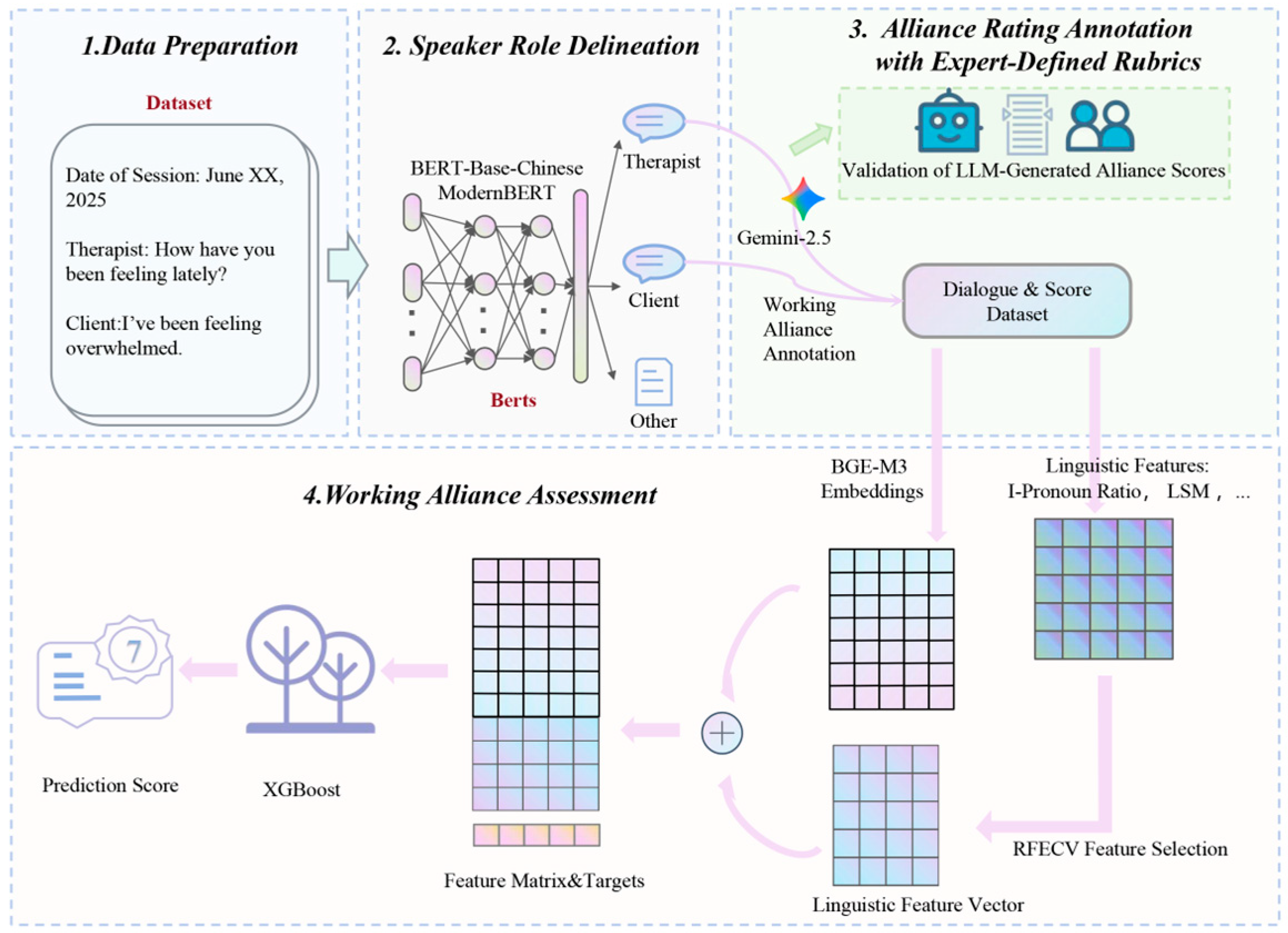
This research proposes a framework for the assessment of working alliance from psychotherapy case reports. The architecture of this framework is illustrated in Figure 1.
Figure 1.
Overview of the automated working alliance assessment framework.
Specifically, the framework converts complex multilingual psychotherapy case reports into structured dialogue representations, which are used for downstream working alliance assessment. The framework consists of four stages: case report data preparation, speaker role delineation, rubric-guided alliance annotation, and hybrid linguistic–semantic score prediction.
2.1. Data Preparation
The framework begins with the construction of the PsyCase dataset. This dataset is generated by applying Gemini-2.5-Pro to transform raw dialogues from two existing open-source psychotherapy corpora, including the Chinese PsyDTCorpus [7] and the English FeedbackESConv [8], into fully formed case reports, as detailed in Section 3.1.1.
The purpose of constructing PsyCase is not to serve as the primary dataset for alliance score prediction, but to provide diverse case-report-style training data for speaker role delineation. To explain further, the final alliance prediction task is trained on Psy-Insight, whose dialogue content is sourced from human-written materials and then annotated using the rubric-guided procedure described in Section 2.3.
2.2. Speaker Role Delineation
A critical prerequisite for analyzing dialogue content within case reports is the accurate identification of speaker roles (“Client”, “Therapist”, “Other”). To perform this foundational task, pre-trained language models are fine-tuned for text classification. For multilingual processing, two widely used models are selected: ModernBERT-base for English and Bert-Base-Chinese for Chinese. The finetuning processes involve adding a simple classification head on top of the pre-trained BERT encoder. This head consists of a fully connected layer that maps the aggregated representation of the input text to an output dimension of three, corresponding to the target classes (“Client”, “Therapist”, “Other”). A softmax function is then applied to this output to generate a probability distribution for the final classification. During the finetuning process, the parameters of both the original BERT model and the new classification head are updated using a unified corpus integrating the PsyCase, Psy-Insight [9], and CPsyCounR [10] datasets (detailed in Section 3.1.1). This process trains the model to accurately delineate dialogue turns and their corresponding speakers from complex case report texts, thus converting raw text into structured data for downstream analysis.
2.3. Alliance Rating Annotation with Expert-Defined Rubrics
The core dataset for the final prediction task is Psy-Insight. This dataset is chosen over dialogue datasets automatically generated by large language models (LLMs), as its content, sourced from human-written books and blogs, offers a higher level of authenticity in its linguistic style and interactional dynamics. It initially lacks therapeutic alliance annotations. To generate rubric-guided supervisory labels for model training, an expert-guided annotation process is implemented. First, a detailed scoring rubric for the 11 subdimensions of the working alliance is developed in collaboration with Associate Professor Xueling Yang and Professor Guifang Fu, both experts in psychology.
These 11 subdimensions, listed in Table 1, are structured around Bordin’s three core components of Goals, Tasks, and Bond [2]. Specifically, dimensions “goal clarity,” “goal summary,” and “goal adjustment” map to the Goals component; “client participation,” “therapist support,” and “effective_communication” relate to the Tasks component; “positive emotions,” “therapist empathy,” “atmosphere label,” “self disclosure,” and “active listening” reflect the Bond component. This rubric provides clear definitions for the 11 subdimensions of the working alliance. For each subdimension, annotators are instructed to provide a score on a 1-to-7 rating scale, where 1 indicates strong disconfirming evidence and 7 indicates strong supporting evidence. Second, a two-tier strategy is also employed for large-scale annotation. Our primary annotator is the Gemini-2.5-Flash model, which is used to apply the expert-defined rubric to each session at a temperature of 0.1 to reduce output stochasticity. However, 65 sessions (approximately 6.8%) cannot be processed by Gemini-2.5-Flash due to its internal content safety filters. For these specific cases, DeepSeek-R1 [11] is utilized as a secondary, fallback annotator to ensure complete coverage of the dataset. Both models are prompted with the identical scoring rubric, few-shot scoring examples, and output format requirements to maintain consistency. The average of the 11 subdimensional scores is then used as the overall working alliance score, serving as the prediction target for our final model.
Table 1.
Description of the 11 subdimensions of working alliance.
2.4. Working Alliance Assessment
In this section, the working alliance assessment is formulated as a session-level regression task. Each counseling session is represented by a hybrid linguistic–semantic feature vector and mapped to an overall alliance score.
2.4.1. Hybrid Feature Engineering
The feature extraction operates on the structured client-therapist dialogue, which is processed by the speaker role delineation module. The core of our approach is a hybrid feature engineering strategy that combines two complementary sources of information: linguistic style and semantic content. The entire process is illustrated in the “Working Alliance Assessment” portion of Figure 1, which outlines two parallel streams for feature extraction.
To capture linguistic style, language-specific text processing is performed using the PKUSEG toolkit [12] for Chinese and the spaCy [13] library for English. Based on the resulting Part-of-Speech (POS) tags and tokens, we first compute utterance-level features inspired by Linguistic Style Matching (LSM) [14] using a hybrid approach: key function words such as pronouns and negations are extracted via predefined explicit word lists, while broader lexical categories including nouns and verbs are derived from the POS tags. These utterance-level features are summarized in Table 2A.
Table 2.
(A) Definitions of utterance-level linguistic features; (B) Derived session-level interaction features.
For example, the first-person singular pronoun usage ratio (), a key indicator of self-focus, is calculated for each utterance . For an utterance containing a set of tokens , this is formally defined as:
where is the set of first-person singular pronouns (e.g., “I”, “me”, “my”), and is the indicator function. Similar ratios are computed for other linguistic categories ().
These utterance-level features are then aggregated to produce a representation for both the client () and the therapist (). Specifically, as summarized in Table 2B, we derive three categories of session-level interaction features, including role-level statistics, talk-turn balance, and cross-role feature ratios. For the role-level statistics, the mean, sum, and standard deviation are simultaneously computed to capture baseline tendencies, total linguistic volume, and conversational variability.
To further model the interactional dynamics inspired by LSM principles, we calculate the Linguistic Style Dominance Ratio () for each category :
where is a small constant for numerical stability. The collection of all such individual and ratio-based linguistic features constitutes the final linguistic feature vector. To enhance robustness, Recursive Feature Elimination with Cross-Validation (RFECV) [15] is applied to the linguistic feature subset.
To quantify the informational contribution of each linguistic feature to alliance quality, we employ Mutual Information (MI) [16], a fundamental measure from information theory. For a linguistic feature and the alliance score MI is defined as:
where denotes the marginal differential entropy of the alliance score and denotes the conditional entropy of given , which quantifies the reduction in uncertainty about given knowledge of . In practice, because the true underlying joint probability density functions are unknown, we empirically estimate Mutual Information using a non-parametric k-nearest neighbor approach based on the KSG estimator [17]. A higher value of indicates that including feature leads to a greater reduction in the uncertainty of , thereby providing a stronger predictive signal. Features are first ranked by their individual MI scores. RFECV then selects the optimal joint feature subset by maximizing cross-validated predictive performance. Table 3 summarizes the entropy reduction achieved by both strategies.
Table 3.
Entropy reduction analysis on the Psy-Insight dataset.
As shown in Table 3, the RFECV-selected subset achieves 47.1% (Chinese) and 40.7% (English) entropy reduction relative to the marginal entropy, consistently outperforming MI-ranked top-K selection. This confirms that the selected features capture substantial predictive information about alliance quality.
While linguistic features capture interaction style and the behavior of roles, the semantic embeddings provide complementary information about session content and contextual meaning. To capture semantic content, the multilingual BGE-M3 text model [18] is utilized. Each utterance is encoded into a 1024-dimensional vector, and these are aggregated via mean pooling to create a single, dense semantic representation for the entire session.
The linguistic and semantic feature vectors are then concatenated, merging two complementary feature sets into a unified and powerful representation. The resulting hybrid feature matrix, together with the corresponding alliance scores as targets, is used as the input to the XGBoost regression model.
2.4.2. Predictive Modeling and Optimization
In this stage, the input to the predictor is a session-level fused vector, and the output is the predicted session-level alliance score. Moreover, our data are on a moderate scale, and the relationships among the features are nonlinear. As a result, this study adopts XGBoost as the predictor, because it is well-suited to heterogeneous tabular features.
The selected hybrid features are used to train an XGBoost regression model [19], an ensemble method based on decision trees. The model aims to minimize a regularized objective function, which balances the prediction error with model complexity. The regularized objective function is defined as:
where the first term is the squared error loss over training samples, with being the true score and the predicted score. The second term is the regularization penalty over all trees in the ensemble. For each tree , is the number of leaves, is the score of the -th leaf, and , (L2 regularization), and (L1 regularization) are complexity control parameters that are optimized using Optuna. Once the optimal parameter set is identified, the final XGBoost model is trained on the combined training and validation sets using this configuration.
3. Experiments
3.1. Identifying Dialogues and Speakers in a Case Report
3.1.1. Datasets and Baselines
Building upon existing, open-source psychotherapy dialogue corpora, we construct the PsyCase dataset as part of our framework to support the development and evaluation of computational models for therapeutic alliance assessment. To generate the PsyCase dataset, we design a structured generation schema incorporating three pivotal dimensions: format, content, and style. This schema orchestrates the transformation process to ensure both diversity and consistency in the generated reports, operationalized through three distinct dimensions:
- Format. To ensure that the PsyCase dataset reflects the structural characteristics and informational richness of real-world psychotherapy records, we adopt three standardized documentation formats commonly used by clinical psychologists and counselors: SOAP (Subjective–Objective–Assessment–Plan) [20], BIRP (Behavior–Intervention–Response–Plan), and DAP (Data–Assessment–Plan) [21]. To enhance the structural diversity, two informal formats are also incorporated—narrative and timeline.
- Content. Generation prompts specify a broad range of clinical and psychological focuses, including intervention procedures, metaphor identification and interpretation, emotional tracking and annotation, cognitive-behavioral (CBT) analysis, psychodynamic analysis, person-centered process focus, behavioral pattern and function analysis, and cultural context analysis [22].
- Style. Four distinct writing styles are defined: academic, instructional, client-oriented, and reflective-practice. These three dimensions can be flexibly combined to generate a diverse set of case reports with coherent structure and professional expression.
Following the generation schema described above, the PsyCase dataset is constructed by applying the three-dimensional generation framework to two existing psychotherapy dialogue corpora: the Chinese PsyDTCorpus and the English FeedbackESConv dataset. Leveraging Gemini-2.5-Pro with prompts incorporating the defined format, content, and style dimensions, we generate 400 structured case reports from each corpus, resulting in a multiple-language dataset named PsyCase. The resulting PsyCase is subsequently integrated with the Psy-Insight dataset and the CPsyCounR dataset—both of which contain records combining dialogue and non-dialogue content. Detailed statistics of the datasets are presented in Table 4.
Table 4.
Statistical summary of the datasets.
After dataset integration and deduplication, a unified and diverse corpus is formed and used to train the speaker role delineation model described in the following section. The model aims to distinguish therapist utterances, client utterances, and non-dialogue content within complex psychotherapy case reports. In this work, all datasets used are publicly available and consist of de-identified dialogue data or synthetically generated case reports. As no real personal identities or sensitive private information are involved at any stage of model training, the study complies with data privacy and research ethics requirements.
To comprehensively evaluate performance, several baseline models are employed for comparison, including XGBoost, Fully Connected Neural Network (FCNN), and Logistic Regression. All models are optimized using the Optuna framework [23] for automated hyperparameter tuning, ensuring a fair and consistent comparison. Baselines are trained on a feature set combining statistical properties, POS frequencies, and semantic embeddings.
3.1.2. Experimental Settings and Evaluation Metrics
All experiments are conducted on a single NVIDIA GeForce RTX 3090 GPU (NVIDIA Corporation, Santa Clara, CA, USA). The dataset is partitioned into training, validation, and test sets using a 70:15:15 split ratio. Stratified sampling is employed to ensure that the class distribution remains consistent across all subsets. The model performance is evaluated using four metrics: Accuracy, Macro Precision, Macro F1 Score, and Macro AUC (One-vs-Rest).
3.1.3. Experimental Results and Comparison
First, we evaluate the performance of the fine-tuned BERTs on the test sets. On the Chinese dataset, the BERT-Base-Chinese model achieves an accuracy of 98% and a macro F1 score of 97%. On the English dataset, the ModernBERT-base model achieves an accuracy of 97% and a macro F1 score of 94%. These results indicate that the fine-tuned BERTs effectively capture speaker-related information from complex case report texts across both languages.
To further analyze model performance, we compare the BERTs with several baseline approaches, including XGBoost, FCNN, and Logistic Regression. As shown in Table 5, the BERT-based models consistently outperform all baseline methods across both languages and all evaluation metrics.
Table 5.
Performance comparison of different models for speaker role delineation on Chinese and English datasets.
3.2. Working Alliance Assessment
3.2.1. Dataset
This study utilizes the Psy-Insight psychotherapy dialogue dataset. Detailed dataset information is provided in Table 6. The input features for model training consist of two main categories: linguistic features and embedding features. For POS tagging, language-specific tools are utilized to ensure high-quality annotations: the EN_CORE_WEB_TRF model from the spaCy framework is used for English, while the PKUSEG toolkit (version 0.0.25) is employed for Chinese. These tools enable accurate syntactic analysis of the dialogue texts, providing structured linguistic information for downstream feature extraction and modeling. Building on this foundation, a unified set of features—such as pronoun usage, non-fluency markers, and LSM categories—is extracted and aggregated at the session level for both the client and the therapist. The multilingual BGE-M3 model is used for semantic feature extraction across both languages.
Table 6.
Statistics of Chinese and English counseling in the Psy-Insight dataset.
In addition to Psy-Insight, we use PsyDial as an external dataset for generalization evaluation. PsyDial is a Chinese long-term counseling dialogue dataset derived from a real psychological counseling platform and reviewed under ethical and expert supervision. In this study, 300 sessions are randomly sampled from PsyDial for external evaluation. The PsyDial sessions have an average of 37.8 dialogue turns, and the average utterance lengths of clients and counselors are 33.7 and 31.1 Chinese characters, respectively.
3.2.2. Experimental Settings and Evaluation Metrics
The dataset is partitioned into training, validation, and test sets using an 80:10:10 split ratio. To optimize the prediction model, we employ the Optuna framework for hyperparameter tuning. The search space is defined as follows: n_estimators (step = 100); learning_rate (log scale); max_depth ; subsample ; colsample_bytree ; and L1/L2 regularization terms (alpha, lambda) and gamma all sampled uniformly on a log scale from . Based on this search, the selected optimal hyperparameters for the Chinese subset are: n_estimators = 1000, learning_rate = 0.029, max_depth = 4, subsample = 0.88, colsample_bytree = 0.89, gamma = , lambda = , and alpha = 0.37. For the English subset, the selected parameters are: n_estimators = 1200, learning_rate = 0.014, max_depth = 3, subsample = 0.61, colsample_bytree = 0.62, gamma = 0.001, lambda = 0.39, and alpha = .
Model performance is evaluated using several regression-based metrics, including Mean Absolute Error (MAE), Root Mean Square Error (RMSE), statistical significance (p-value), Pearson’s Correlation Coefficient (r), and the Intraclass Correlation Coefficient (ICC).
3.2.3. Performance Comparison
To comprehensively evaluate the effectiveness of different approaches for working alliance rating assessment, five representative models are implemented for comparison. The final evaluation results of these models on the test set are summarized in Table 7. Three of the models—XGBoost, ElasticNet, and BERT-RNN—utilize a combination of linguistic features and semantic embedding features as inputs, but differ in their core prediction algorithms, representing a gradient-boosted tree, a regularized linear regression model, and a deep sequence learning model, respectively. Specifically, the BERT-RNN model follows a hierarchical encoding architecture in which each utterance is encoded by a pretrained BERT model, the resulting CLS token representations are passed through a bidirectional LSTM with a hidden size of 128 per direction, and a soft attention mechanism aggregates the LSTM outputs into a session-level context vector that is concatenated with linguistic features and decoded by a two-layer MLP. For a broader comparison, we also replicate two methods from the literature: a Ridge Regression model with TF-IDF/Sent2vec features [4] and a “personae”-based SVR model [24]. Furthermore, we include GPT-4o-mini [25] as a zero-shot baseline to evaluate the capability of general-purpose large language models in directly annotating alliance ratings without task-specific supervised training.
Table 7.
Summary of model evaluation metrics.
These results demonstrate that the proposed model outperforms existing methods for predicting therapeutic alliance from dialogue content. For example, the replicated method of Goldberg et al. [4] achieves an MAE of 0.64 using TF-IDF features extracted from therapist utterances. Furthermore, although direct comparisons across different datasets are inherently limited, the correlation coefficients obtained in our study compare favorably with those reported in prior research. For instance, Aafjes-Van Doorn et al. [26] reported an ICC of 0.66 and a Pearson correlation of 0.70.
As shown in Table 7, the XGBoost model achieves the best performance across all evaluation metrics, which indicates that gradient-boosted ensemble methods are highly effective in leveraging mixed features for predicting therapeutic alliance scores. To assess the reliability of these results, 95% bootstrap confidence intervals are computed, and pairwise Wilcoxon signed-rank tests are conducted with XGBoost as the reference. Across both languages, XGBoost achieves statistically significant MAE reductions relative to TF-IDF_Ridge and the GPT-4o-mini baseline. Furthermore, on the English dataset, it also significantly outperforms SVR and BERT-RNN. Notably, the zero-shot GPT-4o-mini performs substantially worse than all supervised models in terms of error rate. Its predictions exhibit markedly reduced variance compared to the ground truth distribution, highlighting that general-purpose LLMs exhibit limitations in accurately assessing working alliance in the absence of task-specific adaptation. Furthermore, the BERT-RNN model performs relatively poorly. This is attributable to its large parameter count relative to the limited available training data, making it highly susceptible to overfitting and instability in small-sample contexts.
The performance differences between XGBoost and ElasticNet merit particular attention. Both models are trained using the same RFECV-selected feature set. Despite XGBoost’s consistent numerical advantage in point estimates across both datasets, pairwise tests show no statistically significant difference between the two models on the Psy-Insight dataset. This outcome can be attributed to the limited test set sizes, which limits the statistical power available to detect small effect sizes. In such a small-sample scenario, ElasticNet, as a highly regularized linear model, can adequately capture the variance using the well-selected RFECV features, masking the theoretical advantages of non-linear models.
Nevertheless, this lack of significance can be attributed in large part to the limited sample size. As demonstrated later in our cross-dataset generalization analysis (Section 3.2.6), when evaluated on the much larger PsyDial dataset, XGBoost significantly outperforms ElasticNet. This evidence suggests that the underlying relationship between linguistic features and alliance ratings is highly non-linear, and the superior capacity of gradient-boosted trees becomes decisively evident once sufficient statistical power is available.
3.2.4. Ablation Study
An ablation study is conducted to validate the contribution of each feature type within the hybrid feature representation. Model performance is compared across four feature configurations: semantic embeddings only (Semantic Only), full linguistic style features only (Ling Only Full), RFECV-selected linguistic style features only (Ling Only Selected), and the proposed model integrating RFECV-selected linguistic features with semantic embeddings (Hybrid). The experimental results are presented in Table 8.
Table 8.
Ablation study results.
The results indicate that the XGBoost model with hybrid features consistently outperforms all single-feature configurations across all evaluation metrics, confirming the complementary nature of the two feature types. Pairwise Wilcoxon signed-rank tests comparing the Hybrid model with each ablation variant reveal that on the English dataset, the Hybrid model significantly outperforms the Semantic-Only configuration. Other ablation comparisons do not reach statistical significance on either dataset. This is primarily due to the limited test-set size. Nonetheless, the consistent numerical advantage of the Hybrid configuration across both languages, together with the statistically significant result on the English dataset, supports the complementary contribution of linguistic and semantic features. In particular, semantic features prove more informative than linguistic features in the Chinese setting, while the reverse pattern is observed in the English setting, suggesting that the two feature types emphasize different aspects across languages. Furthermore, RFECV-based feature selection consistently improves performance compared with the full linguistic feature set, indicating that removing redundant features enhances predictive accuracy without compromising essential information. Overall, the integration of linguistic style and semantic information serves a crucial role in improving working alliance assessment.
3.2.5. Linguistic Feature Analysis
To identify the linguistic features that are most informative of therapeutic alliance quality, we apply the mutual information (MI) analysis described in Section 2.4.1 to the Psy-Insight dataset. Table 9 and Table 10 present the top 10 MI-ranked linguistic features for the Chinese and English subsets, respectively.
Table 9.
Top 10 linguistic features ranked by MI for Chinese.
Table 10.
Top 10 linguistic features ranked by MI for English.
Mutual information analysis reveals both consistent and distinct cross-linguistic patterns in how linguistic features reduce the entropy of therapeutic alliance ratings. Across both languages, pronoun usage and verb-related features yield the highest information gain, indicating that personal reference patterns and action-oriented language serve as cross-linguistically robust channels for transmitting alliance-relevant information. In the Chinese subset, client-generated features dominate the top rankings. Client pronoun usage ranks first, followed by verb usage and specific first-person pronouns, demonstrating that the client’s active linguistic engagement is the primary source of entropy reduction when evaluating alliance quality. Significantly, interjection usage and negation also emerge as top-ranking features. This suggests that affective expressiveness and markers of resistance encode substantial, non-redundant information regarding the alliance state in Chinese-language counseling. Conversely, in the English subset, the therapist’s pronoun usage ranks first by a notable margin. This indicates that therapist linguistic accommodation provides the most discriminative power for alliance quality, playing a more prominent role in minimizing outcome uncertainty compared to the Chinese context. Furthermore, verb features from both participants appear in the top four, while the variability in therapist adjectives and adverbs also proves highly informative. This indicates that the lexical entropy of the therapist’s expressive language shares significant mutual dependence with the overall alliance state in English-language sessions.
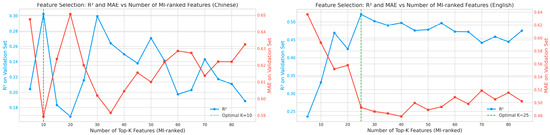
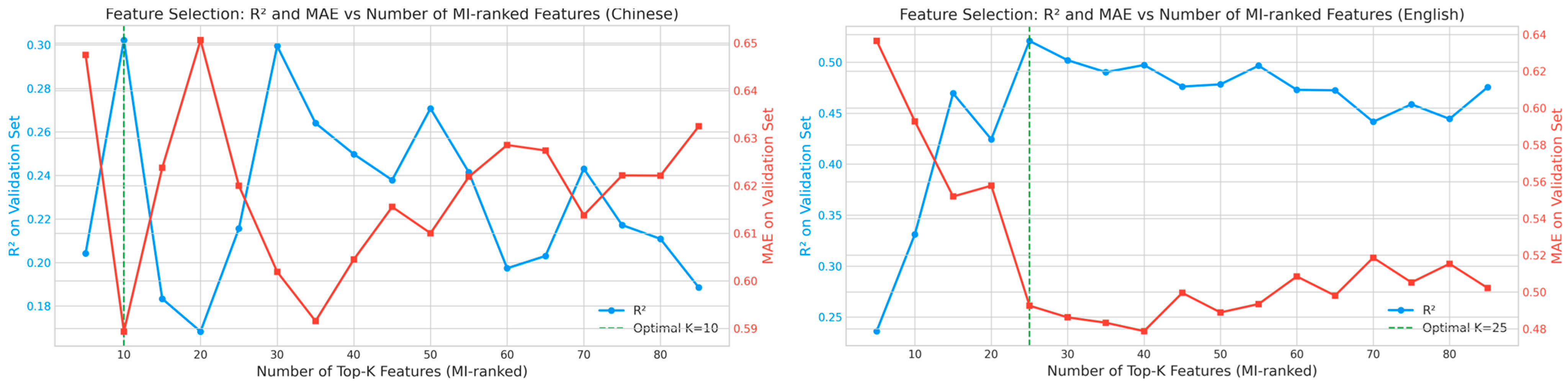
The Top-K cumulative performance analysis shown in Figure 2 provides insight into the minimal informative feature subset. In the English dataset, rises steeply from K = 5 to K = 25 and then plateaus, with the optimal subset at K = 25. In the Chinese dataset, the curve peaks early at K = 10 and exhibits greater fluctuation at larger K values. Despite the differing optimal K, both curves demonstrate that a small subset captures the majority of predictive information. Adding further features yields diminishing or even negative returns, confirming the presence of substantial redundancy in the full linguistic feature space.
Figure 2.
Top-K feature selection curves for the Chinese (left) and English (right) subsets, showing R2 and MAE on the validation set as a function of the number of MI-ranked linguistic features.
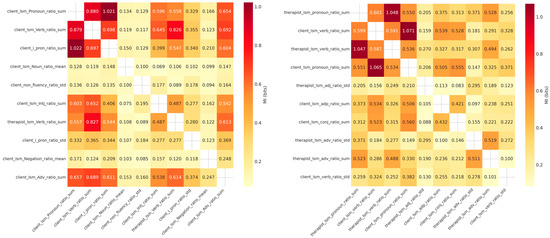
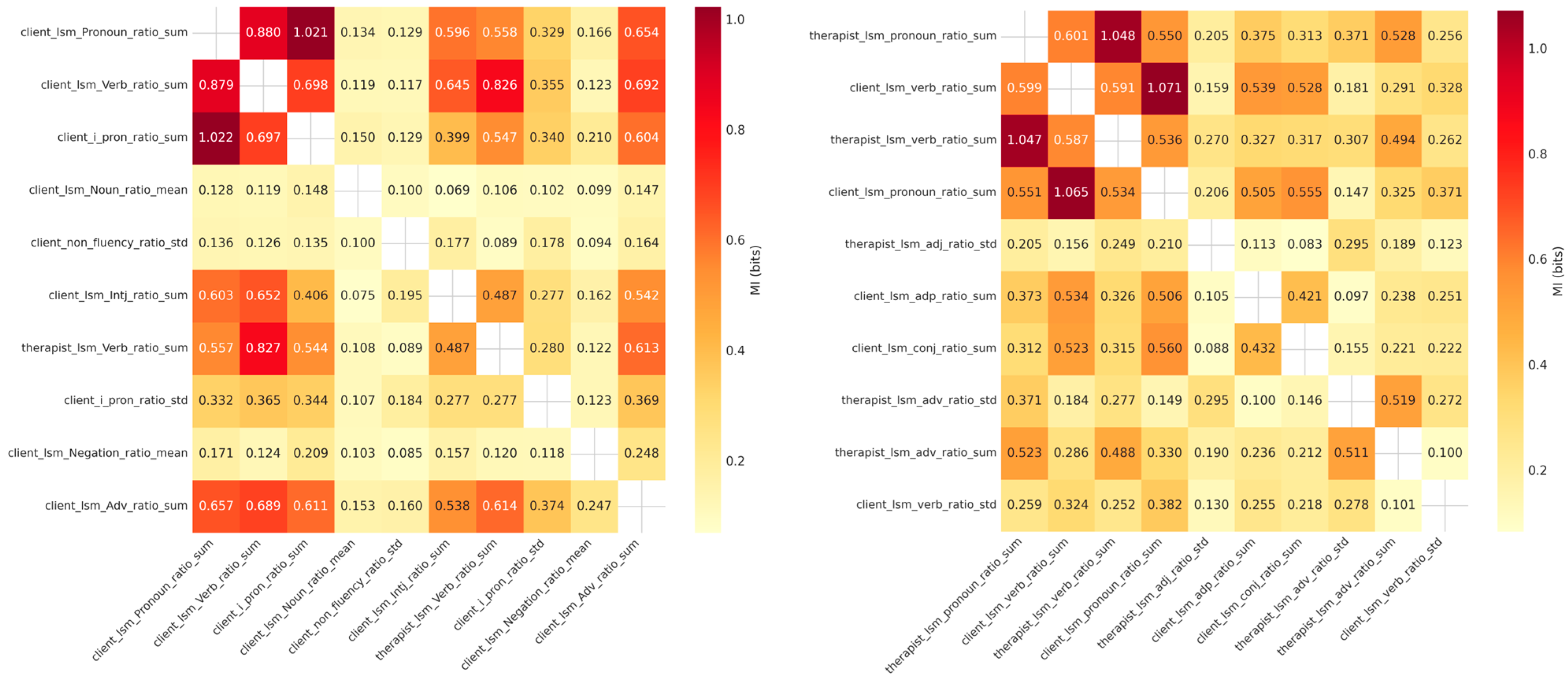
Furthermore, the pairwise MI redundancy heatmap in Figure 3 reveals two dominant sources of redundancy. The first is the subset–superset relationship. In the Chinese heatmap, client_LSM_Pronoun_ratio_sum and client_I_pron_ratio_sum share an MI of 1.02 bits because the first-person pronoun count is a strict subset of the overall pronoun count. The second is the cross-role co-variation in the same lexical category. Therapist_LSM_Verb_ratio_sum and client_LSM_Verb_ratio_sum exhibit MI values of 0.83 in Chinese and 0.59 in English, indicating that verb usage by one participant systematically predicts verb usage by the other, which quantitatively reflects linguistic style matching during therapy. In contrast, features capturing distributional variability such as client_non_fluency_ratio_std in Chinese and therapist_LSM_adj_ratio_std in English show consistently low MI with other features, suggesting that they provide unique and non-redundant information. These findings provide empirical justification for applying feature selection methods to reduce dimensionality without losing predictive power.
Figure 3.
Pairwise mutual information heatmap of the top 10 MI-ranked linguistic features for the Chinese (left) and English (right) subsets, illustrating inter-feature redundancy within and across linguistic categories.
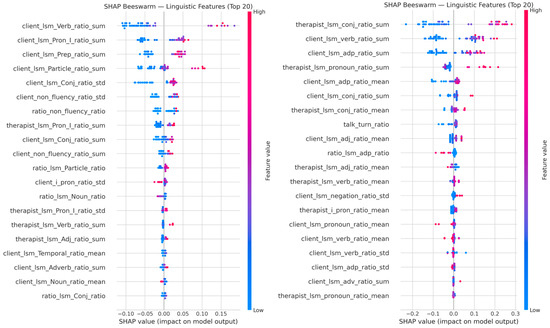
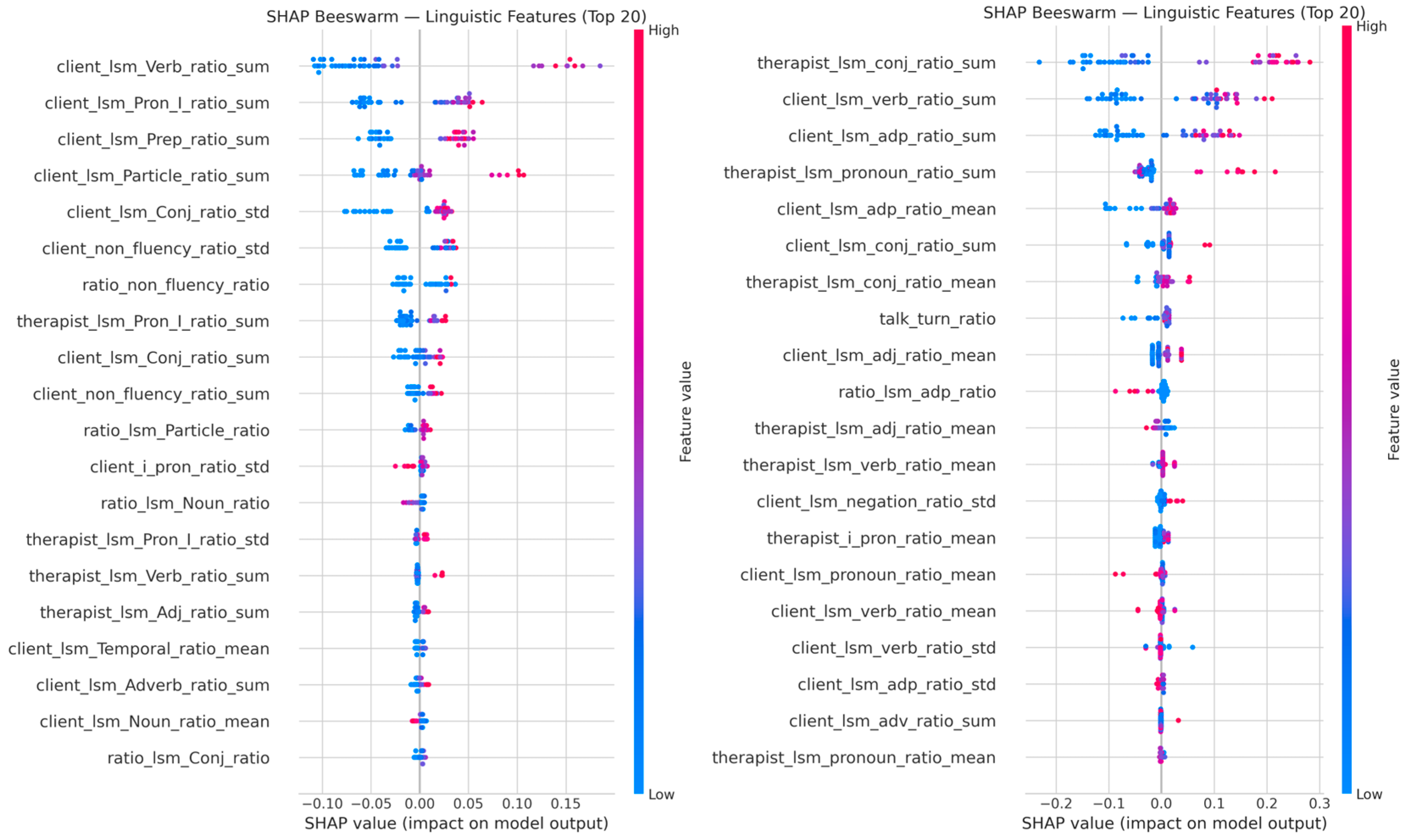
To further validate the predictive contributions of linguistic features from a model-level perspective, we apply SHAP (SHapley Additive exPlanations) analysis to the trained XGBoost models on the Psy-Insight test set. Figure 4 presents the SHAP beeswarm plots for the Chinese and English subsets, showing the top 20 linguistic features ranked by mean absolute SHAP value.
Figure 4.
SHAP beeswarm plots of the top 20 linguistic features for the Chinese (left) and English (right) subsets on the Psy-Insight test set. Each dot represents one session; the x-axis shows the SHAP value (impact on model output); the color indicates the feature value.
In the Chinese subset, client_lsm_Verb_ratio_sum emerges as the most influential feature, with higher verb usage by the client associated with higher predicted alliance scores. client_lsm_Pron_I_ratio_sum and client_lsm_Prep_ratio_sum rank second and third, suggesting that client self-referential language and prepositional usage are strong positive predictors of alliance quality. Notably, client_non_fluency_ratio_std also ranks highly, indicating that variability in disfluency markers carries meaningful predictive signal, consistent with the MI analysis findings.
In the English subset, therapist_lsm_conj_ratio_sum is the dominant feature, with higher conjunction usage by the therapist strongly associated with higher alliance scores. This suggests that therapist discourse connectivity, defined as the degree to which the therapist linguistically links ideas within and across turns, is a key marker of alliance quality in English-language sessions. Client_lsm_verb_ratio_sum and client_lsm_adp_ratio_sum rank second and third, paralleling the client-side verb pattern observed in Chinese.
Overall, the SHAP analysis reveals both cross-linguistic consistencies and language-specific patterns in the predictive structure of the model, providing clinically interpretable evidence for how specific linguistic behaviors relate to therapeutic alliance quality.
3.2.6. Generalization Capability Analysis
To further assess the robustness of our proposed framework, it is validated on a subset of 300 randomly sampled sessions drawn from the PsyDial dataset [27] without retraining. As described in Section 3.2.1, PsyDial differs from Psy-Insight in data source, language setting, and dialogue structure, and therefore provides a meaningful cross-dataset evaluation scenario. The reference alliance labels for the PsyDial subset are generated by Gemini-2.5-Flash using the same expert-defined rubric described in Section 2.3. The main domain differences between Psy-Insight and PsyDial are summarized in Table 11.
Table 11.
Domain differences between Psy-Insight and PsyDial.
These differences indicate that the PsyDial evaluation involves cross-dataset transfer across different data sources, language settings, and dialogue structures. In this case, this experiment is intended to evaluate preliminary assessment of generalization under a consistent LLM-based annotation protocol, while acknowledging that further validation with independently human-rated labels is needed to establish clinical generalizability.
The results provide a preliminary assessment of cross-dataset generalization, as detailed in Table 12.
Table 12.
Generalization Performance on the PsyDial Dataset.
The XGBoost model achieved an MAE of 0.38 and an RMSE of 0.46 on the PsyDial subset. The predicted mean score (5.95) is close to the reference mean score (6.13), suggesting reasonable aggregate-level calibration. However, the statistical analysis shows a statistically significant but moderate correlations (Pearson = 0.35, < 0.05; Spearman ρ = 0.35, < 0.05), revealing that the model captures part of the variance in the LLM-generated reference scores. These results provide preliminary evidence of cross-dataset generalization capability under the same annotation framework.
Comparative analysis further confirms the robustness of the XGBoost model. As shown in Table 12, the larger scale of the PsyDial dataset provides sufficient statistical power to firmly establish model differences. XGBoost significantly outperforms ElasticNet with a MAE 95% CI of [0.329, 0.488] (), confirming that its non-linear modeling capability is indeed superior to linear regularization when evaluated on a larger corpus. Table 12 also shows that when confronted with cross-dataset domain shifts, BERT-RNN fails to produce statistically significant correlations despite maintaining a comparable error rate. Linear models such as ElasticNet produce statistically significant correlations yet exhibit substantially higher error rates, indicating poor absolute calibration. Similarly, SVR and TF-IDF Ridge both achieve a significant Spearman correlation but not Pearson, with considerably higher error rates than XGBoost. These findings demonstrate that the integration of hybrid features with gradient-boosted ensemble learning yields a more stable framework under the current cross-dataset evaluation setting for psychotherapy dialogue assessment.
3.3. Validation of LLM-Generated Alliance Scores
To evaluate the validity of the alliance scores generated by LLMs, we conduct a validation analysis comparing the annotations produced by Gemini-2.5-Flash (with DeepSeek-reasoner as a fallback) with those provided by trained human raters on the entire Psy-Insight dataset. The human annotation process is supervised by Professor Guifang Fu, who has over twenty years of clinical and teaching experience in mental health and provides standardized training to all annotators. The annotators include undergraduate and graduate students majoring in psychology, all of whom receive formal instruction on applying the expert-defined scoring rubric across eleven alliance dimensions.
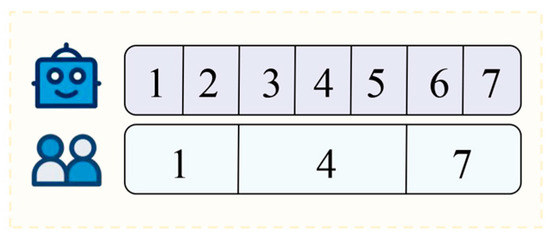
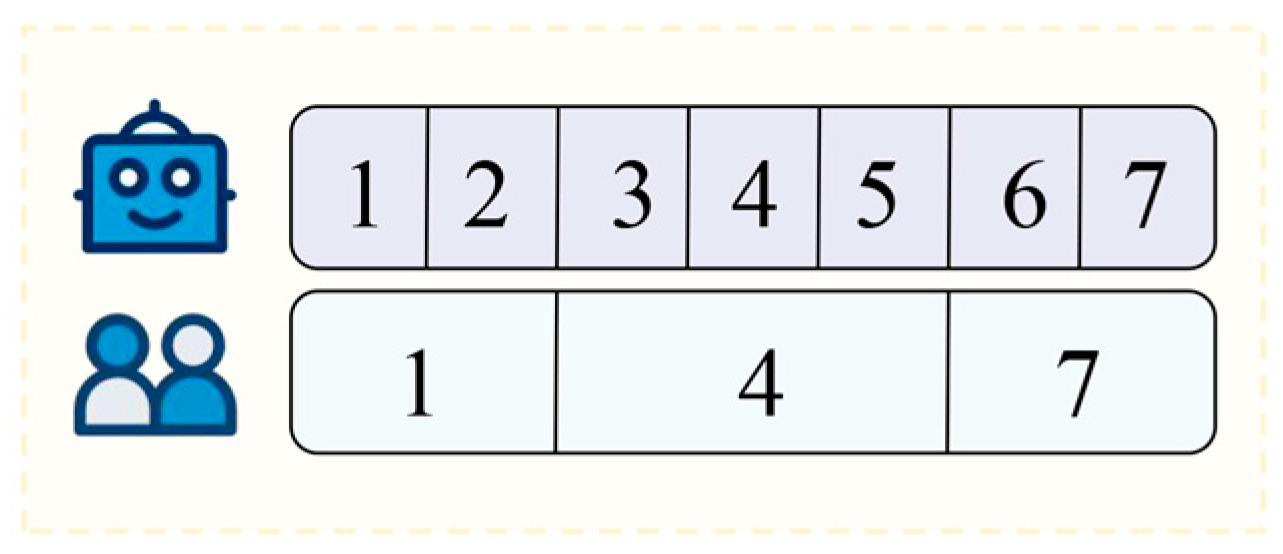
To ensure a fair comparison, both the human raters and the LLMs follow the same scoring rubric, as detailed in Table 1. However, the two groups differ in scoring granularity: the LLMs produce ratings on a 7-point scale (1–7), whereas human raters use a coarser 3-point scale (1, 4, 7). This is due to the challenge for human raters to maintain consistent and reliable distinctions across a 7-point spectrum for such a subjective task. To enable direct comparison, the LLM’s ratings are mapped to the same 3-point scale using threshold-based binning process, as illustrated in Figure 5.
Figure 5.
Illustration of the rating scale mapping process.
We then analyze the agreement between the two sets of scores (LLM and human). To provide a comprehensive view, we examine both the overall score distributions and the level of direct alignment. The comparison includes descriptive statistics such as Mean, Standard Deviation (SD), Minimum, and Maximum. In addition, we calculate the MAE to quantify the average discrepancy and the Pearson Correlation Coefficient (r) to assess the strength of the linear relationship between the two rating sources.
As shown in Table 13, the validation results indicate a moderate correspondence between the LLM-generated annotations and those produced by trained human raters. The score distributions show that Gemini-2.5-Flash exhibits a mean score (M = 4.91) and standard deviation (SD = 1.03) that are broadly comparable to the human ratings (M = 5.37, SD = 0.95). The MAE of 0.80 and Pearson correlation coefficient of r = 0.59 (p < 0.001) indicate a statistically significant but moderate association between the two rating sources. It should be noted that these agreement metrics are computed after mapping LLM scores from the original 7-point scale to the coarser 3-level scale via threshold-based binning. This mismatch biases the reported r and MAE, as binning boundaries may produce apparent agreements or discrepancies that do not fully reflect the underlying evaluative relationship between the two rating sources. Although the use of a simplified 3-point scale for human raters results in some loss of granularity, this correlation indicates that the underlying evaluative trends are well preserved. Overall, these findings suggest that the LLM-generated scores can serve as useful rubric-guided supervisory signals for model development. However, they should not be regarded as fully equivalent to expert clinical ground-truth labels.
Table 13.
Comparison of rating statistics between trained human raters and Gemini-2.5-Flash.
To rigorously evaluate the reliability of the human annotations, we randomly sampled a subset of 100 sessions and had them re-evaluated by other independently trained annotators. During the annotation process, human evaluators found that fine-grained clinical discrimination from raw text transcripts alone was highly challenging. Therefore, to ensure consistency, human annotators were instructed to rate sessions using three primary anchor points: 1 representing low, 4 representing moderate, and 7 representing high.
Based on this reliability subset, the inter-human Intraclass Correlation Coefficient is 0.52 (95% CI: [0.31, 0.67], p < 0.001), with a Pearson correlation of 0.58 and a mean absolute error of 1.00. This level of inter-rater agreement reflects the inherent complexity of assessing the working alliance solely from text transcripts. The discrete nature of the 1, 4, 7 anchor points inherently introduces large numerical penalties for single-category disagreements, thereby inflating the MAE and restricting the variance required for higher correlation coefficients.
In comparison, the agreement analysis between the Gemini-generated labels and the primary human annotators yielded r = 0.59 (p < 0.001) and an MAE of 0.80. We acknowledge that these values represent moderate agreement. However, viewed in the context of the inter-human baseline, this performance demonstrates that the LLM successfully achieves a level of consistency comparable to that of trained human evaluators. Consequently, these results validate that the structured, rubric-guided LLM annotation pipeline provides a reliable and highly scalable proxy for human clinical judgment, justifying its use for generating the prediction targets in this study.
4. Discussion
The experimental results demonstrate that the proposed framework achieves a strong and consistent performance on automated working alliance assessment, outperforming all baseline methods across both languages. A particularly informative comparison is that between XGBoost and ElasticNet, despite sharing identical input features, XGBoost substantially outperforms its linear counterpart, suggesting that the relationship between dialogue features and alliance ratings is inherently nonlinear and cannot be adequately captured by linear models. This advantage is further reinforced by the hybrid feature representation, which integrates linguistic style features with dense semantic embeddings to provide a richer characterization of the therapeutic interaction. Additionally, applying RFECV to the linguistic feature subset helps suppress noise and enhance model robustness by retaining only the most predictive features.
In addition to predictive performance, the validity of the LLM-based annotation pipeline is supported by the agreement analysis between Gemini-2.5-Flash and trained human raters (r = 0.59, p < 0.001, MAE = 0.80). Moreover, the LLM annotator follows a structured, expert-developed rubric grounded in Bordin’s three core components of the working alliance, reducing the risk of unconstrained or idiosyncratic model judgments. Overall, these results indicate that structured, LLM-assisted annotation offers a scalable and scalable rubric-guided annotation strategy for labeling psychotherapy process data.
Despite these promising results, several limitations warrant acknowledgment. First, an inter-human ICC of 0.52 reflects the inherent complexity of assessing the working alliance solely from text transcripts. This moderate inter-rater reliability highlights an intrinsic degree of noise in the ground-truth labels, which constrains the theoretical performance ceiling of any automated predictive model. Second, the scale of the psychotherapy datasets remains relatively limited, especially for training deep learning models and conducting multilingual evaluation. The Psy-Insight dataset contains 431 Chinese sessions and 520 English sessions, which may not fully cover the diversity of counseling styles, client concerns, and therapist intervention patterns. This limitation may partly explain the weaker performance of data-hungry models such as BERT-RNN, which typically require larger training corpora to generalize effectively. Although the proposed XGBoost model is more suitable for moderate-scale tabular features, the current dataset size still limits the strength of robust generalization claims. Furthermore, our framework relies partially on the synthetically structured PsyCase dataset, introducing a theoretical risk of learning LLM-generated artifacts. Future work should therefore prioritize expanding the real clinical corpus and examining the association between automated alliance scores and objective therapy outcomes to validate their clinical utility. Regarding practical deployment, prediction errors in regression-based alliance assessment carry asymmetric clinical risks: underestimating alliance quality may prompt unnecessary clinical intervention, whereas overestimation risks leaving genuinely at-risk cases undetected. Furthermore, careful consideration of data privacy protection remains essential, particularly given the sensitive nature of psychotherapy records.
5. Conclusions
This study proposes a framework for automated therapeutic alliance assessment from complex case reports. We demonstrate that by constructing the PsyCase dataset and leveraging LLMs for annotation, the proposed methods achieve strong performances. Our model, which processes case reports containing therapist–patient dialogue, can be integrated into clinical documentation workflows. After a session note is finalized, the system could automatically generate a consultation-alliance rating assessment, offering clinicians an additional interpretive indicator for identifying cases that may require closer attention to therapeutic engagement. In this role, the model serves as a supplementary analytic component that supports systematic reflection on interaction patterns within routine clinical practice. This research offers a novel approach for the intelligent evaluation of psychotherapy quality and contributes to the advancement of AI-assisted mental health interventions. While our findings are promising, certain limitations remain, pointing to avenues for future work. Significantly, the XGBoost model achieves robust performance, which underscores the effectiveness of our hybrid feature engineering strategy.
Author Contributions
Conceptualization, D.L. and Y.L.; methodology, D.L., Y.L., G.F. and X.Y.; software, Y.L.; validation, Y.L., G.F. and X.Y.; formal analysis, Y.L.; investigation, Y.L.; resources, D.L.; data curation, Y.L., Z.M. and N.S.; writing—original draft preparation, Y.L. and N.S.; writing—review and editing, D.L.; visualization, Y.L.; supervision, D.L.; project administration, D.L.; funding acquisition, D.L. All authors have read and agreed to the published version of the manuscript.
Funding
This research was funded by the National Natural Science Foundation of China (No. 62372494), the Guangdong Key Disciplines Project (No. 2022ZDJS139), the Zhuhai Industry–University Research Project (No. 2220004002671), the Engineering Technology Research Center of Guangdong Provincial Key Scientific Research Platform Project (No. 2024GCZX001), and the National Undergraduate Training Program on Innovation and Entrepreneurship (No. 202313684003S).
Institutional Review Board Statement
Not applicable.
Data Availability Statement
The publicly available datasets analyzed in this study are cited in the references. The newly generated PsyCase dataset presented in this study is not publicly available due to ongoing further research but is available on request from the authors.
Conflicts of Interest
The authors declare no conflicts of interest.
Abbreviations
The following abbreviations are used in this manuscript:
| WAI | Working Alliance Inventory |
| TF-IDF | Term Frequency-Inverse Document Frequency |
| NLP | Natural Language Processing |
| BERT | Bidirectional Encoder Representations from Transformers |
| LLMs | Large Language Models |
| SOAP | Subjective–Objective–Assessment–Plan |
| BIRP | Behavior–Intervention–Response–Plan |
| DAP | Data–Assessment–Plan |
| CBT | Cognitive-Behavioral Therapy |
| FCNN | Fully Connected Neural Network |
| POS | Part-of-Speech |
| LSM | Linguistic Style Matching |
| LSDR | Linguistic Style Dominance Ratio |
| RFECV | Recursive Feature Elimination with Cross-Validation |
| XGBoost | eXtreme Gradient Boosting |
| MAE | Mean Absolute Error |
| RMSE | Root Mean Square Error |
| ICC | Intraclass Correlation Coefficient |
| SVR | Support Vector Regression |
| SD | Standard Deviation |
References
- Horvath, A.O.; Luborsky, L. The role of the therapeutic alliance in psychotherapy. J. Consult. Clin. Psychol. 1993, 61, 561. [Google Scholar] [CrossRef] [PubMed]
- Bordin, E.S. The generalizability of the psychoanalytic concept of the working alliance. Psychother. Theory Res. Pract. 1979, 16, 252–260. [Google Scholar] [CrossRef] [Scilit]
- Horvath, A.O. An Exploratory Study of the Working Alliance: Its Measurement and Relationship to Therapy Outcome. Ph.D. Thesis, University of British Columbia, Vancouver, BC, Canada, 1981. [Google Scholar]
- Goldberg, S.B.; Flemotomos, N.; Martinez, V.R.; Tanana, M.J.; Kuo, P.B.; Pace, B.T.; Villatte, J.L.; Georgiou, P.G.; Van Epps, J.; Imel, Z.E.; et al. Machine learning and natural language processing in psychotherapy research: Alliance as example use case. J. Couns. Psychol. 2020, 67, 438–448. [Google Scholar] [CrossRef] [Scilit] [PubMed]
- Salton, G.; Buckley, C. Term-weighting approaches in automatic text retrieval. Inf. Process. Manag. 1988, 24, 513–523. [Google Scholar] [CrossRef] [Scilit]
- Zhou, Y.; Chen, X.Y.; Liu, D.; Pan, Y.L.; Hou, Y.F.; Gao, T.T.; Peng, F.; Wang, X.C.; Zhang, X.Y. Predicting first session working alliances using deep learning algorithms: A proof-of-concept study for personalized psychotherapy. Psychother. Res. 2022, 32, 1100–1109. [Google Scholar] [CrossRef] [Scilit] [PubMed]
- Xie, H.; Chen, Y.; Xing, X.; Lin, J.; Xu, X. PsyDT: Using LLMs to construct the digital twin of psychological counselor with personalized counseling style for psychological counseling. In Proceedings of the 63rd Annual Meeting of the Association for Computational Linguistics, Vienna, Austria, 27 July–1 August 2025; Volume 1, pp. 1081–1115. [Google Scholar] [CrossRef] [Scilit]
- Chaszczewicz, A.; Shah, R.S.; Louie, R.; Arnow, B.A.; Kraut, R.; Yang, D. Multi-level feedback generation with large language models for empowering novice peer counselors. In Proceedings of the 62nd Annual Meeting of the Association for Computational Linguistics, Bangkok, Thailand, 11–16 August 2024; Volume 1, pp. 4130–4161. [Google Scholar] [CrossRef] [Scilit]
- Chen, K.; Sun, Z.; Wen, Y.; Lian, H.; Gao, Y.; Li, Y. Psy-Insight: Explainable multi-turn bilingual dataset for mental health counseling. arXiv 2025, arXiv:2503.03607. [Google Scholar]
- Zhang, C.; Li, R.; Tan, M.; Yang, M.; Zhu, J.; Yang, D.; Zhao, J.; Ye, G.; Li, C.; Hu, X. CPsyCoun: A report-based multi-turn dialogue reconstruction and evaluation framework for Chinese psychological counseling. In Proceedings of the Findings of the Association for Computational Linguistics: ACL 2024, Bangkok, Thailand, 11–16 August 2024; pp. 13947–13966. [Google Scholar] [CrossRef] [Scilit]
- Guo, D.; Yang, D.; Zhang, H.; Song, J.; Wang, P.; Zhu, Q.; Xu, R.; Zhang, R.; Ma, S.; Bi, X.; et al. DeepSeek-R1 incentivizes reasoning in LLMs through reinforcement learning. Nature 2025, 645, 633–638. [Google Scholar] [CrossRef] [Scilit] [PubMed]
- Luo, R.; Xu, J.; Zhang, Y.; Zhang, Z.; Ren, X.; Sun, X. PKUSEG: A toolkit for multi-domain Chinese word segmentation. arXiv 2019, arXiv:1906.11455. [Google Scholar]
- Honnibal, M.; Montani, I.; Van Landeghem, S.; Boyd, A. spaCy: Industrial-Strength Natural Language Processing in Python. 2017. Available online: https://github.com/explosion/spaCy (accessed on 3 March 2025).
- Doorn, A.V.; Porcerelli, J.; Müller-Frommeyer, L.C. Language style matching in psychotherapy: An implicit aspect of alliance. J. Couns. Psychol. 2020, 67, 509–522. [Google Scholar] [CrossRef] [Scilit] [PubMed]
- Pedregosa, F.; Varoquaux, G.; Gramfort, A.; Michel, V.; Thirion, B.; Grisel, O.; Blondel, M.; Prettenhofer, P.; Weiss, R.; Dubourg, V.; et al. Scikit-learn: Machine learning in Python. J. Mach. Learn. Res. 2011, 12, 2825–2830. [Google Scholar]
- Shannon, C.E. A mathematical theory of communication. Bell Syst. Tech. J. 1948, 27, 379–423. [Google Scholar] [CrossRef] [Scilit]
- Kraskov, A.; Stögbauer, H.; Grassberger, P. Estimating mutual information. Phys. Rev. E 2004, 69, 066138. [Google Scholar] [CrossRef] [Scilit] [PubMed]
- Chen, J.; Xiao, S.; Zhang, P.; Luo, K.; Lian, D.; Liu, Z. M3-Embedding: Multi-linguality, multi-functionality, multi-granularity text embeddings through self-knowledge distillation. In Proceedings of the Findings of the Association for Computational Linguistics: ACL 2024, Bangkok, Thailand, 11–16 August 2024; pp. 2318–2335. [Google Scholar] [CrossRef] [Scilit]
- Chen, T.; Guestrin, C. XGBoost: A scalable tree boosting system. In Proceedings of the 22nd ACM SIGKDD International Conference on Knowledge Discovery and Data Mining, San Francisco, CA, USA, 13–17 August 2016; pp. 785–794. [Google Scholar] [CrossRef] [Scilit]
- Cameron, S.; Turtle-Song, I. Learning to write case notes using the SOAP format. J. Couns. Dev. 2002, 80, 286–292. [Google Scholar] [CrossRef] [Scilit]
- Reiter, M.D. A Therapist’s Guide to Writing in Psychotherapy: Assessment, Documentation, and Intervention, 1st ed.; Routledge: New York, NY, USA, 2023. [Google Scholar] [CrossRef] [Scilit]
- Norcross, J.C.; Goldfried, M.R. (Eds.) Handbook of Psychotherapy Integration, 3rd ed.; Oxford University Press: New York, NY, USA, 2019. [Google Scholar] [CrossRef] [Scilit]
- Akiba, T.; Sano, S.; Yanase, T.; Ohta, T.; Koyama, M. Optuna: A next-generation hyperparameter optimization framework. In Proceedings of the 25th ACM SIGKDD International Conference on Knowledge Discovery & Data Mining, Anchorage, AK, USA, 4–8 August 2019; pp. 2623–2631. [Google Scholar] [CrossRef] [Scilit]
- Martinez, V.R.; Flemotomos, N.; Ardulov, V.; Somandepalli, K.; Goldberg, S.B.; Imel, Z.E.; Atkins, D.C.; Narayanan, S. Identifying therapist and client personae for therapeutic alliance estimation. In Proceedings of the Interspeech 2019, Graz, Austria, 15–19 September 2019; pp. 1901–1905. [Google Scholar] [CrossRef] [Scilit] [PubMed]
- OpenAI. GPT-4o system card. arXiv 2024, arXiv:2410.21276. [Google Scholar]
- Aafjes-Van Doorn, K.; Cicconet, M.; Cohn, J.F.; Aafjes, M. Predicting working alliance in psychotherapy: A multi-modal machine learning approach. Psychother. Res. 2025, 35, 256–270. [Google Scholar] [CrossRef] [Scilit] [PubMed]
- Qiu, H.; Lan, Z. PsyDial: A large-scale long-term conversational dataset for mental health support. In Proceedings of the 63rd Annual Meeting of the Association for Computational Linguistics, Vienna, Austria, 27 July–1 August 2025; Volume 1, pp. 21624–21655. [Google Scholar] [CrossRef] [Scilit]

Disclaimer/Publisher’s Note: The statements, opinions and data contained in all publications are solely those of the individual author(s) and contributor(s) and not of MDPI and/or the editor(s). MDPI and/or the editor(s) disclaim responsibility for any injury to people or property resulting from any ideas, methods, instructions or products referred to in the content. |
© 2026 by the authors. Licensee MDPI, Basel, Switzerland. This article is an open access article distributed under the terms and conditions of the Creative Commons Attribution (CC BY) license.