


Abstract
I study the impact of mixed contrarians on the opinion dynamics of a heterogenous population with conformists using the Galam Majority Model. Activation of contrarians is a function of the majority/minority ratio in the local groups of discussion. Restricting the group size to 3, two types of contrarians are included in respective proportions for configurations with ratio 3 to 0 and for ratio 2 to 1. I then derive the explicit update equation and analytically obtain the fixed points, their stability, and the resulting full two-dimensional landscape of the dynamics of opinion. Setting recovers the original results obtained with uniform contrarians. The findings allow for considering a wide spectrum of new disruptive strategies to secure either a majority/minority ending ensuring the opinion having the larger initial support to win, or a single attractor dynamics at fifty/fifty, which implies a random winner regardless of initial supports.
1. Introduction
Understanding the collective behavior of social systems is a central focus of sociophysics [1,2,3,4,5,6,7,8,9,10]. In particular, a great deal of work has been devoted to the study of opinion dynamics [11,12,13,14,15,16,17,18,19,20,21,22,23,24,25]. Early models investigated homogeneous groups of identical agents. While each agent starts with their initial opinion, they all obey the same update rule of interactions and their respective opinions evolve accordingly along update iteration. Among them stands the Galam Majority Model (GMM), introduced more than four decades ago [26,27]. The field continues to be very active [28,29,30,31,32,33,34,35,36,37,38,39,40,41,42].
However, since real social systems are rarely fully homogeneous, subsequent models have introduced heterogeneity of behavior among agents when updating their respective opinions.
In this regard, I introduced in 1997 the concept of biased agents [43], later defined equivalently as inflexible, stubborn, committed, or zealots [44,45,46,47]. These agents do participate in the discussion groups with others like everyone else, but at the end they do not update their opinion according to the local majorities; instead, they stick to their initial opinion, never shifting from it. Agents who obey majority rules are denoted equivalently as rationals, floaters, or conformists. In the following, I use the term conformist.
Along another path of heterogeneity, in 2004 I introduced contrarians in opinion dynamics [48,49,50,51]. Contrarians oppose the local majority rule, contrary to conformists, who adopt it. They are activated according to some probability which is independent of the initial local configuration of the discussion group. Thus, contrarians generate local fluctuations with respect to the deterministic majority rules used for updating individual opinions when agents are discussing in a small group. Many works have investigated the role of contrarians in opinion dynamics [52,53,54,55,56,57,58,59,60,61,62,63].
In this work, I extend the notion of contrarians by making their activation dependent on the initial majority/minority ratio of opinions in the local discussion groups. This study is restricted to discussion groups of size 3 with two competing opinions, A and B. Contrarian behavior is symmetrical with respect to A and B.
A size of 3 yields four different configurations of opinions. By symmetry, only two different ratios are possible: unanimity and two against one. Therefore, two types of contrarians are introduced alongside conformists.
With three agents initially sharing the same opinion (either A or B), a contrarian is activated to oppose the majority with probability ; the agent behaves as a conformist with probability . However, for two agents holding the same opinion against one agent holding the opposite opinion, a contrarian is activated with probability to oppose the majority; this agent behaves as a conformist with probability . Thus, the parameters and are independent of each other.
Uniform contrarians have a linear impact on the dynamics, with one critical proportion at which the landscape of opinion is turned upside-down from a tipping point-type dynamics into a single attractor dynamics. Here, mixed contrarians generate a two-dimensional area in which a similar impact is achieved. This finding opens up novel flexibility to implement change of the dynamics landscape with a larger spectrum of strategies to monitor contrarians.
In particular, new disruptive strategies can be designed to secure a majority, avoiding a single attractor dynamics at fifty/fifty. Setting recovers the original results obtained with uniform contrarians, i.e., contrarians activated independently of the ratio of opinions.
The rest of this paper is organized as follows: the Galam Majority Model of opinion dynamics and the original subsequent inclusion of contrarians are reviewed in Section 2 and Section 3; investigation of two types of contrarians as a function of the local majority/minority ratio is done in Section 4; and Section 5 highlights the opposite available strategies to implement as a function of both the level of contrarian behavior and the initial majority and minority supports.
2. The Galam Majority Model of Opinion Dynamics
The Galam Majority Model of opinion dynamics (GMM) illustrates how local interactions can amplify small meaningless biases and lead to the phenomenon of democratic minority spreading [26,27]. Despite its simplicity, the model captures essential nonlinear mechanisms.
In the case of homogeneous populations where agents (conformists) obey the local majority rule to update their respective opinions while discussing in small groups, the dynamics are found to exhibit democratic tipping-point behavior, with the tipping-point located at fifty percent.
While application of a local majority rule to small discussion groups eliminates minorities in favor of the initial aggregated majority, a tie-breaking prejudice in even-sized groups drastically disrupts the democratic balance. As a result, the original tipping point at fifty percent splits into two asymmetric tipping points located above and below fifty percent, with the lower one driving the opinion dynamics that benefit from the prejudice [26]. However, even groups do not appear in the present paper.
The simplest nontrivial case of the GMM considers discussion groups of size 3, in which each agent holds one of two opinions, A or B, with respective initial proportions and . The dynamics are implemented by update iterations of individual opinions according to the following scheme:
- 1.
- Randomly dividing the population into groups of size 3.
- 2.
- Applying a majority rule inside each group.
- 3.
- All agents in the group adopt the opinion of the local majority.
- 4.
- All agents are reshuffled.
Four configurations are then possible, as shown in Table 1 with their respective probabilities of occurrence. Thus, the associated update equation for one sequence is written as follows:
where is the new proportion of agents holding opinion A after n consecutive updates with starting proportion . The associated fixed points driving the dynamics are , , and , where is a tipping point and , i.e., and are attractors.
Table 1.
The four possible configurations of agents holding opinion A or B for a group of size three with a proportion for opinion A.
3. Adding Contrarians to the GMM
In 2004, I extended the GMM by introducing contrarians [48], agents who systematically adopt the opinion opposite to the local majority in their local group. Accordingly, if the majority in a group is A, conformists adopt or keep A while contrarians adopt B; if the majority is B, conformists adopt or keep B while contrarians adopt A.
Denoting c as the proportion of contrarians, the proportion of conformists is . Contrarians are assumed to be randomly distributed and to become active only after the group majority has been determined. Accordingly, Equation (1) is re-scaled as
where the first term accounts for the contribution from conformists (local A majorities) and the second for the contribution from contrarians (local B majorities). Equation (2) reduces to
The presence of contrarians weakens the impact of majority rule by preventing the existence of unanimities obtained at (all agents hold opinion B) and (all agents hold opinion A). The associated dynamics are identified by solving the new fixed point equation using Equation (3) instead of Equation (1).
By symmetry, the fixed point is recovered, but are modified with
instead of (0, 1), and exist only in the range [48]. At , and coalesce with , turning it into the unique fixed point of the dynamics in the range . A recent work has unveiled rich behavior on the part of these dynamics [64].
In the range , is the unique attractor of the dynamics. For we have the same unique attractor, but associated now with an alternating regime. However, for , turns back to a tipping point, although without attractors. The explanation of this apparent paradox was shown to be the setting of two alternating attractors [64]. These findings have been revealed by studying the stability of by expanding around using Equation (3), which yields
with
Then, rewriting Equation (5) as and iterating it down to gives
which shows that is an attractor when and a tipping point when or . These conditions are respectively satisfied in the ranges , , and . For and , is a unique fixed point and is an attractor.
In the case with (), solving the equation yields and two alternating fixed points
which are valid in the range , in agreement with above result [64].
4. Extension to Two Different Types of Contrarians
In this work, I make the activation of a contrarian behavior dependent on the local majority/minority ratio in the discussion groups. In the case of discussion groups of size 3, when preserving the symmetry between A and B, two types of contrarians are introduced alongside conformists.
Contrary to the original behavior of contrarians, here I make the activation of a contrarian dependent on the local majority/minority ratio. A contrarian is now sensitive to the initial configuration of the discussion group, and not to the final unanimity produced by the application of majority rule.
When all three agents initially share the same opinion (either A or B), a contrarian is activated with probability to oppose the majority; the agent behaves as a conformist with probability . When the initial ratio in the group is two agents holding the same opinion against one agent holding the opposite opinion, a contrarian is activated with probability to oppose the majority; the agent behaves as a conformist with probability . Contrarian activations are identical for A and B majorities.
To build the associated update equation, I first consider configuration AAA (probability ), which gives AAA after application of majority rule. Then, contrarian behavior is activated with either zero contrarians, one contrarian, two contrarians, or three contrarians, with the following respective probabilities: , as shown in Table 2.
Table 2.
Detailed contributions to opinions A and B starting from configuration AAA under contrarian behavior with respectively zero, one, two, and three contrarians (contras).
Adding all the various contributions to A from Table 2 yields
making the total contribution to A from configuration AAA, while the complementary contribution to B is .
Table 3 shows the equivalent output when starting from configuration BBB (probability ). Adding all the various contributions to A from Table 3 yields
making the total contribution to A from configuration BBB, while the complementary contribution to B is .
Table 3.
Detailed contributions to opinions A and B starting from configuration BBB under contrarian behavior with respectively zero, one, two, and three contrarians (contras).
By symmetry, for AAA and BBB the total contributions to A from (AAB, ABA, BAA) and (ABB, BAB, BBA) are and , where replaces , replaces , and .
From the above results, adding the various contributions to A turns the update equation in Equation (3) to
where the effect of heterogeneous contrarians on the equation can be seen by comparison with Equation (3). In the first term, replaces , a term in appears, and replaces c. Setting recovers Equation (3).
4.1. Fixed Points and Their Domain of Existence
Using Equation (11), the fixed point equation again yields by symmetry, but the two fixed points from Equation (4) are modified with
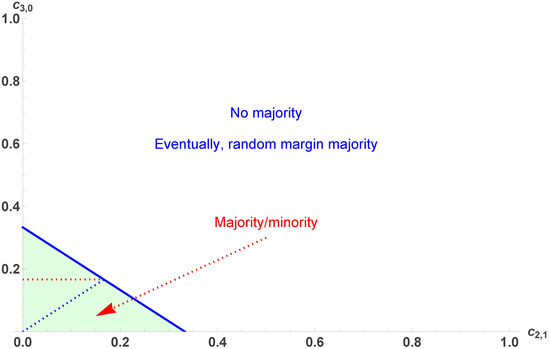
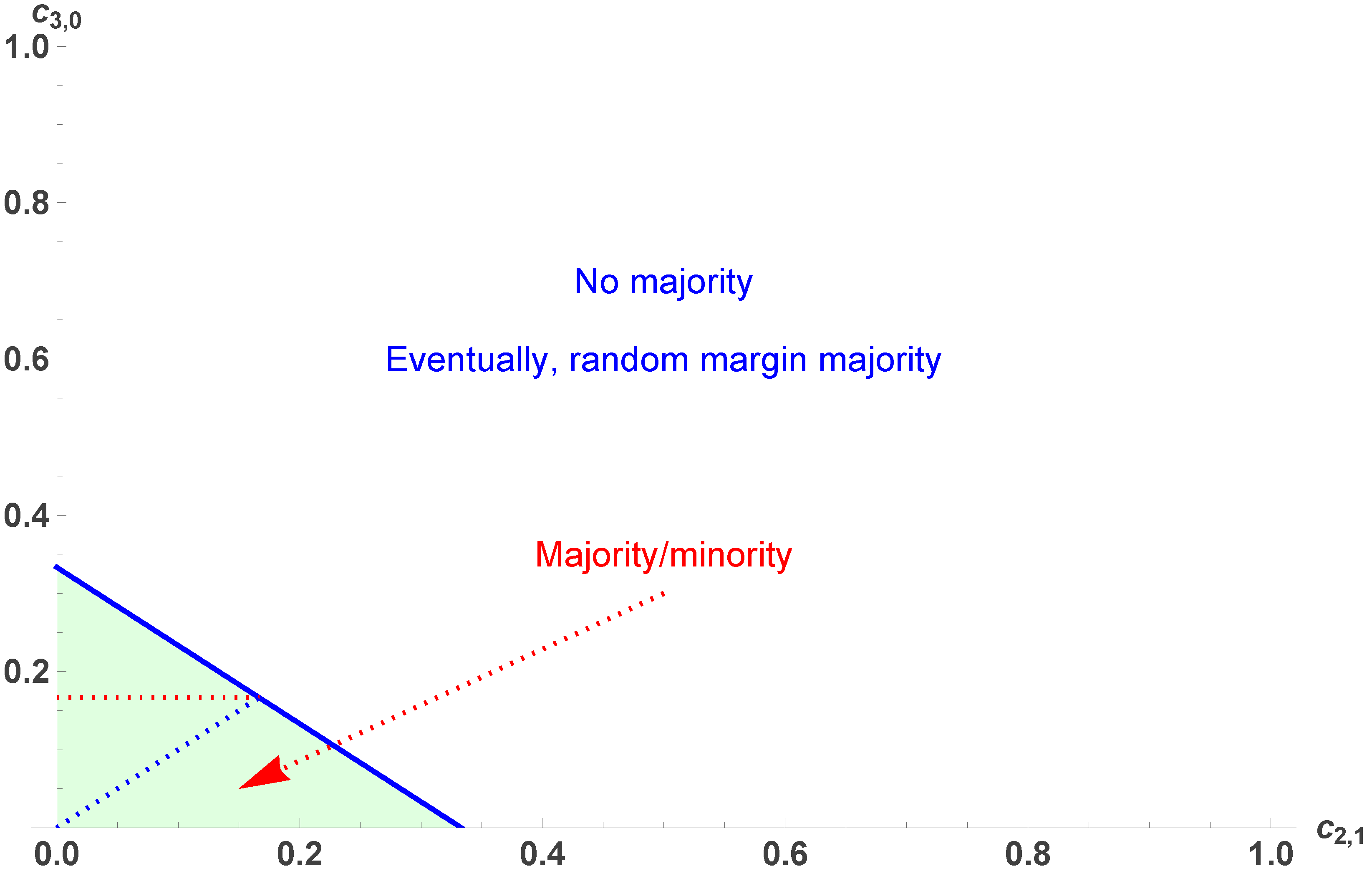
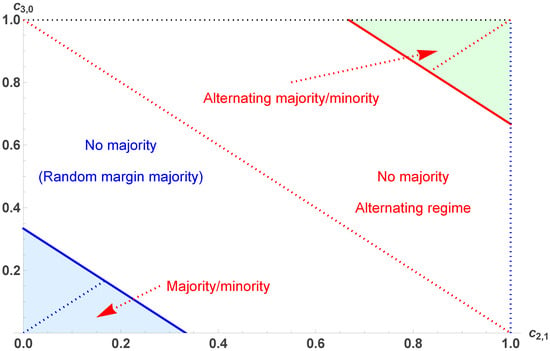
which exist only in the combined range and . Thus, two different qualitative domains are found, which are shown in Figure 1.
Figure 1.
The two domains of the landscape of the dynamics induced by variation of and . The domains are separated by the line . Inside the colored area, exist and are attractors, with being a tipping point. Outside the colored area, in the white area, only the fixed point exists and is the single attractor of the dynamics.
The domains are separated by the line . Inside the colored area, exist and are attractors, with being a tipping point. Here, the dynamics of opinion end up with one opinion being the majority against the other one being the minority. Initial leads to A victory with an ending support of . On the contrary, leads to A being defeated with a final support of .
Along the line , both attractors merge with , which turns from a tipping point to a single attractor. Beyond this line (in the white area), the dynamics are driven by the single attractor , making any initial supports for A and B, respectively, end at precisely equal proportions of fifty percent. There is no majority, the population being perfectly polarized with the coexistence of two balanced opposite supports; however, it is worth stressing that the polarization is not frozen but fluid, with agents continuously shifting opinion in equal proportions [65]. Moreover, in case of a vote, any meaningless mistake in ballot counting, even if it is lower than the statistical error, would lead to a margin random victory of either A or B. The two domains are exhibited in Figure 1 [66].
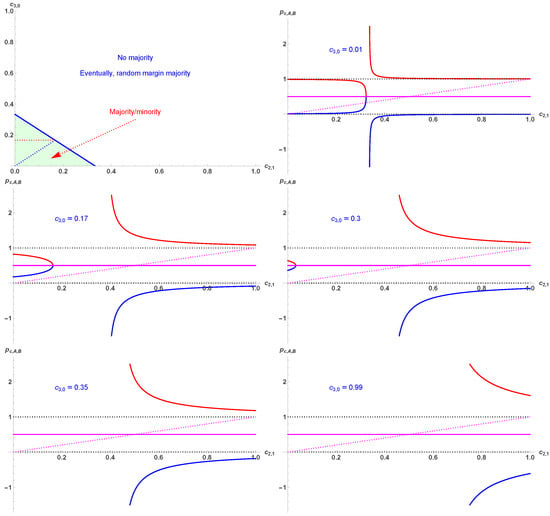
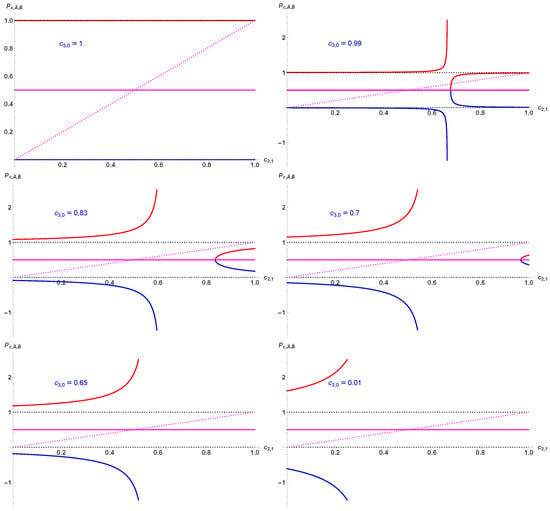
Figure 2 exhibits the main stages of the variation as a function of for the series of values . Only values are valid.
Figure 2.
Various main stages of the variation in red and in blue as a function of for the series of given values . The fixed point is also shown in magenta. Only values between zero and one (inclusive) are valid.
4.2. Stability of the Fixed Point
Figure 1 shows a landscape of opinion dynamics obtained from a study of the domain of existence of combined with a geometric coherence principle. With three valid fixed points, two must be attractors and the one in between them a tipping point. With only one valid fixed point, the fixed point must be an attractor.
A complementary and richer approach involving the stability of the fixed point is of interest. When is unstable, it is a tipping point, meaning that two attractors must then exist around it. When is stable, it is a single attractor; indeed, the stability of is a function of the derivative of with respect to taken at the value , which yields
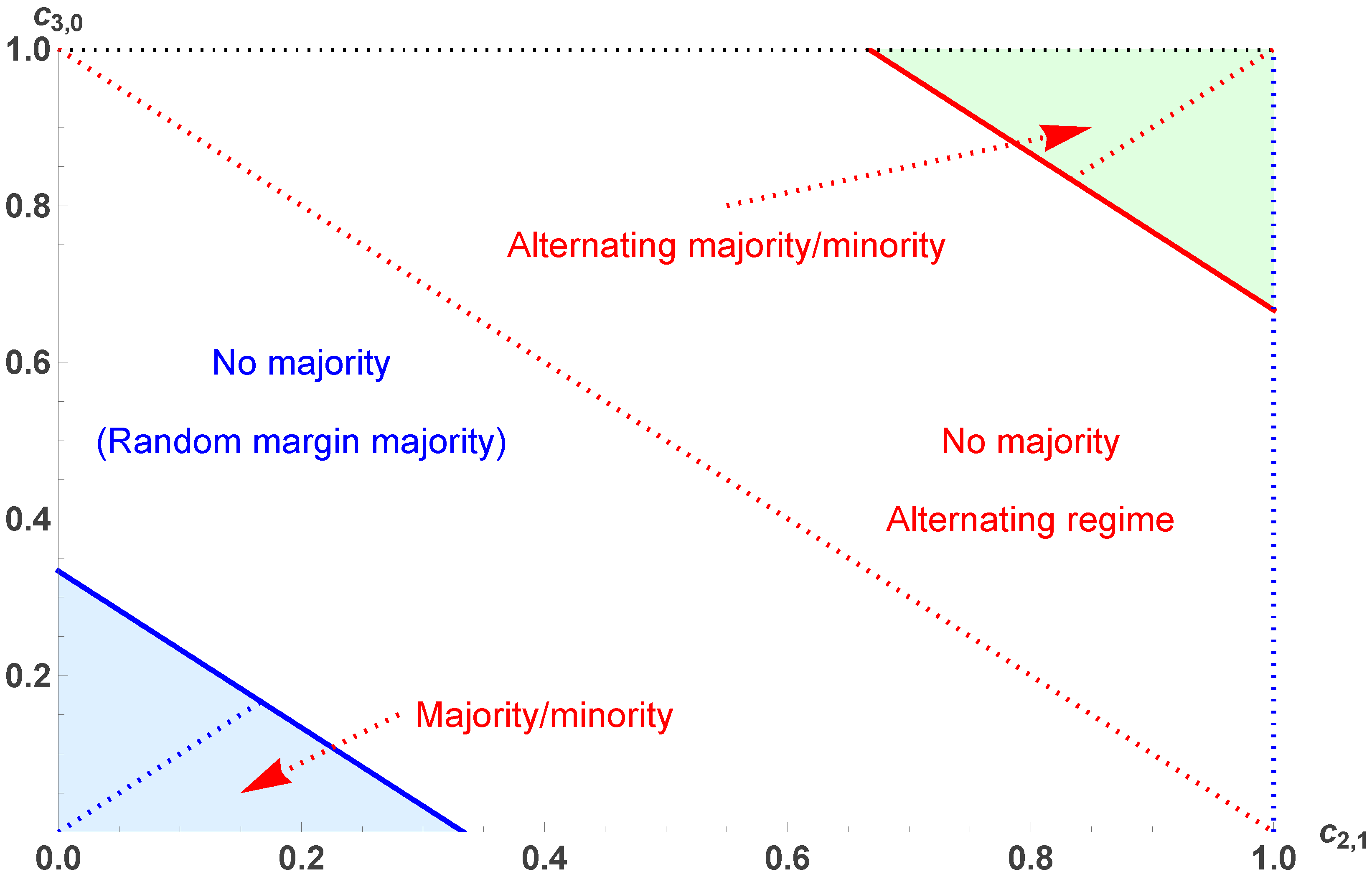
For , the fixed point is an attractor, which happens in the area defined by , recovering the same frontier obtained above and shown in Figure 1.
Dealing with allows us to extend the exploration of the opinion landscape by considering the case , for which is still an attractor but is now associated with an alternating dynamics, since . This condition is satisfied within the domain delimited by the condition , as shown in Figure 3.
Figure 3.
The complete landscape of the dynamics, including alternating regimes. Four domains are shown as a function of and . The domains are separated by the lines and . Inside the lower left colored area, exist and are attractors, with being a tipping point. Inside the colored area (upper right), exist and are alternating attractors, with being an alternating tipping point. Outside the colored areas (in the white area), only the fixed point exists and is the single attractor of the dynamics.
However, beyond this line, where , turns into a tipping point despite the fact that no attractors exist. The apparent contradiction is resolved by noticing that makes into an alternating tipping point. This fact hints at the existence of alternating attractors, as discovered recently in the original contrarian model [64].
Setting recovers the associated values with and for the two frontiers between the various domains of the opinion landscape.
To prove such a scenario and identify the possible alternating attractors, it would be possible solve the equation , which is a polynomial of degree 9. However, solving yields the same results with a polynomial of degree 3, yielding
which exists only in the combined range and . Adding these alternating dynamics to the landscape shown in Figure 1 leads to the complete landscape exhibited in Figure 3.
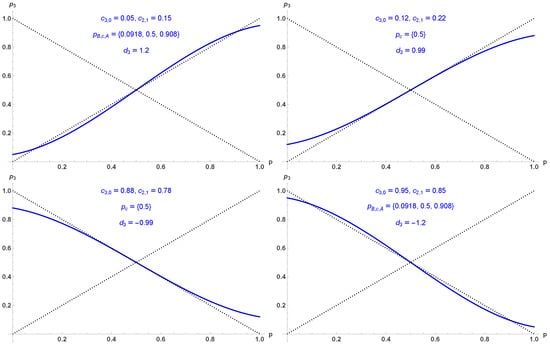
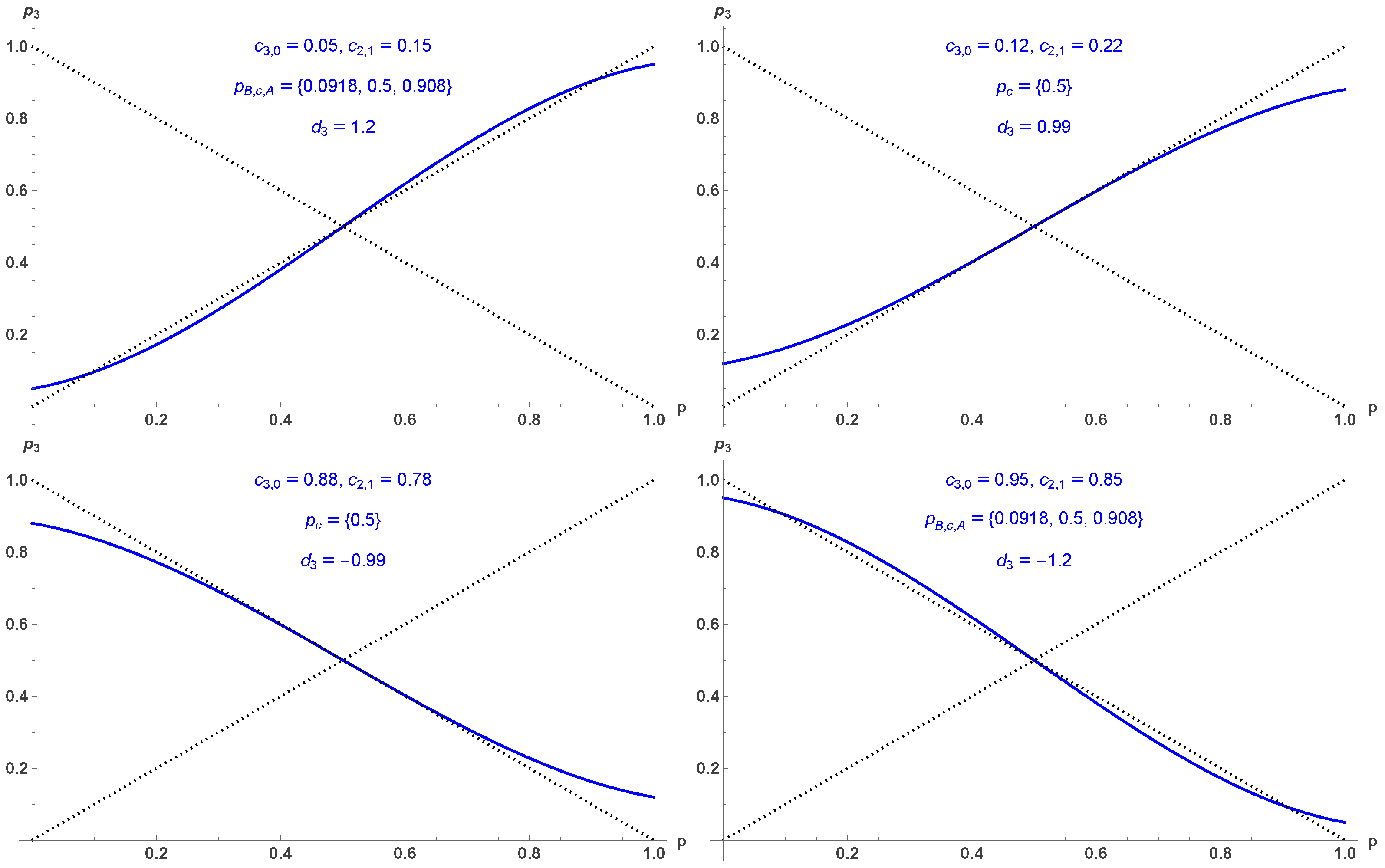
Figure 4 shows the four different associated regimes produced by the update equation in Equation (11), with a tipping point coupled to two attractors, a single attractor, an alternating single attractor, and an alternating tipping point coupled to two alternating attractors, for , , , , and , respectively.
Figure 4.
Four different regimes produced by the update equation in Equation (11), with a tipping point coupled to two attractors, a single attractor, an alternating single attractor, and an alternating tipping point coupled to two alternating attractors, for , , , , , and , respectively.
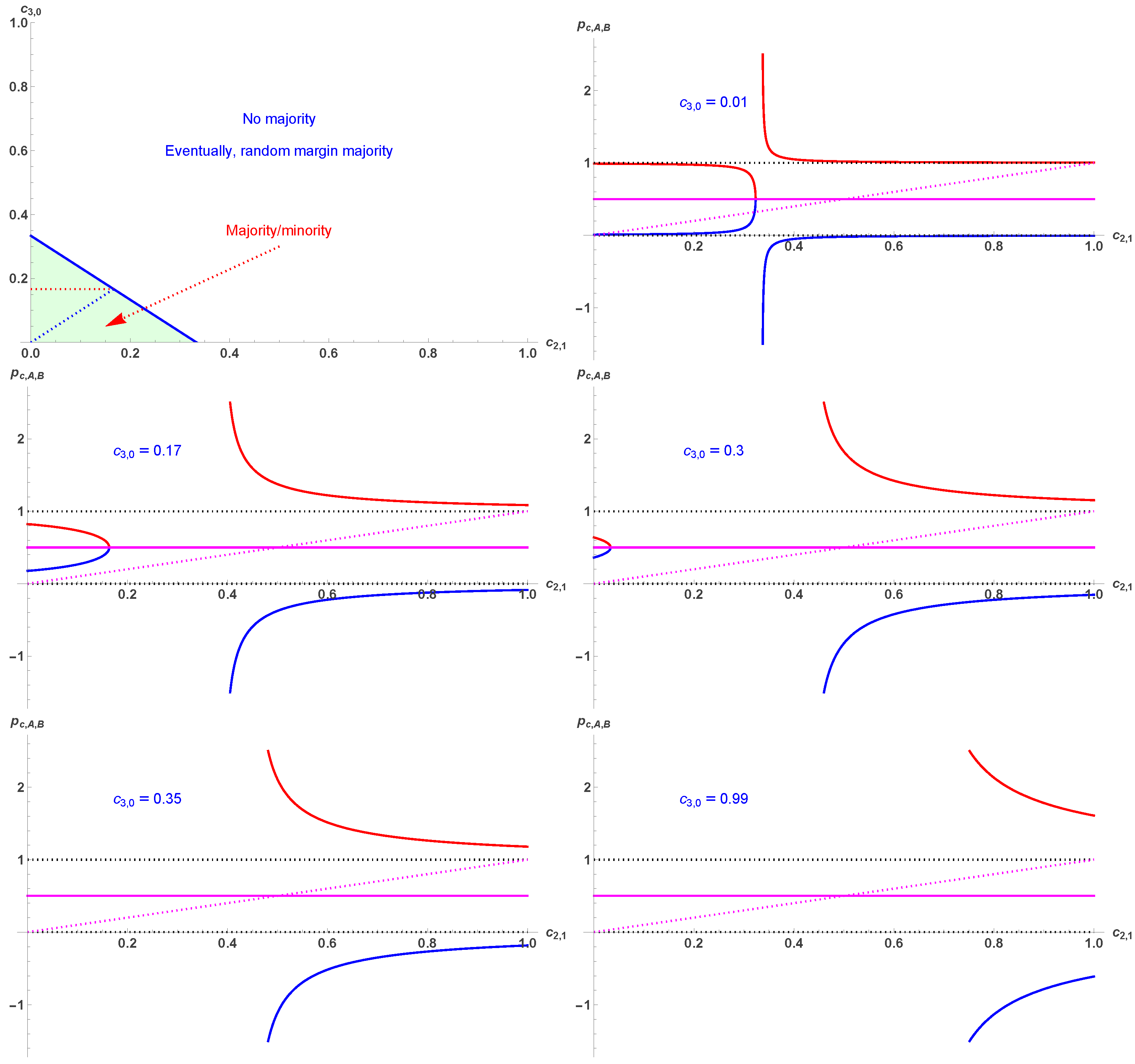
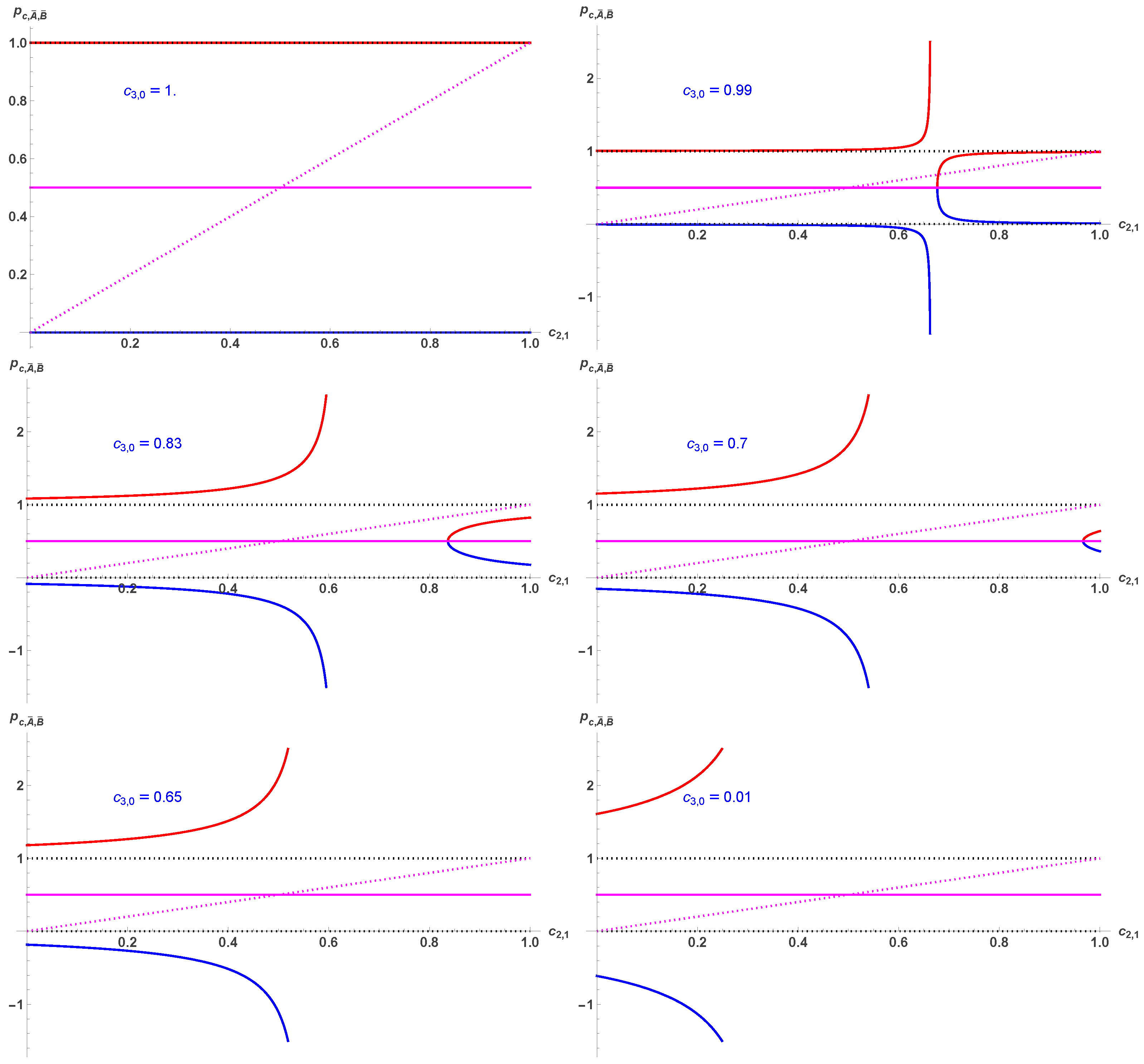
The main stages of the variation (in red) and (in blue) are shown in Figure 5 as a function of for the series of given values . The fixed point is also shown in magenta. Only values between zero and one (inclusive) are valid.
Figure 5.
Various main stages of the variation (in red) and (in blue) as a function of for the series of given values . The fixed point is also shown in magenta. Only values between zero and one (inclusive) are valid.
5. Conclusions
I have built the complete two-dimensional landscape of the dynamics of opinion analytically as a function two independent proportions of contrarians, the respective activations of which depend on the actual majority/minority ratio in the local discussion group. Within the Galam Majority Model with group size 3, the two parameters are and symmetrically for A and B. In case of unanimity in the group, agents are conformists with probability and contrarians with probability . In case of two against one, the probabilities are respectively and .
In the original model with a proportion c of uniform contrarians, the landscape is restricted to one line as a function of c. One unique critical value separates two regions that are qualitatively different. In the first one, for the dynamics yield a clear-cut winner of the public debate, ending at an attractor characterized by stable coexistence of a majority and minority. In contrast, for , any initial conditions ends up at a single attractor located at fifty percent. While fifty percent means no winner, any real situation will yield a winner determined by random small errors that are normally insignificant. For , an alternating majority/minority regime is obtained.
Extending the scheme to a two-dimensional landscape opens up a much richer spectrum that can intervene on the actual dynamics to modify their ending, either going from majority/minority to fifty/fifty or the reverse. The previous regimes are conserved, but the condition to ensure a majority/minority outcome is now , which can be implemented only for . Setting recovers the condition .
Depending on initial supports of each competing opinions, two opposite strategies can be outlined following the above findings. For the side having an initial majority of support, the goal is to reduce at maximum the proportions of contrarians to ensure a final victory. In contrast, for the opinion with minority initial support, the goal is to optimize the proportions of contrarians in order to reach the area where the dynamics becomes driven by a single attractor located at fifty percent. There, the outcome of the dynamics becomes random, with equal probability to win for both opinions; the a priori losing opinion moves up to a fifty percent chance to win, while the a priori winning opinion moves down to a fifty percent chance to win.
Funding
This research received no external funding.
Data Availability Statement
Data is contained within the article.
Conflicts of Interest
The author declares no conflict of interest.
References
- Mullick, P.; Sen, P. Sociophysics models inspired by the Ising model. Eur. Phys. J. B 2025, 98, 206. [Google Scholar] [CrossRef] [Scilit]
- Starnini, M.; Baumann, F.; Galla, T.; Garcia, D.; Ińiguez, G.; Karsai, M.; Lorenz, J.; Sznajd-Weron, K. Opinion dynamics: Statistical physics and beyond. arXiv 2025, arXiv:2507.11521. [Google Scholar] [CrossRef] [Scilit]
- Shirzadi, M.; Cruciani, E.; Zehmakan, A.N. Opinion Dynamics: A Comprehensive Overview. arXiv 2025, arXiv:2511.00401. [Google Scholar] [CrossRef] [Scilit]
- Tsintsaris, D.; Tsompanoglou, M.; Ioannidis, E. Dynamics of Social Influence and Knowledge in Networks: Sociophysics Models and Applications in Social Trading, Behavioral Finance and Business. Mathematics 2024, 12, 1141. [Google Scholar] [CrossRef] [Scilit]
- Schweitzer, F. Sociophysics. Phys. Today 2018, 71, 40–47. [Google Scholar] [CrossRef] [Scilit]
- Galam, S. Sociophysics: A Physicist’s Modeling of Psycho-Political Phenomena; Springer: Berlin/Heidelberg, Germany, 2012. [Google Scholar]
- Chakrabarti, B.K.; Chakraborti, A.; Chatterjee, A. (Eds.) Econophysics and Sociophysics: Trends and Perspectives; Wiley-VCH: Weinheim, Germany, 2006. [Google Scholar]
- Galam, S. Physicists, non physical topics, and interdisciplinarity. Front. Phys. 2022, 10, 986782. [Google Scholar] [CrossRef] [Scilit]
- da Luz, M.G.E.; Anteneodo, C.; Crokidakis, N.; Perc, M. Sociophysics: Social collective behavior from the physics point of view. Chaos Solitons Fractals 2023, 170, 113379. [Google Scholar] [CrossRef] [Scilit]
- Ghosh, A.; Chakrabarti, B.K. Do Successful Researchers Reach the Self-Organized Critical Point? Physics 2024, 6, 46–59. [Google Scholar] [CrossRef] [Scilit]
- Brazil, R. The physics of public opinion. Phys. World 2020, 33, 24–28. [Google Scholar] [CrossRef] [Scilit]
- Maksymov, I.S.; Pogrebna, G. Quantum-Mechanical Modelling of Asymmetric Opinion Polarisation in Social Networks. arXiv 2024, arXiv:2308.02132v2. [Google Scholar] [CrossRef] [Scilit]
- Martins, A.C.R. Agent Mental Models and Bayesian Rules as a Tool to Create Opinion Dynamics Models. Physics 2024, 6, 1013–1031. [Google Scholar] [CrossRef] [Scilit]
- Malarz, K.; Masłyk, T. Phase Diagram for Social Impact Theory in Initially Fully Differentiated Society. Physics 2023, 5, 1031–1047. [Google Scholar] [CrossRef] [Scilit]
- Ellero, A.; Fasano, G.; Favaretto, D. Mathematical Programming for the Dynamics of Opinion Diffusion. Physics 2023, 5, 936–951. [Google Scholar] [CrossRef] [Scilit]
- Mobilia, M. Polarization and Consensus in a Voter Model under Time-Fluctuating Influences. Physics 2023, 5, 517–536. [Google Scholar] [CrossRef] [Scilit]
- Llabrés, J.; Oliver-Bonafoux, S.; Anteneodo, C.; Toral, R. Aging in Some Opinion Formation Models: A Comparative Study. Physics 2024, 6, 515–528. [Google Scholar] [CrossRef] [Scilit]
- Xu, G.; Chen, J.; Zhou, X.; Wang, Y. Phase transitions in voting simulated by an intelligent Ising model. Commun. Theor. Phys. 2026, 78, 055601. [Google Scholar] [CrossRef] [Scilit]
- Khrennikov, A. Social laser theory: A quantum-like framework for collective social dynamics. Adv. Complex Syst. 2026; in press. [CrossRef] [Scilit]
- Hase, M.O.; Ferreira, A.A.; Martins, A.C.R.; Ferreira, F.F. Annealing approximation in master-node network model. Phys. Rev. E 2025, 112, 064314. [Google Scholar] [CrossRef] [Scilit]
- Kovács, Z.; Palla, G.; Zafeiris, A. The desire to avoid cognitive dissonance drives community formation in a social network model. Sci. Rep. 2026, 16, 1932. [Google Scholar] [CrossRef] [Scilit]
- Jdrzejewski, A.; Mendes, J.F.F. When Does Population Diversity Matter? A Unified Framework for Binary-Choice Dynamics. Phys. Rev. Lett. 2025, 135, 217401. [Google Scholar] [CrossRef] [Scilit]
- Caldarelli, G.; Artime, O.; Fischetti, G.; Guarino, S.; Nowak, A.; Saracco, F.; Holme, P.; de Domenico, M. The Physics of News, Rumors, and Opinions. arXiv 2025, arXiv:2510.15053. [Google Scholar] [CrossRef] [Scilit]
- Ermann, L.; Frahm, K.M.; Shepelyansky, D.L. Opinion Formation in Wikipedia Ising Networks. Information 2025, 16, 782. [Google Scholar] [CrossRef] [Scilit]
- Crokidakis, N. Modeling the Fall of the Inca Empire: A Lotka-Volterra Approach to the Spanish Conquest. Physics 2026, 8, 7. [Google Scholar] [CrossRef] [Scilit]
- Galam, S. Minority Opinion Spreading in Random Geometry. Eur. Phys. J. B 2002, 25, 403–406. [Google Scholar] [CrossRef] [Scilit]
- Galam, S.; Cheon, T. Tipping points in opinion dynamics: A universal formula in five dimensions. Front. Phys. 2020, 8, 446. [Google Scholar] [CrossRef] [Scilit]
- Psaltis, C. Conclusion: Rejoinder. In Conflict and Change: Integrating Social and Developmental Psychology; Psaltis, C., Wagoner, B., Eds.; Cambridge University Press: Cambridge, UK, 2025. [Google Scholar] [CrossRef] [Scilit]
- Marková, I. Dialectics of Genesis and Structure. In Conflict and Change: Integrating Social and Developmental Psychology; Psaltis, C., Wagoner, B., Eds.; Cambridge University Press: Cambridge, UK, 2025. [Google Scholar] [CrossRef] [Scilit]
- Bellomo, N.; Burini, D.; Liao, J. New trends in kinetic theory toward the complexity of living systems. Math. Models Methods Appl. Sci. 2026, 36, 341–397. [Google Scholar] [CrossRef] [Scilit]
- Bukina, K.; Shepelyansky, D.L. Opinion Formation at Ising Social Networks. Information 2026, 17, 41. [Google Scholar] [CrossRef] [Scilit]
- Cicala, D.; Jiang, Y.; Lee, J.H.; Kurianski, K.; Ledder, G. A Mathematical Model of Opinion Dynamics with Application to Vaccine Denial. arXiv 2025, arXiv:2511.18166v2. [Google Scholar] [CrossRef] [Scilit]
- Pérez-Martinez, H.; Lamata-Otin, S.; Malizia, F.; Floria, L.M.; Gómez-Gardeñes, J.; Soriano-Paños, D. Social polarization promoted by sparse higher-order interactions. Commun. Phys. 2025, 8, 507. [Google Scholar] [CrossRef] [Scilit]
- De Domenico, F.; Caccioli, F.; Livan, G. Peer influence breaks ergodicity in an opinion dynamics model with external information. J. Phys. Complex. 2025, 6, 045007. [Google Scholar] [CrossRef] [Scilit]
- Mohandas, K.; Górski, P.J.; Suchecki, K.; Andres, G.; Vaccario, G.; Hoĺyst, J.A. Structurally balanced growing network as randomized Pĺya urn process. arXiv 2025, arXiv:2510.24659v2. [Google Scholar]
- Mehdizadeh, A.; Hilbert, M. When Your AI Agent Succumbs to Peer-Pressure: Studying Opinion-Change Dynamics of LLMs. arXiv 2025, arXiv:2510.19107. [Google Scholar]
- Sabin-Miller, D.; Harding, C. Data-Driven Modeling of U.S. Ideological Dynamics. arXiv 2025, arXiv:2510.11983. [Google Scholar]
- Dornelas, V.; Anteneodo, C.; Nunes, R.; Heinsalu, E.; Patri, M. Role of zealots in the spread of linguistic traits. Phys. Rev. E 2025, 112, 044303. [Google Scholar] [CrossRef] [Scilit]
- Miszczak, J.A. Cooperation in public goods game on regular lattices with agents changing interaction groups. arXiv 2025, arXiv:2510.03772. [Google Scholar] [CrossRef] [Scilit]
- Arenzon, J.J.; Corberi, F.; Dantas, W.G.; Smaldone, L. Coarsening in the long-range Persistent Voter Model. arXiv 2026, arXiv:2603.14165. [Google Scholar] [CrossRef] [Scilit]
- Gezha, V.; Kozitsin, I. Control over Recommendation Algorithms in Heterogeneous Modular Systems with Dynamic Opinions. Entropy 2026, 28, 333. [Google Scholar] [CrossRef] [Scilit] [PubMed]
- da C. Filho, J.L.C.; Crokidakis, N. Opinion dynamics under electoral shocks in competitive campaigns. Int. J. Mod. Phys. C 2026. [Google Scholar] [CrossRef] [Scilit]
- Galam, S.; Moscovici, S. Towards a theory of collective phenomena: Consensus and attitude changes in groups. Eur. J. Soc. Psychol. 1991, 21, 49–74. [Google Scholar] [CrossRef] [Scilit]
- Galam, S.; Jacobs, F. The role of inflexible minorities in the breaking of democratic opinion dynamics. Physica A 2007, 38, 366–376. [Google Scholar] [CrossRef] [Scilit]
- Zheng, S.; Sui, D.; Liu, Y.; Leng, S. Opinion dynamics on higher-order networks with stubbornness and trust. Chaos 2026, 36, 023106. [Google Scholar] [CrossRef] [Scilit]
- Shirzadi, M.; Zehmakan, A.N. Do Stubborn Users Always Cause More Polarization and Disagreement? A Mathematical Study. arXiv 2024, arXiv:2410.22577v1. [Google Scholar] [CrossRef] [Scilit]
- Shen, C.; Guo, H.; Hu, S.; Shi, L.; Wang, Z.; Tanimoto, J. How Committed Individuals Shape Social Dynamics: A Survey on Coordination Games and Social Dilemma Games. Eur. Phys. Lett. 2023; in press.
- Galam, S. Contrarian Deterministic Effects on Opinion Dynamics: The Hung Elections Scenario. Phys. A 2004, 333, 453–460. [Google Scholar] [CrossRef] [Scilit]
- Borghesi, C.; Galam, S. Chaotic, staggered, and polarized dynamics in opinion forming: The contrarian effect. Phys. Rev. E 2006, 73, 066118. [Google Scholar] [CrossRef] [Scilit]
- Galam, S. Fake News: “No Ban, No Spread—With Sequestration”. Physics 2024, 6, 859–876. [Google Scholar] [CrossRef] [Scilit]
- Galam, S.; Cheon, T. Asymmetric Contrarians in Opinion Dynamics. Entropy 2020, 22, 25. [Google Scholar] [CrossRef] [Scilit] [PubMed]
- Pradhan, A.; Mullick, P.; Sen, P. Analyzing contrarian behavior using nonlinear biased-voter model. Phys. Rev. E 2026, 113, 034301. [Google Scholar] [CrossRef] [Scilit]
- Lipiecki, A.; Sznajd-Weron, K. When heterogeneity drives hysteresis: Anticonformity in the multistate-voter model on networks. Phys. Rev. E 2025, 112, 054316. [Google Scholar] [CrossRef] [Scilit]
- Grabisch, M.; Li, F. Anti-conformism in the Threshold Model of Collective Behavior. Dyn. Games Appl. 2020, 1, 444–477. [Google Scholar] [CrossRef] [Scilit]
- Azhari; Muslim, R.; Mulya, D.A.; Indrayani, H.; Wicaksana, C.A.; Rizki, A. Independence role in the generalized Sznajd model. Phys. B 2024, 652, 130042. [Google Scholar] [CrossRef] [Scilit]
- Hamann, H. Opinion Dynamics with Mobile Agents: Contrarian Effects by Spatial Correlations. Front. Robot. AI 2018, 5, 63. [Google Scholar] [CrossRef] [Scilit]
- Guo, L.; Cheng, Y.; Luo, Z. Opinion Dynamics with the Contrarian Deterministic Effect and Human Mobility on Lattice. Complexity 2015, 20, 43–49. [Google Scholar] [CrossRef] [Scilit]
- Toth, G. Models of opinion dynamics with random parametrisation. J. Math. Phys. 2024, 65, 073301. [Google Scholar] [CrossRef] [Scilit]
- Chacoma, A.; Zanette, D.H. Critical phenomena in the spreading of opinion consensus and disagreement. Papers Phys. 2014, 6, 060003. [Google Scholar] [CrossRef] [Scilit]
- Gimenez, M.C.; Reinaudi, L.; Vazquez, F. Contrarian Voter Model under the Influence of an Oscillating Propaganda: Consensus, Bimodal Behavior and Stochastic Resonance. Entropy 2022, 24, 1140. [Google Scholar] [CrossRef] [Scilit] [PubMed]
- Iacominia, E.; Vellucci, P. Contrarian effect in opinion forming: Insights from Greta Thunberg phenomenon. J. Math. Sociol. 2023, 47, 123–169. [Google Scholar] [CrossRef] [Scilit]
- Bagnoli, F.; Rechtman, R. Bifurcations in models of a society of reasonable contrarians and conformists. Phys. Rev. E 2015, 92, 042913. [Google Scholar] [CrossRef] [Scilit]
- Pradhan, A.; Sen, P.; Malarz, K. Extending the Biswas-Chatterjee-Sen model with nonconformists and inflexibles. arXiv 2026, arXiv:2601.07432v2. [Google Scholar]
- Galam, S. Democratic Thwarting of Majority Rule in Opinion Dynamics: 1. Unavowed Prejudices Versus Contrarians. Entropy 2025, 27, 306. [Google Scholar] [CrossRef] [Scilit]
- Galam, S. Unanimity, Coexistence, and Rigidity: Three Sides of Polarization. Entropy 2023, 25, 622. [Google Scholar] [CrossRef] [Scilit]
- Galam, S. From 2000 Bush–Gore to 2006 Italian elections: Voting at fifty-fifty and the contrarian effect. Qual. Quant. 2007, 41, 579–589. [Google Scholar] [CrossRef] [Scilit]

Disclaimer/Publisher’s Note: The statements, opinions and data contained in all publications are solely those of the individual author(s) and contributor(s) and not of MDPI and/or the editor(s). MDPI and/or the editor(s) disclaim responsibility for any injury to people or property resulting from any ideas, methods, instructions or products referred to in the content. |
© 2026 by the author. Licensee MDPI, Basel, Switzerland. This article is an open access article distributed under the terms and conditions of the Creative Commons Attribution (CC BY) license.