


Abstract
In this work, we discuss two types of trilocality of probability tensors (PTs) over an outcome set and correlation tensors (CTs) over an outcome-input set based on a triangle network and described by continuous (integral) and discrete (sum) trilocal hidden variable models (C-triLHVMs and D-triLHVMs). We say that a PT (or CT) is C-trilocal (resp. D-trilocal) if it can be described by a C-triLHVM (resp. D-triLHVM). It is proved that a PT (resp. CT) is D-trilocal if and only if it can be realized in a triangle network by three shared separable states and a local POVM (resp. a set of local POVMs) performed at each node; a CT is C-trilocal (resp. D-trilocal) if and only if it can be written as a convex combination of the product deterministic CTs with a C-trilocal (resp. D-trilocal) PT as a coefficient tensor. Some properties of the sets consisting of C-trilocal and D-trilocal PTs (resp. C-trilocal and D-trilocal CTs) are proved, including their path-connectedness and partial star-convexity.
1. Introduction
Quantum networks [1,2,3,4] have recently attracted much interest as they have been identified as a promising platform for quantum information processing, such as long-distance quantum communication [5,6]. In an abstract sense, a quantum network consists of several sources, which distribute entangled quantum states to spatially separated nodes; then, the quantum information is processed locally in these nodes. This may be seen as a generalization of a classical causal model [7,8], where the shared classical information between the nodes is replaced by quantum states. Clearly, it is important to understand the quantum correlations that arise in such a quantum network. Recent developments have shown that the network structure and topology lead to novel notions of nonlocality [9,10], as well as new concepts of entanglement and separability [11,12,13], which differ from the traditional concepts and definitions [14,15]. Dealing with these new concepts requires theoretical tools for their analysis. Thus far, examples of entanglement criteria for the network scenario have been derived using the mutual information [11,12], the fidelity with pure states [12,13], or covariance matrices build from measurement probabilities [16,17]. According to Bell’s local causality assumption [18,19], the different systems measured in the experiment are considered to be all in an initial joint “hidden” state , where is arbitrary and could even describe the state of the entire universe prior to the measurement choices. The probability of obtaining measurement outcome o of any particular system can depend arbitrarily on the global state and on the type m of measurement performed on that system, but not on the measurements performed on distant systems.
Focusing on quantum networks, a completely different approach to multipartite nonlocality was proposed [20,21,22]. For the case where distant observers share entanglement distributed by independent several sources, the observers may correlate distant quantum systems and establish strong correlations across the entire network by performing joint entangled measurements, such as the well-known Bell state measurement used in quantum teleportation [23]. It turns out that this situation is fundamentally different from standard multipartite nonlocality, and allows for radically novel phenomena. As regards correlations, it is now possible to witness quantum nonlocality in experiments where all the observers perform a fixed measurement; i.e., they receive no input [24,25,26,27]. This effect of quantum nonlocality without inputs is remarkable, and radically departs from previous forms of quantum nonlocality [9].
Recently, Kraft et al. [28] demonstrated that the theory of quantum coherence provides powerful tools for analyzing correlations in quantum networks and provided a direct link between the theory of multisubspace coherence [29,30] and the approach to quantum networks using covariance matrices [16,17]. Patricia et al. [31] derived sufficient conditions for entanglement to give rise to genuine multipartite nonlocality in networks and found that any network where the parties are connected by bipartite pure entangled states is genuine multipartite nonlocal, independently of the amount of entanglement in the shared states and of the topology of the network. Šupić et al. [32] introduced a notion of genuine network quantum nonlocality and showed several examples of correlations that are genuine network nonlocal, considering the so-called bilocality network of entanglement swapping. Recently, Tavakoli et al. [33] contributed a review paper by discussing the main concepts, methods, results, and future challenges in the emerging topic of Bell nonlocality in networks. Some open problems were listed at the end of their paper. In particular, the authors said that, “in the triangle network with no inputs and binary outputs, the conjecture that the local and quantum sets are identical remains open”.
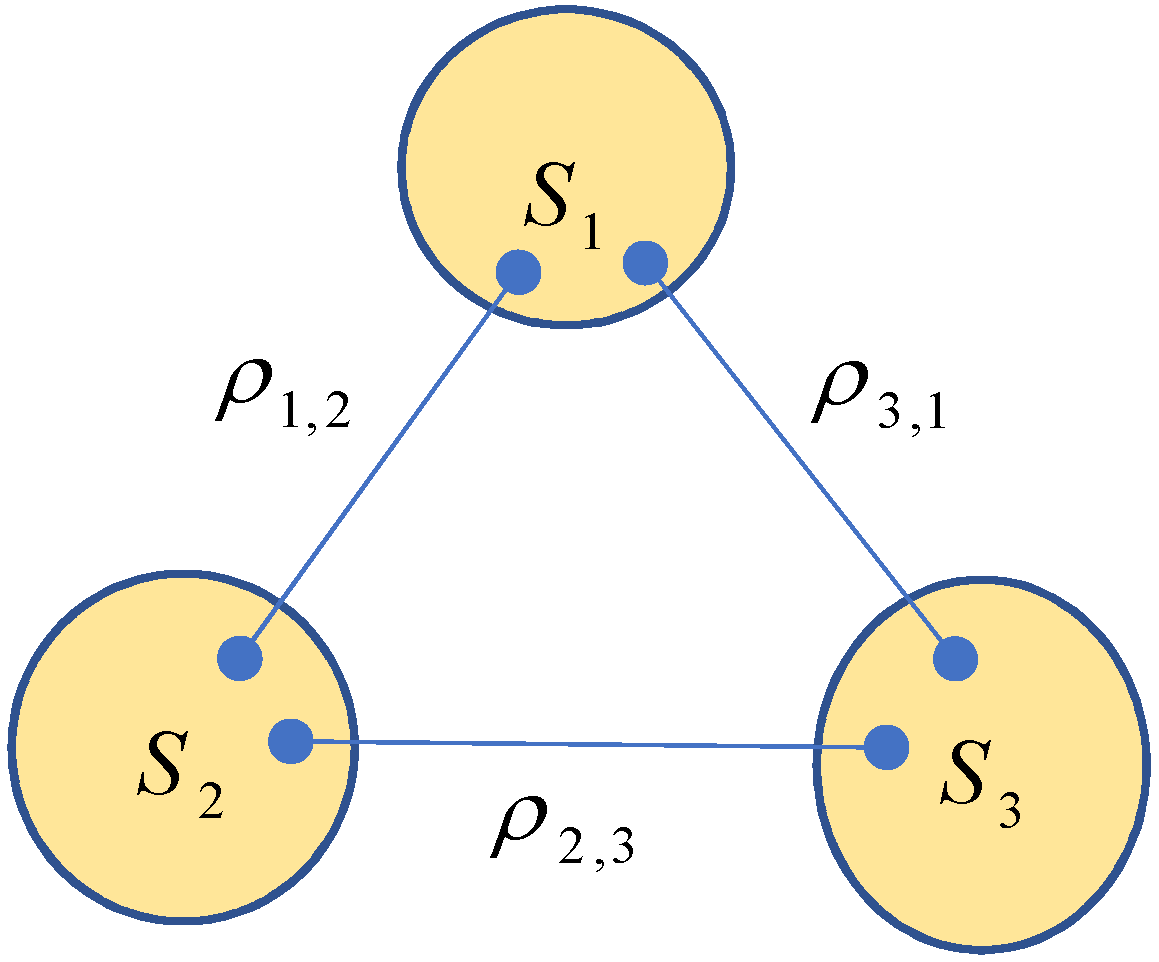
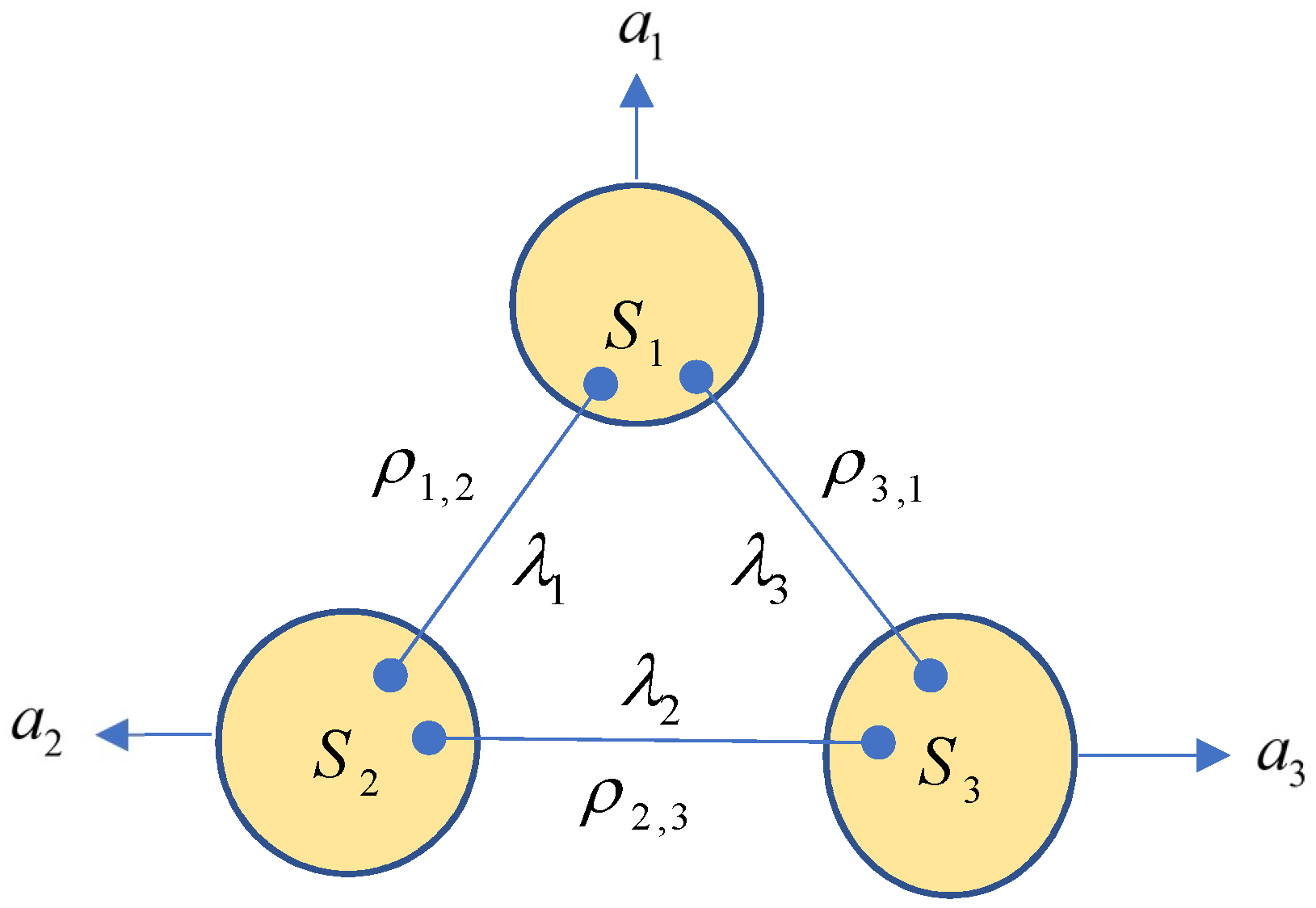
When a triangle network consisting of three quantum systems and (refer to Figure 1 below) is locally measured one time, the probabilities of obtaining outcomes at nodes and form a nonnegative tensor over with
denotes the set consisting of outcomes at node . We call it a probability tensor (PT) over . When a triangle network is locally measured many times, the conditional probabilities of obtaining outcomes at nodes and form a nonnegative tensor over with
for all , denotes the set consisting of inputs at node . We call it a correlation tensor (CT) over .
In this work, we aim to introduce and discuss two types of trilocality of PTs and CTs, called C-trilocality and D-trilocality, according to their descriptions of continuous (integral) and discrete (sum) the types of trilocal hidden variable models. In Section 2, we will define and discuss the C-trilocality and D-trilocality of a PT. Section 3 is devoted to introduce and discuss the C-trilocality and D-trilocality of a CT. In Section 4, we will give a summary and list some open questions.
Figure 1.
A triangle quantum network where the Hilbert spaces of systems and are and respectively.
2. Trilocality of Probability Tensors
In what follows, we use and to denote the finite-dimensional complex Hilbert spaces describing quantum systems A and B, respectively. The composite system of A and B is then described by the Hilbert space . We also use and to denote the identity operator on a Hilbert space and the set of all quantum states of the system X described by , respectively, where and . We also use the notation for every positive integer m.
2.1. Triangle Quantum Networks
Considering a system-based network with N nodes (quantum systems), the topological structure of the network can be described by a directed graph with the set of vertices and the set of edges where if and only if and share a resource (a quantum state of a system ). Put and assume that each node shares a resource with at least one node, i.e., for all . The state of the network , called the network state, is the tensor product of all shared states in a certain order that you chose. Clearly, the feature of a network is determined by its topology together with its network state .
To explore the property of the network, a POVM measurement is performed at each node . Put . The observed probability distribution over the outcomes reads
where are positive operators on the Hilbert space , denotes the state of obtained from the network state after performing the canonical unitary transformation from the space of onto , i.e., We call the measurement state.
Let us consider the triangle network given by Figure 1. To find out the state , we write
Thus, the network state reads
resulting in the measurement state
a state of
Here, the action of is
for all The joint probability is given by
In particular, when the shared states are separable, they can be written as convex combinations of product states. Then, we can assume that the coefficients are probability distributions (PDs) of and that the operators and are all states. Put
which are PDs of outcomes , respectively. Thus, in this case, Equation (4) becomes
for all possible . This is just the motivation for introducing the concept of D-trilocality; see Section 2.2.
2.2. Trilocality of Probability Tensors
The central question is whether a given probability distribution may originate from a network with a given topology [28]. The usual Bell nonlocality of a quantum state or a quantum network is the property that is exhibited by performing a set of non-compatible local POVM measurement.
Renou et al. [9] pointed out that quantum nonlocality can be demonstrated without the need of having various input settings, but only by considering the joint statistics of fixed local measurement outputs. They call this property quantum nonlocality without inputs. For example, when a triangle network is measured by just one local POVM , joint probabilities are obtained, which form a nonnegative tensor over the index set . Generally, when a function satisfies the completeness condition:
we call it a probability tensor (PT) over , denoted by .
Fritz in ([22] Definition 2.12) called a probability tensor over classical in if it can be written as
for appropriate (conditional) distributions and . It was proved ([22] Proposition 2.13) that classical correlations in are monogamous in the sense that is independent of (i.e., and is independent of (i.e., whenever . Since the representation (6) is given by the integral of hidden variables, we call it a continuous trilocal hidden variable model (C-triLHVM) for .
Motivated by this work, we introduce the following concepts of trilocality of tripartite PTs.
Definition 1.
Let be a PT over .
(1) is said to be C-trilocal if it has a C-triLHVM:
for some product measure space
where , and
(a) is a density function (DF) of , i.e., for all in such that ;
(b) and , called response functions (RSs) at nodes and 3, are PDs of and , respectively, for each in and are -measurable on w.r.t. for each in .
(2) is said to be D-trilocal if it has a D-triLHVM:
for all , where , and are PDs of , and , respectively.
(3) is said to be C-nontrilocal (resp. D-nontrilocal) if it is not C-trilocal (resp. not D-trilocal).
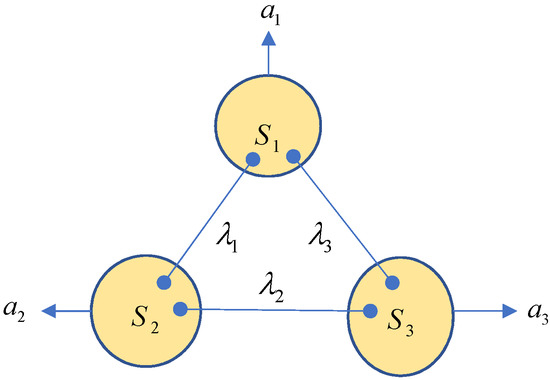
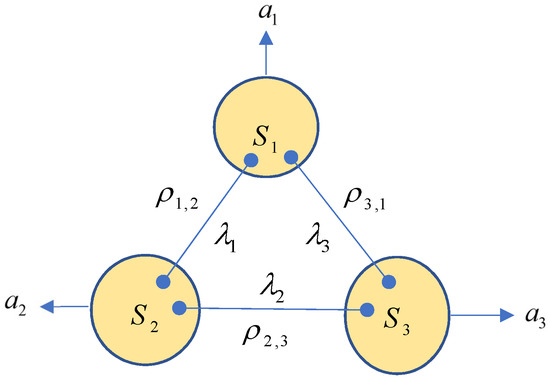
Please refer to Figure 2.
Figure 2.
A trilocal scenario.
We use and to denote the sets of all C-trilocal and D-trilocal PTs over , respectively. Obviously,
When has a C-triLHVM (7), by letting
equivalently, defining measures on as
where is the characteristic function of , we obtain a product probability space
In this setting, the C-triLHVM (7) becomes
where
This leads to the following conclusion.
Proposition 1.
A tripartite PT over is C-trilocal if and only if it admits a C-triLHVM (9) for a product probability space
Example 1.
Consider the PT over defined by Riemann integral
where
which are PDs of , respectively, and measurable w.r.t. Lebesgue measure on . is clearly a C-trilocal PT over using Proposition 1.
Moreover, if we replace the space of hidden variables in Example 1 with and take for , then the PT defined by
is also C-trilocal.
Question 1. Consider the PT over given by Riemann integral
where denotes the closed unit ball in and the PDs and are as in Example 1. An interesting question is whether is C-trilocal.
It is remarkable to mention that a C-triLHVM for a PT must be given by an integral that is taken over a product space due to the independence of the hidden variables and . It is also noted that the integrand must be a product of the three DFs of and and the three PDs of and with parameters and , respectively. Although the unit ball in Question 1 is homeomorphic to the unit cube or , the integrand may be changed as the one that is not of the desired form. Thus, the answer to Question 1 may be very hard.
Definition 2.
A tripartite PT over is said to be tri-quantum if there exists a with the state and a local POVM such that , i.e.,
In particular, when the shares’ states can be chosen as separable states, we say that is separable tri-quantum.
Definition 3.
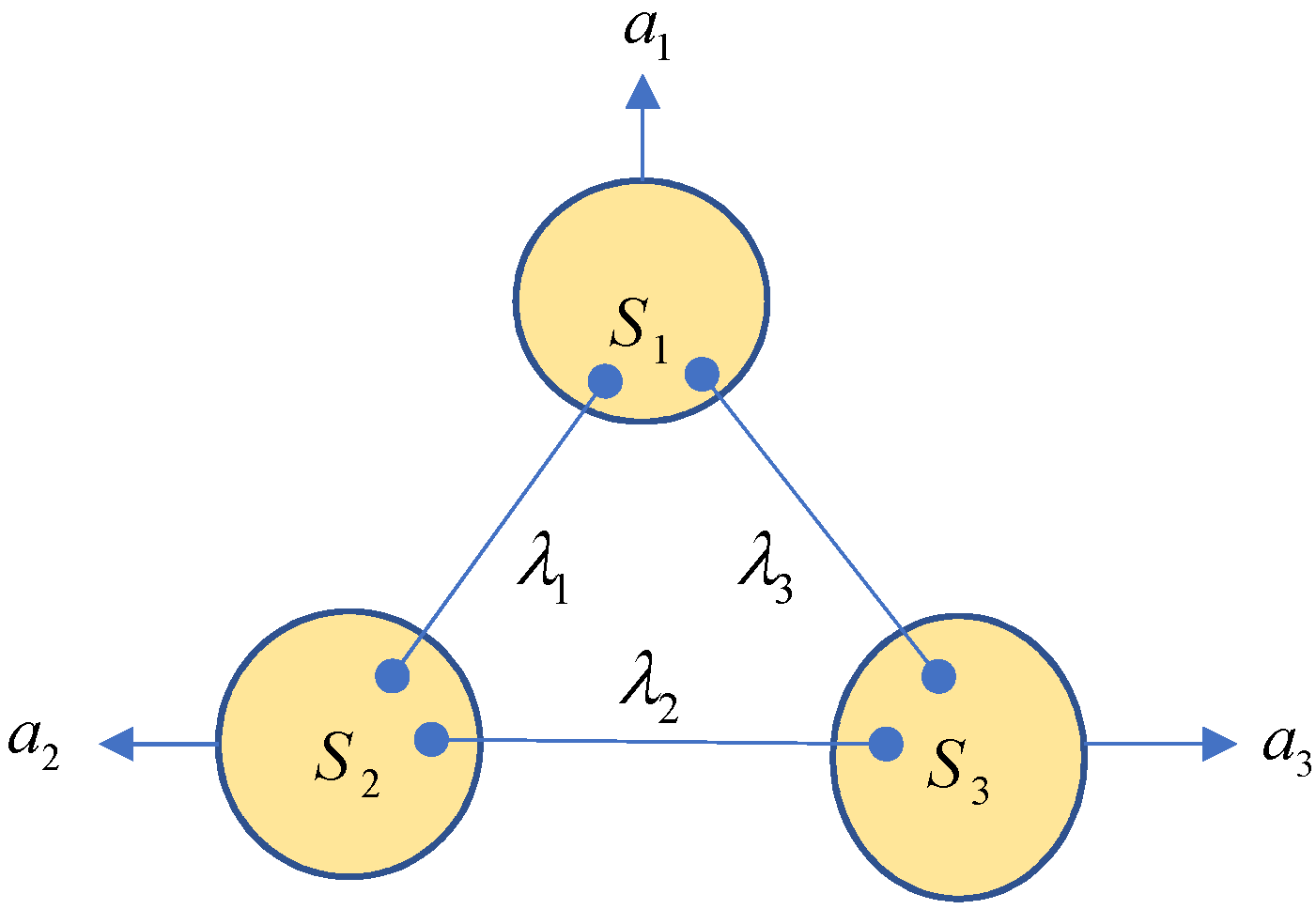
A triangle network given by Figure 1 is said to be C-trilocal (resp. D-trilocal) if, for every local POVM , where , the generated PT is C-trilocal (resp. D-trilocal). It is said to be non C-trilocal (resp. non D-trilocal) if it is not C-trilocal (resp. non D-trilocal), i.e., there exists an such that PT is non-C-trilocal (resp. non-D-trilocal), referring to Figure 3.
Figure 3.
A trilocal triangle network.
Proposition 2.
Every separable (i.e., all shared states are separable) triangle network given by Figure 1 is D-trilocal.
Proof.
Suppose that the given by Figure 1 is separable. Then, the shared states are separable, i.e., there exist scalars satisfying
such that
where Thus, the network state reads
which is a state of system , and then the measurement state is
being a state of system
For every local POVM measurement, of system , where , we have
for all , where and
Clearly,
are PDs. It follows from Definition 3 that the triangle network given by Figure 1 is D-trilocal. The proof is completed. □
Proposition 3.
A PT over is D-trilocal if and only if it is separable tri-quantum.
Proof.
The sufficiency is given by Proposition 2. To show the necessity, we let be a D-trilocal PT over . Then, it can be written as (8). Choose Hilbert spaces
take their orthonormal bases , and , respectively, and put
and choose separable states
then we obtain a triangle network with the network state
inducing the measurement state
in . By defining separable positive operators:
on Hilbert spaces and , respectively, we obtain POVMs of system for each Using (8) yields that
This shows that is separable tri-quantum. The proof is completed. □
Recently, Tavakoli et al. [33] said that, “in the triangle network with no inputs and binary outputs, the conjecture that the local and quantum sets are identical remains open”. Proposition 3 above shows that D-trilocality and separable tri-quantum of a tripartite PT are equivalent. Renou et al. ([9] Theorem I) found a PT (they called a quantum distribution) that cannot be reproduced by any classical trilocal model (9) with deterministic response functions (DRFs) . After a careful reading of their proof, we find that the proof of (for example) works well only for a D-triLHVM with DRFs. In fact, they proved that the cannot be reproduced by any D-triLHVM with DRFs. The following proposition shows that a D-triLHVM (8) can be assumed to be deterministic, i.e., the response functions are -valued. Thus, combining ([9] Theorem I), we see that the quantum distribution is not D-trilocal. This shows that a tri-quantum PT is not necessarily D-trilocal. Thus, an interesting question is whether the is C-trilocal.
Proposition 4.
A tripartite PT over is D-trilocal if and only if it can be written as
for all , where are PDs and
are -PDs for all .
Proof.
The sufficiency is clear. To show the necessity, we assume that is D-trilocal. Then, it can be written as (8). Since matrices
are row-stochastic (RS), they can be represented as convex combinations of all -RS matrices [34], i.e.,
where and and are the sets of all maps from into , into , and into , respectively. Using (8) yields that
where and
Clearly, are PDs and for all ,
are -PDs. Equation (14) follows, and the proof is completed. □
To discuss geometric and topological properties of C-trilocal and D-trilocal PTs, we have to put them into a topological space. A natural way is to consider the real Hilbert space consisting of all tensors over defined by functions , in which the operations and inner products are given by
for all and all elements and of . The norm induced by the inner product reads
and then a sequence is convergent (in norm) to if and only if
Thus, the set of all PTs over forms a compact convex set in the Hilbert space .
Since the hidden variables in a C-triLHVM or a D-triLHVM for a PT are assumed to be independent, the sets and are not necessarily convex. However, we have the following.
Proposition 5.
Both and are path-connected sets in the Hilbert space .
Proof.
Let and be any two elements of . Then, and have C-trLHVMs:
for all possible . Put ; then, is a D-trilocal (and then C-trilocal) CT over For every , set
which are clearly PDs of and , respectively. Putting
then is a C-trilocal CT for all with and . Obviously, the map from into is continuous.
For every , set
which are clearly PDs of and , respectively. Putting
then is a C-trilocal CT for all with and . Obviously, the map from into is continuous.
Next, we define a mapping by
Clearly, f is continuous everywhere and and then induces a path in , connecting and . This shows that is path-connected. Similarly, is also path-connected. The proof is completed. □
Clearly, if a PT is D-trilocal, then it must be C-trilocal with a C-triLHVM given by counting measures on . We can not show that the converse of this implication, but we obtain the following approximation result.
Proposition 6.
Suppose that is a C-trilocal PT over with a C-triLHVM given by three-hold Riemann integral over ; then, is in the closure of in the Hilbert space .
Proof.
Suppose that
for all , where with Let us show that there exists a sequence of D-trilocal PTs over such that as .
Dividing each interval into n small equal-length intervals:
we obtain a partition of :
For each , by taking a point and letting
we obtain a PD such that
Put
Clearly, are D-trilocal PTs over . We see from the property of Riemann integral that
Thus, by using Equations (17), (16) and the property of Riemann integral as well as Equation (15), we obtain that, for each ,
This shows that as . The proof is completed. □
This conclusion implies that, if the set of all a D-trilocal PTs over is closed, then the PT given by Equation (15) is D-trilocal.
In addition, when a PT is given by Equation (15) where , DFs and RFs are Riemann integrable on any and , respectively, it is C-trilocal with a C-triLHVM (15) given by Lebesgue measure on . In this case, the Levi’s lemma yields that
for all , where . Put
then as , and
For each letting
we obtain a C-trilocal PT over with a C-triLHVM (19) in terms of Riemann integral over . Proposition 6 yields that for all n. Equation (18) implies that . It follows that .
Similarly, one can check that the PT over defined by infinite series
is also C-trilocal and in the closure of .
3. Trilocality of Tripartite CTs
In this section, we aim to discuss two types of trilocality of a tripartite correlation tensor (CTs) [35]: over an index set
which is a nonnegative tensor with index set such that
We use to denote the sets of CTs over .
Definition 4.
Let be a CT over
(1) is said to C-trilocal if it has a C-triLHVM:
for a product measure space
where , is a DF of , and , called response functions (RSs) at nodes and 3, are nonnegative -measurable on for all and PDs of outcomes and , respectively, for all and .
(2) is said to be D-trilocal if it has a D-triLHVM:
for all , where
are PDs of , respectively.
(3) is said to be C-nontrilocal (resp. D -nontrilocal) if it is not C-trilocal (resp. not D-trilocal).
We use and to denote the sets of all C-trilocal and D-trilocal CTs over , respectively. Clearly, .
Similar to the analysis before Proposition 1, we can obtain the following.
Proposition 7.
A CT over is C-trilocal if and only if it admits a C-triLHVM:
for some product probability space
It is obvious that different C-trilocal CTs over the same index set have their C-triLHVMs that are given by product measure spaces that may be different. However, the following result shows that a finite number of C-trilocal CTs over have C-triLHVMs based on a common product measure space.
Proposition 8.
Let be m C-trlocal CTs over . Then, there is a product measure space
and three DFs of such that
for all
Proof.
By Definition 4, each can be represented as
for some product measure space
Putting
produces a product measure space
and three DFs of . By letting
for all in , we obtain (23) using Equation (24). The proof is completed.
Using Definitions 1 and 4, we see that, when a CT over is C-trilocal (resp. D-trilocal), the induced PTs over must be C-trilocal (resp. D-trilocal) for all in . Equivalently, if the PT is non-C-trilocal (resp. non-D-trilocal) for some in , then the CT must be non-C-trilocal (resp. non-D-trilocal). In this sense, we can say that the non-trilocality of PTs is stronger than that of CTs. Furthermore, let be a C-trilocal CT. Then, it has a C-triLHVM (20). By letting
we see from (20) that the marginal distribution of on the subsystem reads
for all possible . Thus, becomes a Bell local CT [35] over Similarly, the marginal distributions and are Bell local CTs over and , respectively. This analysis leads to the following necessary condition for a CT to be C-trilocal. □
Proposition 9.
The three bipartite marginal distributions of a tripartite C-trilocal CT are Bell local.
Remark 1.
In particular, when is a singleton and , Equation (20) becomes
In this case, is said to be C-bilocal, shortly bilocal [20,21,36] and Equation (26) is called a C-biLHVM of . In addition, when and can be chosen as finite sets, is said to be D-bilocal. We use and to denote the sets of all C-bilocal and D-bilocal CTs over , respectively. Conversely, when is a C-bilocal over , it has a C-biLHVM (26), which can be written as (20) with being a singleton with and . Thus,
It is proved in ([36] Theorem 2.1) that
Definition 5.
A tripartite CT over is said to be tri-quantum if there exists a with the state and a set of local POVMs
with such that , where
for all possible . In particular, when the shares states can be chosen as separable states, we say that P is separable tri-quantum.
Definition 6.
Using Proposition 9, we see that, when one of the three marginal distributions is Bell nonlocal, must be neither C-trilocal nor D-trilocal. Since every entangled pure state is Bell nonlocal [37], when one of the shared states in the triangle network given by Figure 1 is an entangled pure state, there are a set of local POVMs (27) such that the resulting CT is not C-trilocal and then not D-trilocal. Thus, the network is not strongly trilocal. Conversely, we have the following.
Proposition 10.
Every separable (i.e., all shared states are separable) triangle network given by Figure 1 is strongly trilocal.
Proof .
Suppose that the given by Figure 1 is separable. Then, the shared states are separable, i.e., there exist PDs and such that
where Thus, the network state reads
being a state of system . Then, the measurement state is
being a state of system
for any set of local POVMs of the form (27) of system , we compete that
for all , where
Clearly, and are PDs of and , respectively. This shows that is D-trilocal. It follows from Definition 6 that the triangle network given by Figure 1 is strongly trilocal. The proof is completed. □
Theorem 1.
(Realization).A CT over is D-trilocal if and only if it is separable tri-quantum.
Proof.
The sufficiency is given by Proposition 10. To show the necessity, we let be a D-trilocal PT over . Then, it can be written as the form of (21):
for all , where
are PDs for all possible Define
take their orthonormal bases , and , respectively, and put
and choose separable states
then we obtain a triangle network with the network state
inducing the measurement state
in . By defining positive operators:
on and , respectively, we obtain POVMs of system for each It is easy to check that
This shows that is separable tri-quantum. The proof is completed. □
To discuss geometric and topological properties of C-trilocal and D-trilocal CTs, we have to put them into a topological space. A natural way is to consider the real Hilbert space consisting of all correlation-type tensors [35] over defined by functions , in which the operations and inner products are given by
for all and all elements and of . The norm induced by the inner product reads
and then a sequence in is convergent (in norm) to if and only if
Thus, the set of all CTs over forms a compact convex set in . Since the hidden variables in a C-triLHVM or a D-triLHVM are assumed to be independent, the sets and are not necessarily convex. However, we have the following.
Theorem 2.
(Path-connectedness).Bothandare path-connected sets in the Hilbert space.
Proof.
Let and be any two elements of . Then, and have C-trLHVMs:
and
for all possible . Put
then is a D-trilocal (and then C-trilocal) CT over For every , set
which are clearly PDs of and , respectively. Putting
then is a C-trilocal CT over for every with and . Obviously, the map from into is continuous.
Similarly, for every , set
which are clearly PDs of and , respectively. Putting
then is a C-trilocal CT over for every with and . Obviously, the map from into is continuous.
Define a mapping by
then f is continuous everywhere and and then induces a path in , connecting and . This shows that is path-connected. Similarly, is also path-connected. The proof is completed. □
For , taking a CT over and defining
we obtain three CTs over with
for . Clearly, is D-trilocal and then C-trilocal CT over for each k. Put
where
denotes the marginal distribution of on the k-th node.
Theorem 3.
(Partial star-convexity).The setis star-convex with a sunfor each, i.e.,
Proof.
Let . Then, has a C-triLHVM:
where is a product measure space with . Thus,
Put which is a -algebra on , and set
where c denotes the counting measure on . Then, we obtain a product measure space
For every and every , set
which is a DF of ; define
which are PDs of and , respectively. For all , we see from (32) and (31) that
This shows that is C-trilocal with and then an element of . Thus,
for all . That is, is star-convex with a sun . Similarly, is star-convex with a sun for The proof is completed. □
Remark 2.
Let be a C-trilocal PT over a finite set with a C-triLHVM:
where is a DF of , are PDs of and k, respectively. Suppose that and are PDs of and , respectively, Thus, the CT defined by
can be written as
where
which are PDs of and , respectively. Thus, is a C-trilocal CT over . In particular, when
we obtain that is a C-trilocal CT over , where
in which
Clearly, ’s are D-trilocal CTs over . This shows that
Similarly,
Next, we aim to show that Equations (34) and (35) are indeed equalities. To do this, we recall that an function matrix on is said to be row-stochastic (RS) means that, for each , for all and for all It is clear that every -row statistics matrix corresponds uniquely a mapping so that . Thus, the sets of all -row-stochastic matrices of orders , , and can be written as
respectively.
Lemma 1
([36]). Let be a measure space. Then, every function RS matrix on Λ whose entries are Ω-measurable on Λ can be written as a convex combination of all -RS matrices ’s:
where are all nonnegative and Ω-measurable functions on Λ.
Using ([35] Theorem 5.1) implies that
where denotes the set of all PTs over . Based this lemma, we can show the following conclusion, which say that a CT over is C-trilocal (resp. D-trilocal) if and only if it can be written as a convex combination of local deterministic CTs ’s with C-trilocal (resp. D-trilocal) coefficients.
Theorem 4.
Proof.
Suppose that is C-trilocal; then, it has a C-triLHVM (20). Since matrices
are row-stochastic with measurable entries, we see from Lemma 1 that they have the following decompositions:
where and are PDs of and k, respectively, and measurable w.r.t. and , respectively. Hence,
where
which forms a C-trilocal PT over , satisfying
Theorem 4 implies that both D-trilocal and C-trilocal CTs over are Bell local. It also yields that every C-trilocal CT over can be written as a convex combination (43) of the deterministic D-bilocal CTs over .
Corollary 1.
Let be the set of all C-trilocal CTs over with C-triLHVMs given by three-hold Riemann integrals over a product region .
Theorem 5.
where denotes the closure of in the Hilbert space .
Proof.
The second inclusion can be checked in a way similar to the proof of Proposition 6. To check the first inclusion, we let Then, it can be written as (21):
for all , where
are PDs of , respectively. By using the characteristic function of a set S:
we define functions:
if , otherwise;
if , otherwise;
if , otherwise. Clearly, is a DF of , , and are PDs of and , respectively, for all and all . It is easy to check that
for all possible . Thus, This completes the proof. □
4. Conclusions and Questions
When a triangle network is locally measured one run or many runs, a probability tensor (PT) over or a correlation tensor (CT) over is obtained. In this work, we have introduced and discussed C-trilocality and D-trilocality of PTs and CTs according to their descriptions of continuous (integral) and discrete (sum) trilocal hidden variable models (C-triLHVMs and D-triLHVMs). We named that a PT (or CT) is C-trilocal (resp. D-trilocal) if it can be described by a C-triLHVM (resp. D-triLHVM). With these definitions, the following conclusions have been proved:
(1) A PT (resp. CT) is D-trilocal if and only if it can be realized in a triangle network by three shared separable states and a local POVM (resp. a set of local POVMs);
(2) A CT is C-trilocal (resp. D-trilocal) if and only if it can be written as a convex combination of the product deterministic CTs with a C-trilocal (resp. D-trilocal) PT as coefficient tensor;
(3) When one of the shared states in the triangle network is Bell nonlocal (especially, a pure entangled state), the network must be C-nontrilocal and then D-nontrilocal;
(4) The sets , , and are path-connectedness and have partial star-convexity.
However, the following questions are interesting and needed to be discussed further.
Question 2.
(Q2.1)
(Q2.2)
Question 3.
(Q3.1)
(Q3.2)
Question 4.
(Q4.1)
(Q4.2)
Theorem 4 implies that (Qi.1) and (Qi.2) are equivalent for each .
Author Contributions
The work of this paper was accomplished by S.X., H.C., Z.G. and K.H. Moreover, all authors have read the paper carefully and approved the research contents that were written in the final manuscript. All authors have read and agreed to the published version of the manuscript.
Funding
This research was funded by the National Natural Science Foundation of China (Grant Nos. 11871318, 12271325) and the Special Plan for Young Top-Notch Talent of Shaanxi Province (Grant No. 1503070117).
Institutional Review Board Statement
Not applicable.
Data Availability Statement
Not applicable.
Acknowledgments
We thank the referees for their useful suggestions and kind comments.
Conflicts of Interest
The authors declare no conflict of interest.
References
- Kimble, H.J. The quantum internet. Nature 2008, 453, 1023. [Google Scholar] [CrossRef] [Scilit] [PubMed]
- Sangouard, N.; Simon, C.; de Riedmatten, H.; Gisin, N. Quantum repeaters based on atomic ensembles and linear optics. Rev. Mod. Phys. 2011, 83, 33. [Google Scholar] [CrossRef] [Scilit]
- Simon, C. Towards a global quantum network. Nat. Phot. 2017, 11, 678. [Google Scholar] [CrossRef] [Scilit]
- Wehner, S.; Elkouss, D.; Hanson, R. Quantum internet: A vision for the road ahead. Science 2018, 362, 303. [Google Scholar] [CrossRef] [Scilit] [PubMed]
- Cirac, J.I.; van Enk, S.J.; Zoller, P.; Kimble, H.J.; Mabuchi, H. Quantum communication in a quantum network. Phys. Scr. 1998, T76, 223. [Google Scholar] [CrossRef] [Scilit]
- Gisin, N.; Ribordy, G.; Tittel, W.; Zbinden, H. Quantum cryptography. Rev. Mod. Phys. 2002, 74, 145. [Google Scholar] [CrossRef] [Scilit]
- Spirtes, P.; Glymour, C.; Scheines, R. Causation, Prediction, and Search; MIT Press: Cambridge, MA, USA, 2000. [Google Scholar]
- Pearl, J. Causality; Cambridge University Press: Cambridge, UK, 2009. [Google Scholar]
- Renou, M.O.; Ba¨umer, E.; Boreiri, S.; Brunner, N.; Gisin, N.; Beigi, S. Genuine quantum nonlocality in the triangle network. Phys. Rev. Lett. 2019, 123, 140401. [Google Scholar] [CrossRef] [Scilit]
- Gisin, N.; Bancal, J.D.; Cai, Y.; Remy, P.; Tavakoli, A.; Cruzeiro, E.Z.; Popescu, S.; Brunner, N. Constraints on nonlocality in networks from no-signaling and independence. Nat. Commun. 2020, 11, 2378. [Google Scholar] [CrossRef] [Scilit]
- Navascués, M.; Wolfe, E.; Rosset, D.; Pozas-Kerstjens, A. Genuine network multipartite entanglement. Phys. Rev. Lett. 2020, 125, 240505. [Google Scholar] [CrossRef] [Scilit]
- Kraft, T.; Designolle, S.; Ritz, C.; Brunner, N.; Gühne, O.; Huber, M. Quantum entanglement in the triangle network. Phys. Rev. A 2021, 103, L060401. [Google Scholar] [CrossRef] [Scilit]
- Luo, M.X. New genuinely multipartite entanglement. Adv. Quantum Technol. 2021, 4, 2000123. [Google Scholar] [CrossRef] [Scilit]
- Acín, D.; Bruß, A.; Lewenstein, M.; Sanpera, A. Classification of mixed three-qubit states. Phys. Rev. Lett. 2001, 87, 040401. [Google Scholar] [CrossRef] [Scilit]
- Gühne, O.; Tóth, G. Entanglement detection. Phys. Rep. 2009, 474, 1. [Google Scholar] [CrossRef] [Scilit]
- Kela, A.; Von Prillwitz, K.; Åberg, J.; Chaves, R.; Gross, D. Semidefinite tests for latent causal structures. IEEE Trans. Inf. Theory 2020, 66, 339. [Google Scholar] [CrossRef] [Scilit]
- Åberg, J.; Nery, R.; Duarte, C.; Chaves, R. Semidefinite tests for quantum network topologies. Phys. Rev. Lett. 2020, 125, 110505. [Google Scholar] [CrossRef] [Scilit]
- Bell, J.S. On the Einstein Podolsky Rosen paradox. Physics 1964, 1, 195–200. [Google Scholar] [CrossRef] [Scilit]
- Bell, J.S. Speakable and Unspeakable in Quantum Mechanics, 2nd ed.; Cambridge University Press: Cambridge, UK, 2004. [Google Scholar]
- Branciard, C.; Gisin, N.; Pironio, S. Characterizing the nonlocal correlations created via entanglement swapping. Phys. Rev. Lett. 2010, 104, 170401. [Google Scholar] [CrossRef] [Scilit]
- Branciard, C.; Rosset, D.; Gisin, N.; Pironio, S. Bilocal versus nonbilocal correlations in entanglement—Swapping experiments. Phys. Rev. A 2012, 85, 032119. [Google Scholar] [CrossRef] [Scilit]
- Fritz, T. Beyond Bell’s theorem: Correlation scenarios. New J. Phys. 2012, 14, 103001. [Google Scholar] [CrossRef] [Scilit]
- Bennett, C.H.; Brassard, G.; Crepeau, C.; Jozsa, R.; Peres, A.; Wootters, W.K. Teleporting an unknown quantum state via dual classical and Einstein-Podolsky-Rosen channels. Phys. Rev. Lett. 1993, 70, 1895. [Google Scholar] [CrossRef] [Scilit]
- Wolfe, E.; Spekkens, R.W.; Fritz, T. The inflation technique for causal inference with latent variables. J. Causal Infer. 2019, 7, 20170020. [Google Scholar] [CrossRef] [Scilit]
- Fraser, T.C.; Wolfe, E. Causal compatibility inequalities admitting quantum violations in the triangle structure. Phys. Rev. A 2018, 98, 022113. [Google Scholar] [CrossRef] [Scilit]
- Gisin, N. Entanglement 25 years after quantum teleportation: Testing joint measurements in quantum networks. Entropy 2019, 21, 325. [Google Scholar] [CrossRef] [Scilit] [PubMed]
- Renou, M.O.; Wang, Y.; Boreiri, S.; Beigi, S.; Gisin, N.; Brunner, N. Limits on correlations in networks for quantum and no-signaling resources. Phys. Rev. Lett. 2019, 123, 070403. [Google Scholar] [CrossRef] [Scilit] [PubMed]
- Kraft, T.; Spee, C.; Yu, X.D.; Gühne, O. Characterizing quantum networks: Insights from coherence theory. Phys. Rev. A 2021, 103, 052405. [Google Scholar] [CrossRef] [Scilit]
- Ringbauer, M.; Bromley, T.R.; Cianciaruso, M.; Lami, L.; Lau, W.Y.S.; Adesso, G.; White, A.G.; Fedrizzi, A.; Piani, M. Certification and quantification of multilevel quantum coherence. Phys. Rev. X 2018, 8, 041007. [Google Scholar] [CrossRef] [Scilit]
- Kraft, T.; Piani, M. Monogamy relations of quantum coherence between multiple subspaces. arXiv 2019, arXiv:1911.10026. [Google Scholar]
- Contreras-Tejada, P.; Palazuelos, C.; de Vicente, J.I. Genuine multipartite nonlocality is intrinsic to quantum networks. Phys. Rev. Lett. 2021, 126, 040501. [Google Scholar] [CrossRef] [Scilit]
- S˘upic´, I.; Bancal, J.D.; Cai, Y.; Brunner, N. Genuine network quantum nonlocality and self-testing. Phys. Rev. A 2022, 105, 022206. [Google Scholar] [CrossRef] [Scilit]
- Tavakoli, A.; Pozas-Kerstjens, A.; Luo, M.X.; Renou, M.O. Bell nonlocality in networks. Rep. Prog. Phys. 2022, 85, 056001. [Google Scholar] [CrossRef] [Scilit]
- Li, C.K.; Tam, B.S.; Tsing, N.K. Linear maps preserving permutation and stochastic matrices. Linear Algebra Appl. 2002, 341, 5–22. [Google Scholar] [CrossRef] [Scilit]
- Bai, L.H.; Xiao, S.; Guo, Z.H.; Cao, H.X. Decompositions of n-partite nonsignaling correlation-type tensors with applications. Front. Phys. 2022, 10, 864452. [Google Scholar] [CrossRef] [Scilit]
- Xiao, S.; Cao, H.X.; Guo, Z.H.; Han, K.Y. Characterizations of Bilocality and n-Locality of Correlation Tensors. arXiv 2022, arXiv:2210.04207. [Google Scholar]
- Cao, H.X.; Zhang, C.Y.; Guo, Z.H. Some measurement based characterizations of separability of bipartite states. Int. J. Theor. Phys. 2021, 60, 2558–2572. [Google Scholar] [CrossRef] [Scilit]
Disclaimer/Publisher’s Note: The statements, opinions and data contained in all publications are solely those of the individual author(s) and contributor(s) and not of MDPI and/or the editor(s). MDPI and/or the editor(s) disclaim responsibility for any injury to people or property resulting from any ideas, methods, instructions or products referred to in the content. |
© 2023 by the authors. Licensee MDPI, Basel, Switzerland. This article is an open access article distributed under the terms and conditions of the Creative Commons Attribution (CC BY) license (https://creativecommons.org/licenses/by/4.0/).