


Abstract
The growth of the renewable energy industry is happening at a swift pace pushed, by the emergence of Industry 4.0. Smart technologies like artificial intelligence (AI), Big Data, the Internet of Things (IoT), Digital Twin (DT), etc. enable companies within the sector of renewable energies to drastically improve their operations. In this sectoral context, where upgraded sustainability standards also play a vital role, it is necessary to fulfil the human capital requirements of the imminent technological advances. This article aims to determine the current skills of the renewable energy industry workforce and to predict the upcoming skill requirements linked to a digital transition by creating a unified database that contains both types of skills. This will serve as a tool for renewable energy businesses, education centers, and policymakers to plan the training itinerary necessary to close the skills gap, as part of the sectoral strategy to achieve a competent future workforce.
1. Introduction
The renewable energy sector includes all sorts of technologies that obtain energy from renewable resources: wind power, solar power, hydro power, geothermal power, marine power, and biofuels [1]. Renewable energies are major actors in the transition towards a climate-neutral economy, as they outpace conventional energy sources, contributing to the decarbonization needed to counter climate change [2]. The sector has gained significance over the last decades, as proven by the increasing share of renewable energies in the global energy market [3].
The evolution of renewable energies is partly driven by the digitalization of industry, also known as Industry 4.0. It can be defined as the fourth industrial revolution and it consists of the adoption of advanced digital technologies, namely IoT, Big Data analytics, and cyber-physical systems, that enhance the productivity and performance of the industry [4].
Achieving sustainability is also a key aim of Industry 4.0, which enables the efficient consumption of material and energy resources [5]. Therefore, the renewable energy sector benefits from industry-wide digital transformation, as the changes led by Industry 4.0 in most sectors will presumably favor the use of renewable energy resources, thus increasing their presence and share in the energy system [6].
Moreover, digitalization within the renewable energy sector can help boost its development prospects and competitiveness as it will improve the flexibility, generation, and efficiency of renewable energy supply [7]. Digital technologies such as IoT, AI, and blockchain allow the optimization of renewable assets as well as enabling the creation of smart grids, new energy transfer modes, improvement of the system operation, eased integration of electric vehicles and energy storage technologies into the grid, stimulation of energy trade interactions without the need of a central authority, and decentralized storage systems [8,9,10].
Overall, the benefits provided by digitalization include supporting decarbonization by increasing the share of renewable energy sources; providing new business model opportunities within the future decentralized energy system; enhancing the efficiency of energy generation, distribution, and consumption; and ensuring a reliable, cost-competitive, and secure energy supply for end-users [11].
To accommodate the renewable energy sector to Industry 4.0 development, human resources need to be competent in digital technologies and capable of overcoming the challenges associated with the rapid evolution of the sector. For that purpose, the creation of a suitable workforce for the future renewable energy sector involves the upskilling and reskilling of current workers of the sector and akin industries [12]. For the sector to successfully introduce digital technologies, transition to new systems, and change internal processes, a sufficiently updated workforce is needed, regarding its competences, skills, and knowledge.
Achieving the desired pool of professionals must be the goal of a sectoral level strategy that effectively provides the skills demanded by the market for the 2025–2030 period, bridging the gap between present and future skills. This strategy focuses on determining the future requirements for renewable energy sector professionals, as well as evaluating the current state of the workforce in order to align industry efforts into obtaining the desired future skills. To do so, renewable energy sector companies, training centers, and policymakers should collaborate in the creation of training programs that ensure the acquisition of such competences by the future workers of the sector.
This research responds to the renewable energy sector’s need to define a skills strategy for the 2025–2030 period, by generating a job profile database that incorporates future skills needs for the selected professionals linked to the sector. Eventually, it will serve as a tool for the creation of such educational itineraries as a baseline that outlines the mismatch between current and future skills in the renewable energy sector.
The article is divided into the following sections: Section 2 shows a literature review of the latest evolutions of the renewable energy sector and changes coming from the digitalization of industry. These trends lead to a change in the skill needs of the renewable energy sector, as discussed in Section 3.1. Then, Section 3.2 introduces the proposed procedure shown for deploying the skill needs onto specific profiles of the renewable energy sector by means of a sector-wide skills strategy; followed by, in Section 3.3, detailing the development of the database that contains current and future skills needs for professional profiles of the renewable energy sector. Finally, in Section 4, main conclusions of the research are discussed and future research pathways are suggested.
2. The Effect of Digitalization on the Renewable Energy Sector
The conventional power system is rapidly experimenting transformation due to digitalization, electrification, and decentralization, which unlock opportunities for the inclusion of renewable energy sources into the energy system. Digitalization allows controlling great amounts of data to provide additional functionalities such as the optimization of operations, new business models, the improvement of performance, and closer control to real-time [8]. This section presents the latest evolutions of the renewable energy sector, mainly coming from the digitalization of industry. For this aim, we carried out an extensive desktop research on these digital technologies as well as on their effect on the sector, focusing on the most relevant literature.
Due to the decentralized, variable, and unpredictable nature of renewable energy sources [13], a smart system that controls and solves intermittency [14] as well as allowing a highly distributed grid [15] is needed. A smart grid is the result of digitalizing the traditional electric power system to facilitate the integration of renewable energy sources [15]. The smart grid infrastructure is based on IoT: it connects energy generation to consumption with bidirectional devices such as sensors and smart meters [16].
In addition to renewable energy source integration, with the inclusion of distributed energy resources, the appearance of prosumers, and the connection of dynamic mobile loads like electric vehicles, the power flow will increase in complexity, both on the supply and demand side, which will bring additional challenges to the smart grid [17].
The structure of the conventional, unidirectional, and centralized grid is already being transformed by the inclusion of distributed energy resources, which are defined as multi-input and multi-output energy systems powered by small-scale technologies and with IT platform integration potential [8,18,19].
Prosumers, defined as consumers that either produce energy from renewable energy sources to cover their power needs or generate surplus energy to transfer to the grid, are emerging agents on the energy market [20,21,22]. Energy storage applications such as Power-to-X will gain importance as enablers of renewable energy integration while decoupling energy generation from demand [8].
Hence, coordinated management of the electric grid is needed in order to effectively control bidirectional energy transactions between supply and demand [23]. For that purpose, virtual power plants allow grouping nearby generators and controlling them according to energy demand, electricity market prices, and distance to the generators among other parameters.
Ultimately, the conventional centralized power grid will become the IoE (Internet of Energy) [17]. Benefits of the smart grid include flexible electricity distribution, a permanently controlled system, reduction of losses, improved efficiency, balanced supply and demand, and the integration of renewable energy sources and energy storage technologies [16]. Consequently, smart grids ought to be a crucial infrastructure to foster the energy transition by increasing the use of renewable energy [7].
However, due to Internet-based protocols and inherent security risks in the general IT environment, smart grid possesses a high vulnerability to cyber-attacks. Thus, it is necessary to consider cyber-security by appropriately constructing the network and applying sufficient countermeasures [16]. Blockchain is a technology that guarantees security for peer-to-peer (P2P) transactions in the energy field. This technology enables the creation of P2P networks that do not need trusted controller or centralized processing units, so it can become a key tool for a decentralized energy system [10]. Additionally, blockchain applications for energy systems include carbon tracking, smart device connections, distributed energy systems transactions, energy trading platform enabler, electric vehicle charging, and energy production source certificates [24].
A digital twin is a virtual replica of a physical component or system that accurately depicts the status of the element empowered by data and simulation [25]. Energy suppliers can use the obtained data from digital twins for failure detection at the grid [13]. Therefore, digital twins are key enablers for the integration of renewable energy sources in smart grids, as they can predict, monitor, control, and diagnose energy supply [26]. Another application of digital twins is the monitorization of renewable energy generators as both physical damage and performance can be forecasted and modeled [27,28,29,30,31].
Renewable energy technologies can improve performance supported by better maintenance of the equipment through its lifespan [32]. For that purpose, predictive maintenance is an ever-growing strategy within the renewable energy sector to minimize O&M (operations and maintenance) cost [33]. In addition to DT, AI, Big Data, machine learning, and IoT are used in the renewable energy sector to analyze and monitor real-time data gathered by sensors [33,34,35,36]. Modeling equipment behavior leads to early detection of damage, performance tracking, operation optimization, and the prevention of failures and inefficiencies [33].
Forecasting is essential to avoid the uncertainty and variability of renewable power generation, particularly for wind and solar energies. Solutions based on cloud computing, machine learning, and AI can improve the detail and accuracy of such kinds of renewable energy sources [8].
Essentially, Industry 4.0 possesses several energy sustainability applications such as smart energy management, energy sector transformation, and new business models among others [5], which means it fosters great opportunities for renewable energy sector development. Industry 4.0 can technically contribute to the adoption of a renewable energy system by providing flexibility, improving traceability, enhancing efficiency and reducing consumption [13].
Nevertheless, the digitalization of the renewable energy sector has several drawbacks brought by the issues associated with Industry 4.0 such as cyber-security risks, the shortage of skilled workers, the need for substantial investment, and resistance to change from workers [37]. The digital evolution of the sector will also limit job creation [38], whereas highly qualified workers with the knowledge of digital technologies will always be needed by the sector [39].
3. Identification of the Skills Needs of the Renewable Energy Sector Job Profiles
In this section, current and future skills requirements for the renewable energy sector are identified. For this aim, a literature review was performed on the skills trends influencing the renewable energy sector and the obtained findings are presented in Section 3.1, regarding the impact of the digitalization of the industry in Section 2. Afterwards, a sectoral long-term skill strategy is proposed in Section 3.2, with the aim of fulfilling future skills requirements. Lastly, in Section 3.3, the methodology and results of our research are presented: the development of a database of skills for the renewable energy sector.
The aim of this paper is precisely to generate the sectoral database that contains job profiles from the renewable energy sector containing both current and forthcoming skills. To do so, future skills requirements were forecasted, regarding industry’s upcoming digitalization and transformation. Eventually, this database will serve as a framework for designing the necessary training programs to obtain the required skills by the future workforce of the renewable energy sector, as part of the sectoral skill strategy. Stakeholders such as education centers, renewable energy companies, and policymakers will benefit from the use of the database to ease the creation of the aforementioned training programs.
3.1. Renewable Energy Sector Skills Trends
Envisioning the evolution of the renewable energy sector is essential for future skills requirements to be identified, as they accommodate the changes undergone by the sector, fueled by the adoption of Industry 4.0. The inclusion of smart sensors, robots, and automation entailed by Industry 4.0 will demand change in the skills of the workforce [40].
Automation and robots will substitute certain aspects of tasks that are routine; organized in a standardized, discrete, and predictable manner; with no need for social interaction and low-level education requirements, whereas work that involves creativity, sociability, and full autonomy exceeds the capabilities of advanced AI [41,42]. Furthermore, automation increases productivity, and higher productivity augments the value of non-automated tasks performed by workers. Hence, the demand for supplementary skills to automation is rising [43].
In the renewable energy sector, the demand for medium-skilled (supervisory/technician/skilled crafts) and high-skilled (professional/managerial) [44] professionals will increase, as the growth of remote operation and automation requests ICT (information and communications technology) skills and STEM (science, technology, engineering, and mathematics) skills for these profiles.
Moreover, interdisciplinary knowledge linked to social initiatives and new business models will be required: entrepreneurship, business and customer awareness, finance, economics, legal literacy, self-management, problem-solving, and team working [45,46,47]. However, ICT skills and digital literacy will also be demanded for lower-skilled profiles such as technicians, to substitute traditionally hazardous tasks and therefore contribute to the reduction of risks [42,48].
As for the energy system, regarding the future smart grid structure that will foster renewable energy sources, skill needs for future professionals on the field are described thereupon. Despite its high level of automation, the smart grid based on IoT and cloud computing will require professionals managing the grid to acquire core computer programming skills, higher mathematical knowledge, data management skills, and software hard skills. Additionally, the adoption of such Industry 4.0 elements will result in a transformation of roles such as operators becoming employees with problem-solving skills [10].
Soft skills will also be a key factor for the successful development of the smart grid, such as a proactive and dynamic attitude, advanced communication skills, adaptability to change, systematic thinking, leadership skills, and the ability to assume social and ethical responsibility [49].
In addition, the smart grid embedded in a web-based platform allows other operating agents such as renewable energy sales agents to create, manage, and publish content regarding smart grid application services for end-users without the necessity of specific web programming [49].
The technology differs depending on the renewable energy source; thus, some subsectors require specific skills linked to the sectoral-particular evolution of technology. Within the wind power subsector, onshore wind power and offshore wind power share the specific skill need use of ROVs (remotely operated vehicles) such as drones [45,50,51] for remote inspection, surveillance, and damage detection of wind turbines. Furthermore, offshore wind future professionals will require particular skills regarding the marine environment where activities will take place: deep-sea exploration skills [45], advanced first aid and rescue [51], working in confined spaces/at heights [42], and team living skills [42,51].
Cyber-security skills and related knowledge will be needed to properly manage potential safety risks linked to the use of data on cloud-based platforms, as well as for maintaining the security of sensible information [52,53].
As the literature proposes, the skills mentioned above will have to be developed so that the sector achieves a relevant level of domain in them. Complementarily, other mainly digital and sustainability-oriented skills must be included, as these skills are already targeted in other sectors, such as the food sector [54], the oil and gas sector [55], the civil engineering sector [56], and the machine tool sector [57].
Meeting these skill trends in the future brings the opportunity for reskilling and upskilling workers from conventional energy industries, namely coal, gas, and oil sectors [42], but skill transfer can also come from sectors like construction, military, or industry [45].
3.2. Long-Term Skills Strategy Proposal
Developing a sectoral strategy is decisive to achieve a competent workforce with the skills required by the future renewable energy sector. This will serve as a guide to address and close the breach between the skills expected by the industry and the actual capabilities of the professionals.
For that purpose, the proposed long-term strategy for the renewable energy sector is to incorporate several phases described hereafter. The long-term strategy proposal of the renewable energy sector is based on an already tested procedure. This procedure is the one that the ESSA (European Steel Skills Alliance) project is following [58] to upgrade the steel job profiles to the future needs of the sector. This procedure is considered valid as, among others, it has been honored by a Social Impact award [59].
3.2.1. Assessment of the State of the Digitalization of the Renewable Energy Sector
Firstly, the state of the art of the renewable energy sector with regards to its digitalization needs to be comprehensively analyzed. From this evaluation, the direction the sector moves towards can be extracted, regarding technology and innovation, as well as sustainability and the economic factor [58], in addition to the changes to be undergone by professional profiles and internal operations in the renewable energy sector.
The obtained results will be the upcoming sectoral technological advances and their associated required skills, and they will portray the immediate future of the sector.
3.2.2. Determination of Future Skill Requirements of the Sector
Once the future scenario of the renewable energy sector is obtained, job profiles, and future skills demanded by the sector are defined, considering the changes undergone by the digitalization and development of Industry 4.0. Then, the skills gap between the current and upcoming industry requirements is identified.
The creation of the database that contains skills requirements of the future for professional profiles within the renewable energy sector collects the findings from all the previous research work on skills and the digitalization of the sector. This automated database will consider skills shortages and construct future skills need accordingly. Eventually, the database will serve as a benchmark for job profiles and skills to be demanded in the renewable energy sector.
3.2.3. Creation of Training Programs to Obtain the Required Skills
For future professionals to acquire the skills demanded by the enterprises from the renewable energy sector, universities and education centers should offer the proper itinerary of training [60]. This includes adapting not only training content but also the methodology used to educate. For example, synergies between dual education pathway students and industry veterans are proposed, as the former lack knowledge of internal processes but excel at IT (information technology) skills, whereas the latter present the opposite.
In addition, training programs should cover internal workplace training as it is a major enabler for Industry 4.0 [61] and could promote its development within the renewable energy sector. Furthermore, training programs both for educational and business frameworks should be kept up to date according to the evolution of skills requirements as the renewable energy sector transitions promoted by the digitalization of industry.
If this phase is successfully performed, the renewable energy sector will achieve a highly competent workforce that will meet industry expectations and procure a shared benchmark for sectoral skills requirements.
3.2.4. Acquisition of Talent
The final stage of the strategy aims to engage a highly valuable workforce that fulfils renewable energy sector demands. Promoting optimal talent acquisition and recruitment will result in the inclusion of professionals suited for the challenges brought by digitalization in the industry.
3.3. Development of the Database for the Renewable Energy Sector
This section consists of the creation of a database that integrates professional profiles from the renewable energy sector that contain both current and future skill needs per job position. The database will be used as a guide for the later design of training programs, as stated by the second phase of the strategic plan presented in the previous section.
3.3.1. Methodology
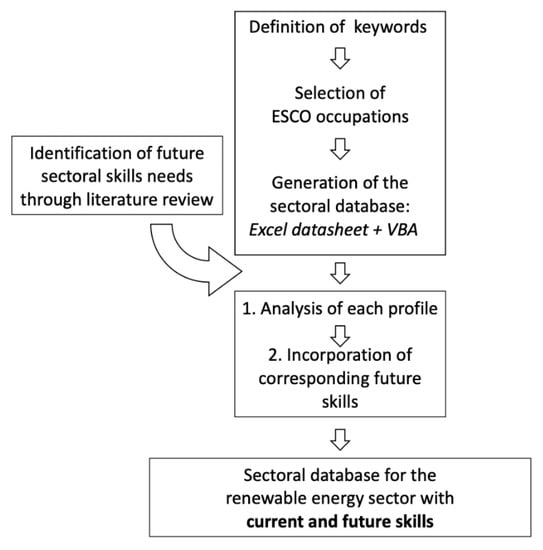
This work was developed following the procedures employed by our research team in the elaboration of studies [54,55,56,57]: findings from the literature review in Section 2 and Section 3.1 and European skills/competences, qualifications, and occupations (ESCO) framework were collated with experts on the matter in order to validate the identified future skills requirements of the renewable energy sector. Figure 1 shows the summary of the methodology of this research.
Figure 1.
Summary of the methodology.
The ESCO database, which is an initiative managed by the European Commission, is the starting point from which this work emerges. It is a directory that identifies and categorizes skills, competences, qualifications, and occupations relevant for the European Union labor market and education and training, as well as showing the relationships between the different concepts [62]. The skills pillar of ESCO involves 13,485 concepts structured in a hierarchy that contains four sub-classifications. Each sub-classification targets different types of knowledge and skill/competence concepts: (a) knowledge, (b) skills, (c) attitudes and values, and (d) language skills and knowledge. In addition to the hierarchy, subsets of skills can be accessed through: (a) a transversal skill hierarchy, (b) a collection of languages, or (c) a collection of digital skills. In our research, the ESCO database was the main source for the selection of job profiles and their current skill needs.
In order to identify the renewable energy sector related professional profiles, we determined the keywords (“renewable”, “solar”, “wind”, “hydro”, “geothermal”, “bio”, “power”, and “energy”) directly connected with the sector, which the title of the profile should include.
Then, keywords were introduced as search terms in the ESCO database; among the resulting 67 occupations obtained from keyword searches, we identified 19 sector-related ones through a detailed analysis. Occupations labeled as “engineer”, “technician”, “plant operator”, or “consultant” were considered, as well as occupations including “renewable energy” or “sustainable” in their description and/or in their corresponding skills/competences. Table 1 demonstrates the keywords and the ESCO occupations selected from the search.
Table 1.
The key terms related to “renewable energy” and 19 ESCO occupations identified after the analysis.
After identifying the relevant profiles, we used ESCO database to define the current skills needs. Then, the ESCO profiles along with solely current skills and knowledge, were inserted into an Excel spreadsheet. Next, through Excel’s VBA (visual basic for applications) automated process, the initial database containing current skills for the identified job profiles of the renewable energy sector was generated.
Subsequently, we needed to determine the future skills needs. Since ESCO’s content did not involve future skills demands particularly about digitalization, we carried out a research based on literature review about the forthcoming skills requirements of the selected profiles. As a result, we utilized other references dealing with the future skills requirements of the machine tool sector. For this reason, an expanded literature review was executed (Section 3.1), associated with the research on the digitalization and diffusion of Industry 4.0 in the renewable energy sector (Section 2). Furthermore, the other main reference of future skills was the work on the machine tool sector elaborated by this research team [57].
The following step was to analyze each professional profile to identify whether it would transform due to digitalization and technology advances in the sector, based on desktop research findings. The future skills requirements demanded by the renewable energy sector must be guaranteed by these professional profiles. We assume that future profiles will correspond to the selected current professional profiles, and although we presume there will be new occupations in the future that do not currently exist, the design and definition of those goes beyond the scope of this research. Thus, we consider that the existing professional profiles will cover the future skills requirements of the sector, noting that proficiency for each skill will differ among profiles.
After the analysis, identified skills were fed to the initial database manually. The decision-making was backed up by expert opinions on the matter as part of the process of introducing specific future skills for the selected profiles. Moreover, the identified skills were only deemed future skills if they were not already in the ESCO database. The incorporation of future skills to the professional profiles ended with the verification of the professional profiles meeting the future skills demand of the renewable energy sector. Lastly, the automated sectoral database was finalized, containing both current and future skills needs.
3.3.2. Results and Discussion
The aim of this research was to generate a sectoral database incorporating the renewable energy-related professional profiles along with their current and future skill needs. As described in the methodology, Section 3.3.1, we extracted the professional profiles and their skill requirements from ESCO’s content to generate the database. Therefore, our main desktop research focused on identifying the specific and general skills that will be needed by the renewable energy sector workforce in the near future. The defined future skills can be divided into three main categories: technical skills, transversal skills, and green skills, as shown in Table 2, Table 3 and Table 4.
Table 2.
List of selected future technical skills for the renewable energy sector workforce. Reprinted from Akyazi, T.; Goti, A.; Oyarbide-Zubillaga, A.; Alberdi, E.; Carballedo, R.; Ibeas, R.; and Garcia-Bringas, P. 2020.
Table 3.
List of selected future transversal skills for the renewable energy sector workforce. Reprinted from Akyazi, T.; Goti, A.; Oyarbide-Zubillaga, A.; Alberdi, E.; Carballedo, R.; Ibeas, R.; and Garcia-Bringas, P. 2020.
Table 4.
List of selected future green skills for the renewable energy sector workforce. Reprinted from Akyazi, T.; Goti, A.; Oyarbide-Zubillaga, A.; Alberdi, E.; Carballedo, R.; Ibeas, R.; and Garcia-Bringas, P. 2020.
Then, we identified the future skill need of each selected profile. The database, which is the main outcome of the methodology, was completed. It integrated all the current skills included in the ESCO database and the identified additional future skills.
As an example, the “renewable energy engineer” job profile (Table 5) shows the appearance of the database and the information displayed for every tab corresponding to each professional profile. The top four rows of the table make up the occupational group classification in a graded order: “Renewable energy engineer” is a professional profile part of the “engineering professionals not elsewhere classified” group, which belongs to the “engineering professionals (excluding electrotechnology)” upper group, included in the “science and engineering professionals” group. Each professional profile is provided with a URL to the profile on the ESCO website, alternative labels for naming the job, a description of the profile, and a unique number that is the international occupation code for the ISCO (International Standard Classification of Occupations). The skills and knowledge required for the professional profile are listed consecutively, both current and future.
Table 5.
Sample job profile tab from the database.
Table 5 is described as a smart table because changing the name of the job profile will return the tab with the information associated with the introduced term. This feature turns the database into a very useful and easy to use tool, as it allows instant access to the searched professional profile.
A sample of the resulting database from this research is provided in Table 6, which displays 4 tabs of job profiles from the renewable energy sector. Each profile contains the information from ESCO and the selected future skills, our contribution to the database and the product of this research. The future skills are retrieved from the identified skills as shown in Table 2, Table 3 and Table 4. The complete database that contains all the selected professional profiles for the renewable energy sector is available as Supplementary Materials.
Table 6.
Preview of some tabs from the generated database of job profiles from the renewable energy sector.
The generated database is very significant for the sector since it involves all the information about the sector-related job profiles. Since it is an automated database and also a smart table; training providers, companies, and universities have very quick access to the data related to the profile that they want to work with. Our main contribution to the database is the identification of the future skills for each profile through a detailed analysis. These addressed skill demands will be the fundamental part of the next generation training programs.
The database generated through this research may contribute to the evolution and upgrade of the ESCO database, which would result in improved usability for users.
Moreover, findings from this research were endorsed by industry insiders and experts on the matter. Selected profiles and future skills requirements for the renewable energy sector were reviewed and validated, proving the generated database to become a key tool in the development of a sectoral strategy for the successful development of the sector in the Industry 4.0 context.
4. Conclusions
Shifting towards a clean energy system demands an increased presence of renewable energy sources that effectively substitute conventional energies. The ever-growing renewable energy sector can benefit from emerging technologies to support its integration within the current energy system. Digitalization can also achieve a more efficient, flexible, reliable, and competitive generation and distribution of renewable energy. Thus, Industry 4.0 unfolds as a key enabler for boosting renewable energy sector prospects.
The opportunity, however, raises issues regarding the workforce’s ability to satisfactorily deliver industry needs. The sector evolves at the swift pace of technology advances which the human resources’ skills should keep up with. For that purpose, it is proposed to elaborate a long-term skill strategy based on the assessment of the current state of the digitalization of the renewable energy sector and the determination of future skills requirements. The strategy aims to create training programs regarding the findings from the evaluation of current and future state of the renewable energy sector, for the workforce to obtain the required skills. For that purpose, renewable energy sector–academia cooperation is essential to design appropriate education that will close the breach between industry needs and human resources’ actual capabilities. Eventually, once the skills requirements are met, the focus will shift towards the attraction and acquisition of talent. The renewable energy sector is in need of a skills guideline leading the sector through industrial changes. This study responds to the need and fills the void in the sector by analyzing future skills requirements of job profiles of the renewable energy sector through its digital evolution.
Therefore, the object of this research was to examine the evolution of the renewable energy sector job profiles and their skill demands through the adoption of Industry 4.0 technologies. Based on the ESCO database, the future skills obtained from desktop research were incorporated into the selected professional profiles of the sector. Thus, an integrated database was created, which includes both current and future skills for the selected jobs at the renewable energy sector.
As stated before, we believe the database will be a fundamental guideline for the renewable energy sector companies, educational centers, and policymakers to design training programs as part of the sectoral long-term skill strategy. By providing a common framework of future skills requirements, the database will guide and serve as a benchmark to create appropriate itineraries that will achieve trained professionals with the capabilities expected by the industry. Thus, the database is a very functional tool to increase the competitiveness of the sector if the sector addresses the skill needs correctly. It can be utilized actively during the development of training programs for reskilling and upskilling the workforce and lead to the generation of a highly qualified workforce for the sector.
Moreover, the findings of the research have the potential to be evaluated by the ESCO experts and be used for the updating process of the ESCO. Hence, it could be used more effectively by the end-users since ESCO is a European framework commonly used by the European labor market and training centers.
Future research is needed on the development of skills linked to the changes brought by the digitalization and implementation of Industry 4.0 in the renewable energy sector, particularly in the steps of the skills strategy that follow with this work’s research: the development of training programs and the recruitment of professionals. Hence, this research can be a guide for upcoming investigations on the matter.
Supplementary Materials
The following are available online at https://www.mdpi.com/article/10.3390/en14092609/s1, Figure S1: a sample of the database (in excel format) with the renewable energy sector job profiles including current and future skills needs.
Author Contributions
I.A., writing, conceptualization, and investigation; A.G., writing, conceptualization, investigation, and funding acquisition; A.O.-Z. and T.A., writing, conceptualization, and investigation; E.A., conceptualization and investigation; P.G.-B. funding acquisition. All authors have read and agreed to the published version of the manuscript.
Funding
This research was partly funded by (a) the European Union through the Erasmus Plus Programme (Grant Agreement No. 2018-3019/001-001, Project No. 600886-1-2018-1-DE-EPPKA2-SSA-B)*, (b) the 4gune cluster, Siemens Gamesa and Aalborg University through the project “Identification of the necessary skills and competences for professionals of the future renewable energy sector”, and (c) Lantek, Inzu Group, Fundación Telefónica and Fundación BBK, partners of the Deusto Digital Industry Chair.
Institutional Review Board Statement
Not applicable.
Informed Consent Statement
Not applicable.
Data Availability Statement
Publicly available data from ESCO were analyzed in this study. This data can be found here: https://ec.europa.eu/esco/portal/home/. The obtained database in this study is available as supplementary materials in https://www.mdpi.com/article/10.3390/en14092609/s1. Interviews with experts are not publicly available due to confidentiality.
Acknowledgments
We would like to thank the support received from the Energy Agency of the Basque Government (EVE) and Enrique Burguera Montoya, Senior Expert of the Energy Sector.
Conflicts of Interest
The authors declare no conflict of interest.
References
- OECD. Energy-Renewable Energy-OECD Data. Available online: https://data.oecd.org/energy/renewable-energy.htm (accessed on 24 March 2021).
- Ilzarbe, J.M.B.; Gonzalez, J.C.R. Energy and climate change in the post-covid-19 scenario. DYNA Ing. E Ind. 2020, 95, 570–571. [Google Scholar] [CrossRef] [Scilit]
- Khanna, M. COVID-19: A cloud with a silver lining for renewable energy. Appl. Econ. Perspect. Policy 2021, 43, 73–85. [Google Scholar] [CrossRef] [Scilit] [PubMed]
- Hernandez, D.M.; Peralta, G.; Manero, L.; Gomez, R.; Bilbao, J.; Zubia, C. Energy and coverage study of LPWAN schemes for Industry 4.0. In Proceedings of the 2017 IEEE International Workshop of Electronics, Control, Measurement, Signals and Their Application to Mechatronics (ECMSM), Donostia, Spain, 24–26 May 2017; pp. 1–6. [Google Scholar]
- Ng, T.C.; Ghobakhloo, M. Energy sustainability and industry 4.0. IOP Conf. Ser. Earth Environ. Sci. 2020, 463, 012090. [Google Scholar] [CrossRef] [Scilit]
- Dogaru, L. The main goals of the fourth industrial revolution. renewable energy perspectives. Procedia Manuf. 2020, 46, 397–401. [Google Scholar] [CrossRef] [Scilit]
- Renewable Energy Agency International. World Energy Transitions Outlook 1.5 °C Pathway; IRENA: Abu Dhabi, United Arab Emirates, 2021; ISBN 978-92-9260-334-2. [Google Scholar]
- Renewable Energy Agency International. Innovation Landscape for a Renewable-Powered Future: Solutions to Integrate Variable Renewables; IRENA: Abu Dhabi, United Arab Emirates, 2019. [Google Scholar]
- da Silva, F.S.T.; da Costa, C.A.; Crovato, C.D.P.; Righi, R.D.R. Looking at energy through the lens of Industry 4.0: A systematic literature review of concerns and challenges. Comput. Ind. Eng. 2020, 143, 106426. [Google Scholar] [CrossRef] [Scilit]
- Borowski, P. Digitization, digital twins, blockchain, and industry 4.0 as elements of management process in enterprises in the energy sector. Energies 2021, 14, 1885. [Google Scholar] [CrossRef] [Scilit]
- Verma, P.; Savickas, R.; Buettner, S.M.; Strüker, J.; Kjeldsen, O.; Wang, X. Enabling the New Phase of Energy Efficiency; Group of Experts on Energy Efficiency Digitalization: Geneva, Switzerland, 2020. [Google Scholar]
- Jennings, P. New directions in renewable energy education. Renew. Energy 2009, 34, 435–439. [Google Scholar] [CrossRef] [Scilit]
- Scharl, S.; Praktiknjo, A. The role of a digital industry 4.0 in a renewable energy system. Int. J. Energy Res. 2019, 43, 3891–3904. [Google Scholar] [CrossRef] [Scilit]
- Ramakrishna, S.; Ngowi, A.; De Jager, H.; Awuzie, B.O. Emerging industrial revolution: Symbiosis of industry 4.0 and circular economy: The role of universities. Sci. Technol. Soc. 2020, 25, 505–525. [Google Scholar] [CrossRef] [Scilit]
- Dileep, G. A survey on smart grid technologies and applications. Renew. Energy 2020, 146, 2589–2625. [Google Scholar] [CrossRef] [Scilit]
- Gunduz, M.Z.; Das, R. Cyber-security on smart grid: Threats and potential solutions. Comput. Netw. 2020, 169, 107094. [Google Scholar] [CrossRef] [Scilit]
- Mahmud, K.; Khan, B.; Ravishankar, J.; Ahmadi, A.; Siano, P. An internet of energy framework with distributed energy resources, prosumers and small-scale virtual power plants: An overview. Renew. Sustain. Energy Rev. 2020, 127, 109840. [Google Scholar] [CrossRef] [Scilit]
- Di Somma, M.; Graditi, G.; Heydarian-Forushani, E.; Shafie-Khah, M.; Siano, P. Stochastic optimal scheduling of distributed energy resources with renewables considering economic and environmental aspects. Renew. Energy 2018, 116, 272–287. [Google Scholar] [CrossRef] [Scilit]
- Howell, S.; Rezgui, Y.; Hippolyte, J.-L.; Jayan, B.; Li, H. Towards the next generation of smart grids: Semantic and holonic multi-agent management of distributed energy resources. Renew. Sustain. Energy Rev. 2017, 77, 193–214. [Google Scholar] [CrossRef] [Scilit]
- UNIDO. Industrial Prosumers of Renewable Energy, Contribution to Inclusive and Sustainable Industrial Development; UNIDO: Vienna, Austria, 2015. [Google Scholar]
- Milčiuvienė, S.; Kiršienė, J.; Doheijo, E.; Urbonas, R.; Milčius, D. The role of renewable energy prosumers in implementing energy justice theory. Sustainability 2019, 11, 5286. [Google Scholar] [CrossRef] [Scilit]
- Borowski, P.F. Zonal and nodal models of energy market in european union. Energies 2020, 13, 4182. [Google Scholar] [CrossRef] [Scilit]
- Zhang, W.; Xu, Y.; Liu, W.; Zang, C.; Yu, H. Distributed online optimal energy management for smart grids. IEEE Trans. Ind. Inform. 2015, 11, 717–727. [Google Scholar] [CrossRef] [Scilit]
- Wang, Q.; Su, M. Integrating blockchain technology into the energy sector—From theory of blockchain to research and application of energy blockchain. Comput. Sci. Rev. 2020, 37, 100275. [Google Scholar] [CrossRef] [Scilit]
- Rasheed, A.; San, O.; Kvamsdal, T. Digital twin: Values, challenges and enablers from a modeling perspective. IEEE Access 2020, 8, 21980–22012. [Google Scholar] [CrossRef] [Scilit]
- Steindl, G.; Stagl, M.; Kasper, L.; Kastner, W.; Hofmann, R. Generic digital twin architecture for industrial energy systems. Appl. Sci. 2020, 10, 8903. [Google Scholar] [CrossRef] [Scilit]
- Zierath, J.; Rosenow, S.-E.; Luthe, J.; Schulze, A.; Saalbach, C.; Sander, M.; Woernle, C. A structural fatigue monitoring concept for wind turbines by means of digital twins. Rotating Mach. Hybrid Test Methods Vibro-Acoust. Laser Vibrometry 2020, 8, 139–142. [Google Scholar]
- Pimenta, F.; Pacheco, J.; Branco, C.M.; Teixeira, C.M.; Magalhães, F. Development of a digital twin of an onshore wind turbine using monitoring data. J. Phys. Conf. Ser. 2020, 1618. [Google Scholar] [CrossRef] [Scilit]
- A Smirnov, A.; Lunenko, V.S.; A Boldyrev, I. Application of digital twins of equipment for managing complex renewable energy. IOP Conf. Series: Mater. Sci. Eng. 2021, 1035, 012023. [Google Scholar] [CrossRef] [Scilit]
- Errandonea, I.; Beltrán, S.; Arrizabalaga, S. Digital twin for maintenance: A literature review. Comput. Ind. 2020, 123, 103316. [Google Scholar] [CrossRef] [Scilit]
- Onederra, O.; Asensio, F.J.; Eguia, P.; Perea, E.; Pujana, A.; Martinez, L. MV cable modeling for application in the digital twin of a windfarm. In Proceedings of the 2019 International Conference on Clean Electrical Power (ICCEP), Otranto, Italy, 2–4 July 2019; pp. 617–622. [Google Scholar] [CrossRef] [Scilit]
- IEA. Digitalization & Energy; IEA: Paris, France, 2017.
- Shin, W.; Han, J.; Rhee, W. AI-assistance for predictive maintenance of renewable energy systems. Energy 2021, 221, 119775. [Google Scholar] [CrossRef] [Scilit]
- Bosman, L.B.; Leon-Salas, W.D.; Hutzel, W.; Soto, E.A. PV System predictive maintenance: Challenges, current approaches, and opportunities. Energies 2020, 13, 1398. [Google Scholar] [CrossRef] [Scilit]
- Canizo, M.; Onieva, E.; Conde, A.; Charramendieta, S.; Trujillo, S. Real-time predictive maintenance for wind turbines using Big Data frameworks. In Proceedings of the 2017 IEEE International Conference on Prognostics and Health Management (ICPHM), Dallas, TX, USA, 19–21 June 2017; pp. 70–77. [Google Scholar] [CrossRef] [Scilit]
- Hsu, J.-Y.; Wang, Y.-F.; Lin, K.-C.; Chen, M.-Y.; Hsu, J.H.-Y. Wind turbine fault diagnosis and predictive maintenance through statistical process control and machine learning. IEEE Access 2020, 8, 23427–23439. [Google Scholar] [CrossRef] [Scilit]
- Sony, M. Pros and cons of implementing Industry 4.0 for the organizations: A review and synthesis of evidence. Prod. Manuf. Res. 2020, 8, 244–272. [Google Scholar] [CrossRef] [Scilit]
- Aldieri, L.; Grafström, J.; Sundström, K.; Vinci, C.P. Wind power and job creation. Sustainability 2019, 12, 45. [Google Scholar] [CrossRef] [Scilit]
- Bughin, J.; Hazan, E.; Lund, S.; Dahlstrom, P. Skill Shift: Automation and the Future of the Workforce; McKinsey &Company: Hong Kong, China, 2018; pp. 3–84. [Google Scholar]
- Bongomin, O.; Ocen, G.G.; Nganyi, E.O.; Musinguzi, A.; Omara, T. Exponential disruptive technologies and the required skills of industry 4.0. J. Eng. 2020, 2020, 1–17. [Google Scholar] [CrossRef] [Scilit]
- Gonzalez Vazquez, I.; Milasi, S.; Carretero Gomez, S.; Napierala, J.; Robledo Bottcher, N. The Changing Nature of Work and Skills in the Digital Age; Publications Office of the EU: Brussels, Belgium, 2019; ISBN 978-92-76-09206-3. [Google Scholar]
- CISL. CLG Europe Working towards a Climate Neutral Europe: Jobs and Skills in a Changing World; CISL: Hong Kong, China, 2020. [Google Scholar]
- Autor, D.H. Why Are there still so many jobs? the history and future of workplace automation. J. Econ. Perspect. 2015, 29, 3–30. [Google Scholar] [CrossRef] [Scilit]
- ISCO. International Standard Classification of Occupations: Structure, Group Definitions and Correspondence Tables; International Labour Office: Geneva, Switzerland, 2012. [Google Scholar]
- Czako, V. Employment in the Energy Sector Status Report 2020; Publications Office of the European Union: Brussels, Belgium, 2020. [Google Scholar] [CrossRef]
- LMI. Humber Skills for Employment. Available online: https://lmihumber.co.uk/skills-for-employment/ (accessed on 23 March 2021).
- European Comission. JRC SETIS Magazine; European Comission: Brussels, Belgium; Luxembourg; Carquefou, France, 2018. [Google Scholar]
- Fong, T. Robotics and Autonomous Systems in O&M: Removing the Barriers to BVLOS Operations; Offshore Renewable Energy Catapult: Glasgow, UK, 2019. [Google Scholar]
- Faheem, M.; Shah, S.; Butt, R.; Raza, B.; Anwar, M.; Ashraf, M.; Ngadi, A.; Gungor, V. Smart grid communication and information technologies in the perspective of Industry 4.0: Opportunities and challenges. Comput. Sci. Rev. 2018, 30, 1–30. [Google Scholar] [CrossRef] [Scilit]
- Shihavuddin, A.; Chen, X.; Fedorov, V.; Christensen, A.N.; Riis, N.A.B.; Branner, K.; Dahl, A.B.; Paulsen, R.R. Wind turbine surface damage detection by deep learning aided drone inspection analysis. Energies 2019, 12, 676. [Google Scholar] [CrossRef] [Scilit]
- Energy & Utility Skills. Skills and Labour Requirements of the UK Offshore Wind Industry; Energy & Utility Skills: Solihull, UK, 2018; pp. 1–143. [Google Scholar]
- Accenture. Building Greater Cyber Resilience in Renewables; Accenture: Hong Kong, China, 2020. [Google Scholar]
- Negreiro, M.; Belluomini, A. The New European Cybersecurity Competence Centre and Network; European Commission: Brussels, Belgium; Luxembourg; Carquefou, France, 2020. [Google Scholar]
- Akyazi, T.; Goti, A.; Oyarbide, A.; Alberdi, E.; Bayon, F. A guide for the food industry to meet the future skills requirements emerging with industry 4.0. Foods 2020, 9, 492. [Google Scholar] [CrossRef] [Scilit]
- Akyazi, T.; Oyarbide, A.; Goti, A.; Gaviria, J.; Bayon, F. Creating a roadmap for professional skills in industry 4.0. Hydrocarb. Process. 2020, 99, 11. [Google Scholar]
- Akyazi, T.; Alvarez, I.; Alberdi, E.; Oyarbide-Zubillaga, A.; Goti, A.; Bayon, F. Skills needs of the civil engineering sector in the european union countries: Current situation and future trends. Appl. Sci. 2020, 10, 7226. [Google Scholar] [CrossRef] [Scilit]
- Akyazi, T.; Goti, A.; Oyarbide-Zubillaga, A.; Alberdi, E.; Carballedo, R.; Ibeas, R.; Garcia-Bringas, P. Skills requirements for the european machine tool sector emerging from its digitalization. Metals 2020, 10, 1665. [Google Scholar] [CrossRef] [Scilit]
- ESSA. ESTEP-European Steel Skills Agenda (ESSA). Available online: https://www.estep.eu/essa/ (accessed on 24 March 2021).
- University of Deusto Label. Deusto Research Social Impact. Available online: https://www.deusto.es/cs/Satellite/deustoresearch/en/home/dissemination-and-transfer/label-deusto-research-social-impact?cambioidioma=si&_ga=2.184954729.1348305076.1616511738-1234147669.1606250526 (accessed on 24 March 2021).
- Lucchi, E.; Lopez, C.S.P.; Franco, G. A Conceptual Framework on the Integration of Solar Energy Systems in Heritage Sites and Buildings; IOP Conference Series: Materials science and engineering; IOP Publishing: Bristol, UK, 2020; Volume 949. [Google Scholar]
- Acatech. Skills for Industrie 4.0 Training Requirements and Solutions; Acatech Position Paper: Munich, Germany, 2017; pp. 1–14. [Google Scholar]
- ESCO. ESCO-European Commission. Available online: https://ec.europa.eu/esco/portal/home?resetLanguage=true&newLanguage=en (accessed on 22 March 2021).

Publisher’s Note: MDPI stays neutral with regard to jurisdictional claims in published maps and institutional affiliations. |
© 2021 by the authors. Licensee MDPI, Basel, Switzerland. This article is an open access article distributed under the terms and conditions of the Creative Commons Attribution (CC BY) license (https://creativecommons.org/licenses/by/4.0/).