
Topic Menu
► Topic MenuTopic Editors


Polymer Electrolytes
Topic Information
Dear Colleagues,
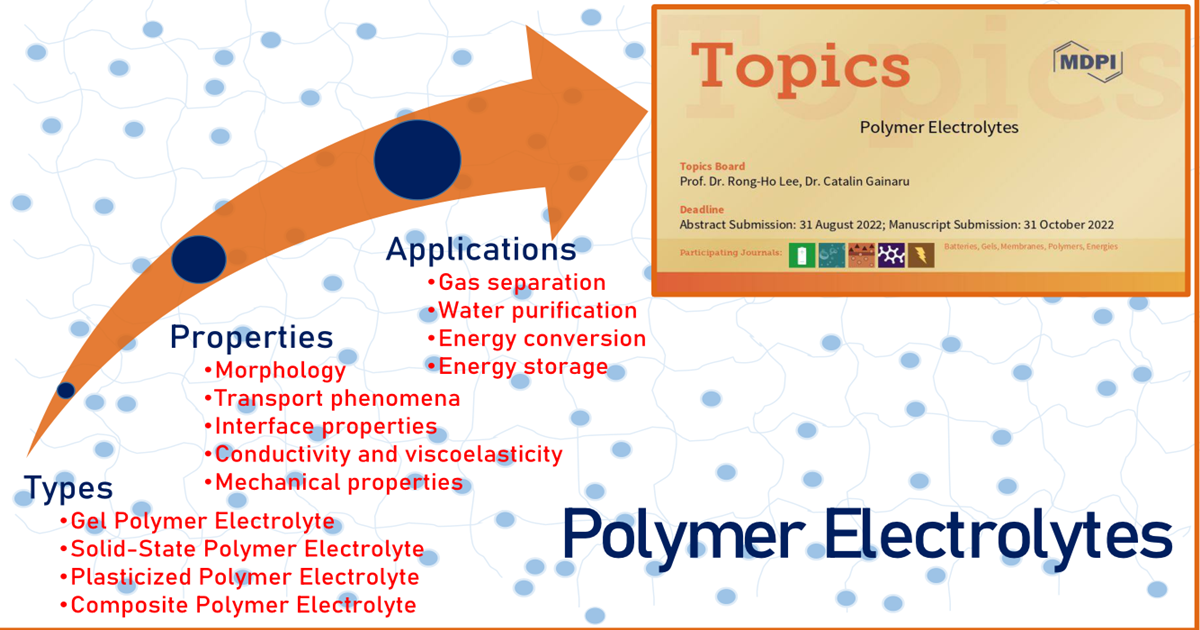
Triggered by the continuous upsurge in household and industrial power consumption, one goal of modern science is to provide up-to-date recipes for the efficient harvesting, transportation, and storing of electric energy. In this regard, several categories of structurally disordered materials, including acid solutions, ionic liquids, and superionic glassy conductors have been thoroughly investigated. However, several drawbacks, including moisture sensitivity, toxicity, and processing difficulty, preclude their exploitation on industrial scales. More suitable for small-size encapsulation, as required in, for example, electronic devices, are polymer electrolytes, which, nowadays, can be manufactured at relatively low costs in a large morphological diversity. They can host charge carriers as matrices with tunable mechanical properties, for example, as stretchable membranes, soft gels, or highly viscous melts. Despite the already widespread use of polymer electrolytes in current technologies, rationalizing the relationship between their microscopic behavior and their technologically exploited macroscopic properties remains one of the most challenging problems of applied polymer science. In pursuit of unraveling the physical mechanism underlying this connection, but also to broaden the applicability range of these materials, I am inviting you to submit a research paper to the topic “Polymer electrolytes”. This topic seeks original contributions focusing on the following (and related) subtopics:
- Transport phenomena in polymer electrolytes;
- Nonlinear conductivity and the viscoelasticity of polymer electrolytes;
- Gel polymer electrolytes;
- Single-ion-conducting polymers;
- Polymer electrolyte membranes for gas separation;
- Polymer electrolytes for water purification;
- Polymers for energy conversion and energy storage technologies.
Prof. Dr. Rong-Ho Lee
Dr. Catalin Gainaru
Topic Editors
Keywords
- electrolytes
- polymers
- conductivity
- viscoelasticity
- nonlinear spectroscopy
- gel electrolytes
- gas separation
- energy storage
Participating Journals
| Journal Name | Impact Factor | CiteScore | Launched Year | First Decision (median) | APC |
|---|---|---|---|---|---|

Batteries
|
6.3 | 9.8 | 2015 | 16.4 Days | CHF 2700 |

Energies
|
3.9 | 8.3 | 2008 | 16.7 Days | CHF 2600 |

Gels
|
6.4 | 10.3 | 2015 | 13 Days | CHF 2100 |

Membranes
|
4.2 | 9.4 | 2011 | 14.9 Days | CHF 2200 |

Polymers
|
5.8 | 11.0 | 2009 | 13.4 Days | CHF 2700 |

Preprints.org is a multidisciplinary platform offering a preprint service designed to facilitate the early sharing of your research. It supports and empowers your research journey from the very beginning.
MDPI Topics is collaborating with Preprints.org and has established a direct connection between MDPI journals and the platform. Authors are encouraged to take advantage of this opportunity by posting their preprints at Preprints.org prior to publication:
- Share your research immediately: disseminate your ideas prior to publication and establish priority for your work.
- Safeguard your intellectual contribution: Protect your ideas with a time-stamped preprint that serves as proof of your research timeline.
- Boost visibility and impact: Increase the reach and influence of your research by making it accessible to a global audience.
- Gain early feedback: Receive valuable input and insights from peers before submitting to a journal.
- Ensure broad indexing: Web of Science (Preprint Citation Index), Google Scholar, Crossref, SHARE, PrePubMed, Scilit and Europe PMC.
