Topic Editors

Dr. Zhaoming Chen
Institute of Environment, Resources, Soil and Fertilizer, Zhejiang Academy of Agricultural Sciences, Hangzhou 310021, China
Institute of Bast Fiber Crops, Chinese Academy of Agricultural Sciences, Changsha 410205, China
Dr. Xianfeng Zhang
Institute of Soil Science, Chinese Academy of Sciences, 298 Chuangyou Road, Nanjing 211135, China
Dr. Minchong Shen
Institute of Tobacco Research, Chinese Academy of Agricultural Sciences, Qingdao 266101, China
Hunan Institute of Microbiology, Hunan Academy of Agricultural Sciences, Changsha 410009, China

Recent Advances in Soil Health Management
Abstract submission deadline
31 October 2026
Manuscript submission deadline
31 December 2026
Viewed by
3756

Topic Information

Dear Colleagues,

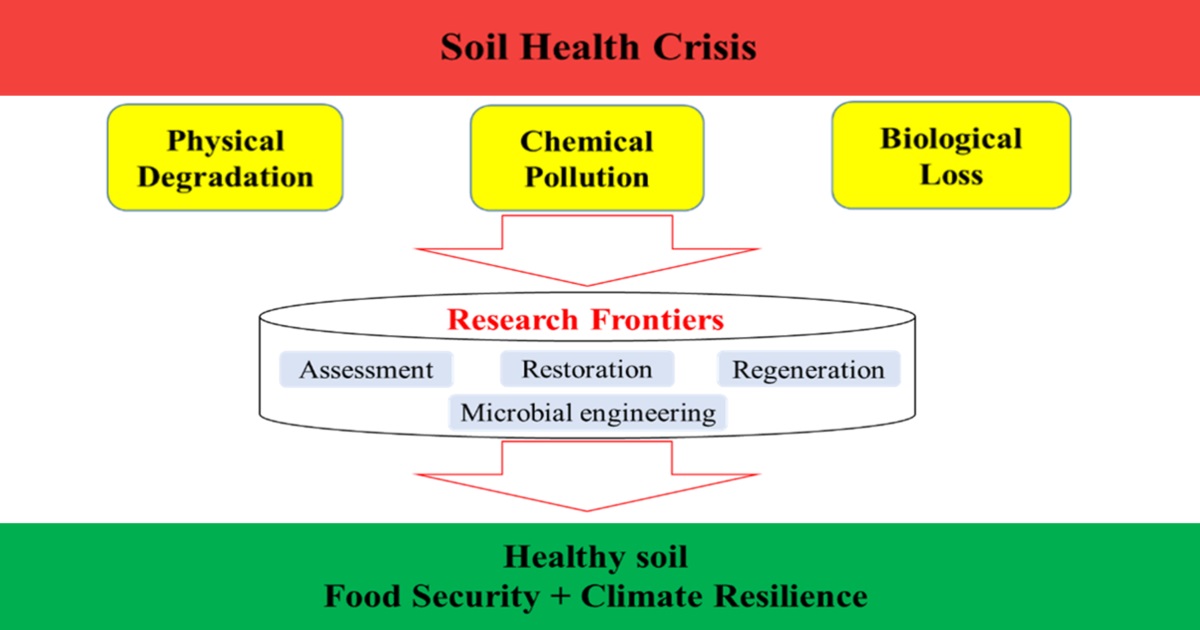
Soil is the fundamental bedrock of terrestrial ecosystems, global food security, and climate regulation. However, soil degradation driven by intensive agriculture, climate change, and pollution poses an existential threat. Understanding and enhancing soil health is no longer optional: it is an urgent necessity for sustainable development. This topic aims to compile cutting-edge research and innovative perspectives on recent advances in soil health management as well as the interactions between plants and soils.

We invite original research articles and reviews exploring the latest scientific breakthroughs, technological innovations, and practical strategies for assessing, monitoring, improving, and sustaining soil health. We seek multidisciplinary contributions that bridge fundamental science with practical applications, addressing the complex biological, chemical, physical, and socio-economic dimensions of soil health.

Topics of interest include (but are not limited to) the following:

  • Novel soil health assessment indicators and monitoring frameworks;
  • Interactions between crop yield/quality and soil health indexes;
  • Advances in understanding and managing soil microbiomes for functionality;
  • Innovative soil organic carbon sequestration strategies and mechanisms;
  • Development and efficacy evaluation of new-generation soil amendments;
  • Precision conservation agriculture and regenerative farming practices enhancing soil health;
  • Remediation techniques for degraded and contaminated soils;
  • Leveraging remote sensing and AI for large-scale soil health mapping and prediction;
  • Impact of climate-smart practices on soil resilience.

Dr. Zhaoming Chen
Dr. Xinlin Zhao
Dr. Xianfeng Zhang
Dr. Minchong Shen
Dr. Shuaishuai Gao
Topic Editors

Keywords

  • soil health assessment
  • soil microbiome
  • soil organic carbon
  • sustainable agriculture
  • regenerative farming
  • soil amendments
  • climate resilience
  • soil remediation
  • remote sensing
  • circular economy

Participating Journals

Journal Name Impact Factor CiteScore Launched Year First Decision (median) APC
Agriculture
agriculture
3.6 6.3 2011 18 Days CHF 2600 Submit
Microorganisms
microorganisms
4.2 7.7 2013 15.2 Days CHF 2700 Submit
Plants
plants
4.1 7.6 2012 17.7 Days CHF 2700 Submit
Soil Systems
soilsystems
3.5 5.4 2017 31.6 Days CHF 1800 Submit
Microplastics
microplastics
5.1 6.8 2022 34.6 Days CHF 1200 Submit
Land
land
3.2 5.9 2012 16 Days CHF 2600 Submit
Forests
forests
2.5 4.6 2010 17.1 Days CHF 2600 Submit
Crops
crops
1.9 2.4 2021 23.5 Days CHF 1200 Submit

Preprints.org is a multidisciplinary platform offering a preprint service designed to facilitate the early sharing of your research. It supports and empowers your research journey from the very beginning.

MDPI Topics is collaborating with Preprints.org and has established a direct connection between MDPI journals and the platform. Authors are encouraged to take advantage of this opportunity by posting their preprints at Preprints.org prior to publication:

  1. Share your research immediately: disseminate your ideas prior to publication and establish priority for your work.
  2. Safeguard your intellectual contribution: Protect your ideas with a time-stamped preprint that serves as proof of your research timeline.
  3. Boost visibility and impact: Increase the reach and influence of your research by making it accessible to a global audience.
  4. Gain early feedback: Receive valuable input and insights from peers before submitting to a journal.
  5. Ensure broad indexing: Web of Science (Preprint Citation Index), Google Scholar, Crossref, SHARE, PrePubMed, Scilit and Europe PMC.

Published Papers (4 papers)

Order results
Result details
Journals
Select all
Export citation of selected articles as:
22 pages, 2659 KB  
Article
Biochar–Urea Peroxide Composite Particles Alleviate Phenolic Acid Stress in Pogostemon cablin Through Soil Microenvironment Modification
by Yuting Tu, Baozhu Chen, Qiufang Wei, Yanggui Xu, Yiping Peng, Zhuxian Li, Jianyi Liang, Lifang Zhuo, Wenliang Zhong and Jichuan Huang
Microorganisms 2025, 13(12), 2772; https://doi.org/10.3390/microorganisms13122772 - 5 Dec 2025
Viewed by 303
Abstract
The continuous-cropping obstacles of Pogostemon cablin (patchouli) is severely constrained by autotoxic phenolic acids accumulated in the rhizosphere soil. Biochar adsorption and chemical oxidation are common remediation strategies; they often fail to simultaneously and efficiently remove phenolic allelochemicals while improving the soil micro-ecological [...] Read more.
The continuous-cropping obstacles of Pogostemon cablin (patchouli) is severely constrained by autotoxic phenolic acids accumulated in the rhizosphere soil. Biochar adsorption and chemical oxidation are common remediation strategies; they often fail to simultaneously and efficiently remove phenolic allelochemicals while improving the soil micro-ecological environment. To address this issue, this study developed a novel biochar–urea peroxide composite particle (BC-UP). Batch degradation experiments and electron paramagnetic resonance (EPR) analysis confirmed the synergistic adsorption-oxidation function of BC-UP. A pot experiment demonstrated that application of BC-UP (5.0 g/kg) significantly alleviated phenolic acid stress. Specifically, BC-UP application significantly enhanced shoot biomass by 28.8% and root surface area by 49.3% compared to the phenolic acid-stressed treatment and concurrently reduced the total phenolic acid content in the rhizosphere soil by 37.3%. This growth promotion was accompanied by the enhanced accumulation of key bioactive compounds (volatile oils, pogostone, and patchouli alcohol). BC-UP amendment also improved key soil physicochemical properties (e.g., pH, and organic matter) and enhanced the activities of critical enzymes. Furthermore, BC-UP reshaped the microbial community, notably reducing the fungi-to-bacteria OTU ratio by 49.7% and enriching the relative abundance of Firmicutes and Nitrospirota but suppressing the Ascomycota phylum abundance. Redundancy analysis identified soil sucrase and catalase activity, total phenolic acid content, and Ascomycota abundance as key factors influencing patchouli biomass. In conclusion, BC-UP effectively mitigates phenolic acid stress through combined adsorption and radical oxidation, subsequently improving soil properties and restructuring the rhizosphere microbiome, offering a promising soil remediation strategy for patchouli and other medicinal crops. Full article
(This article belongs to the Topic Recent Advances in Soil Health Management)
Show Figures

Figure 1

29 pages, 3298 KB  
Review
Soil Aggregate Dynamics and Stability: Natural and Anthropogenic Drivers
by Ameer Hamza, Danutė Karčauskienė, Ieva Mockevičienė, Regina Repšienė, Mukkram Ali Tahir, Muhammad Zeeshan Manzoor, Shehnaz Kousar, Sumaira Salahuddin Lodhi, Nazima Rasool and Ikram Ullah
Agriculture 2025, 15(23), 2500; https://doi.org/10.3390/agriculture15232500 - 1 Dec 2025
Viewed by 1167
Abstract
Soil aggregate stability is a key indicator of soil health and is fundamental to soil processes such as water infiltration, nutrient cycling, carbon sequestration, erosion control, and ecosystem functionality. However, research concerning the impact of natural and anthropogenic factors on SAS across different [...] Read more.
Soil aggregate stability is a key indicator of soil health and is fundamental to soil processes such as water infiltration, nutrient cycling, carbon sequestration, erosion control, and ecosystem functionality. However, research concerning the impact of natural and anthropogenic factors on SAS across different climates, soil types, and management practices is lacking. This review synthesizes current understanding of physical, chemical, and biological mechanisms that govern the aggregate formation and stability and brings to light how the natural and anthropogenic drivers influence these processes. It highlights how clay mineralogy, root systems, microbial diversity, soil organic matter, and management practices shape the structure and turnover of aggregates essential for agricultural productivity. Key drivers of aggregate formation, categorized into natural (such as texture, clay mineral interaction, biota, and climate) and anthropogenic (such as tillage, land use changes, organic amendments) factors, have been critically evaluated. This review provides an insightful framework for soil management that may help enhance soil aggregation and promote sustainable agriculture and food security, especially under climate change. Full article
(This article belongs to the Topic Recent Advances in Soil Health Management)
Show Figures

Figure 1

18 pages, 3633 KB  
Article
The Effect of Long-Term Organic Amendments on Soil Organic Carbon Accumulation via Regulating Microbial Traits in a Paddy Soil
by Jing Ye, Zhaoming Chen, Jinchuan Ma, Junwei Ma, Ping Zou, Wanchun Sun, Feng Wang, Qiaogang Yu and Qiang Wang
Agriculture 2025, 15(21), 2308; https://doi.org/10.3390/agriculture15212308 - 6 Nov 2025
Viewed by 857
Abstract
Understanding how organic amendments affect microbial carbon use efficiency (CUE) and necromass C (MNC) is crucial for understanding soil organic C (SOC) formation and accrual in paddy fields, but the underlying mechanisms remain largely unclear. In this study, the microbial CUE, MNC, and [...] Read more.
Understanding how organic amendments affect microbial carbon use efficiency (CUE) and necromass C (MNC) is crucial for understanding soil organic C (SOC) formation and accrual in paddy fields, but the underlying mechanisms remain largely unclear. In this study, the microbial CUE, MNC, and microbial community composition, as well as SOC fractions and chemical composition, were measured under long-term organic amendments: rice straw (RS), green manure (GM), and pig manure (PM) in paddy soils. Four treatments were included: (1) chemical fertilizers (CF); (2) CF plus RS (CF + RS); (2) CF plus GM (CF + GM); and (4) CF plus PM (CF + PM). The CUE, MNC, and microbial community were determined by 18O-H2O incubation, amino sugars levels, and phospholipid fatty acids (PLFAs) content, respectively. Results showed that SOC, particulate organic C (POC), and mineral-associated organic C (MAOC) concentrations were significantly increased by organic amendments compared with chemical fertilization alone. The O-alkyl C decreased, but aromatic C increased with long-term organic amendments, suggesting enhanced SOC hydrophobicity. GM and PM inputs significantly enhanced microbial CUE, but straw return did not affect microbial CUE compared to CF. Microbial growth and C uptake increased by 25.2–42.4% and 19.8–30.0% under organic amendments relative with CF. Microbial respiration was increased by RS and GM amendments. Turnover time was more rapid in CF + RS and CF + GM than in CF and CF + PM. Compared to CF, organic amendments increased the MNC concentration due to the increase in microbial biomass. In addition, CF + RS and CF + GM enhanced the MNC contribution to SOC, but PM had no effect, suggesting that PM contributed more organic C from non-microbial sources. The SOC, POC, and MAOC increased with microbial CUE and MNC, indicating that microbial traits play a crucial role in SOC accrual. Higher microbial CUE and biomass explained the increased MNC accumulation under organic amendments. Our study highlights the crucial role of microbe-mediated processes in SOC accrual under long-term organic amendments in paddy soils. Our findings show that organic amendments are an effective management practice for accumulating more SOC in paddy soils. Full article
(This article belongs to the Topic Recent Advances in Soil Health Management)
Show Figures

Figure 1

22 pages, 2521 KB  
Article
The Remediation of Arsenic-Contaminated Soil by Pteris vittata L. Facilitates the Recovery of Soil Bacterial Diversity and Network Complexity
by Feng Li, Jinhua Liu, Tao Tian, Bin Deng and Haifeng Xiao
Microorganisms 2025, 13(10), 2316; https://doi.org/10.3390/microorganisms13102316 - 7 Oct 2025
Viewed by 951
Abstract
The remediation of contaminated soils is essential for restoring land productivity and soil health. Pteris vittata L., an arsenic hyperaccumulator, has been widely used for phytoremediation, yet its ecological effects on soil systems remain insufficiently understood. In this field study, we evaluated the [...] Read more.
The remediation of contaminated soils is essential for restoring land productivity and soil health. Pteris vittata L., an arsenic hyperaccumulator, has been widely used for phytoremediation, yet its ecological effects on soil systems remain insufficiently understood. In this field study, we evaluated the influence of Pteris vittata L. remediation on soil physico-chemical properties, microbial diversity, and molecular ecological networks. The results showed that long-term arsenic contamination significantly reduced soil total carbon, total nitrogen, and available phosphorus, simplified bacterial network structures, and markedly altered the keystone taxa that maintain microbial interactions. In contrast, soils under Pteris vittata L. remediation exhibited higher nutrient availability, greater bacterial diversity, and more complex microbial networks than contaminated soils, indicating partial recovery of ecosystem functions. These findings demonstrate that Pteris vittata L. remediation can mitigate arsenic-induced soil degradation and provide an important scientific basis for assessing the long-term impacts of arsenic contamination and the role of remediation measures in soil health evolution. Full article
(This article belongs to the Topic Recent Advances in Soil Health Management)
Show Figures

Figure 1

Back to TopTop