

Data Collection Instruments for Obesogenic Environments in Adults: A Scoping Review

 ,
, 
Abstract
1. Introduction
2. Materials and Methods
2.1. Selection Criteria
2.2. Search Strategy
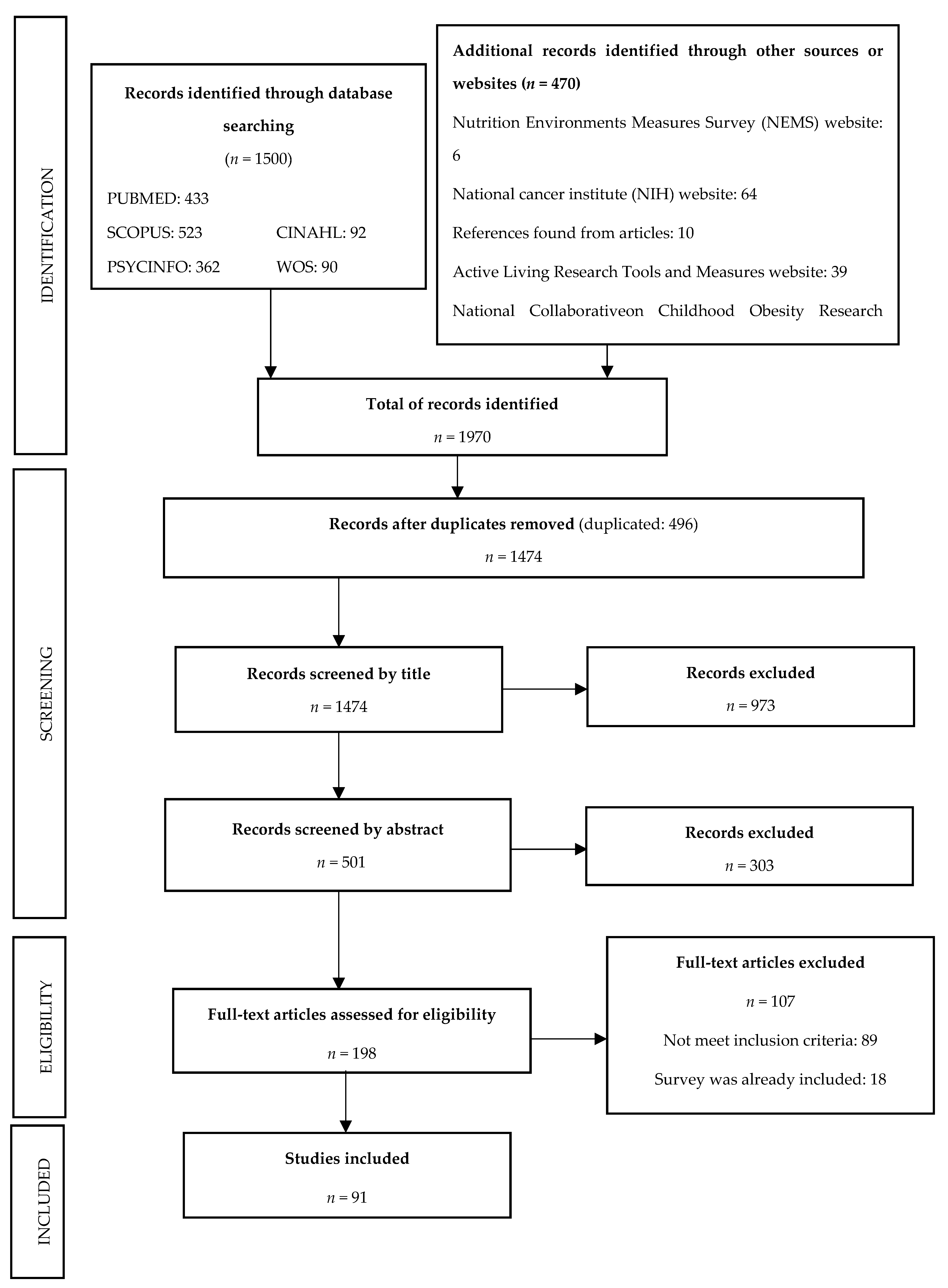
2.3. Study Selection
2.4. Organisation of the Information
3. Results
3.1. General Characteristics of the Instruments
3.2. Food Environment
3.3. Built Environment
3.4. Instruments That Characterised Both Environments
3.5. Reference Instruments for the Development of Others
4. Discussion
Limitations
5. Conclusions
Author Contributions
Funding
Acknowledgments
Conflicts of Interest
References
- Swinburn, B.; Egger, G. Preventive Strategies against Weight Gain and Obesity. Obes. Rev. 2002, 3, 289–301. [Google Scholar] [CrossRef] [PubMed]
- Swinburn, B.; Egger, G.; Raza, F. Dissecting Obesogenic Environments: The Development and Application of a Framework for Identifying and Prioritizing Environmental Interventions for Obesity. Prev. Med. 1999, 29 (Pt 1), 563–570. [Google Scholar] [CrossRef]
- Glanz, K.; Sallis, J.F.; Saelens, B.E.; Frank, L.D. Healthy Nutrition Environments: Concepts and Measures. Am. J. Health Promot. 2005, 19, 330–333. [Google Scholar] [CrossRef]
- Lake, A.; Townshend, T. Obesogenic Environments: Exploring the Built and Food Environments. J. R. Soc. Promot. Health 2006, 126, 262–267. [Google Scholar] [CrossRef] [PubMed]
- Cummins, S.; Macintyre, S. Food Environments and Obesity—Neighbourhood or Nation? Int. J. Epidemiol. 2006, 35, 100–104. [Google Scholar] [CrossRef]
- Handy, S.L.; Boarnet, M.G.; Ewing, R.; Killingsworth, R.E. How the Built Environment Affects Physical Activity: Views from Urban Planning. Am. J. Prev. Med. 2002, 23 (Suppl. 2), 64–73. [Google Scholar] [PubMed]
- Thornton, L.E.; Pearce, J.R.; Kavanagh, A.M. Using Geographic Information Systems (GIS) to Assess the Role of the Built Environment in Influencing Obesity: A Glossary. Int. J. Behav. Nutr. Phys. Act. 2011, 8, 71. [Google Scholar] [CrossRef]
- Townshend, T.; Lake, A. Obesogenic Environments: Current Evidence of the Built and Food Environments. Perspect. Public Health 2017, 137, 38–44. [Google Scholar] [CrossRef] [PubMed]
- Tricco, A.C.; Lillie, E.; Zarin, W.; O’Brien, K.K.; Colquhoun, H.; Levac, D.; Moher, D.; Peters, M.D.J.; Horsley, T.; Weeks, L.; et al. PRISMA Extension for Scoping Reviews (PRISMA-ScR): Checklist and Explanation. Ann. Intern. Med. 2018, 169, 467–473. [Google Scholar] [CrossRef] [PubMed]
- Munn, Z.; Peters, M.D.J.; Stern, C.; Tufanaru, C.; McArthur, A.; Aromataris, E. Systematic review or scoping review? Guidance for authors when choosing between a systematic or scoping review approach. BMC Med. Res. Methodol. 2018, 18, 143. [Google Scholar] [CrossRef] [PubMed]
- Arksey, H.; O’Malley, L. Scoping Studies: Towards a Methodological Framework. Int. J. Soc. Res. Methodol. 2005, 8, 19–32. [Google Scholar] [CrossRef]
- The Joanna Briggs Institute. Joanna Briggs Institute Reviewers’ Manual: Methodology for JBI Scoping Reviews; The University of Adelaide: South Australia, Australia, 2015. [Google Scholar]
- National Cancer Institute (NCI). Available online: https://www.nih.gov/about-nih/what-we-do/nih-almanac/national-cancer-institute-nci (accessed on 4 March 2019).
- Lytle, L.A.; Sokol, R.L. Measures of the Food Environment: A Systematic Review of the Field, 2007-2015. Health Place 2017, 44, 18–34. [Google Scholar] [CrossRef] [PubMed]
- Oldenburg, B.; Sallis, J.F.; Harris, D.; Owen, N. Checklist of Health Promotion Environments at Worksites (CHEW): Development and Measurement Characteristics. Am. J. Health Promot. 2002, 16, 288–299. [Google Scholar] [CrossRef]
- Abarca, J.; Ramachandran, S. Using Community Indicators to Assess Nutrition in Arizona-Mexico Border Communities. Prev. Chronic Dis. 2005, 2, A06. [Google Scholar]
- Sloane, D.C.; Diamant, A.L.; Lewis, L.B.; Yancey, A.K.; Flynn, G.; Nascimento, L.M.; McCarthy, W.J.; Guinyard, J.J.; Cousineau, M.R. Improving the Nutritional Resource Environment for Healthy Living Through Community-Based Participatory Research. J. Gen. Intern. Med. 2003, 18, 568–575. [Google Scholar] [CrossRef] [PubMed]
- Baker, E.A.; Schootman, M.; Barnidge, E.; Kelly, C. The Role of Race and Poverty in Access to Foods That Enable Individuals to Adhere to Dietary Guidelines. Prev. Chronic Dis. 2006, 3, 1–11. [Google Scholar]
- Winkler, E.; Turrell, G.; Patterson, C. Does Living in a Disadvantaged Area Entail Limited Opportunities to Purchase Fresh Fruit and Vegetables in Terms of Price, Availability, and Variety? Findings from the Brisbane Food Study. Health Place 2006, 12, 741–748. [Google Scholar] [CrossRef] [PubMed]
- Zenk, S.N.; Grigsby-Toussaint, D.S.; Curry, S.J.; Berbaum, M.; Schneider, L. Short-Term Temporal Stability in Observed Retail Food Characteristics. J. Nutr. Educ. Behav. 2010, 42, 26–32. [Google Scholar] [CrossRef]
- Anderson, A.S.; Dewar, J.; Marshall, D.; Cummins, S.; Taylor, M.; Dawson, J.; Sparks, L. The Development of a Healthy Eating Indicator Shopping Basket Tool (HEISB) for Use in Food Access Studies—Identification of Key Food Items. Public Health Nutr. 2007, 10, 1440–1447. [Google Scholar] [CrossRef]
- Glanz, K.; Sallis, J.F.; Saelens, B.E.; Frank, L.D. Nutrition Environment Measures Survey in Stores (NEMS-S): Development and Evaluation. Am. J. Prev. Med. 2007, 32, 282–289. [Google Scholar] [CrossRef] [PubMed]
- Saelens, B.E.; Glanz, K.; Sallis, J.F.; Frank, L.D. Nutrition Environment Measures Study in Restaurants (NEMS-R): Development and Evaluation. Am. J. Prev. Med. 2007, 32, 273–281. [Google Scholar] [CrossRef] [PubMed]
- Liese, A.D.; Weis, K.E.; Pluto, D.; Smith, E.; Lawson, A. Food Store Types, Availability, and Cost of Foods in a Rural Environment. J. Am. Diet. Assoc. 2007, 107, 1916–1923. [Google Scholar] [CrossRef]
- Mujahid, M.S.; Diez Roux, A.V.; Morenoff, J.D.; Raghunathan, T. Assessing the Measurement Properties of Neighborhood Scales: From Psychometrics to Ecometrics. Am. J. Epidemiol. 2007, 165, 858–867. [Google Scholar] [CrossRef]
- Shimotsu, S.T.; French, S.A.; Gerlach, A.F.; Hannan, P.J. Worksite Environment Physical Activity and Healthy Food Choices: Measurement of the Worksite Food and Physical Activity Environment at Four Metropolitan Bus Garages. Int. J. Behav. Nutr. Phys. Act. 2007, 4, 17. [Google Scholar] [CrossRef]
- DeJoy, D.M.; Wilson, M.G.; Goetzel, R.Z.; Ozminkowski, R.J.; Wang, S.; Baker, K.M.; Bowen, H.M.; Tully, K.J. Development of the Environmental Assessment Tool (EAT) to Measure Organizational Physical and Social Support for Worksite Obesity Prevention Programs. J. Occup. Environ. Med. 2008, 50, 126–137. [Google Scholar] [CrossRef]
- Tessier, S.; Traissac, P.; Maire, B.; Bricas, N.; Eymard-Duvernay, S.; El Ati, J.; Delpeuch, F. Regular Users of Supermarkets in Greater Tunis Have a Slightly Improved Diet Quality. J. Nutr. 2008, 138, 768–774. [Google Scholar] [CrossRef][Green Version]
- Izumi, B.T.; Zenk, S.N.; Schulz, A.J.; Mentz, G.B.; Sand, S.L.; de Majo, R.F.; Wilson, C.; Odoms-Young, A. Inter-Rater Reliability of the Food Environment Audit for Diverse Neighborhoods (FEAD-N). J. Urban Health 2012, 89, 486–499. [Google Scholar] [CrossRef][Green Version]
- Ball, K.; Timperio, A.; Crawford, D. Neighbourhood Socioeconomic Inequalities in Food Access and Affordability. Health Place 2009, 15, 578–585. [Google Scholar] [CrossRef]
- Cappelleri, J.C.; Bushmakin, A.G.; Gerber, R.A.; Leidy, N.K.; Sexton, C.C.; Karlsson, J.; Lowe, M.R. Evaluating the Power of Food Scale in Obese Subjects and a General Sample of Individuals: Development and Measurement Properties. Int. J. Obes. 2009, 33, 913–922. [Google Scholar] [CrossRef] [PubMed]
- Freedman, D.A. Local Food Environments: They’re All Stocked Differently. Am. J. Community Psychol. 2009, 44, 382–393. [Google Scholar] [CrossRef] [PubMed]
- French, S.A.; Wall, M.; Mitchell, N.R.; Shimotsu, S.T.; Welsh, E. Annotated Receipts Capture Household Food Purchases from a Broad Range of Sources. Int. J. Behav. Nutr. Phys. Act. 2009, 6, 37. [Google Scholar] [CrossRef]
- Fulkerson, J.A.; Nelson, M.C.; Lytle, L.; Moe, S.; Heitzler, C.; Pasch, K.E. The Validation of a Home Food Inventory. Int. J. Behav. Nutr. Phys. Act. 2008, 5, 55. [Google Scholar] [CrossRef]
- Song, H.-J.; Gittelsohn, J.; Kim, M.; Suratkar, S.; Sharma, S.; Anliker, J. A Corner Store Intervention in a Low-Income Urban Community Is Associated with Increased Availability and Sales of Some Healthy Foods. Public Health Nutr. 2009, 12, 2060–2067. [Google Scholar] [CrossRef]
- Nelson, M.C.; Story, M. Food Environments in University Dorms: 20,000 Calories per Dorm Room and Counting. Am. J. Prev. Med. 2009, 36, 523–526. [Google Scholar] [CrossRef]
- Minaker, L.M.; Raine, K.D.; Cash, S.B. Measuring the Food Service Environment: Development and Implementation of Assessment Tools. Can. J. Public Health 2009, 100, 421–425. [Google Scholar]
- Franzen, L.; Smith, C. Food System Access, Shopping Behavior, and Influences on Purchasing Groceries in Adult Hmong Living in Minnesota. Am. J. Health Promot. 2010, 24, 396–409. [Google Scholar] [CrossRef]
- Farley, T.A.; Baker, E.T.; Futrell, L.; Rice, J.C. The Ubiquity of Energy-Dense Snack Foods: A National Multicity Study. Am. J. Public Health 2010, 100, 306–311. [Google Scholar] [CrossRef]
- Gloria, C.T.; Steinhardt, M.A. Texas Nutrition Environment Assessment of Retail Food Stores (TxNEA-S): Development and Evaluation. Public Health Nutr. 2010, 13, 1764–1772. [Google Scholar] [CrossRef]
- Lucan, S.C.; Karpyn, A.; Sherman, S. Storing Empty Calories and Chronic Disease Risk: Snack-Food Products, Nutritive Content, and Manufacturers in Philadelphia Corner Stores. J. Urban Health 2010, 87, 394–409. [Google Scholar] [CrossRef]
- Lake, A.A.; Burgoine, T.; Greenhalgh, F.; Stamp, E.; Tyrrell, R. The Foodscape: Classification and Field Validation of Secondary Data Sources. Health Place 2010, 16, 666–673. [Google Scholar] [CrossRef]
- Lee, S.H.; Rowan, M.T.; Powell, L.M.; Newman, S.; Klassen, A.C.; Frick, K.D.; Anderson, J.; Gittelsohn, J. Characteristics of Prepared Food Sources in Low-Income Neighborhoods of Baltimore City. Ecol. Food Nutr. 2010, 49, 409–430. [Google Scholar] [CrossRef] [PubMed]
- Ghirardelli, A.; Quinn, V.; Sugerman, S. Reliability of a Retail Food Store Survey and Development of an Accompanying Retail Scoring System to Communicate Survey Findings and Identify Vendors for Healthful Food and Marketing Initiatives. J. Nutr. Educ. Behav. 2011, 43 (Suppl. 2), S104–S112. [Google Scholar] [CrossRef] [PubMed]
- Gordon, C.; Purciel-Hill, M.; Ghai, N.R.; Kaufman, L.; Graham, R.; Van Wye, G. Measuring Food Deserts in New York City’s Low-Income Neighborhoods. Health Place 2011, 17, 696–700. [Google Scholar] [CrossRef]
- Gustafson, A.A.; Sharkey, J.; Samuel-Hodge, C.D.; Jones-Smith, J.; Folds, M.C.; Cai, J.; Ammerman, A.S. Perceived and Objective Measures of the Food Store Environment and the Association with Weight and Diet among Low-Income Women in North Carolina. Public Health Nutr. 2011, 14, 1032–1038. [Google Scholar] [CrossRef]
- Hosler, A.S.; Dharssi, A. Reliability of a Survey Tool for Measuring Consumer Nutrition Environment in Urban Food Stores. J. Public Health Manag. Pract. 2011, 17, E1–E8. [Google Scholar] [CrossRef]
- Stevens, J.; Bryant, M.; Wang, L.; Borja, J.; Bentley, M.E. Exhaustive Measurement of Food Items in the Home Using a Universal Product Code Scanner. Public Health Nutr. 2011, 14, 314–318. [Google Scholar] [CrossRef]
- Suratkar, S.; Gittelsohn, J.; Song, H.-J.; Anliker, J.A.; Sharma, S.; Mattingly, M. Food Insecurity Is Associated with Food-Related Psychosocial Factors and Behaviors Among Low-Income African American Adults in Baltimore City. J. Hunger Environ. Nutr. 2010, 5, 100–119. [Google Scholar] [CrossRef]
- Emond, J.A.; Madanat, H.N.; Ayala, G.X. Do Latino and Non-Latino Grocery Stores Differ in the Availability and Affordability of Healthy Food Items in a Low-Income, Metropolitan Region? Public Health Nutr. 2012, 15, 360–369. [Google Scholar] [CrossRef]
- Whitehouse, A.; Simon, A.; French, S.A.; Wolfson, J. Availability of Snacks, Candy and Beverages in Hospital, Community Clinic and Commercial Pharmacies. Public Health Nutr. 2012, 15, 1117–1123. [Google Scholar] [CrossRef]
- Voss, C.; Klein, S.; Glanz, K.; Clawson, M. Nutrition Environment Measures Survey-Vending: Development, Dissemination, and Reliability. Health Promot. Pract. 2012, 13, 425–430. [Google Scholar] [CrossRef] [PubMed]
- Kelly, B.; Flood, V.M.; Bicego, C.; Yeatman, H. Derailing Healthy Choices: An Audit of Vending Machines at Train Stations in NSW. Health Promot. J. Aust. 2012, 23, 73–75. [Google Scholar] [CrossRef]
- Kersten, E.; Laraia, B.; Kelly, M.; Adler, N.; Yen, I.H. Small Food Stores and Availability of Nutritious Foods: A Comparison of Database and in-Store Measures, Northern California, 2009. Prev. Chronic Dis. 2012, 9, E127. [Google Scholar] [CrossRef] [PubMed]
- Cavanaugh, E.; Mallya, G.; Brensinger, C.; Tierney, A.; Glanz, K. Nutrition Environments in Corner Stores in Philadelphia. Prev. Med. 2013, 56, 149–151. [Google Scholar] [CrossRef] [PubMed]
- Hoehner, C.M.; Budd, E.L.; Marx, C.M.; Dodson, E.A.; Brownson, R.C. Development and Reliability Testing of the Worksite and Energy Balance Survey. J. Public Health Manag. Pract. 2013, 19 (Suppl. 1), S105–S113. [Google Scholar] [CrossRef]
- Krukowski, R.A.; Sparks, C.; DiCarlo, M.; McSweeney, J.; West, D.S. There’s More to Food Store Choice than Proximity: A Questionnaire Development Study. BMC Public Health 2013, 13, 586. [Google Scholar] [CrossRef]
- Pomerleau, J.; Knai, C.; Foster, C.; Rutter, H.; Darmon, N.; Derflerova Brazdova, Z.; Hadziomeragic, A.F.; Pekcan, G.; Pudule, I.; Robertson, A.; et al. Measuring the Food and Built Environments in Urban Centres: Reliability and Validity of the EURO-PREVOB Community Questionnaire. Public Health 2013, 127, 259–267. [Google Scholar] [CrossRef]
- Bethlehem, J.R.; Mackenbach, J.D.; Ben-Rebah, M.; Compernolle, S.; Glonti, K.; Bárdos, H.; Rutter, H.R.; Charreire, H.; Oppert, J.-M.; Brug, J.; et al. The SPOTLIGHT Virtual Audit Tool: A Valid and Reliable Tool to Assess Obesogenic Characteristics of the Built Environment. Int. J. Health Geogr. 2014, 13. [Google Scholar] [CrossRef]
- Green, S.H.; Glanz, K. Development of the Perceived Nutrition Environment Measures Survey. Am. J. Prev. Med. 2015, 49, 50–61. [Google Scholar] [CrossRef] [PubMed]
- Lo, B.K.C.; Minaker, L.; Chan, A.N.T.; Hrgetic, J.; Mah, C.L. Adaptation and Validation of a Nutrition Environment Measures Survey for University Grab-and-Go Establishments. Can. J. Diet. Pract. Res. 2016, 77, 17–24. [Google Scholar] [CrossRef] [PubMed]
- Ruff, R.R.; Akhund, A.; Adjoian, T. Small Convenience Stores and the Local Food Environment: An Analysis of Resident Shopping Behavior Using Multilevel Modeling. Am. J. Health Promot. 2016, 30, 172–180. [Google Scholar] [CrossRef] [PubMed]
- DeWeese, R.S.; Todd, M.; Karpyn, A.; Yedidia, M.J.; Kennedy, M.; Bruening, M.; Wharton, C.M.; Ohri-Vachaspati, P. Short-Form Audit Instrument for Assessing Corner Store Healthfulness. Am. J. Health Promot. 2018, 32, 224–232. [Google Scholar] [CrossRef]
- Pikora, T.J.; Bull, F.C.L.; Jamrozik, K.; Knuiman, M.; Giles-Corti, B.; Donovan, R.J. Developing a Reliable Audit Instrument to Measure the Physical Environment for Physical Activity. Am. J. Prev. Med. 2002, 23, 187–194. [Google Scholar] [CrossRef]
- Kirtland, K.A.; Porter, D.E.; Addy, C.L.; Neet, M.J.; Williams, J.E.; Sharpe, P.A.; Neff, L.J.; Kimsey, C.D.; Ainsworth, B.E. Environmental Measures of Physical Activity Supports: Perception versus Reality. Am. J. Prev. Med. 2003, 24, 323–331. [Google Scholar] [CrossRef]
- Saelens, B.E.; Sallis, J.F.; Black, J.B.; Chen, D. Neighborhood-Based Differences in Physical Activity: An Environment Scale Evaluation. Am. J. Public Health 2003, 93, 1552–1558. [Google Scholar] [CrossRef] [PubMed]
- Evaluation on reliability and validity of Chinese Walkable Environment Scale for urban community residents. Chin. J. Public Health 2011, 7. Available online: http://en.cnki.com.cn/Article_en/CJFDTOTAL-ZGGW201107013.htm (accessed on 6 March 2019).
- Malavasi, L.M.; Duarte, M.F.S.; Both, J.; Reis, R.S. Escala de mobilidade ativa no ambiente comunitário - NEWS Brasil: retradução e reprodutibilidade. Rev. Bras. Cineantropom Desempenho Hum. 2007, 9, 339–350. [Google Scholar]
- Oyeyemi, A.L.; Conway, T.L.; Adedoyin, R.A.; Akinroye, K.K.; Aryeetey, R.; Assah, F.; Cain, K.L.; Gavand, K.A.; Kasoma, S.S.; Kolbe-Alexander, T.L.; et al. Construct Validity of the Neighborhood Environment Walkability Scale for Africa. Med. Sci. Sports Exerc. 2017, 49, 482–491. [Google Scholar] [CrossRef] [PubMed]
- Adlakha, D.; Hipp, J.A.; Brownson, R.C. Adaptation and Evaluation of the Neighborhood Environment Walkability Scale in India (NEWS-India). Int. J. Environ. Res. Public Health 2016, 13, 401. [Google Scholar] [CrossRef]
- Reliability of Two Instruments for Auditing the Environment for Physical Activity | Active Living Research. Available online: https://activelivingresearch.org/reliability-two-instruments-auditing-environment-physical-activity (accessed on 5 March 2019).
- Craig, C.L.; Marshall, A.L.; Sjöström, M.; Bauman, A.E.; Booth, M.L.; Ainsworth, B.E.; Pratt, M.; Ekelund, U.; Yngve, A.; Sallis, J.F.; et al. International Physical Activity Questionnaire: 12-Country Reliability and Validity. Med. Sci. Sports Exerc. 2003, 35, 1381–1395. [Google Scholar] [CrossRef]
- Lee, P.H.; Macfarlane, D.J.; Lam, T.; Stewart, S.M. Validity of the International Physical Activity Questionnaire Short Form (IPAQ-SF): A Systematic Review. Int. J. Behav. Nutr. Phys. Act. 2011, 8, 115. [Google Scholar] [CrossRef]
- International Physical Activity Questionnaire. Available online: https://sites.google.com/site/theipaq/ (accessed on 5 March 2019).
- Emery, J.; Crump, C.; Bors, P. Reliability and Validity of Two Instruments Designed to Assess the Walking and Bicycling Suitability of Sidewalks and Roads. Am. J. Health Promot. 2003, 18, 38–46. [Google Scholar] [CrossRef] [PubMed]
- Huston, S.L.; Evenson, K.R.; Bors, P.; Gizlice, Z. Neighborhood Environment, Access to Places for Activity, and Leisure-Time Physical Activity in a Diverse North Carolina Population. Am. J. Health Promot. 2003, 18, 58–69. [Google Scholar] [CrossRef]
- Clifton, K.J.; Livi Smith, A.D.; Rodriguez, D. The Development and Testing of an Audit for the Pedestrian Environment. Landsc. Urban Plan. 2007, 80, 95–110. [Google Scholar] [CrossRef]
- Humpel, N.; Marshall, A.L.; Leslie, E.; Bauman, A.; Owen, N. Changes in Neighborhood Walking Are Related to Changes in Perceptions of Environmental Attributes. Ann. Behav. Med. 2004, 27, 60–67. [Google Scholar] [CrossRef] [PubMed]
- Rodrĺguez, D.A.; Joo, J. The Relationship between Non-Motorized Mode Choice and the Local Physical Environment. Transp. Res. Part D Transp. Environ. 2004, 9, 151–173. [Google Scholar] [CrossRef]
- Bedimo-Rung, A.L.; Gustat, J.; Tompkins, B.J.; Rice, J.; Thomson, J. Development of a Direct Observation Instrument to Measure Environmental Characteristics of Parks for Physical Activity. J. Phys. Act Health 2006, 3, S176–S189. [Google Scholar] [CrossRef] [PubMed]
- Lee, R.E.; Booth, K.M.; Reese-Smith, J.Y.; Regan, G.; Howard, H.H. The Physical Activity Resource Assessment (PARA) Instrument: Evaluating Features, Amenities and Incivilities of Physical Activity Resources in Urban Neighborhoods. Int. J. Behav. Nutr. Phys. Act. 2005, 2, 13. [Google Scholar] [CrossRef]
- Armstrong, T.; Bull, F. Development of the World Health Organization Global Physical Activity Questionnaire (GPAQ). J. Public Health 2006, 14, 66–70. [Google Scholar] [CrossRef]
- Boarnet, M.G.; Day, K.; Alfonzo, M.; Forsyth, A.; Oakes, M. The Irvine-Minnesota Inventory to Measure Built Environments: Reliability Tests. Am. J. Prev. Med. 2006, 30, 153–159. [Google Scholar] [CrossRef] [PubMed]
- Boehmer, T.K.; Lovegreen, S.L.; Haire-Joshu, D.; Brownson, R.C. What Constitutes an Obesogenic Environment in Rural Communities? Am. J. Health Promot. 2006, 20, 411–421. [Google Scholar] [CrossRef] [PubMed]
- Brownson, R.C.; Chang, J.J.; Eyler, A.A.; Ainsworth, B.E.; Kirtland, K.A.; Saelens, B.E.; Sallis, J.F. Measuring the Environment for Friendliness toward Physical Activity: A Comparison of the Reliability of 3 Questionnaires. Am. J. Public Health 2004, 94, 473–483. [Google Scholar] [CrossRef]
- Giles-Corti, B.; Timperio, A.; Cutt, H.; Pikora, T.J.; Bull, F.C.L.; Knuiman, M.; Bulsara, M.; Van Niel, K.; Shilton, T. Development of a Reliable Measure of Walking within and Outside the Local Neighborhood: RESIDE’s Neighborhood Physical Activity Questionnaire. Prev. Med. 2006, 42, 455–459. [Google Scholar] [CrossRef]
- Handy, S.; Cao, X.; Mokhtarian, P.L. Self-Selection in the Relationship between the Built Environment and Walking: Empirical Evidence from Northern California. J. Am. Plan. Assoc. 2006, 72, 55–74. [Google Scholar] [CrossRef]
- McKenzie, T.L.; Cohen, D.A.; Sehgal, A.; Williamson, S.; Golinelli, D. System for Observing Play and Recreation in Communities (SOPARC): Reliability and Feasibility Measures. J. Phys. Act. Health 2006, 3 (Suppl. 1), S208–S222. [Google Scholar] [CrossRef]
- Troped, P.J.; Cromley, E.K.; Fragala, M.S.; Melly, S.J.; Hasbrouck, H.H.; Gortmaker, S.L.; Brownson, R.C. Development and Reliability and Validity Testing of an Audit Tool for Trail/Path Characteristics: The Path Environment Audit Tool (PEAT). J. Phys. Act. Health 2006, 3, S158–S175. [Google Scholar] [CrossRef] [PubMed]
- Hoehner, C.M.; Ivy, A.; Ramirez, L.K.B.; Handy, S.; Brownson, R.C. Active Neighborhood Checklist: A User-Friendly and Reliable Tool for Assessing Activity Friendliness. Am. J. Health Promot. 2007, 21, 534–537. [Google Scholar] [CrossRef] [PubMed]
- Forman, H.; Kerr, J.; Norman, G.J.; Saelens, B.E.; Durant, N.H.; Harris, S.K.; Sallis, J.F. Reliability and Validity of Destination-Specific Barriers to Walking and Cycling for Youth. Prev. Med. 2008, 46, 311–316. [Google Scholar] [CrossRef]
- Ogilvie, D.; Mitchell, R.; Mutrie, N.; Petticrew, M.; Platt, S. Perceived Characteristics of the Environment Associated with Active Travel: Development and Testing of a New Scale. Int. J. Behav. Nutr. Phys. Act. 2008, 5, 32. [Google Scholar] [CrossRef] [PubMed]
- Evenson, K.R.; Sotres-Alvarez, D.; Herring, A.H.; Messer, L.; Laraia, B.A.; Rodríguez, D.A. Assessing Urban and Rural Neighborhood Characteristics Using Audit and GIS Data: Derivation and Reliability of Constructs. Int. J. Behav. Nutr. Phys. Act. 2009, 6, 44. [Google Scholar] [CrossRef] [PubMed]
- Forsyth, A.; Oakes, J.M.; Schmitz, K.H. Test–retest Reliability of the Twin Cities Walking Survey. J. Phys. Act. Health 2009, 6, 119–131. [Google Scholar] [CrossRef]
- Purciel, M.; Neckerman, K.M.; Lovasi, G.S.; Quinn, J.W.; Weiss, C.; Bader, M.D.M.; Ewing, R.; Rundle, A. Creating and Validating GIS Measures of Urban Design for Health Research. J. Environ. Psychol. 2009, 29, 457–466. [Google Scholar] [CrossRef]
- Spittaels, H.; Verloigne, M.; Gidlow, C.; Gloanec, J.; Titze, S.; Foster, C.; Oppert, J.-M.; Rutter, H.; Oja, P.; Sjöström, M.; et al. Measuring Physical Activity-Related Environmental Factors: Reliability and Predictive Validity of the European Environmental Questionnaire ALPHA. Int. J. Behav. Nutr. Phys. Act. 2010, 7, 48. [Google Scholar] [CrossRef] [PubMed]
- Yousefian, A.; Hennessy, E.; Umstattd, M.R.; Economos, C.D.; Hallam, J.S.; Hyatt, R.R.; Hartley, D. Development of the Rural Active Living Assessment Tools: Measuring Rural Environments. Prev. Med. 2010, 50 (Suppl. 1), S86–S92. [Google Scholar] [CrossRef] [PubMed]
- Blunt, G.H.; Hallam, J.S. The Worksite Supportive Environments for Active Living Survey: Development and Psychometric Properties. Am. J. Health Promot. 2010, 25, 48–57. [Google Scholar] [CrossRef]
- Kaiser, B.L.; Brown, R.L.; Baumann, L.C. Perceived Influences on Physical Activity and Diet in Low-Income Adults from Two Rural Counties. Nurs. Res. 2010, 59, 67–75. [Google Scholar] [CrossRef] [PubMed]
- Frank, L.D.; Sallis, J.F.; Saelens, B.E.; Leary, L.; Cain, K.; Conway, T.L.; Hess, P.M. The Development of a Walkability Index: Application to the Neighborhood Quality of Life Study. Br. J. Sports Med. 2010, 44, 924–933. [Google Scholar] [CrossRef]
- Sallis, J.F.; Kerr, J.; Carlson, J.A.; Norman, G.J.; Saelens, B.E.; Durant, N.; Ainsworth, B.E. Evaluating a Brief Self-Report Measure of Neighborhood Environments for Physical Activity Research and Surveillance: Physical Activity Neighborhood Environment Scale (PANES). J. Phys. Act. Health 2010, 7, 533–540. [Google Scholar] [CrossRef] [PubMed]
- Oyeyemi, A.L.; Sallis, J.F.; Oyeyemi, A.Y.; Amin, M.M.; De Bourdeaudhuij, I.; Deforche, B. Adaptation, Test–retest Reliability, and Construct Validity of the Physical Activity Neighborhood Environment Scale in Nigeria (PANES-N). J. Phys. Act. Health 2013, 10, 1079–1090. [Google Scholar] [CrossRef]
- International physical activity questionnaire. 2018. Available online: https://sites.google.com/site/theipaq/references (accessed on 14 May 2018).
- Sallis, J.F. Physical Activity Neighborhood Environment Survey (PANES). Available online: http://sallis.ucsd.edu/measure_panes.html (accessed on 14 May 2018).
- Spruijt-Metz, D.; Wolch, J.; Jerrett, M.; Byrne, J.; Hsieh, S.; Myles, R.; Xie, B.; Wang, L.; Chou, C.-P.; Reynolds, K.D. Development, Reliability, and Validity of an Urban Trail Use Survey. Am. J. Health Promot. 2010, 25, 2–11. [Google Scholar] [CrossRef]
- Wahlgren, L.; Schantz, P. Bikeability and Methodological Issues Using the Active Commuting Route Environment Scale (ACRES) in a Metropolitan Setting. BMC Med. Res. Methodol. 2011, 11, 6. [Google Scholar] [CrossRef] [PubMed]
- Kaczynski, A.T.; Wilhelm Stanis, S.A.; Besenyi, G.M. Development and Testing of a Community Stakeholder Park Audit Tool. Am. J. Prev. Med. 2012, 42, 242–249. [Google Scholar] [CrossRef] [PubMed]
- Umstattd, M.R.; Baller, S.L.; Hennessy, E.; Hartley, D.; Economos, C.D.; Hyatt, R.R.; Yousefian, A.; Hallam, J.S. Development of the Rural Active Living Perceived Environmental Support Scale (RALPESS). J. Phys. Act. Health 2012, 9, 724–730. [Google Scholar] [CrossRef]
- Adams, E.J.; Goodman, A.; Sahlqvist, S.; Bull, F.C.; Ogilvie, D. Correlates of Walking and Cycling for Transport and Recreation: Factor Structure, Reliability and Behavioural Associations of the Perceptions of the Environment in the Neighbourhood Scale (PENS). Int. J. Behav. Nutr. Phys. Act. 2013, 10, 87. [Google Scholar] [CrossRef]
- Duncan, M.J.; Rashid, M.; Vandelanotte, C.; Cutumisu, N.; Plotnikoff, R.C. Development and Reliability Testing of a Self-Report Instrument to Measure the Office Layout as a Correlate of Occupational Sitting. Int. J. Behav. Nutr. Phys. Act. 2013, 10, 16. [Google Scholar] [CrossRef]
- SOPARNA: System for Observing Physical Activity and Recreation in Natural Areas|Active Living Research. Available online: https://activelivingresearch.org/soparna-system-observing-physical-activity-and-recreation-natural-areas (accessed on 6 March 2019).
- Malecki, K.C.; Engelman, C.D.; Peppard, P.E.; Nieto, F.J.; Grabow, M.L.; Bernardinello, M.; Bailey, E.; Bersch, A.J.; Walsh, M.C.; Lo, J.Y.; et al. The Wisconsin Assessment of the Social and Built Environment (WASABE): A Multi-Dimensional Objective Audit Instrument for Examining Neighborhood Effects on Health. BMC Public Health 2014, 14, 1165. [Google Scholar] [CrossRef]
- Drewnowski, A.; Aggarwal, A.; Rehm, C.D.; Cohen-Cline, H.; Hurvitz, P.M.; Moudon, A.V. Environments Perceived as Obesogenic Have Lower Residential Property Values. Am. J. Prev. Med. 2014, 47, 260–274. [Google Scholar] [CrossRef][Green Version]
- Sallis, J.F. Is Your Neighborhood Designed to Support Physical Activity? A Brief Streetscape Audit Tool. Prev. Chronic Dis. 2015, 12. [Google Scholar] [CrossRef]
- Cain, K.L.; Gavand, K.A.; Conway, T.L.; Geremia, C.M.; Millstein, R.A.; Frank, L.D.; Saelens, B.E.; Adams, M.A.; Glanz, K.; King, A.C.; et al. Developing and Validating an Abbreviated Version of the Microscale Audit for Pedestrian Streetscapes (MAPS-Abbreviated). J. Transp. Health 2017, 5, 84–96. [Google Scholar] [CrossRef] [PubMed]
- McKinnon, R.A.; Reedy, J.; Morrissette, M.A.; Lytle, L.A.; Yaroch, A.L. Measures of the Food Environment: A Compilation of the Literature, 1990–2007. Am. J. Prev. Med. 2009, 36 (Suppl. 4), S124–S133. [Google Scholar] [CrossRef]
- Glanz, K.; Johnson, L.; Yaroch, A.L.; Phillips, M.; Ayala, G.X.; Davis, E.L. Measures of Retail Food Store Environments and Sales: Review and Implications for Healthy Eating Initiatives. J. Nutr. Educ. Behav. 2016, 48, 280–288.e1. [Google Scholar] [CrossRef]
- Mackenbach, J.D.; Lakerveld, J.; van Lenthe, F.J.; Bárdos, H.; Glonti, K.; Compernolle, S.; De Bourdeaudhuij, I.; Oppert, J.-M.; Roda, C.; Rutter, H.; et al. Exploring Why Residents of Socioeconomically Deprived Neighbourhoods Have Less Favourable Perceptions of Their Neighbourhood Environment than Residents of Wealthy Neighbourhoods. Obes. Rev. 2016, 17 (Suppl. 1), 42–52. [Google Scholar] [CrossRef]
- Shaver, E.R.; Sadler, R.C.; Hill, A.B.; Bell, K.; Ray, M.; Choy-Shin, J.; Lerner, J.; Soldner, T.; Jones, A.D. The Flint Food Store Survey: Combining Spatial Analysis with a Modified Nutrition Environment Measures Survey in Stores (NEMS-S) to Measure the Community and Consumer Nutrition Environments. Public Health Nutr. 2018, 21, 1474–1485. [Google Scholar] [CrossRef]
- Camden, A.; Levy, J.; Bassil, K.; Vanderlinden, L.; Barnett, O.W.; Minaker, L.M.; Mulligan, K.; Campbell, M. A Census of Midsize to Large Supermarkets in Toronto: A Cross-Sectional Analysis of the Consumer Nutrition Environment. J. Nutr. Educ. Behav. 2018, 50, 573–581. [Google Scholar] [CrossRef] [PubMed]
- Lindberg, R.; Sidebottom, A.C.; McCool, B.; Pereira, R.F.; Sillah, A.; Boucher, J.L. Changing the Restaurant Food Environment to Improve Cardiovascular Health in a Rural Community: Implementation and Evaluation of the Heart of New Ulm Restaurant Programme. Public Health Nutr. 2018, 21, 992–1001. [Google Scholar] [CrossRef]
- Díez, J.; Valiente, R.; Ramos, C.; García, R.; Gittelsohn, J.; Franco, M. The Mismatch between Observational Measures and Residents’ Perspectives on the Retail Food Environment: A Mixed-Methods Approach in the Heart Healthy Hoods Study. Public Health Nutr. 2017, 1–10. [Google Scholar] [CrossRef] [PubMed]
- Hearst, M.O.; Fulkerson, J.A.; Parke, M.; Martin, L. Validation of a Home Food Inventory among Low-Income Spanish- and Somali-Speaking Families. Public Health Nutr. 2013, 16, 1151–1158. [Google Scholar] [CrossRef] [PubMed]
- Jilcott Pitts, S.B.; Wu, Q.; Truesdale, K.P.; Laska, M.N.; Grinchak, T.; McGuirt, J.T.; Haynes-Maslow, L.; Bell, R.A.; Ammerman, A.S. Baseline Assessment of a Healthy Corner Store Initiative: Associations between Food Store Environments, Shopping Patterns, Customer Purchases, and Dietary Intake in Eastern North Carolina. Int. J. Environ. Res. Public Health 2017, 14, 1189. [Google Scholar] [CrossRef]
- Global Obesity Observatory|Home. Available online: https://www.worldobesitydata.org/map/overview-adults (accessed on 6 March 2019).
- National Institutes of Health (NIH). Available online: https://www.nih.gov/ (accessed on 6 March 2019).
- Overweight and obesity—BMI statistics—Statistics Explained. Available online: https://ec.europa.eu/eurostat/statistics-explained/index.php/Overweight_and_obesity_-_BMI_statistics (accessed on 6 March 2019).
- Overweight & obesity Overview. Available online: https://www.aihw.gov.au/reports-data/behaviours-risk-factors/overweight-obesity/overview (accessed on 6 March 2019).
- Congdon, P. Variations in Obesity Rates between US Counties: Impacts of Activity Access, Food Environments, and Settlement Patterns. Int. J. Environ. Res. Public Health 2017, 14, 1023. [Google Scholar] [CrossRef] [PubMed]
- Poli, A. The Food Pyramid and the Environmental Pyramid. Barilla Center for Food & Nutrition. 2010. Available online: http://www.fao.org/ag/humannutrition (accessed on 6 March 2019).
- Roda, C.; Charreire, H.; Feuillet, T.; Mackenbach, J.D.; Compernolle, S.; Glonti, K.; Ben Rebah, M.; Bárdos, H.; Rutter, H.; McKee, M.; et al. Mismatch between Perceived and Objectively Measured Environmental Obesogenic Features in European Neighbourhoods. Obes. Rev. 2016, 17 (Suppl. 1), 31–41. [Google Scholar] [CrossRef] [PubMed]
- WHO Regional Office for Europe. Prevention and Control of Noncommunicable Diseases in the European Region: A Progress Report; World Health Organization: Copenhagen, Denmark, 2014. [Google Scholar]
- Visscher, T.L.S.; Lakerveld, J.; Olsen, N.; Küpers, L.; Ramalho, S.; Keaver, L.; Brei, C.; Bjune, J.-I.; Ezquerro, S.; Yumuk, V. Perceived Health Status: Is Obesity Perceived as a Risk Factor and Disease? Obes. Facts 2017, 10, 52–60. [Google Scholar] [CrossRef]

| Database | Search strategy |
|---|---|
| PUBMED | (((obesity[MeSH Terms] OR overweight[MeSH Terms] OR body mass index[MeSH Terms]) AND (environment[MeSH Terms]) AND (adult[MeSH Terms]) AND (surveys and questionnaires[MeSH Terms])) |
| SCOPUS | (TITLE-ABS-KEY (overweight) OR TITLE-ABS-KEY (obesity) OR TITLE-ABS-KEY (body AND mass AND index) AND TITLE-ABS-KEY (environment) AND TITLE-ABS-KEY (adult) AND TITLE-ABS-KEY (surveys AND questionnaires)) |
| PSYCINFO | ((obesity) OR (overweight) OR (body mass index)) AND (environment) AND (adult) AND (survey AND questionnaires) |
| CINAHL | (AB (overweight or obesity or obese) AND AB adults AND AB environment AND AB (survey or questionnaire or scale or instrument) |
| Web Of Science | TOPIC: (obesity OR overweight) AND TOPIC: (environment) AND TOPIC: (adult) AND TOPIC: (surveys and questionnaires) |
| Author (Year) | Instrument | City; Country | Methods | Population/Sample | Environment | Validity | Reliability | Items; Versions | Language | Cultural Adaptation |
|---|---|---|---|---|---|---|---|---|---|---|
| Oldenburg et al. (2002) [15] | Checklist of Health Promotion Environments at Worksites (CHEW) | Australia | Checklist Interview | Workers | Worksite | Face-validity | Inter-rater | 112 | English | No |
| Abarca et al. (2003) [16] | Grocery Store Manager Questions | Arizona; United States/Mexico border communities | Interview/Questionnaire | Grocery store Manager/assistant manager | Food store | No | No | 26 | English Spanish | No |
| Sloane et al. (2003) [17] | Healthy Food Assessment Survey | United States | Checklist | African-American community organizations and community residents in the target areas | Food store | No | No | 31 | English | No |
| Baker et al. (2006) [18] | Grocery Store Audit Tool, Saint Louis University School of Public Health | Saint Louis; United States | Audit checklist | Community supermarkets | Food store | No | No | 92 | English | No |
| Baker et al. (2006) [18] | Fast Food Restaurant Audit Tool, Saint Louis University School of Public Health | Saint Louis; United States | Audit checklist | Community fast food restaurants | Restaurant | No | No | 6 | English | No |
| Winkler et al. (2006) [19] | Micro-level Data Collection Worksheet (conventional food store major) | Brisbane City; Australia | Checklist | Trained data collectors recorded detailed information about the availability, variety, and price of 10 fruits and 10 vegetables from nearly all local supermarkets, greengrocers or convenience stores | Food store | No | No | 66 | English | No |
| Zenk et al. (2006) [20] | Southwest Chicago Food Store Audit Instrument | Southwest Chicago; United States | Checklist | In-person observations of retail food stores at 2 time points, 2 weeks apart | Food store | No | Test–retest | Food list 16 food items | English | No |
| Anderson et al. (2007) [21] | Healthy Eating Indicator Shopping Basket (HEISB) Tool | United Kingdom | Checklist | Five contiguous, racially/ethnically and socioeconomically diverse community areas in southwest Chicago | Food store | No | No | 35 | English | No |
| Glanz et al. (2007) [22] | Nutrition Environment Measures Study in Stores (NEMS-S) | United States | Interview/Questionnaire | Four neighborhoods that represented four possible combinations of neighbourhood walkability (high/low) and socioeconomic status (high/low) Two other neighborhoods (one high-walkability and one lowwalkability) were selected for pretesting measures | Food store | Face-validity; Construct-validity | Inter-rater and test–retest reliability | 93 (11 sections) | English | No |
| Glanz et al. (2007) [23] | Nutrition Environment Measures Study in Restaurants (NEMS-R) | United States | Interview/Questionnaire | Four neighborhoods were selected to provide diversity in community design (walkable versus nonwalkable) and socioeconomic status (higher and lower income). | Restaurants | Construct validity | Inter-rater and test–retest reliability | 25 | English | No |
| Liese et al. (2007) [24] | Food Store Survey | Orangeburg County, South Carolina; United States | Checklist Interview/Questionnaire | Rural county Food stores identified from a database were mapped and presence, location, and store type verified by ground-truthing | Food store | No | Inter-rater reliability | 13 | English | No |
| Mujahid et al. (2007) [25] | Neighborhood Health Questionnaire | Baltimore, Maryland; Forsyth County, North Carolina; and New York, New York; United States | Telephone interview/Questionnaire | Residents at three U.S. study sites | Food store Restaurants | No | Internal consistency and test–retest reliability | 36 | English | No |
| Shimotsu et al. (2007) [26] | Worksite Environment Measure (WEM) * | United States | Checklist | Two trained raters visited each of the four bus garages and independently completed the survey | Worksite | No | Inter-rater reliability | 86 (7 sections) | English | No |
| DeJoy et al. (2008) [27] | Environmental Assessment Tool (EAT) * | United States | Checklist | Section I completed by site staff and Section II completed by independent observers who toured the site and recorded their observations | Worksite | Concurrent validity; Predictive validity | Inter-rater reliability | 105 | English | No |
| Tessier et al. (2008) [28] | “Food supply questionnaire” | Tunis; Africa | Checklist (yes/no) | Food retail outlets | Food store | No | No | 146 | Arabic | No |
| Zenk et al. (2008) [29] | Food Environment Audit for Diverse Neighborhoods (FEAD-N) | Detroit; United States | Checklist | Trained observers conducted observations of 167 food stores | Food store | Face-validity; Construct-validity | Inter-rater reliability | 267 | English | No |
| Ball et al. (2009) [30] | Food Store Survey | Melbourne; Australia | Checklist | Women aged between 18 and 65 years in each of the 45 neighbourhoods | Food store Perceptions food environment | No | No | 53 | English | No |
| Cappelleri et al. (2009) [31] | Power of Food Scale (PFS) | United States | Five-point Likert scale ranging from 1 (do not agree at all) to 5 (strongly agree) | Obese and general population, age not mentioned | Psychological impact of living in food-abundant environments | Content validity | Test–retest reliability; internal consistency | 21 | English | No |
| Freedman et al. (2009) [32] | Grocery store survey Perception of Food Environment Scale | Nashville, TN; United States | Checklist | Anyone (adults) shopping at one of the three farmers’ markets that were established at the Boys and Girls Clubs | Food store | No | No | 33 8 | English | No |
| French et al. (2009) [33] | Annotated Receipts to Capture Household Purchasing | Minneapolis, Minnesota; United States | Inventory | At least one adult and one child in the household, residence in a private house or apartment within 15 miles of the university, and willingness to be randomized to active intervention or control group | Home food environment | No | No | 24 | English | No |
| Fulkerson et al. (2009) [34] | Home Food Inventory (HFI) | Minneapolis, Minnesota; United States | Inventory Yes/no (1/0) response options | Adults and families in which parents completed the HFI | Home food environment | Construct validity; Criterion validity | No | 23 | English Spanish Somali [31] | No |
| Song et al. (2009) [35] | Baltimore Healthy Stores Project Survey | Baltimore; United States | Checklist | Low socioeconomic level | Food store | No | No | 42 | English | No |
| Nelson MC, Story M (2009) [36] | Dorm room food inventory form | Minnesota; United States | Inventory | Dormitory-residing students from public university | Home food environment | No | No | 16 | English | No |
| Minaker et al. (2009) [37] | Assessment tools (food availability and affordability, and establishments) | North America (United States) | Checklist | Food service outlets, (preparing and serving food for immediate consumption), within the geographic boundaries of the campus of the University of Alberta | Restaurants | Face validity; Content validity | No | NM | English | No |
| Franzen, Smith (2010) [38] | Food Survey Tool for Grocery Stores | Minnesota; United States | Checklist | Grocery stores (13 Hmong/Asian and 2 American) | Food store | No | Test–retest reliability | 75 | English | No |
| Futrell et al. (2010) [39] | Food Ubiquity Study | United States | Checklist | Retail stores | Food store | No | No | 7 | English | No |
| Gloria et al. (2010) [40] | Texas Nutrition Environment Assessment (TxNEA) | Austin, Texas; United States | Checklist | Convenience stores and grocery stores in one high-income and one low-income neighbourhood | Food store | Face validity | Inter-rater and test–retest reliability | 21 | English | No |
| Lucan et al. (2010) [41] | Instrument for Corner Store Snack Food Assessment | Philadelphia; United States | Checklist | Snack foods in 17 Philadelphia corner stores, located in three ethnically distinct, low-income school neighborhoods | Food store | No | No | Depending on the products | English | No |
| Lake et al. (2010) [42] | Food Environment Classification Tool | Newcastle-Upon-Tyne; United Kingdom | Classification tool | Establishments selling food and/or food products | Food store | NM | Inter-rater | 21 points, with 77 sub-categories | English | No |
| Lee et al. (2010) [43] | Carry-out/fast food restaurant checklist | Baltimore; United States | Checklist | prepared food sources in low-income neighborhoods | Restaurants | No | No | 31 | English | No |
| Ghirardelli el at (2011) [44] | Communities of Excellence in Nutrition, Physical Activity, and Obesity Prevention (CX3) Food Availability and Marketing Survey | United States | Checklist | Twenty six retail food stores in low-income areas | Food store | Face validity | Inter-rater reliability | 34 | English | No |
| Gordon et al. (2011) [45] | Retail Food Assessment | New York; United States | Checklist | Low-income and largely Black and Hispanic neighborhoods with high levels of premature morbidity and mortality | Food store | No | No | 10 | English | No |
| Gustafson et al. (2011) [46] | Perceived and objective measures of the food store environment | North Carolina; United States | Questionnaire with 5-point Likert Scale (items Adapted from others instruments) | Women aged 40 to 64 years, with incomes at or below 250 % of the federal poverty level, and who had a Body Mass Index between 27.5 and 45.0 kg/m2 inclusive | Food store Perceived food environment | No | No | 37 | English | No |
| Hosler and Dharssi (2011) [47] | Food Retail Outlet Survey Tool (FROST) | New York; United States | Checklist | 39 food stores were visited by the research team | Food store | No | Inter-rater reliability | 23 | English | No |
| Stevens et al. (2011) [48] | Exhaustive Home Food Inventory (EHFI) | North Carolina, Durham counties; United States | Inventory | Low-income African-American women with an infant between the ages of 12 and 18 months | Home food environment | No | No | NM | English | No |
| Suratkar et al. (2011) [49] | Consumer Impact Questionnaire (CIQ) | Baltimore City; United States | Interview | Low-income African-American adult residents | Food store | NM | NM | 106 | English | No |
| Ayala et al. (2012) [50] | Grocery Store Observation Guide | South San Diego County; United States | Checklist | Ten stores and 15 supermarkets | Food store | No | Inter-rater reliability | 155 | English | No |
| French et al. (2012) [51] | Pharmacy Food Environment: Promoting Sugary Snacks at the Point of Prescription Drug Purchase | Minneapolis; United States | Checklist | Employees from community clinic, hospital and commercial pharmacies | Public facilities | No | Inter-rater reliability | 16 | English | No |
| Glanz et al. (2012) [52] | Nutrition Environment Measures Survey-Vending (NEMS-V) | United States | Checklist | Vending machines in Businesses, schools, and communities | Public facilities | NM | Inter-rater reliability Test–retest reliability | Depending on the food | English | No |
| Kelly et al. (2012) [53] | Measuring Food Environments at Public Transport Sites | Sydney; Australia | Checklist | Vending machines in train stations | Public facilities | No | Inter-rater reliability | 8 | English | No |
| Kersten et al. (2012) [54] | Northern CA Retail Food Environment Store Survey | Northern California; United States | Checklist | Small food stores | Food store | No | No | 18 | English | No |
| Glanz et al. (2013) [55] | Nutrition Environment Survey for Corner Stores (NEMS-CS) | Philadelphia; United States | Checklist | Corner stores | Food store | NM | Inter-rater reliability Test–retest reliability | 111 | English | No |
| Hoehner et al. (2013) [56] | Worksite and Energy Balance Survey (WEBS) | Missouri regions; United States | Interview | Adults 21–65 years old; employed at least 20 hours/week; works at one primary location; primary workplace has ≥5 employees; not pregnant; and no physical limitations to prevent walking or bicycling in the past week | Perceptions food environment worksite | No | Test–retest reliability | 84 | English | No |
| Krukowski et al. (2013) [57] | Food Store Selection Questionnaire (FSSQ) | Arkansas communities; United States | Interview | Household food shoppers (93% female, 64% African American), in rural and urban communities | Food store | No | No | 49 | English | No |
| Pomerleau et al. (2013) [58] | EURO-PREVOB * | Ankara, Brno, Marseille, Riga, and Sarajevo; Europe | Community Questionnaire | Urban areas | Food and built environment | Content, face and discriminant validity | Inter-rater reliability | English | No | |
| Lakerveld et al. (2014) [59] | SPOTLIGHT Virtual Audit Tool (S-VAT) * | The four largest Dutch cities and their surroundings; west of the Netherlands | Checklist | 128 street segments in four Dutch urban neighbourhood that were heterogeneous in socio-economic status and residential density | Food store | Criterion validity | Inter- and intra-observer reliability | 40 | English | No |
| Glanz et al. (2015) [60] | Perceived Nutrition Environment Measures Survey (NEMS-P) | Philadelphia; United States | Interview/Questionnaire | Adults (18 or older) residents of higher- and lower-SES neighborhoods | Perceived food environment | Face and content validity | Test–retest reliability | 118 | English | No |
| Lo et al. (2015) [61] | NEMS Grab and GO: Food Environment Assessment (NEMS-GG) | Canada; United States | Checklist | Grab-and-go establishments at the University of Toronto | Restaurants: Grab-and-go establishments | Face and construct validity | Inter-rater reliability | 7 sections, 22 items | English | No |
| Ruff et al. (2016) [62] | “A store assessment, a health and behavior survey” | New York City; United States | Interview | Any bodega shopper aged 18+ who purchased food or beverage from a participating store | Food store | No, but included validated questions | No | NM | English | No |
| DeWeese et al. (2018) [63] | Short-Form Corner Store Audit Tool (SCAT) | New Jersey cities; United States | Checklist | Corner stores | Food store | Criterion validity | Inter-rater reliability | 7 | English | No |
| Author (Year) | Instrument | City; Country | Kind of instrument | Population/Sample | Environment | Validity | Reliability | Items; Versions | Language | Cultural Adaptation |
|---|---|---|---|---|---|---|---|---|---|---|
| Pikora et al. (2000) [64] | Systematic Pedestrian and Cycling Environmental Scan (SPACES) Instrument | Perth (Western Australia) | Checklist | Sixteen observers with prior experience and trained examined segments within a 400-meter radius of each of the 1803 residences of individuals who had participated in the previous survey of physical activity | Physical activity environment | No | Inter- and intra-rater reliability | 37 | English | No |
| Ainsworth et al. (2002) [65] | Environmental Supports for Physical Activity Questionnaire | South Carolina; United States | Multiple choice scale questionnaire- Telephone survey | Adults of geographically selected households | Physical activity environment | Content validity | Test–retest reliability | Original version: 27 Long version: 11 Short version: 5 | English | No |
| Saelens and Sallis, (2002) [66] | Neighborhood Environment Walkability Survey (NEWS) and Neighborhood Environment Walkability Survey–Abbreviated (NEWS-A) | San Diego; United States | Multiple choice scale questionnaire Self-administrated or interview | Adults from two neighborhoods with differing “walkability”, high walkability neighborhood had a mixture of single-family and multiple-family residences, which is consistent with higher residential density, whereas the low-walkability neighbourhood had predominantly single-family homes | Perception of built environment | Construct validity | Test–retest reliability | 98 NEWS 54 NEWS-A | English | CNEWS (China) [67] NEWS (Brasil) [68] NEWS (Africa) [69] NEWS (India) [70] |
| Brownson et al. (2003) [71] | Analytic Audit Tool Checklist Audit Tool | St Louis; United States | “Analytic” (with Likert-scale and ordinal-response choices) “Checklist” (with dichotomous response choices) | Higher income and lower income street segments were audited by different observer pairs | Street-scale environments and rates of physical activity | No | Inter-rater reliability | Analytic: 27 Checklist: 24 | English | No |
| Craig et al. (2003) [72] | International Physical Activity Questionnaire (IPAQ) | 12 countries (international) | Checklist | 15–64 years | Physical activity environments | Concurrent validity Criterion validity | Test–retest reliability | 7 items Short: “Physical activity over the last 7 days” [73]; Long: “Usual physical activity” | English Arabic Croatian Bahasa-Malaysian Danish Dutch (Belgian) Hebrew Greek German French Estonian Korean Icelandic Italian Spanish (Argentina, Columbia, and the United States) Lithuanian Norwegian Persian–Farsi Polish Swedish Taiwanese Vietnamese Turkish | English Arabic Croatian Bahasa-Malaysian Danish Dutch (Belgian) Hebrew Greek German French Estonian Korean Icelandic Italian Spanish (Argentina, Columbia, and the United States) Lithuanian Norwegian Persian–Farsi Polish Swedish Taiwanese Vietnamese Turkish [74] |
| Emery et al. (2003) [75] | Walking and Bicycling Suitability Assessment (WABSA) | United States | Likert response system Yes/no questions | Two data collectors used walking and bicycling suitability assessment instruments to collect data on 31 road segments | Walkability and bikeability in the neighbourhood | Criterion-related validity | Inter-rater reliability | 44: Walking 17 Bicycling 27 | English | No |
| Huston et al. (2003) [76] | NC Six-County Cardiovascular Health (CVH) Survey | Cabarrus, Henderson, Pitt, Robeson, Surry, Wake counties in North Carolina; United States | Cross-sectional telephone survey (mix of surveys) | Age: 18 or more | Perceived built environment | No | No | 133 | English | No |
| Clifton et al. (2004) [77] | Pedestrian Environment Data Scan (PEDS) Tool | United States | Audit tool | Segments of a pedestrian network or pathway | Physical activity environment | internal and external validity | Inter- and intra-rater reliability | 35 | English- Large version (35 items) Spanish- version mini (19 items) | No |
| Humpel et al. (2004) [78] | Perceptions of Local Environmental Attributes | Australia | Questionnaire | Adults | Physical activity environment | No | Test–Retest Reliability | 10 | English | No |
| Rodriguez et al. (2004) [79] | Local Physical Environment | Chapel Hill and Carrboro; United States | Questionnaire | Adults Students and staff commuters to the University of North Carolina in Chapel Hill | Physical activity environment | No | No | NM | English | No |
| Bedimo-Rung (2005) [80] | Bedimo-Rung Assessment Tools-Direct Observation (BRAT-DO) | New Orleans, Luisiana; United States | Checklist | Fifteen pairs of observers were trained and sent to two parks simultaneously to assess two target areas each | Neighbourhood design Physical characteristics of parks | Criterion validity | Inter-rater reliability | 181 | English | No |
| Lee et al. (2005) [81] | Physical Activity Resource Assessment (PARA) instrument | Kansas City, Kansas and Missouri; United States | Check-box | Thirteen urban lower income, high ethnic minority concentration neighborhoods that surrounded public housing developments and four higher income, low ethnic minority concentration comparison neighborhoods | Physical activity environment | No | Test–retest | 49 | English | No |
| Armstrong et al. (2006) [82] | Global Physical Activity Questionnaire (GPAQ) | Global Developed by WHO for physical activity surveillance in countries | Questionnaire | Adults | Physical activity environment | Criterion validity | Test–retest reliability | 16 | English French | No |
| Boarnet et al. (2006) [83] | Irvine Minnesota Inventory | Southern California and the Minneapolis; United States | Checklist | Street segments | Neighbourhood features and perceived safety | No | Inter-rater reliability | 160 | English | No |
| Boehmer et al. (2006) [84] | Telephone Questionnaire Physical Activity and Activity Friendliness of Missouri Ozark Region | Missouri, Tennessee, and Arkansas; United States | Telephone Interview/Questionnaire | 18 and older Rural communities | Perceived built environment | No | No | 106 | English | No |
| Brownson et al. (2006) [85] | Saint Louis Environment and Physical Activity Instrument | St Louis; United States | Telephone questionnaire | NM | Perceived built environmental | NM | NM | 60 | English | No |
| Giles-Corti B et al. (2006) [86] | Neighborhood Physical Activity Questionnaire (NPAQ) | Western Australia | Questionnaire | 20–71 years (mean 39 years; SD 11.7) A convenience sample of participants drawn from general and academic staff at three universities completed two instruments approximately 1 week apart | Physical Activity Environment | No | Test–retest reliability | 28 | English | No |
| Handy et al. (2006) [87] | Perceived Measures of Neighborhood Environment That May Affect Walking | San Francisco Bay area, Silicon Valley Area, Santa Rosa, Sacramento, and Modesto, California; United States | Questionnaire | Adults | Physical Activity Environment | NM | NM | 34 | English | No |
| McKenzie et al. (2006) [88] | SOPARC: System for Observing Play and Recreation in Communities | Los Angeles; United States | Check-box | Park and recreation areas, including park users’ physical activity levels, gender, activity modes/types, and estimated age and ethnicity groupings It also collects information on park activity area characteristics (e.g., accessibility, usability, supervision, and organization) | Physical activity environment | Construct validity | Inter-rater | Two boxes | English | No |
| Troped et al. (2006) [89] | Path Environment Audit Tool (PEAT) | Massachusetts; United States | Audit Tool | Urban, suburban and rural communities | Neighbourhood design | Criterion validity | Inter-observer reliability | 36 | English | No |
| Hoehner et al. (2007) [90] | Active Neighborhood Checklist | St. Louis and southeastern Missouri; United States | Checklist- observational tool | Sixty-four street segments in St. Louis and southeastern Missouri were selected among diverse areas that varied with respect to socioeconomic levels, urbanization, and land use | Street-scale features | No | Inter-rater reliability | 40 | English | No |
| Shimotsu et al. (2007) [26] | Worksite Environment Measure (WEM) * | United States | Checklist | Two trained raters visited each of the four bus garages and independently completed the survey | Worksite physical activity environment | No | Inter-rater reliability | 86 (7 sections) | English | No |
| DeJoy et al. (2008) [27] | Environmental Assessment Tool (EAT) * | United States | Checklist | Section I completed by site staff and Section II completed by independent observers who toured the site and recorded their observations | Worksite physical activity environment | Concurrent validity; Predictive validity | Inter-rater reliability | 105 | English | No |
| Forman et al. (2008) [91] | Perceived Barriers to Walking or Cycling Survey | San Diego (CA); Boston (MA); Cincinnati (OH); United States | Questionnaire Self-administered | Adults parents of children aged 2–18 years | Physical activity environment | Concurrent validity | Test–retest reliability Internal consistency | 17 | English | No |
| Ogilvie et al. (2008) [92] | Environmental Characteristics Scale | Glasgow; Scotland | Questionnaire | Adults and those aged 12–18 years Metro/urban population | Physical activity environment | Face validity Concurrent validity | Internal consistency and test–retest reliability | 14 | English | No |
| Evenson et al. (2009) [93] | Pregnancy, Infection, and Nutrition (PIN3) Neighborhood Audit Instrument | North Carolina; United States | Audit-instrument. Checklist | Street segments in the research area | Neighbourhood design and walkability | Construct validity | Test–retest reliability | 43 | English | No |
| Forsyth et al. (2009) [94] | Twin Cities Walking Survey | Minnesota; United States | Checklist | Adults | Physical activity environment | No | Test–retest reliability | 273 (5 sections) | English | No |
| Purciel et al. (2009) [95] | Measurement Instrument for Urban Design Quantities Related to Walkability | New York; United States | Questionnaire with pictures | Urban design qualities | Built environment and walking behavior | Predictive validity | Inter-rater reliability | 25 | English | No |
| Spittaels et al. (2009) [96] | Assessing Levels of PHysical Activity and fitness at population level (ALPHA) | Europe | Questionnaire | General adult populations | Physical activity environment | Predictive validity | Internal consistency Test–retest reliability | 49 items grouped in 9 themes | Dutch, English, French, Finnish, German, Spanish | Dutch, English, French, Finnish, German, Spanish |
| Yousefian et al. (2009) [97] | The Rural Active Living Assessment (RALA) Tools | United States | Checklist | Street segment in seven rural US communities | Neighbourhood design Physical activity environment | No | Inter-rater reliability | 81 | English | No |
| Blunt and Hallam (2010) [98] | The Worksite Supportive Environments for Active Living Survey (SEALS) | Kentuky and Mississippi; United States | Self-report questionnaire form using a four-point, Likert-type response scale | 20–80 years, and the mean age was 45.5 ± 6.43 years A random sample of regular, full-time employees at two universities | Worksite perceived built environment | face and content validity. Discriminant validity | Internal consistency Construct reliability Test–retest | 28 | English | No |
| Kaiser BL et al. (2010) [99] | “Cross-sectional survey” | Wisconsin counties; United States | Questionnaire Five choice-scales Four-point scales | Low-income Anglo and Latino adults Physical activity behaviour and individual, social, and environmental influences on physical activity among adults | Physical activity environment | NM | Test–retest reliability | 63 | Spanish English | No |
| Sallis, J.F. et al. (2010) [100] | The Neighborhood Quality of Life Study (NQLS) Survey | 32 neighborhoods in Seattle, WA and Baltimore; United States | Checklist | 20–65 years residents of neighbourhoods stratified on “walkability” characteristics and median household income | Physical activity environment | NM | NM | 222 | English | No |
| Sallis, J.F. et al. (2010) [101] | PANES: Physical Activity Neighborhood Environment Survey | United States | Checklist (self-administered) | Adults recruited from neighborhoods that varied in walkability in three U.S. cities | Walkability and bikeability in the neighbourhood | No | Test–retest reliability | 17 | English Japanese Italian Nigeria | Nigeria [102] Japanese [103] Italian [104] |
| Spruijt-Metz D. et al. (2010) [105] | Research on Urban Trail Environments (ROUTES) Trail Use Questionnaire | Chicago, Dallas, and Los Angeles; United States | Checklist Yes/no questions and 9 items with multiple response | STUDY 1: 40 and 60 years of age (10 men and 24 women) Study 2: 490 adults (48% female and 73% white), mean age 48 years | Trail use | Construct validity | Test–retest reliability | 43 | English | No |
| Wahlgren L. (2010) [106] | Active Commuting Route Environment Scale (ACRES) | Urban and suburban parts of Greater Stockholm, Sweden; Europe | Questionnaire, 11 or 15-point response scale | 20 years or older, living in urban and suburban part of Stockholm County, commute to work or study walking or bicycling at least once a year | Perceived built environment Walkability and bikeability | Criterion-related validity | Test–retest reliability | 18 | Sweden | No |
| Kaczynski et al. (2012) [107] | COMMUNITY PARK AUDIT TOOL (CPAT) | Kansas City, Missouri; United States | Checklist | 32 adults and 2 teenagers agreed to participate (14 male, 20 female) These included representatives from public health, parks and recreation, planning, nonprofit agencies, youth agencies, education, business associations, municipal legislators, academia, and adult and youth park users and nonusers | Neighbourhood design Physical characteristics of parks | No | Inter-rater reliability | 28 | English | No |
| Umstattd et al. (2012) [108] | Development of the Rural Active Living Perceived Environmental Support Scale (RALPESS) | Two rural southeastern states in the United States | Checklist | Adolescents, parents, public school staff, and older adults in two rural southeastern United States counties | Physical activity environment Perceived built environment | Face and content validity | Internal consistency | 33 | English | No |
| Adams et al. (2013) [109] | Perceptions of the Environment in the Neighbourhood (PENS) | Cardiff, Kenilworth and Southampton; United Kingdom | Survey scale | Adults living in the study areas | Perceived built environment | No | Test–retest reliability | 13 | English | No |
| Duncan et al. (2013) [110] | Office Environment and Sitting Scale (OFFESS) | Australia | Self-administered questionnaire | Adults, workers | Physical Activity Environment Worksite environment | Construct validity | Internal consistency and test re-test reliability | 42 | English | No |
| Pomerleau et al. (2013) [58] | EURO-PREVOB * | Ankara, Brno, Marseille, Riga, and Sarajevo; Europe | Community Questionnaire | Urban areas | Food and Built Environment | Content, face and discriminant validity | Inter-rater reliability | English | No | |
| Sasidhara et al. (2014) [111] | SOPARNA: System for Observing Physical Activity and Recreation in Natural Areas | Los Angeles; United States | Checklist—direct observation tool | Wilderness zones and natural open spaces | Physical activity environment in natural zones | Construct validity | Inter-rater | NM | English | No |
| Malecki et al. (2014) [112] | The Wisconsin Wasabe of the Social and Built Environment (WASABE) | Wisconsin; United States | Multi-dimensional objective audit instrument | Adults aged 21–65 years | Neighbourhood design | Construct validity | Inter-rater reliability | 153 | English | No |
| Lakerveld et al. (2014) [59] | SPOTLIGHT virtual audit tool (S-VAT) * | Four largest Dutch cities and their surroundings; west of the Netherlands | Checklist | 128 street segments in four Dutch urban neighbourhoods, heterogeneous in socio-economic status and residential density | Neighbourhood design Physical activity environmen Walkability and bikeability in the neighbourhood | Criterion validity | Inter- and intra-observer reliability | 40 | English | No |
| Drewnowski et al. (2014) [113] | “20-minute telephone survey” from Seattle Obesity Study (SOS) | King County Washington; United States | Interview/questionnaire Telephone survey | 18–65 or older Lower incomen population | Neighbourhood design | NM | NM | 22 | English | No |
| Sallis et al. (2015) [114] | Microscale Audit of Pedestrian Streetscapes (MAPS) | United States | Audit Tool | Children, adolescents, younger adults, adults, older adults | Walkability in neighbourhoods | Internal consistency | Inter observer reliability | MAPS-Full: 120 MAPS-Abbreviated: 54 [115] MAPS-Mini: 15 | English | No |
| Reference Instrument (Author; Instrument) | Instrument Developed Based on Reference Instrument (Article Reference Number) |
|---|---|
| Food environment | |
| Oldenburg et al.; CHEW [15] | [26,56] |
| Baker et al.; Grocery Store/Fast Food Restaurant Audit Tool, Saint Louis [16] | [29] |
| Zenk et al.; Southwest Chicago Food Store Audit Instrument [20] | [29] |
| Glanz et al.; NEMS-S [22] | [29,40,46] |
| Glanz et al.; NEMS-R [23] | [43,61] |
| Glanz et al.; NEMS-CS [55] | [63] |
| DeJoy et a.l; EAT [27] | [56] |
| Lake et al.; Food Environment Classification Tool [42] | [105] |
| Ghirardelli el at; CX3 Food Availability and Marketing Survey [44] | [54] |
| Other tools not included in present review (such as population surveys, etc.) | [24,27,29,34,46,50,51] |
| Built environment | |
| Pikora et al.; SPACES [64] | [77,87] |
| Saelens and Sallis; NEWS [66] | [78,92,97,106] |
| Brownson et al.; Analitic/Checklist Audit Tool [67] | [77,84,93,104] |
| Craig et al.; IPAQ [68] | [76,80,95] |
| Emery et al.; WABSA [69] | [104] |
| Giles-Corti B et al.; NPAQ [80] | [106] |
| Hoehner et al.; Active Neighborhood Checklist [84] | [104,105] |
| Other tools not included in present review (such as population surveys, etc.) | [65,67,70,77,82,87,98,100,104,105,106,107] |
© 2019 by the authors. Licensee MDPI, Basel, Switzerland. This article is an open access article distributed under the terms and conditions of the Creative Commons Attribution (CC BY) license (http://creativecommons.org/licenses/by/4.0/).
Share and Cite
Martínez-García, A.; Trescastro-López, E.M.; Galiana-Sánchez, M.E.; Pereyra-Zamora, P. Data Collection Instruments for Obesogenic Environments in Adults: A Scoping Review. Int. J. Environ. Res. Public Health 2019, 16, 1414. https://doi.org/10.3390/ijerph16081414
Martínez-García A, Trescastro-López EM, Galiana-Sánchez ME, Pereyra-Zamora P. Data Collection Instruments for Obesogenic Environments in Adults: A Scoping Review. International Journal of Environmental Research and Public Health. 2019; 16(8):1414. https://doi.org/10.3390/ijerph16081414
Chicago/Turabian StyleMartínez-García, Alba, Eva María Trescastro-López, María Eugenia Galiana-Sánchez, and Pamela Pereyra-Zamora. 2019. "Data Collection Instruments for Obesogenic Environments in Adults: A Scoping Review" International Journal of Environmental Research and Public Health 16, no. 8: 1414. https://doi.org/10.3390/ijerph16081414
APA StyleMartínez-García, A., Trescastro-López, E. M., Galiana-Sánchez, M. E., & Pereyra-Zamora, P. (2019). Data Collection Instruments for Obesogenic Environments in Adults: A Scoping Review. International Journal of Environmental Research and Public Health, 16(8), 1414. https://doi.org/10.3390/ijerph16081414

