


You are currently on the new version of our website. Access the old version .

Universe

  • Congratulations to Prof. Roger Penrose, Advisory Board member of Universe, for receiving the Nobel Prize in Physics 2020.
Universe is a peer-reviewed, open access journal focused on theoretical, experimental, and observational progress in fundamental and applied physics, from circumterrestrial space to cosmological scenarios, and is published monthly online by MDPI.

Quartile Ranking JCR - Q2 (Astronomy and Astrophysics)

All Articles (3,363)

With the rapid expansion of pulsar survey data driven by advanced radio telescopes such as FAST, automated detection methods have become crucial for the efficient and accurate identification of single-pulse signals. A key challenge in this task is the extreme class imbalance between genuine pulsar pulses and radio frequency interference (RFI), which significantly hampers classifier performance—particularly in low signal-to-noise ratio (S/N) environments. To address this issue and improve detection accuracy, we propose Pulsar-WRecon, a Wasserstein GAN with Gradient Penalty (WGAN-GP)-based framework designed to generate realistic single-pulse profiles. The synthetic samples generated by Pulsar-WRecon are used to augment training data and alleviate class imbalance. Building upon the enhanced dataset, Convolutional Kolmogorov–Arnold Network (CKAN) is further introduced as a novel hybrid model that integrates convolutional layers with KAN-based functional decomposition to better capture complex patterns in pulse signals. On the three-channel pulsar images from the HTRU1 dataset, our method achieves a recall of 97.5% and a precision of 98.5%. On the DM time series image dataset, FAST-DATASET, it achieves a recall of 93.2% and a precision of 92.5%. These results validate that combining generative data augmentation with an improved model architecture can effectively enhance the precision of single-pulse detection in large-scale pulsar surveys, especially in challenging, real-world conditions.

19 January 2026

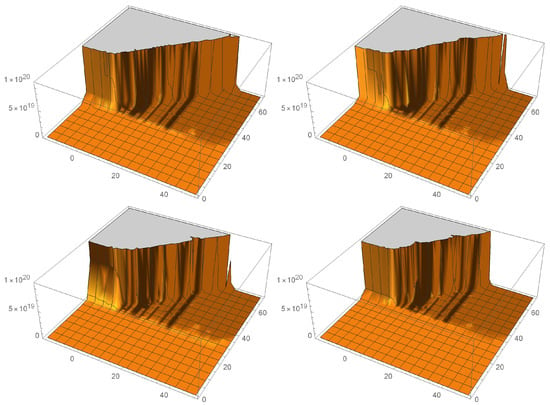
Three-channel pulsar images from the HTRU dataset, as well as samples after central cropping and normalization. The (top left) of the figure shows negative samples, the (bottom left) shows positive samples, and the (right side) shows the processed samples. In this figure, red areas indicate the strength of pulsar signals, while other colors represent RFI (Radio Frequency Interference) signals.

We investigated an exact solution in a conformal invariant Randall-Sundrum 5D warped brane world model on a time dependent Kerr-like spacetime. The singular points are determined by a quintic polynomial in the complex plane and fulfills Cauchy’s theorem on holomorphic functions. The solution, which is determined by a first-degree differential equation, shows many similarities with an instanton. In order to describe the quantum mechanical aspects of the black hole solution, we apply the antipodal boundary condition. The solution is invariant under time reversal and also valid in Riemannian space. Moreover, CPT invariance in maintained. The vacuum instanton solution follows from the 5D as well as the effective 4D brane equations, only when we allow the contribution of the projected 5D Weyl tensor on the brane (the KK-‘particles’). The topology of the effective 4D space of the brane is the projective RP3 (elliptic space) by identifying antipodal points on S3. The 5D is completed by applying the Klein bottle embedding and the Z2 symmetry of the RS model. This model fits very well with the description of the Hawking radiation, which remains pure. We have also indicated a possible way to include fermions. Our 5D space admits a double cover of S3 and after fibering to the S2, we obtain the effective black hole horizon. The connection with the icosahedron discrete symmetry group is investigated. It seem that Bekenstein’s conjecture that the area of a black hole is quantized, could be applied to our model.

16 January 2026

Penrose diagram for our 5D model, stereographic projected from 
  
    S
    3
  
. The antipodal points 
  
    P
    (
    X
    )
  
 and 
  
    P
    (
    
      X
      ¯
    
    )
  
 are identified. Particles entering the black hole will create waves that approach the horizon from the outside, and those that pass the horizon will emerge from the ‘other side’ of the black hole. Note that 
  
    
      t
      ∗
    
    =
    l
    o
    g
    
      (
      U
      /
      V
      )
    
  
∼
  
    l
    o
    g
    (
    t
    −
    
      t
      H
    
    )
  
. In this approach, I and II are CPT invariant. This means that time runs backwards in II. We have also indicated two antipodal points 
  
    [
    P
    
      (
      x
      )
    
    ,
    
      P
      ¯
    
    
      (
      x
      )
    
    ]
  
. The red and green arrows represent incoming and outgoing Hawking particles.

Testing Running Vacuum Energy in f(Q) Gravity with DESI Data

  • Dalale Mhamdi,
  • Redouane El Ouardi and
  • Amine Bouali
  • + 1 author
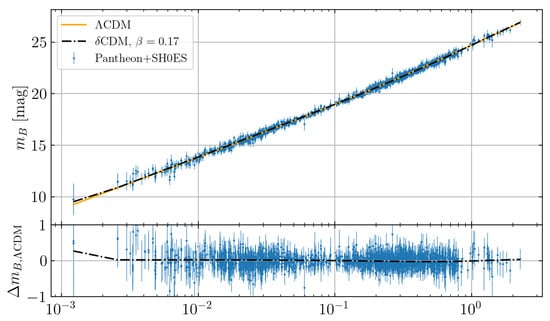
In this paper, we investigate the running vacuum energy (RVE) model within the framework of f(Q) gravity (f(Q)-RVE). In this context, the modified Friedmann equation can be used to establish a formal analogy with the structure of the RVE. A key feature is that the vacuum equation of state is no longer fixed but receives a dynamical correction proportional to H˙ and H¨/H. We consider two cases of f(Q)-RVE, denoted as Model I (parametrized by ν) and Model II (parametrized by ν and α), corresponding to the first and second derivatives of H, respectively. The models are constrained using recent DESI BAO data in combination with Pantheon+, cosmic chronometer (CC), and CMB observations. Our analysis shows a deviation of ν from zero at a significance level of ∼1.4σ for Model I, while in Model II, ν and α deviate from zero at 0.7σ and 1.3σ, respectively, relative to ΛCDM. Furthermore, the statistical comparison based on the Akaike, Bayesian, and Deviance Information Criteria (AIC, BIC, DIC) indicates that Model I remains competitive with ΛCDM, while Model II is penalized due to its higher complexity and the sensitivity associated with the additional parameter α.

15 January 2026

Posterior distributions of the RVE parameters 
  ν
 and 
  α
. Model I is shown in blue and Model II in orange, both using the full dataset, while 
  
    α
    =
    ν
    =
    0
  
 corresponds to the 
  Λ
CDM model (green dashed line).

Black hole jets represent one of the most extreme manifestations of astrophysical processes, linking accretion physics, relativistic magnetohydrodynamics, and large-scale feedback in galaxies and clusters. Despite decades of observational and theoretical work, the mechanisms governing jet launching, collimation, and energy dissipation remain open questions. In this article, we discuss how upcoming facilities such as the Event Horizon Telescope (EHT), the Cherenkov Telescope Array (CTA), the Vera C. Rubin Observatory (LSST), and the Whole Earth Blazar Telescope (WEBT) will provide unprecedented constraints on jet dynamics, variability, and multi-wavelength signatures. Furthermore, we highlight theoretical challenges, including the role of magnetically arrested disks (MADs), plasma microphysics, and general relativistic magnetohydrodynamic (GRMHD) simulations in shaping our understanding of jet formation. By combining high-resolution imaging, time-domain surveys, and advanced simulations, the next decade promises transformative progress in unveiling the physics of black hole jets.

15 January 2026

(Top) Observations from the Event Horizon Telescope of the supermassive black hole at the center of the elliptical galaxy M87, for four different days. (Bottom) Snapshots of the M87* black hole appearance, obtained from the EHT array of telescopes in 2009–2017. Where JCMT (James Clerk Maxwell Telescope), CARMA (Combined Array for Research in Millimeter-wave Astronomy), SMT (Heinrich Hertz Submillimeter Telescope), SMA (Submillimeter Array), CSO (Caltech Submillimeter Observatory), APEX (Atacama Pathfinder Experiment), LMT (Large Millimeter Telescope), IRAM (Institute for Radio Astronomy in the Millimetre Range) and SPT (South Pole Telescope). (EHT Collaboration (2019) [73]).

News & Conferences

Issues

Open for Submission

Editor's Choice

Reprints of Collections

New Discoveries in Astronomical Data
Reprint

New Discoveries in Astronomical Data

Editors: Yanxia Zhang, A-Li Luo
Quantum Gravity Phenomenology II
Reprint

Quantum Gravity Phenomenology II

Editors: Arundhati Dasgupta, Alfredo Iorio

Get Alerted

Add your email address to receive forthcoming issues of this journal.

XFacebookLinkedIn
Universe - ISSN 2218-1997