

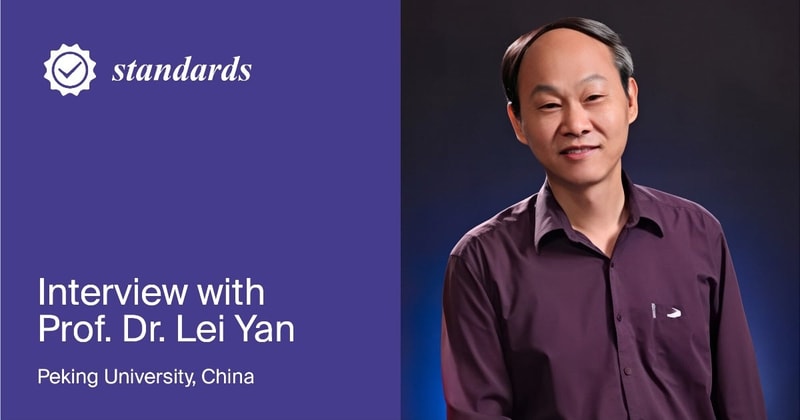
Standards | Interview with Deputy Editor-in-Chief—Prof. Dr. Lei Yan
We are pleased to share the following interview with Prof. Dr. Lei Yan, Deputy Editor-in-Chief of Standards (ISSN 2305-6703, indexed in Scopus).
Name: Prof. Dr. Lei Yan
Affiliation: Institute of Remote Sensing and Geographic Information System, School of Earth and Space Sciences, Peking University, Beijing 100871, China
Interests: remote sensing; polarization remote sensing; vector remote sensing; UAV remote sensing; cloud image; polar-coordinate photogrammetry; IEEE standards
The following is a short Q&A with Prof. Dr. Lei Yan:
1. Why did you choose to join Standards as Deputy Editor-in-Chief?
My decision to serve as Deputy Editor-in-Chief of Standards is based on three considerations: the current state of the field, the inherent value of standards, and the development trends of OA publishing. Globally, there are very few journals dedicated specifically to comprehensive standardization research. The field lacks a unified, open academic communication platform. Through this international journal platform, I hope to encourage researchers and institutions worldwide to prioritize standardization and to leverage standards as a core driver of industrial technology upgrading. Any industry seeking stable, sustainable development requires a standardized, replicable standard system as its foundation. Standardization can bring order to industries and drive technological iteration—this is the core reason I am willing to contribute to this journal.
In addition, open access publishing is the mainstream trend in scientific publishing today. It offers low cost, broad dissemination, and high efficiency—characteristics that closely align with the core attributes of standards: openness, inclusivity, and global applicability. Compared with traditional subscription-based journals, OA publishing breaks down geographical barriers, accelerates the integration of standards across countries and fields, and supports the global standardization system. For these reasons, I am very pleased to serve as Deputy Editor-in-Chief and work together with the journal to advance global standardization.
2. What are your current research focuses, and how are they connected to standards?
My research revolves around three main areas: spatiotemporal information, low-altitude economy, and hydrogen-powered UAVs. My daily research work is deeply intertwined with international standard-setting, and research outputs are continuously translated into industry-wide standards.
In the information society, nearly two-thirds of information exists within spatiotemporal coordinates—spatiotemporal information is the backbone of information technology development. I currently serve as Chair of the IEEE Low-Altitude Economy and Low-Altitude Sensing Subcommittee. My core work involves distilling and refining cutting-edge technologies related to low-altitude spatiotemporal information into unified international standards that guide the standardized implementation of the low-altitude industry. In addition, I also serve as Chair of the IEEE Hydrogen-Powered UAV Standards Series.
UAVs are the most critical platform for low-altitude spatiotemporal information collection. Traditional lithium-battery-powered UAVs generally suffer from two major pain points: poor performance in low-temperature environments and insufficient endurance. To address these bottlenecks, Chinese research teams have long been working on core hydrogen-powered UAV technologies, achieving a world record for grid monitoring in -40°C extreme cold environments. Endurance has been improved by 5-8 times compared with conventional lithium-battery UAVs, with a related achievement being setting a Guinness World Record for continuous flight of over 4 hours and a range of 188 kilometers. I am committed to consolidating these mature engineering technologies and experimental data into international standards, filling the standard gaps in the low-altitude hydrogen-powered equipment sector and promoting the industrialization and standardized adoption of related equipment.
3. What do you foresee for the future development of low-altitude economy and UAV international standards?
The global low-altitude economy is currently at a critical stage of large-scale implementation and regulatory upgrading. China has over 3 million UAV units serving various scenarios—the world’s largest low-altitude economy application market and the most important testing ground for new low-altitude technologies. At the national level, the low-altitude economy has been incorporated into medium- and long-term development plans, with dedicated regulatory bodies established to promote industrial standardization from the top down—demonstrating the leading role of standards in the low-altitude industry. From a global perspective, for the low-altitude economy and UAV industry to achieve cross-border collaborative development, unified and interoperable international standards must be established. Leveraging the “Belt and Road” framework, which covers major global economies, standardization can effectively dismantle cross-border technical barriers and enable the sharing of industrial resources and technical expertise among countries.
In the long term, only by building an open, unified, and mutually recognized international standards system can we regulate the global low-altitude industry order, address technical adaptation challenges across different regions, and inject new momentum into the global low-altitude economy, shifting the industry from mere scale expansion to high-quality, internationalized, and standardized development.
4. What suggestions or expectations do you have for the journal’s future development?
Globally, there are many vertical niche standard journals, but few comprehensive standardization journals. Standards has a natural differentiating advantage. I have three recommendations for its development.
First, to connect with various international standardization organizations to expand high-end academic resources. I hold positions in multiple international standard organizations including IEEE, ISO, and ITU. Going forward, I can facilitate the participation of experts and core members from these organizations in the journal’s development, continuously publishing the latest global standard updates, technology roadmaps, and industry policies to address the journal’s current resource gaps.
Second, to establish a unique content positioning with a focus on cross-system standard integration. Most existing journals only cover single-field or single-country standards. Standards can focus on how standards from different countries, industries, and technologies can interoperate, align, and be developed collaboratively—creating distinctive content that sets it apart from other journals.
Third, establish dedicated fixed columns to build the journal’s brand identity. I suggest launching a regular column on “Standards System Development and Regulatory Alignment” to discuss topics such as standard-setting logic, multi-system integration, and open collaborative development. By consistently inviting experts in international standardization to contribute, the journal can steadily enhance its influence and gradually grow into a leading global platform for standardization discourse.
5. How do you view the current status and trends of open access publishing?
Open access publishing and standards journals are naturally aligned. OA is an irreversible trend in academic dissemination within the standards field. The core value of standards lies in their openness and universal applicability, enabling global researchers and industry practitioners to adopt them in practice. OA’s free access, lack of geographical barriers, and global coverage perfectly match the need for widespread standards dissemination, accelerating the sharing and iteration of standardization technologies among scholars and engineers worldwide.
Traditional subscription journals, constrained by distribution costs and channels, struggle to achieve global standards dissemination. MDPI has long been committed to open access publishing, leveraging an efficient and lightweight dissemination model to become a mainstream platform in international scientific publishing.
For a standards-focused journal like Standards, publication should not be limited to purely theoretical research. We should prioritize content with practical value, such as international standards alignment and cross-industry technical adaptation. Leveraging the advantages of open access, the journal can break down communication barriers between domestic and international standards, bringing together global practical experience and academic perspectives. Through this open and inclusive development path, the journal can gradually expand its influence, evolving from a niche publication into a core bridge for global standards exchange, technical interoperability, and system co-development.