

- Article

Sex-Based Differences in Fatigue During Repeated Sprinting in 9- to 14-Year-Old Children Are Task- and Metric-Dependent
- Bilgin Ataş,
- İbrahim Can and
- Bouwien C. M. Smits-Engelsman
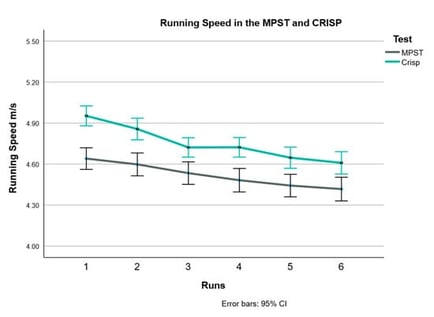
Background: This study investigated sex-based differences in sprint performance and fatigue among 9–14-year-olds using two repeated-sprint protocols: the Muscle Power Sprint Test (MPST; 6 × 15 m) and the Children’s Repetitive Intermittent Sprint Performance test (CRISP; 6 × 30 m). Additionally, four fatigue metrics were compared: decay (first vs. last sprint), fatigue index (fastest vs. slowest sprint), sprint decrement (ideal vs. actual total time), and slope IP (regression slope across all sprints). Methods: A total of 140 children (9–14 years; 70 females, 70 males) performed the two tests in randomized order. They completed the six sprints per test with 10 s of recovery between each sprint of either 15 or 30 m. Fatigue metrics were calculated for each test based on the sprint times. Results: Running speed was higher in CRISP than in MPST, and males outperformed females in both tests. In the MPST, fatigue metrics did not differ significantly by sex. In contrast, all fatigue indices in CRISP were significantly greater in females, indicating higher fatigue despite slower sprinting compared to males. Among the fatigue metrics, slope IP correlated most strongly with decay, while associations with fatigue index and sprint decrement were weaker. Conclusions: Fatigue assessment is more sensitive over longer sprint distances. Females demonstrated significant fatigue in CRISP, indicating that fatigue is task-dependent. The slope metric, which incorporates all sprints, offers a robust fatigue measure for group comparison, while decay remains a practical alternative for field settings.
5 March 2026