

- Article

Robust Soil Salinity Retrieval Under Small-Sample and High-Dimensional Hyperspectral Conditions via Physically Constrained Generative Augmentation
- Shan Yu,
- Lide Su and
- Rong Li
- + 6 authors
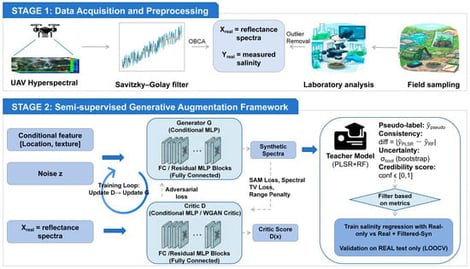
Soil salinity mapping in heterogeneous irrigation districts faces a dual challenge: the high dimensionality of hyperspectral data leads to redundancy, while the scarcity of ground-truth samples restricts the generalization of data-driven models. Traditional regression methods often struggle to capture non-linear spectral responses under such “small-sample” conditions. To address these limitations, this study proposes a semi-supervised retrieval framework coupling Optimal Band Combination Analysis (OBCA) with a Spectral Wasserstein GAN with Gradient Penalty (S-WGAN-GP). We constructed a robust feature set via cross-scenario evaluation and developed a rigorous “Uncertainty-Aware Filtering” protocol to screen synthetic samples generated by a teacher mechanism. The OBCA screening revealed that salinity-sensitive features are robustly clustered in the Green (550–570 nm) and Near-Infrared (NIR, 880–950 nm) regions, with NIR bands demonstrating superior stability across different sites. The proposed S-WGAN-GP successfully densified the feature manifold by generating 1186 high-fidelity synthetic samples. By incorporating these augmented data, the inversion accuracy was substantially improved: the R2 of the optimal SVR model increased from 0.36 (baseline) to 0.60 (+66.7%), and the RMSE decreased from 7.06 to 5.57 dSm−1. This study confirms that physically constrained generative augmentation, when combined with rigorous quality control, effectively bridges the distribution gap in limited datasets. The proposed framework offers a transferable and accurate solution for fine-scale soil salinity monitoring in data-scarce arid regions.
2 March 2026