Resident Space Object (RSO) Tracking in Space-Based, Low Resolution, Non-Constant-Attitude Imagery

 ,
,
Highlights
- A rules-based, end-to-end Resident Space Objects (RSOs) detection and tracking pipeline is demonstrated for low-resolution, short-exposure, non-constant-attitude space imagery without relying on external attitude information.
- The proposed method achieves robust detection of faint RSOs using real on-orbit imagery, validated on 878 images containing 2191 labelled RSO instances.
- Reliable RSO detection can be achieved using wide field-of-view, low-cost optical sensors, expanding Space Situational Awareness capabilities beyond dedicated instruments.
- The lightweight and interpretable design enables potential onboard deployment and repurposing of degraded, auxiliary, or End-of-Life spacecraft for Space Situational Awareness purposes.
Abstract
1. Introduction
- (1)
- Systematic review and selection of the imagery from the Fast Auroral Imager (FAI) instrument onboard the Cascade SmallSat and Ionospheric Polar Explorer (CASSIOPE) satellite, using criteria such as scene illumination, RSO motion, and brightness variation to identify sequences suitable for RSO detection.
- (2)
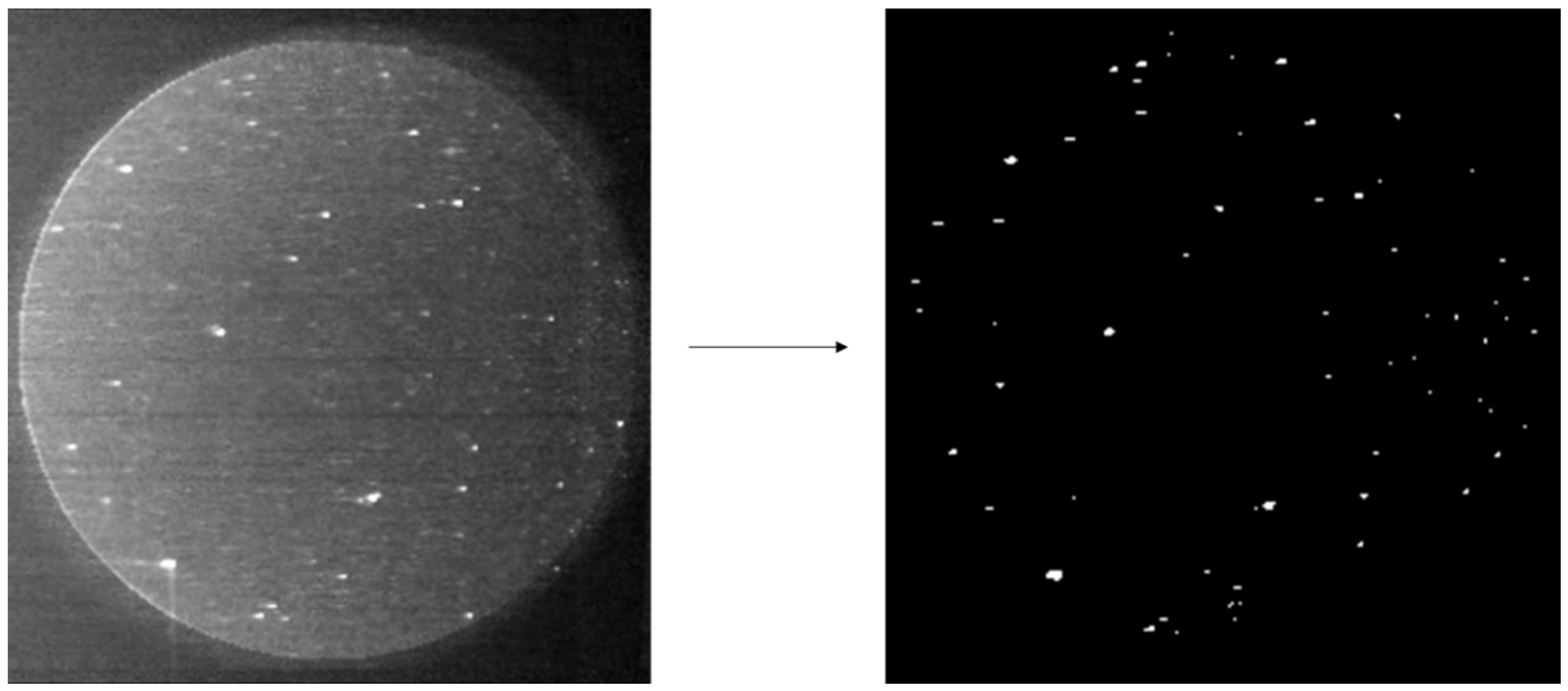
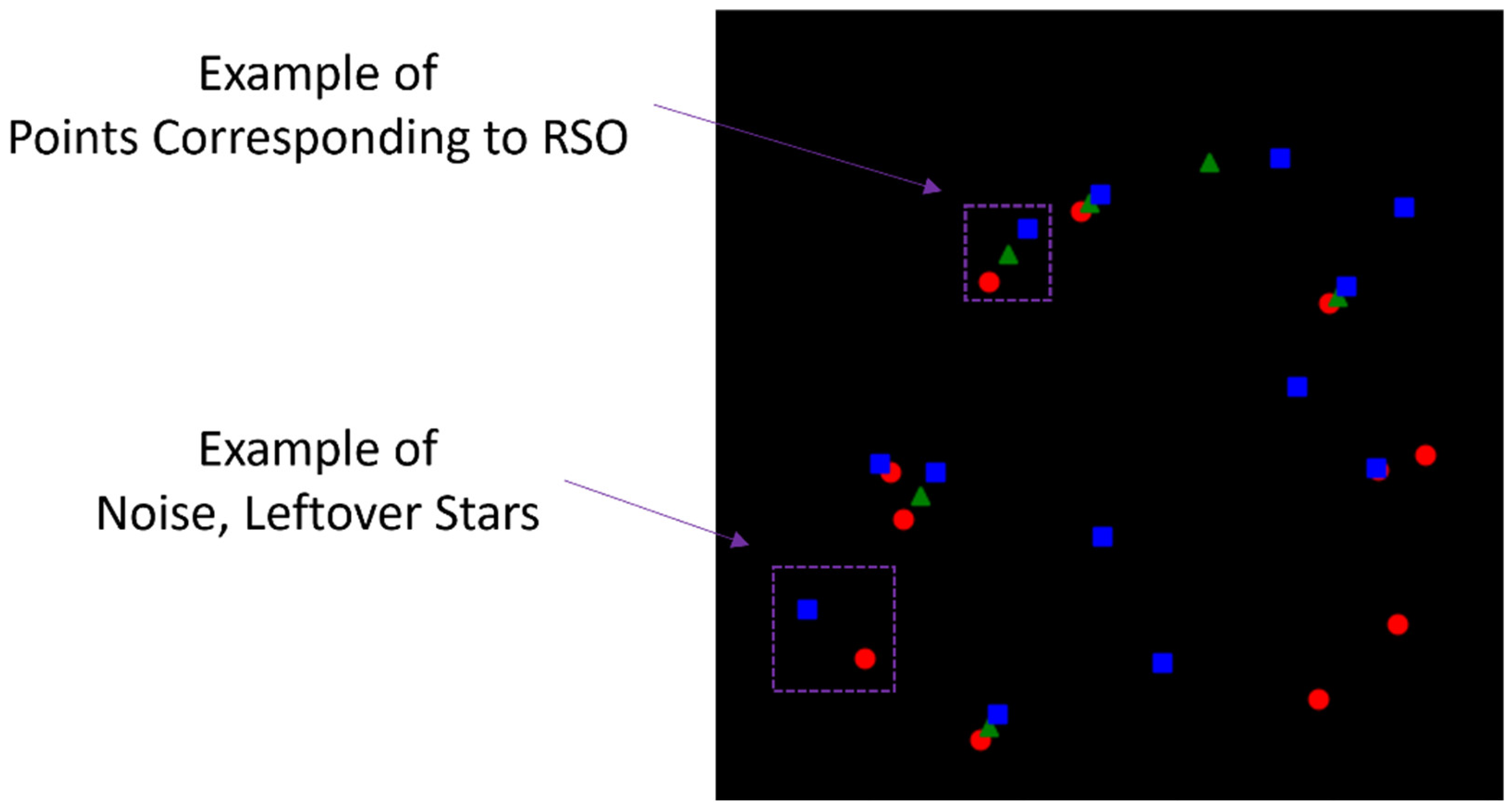
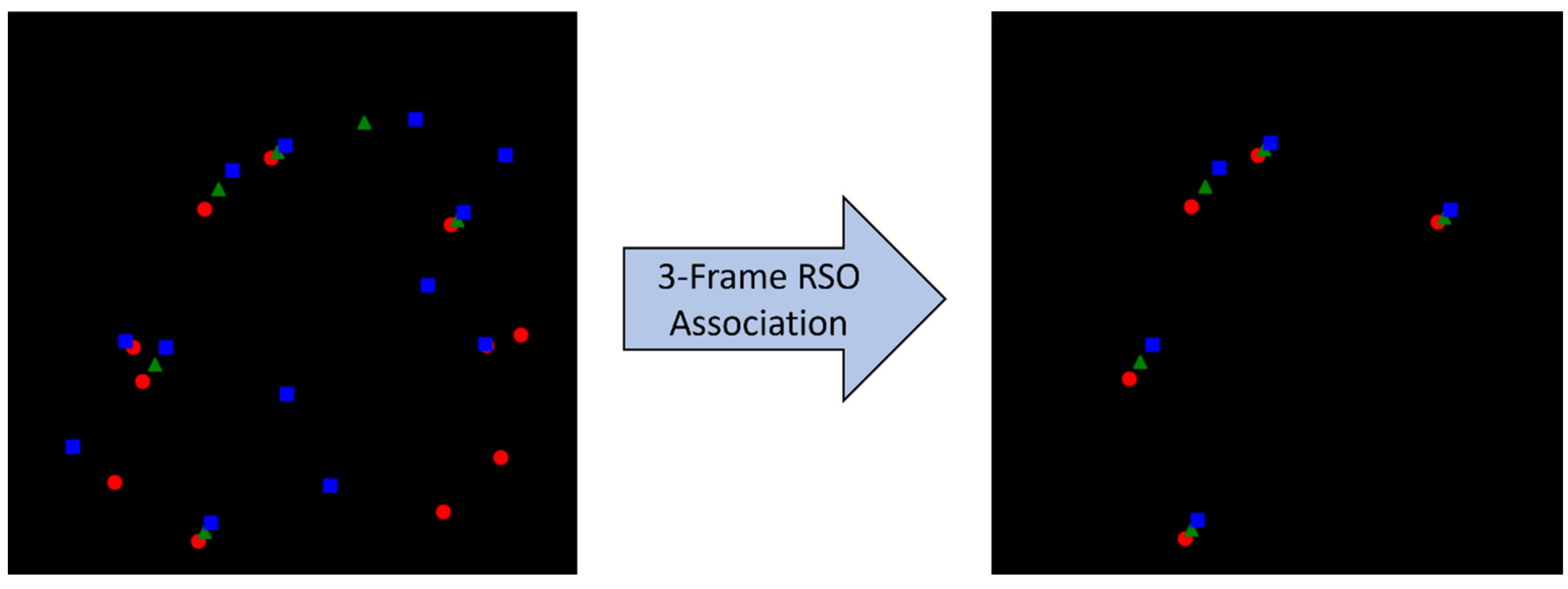
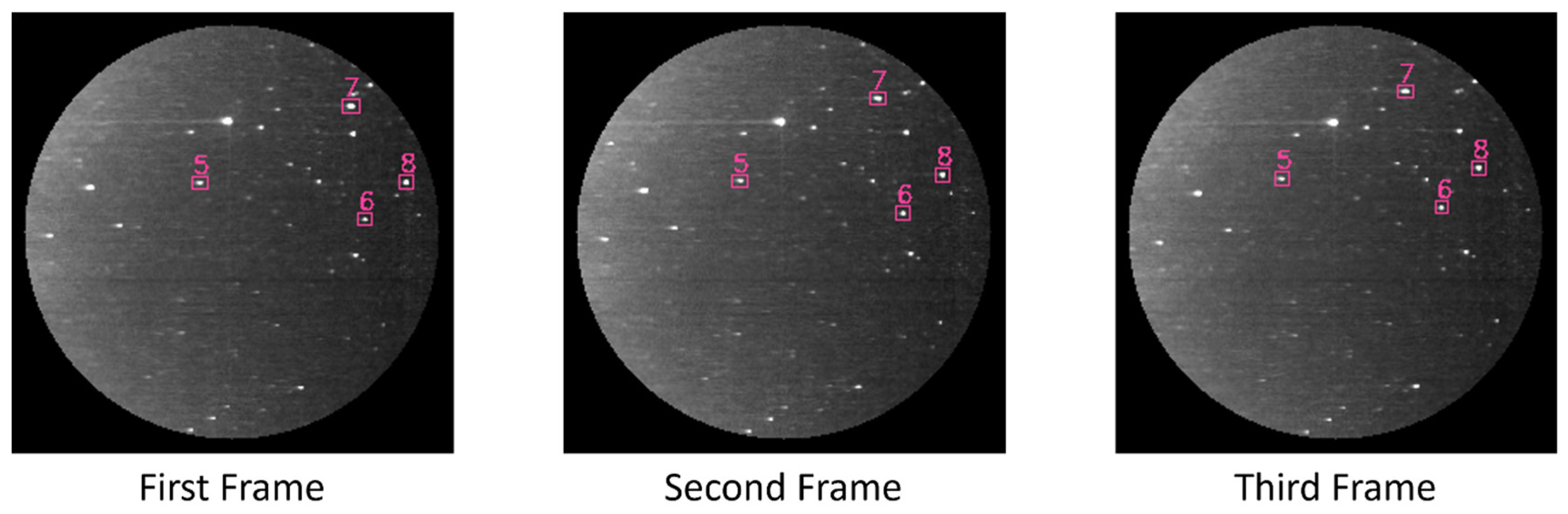
- A novel rules-based RSO detection algorithm specifically designed for low-resolution, short-exposure, non-inertial space-based imagery, integrating local adaptive thresholding, Iterative Closest Point (ICP) for background star motion correction without attitude information, and a three-frame motion-consistency tracker for robust RSO identification and tracking.
- (3)
- A detection pipeline that operates independently of external attitude solutions, enabling RSO detection from star trackers or slew-phase imagery, expanding SSA capability to degraded or auxiliary space sensors.
- (4)
- A robust, algorithm validation process, making use of real data from on-orbit imagery, featuring 878 images containing 2191 labeled RSO instances corresponding to 75 unique RSOs from 12 different observations periods with varying challenging conditions.
2. Materials and Methods
2.1. Space Situational Awareness Pipeline
2.1.1. RSO Detection and Tracking
2.1.2. Celestial Coordinate System Transformation
2.1.3. Initial Orbit Determination
2.1.4. RSO Identification
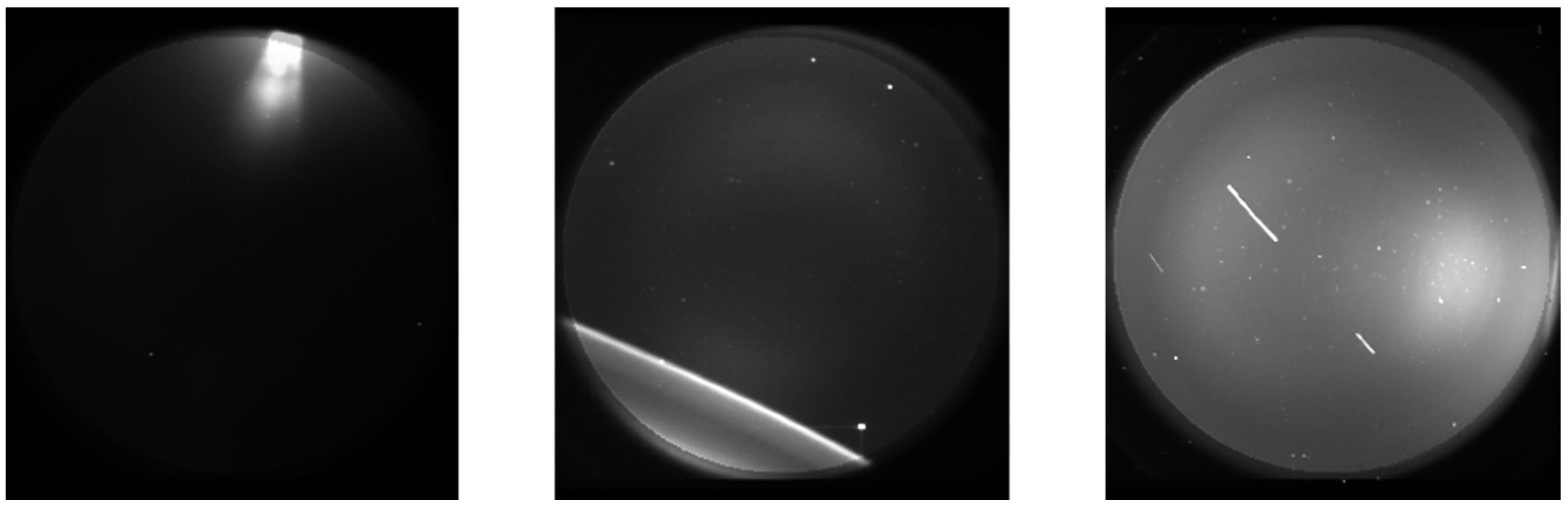
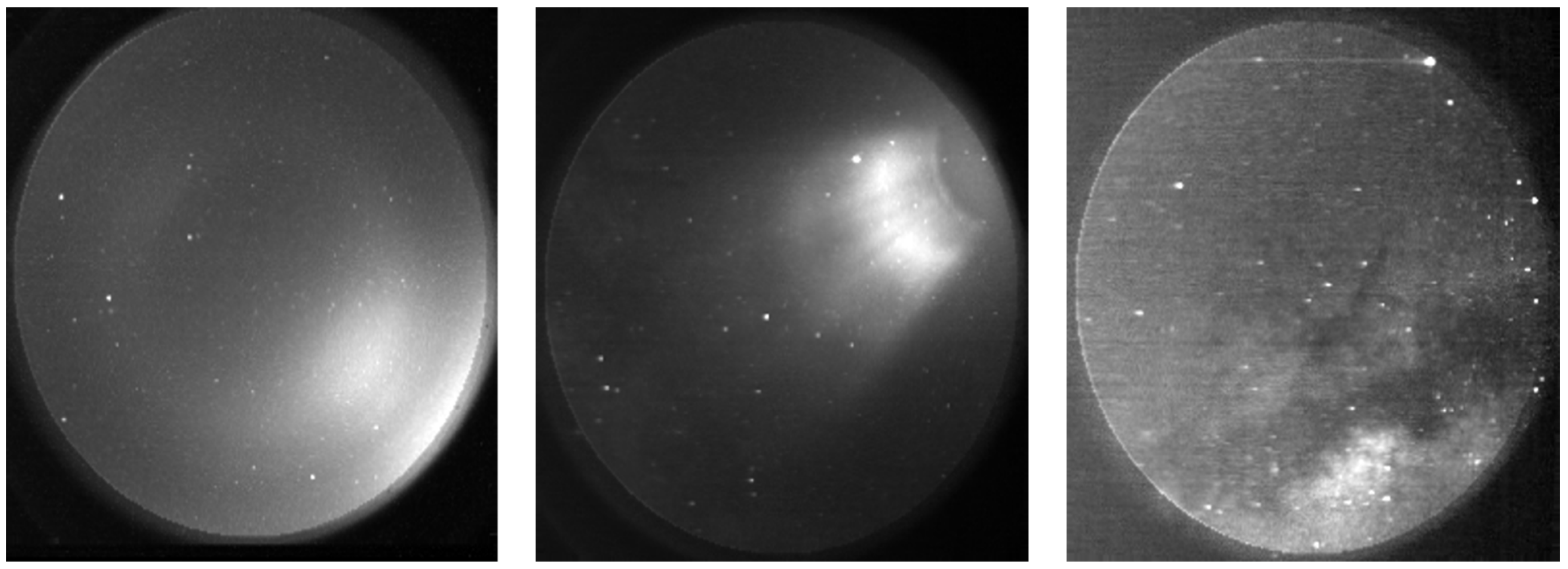
2.2. Dataset Used in the Study
2.3. Tracking Algorithm Overview
2.3.1. Preprocessing
Image Reading and Cropping
Circular Region of Interest (ROI) Extraction
Windowed Multi-Otsu Thresholding
Object Detection
Object Filtration
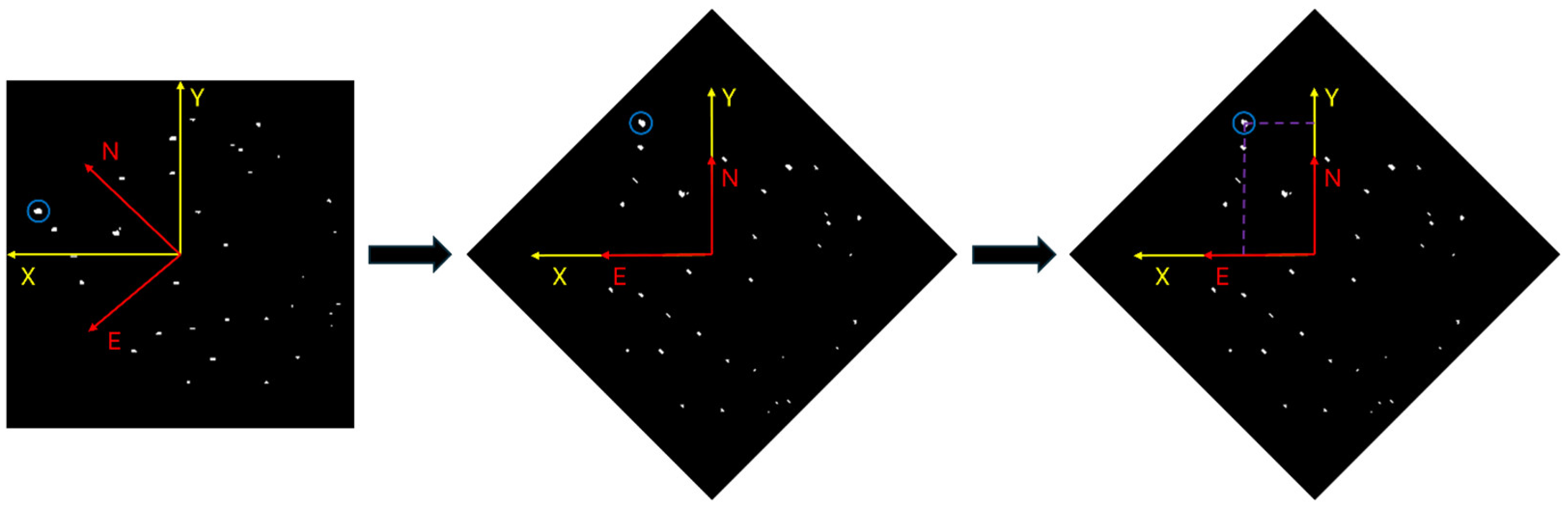
2.3.2. ICP Star Removal
2.3.3. Three-Frame RSO Association and Tracking
2.3.4. Position Estimation
2.3.5. RSO Status and Archival
3. Results
3.1. RSO Detection
3.2. Detection Accuracy
3.3. Detection Brightness
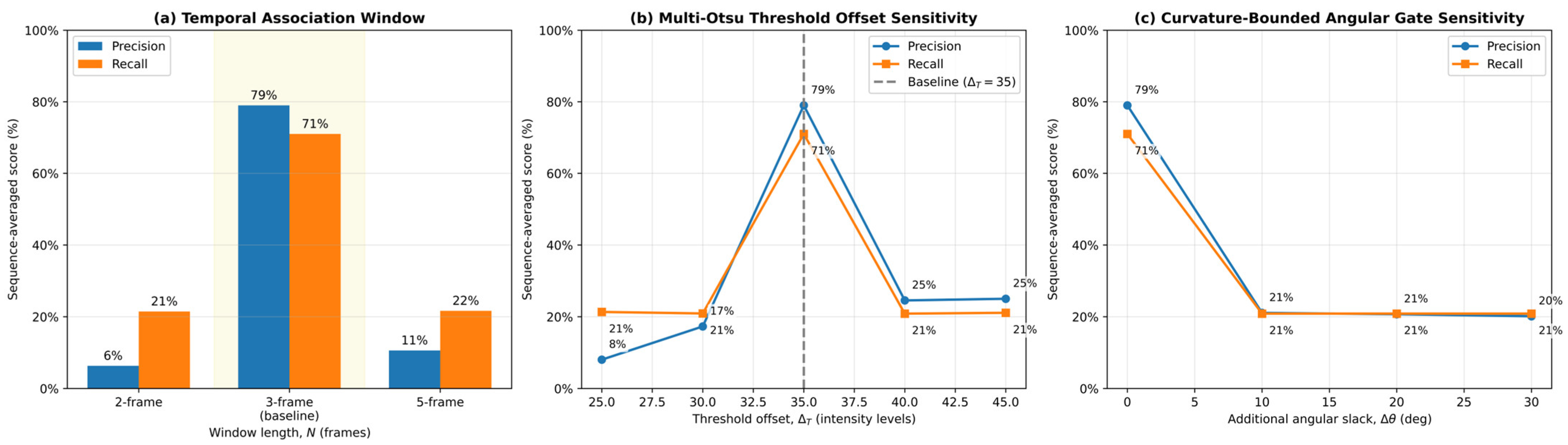
3.4. Ablation and Sensitivity Analysis
4. Discussion
Future Work
5. Conclusions
Author Contributions
Funding
Data Availability Statement
Conflicts of Interest
References
- Kelso, T.S. Analysis of the Iridium 33-Cosmos 2251 Collision. In Proceedings of the 19th AIAA/AAS Astrodynamics Specialist Conference, Pittsburgh, PA, USA, 9–13 August 2009. [Google Scholar]
- Johnson, N.L.; Stansbery, E.; Liou, J.-C.; Horstman, M.; Stokely, C.; Whitlock, D. The Characteristics and Consequences of the Break-up of the Fengyun-1C Spacecraft. Acta Astronaut. 2008, 63, 128–135. [Google Scholar] [CrossRef]
- Migaud, M.R. Protecting Earth’s Orbital Environment: Policy Tools for Combating Space Debris. Space Policy 2020, 52, 101361. [Google Scholar] [CrossRef]
- Weeden, B.C.; Cefola, P.; Sankaran, J. Global Space Situational Awareness Sensors. Secure World Foundation. 2010. Available online: https://www.researchgate.net/publication/228787139_Global_Space_Situational_Awareness_Sensors (accessed on 21 June 2024).
- Abercromby, K.J.; Seitzer, P.; Cowardin, H.M.; Barker, E.S.; Matney, M.J. Michigan Orbital DEbris Survey Telescope Observations of the Geosynchronous Orbital Debris Environment Observing Years: 2007–2009. National Aeronautics and Space Administration. 2011. Available online: https://ntrs.nasa.gov/api/citations/20110022976/downloads/20110022976.pdf (accessed on 13 January 2023).
- Petit, A.; Rolin, A.; Duthil, L.; Tarrieu, H.; Lucken, R.; Giolito, D. Extraction of light curve from passive observations during survey campaign in LEO, MEO and GEO regions. In Proceedings of the Advanced Optical Maui Optical and Space Surveillance (AMOS) Technologies Conference, Maui, HI, USA, 27–30 September 2022. [Google Scholar]
- Oltrogge, D.L. The “we” approach to space traffic management. In Proceedings of the 15th International Conference on Space Operations, Marseille, France, 28 May–1 June 2018; pp. 1–21. [Google Scholar]
- Clemens, S.; Lee, R.S.K.; Harrison, P.; Soh, W. Feasibility of Using Commercial Star Trackers for On-Orbit Resident Space Object Detection. In Proceedings of the Advanced Maui Optical and Space Surveillance (AMOS) Technologies Conference, Maui, HI, USA, 11–14 September 2018. [Google Scholar]
- SpaceX. Starlink Technology. 2023. Available online: https://www.starlink.com/ca/technology (accessed on 10 July 2025).
- Cogger, L.; Howarth, A.; Yau, A.; White, A.; Enno, G.; Trondsen, T.; Asquin, D.; Gordon, B.; Marchand, P.; Ng, D.; et al. Fast Auroral Imager (FAI) for the e-POP Mission. Space Sci. Rev. 2014, 189, 15–25. [Google Scholar] [CrossRef]
- Nir, G.; Zackay, B.; Ofek, E.O. Optimal and Efficient Streak Detection in Astronomical Images. Astron. J. 2018, 156, 229. [Google Scholar] [CrossRef]
- Waszczak, A.; Prince, T.A.; Laher, R.; Masci, F.; Bue, B.; Rebbapragada, U.; Barlow, T.; Surace, J.; Helou, G.; Kulkarni, S. Small Near-Earth Asteroids in the Palomar Transient Factory Survey: A Real-Time Streak-Detection System. Publ. Astron. Soc. Pac. 2017, 129, 034402. [Google Scholar] [CrossRef]
- Canny, J. A Computational Approach to Edge Detection. IEEE Trans. Pattern Anal. Mach. Intell. 1986, 8, 679–698. [Google Scholar] [CrossRef]
- Cvrček, V.; Šára, R. Detection and Certification of Faint Streaks in Astronomical Images. In Proceedings of the 14th International Joint Conference on Computer Vision, Imaging and Computer Graphics Theory and Applications, Prague, Czech Republic, 25–27 February 2019; pp. 498–509. [Google Scholar] [CrossRef]
- Jeffries, C.; Acuña, R. Detection of Streaks in Astronomical Images Using Machine Learning. J. Artif. Intell. Technol. 2023, 4, 1–8. [Google Scholar] [CrossRef]
- Yao, R.; Zhang, Y. Compressive Sensing for Small Moving Space Object Detection in Astronomical Images. J. Syst. Eng. Electron. 2012, 23, 378–384. [Google Scholar] [CrossRef]
- Privett, G.; Appleby, G.; Sherwood, R. Image stacking techniques for GEO satellites and a three-site collection. In Proceedings of the Advanced Maui Optical and Space Surveillance (AMOS) Technologies Conference, Maui, HI, USA, 9–12 September 2014. [Google Scholar]
- Qashoa, R.; Driedger, M.; Clark, R.; Harrison, P.; Berezin, M.; Lee, R.S.K.; Howarth, A. SPACEDUST-Optical: Wide-FOV Space Situational Awareness from Orbit. In Proceedings of the Advanced Maui Optical and Space Surveillance (AMOS) Technologies Conference, Maui, HI, USA, 19–22 September 2023. [Google Scholar]
- Dave, S.; Clark, R.; Lee, R.S.K. RSOnet: An Image-Processing Framework for a Dual-Purpose Star Tracker as an Opportunistic Space Surveillance Sensor. Sensors 2022, 22, 5688. [Google Scholar] [CrossRef]
- Lang, D.; Hogg, D.W.; Mierle, K.; Blanton, M.; Roweis, S. Astrometry.Net: Blind Astrometric Calibration of Arbitrary Astronomical Images. Astron. J. 2010, 139, 1782–1800. [Google Scholar] [CrossRef]
- Lovell, T.A.; Sinclair, A.J.; Newman, B. Angles Only Initial Orbit Determination: Comparison of Relative Dynamics and Inertial Dynamics Approaches with Error Analysis. In Proceedings of the 2018 Space Flight Mechanics Meeting, Kissimmee, FL, USA, 8–12 January 2018. [Google Scholar]
- CASSIOPE/e-POP Fact Sheet. Available online: https://epop.phys.ucalgary.ca/quickfacts/ (accessed on 21 June 2024).
- Zhang, Y.; Zhang, R.; Jia, Q.; Xiao, J.; Bai, L.; Feroskhan, M. Astro-Det: Resident Space Object Detection for Space Situational Awareness. In Proceedings of the 2024 IEEE Conference on Artificial Intelligence (CAI), Singapore, 25–27 June 2024; IEEE: New York, NY, USA, 2024; pp. 228–233. [Google Scholar]
- Weigel, M.; Meinel, M.; Fiedler, H. Comparison of Observation Correlation Techniques for a Telescope Survey of the Geostationary Ring. In Proceedings of the 6th European Conference on Space Debris, Darmstadt, Germany, 22–25 April 2013; p. 141. [Google Scholar]
- Milani, A.; Tommei, G.; Farnocchia, D.; Rossi, A.; Schildknecht, T.; Jehn, R. Correlation and Orbit Determination of Space Objects Based on Sparse Optical Data. Mon. Not. R. Astron. Soc. 2011, 417, 2094–2103. [Google Scholar] [CrossRef]
- Open3D Team. ICP Registration. Open3D 0.19.0 Documentation. 2023. Available online: https://www.open3d.org/docs/release/tutorial/pipelines/icp_registration.html (accessed on 14 February 2026).
- Bertin, E.; Arnouts, S. SExtractor: Software for Source Extraction. Astron. Astrophys. Suppl. Ser. 1996, 117, 393–404. [Google Scholar] [CrossRef]
- Otsu, N. A Threshold Selection Method from Gray-Level Histograms. IEEE Trans. Syst. Man Cybern. 1979, 9, 62–66. [Google Scholar] [CrossRef]
- Liu, D.; Yu, J. Otsu Method and K-Means. In Proceedings of the 2009 Ninth International Conference on Hybrid Intelligent Systems, Shenyang, China, 12–14 August 2009; IEEE: New York, NY, USA, 2009; Volume 1, pp. 344–349. [Google Scholar]
- Scikit-Learn Developers. sklearn.cluster.KMeans. Scikit-Learn 1.8.0 Documentation. 2025. Available online: https://scikit-learn.org/stable/modules/generated/sklearn.cluster.KMeans.html (accessed on 14 February 2026).
- Ayunie Ahmad Khairudin, N.; Shamimi Rohaizad, N.; Salihah Abdul Nasir, A.; Chee Chin, L.; Jaafar, H.; Mohamed, Z. Image Segmentation Using K-Means Clustering and Otsu’s Thresholding with Classification Method for Human Intestinal Parasites. In IOP Conference Series: Materials Science and Engineering; IOP Publishing: Bristol, UK, 2020; Volume 864, p. 012132. [Google Scholar]
- Scikit-Image Team. Multi-Otsu Thresholding. Scikit-Image 0.25.2 Documentation. 2025. Available online: https://scikit-image.org/docs/0.25.x/auto_examples/segmentation/plot_multiotsu.html (accessed on 14 February 2026).
- Bolelli, F.; Allegretti, S.; Baraldi, L.; Grana, C. Spaghetti Labeling: Directed Acyclic Graphs for Block-Based Connected Components Labeling. IEEE Trans. Image Process. 2020, 29, 1999–2012. [Google Scholar] [CrossRef]
- Chen, Y.; Medioni, G. Object Modelling by Registration of Multiple Range Images. Image Vis. Comput. 1992, 10, 145–155. [Google Scholar] [CrossRef]
- Besl, P.J.; McKay, N.D. A Method for Registration of 3-D Shapes. IEEE Trans. Pattern Anal. Mach. Intell. 1992, 14, 239–256. [Google Scholar] [CrossRef]
- Lu, F.; Milios, E. Robot Pose Estimation in Unknown Environments by Matching 2D Range Scans. In Proceedings of the IEEE Conference on Computer Vision and Pattern Recognition, Seattle, WA, USA, 21–23 June 1994. [Google Scholar] [CrossRef]
- Wenger, M.; Ochsenbein, F.; Egret, D.; Dubois, P.; Bonnarel, F.; Borde, S.; Genova, F.; Jasniewicz, G.; Laloë, S.; Lesteven, S.; et al. The SIMBAD Astronomical Database. Astron. Astrophys. Suppl. Ser. 2000, 143, 9–22. [Google Scholar] [CrossRef]
- Schwab, D.; Singla, P.; O’Rourke, S. Angles-Only Initial Orbit Determination via Multivariate Gaussian Process Regression. Electronics 2022, 11, 588. [Google Scholar] [CrossRef]
- Nandakumar, S.; Eggl, S.; Tregloan-Reed, J.; Adam, C.; Anderson-Baldwin, J.; Bannister, M.T.; Battle, A.; Benkhaldoun, Z.; Campbell, T.; Colque, J.P.; et al. The High Optical Brightness of the BlueWalker 3 Satellite. Nature 2023, 623, 938–941. [Google Scholar] [CrossRef]
- Suthakar, V.; Sanvido, A.A.; Qashoa, R.; Lee, R.S.K. Comparative Analysis of Resident Space Object (RSO) Detection Methods. Sensors 2023, 23, 9668. [Google Scholar] [CrossRef]
- Suthakar, V.; Porto, I.; Myhre, M.; Sanvido, A.A.; Clark, R.; Lee, R.S.K. RSONAR: Data-Driven Evaluation of Dual-Use Star Tracker for Stratospheric Space Situational Awareness (SSA). Sensors 2026, 26, 179. [Google Scholar] [CrossRef]
- Qashoa, R.; Suthakar, V.; Chianelli, G.; Kunalakantha, P.; Lee, R.S.K. Technology Demonstration of Space Situational Awareness (SSA) Mission on Stratospheric Balloon Platform. Remote Sens. 2024, 16, 749. [Google Scholar] [CrossRef]







| Instrument Property | Property Value |
|---|---|
| FOV | 26° full angle |
| Focal length | 68.9 mm |
| Focal length with reducer | 13.78 mm |
| f-number | 4.0 |
| Pixel size | 26 µm by 26 µm |
| Pixel scale | 388 arcsec/pixel |
| Resolution | 256 by 256 pixels |
| Exposure time | 100 ms |
| 1 | Function RSO_Detection_Tracking(image_sequence): |
| 2 | Load image1, image2 from image_sequence; |
| 3 | Apply circular ROI mask to image1, image2; |
| 4 | Apply local adaptive thresholding to each image; |
| 5 | Perform connected components analysis; |
| 6 | Extract and filter objects by size and shape; |
| 7 | Build point lists of centroids from both images; |
| 8 | foreach image3 in image_sequence[3:] do |
| 9 | Apply ROI mask and thresholding; |
| 10 | Perform connected components and extract features; |
| 11 | Create point list for image3; |
| 12 | Align image1 and image3 to image2 using ICP; |
| 13 | Identify star matches and remove background stars; |
| 14 | foreach unmatched triplet (point1, point2, point3) do |
| 15 | Calculate inter-point distances d1, d2; |
| 16 | Calculate distance similarity and motion angle; |
| 17 | if similarity and angle within threshold then |
| 18 | Label as RSO and assign ID; |
| 19 | Update in-frame tracking list; |
| 20 | foreach RSO in previous frame do |
| 21 | if eligible for state estimation then |
| 22 | Predict next position using motion vector; |
| 23 | Add as estimated detection; |
| 24 | Save output images and detection text; |
| 25 | Shift frame windows: image1 ← image2, image2 ← image3; |
| 26 | Archive completed RSO tracks; |
| Parameter | Description | Value |
|---|---|---|
| ROI radius | Limit on detection region (central circular area) | 120 px |
| Slice size | Window size for local thresholding | 32 px |
| Otsu threshold bins | Histogram bins used for fallback Otsu thresholding | 256 |
| Threshold offset | Offset added to multi-Otsu value to reduce false negatives | 35 |
| Min area | Minimum object size to avoid bright noise pixels | 2 px2 |
| Max area | Maximum object size to filter large artifacts | 81 px2 |
| Max width/height | Object size filter to reject streaks | 15 px |
| ICP distance threshold | Max distance between matched points | 3 px |
| ICP rotation convergence | Minimum rotation difference to terminate ICP | 0.0001 rad |
| ICP translation conv. | Minimum translation difference to terminate ICP | 0.001 px |
| ICP min pairs | Minimum point pairs required for successful ICP match | 5 |
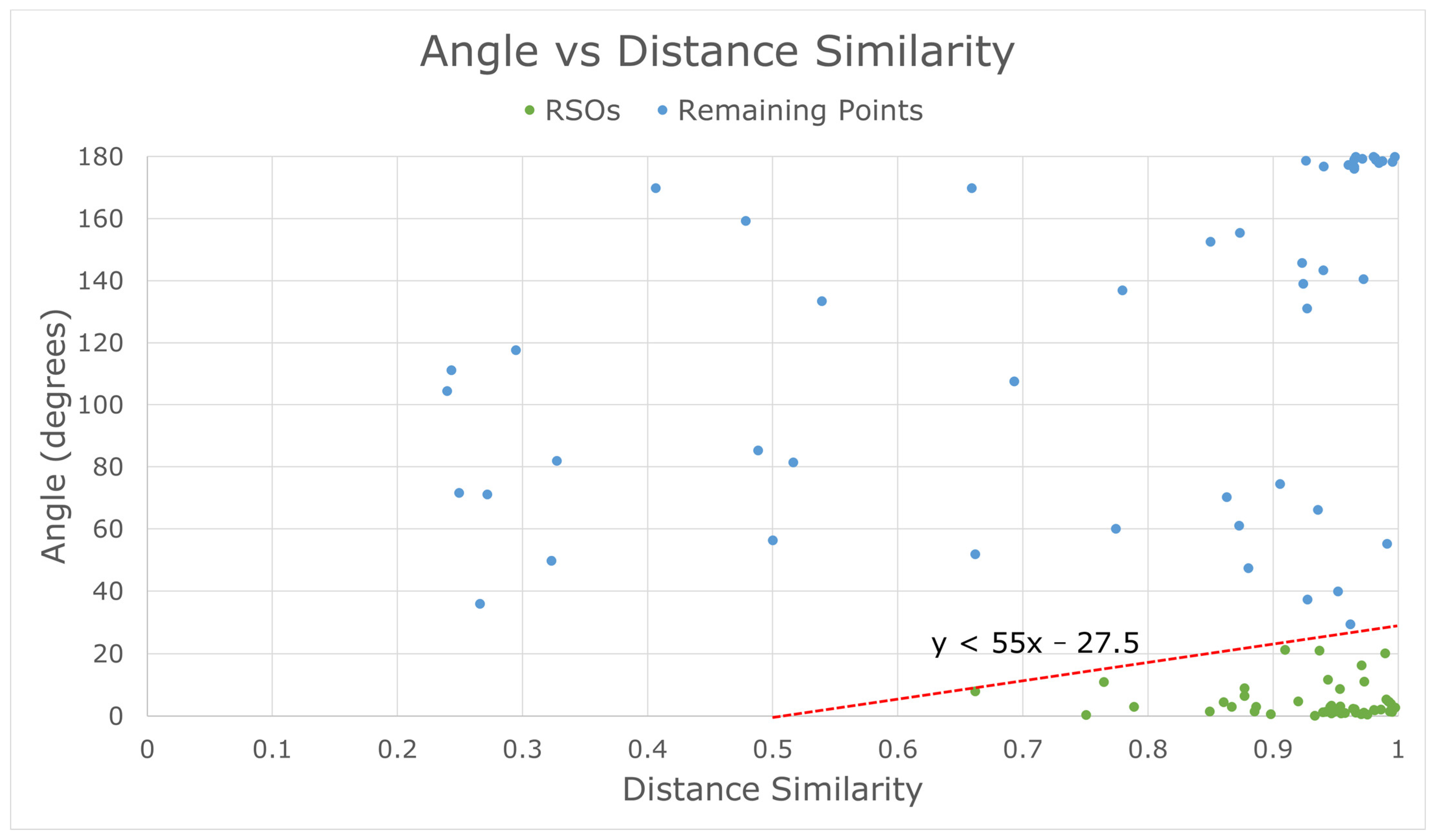
| Angle function slope | Used to define motion angle threshold for RSO matching | 55 |
| Angle function intercept | Defines threshold line with distance similarity | −27.5 |
| RSO distance threshold | Max allowed motion per frame between RSO detections | 20 px |
| State estimation radius | Limit for projecting future RSO positions | 110 px |
| Test Number | Date | Number of Images | Precision (PF) | Recall (PF) | Precision (FS) | Recall (FS) |
|---|---|---|---|---|---|---|
| 1 | 2023-01-16 | 41 | 95% | 85% | 90% | 90% |
| 2 | 2023-01-21 | 76 | 88% | 87% | 77% | 93% |
| 3 | 2023-01-25 | 53 | 91% | 68% | 89% | 75% |
| 4 | 2023-03-31 | 139 | 90% | 64% | 83% | 71% |
| 5 | 2023-05-31 | 128 | 96% | 64% | 92% | 72% |
| 6 | 2023-06-03 | 91 | 68% | 46% | 57% | 52% |
| 7 | 2023-06-20 | 39 | 100% | 52% | 100% | 56% |
| 8 | 2023-07-19 | 114 | 92% | 81% | 86% | 91% |
| 9 | 2023-08-04 | 24 | 94% | 89% | 86% | 100% |
| 10 | 2023-08-04 | 75 | 84% | 44% | 72% | 48% |
| 11 | 2023-08-05 | 35 | 90% | 81% | 84% | 90% |
| 12 | 2023-08-05 | 63 | 88% | 76% | 80% | 91% |
| Total | 878 | 87% | 63% | 79% | 71% |
| Test Number | Date | Number of Images | Unique RSOs | Detected RSOs | Missed RSOs | Percentage Detected |
|---|---|---|---|---|---|---|
| 1 | 2023-01-16 | 41 | 1 | 1 | 0 | 100% |
| 2 | 2023-01-21 | 76 | 3 | 3 | 0 | 100% |
| 3 | 2023-01-25 | 53 | 5 | 5 | 0 | 100% |
| 4 | 2023-03-31 | 139 | 13 | 12 | 1 | 92% |
| 5 | 2023-05-31 | 128 | 17 | 13 | 4 | 76% |
| 6 | 2023-06-03 | 91 | 11 | 9 | 2 | 82% |
| 7 | 2023-06-20 | 39 | 2 | 1 | 1 | 50% |
| 8 | 2023-07-19 | 114 | 8 | 8 | 0 | 100% |
| 9 | 2023-08-04 | 24 | 2 | 2 | 0 | 100% |
| 10 | 2023-08-04 | 75 | 6 | 4 | 2 | 67% |
| 11 | 2023-08-05 | 35 | 3 | 3 | 0 | 100% |
| 12 | 2023-08-05 | 63 | 4 | 4 | 0 | 100% |
| Total | 878 | 75 | 65 | 10 | 87% |
| Test Number | Date | Number of Stars | Average Centroid Difference in X (Pixels) | Average Centroid Difference in Y (Pixels) |
|---|---|---|---|---|
| 1 | 2023-01-16 | 82 | 0.65 | 0.75 |
| 2 | 2023-01-21 | 59 | 0.45 | 0.62 |
| 3 | 2023-01-25 | 50 | 0.49 | 0.63 |
| 4 | 2023-03-31 | 49 | 0.53 | 0.50 |
| 5 | 2023-05-31 | 44 | 0.58 | 0.59 |
| 6 | 2023-06-03 | 57 | 0.61 | 0.79 |
| 7 | 2023-06-20 | N/A | N/A | N/A |
| 8 | 2023-07-19 | 68 | 0.82 | 0.81 |
| 9 | 2023-08-04 | 82 | 0.91 | 0.79 |
| 10 | 2023-08-04 | 65 | 0.65 | 0.77 |
| 11 | 2023-08-05 | 72 | 0.60 | 0.65 |
| 12 | 2023-08-05 | 52 | 0.80 | 0.91 |
| Total | 680 | 0.66 | 0.72 |
| Test Number | Date | Number of Stars | Brightest Visual Magnitude | Faintest Visual Magnitude | Average Visual Magnitude |
|---|---|---|---|---|---|
| 1 | 2023-01-16 | 75 | 2.98 | 7.14 | 5.12 |
| 2 | 2023-01-21 | 57 | 2.89 | 6.17 | 4.90 |
| 3 | 2023-01-25 | 46 | 2.89 | 6.57 | 4.95 |
| 4 | 2023-03-31 | 40 | 0.97 | 8.64 | 5.06 |
| 5 | 2023-05-31 | 43 | 0.91 | 7.74 | 4.01 |
| 6 | 2023-06-03 | 55 | 0.91 | 7.74 | 4.43 |
| 7 | 2023-06-20 | N/A | N/A | N/A | N/A |
| 8 | 2023-07-19 | 67 | 2.07 | 7.44 | 5.17 |
| 9 | 2023-08-04 | 73 | 2.89 | 7.14 | 5.52 |
| 10 | 2023-08-04 | 66 | 3.08 | 7.31 | 5.13 |
| 11 | 2023-08-05 | 65 | 2.89 | 7.36 | 5.19 |
| 12 | 2023-08-05 | 51 | 2.89 | 7.23 | 5.25 |
| Total | 638 | 0.91 | 8.64 | 5.02 |
Disclaimer/Publisher’s Note: The statements, opinions and data contained in all publications are solely those of the individual author(s) and contributor(s) and not of MDPI and/or the editor(s). MDPI and/or the editor(s) disclaim responsibility for any injury to people or property resulting from any ideas, methods, instructions or products referred to in the content. |
© 2026 by the authors. Licensee MDPI, Basel, Switzerland. This article is an open access article distributed under the terms and conditions of the Creative Commons Attribution (CC BY) license.
Share and Cite
Kunalakantha, P.; Suthakar, V.; Harrison, P.; Driedger, M.; Qashoa, R.; Chianelli, G.; Lee, R.S.K. Resident Space Object (RSO) Tracking in Space-Based, Low Resolution, Non-Constant-Attitude Imagery. Remote Sens. 2026, 18, 755. https://doi.org/10.3390/rs18050755
Kunalakantha P, Suthakar V, Harrison P, Driedger M, Qashoa R, Chianelli G, Lee RSK. Resident Space Object (RSO) Tracking in Space-Based, Low Resolution, Non-Constant-Attitude Imagery. Remote Sensing. 2026; 18(5):755. https://doi.org/10.3390/rs18050755
Chicago/Turabian StyleKunalakantha, Perushan, Vithurshan Suthakar, Paul Harrison, Matthew Driedger, Randa Qashoa, Gabriel Chianelli, and Regina S. K. Lee. 2026. "Resident Space Object (RSO) Tracking in Space-Based, Low Resolution, Non-Constant-Attitude Imagery" Remote Sensing 18, no. 5: 755. https://doi.org/10.3390/rs18050755
APA StyleKunalakantha, P., Suthakar, V., Harrison, P., Driedger, M., Qashoa, R., Chianelli, G., & Lee, R. S. K. (2026). Resident Space Object (RSO) Tracking in Space-Based, Low Resolution, Non-Constant-Attitude Imagery. Remote Sensing, 18(5), 755. https://doi.org/10.3390/rs18050755