

- Article

First Find of Hippopotamus cf. amphibius in the Quaternary of Bosnia and Herzegovina: Notes on Its Regional Distribution
- Siniša Radović,
- Jadranka Mauch Lenardić and
- Vibor Novak
- + 2 authors
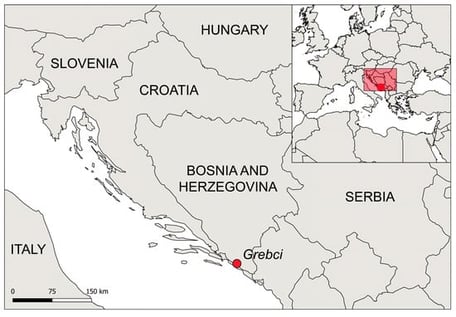
The discovery of hippopotamid remain from a cave near the village of Grebci, Bosnia and Herzegovina, represents the first confirmed record of Hippopotamus in this part of southeastern Europe. The specimen, a partially preserved right os coxae, is housed at the Dubrovnik Natural History Museum. Morphological and metric analyses identify it as Hippopotamus cf. amphibius, although its fragmentary state prevents a more precise taxonomic attribution, while lack of stratigraphic context prevents chronological assessment. Despite the uncertain stratigraphic context, taphonomic analysis reveals evidence of mineralization, surface abrasion, and post-depositional fracturing, consistent with long-term cave deposition. This find fills a long-standing paleogeographic gap in the distribution of the Pleistocene hippopotamids in southeastern Europe, as no remains have previously been documented from the region outside Greece. Its presence supports the hypothesis that the Balkan Peninsula functioned as a migratory corridor for hippopotamids dispersing from Africa into Europe. Further research integrating stratigraphic, geochronological, and comparative morphological data is needed to clarify its evolutionary and biogeographic significance.
9 February 2026
![(a) Time series of the superposed SSA-filtered EPICA stacks (red line, [19]) and global benthic δ18O stack (blue line, [57]) that is SSA-filtered [8]. Time series are standardized (0-mean, 1-SD), and the δ18O is inverted. (b) Cross-correlation analysis. CCF has the highest Pearson coefficient (0.91) at −5 lag number, equivalent to a δ18O ‘bulk’ lag of 2.5 kyr. The Pearson correlation at 0-lag is 0.87. (c) Cross-plot of the linear correlation (r = 0.87) between LR04 and EPICA stacks with 95% confidence intervals (light blue lines) and significance test of the correlation coefficient (t = 69.9; Sig. = 0.000). MPT = Mid-Pleistocene Transition; MBE = Mid-Brunhes Event. Figure is from [9].](https://mdpi-res.com/cdn-cgi/image/w=281,h=192/https://mdpi-res.com/quaternary/quaternary-09-00012/article_deploy/html/images/quaternary-09-00012-ag-550.jpg)