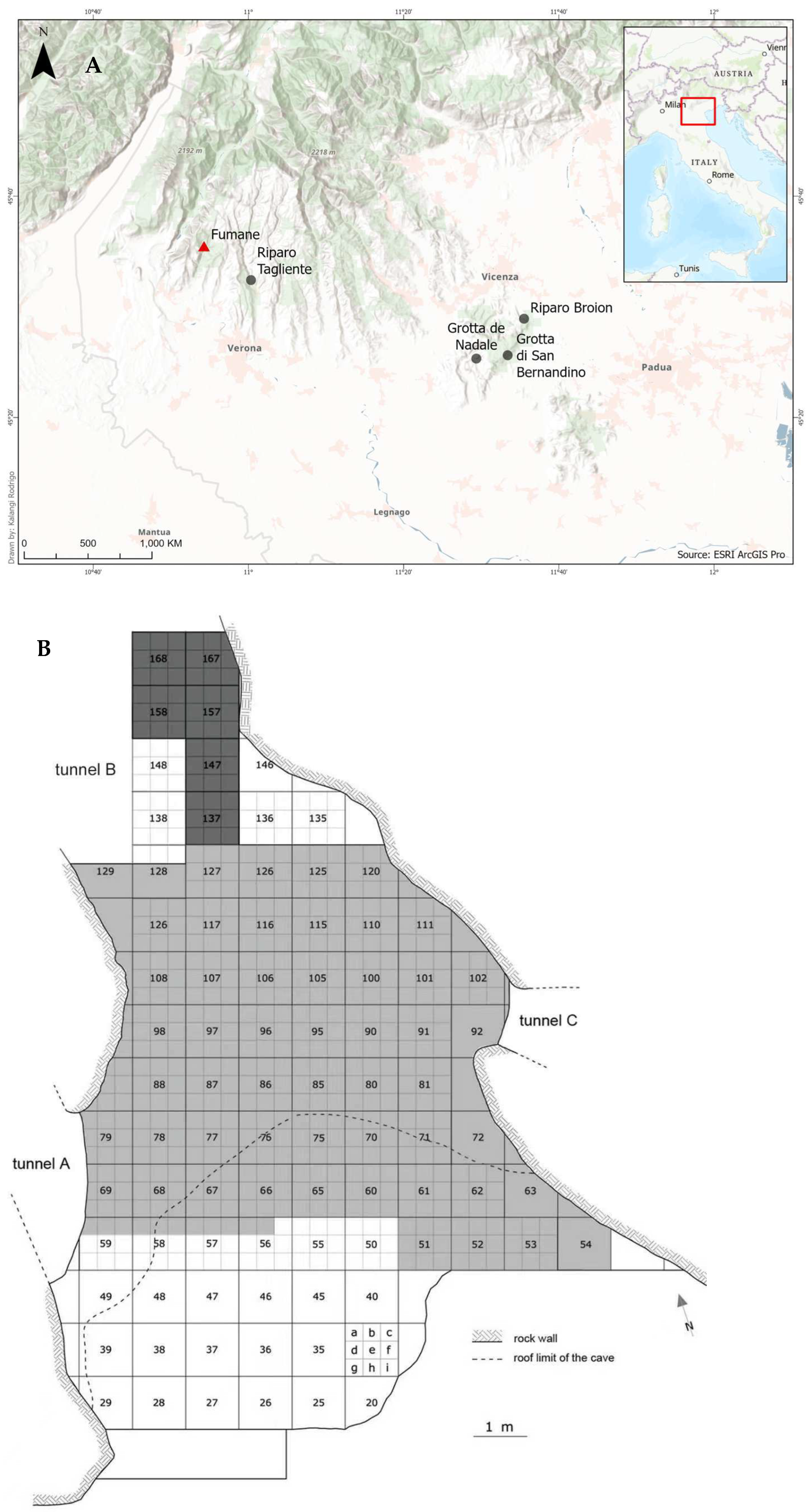

From Prey to Pattern: Integrating Faunal and Behavioural Evidence of Neanderthal Subsistence at Fumane Cave (Unit A9), Northern Italy

 , , and
Abstract
1. Introduction
2. Materials and Methods
Zooarchaeological and Taphonomical Frame of Reference
3. Results
3.1. Zooarchaeology and Taphonomy
3.2. Exploitation of Carcasses
3.3. Carcass Representation Index
4. Discussion
5. Conclusions
Author Contributions
Funding
Data Availability Statement
Acknowledgments
Conflicts of Interest
References
- Romandini, M.; Nannini, N.; Tagliacozzo, A.; Peresani, M. The ungulate assemblage from layer A9 at Grotta di Fumane, Italy: A zooarchaeological contribution to the reconstruction of Neanderthal ecology. Quat. Int. 2014, 337, 11–27. [Google Scholar] [CrossRef]
- Delpiano, D.; Zupancich, A.; Peresani, M. Innovative Neanderthals: Results from an integrated analytical approach applied to backed stone tools. J. Archaeol. Sci. 2019, 110, 105011. [Google Scholar] [CrossRef]
- Delpiano, D.; Heasley, K.; Peresani, M. Assessing Neanderthal land use and lithic raw material management in Discoid technology. J. Anthropol. Sci. 2018, 96, 89–110. [Google Scholar] [CrossRef]
- Peresani, M.; Sauro, U. Palaeolithic Cave deposits and Karst evolution in the Venetian Pre-Alps. Geol. Field Trips Maps 2024, 16, 1–40. [Google Scholar] [CrossRef]
- Marcazzani, D.; Miller, C.E.; Ligouis, B.; Duches, R.; Conard, N.J.; Peresani, M. Middle and Upper Paleolithic occupations of Fumane Cave (Italy): A geoarchaeological investigation of the anthropogenic features. J. Anthropol. Sci. 2023, 101, 37–62. [Google Scholar]
- Peresani, M. Inspecting human evolution from a cave. Late Neanderthals and early sapiens at Grotta di Fumane: Present state and outlook. J. Anthropol. Sci. 2022, 100, 71–107. [Google Scholar]
- López-García, J.M.; dalla Valle, C.; Cremaschi, M.; Peresani, M. Reconstruction of the Neanderthal and Modern Human landscape and climate from the Fumane cave sequence (Verona, Italy) using small-mammal assemblages. Quat. Sci. Rev. 2015, 128, 1–13. [Google Scholar] [CrossRef]
- Kehl, M.; Marcazzan, D.; Miller, C.E.; Falcucci, A.; Duches, R.; Peresani, M. The Upper Sedimentary Sequence of Grotta di Fumane, Northern Italy: A Micromorphological Approach to Study Imprints of Human Occupation and Paleoclimate Change. Geoarchaeology 2025, 40, e70000. [Google Scholar] [CrossRef]
- Sánchez-Romero, L.; Govoni, M.; Marcazzan, D.; Delpiano, D.; Nannini, N.; Martellotta, E.F.; Duches, R.; Peresani, M. Intra-site Organization of the Repeated Neanderthal Occupation of Unit A9, Grotta di Fumane (Pre-Alps, Italy). J. Archaeol. Method Theory 2025, 32, 45. [Google Scholar] [CrossRef]
- France, D.L. Human and Nonhuman Bone Identification: A Color Atlas; CRC Press: New York, NY, USA, 2009. [Google Scholar]
- Davis, S.J.M. The Archaeology of Animals; Routledge Press: London, UK, 1987. [Google Scholar]
- Lyman, R.L. Vertebrate Taphonomy; Cambridge University Press: Cambridge, UK, 2014; pp. 1–524. [Google Scholar] [CrossRef]
- Broughton, J.M. Zooarchaeology. In International Encyclopedia of the Social & Behavioral Sciences, 2nd ed.; Elsevier: Amsterdam, The Netherlands, 2015; pp. 849–853. [Google Scholar]
- Reitz, E.J.; Wing, E.S. Cambridge Manual of Zooarchaology; Cambridge University Press: Cambridge, UK, 2008. [Google Scholar]
- Bunn, H.T.; Bartram, L.E.; Kroll, E.M. Variability in bone assemblage formation from Hadza hunting, scavenging, and carcass processing. J. Anthropol. Archaeol. 1988, 7, 412–457. [Google Scholar] [CrossRef]
- Aitken, R.J. Delayed implantation in roe deer (Capreolus capreolus). Reproduction 1974, 39, 225–233. [Google Scholar] [CrossRef]
- Mariezkurrena, K. Contribución al conocimiento del desarrollo de la dentición y el esqueleto postcraneal de Cervus elaphus. Munibe 1983, 35, 149–202. [Google Scholar]
- D’errico, F.; Vanhaeren, M. Criteria for Identifying Red Deer (Cervus elaphus) Age and Sex from Their Canines. Application to the Study of Upper Palaeolithic and Mesolithic Ornaments. J. Archaeol. Sci. 2002, 29, 211–232. [Google Scholar] [CrossRef]
- Hillson, S. Teeth; Cambridge University Press: Cambridge, UK, 2005. [Google Scholar]
- Silver, I. The Ageing of Domestic Animals in Science in Archaeology: A Survey of Progress and Research; Brothewell, D., Higgs, E., Clark, G., Eds.; Praeger Press: New York, NY, USA, 1969; pp. 250–268. [Google Scholar]
- Bunn, H.T.; Pickering, T.R. Methodological recommendations for ungulate mortality analyses in paleoanthropology. Quat. Res. 2010, 74, 388–394. [Google Scholar] [CrossRef]
- Habermehl, K.H. Die Altersbestimmung Bei Hausund Labortieren; Auflage: Berlin/Hamburg, Germany, 1975. [Google Scholar]
- Grayson, D.K. Quantitative Zooarchaeology: Topics in the Analysis of Archaeological Faunas; Academic Press: Orlando, FL, USA, 1984. [Google Scholar]
- Bökönyi, S. A New Method for the Determination of the Number of Individuals in Animal Bone Material. Am. J. Archaeol. 1970, 74, 291–292. [Google Scholar] [CrossRef]
- Behrensmeyer, A.K. Taphonomic and ecologic information from bone weathering. Paleobiology 1978, 4, 150–162. [Google Scholar] [CrossRef]
- Fernandez-Jalvo, Y.; Andrews, P. Atlas of Taphonomic Identifications; Springer: Dordrecht, The Netherlands, 2016. [Google Scholar]
- Brain, C.K. Bone weathering and the problem of bone pseudo-tools. S. Afr. J. Sci. 1967, 63, 97–99. [Google Scholar]
- Shipman, P. Life History of a Fossil: An Introduction to Taphonomy and Paleoecology; Harvard University Press: Cambridge, UK, 1981. [Google Scholar]
- Fisher, J.W. Bone surface modifications in zooarchaeology. J. Archaeol. Method Theory 1995, 2, 7–98. [Google Scholar] [CrossRef]
- Binford, L.R. Bones: Ancient Men and Modern Myth; Elsevier: Amsterdam, The Netherlands; Academic Press: Cambridge, MA, USA, 1981. [Google Scholar]
- Brain, C.K. The Hunters or the Hunted? An Introduction to African Cave Taphonomy; Chicago University Press: Chicago, IL, USA, 1981. [Google Scholar]
- Blumenschine, R.J.; Selvaggio, M.M. Percussion marks on bone surfaces as a new diagnostic of hominid behaviour. Nature 1988, 333, 763–765. [Google Scholar] [CrossRef]
- Capaldo, S.D.; Blumenschine, R.J. A Quantitative Diagnosis of Notches Made by Hammerstone Percussion and Carnivore Gnawing on Bovid Long Bones. Am. Antiq. 1994, 59, 724–748. [Google Scholar] [CrossRef]
- Blumenschine, R.J. Percussion marks, tooth marks, and experimental determinations of the timing of hominid and carnivore ace to long bones at FLK Zinjanthropus, Olduvai Gorge, Tanzania. J. Hum. Evol. 1995, 27, 197–213. [Google Scholar] [CrossRef]
- Domínguez-Rodrigo, M.; Piqueras, A. The use of tooth pits to identify carnivore taxa in tooth-marked archaeofaunas and their relevance to reconstruct hominid carcass processing behaviours. J. Archaeol. Sci. 2003, 30, 1385–1391. [Google Scholar] [CrossRef]
- Potts, R.; Shipman, P. Cutmarks made by stone tools on bones from Olduvai Gorge, Tanzania. Nature 1981, 291, 577–580. [Google Scholar] [CrossRef]
- Shipman, P.; Rose, J. Early hominid hunting, butchering, and carcass-processing behaviors: Approaches to the fossil record. J. Anthropol. Archaeol. 1983, 2, 57–98. [Google Scholar] [CrossRef]
- Lyman, R.L. Quantitative Paleozoology; Cambridge University Press: Cambridge, UK, 2008. [Google Scholar]
- Costamagno, S.; Soulier, M.-C.; Val, A.; Chong, S. The reference collection of cutmarks. Palethnologie 2019, 1, 1–93. [Google Scholar] [CrossRef]
- Blumenschine, R.J.; Selvaggio, M.M. On the marks of marrow bone processing by hammerstones hyaenas: Their anatomical patterning archaeological implications. In Cultural Beginnings: Approaches to Understanding Early Hominid Life-Ways in the African Savanna; Clark, J.D., Ed.; Dr Rudolf Habelt GMBH: Bonn, Germany, 1991; pp. 17–32. [Google Scholar]
- Blasco, R.; Rosell, J.; Domínguez-Rodrigo, M.; Lozano, S.; Pastó, I.; Riba, D.; Vaquero, M.; Peris, J.F.; Arsuaga, J.L.; de Castro, J.M.B.; et al. Learning by Heart: Cultural Patterns in the Faunal Processing Sequence during the Middle Pleistocene. PLoS ONE 2013, 8, e55863. [Google Scholar] [CrossRef]
- Vettese, D.; Daujeard, C.; Blasco, R.; Borel, A.; Caceres, I.; Moncel, M.H. Neandertal long bone breakage process: Standardized or random patterns? The example of Abri du Maras (Southeastern France, MIS 3). J. Archaeol. Sci. Rep. 2017, 13, 151–163. [Google Scholar] [CrossRef]
- Villa, P.; Mahieu, E. Breakage patterns of human long bones. J. Hum. Evol. 1991, 21, 27–48. [Google Scholar] [CrossRef]
- Outram, A.K. A New Approach to Identifying Bone Marrow and Grease Exploitation: Why the “Indeterminate” Fragments should not be Ignored. J. Archaeol. Sci. 2001, 28, 401–410. [Google Scholar] [CrossRef]
- Grunwald, A.M. Analysis of fracture patterns from experimentally marrow-cracked frozen and thawed cattle bones. J. Archaeol. Sci. Rep. 2016, 8, 356–365. [Google Scholar] [CrossRef]
- Coil, R.; Tappen, M.; Yezzi-Woodley, K. New analytical methods for comparing bone fracture angles: A controlled study of hammerstone and hyena (Crocuta crocuta) long bone breakage. Archaeometry 2017, 59, 900–917. [Google Scholar] [CrossRef]
- Stiner, M.C.; Kuhn, S.L.; Weiner, S.; Bar-Yosef, O. Differential Burning, Recrystallization, and Fragmentation of Archaeological Bone. J. Archaeol. Sci. 1995, 22, 223–237. [Google Scholar] [CrossRef]
- Miller, F.L. Caribou. In Wild Mammals of North America: Biology, Management, and Conservation; Feldhamer, G.A., Thompson, B.C., Chapman, J.A., Eds.; John Hopkins University Press: Baltimore, MD, USA, 2003; pp. 965–997. [Google Scholar]
- Mysterud, A. Diet overlap among ruminants in Fennoscandia. Oecologia 2000, 124, 130–137. [Google Scholar] [CrossRef]
- Jackson, J.E. Feeding habits of deer. Mammal Rev. 1974, 4, 93–101. [Google Scholar] [CrossRef]
- Alekseĭ, D.; Hewison, A.M. Behavioural Ecology of Siberian and European Roe Deer; Chapman & Hall: London, UK, 1996. [Google Scholar]
- van Beeck Calkoen, S.T.S.; Leigh-Moy, K.; Cromsigt, J.P.G.M.; Spong, G.; Lebeau, L.C.; Heurich, M. The blame game: Using eDNA to identify species-specific tree browsing by red deer (Cervus elaphus) and roe deer (Capreolus capreolus) in a temperate forest. For. Ecol. Manag. 2019, 451, 117483. [Google Scholar] [CrossRef]
- Yravedra, J.; Cobo-Sánchez, L. Neanderthal exploitation of ibex and chamois in southwestern Europe. J. Hum. Evol. 2015, 78, 12–32. [Google Scholar] [CrossRef] [PubMed]
- Carvalho, M.; Haws, J.A.; Jones, E.L. Late Neanderthal subsistence foraging mobility at Lapa do Picareiro: A zooarchaeological taphonomic analysis of Level JJ. Front. Environ. Archaeol. 2025, 4, 1–21. [Google Scholar] [CrossRef]
- Rendu, W.; Costamagno, S.; Meignen, L.; Soulier, M.-C. Monospecific faunal spectra in Mousterian contexts: Implications for social behavior. Quat. Int. 2012, 247, 50–58. [Google Scholar] [CrossRef]
- Bal-García, H.; Rey-Rodríguez, I.; de Lombera-Hermida, A.; Díaz-Rodríguez, M.; Fernández-Rodríguez, C.; Rodríguez-Álvarez, X.P.; Valcarce, R.F. Landscape and subsistence in NW Iberia during the Middle Palaeolithic (MIS3): Faunal analysis of Cova Eirós (Triacastela, Galicia, Spain). J. Archaeol. Sci. Rep. 2025, 64, 105149. [Google Scholar] [CrossRef]
- Yravedra, J.; Estaca-Gómez, V.; Grandal-d’Anglade, A.; Pinto-Llona, A.C. Neanderthal subsistence strategies: New evidence from the Mousterian Level XV of the Sopeña rock shelter (Asturias, northern Spain). Archaeol. Anthropol. Sci. 2024, 16, 6. [Google Scholar] [CrossRef]
- Grimstead, D.N. Ethnographic and Modeled Costs of Long-Distance, Big-Game Hunting. Am. Antiq. 2010, 75, 61–80. [Google Scholar] [CrossRef]
- Grimstead, D.N. Prestige and Prejudice: The Role of Long Distance Big Game Hunting as an Optimal Foraging Decision. Am. Antiq. 2012, 77, 168–178. [Google Scholar] [CrossRef]
- Broughton, J.M.; Cannon, M.D.; Bayham, F.E.; Byers, D.A. Prey Body Size and Ranking in Zooarchaeology: Theory, Empirical Evidence, and Applications from the Northern Great Basin. Am. Antiq. 2011, 76, 403–428. [Google Scholar] [CrossRef]
- Bird, D.W.; Bird, R.B.; Codding, B.F. In Pursuit of Mobile Prey: Martu Hunting Strategies and Archaeofaunal Interpretation. Am. Antiq. 2009, 74, 3–29. [Google Scholar] [CrossRef][Green Version]
- Wilson, D.E.; Mittermeier, R.A. (Eds.) Handbook of the Mammals of the World, Volume 1: Carnivores; Lynx Edicions: Barcelona, Spain, 2009. [Google Scholar]
- López-González, F.; Grandal-d’Anglade, A.; Vidal-Romaní, J.R. Deciphering bone depositional sequences in caves through the study of manganese coatings. J. Archaeol. Sci. 2006, 33, 707–717. [Google Scholar] [CrossRef]
- Pineda, A.; Saladié, P. Beyond the Problem of Bone Surface Preservation in Taphonomic Studies of Early and Middle Pleistocene Open-Air Sites. J. Archaeol. Method Theory 2022, 29, 1090–1130. [Google Scholar] [CrossRef]
- Schiffer, M.B. Toward the Identification of Formation Processes. Am. Antiq. 1983, 48, 675–706. [Google Scholar] [CrossRef]
- Morin, E. Taphonomy. In Reassessing Paleolithic Subsistence The Neandertal and Modern Human Foragers of Saint-Césaire; Cambridge University Press: Cambridge, UK, 2012; pp. 93–131. [Google Scholar]
- Macho-Callejo, A.; García-Morato, S.; Gutiérrez, A.; Marin-Monfort, D.; Fernández-Jalvo, Y. Put down roots and find the plant!: Preliminary results of root etching and its implications. Hist. Biol. 2024, 36, 2502–2510. [Google Scholar] [CrossRef]
- Olsen, S.L.; Shipman, P. Surface modification on bone: Trampling versus butchery. J. Archaeol. Sci. 1988, 15, 535–553. [Google Scholar] [CrossRef]
- Moclán, A.; Domínguez-Rodrigo, M. An experimental study of the patterned nature of anthropogenic bone breakage and its impact on bone surface modification frequencies. J. Archaeol. Sci. 2018, 96, 1–13. [Google Scholar] [CrossRef]
- Thun Hohenstein, U.; Caffarelli, L.; Arnetta, G.; Rivals, F.; Pozzobon, P.; Gialanella, S.; Delpiano, D.; Peresani, M. Taphonomy of the fauna and chert assemblages from the Middle Palaeolithic site of Vajo Salsone, Eastern Italian Alps. Quat. Sci. Adv. 2024, 14, 100183. [Google Scholar] [CrossRef]
- Modolo, M.; Delpiano, D.; Martellotta, E.F.; Peresani, M. Bone Refits and Implications for the Reconstruction of a Late Middle Palaeolithic Context: Unit A9 of Fumane Cave. J. Paleolit. Archaeol. 2024, 8, 1. [Google Scholar] [CrossRef]
- Thun-Hohenstein, U.; Parere, V.; Sala, B.; Giunti, P.; Longo, L. Large mammals from Mezzena rockshelter: New biocronological and palaeoecological hypotheses and preliminary data on subsistence strategies. Quat. Int. 2012, 259, 1–6. [Google Scholar]
- Fiore, I.; Gala, M.; Romandini, M.; Cocca, E.; Tagliacozzo, A.; Peresani, M. From feathers to food: Reconstructing the complete exploitation of avifaunal resources by Neanderthals at Fumane cave, unit A9. Quat. Int. 2016, 421, 134–153. [Google Scholar] [CrossRef]
- Romandini, M.; Hohenstein, U.T.; Fiore, I.; Tagliacozzo, A.; Perez, A.; Lubrano, V.; Terlato, G.; Peresani, M. Late neandertals and the exploitation of small mammals in northern Italy: Fortuity, necessity or hunting variability? Quaternaire 2018, 29, 61–67. [Google Scholar] [CrossRef]
- Terlato, G.; Livraghi, A.; Romandini, M.; Peresani, M. Large bovids on the Neanderthal menu: Exploitation of Bison priscus and Bos primigenius in northeastern Italy. J. Archaeol. Sci. Rep. 2019, 25, 129–143. [Google Scholar] [CrossRef]
- Schoville, B.J.; Otárola-Castillo, E. A model of hunter-gatherer skeletal element transport: The effect of prey body size, carriers, and distance. J. Hum. Evol. 2014, 73, 1–14. [Google Scholar] [CrossRef]
- Faith, J.T.; Gordon, A.D. Skeletal element abundances in archaeofaunal assemblages: Economic utility, sample size, and assessment of carcass transport strategies. J. Archaeol. Sci. 2007, 34, 872–882. [Google Scholar] [CrossRef]
- Binford, L.R. Nunamiut Ethnoarchaeology; Academic Press: New York, NY, USA, 1978. [Google Scholar]
- Bunn, H.T. Patterns of skeletal representation and hominid subsistence activities at Olduvai Gorge, Tanzania, and Koobi Fora, Kenya. J. Hum. Evol. 1986, 15, 673–690. [Google Scholar] [CrossRef]
- Bartram, L.E. Perspectives on skeletal part profiles and utility curves from eastern Kalahari ethnoarchaeology. In From Bones to Behavior: Ethnoarchaeological and Experimental Contributions to the Interpretation of Faunal Remains; Hudson, J., Ed.; The Center for Archaeological Investigations at Southern Illinois University: Carbondale, IL, USA, 1993; pp. 115–137. [Google Scholar]
- Lam, Y.M.; Chen, X.; Pearson, O.M. Intertaxonomic Variability in Patterns of Bone Density and the Differential Representation of Bovid, Cervid, and Equid Elements in the Archaeological Record. Am. Antiq. 1999, 64, 343–362. [Google Scholar] [CrossRef]
- Lyman, R.L. Anatomical considerations of utility curves in Zooarchaeology. J. Archaeol. Sci. 1992, 19, 7–22. [Google Scholar] [CrossRef]
- Binford, L.R. In Pursuit of the Past: Decoding the Archaeological Record; University of California Press: Los Angeles, CA, USA, 1983. [Google Scholar]
- Chang, C.-Y.; Ke, D.-S.; Chen, J.-Y. Essential fatty acids and human brain. Acta Neurol. Taiwanica 2009, 18, 231–241. [Google Scholar]
- Agam, A.; Barkai, R. Not the brain alone: The nutritional potential of elephant heads in Paleolithic sites. Quat. Int. 2016, 406, 218–226. [Google Scholar] [CrossRef]
- Rougier, H.; Crevecoeur, I.; Beauval, C.; Posth, C.; Flas, D.; Wißing, C.; Furtwängler, A.; Germonpré, M.; Gómez-Olivencia, A.; Semal, P.; et al. Neandertal cannibalism and Neandertal bones used as tools in Northern Europe. Sci. Rep. 2016, 6, 29005. [Google Scholar] [CrossRef]
- Domínguez-Rodrigo, M.; Pickering, T.R.; Semaw, S.; Rogers, M.J. Cutmarked bones from Pliocene archaeological sites at Gona, Afar, Ethiopia: Implications for the function of the world’s oldest stone tools. J. Hum. Evol. 2005, 48, 109–121. [Google Scholar] [CrossRef]
- Blasco, R.; Fernández Peris, J. A uniquely broad spectrum diet during the Middle Pleistocene at Bolomor Cave (Valencia, Spain). Quat. Int. 2012, 252, 16–31. [Google Scholar] [CrossRef]
- Marín, J.; Daujeard, C.; Saladié, P.; Rodríguez-Hidalgo, A.; Vettese, D.; Rivals, F.; Boulbes, N.; Crégut-Bonnoure, E.; Lateur, N.; Gallotti, R.; et al. Neanderthal faunal exploitation and settlement dynamics at the Abri du Maras, level 5 (south-eastern France). Quat. Sci. Rev. 2020, 243, 106472. [Google Scholar] [CrossRef]
- Chase, P.G. The Hunters of Combe-Grenal: Approaches to Middle Paleolithic Subsistence in Europe. In British Archaeological Reports; BAR International Series S286; BAR Publishing: Oxford, UK, 1986. [Google Scholar]
- Berlioz, E.; Capdepon, E.; Discamps, E. A long-term perspective on Neanderthal environment and subsistence: Insights from the dental microwear texture analysis of hunted ungulates at Combe-Grenal (Dordogne, France). PLoS ONE 2023, 18, e0278395. [Google Scholar] [CrossRef]
- Romandini, M.; Terlato, G.; Nannini, N.; Tagliacozzo, A.; Benazzi, S.; Peresani, M. Bears and humans, a Neanderthal tale. Reconstructing uncommon behaviors from zooarchaeological evidence in southern Europe. J. Archaeol. Sci. 2018, 90, 71–91. [Google Scholar] [CrossRef]
- Livraghi, A.; Fanfarillo, G.; Colle, M.D.; Romandini, M.; Peresani, M. Neanderthal ecology and the exploitation of cervids and bovids at the onset of MIS4: A study on De Nadale cave, Italy. Quat. Int. 2021, 586, 24–41. [Google Scholar] [CrossRef]
- Romandini, M.; Silvestrini, S.; Real, C.; Lugli, F.; Tassoni, L.; Carrera, L.; Badino, F.; Bortolini, E.; Marciani, G.; Delpiano, D.; et al. Late Neanderthal “menu” from northern to southern Italy: Freshwater and terrestrial animal resources. Quat. Sci. Rev. 2023, 315, 108233. [Google Scholar] [CrossRef]
- Gaudzinski, S. A matter of high resolution? The Eemian Interglacial (OIS 5e) in north-central Europe and Middle Palaeolithic subsistence. Int. J. Osteoarchaeol. 2004, 14, 201–211. [Google Scholar] [CrossRef]
- Adler, D.S.; Bar-Oz, G.; Belfer-Cohen, A.; Bar-Yosef, O. Ahead of the Game. Curr. Anthropol. 2006, 47, 89–118. [Google Scholar] [CrossRef]
- Stiner, M.C.; Munro, N.D.; Surovell, T.A. The Tortoise and the Hare: Small-Game Use, the Broad-Spectrum Revolution, and Paleolithic Demography. Curr. Anthropol. 2000, 41, 39–79. [Google Scholar] [CrossRef]
- Uzunidis, A.; Blasco, R.; Brugal, J.-P.; Fourcade, T.; Ochando, J.; Rosell, J.; Roussel, A.; Rufà, A.; Sánchez Goñi, M.F.; Texier, P.-J.; et al. Neanderthal hunting grounds: The case of Teixoneres Cave (Spain) and Pié Lombard rockshelter (France). J. Archaeol. Sci. 2024, 168, 106007. [Google Scholar] [CrossRef]
- Daujeard, C.; Vettese, D.; Britton, K.; Béarez, P.; Boulbes, N.; Crégut-Bonnoure, E.; Desclaux, E.; Lateur, N.; Pike-Tay, A.; Rivals, F.; et al. Neanderthal selective hunting of reindeer? The case study of Abri du Maras (south-eastern France). Archaeol. Anthropol. Sci. 2019, 11, 985–1011. [Google Scholar] [CrossRef]

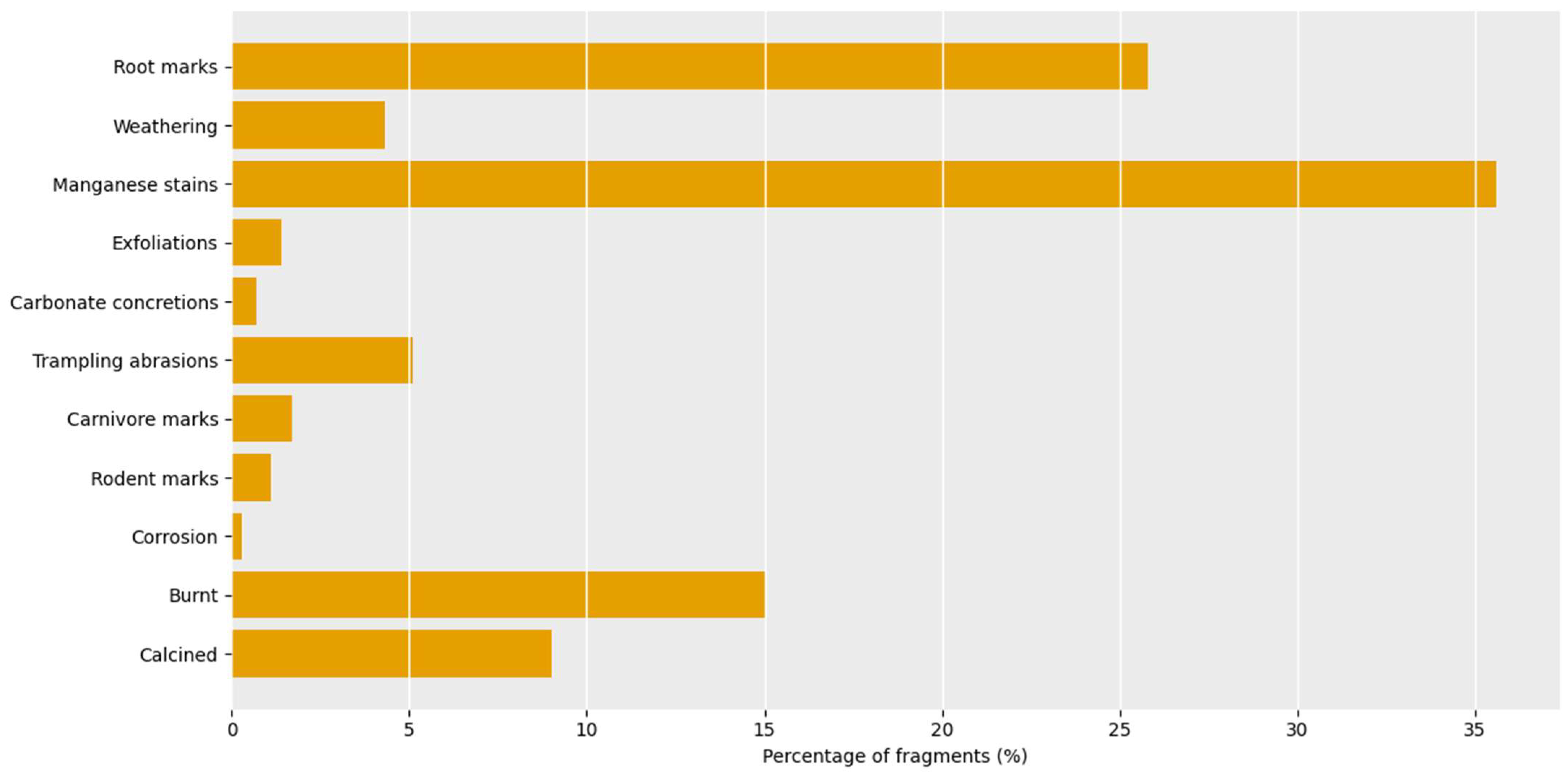
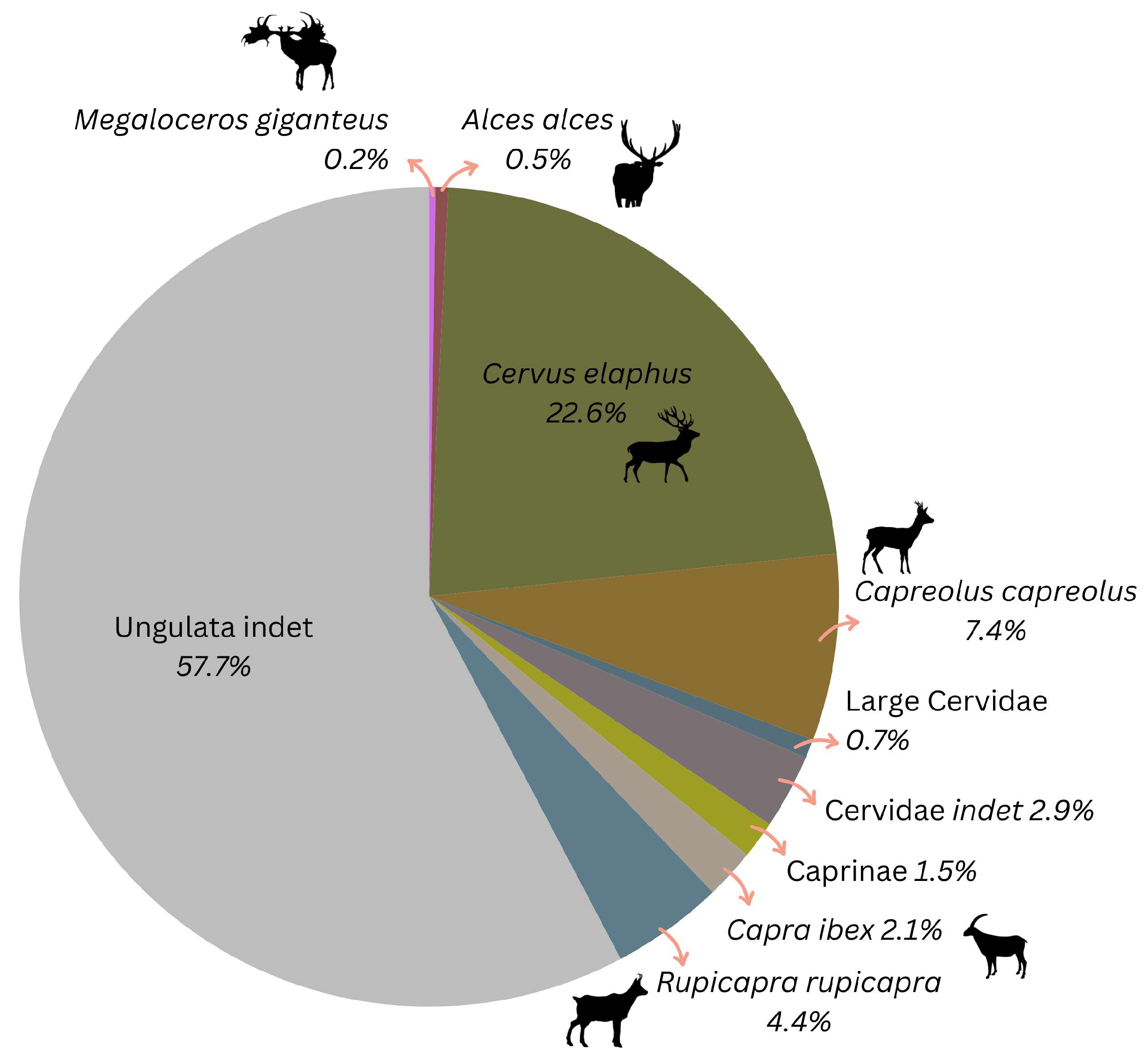


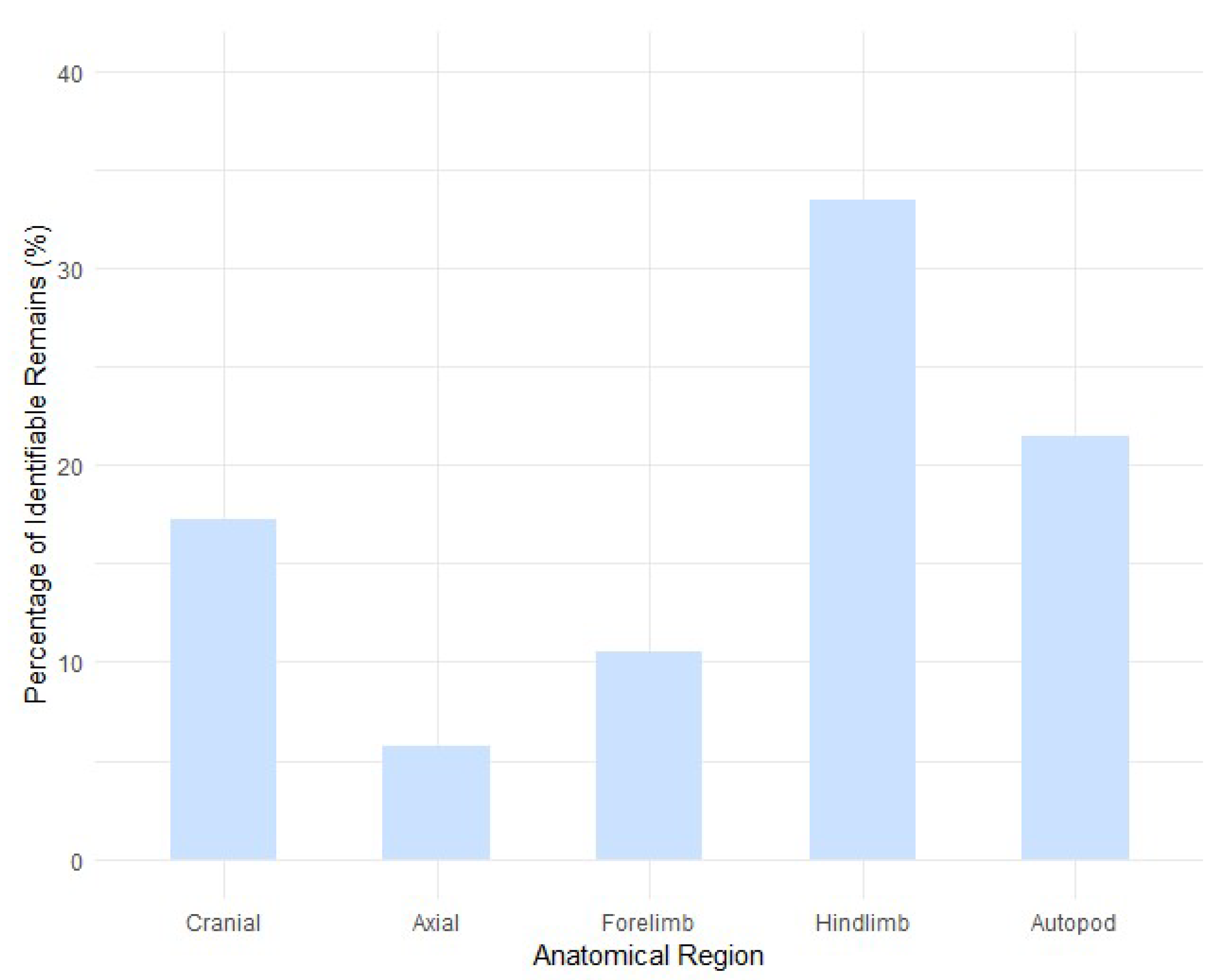

| Taxa | NISP | NISP% | MNI |
|---|---|---|---|
| Rodentia indet. | 4 | 0.9 | 1 |
| Total Rodentia | 4 | 0.9 | 1 |
| Aves | 1 | 0.2 | 1 |
| Total Aves | 1 | 0.2 | 1 |
| Vulpes vulpes | 1 | 0.2 | 1 |
| Ursus arctos | 3 | 0.7 | 3 |
| Ursus spelaeus | 2 | 0.5 | 2 |
| Ursus sp. | 3 | 0.7 | 3 |
| Meles meles | 2 | 0.5 | 1 |
| Carnivora indet | 1 | 0.2 | |
| Total Carnivora | 12 | 2.8 | 10 |
| Megaloceros giganteus | 1 | 0.2 | 1 |
| Alces alces | 2 | 0.5 | 1 |
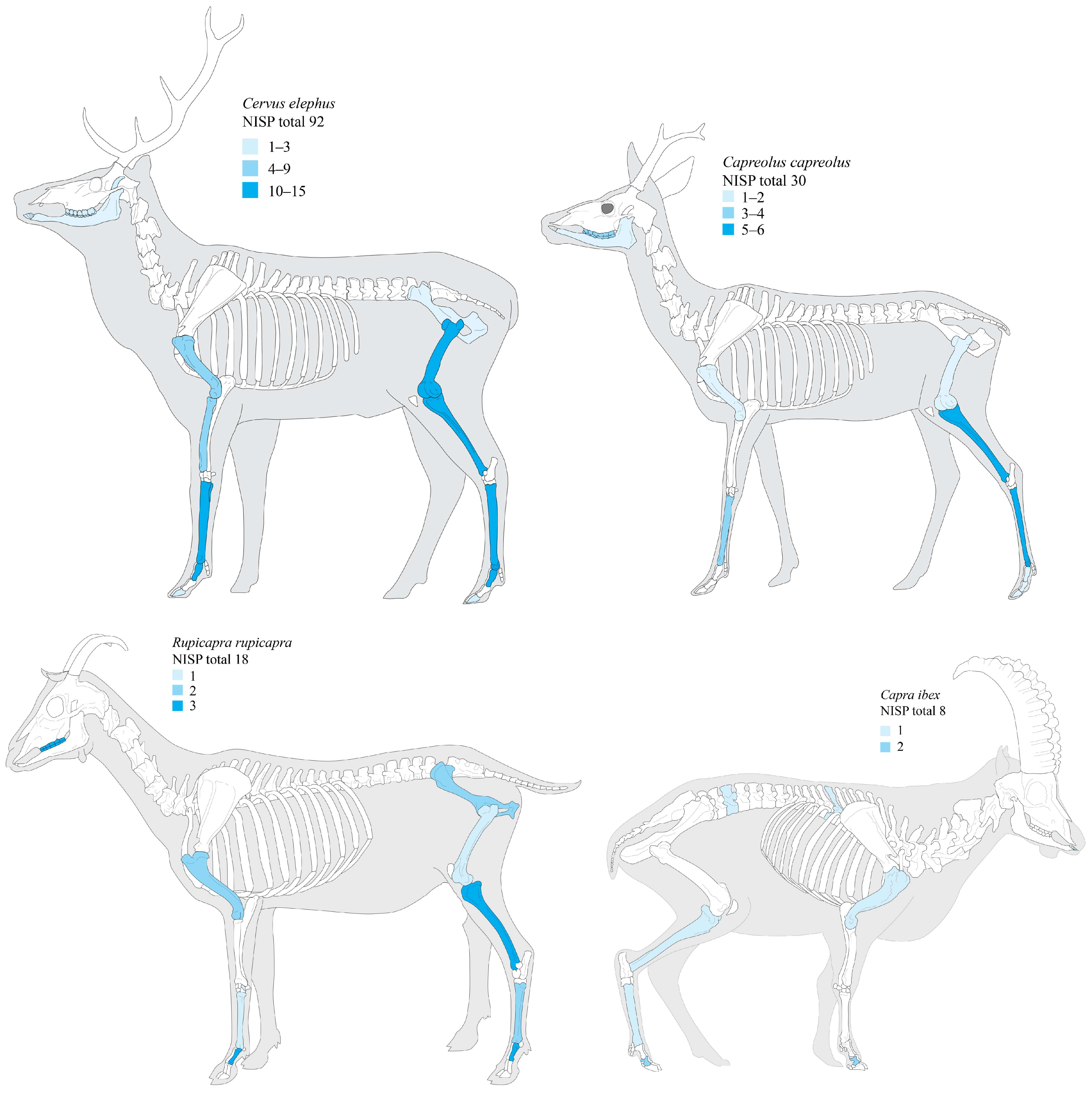
| Cervus elaphus | 92 | 21.7 | 8 |
| Capreolus capreolus | 30 | 7.1 | 3 |
| Large Cervidae | 3 | 0.7 | 2 |
| Cervidae indet. | 12 | 2.8 | 5 |
| Caprine | 6 | 1.4 | 1 |
| Capra ibex | 8 | 1.9 | 3 |
| Rupicapra rupicapra | 18 | 4.2 | 2 |
| Ungulata indet. | 235 | 55.4 | |
| Total Ungulates | 407 | 96 | 26 |
| Total Determined | 424 | 24.4 | 38 |
| Undetermined Specimens | |||
| Small-sized mammals | 1 | 0.1 | |
| Medium-sized mammals | 18 | 1.0 | |
| Medium–big-sized mammals | 27 | 1.6 | |
| Big-sized mammals | 8 | 0.5 | |
| Undetermined diaphysis | 1260 | 72.5 | |
| Total Undetermined | 1314 | 75.6 | |
| Total NISPs | 1738 | 100.00 | |
| Taxa | NISP | CM | PM | CM + PM | Tot. BM | % BM | R | B | C | TM |
|---|---|---|---|---|---|---|---|---|---|---|
| Megaloceros giganteus | 1 | |||||||||
| Alces alces | 2 | 1 | 1 | 50.00 | 1 | |||||
| Cervus elaphus | 92 | 28 | 4 | 1 | 33 | 35.87 | 1 | 3 | 3 | 7 |
| Capreolus capreolus | 30 | 9 | 1 | 1 | 11 | 36.67 | 1 | 1 | ||
| Large Cervidae | 3 | |||||||||
| Cervidae indet. | 12 | 1 | 1 | 8.33 | ||||||
| Caprine | 6 | 2 | 1 | 1 | 4 | 66.67 | ||||
| Capra ibex | 8 | 2 | 1 | 3 | 37.50 | |||||
| Rupicapra rupicapra | 18 | 3 | 1 | 1 | 5 | 27.78 | 1 | 2 | ||
| Ungulata indet. | 235 | 65 | 2 | 2 | 69 | 29.36 | 2 | 6 | 8 | 5 |
| Total | 407 | 111 | 10 | 6 | 127 | 31.20 | 4 | 13 | 12 | 12 |
| Anatomical Element | NISP | CM | PM | CM + PM | Tot. BM | % BM | R | B | C | TM |
|---|---|---|---|---|---|---|---|---|---|---|
| Cranium | ||||||||||
| Hemimandible | 5 | 1 | 1 | 20.0 | 1 | 1 | ||||
| Tooth | 4 | |||||||||
| Hyoid | ||||||||||
| Total cranium | 9 | 1 | 1 | 11.1 | ||||||
| Atlas axis | ||||||||||
| Vertebra | ||||||||||
| Rib | ||||||||||
| Total axial skeleton | ||||||||||
| Scapula | ||||||||||
| Humerus | 6 | 2 | 2 | 33.3 | 1 | 1 | ||||
| Radius | 5 | 3 | 3 | 60.0 | ||||||
| Ulna | ||||||||||
| Metacarpal | 14 | 4 | 4 | 28.6 | 1 | 2 | ||||
| Total forelimb | 25 | 9 | 9 | 36.0 | ||||||
| Coxal | 1 | |||||||||
| Femur | 12 | 3 | 3 | 1 | 7 | 58.3 | 1 | |||
| Tibia | 13 | 4 | 4 | 30.8 | 1 | 2 | ||||
| Metatarsal | 12 | 6 | 6 | 50.0 | 1 | 1 | 1 | |||
| Total hindlimb | 38 | 13 | 3 | 1 | 17 | 44.7 | ||||
| Metapodials | 6 | 2 | 1 | 3 | 50.0 | |||||
| First phal. | 7 | 2 | 2 | 28.6 | ||||||
| Second phal. | ||||||||||
| Third phal. | 2 | |||||||||
| First phal. rudim. | ||||||||||
| Second phal. rudim. | 1 | |||||||||
| Third phal. rudim. | 1 | |||||||||
| Sesamoid | 2 | 1 | 1 | 50.0 | ||||||
| Diaphysis | 1 | |||||||||
| Total indet. Limb | 20 | 5 | 1 | 6 | 30.0 | |||||
| Total | 92 | 28 | 4 | 1 | 33 | 35.9 | 1 | 3 | 3 | 7 |
Disclaimer/Publisher’s Note: The statements, opinions and data contained in all publications are solely those of the individual author(s) and contributor(s) and not of MDPI and/or the editor(s). MDPI and/or the editor(s) disclaim responsibility for any injury to people or property resulting from any ideas, methods, instructions or products referred to in the content. |
© 2026 by the authors. Licensee MDPI, Basel, Switzerland. This article is an open access article distributed under the terms and conditions of the Creative Commons Attribution (CC BY) license.
Share and Cite
Rodrigo, K.; Nannini, N.; Facincani, V.; De Lorenzi, M.; Peresani, M. From Prey to Pattern: Integrating Faunal and Behavioural Evidence of Neanderthal Subsistence at Fumane Cave (Unit A9), Northern Italy. Quaternary 2026, 9, 14. https://doi.org/10.3390/quat9010014
Rodrigo K, Nannini N, Facincani V, De Lorenzi M, Peresani M. From Prey to Pattern: Integrating Faunal and Behavioural Evidence of Neanderthal Subsistence at Fumane Cave (Unit A9), Northern Italy. Quaternary. 2026; 9(1):14. https://doi.org/10.3390/quat9010014
Chicago/Turabian StyleRodrigo, Kalangi, Nicola Nannini, Vittorio Facincani, Matteo De Lorenzi, and Marco Peresani. 2026. "From Prey to Pattern: Integrating Faunal and Behavioural Evidence of Neanderthal Subsistence at Fumane Cave (Unit A9), Northern Italy" Quaternary 9, no. 1: 14. https://doi.org/10.3390/quat9010014
APA StyleRodrigo, K., Nannini, N., Facincani, V., De Lorenzi, M., & Peresani, M. (2026). From Prey to Pattern: Integrating Faunal and Behavioural Evidence of Neanderthal Subsistence at Fumane Cave (Unit A9), Northern Italy. Quaternary, 9(1), 14. https://doi.org/10.3390/quat9010014