


Abstract
This article reviews key data in the context of the Strait of Gibraltar from the Iberian perspective: a region of significant importance that boasts the highest concentration of rock art sites containing prehistoric paintings and engravings spanning the full spectrum of human rock art, from its inception to the recent historic period. This area is of exceptional value for investigating the replacement of hunter–gatherer–fisher groups by tribal community societies over time, as well as the transition from Neanderthals to Homo sapiens on both sides of the Strait. Current understanding of this resource is analysed and the main threats to it are addressed alongside possible solutions.
1. Introduction
Rock art refers to drawings, paintings or engravings created by humans on natural rock surfaces. These can be found both inside rock cavities and in open-air settings. Associated with prehistoric societies, the earliest examples date back more than 64.8 thousand years (ka) [1]. They provide an important cultural record of early human life and beliefs, offering invaluable insights into these societies and constituting particularly impressive and important evidence for symbolic behaviour [2].
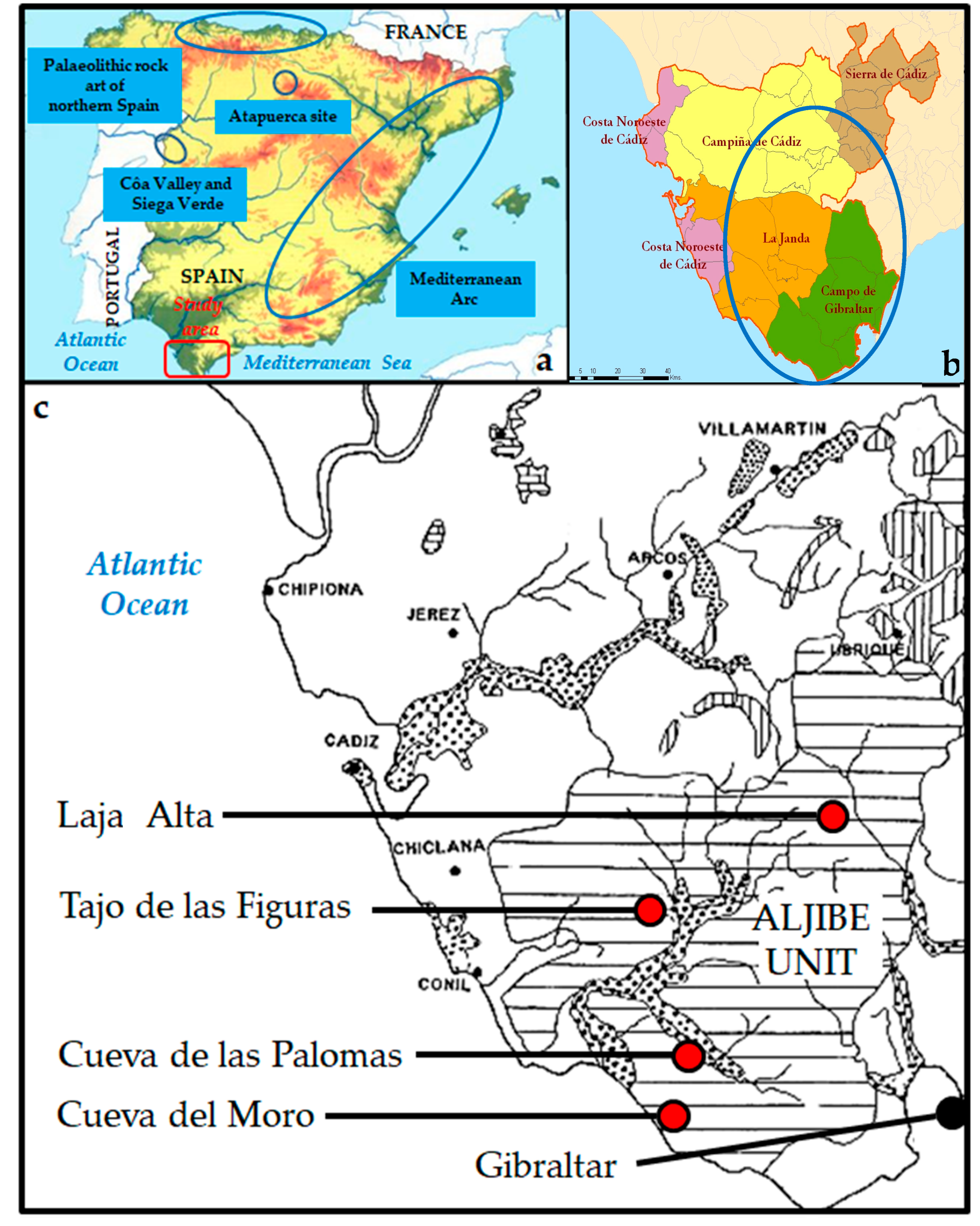
The Iberian Peninsula is a geographical territory that boasts one of greatest concentrations of prehistoric rock art sites. Their diversity is great, with a wide chronological and stylistic variety [3]. UNESCO [4] has included in its World Heritage List four localities in the Iberian Peninsula (Figure 1a):

Figure 1.
(a) Location of the UNESCO properties located in the Iberian Peninsula and the study area (modified from [5]); (b) regions of the province of Cádiz (modified from [6]); (c) location of some Southern Iberian rock art sites within the Aljibe Unit (modified from [7]).
- (i)
- Altamira Cave and Palaeolithic rock art in northern Spain. This site exemplifies some of the most ancient human art, representing a lengthy period of the history of Homo sapiens. It corresponds to the period when the Upper Palaeolithic hunter–gatherers achieved a full artistic, symbolic and spiritual expression of human society.
- (ii)
- Atapuerca archaeological site. Some of the oldest and most abundant evidence of humanity in Europe is located in the caves of the Sierra de Atapuerca, the fossil remains of which constitute an exceptional reservoir of information on the physical nature and way of life of the first human communities in Europe.
- (iii)
- Rock art from the Mediterranean Arc of the Iberian Peninsula. The corpus of late prehistoric rock paintings from the Mediterranean basin of eastern Spain is the largest collection of rock art sites in Europe and provides an exceptional picture of human life from a pivotal period in the evolution of human culture.
- (iv)
- Prehistoric rock art sites in the Côa Valley and Siega Verde. These rock engravings represent a unique example of the first manifestations of human symbolic creativity and the beginnings of cultural development and constitute an unparalleled source for understanding Palaeolithic art. When considered as a whole, this resource provides exceptional information on the life, society, economy and spirituality of our human origins.
Meanwhile, the south of the Iberian Peninsula conserves an important group of rock art sites that have yet to be evaluated by UNESCO, mainly due to a lack of research and assessment. The aim of this paper is to review the different manifestations of rock art in the south of the Iberian Peninsula, their historical discovery, state of conservation and threats and proposals for future preservation.
2. Study Area: Geological Context
The study area is located in the south of the province of Cádiz (southern Spain), near the Strait of Gibraltar (Figure 1a). It mainly encompasses the regions of Campo de Gibraltar and La Janda, although some isolated localities of interest have also been found in the neighbouring regions of Campiña and Sierra de Cádiz (Figure 1b). These regions form part of the western sector of the Betic System and their geological context is characterised by the presence of flysch strata (Unidades del Campo de Gibraltar) [8], which essentially comprise turbidite sequences formed during the Cretaceous and Tertiary periods. Specifically, the representations of art rock here are associated with a unit called the Aljibe Unit (Figure 1c; 23–20 Ma; Aquitanian) characterised by the alternation of ochrous clays with important interbeds of coarse-grained quartzitic sandstones [9].
In the Aljibe Unit, the occurrence of rock shelters has been influenced by weathering and differential erosion. Weathering processes include haloclasty (salt weathering), humectation (wetting and moisture absorption), drying and the action of bacteria and lichens. Erosion processes due to the strong winds of the area generate honeycombs, defoliation, brittle surface layers and even saline efflorescence [10]. This prompts the formation of a wide range of cavities of different sizes, morphologies and depths, on both horizontal (vasques and gnammas) and vertical surfaces (honeycomb weathering). The presence of these cavities has been fundamental to the development of rock art in this area.
3. Methodology
First, a comprehensive historiographic reconstruction of the study area was made based on existing bibliographic sources, primarily local and occasionally national. This reconstruction includes references to the main researchers involved, the sites studied and the means of dissemination. In a second phase, the main characteristics of Southern Iberian rock art were identified and summarised, including (i) its relationship with its geological context; (ii) stylistic techniques and (iii) the main features of Palaeolithic and post-Palaeolithic localities. The third phase focused on two main areas: (i) the dangers threatening this heritage and (ii) possible protection measures.
4. Southern Iberian Rock Art: The Progressive Discovery of an Exceptional Heritage Resource
The first evidence of rock art representations in the province of Cádiz was provided at the beginning of the 20th century by Cabré and Hernández Pacheco [11]. Seven rock art sites were identified as the most significant in the area, distinguished by the abundance, quality and diversity of artistic expressions across various historical periods. In 1914, a first systematic survey headed by the Frenchman Abbé Henri Breuil described a total of 59 rock art sites in the area, making an exhaustive study of Tajo de la Figuras (Figure 1c) and describing newly discovered sites, such as Pretina or Cuevas de las Palomas (Figure 1c), among others. It is important to note the Palaeolithic attribution of Cueva de las Palomas, which became the first record of Palaeolithic painting found in an open-air rock shelter in those years. However, this was subsequently overshadowed by other discoveries that were made in Iberian caves [12].
In the following 60 years, there were no significant discoveries until 1978–1979, when Laja Alta (Figure 1c) was introduced as a newly recognised site by several authors [13,14,15]. This shelter stood out for the depiction of boats, unique in the whole Mediterranean region. The research consensus dated this naval scene to the first or the end of the second millennium BC, but a recent publication [16] demonstrates, based on absolute dating, that the rock shelter was used during the IV−III millennia cal. BC, i.e., the late Neolithic and Copper Age. The findings of the research suggest that the Mediterranean Sea acted as a catalyst for the evolution and refinement of long-distance sailing, marking its genesis as the inaugural maritime laboratory for these endeavours. This publication, like all attempts to highlight the value of Southern Art, has been hotly debated by the scientific community. In this regard, a second article published this year has cast doubt on the analytical data used to support its conclusions [17].
The 1980s witnessed a key publication that described a total of 81 rock art sites in the area [18], showing the importance of this phenomenon at a European level. From 1988 to 1993, Martí Mas Cornellá directed a research project in the area that identified more than thirty new rock art sites [19,20,21,22,23,24,25] and the existence of Palaeolithic engravings at the Tajo de las Figuras site was also mentioned [20].
In 1991, the Instituto de Estudios Campogibraltareños (IECG) was created as an autonomous organism of the Mancomunidad de Municipios del Campo de Gibraltar. Its main objective is to serve, rescue, protect and enhance the cultural heritage of the region, promoting the dissemination of cultural, social and scientific studies related to the area. In 1995, Lothar Bergmann discovered another important rock art locality, Cueva del Moro, which undoubtedly proved the existence of Palaeolithic art in the area (in this case belonging to the Solutrean period). Until that point, the phenomenon had been attributed to the post-Palaeolithic period, notwithstanding the irrefutable Palaeolithic discoveries made at the Cueva de las Palomas or Tajo de las Figuras sites. He ascribed the term “Southern Art” to this phenomenon and his work over more than 15 years with some local associations added new discoveries, reaching a total of 220 by the year 2005 [26,27,28,29,30,31,32,33,34,35] and achieving the protection of some of the most significant.
Since 2004, new research has been initiated by Mónica Solís as well as María Lazarich and others, mainly in the municipality of Los Barrios and the vicinity of the ancient lagoon of La Janda, focusing on additional perspectives. These include the geographical framework of the area, the different techniques used in the execution of the paintings, their iconography and stylistic parameters, together with the morphology of the shelters and their location in the landscape. Collectively, this provided a chronocultural vision of the art of the prehistoric communities that inhabited the region [36,37,38,39,40,41,42,43,44,45,46,47,48,49,50,51,52,53,54].
Some years later, another turning point arose with the discoveries by Simón Blanco and his team, which gradually increased the number of known rock art sites [55]. In this vein, in 2014 he also discovered negative handprints at the Cueva de las Estrellas site (belonging to Tajo de las Abejeras, already mentioned by Breuil). At this point, it became evident that the scientific community was gradually acknowledging this phenomenon, which had been largely overlooked following its initial discovery. In addition, the local community had come to appreciate the importance of this phenomenon. Thus, numerous interest groups in the form of local associations (e.g., Asociación gaditana para el estudio y la defensa del Patrimonio Arqueológico, Asociación para la protección del Arte Sureño, Mellaria, Tanit, etc.) and a platform (Plataforma para la defensa del Arte Sureño) were constituted for the defence of this heritage.
In 2018, the Cueva de las Estrellas rock art site was included in a research project called Handpass, which focused on documentation and dissemination data on Palaeolithic hand representations in Europe [56]. This site was also the subject of a local monograph in 2019 [57] and a journal manuscript [58] with a review of the important Palaeolithic representations of the site. This research states that this site is among the earliest Upper Palaeolithic artworks in the Iberian Peninsula, although there might also be inclusion of work of Middle Palaeolithic origin. By this time, the significance of this region is attributable mainly to the high density of sites and the temporal diversity exhibited: from Middle Palaeolithic to historic [59,60].
In 2021, a new study on the Palomas IV site demonstrated the existence of at least four hitherto unknown hand stencils, as well as other motifs that seems to be a narrative characteristic of Palaeolithic wall painting in the region around the Strait of Gibraltar. The study proposes a chronology belonging to an early stage of Andalusian Palaeolithic art [61]. The same year, another study raised the number of rock art sites in the area to more than 300 [62].
5. Features of the Southern Iberian Rock Art
It should be emphasised that this study does not seek to provide a comprehensive definition of any particular type of rock art. Instead, it aims to elucidate a phenomenon manifesting in a specific geographical region, characterised by its inherent uniqueness and the specific environmental conditions that demand a holistic approach to its analysis.
5.1. Geographical and Geological Contexts: Rock Art That Crosses Straits
These artistic representations only develop in rock shelters that are exposed to the open air. These shelters are found in the Aljibe Unit, and it is the unique geographical location of this geological unit that has enabled the type of weathering and erosion that has generated the shelters [59].
In this sense, shelters with many similarities to Southern Art are now being discovered on the African shore, in the Tangier region, where there is similar geology to those outcrops in the province of Cádiz, representing the continuation of the Aljibe Unit in northern Morocco.
Other Moroccan sites that were discovered many years ago [63,64,65], such as that at Magara, are being reviewed [66]. An important question is whether the Moroccan shelters with rock art are part of the same corpus or represent a distinct occurrence. A recent contribution [66] is clear on this point: similarities of a large part of the iconographic corpus of Magara Sanar with respect to the rock paintings of the Campo de Gibraltar and the mountain ranges that border the ancient Laguna de la Janda (province of Cádiz) have been noted by various authors from the first discovery of the North African site, although based on different theoretical approaches. These analogies were related to post-Palaeolithic contexts, but the discovery of the use of three types of pigments (red, ochre and white) has led to the finding of similarities with those documented and fully accepted in cultural contexts of the Upper Palaeolithic (Solutrean and Magdalenian) at the southern tip of the Iberian Peninsula, related to strategies of subsistence hunter-gathering. The stylistic similarities seem to extend to different phases of rock art execution on the northern shore of the Strait of Gibraltar, which seems to demonstrate the existence of interactions and/or analogous processes between both shores at different times of Prehistory.
These conclusions led to the statement that Moroccan shelters with rock art are part of the same art corpus, this being a phenomenon which took place across two continents simultaneously and is thus the world’s only intercontinental rock art occurrence [59].
5.2. Density of Outdoor Shelters
The recognition of open-air rock art as a consistent and convincing phenomenon, as opposed to the exceptionality of the first discoveries, is a relatively recent development that can be traced to the late 20th century. On the Iberian shore of the Strait of Gibraltar, as early as 2009, the scientific community was clear about consolidated numerous groups of rock art sites with engravings as well as paintings in the open air [67]. As indicated above, the number of detected sites has increased over the last century and it can be stated that rock art in this region is represented at a density per square kilometre that is unequivocally unique on a global scale [59].
5.3. Representations of Palaeolithic Hands
These belong to the oldest phases of art, having been dated at Cueva de Maltravieso (province of Cáceres, SW Spain) with a minimum age of 64,000 years, leading to the conclusion that its originators much have been Neanderthals [1] and that these are the earliest rock art representations of humanity [68]. They were made using the same technique as at other European rock art sites, these being the southernmost of the European continent and the only ones made in the open air in sandstone. As is usual at other European sites, here it is the hand of a teenager/woman with a missing phalanx. In Europe, only about thirty sites with Palaeolithic hands have been found, with only fourteen belonging to the Iberian Peninsula. In recent years, more than 10 new hand stencils have been documented just from the study area: 8 at Cueva de las Estrellas and 4 at Cueva de las Palomas [56,57,58,60,61]. It can thus be concluded that the importance of this rock art cluster at the Iberian level is indisputable, as well as at European and international levels.
5.4. Age of the Southern Iberian Rock Art
Southern Art represents a full time frame, from the beginning of rock art to recent historic periods [59,61]. It may even include some hints of the beginnings of writing [34], being the only open-air rock art concentration of such great antiquity.
In Prehistory, the strategic geographic confluence in which the study area is located marked the settlement of different human groups as reflected by Gorham’s and Vanguard Caves in Gibraltar (Figure 1c) or the Benzú site (Ceuta, Spain) on the African shore. Gorham’s Cave is located on the eastern coast of the Rock of Gibraltar, at the southernmost extremity of the Iberian Peninsula. Several stratigraphic levels with archaeological evidence of Neanderthals and Modern Humans have been identified: Levels I and II belong to the Holocene, with significant Phoenician and Carthaginian artefacts. Level III is Upper Palaeolithic, and Level IV is Mousterian, which is associated with Neanderthals in Western Europe [69,70,71,72]. Vanguard Cave is also located on the eastern side of Gibraltar, adjacent to Gorham’s Cave. It contains a sequence of about 17 metres of sandy sediments with animal and plant fossils and Mousterian lithic tools, also indicating Neanderthal occupation. A number of well-stratified occupation beds, containing hearths and vertebrate and invertebrate fossils, as well as pollen and charcoal remains, have been found. Preliminary data from OSL suggest an age between 120,000 and 75,000 BP [71,72]. Benzú Cave is located on the North African shore of the Strait of Gibraltar, belonging to the locality of Ceuta (Spain). Research suggests that it was a location frequented by hunter–gatherer–fisher societies during the Middle and Upper Pleistocene. The documented archaeological record suggests the use of this space as a semi-permanent place of dependent occupation from a larger one located in the immediate proximity [73].
Taking into account that level IV of Gorham’s Cave (Gibraltar) has been interpreted as a possible Neanderthal refuge in which the survival of this species reached 30,500 BP, [70] it is not unreasonable to present as a working hypothesis the possible Neanderthal origin of these hands, which are located just 25 km from Gorham’s Cave [59]. Evidence of Neanderthal engravings in the same cavity, presented in 2014 [70], makes this interpretation even more convincing. This working hypothesis can only be confirmed or discarded if rigorous scientific studies are carried out in the area. It is not the first time that this hypothesis has been presented, since at Cueva del Castillo [74] and Altamira, the same line of reasoning has been followed [75], while at Cueva de Maltravieso (Cáceres) the Neanderthal origin of hand stencils has already been demonstrated [1].
5.5. Wide Range of Stylistic Techniques
The broad time frame allows us to contemplate all the changes in styles, techniques, evolutions and cultural influences that took place during this lengthy period of time and that do not present parallels with other peninsular events. To summarize, the following information can be specified.
5.5.1. Palaeolithic Sites
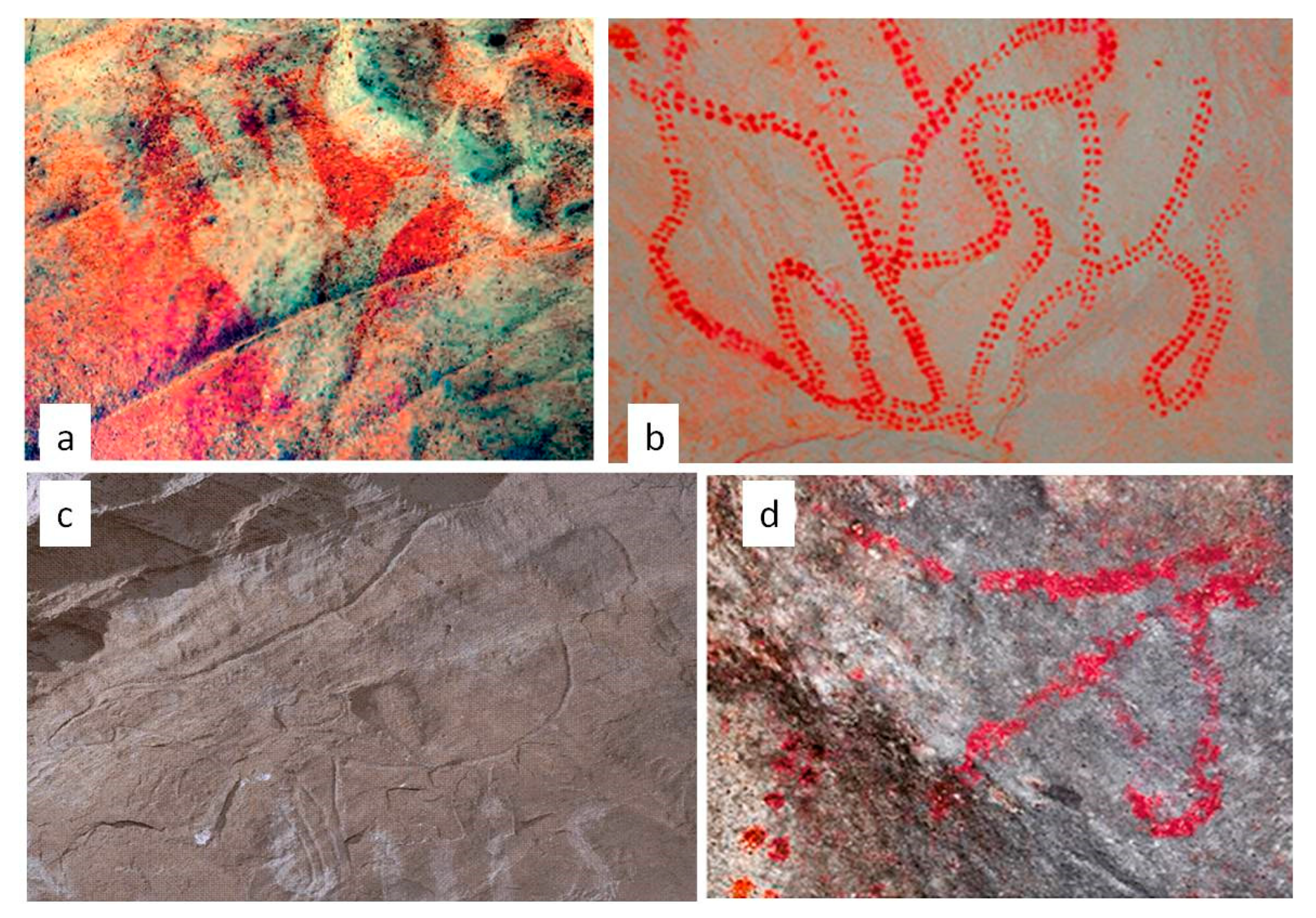
Although it is true that they are fewer in number, Palaeolithic rock art sites are no less important. Among them, the silhouettes of negative hands stand out. These airbrushed hands were made by projecting a pigment, either directly from the mouth or using reeds or bird bones. If an element is placed between the wall and the projection of the pigment, a stencil effect is obtained (Figure 2a). Positive hands have also been found and figures of animals in a naturalistic style, such as engravings (by incision with a sharp object) of a pregnant mare from the Cueva del Moro site of Solutrean age (Figure 2c), or numerous deer and horse protomes (Figure 2d). Also noteworthy are series of paired dots (Cueva del Moro, Palomas, Cueva de las Estrellas), where figures are formed by the successive arrangement of dots that can be made directly with fingers stained with dye (Figure 2b) [28,30,56,57,58,60,61].

Figure 2.
(a) Palaeolithic hand stencil from Cueva de las Estrellas (modified from [58]), (b) paired dots from Cueva de las Estrellas (modified from [58]), (c) pregnant mare from Cueva del Moro (modified from [34]), (d) horse protome from Cueva de las Palomas I (modified from [34]).
5.5.2. Post-Palaeolithic Sites
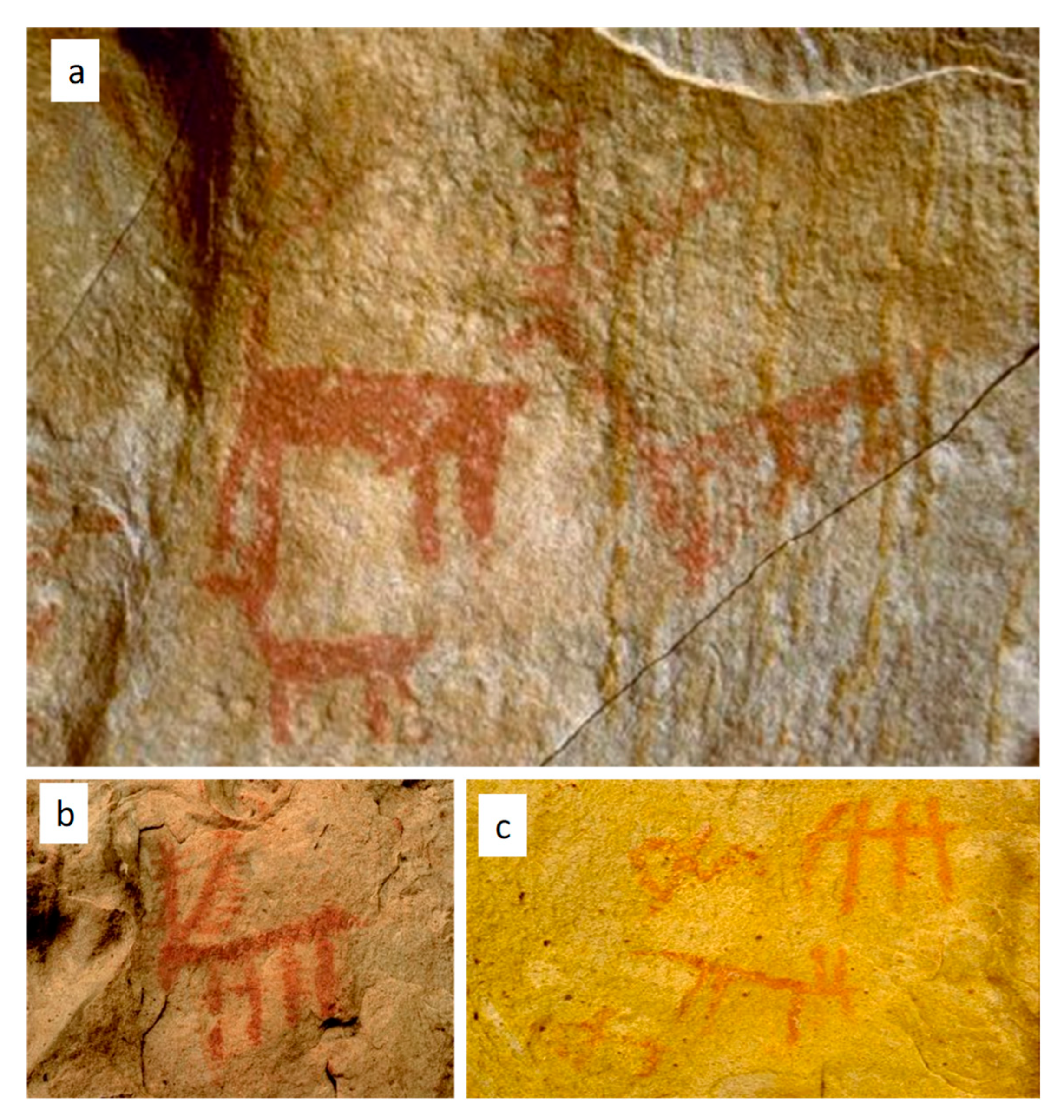
As distinctive elements, it is worth mentioning the existence of a large number of representations of birds (as evidenced by the Tajo de las Figuras, which are closely related to the ancient lagoon of La Janda), the great typology of existing signs (e.g., nests, huts, bows, suns, stars and even boats) and finally the prominence of anthropomorphic figures at the most recent sites (e.g., men, children, goddesses, midwives, little chiefs and warriors). Synthetically, three types or styles can be defined, which in turn are related to three chronological divisions [76]:
- (i)
- A semi-naturalistic style of light red or black, in which figures appear, forming scenes; this type seems to correspond to the Mesolithic (Figure 3a);
 Figure 3. (a) Semi-naturalistic post-Palaeolithic style; Cueva de las Palomas I; (b) semi-schematic post-Palaeolithic style; Bacinete; (c) schematic post-Palaeolithic style; Bacinete (modified from [34]).
 - (ii)
- A semi-schematic style, in which dark red and brownish colours predominate, which seems to correspond to the beginning of the Neolithic (Figure 3b);
- (iii)
- A schematic style, in which white paintings predominate from the end of the Neolithic, Metal Age or even Roman times (Figure 3c).
5.6. Overlapping Styles
It is important to draw attention at this point to another phenomenon that occurs in Southern Art, which in turn is interrelated with its extensive time frame: the use of shelters over varying time intervals, giving rise to the overlapping of different techniques and styles. As an example, in 1929, Breuil and Burkitt carried out a detailed analysis of different styles at the Tajo de las Figuras site, the diversity of which suggests that they correspond to different periods and overlaps; they established seven different series within this cave based on colour. They determined the existence of 507 representations, predominantly birds, followed by deer and human figures. According to Breuil and Burkitt, a Neolithic date is evident, although certain figures appear to be earlier [12]. In the final decades of the last century, between 1986 and 1992, Martí Más reappraised the information and contents of this exceptional site, bringing the number of existing figures to 920 [25].
6. Potential Hazards
This art is under threat from two main problems: climate change and a lack of research and protection. This review focuses on both of these issues.
6.1. Climate Change
Until relatively recent years, the only protection preventing direct contact between the winds and the rock shelters was the forest that grew in front of them. Dominated by the genus Quercus, this forest acted as a protective screen, slowing down wind erosion. However, in recent decades, these Quercus populations have been affected by a disease known as “la seca”. The origins of this disease are still hotly debated by experts, although there seems to be a combination of reasons induced by climate change, such as soil dryness, changes in land use and the spread of the fungus Phytophthora cinnamomi. The cumulative effect is the progressive decline and eventual death of the tree, with regenerative shoots also affected. This is generating greater damage from weathering and erosive agents on rock shelters (winds, solar radiation, low temperatures and fluctuations in humidity levels), so that over just a few years, the disappearance rate of these paintings has risen exponentially [57].
6.2. Lack of Research and Protection: Comparative Analysis with Nearby Open-Air Rock Art and Sites with Negative Handprints
The lack of research on Southern Iberian rock art hampers public administrations on decision making and putting protection measures in place. The few studies that have been carried out have been mainly descriptive with references to relative dating (only one study has provided an absolute date for the Laja Alta rock shelter: IV-III millennia cal. BC) [16].
In order to establish a comprehensive overview of the extant administrative protection measures, this study makes a comparison with those measures adopted at other open-air rock art sites on the Iberian Peninsula. The legal starting point for any cave or shelter with known or undiscovered rock art anywhere in Spain is its classification as a Site of Cultural Interest (BIC). However, it is evident that this measure does not prevent vandalism or natural damage such as from wind erosion, collapse of supports, deforestation, attack by micro-organisms or water ingress. Consequently, the administrations involved in the management of other important rock art sites have opted to provide these areas with a status that offers them the greatest possible protection.
For example, Siega Verde (Solutrean–Magdalenian; 22,000–10,000 BC) is located 5 km from Ciudad Rodrigo (province of Salamanca, western Spain), on the banks of the Águeda River. The site contains up to 94 panels on schist, with 645 animal engravings. Two main techniques were used to create the images: pitting, which outlines the figure with dots, and incision or drawing with fine engraved lines. This rock art site was discovered in 1988 by Manuel Santonja. Declared an Archaeological Zone of cultural interest by the Regional Government of Castile and León in 1998, it is undoubtedly one of the most important finds in Palaeolithic art on the Iberian Peninsula. According to Law 12/2002 (of 11 July) on Cultural Heritage in Castile and León, an Archaeological Zone is a place or natural site where there are movable or immovable assets that can be studied using archaeological methodology, whether or not they have been extracted and whether they are found on the surface, underground or underwater. There are also ongoing projects for the conservation of the Siega Verde landscape [4]. This was listed as a UNESCO World Heritage Site in 1998.
The Côa Valley (22,000–10,000 BC) is located in northeastern Portugal, specifically along the lowest 17 km of the northward-flowing Côa River.The site contains more than 150 slate panels with over 1000 engraved representations of animals. It is classified as the most important open-air site with Palaeolithic rock art. The rock art of the Coa Valley would have been completely submerged if the construction of the large Foz Coa dam, which began in 1992, had been allowed to continue. The dam project was halted by the Portuguese government in 1995, which opted instead to build a 200 km2 Archaeological Park, now legally protected at the highest level as a National Monument [4]. It was listed as a UNESCO World Heritage Site in 1998.
The rock art of the Mediterranean Arc (Epipalaeolithic–Neolithic; 10,000–4500 BC) is considered to encompass the largest number of rock art sites in the world, with 758 rock art occurrences. Focusing on Andalusia, there are 69 sites, 42 in Jaén, 25 in Almería and 32 in Granada. With regard to protection measures, most of the sites are complemented by physical protection, with the aim of regulating access and ensuring their conservation [77,78]. This was listed as a UNESCO World Heritage Site in 1998.
If we compare the Southern Art with Siega Verde/Coa Valley, we have, on the one hand, an approximate total of some 250 engraved vertical slate panels dating from 22,000 to 10,000 BC, while on the other hand, Southern Art comprises about 400 rock art occurrences with engravings and paintings dating from the beginning of cave painting to historical periods. If we compare it to the Mediterranean Arc, which has the largest number of rock art sites in the world, with 758 sites in 20 different provinces, Southern Art has about 400 sites all within the province of Cádiz. Comparison of the temporal range of Southern Art with the rock art of the Mediterranean Arc (5500 years) or the Siega Verde and Côa Valley sites (12,000 years) shows the much greater chronological extent of the former. Notwithstanding this, and despite the fact that Southern Art has been known about since 1916, only eight rock shelters are physically protected: Laja Alta, Bacinete, Alemanes, Bailaoras, Ciervo, Tajo de las Figuras, Atlanterra and Cueva del Moro. There is no other protection for this rock art site, nor is it designated as a World Heritage Site [59,79,80].
If this comparative study is extended to sites with negative handprints in the southern part of the Iberian Peninsula, hand stencils belonging to Southern Art again lack any physical protection. In contrast, current access to Ardales Cave (Málaga, Spain) is protected by a contemporary staircase-like structure that supports a security enclosure to prevent uncontrolled visits, the Gorham’s Cave Complex in Gibraltar, a UNESCO World Heritage Site since 2016, has physical protection and the Pileta Cave is an Archaeological Zone protected by the Andalusian Historical Heritage Law (LPHA), also with physical protection.
7. Protective Measures
The prehistoric rock art of the southernmost area of Europe is located in the southern mountains of the Cádiz province, in visual contact with the neighbouring African continent, so it is an ideal place to understand the possible relations between North Africa and the southernmost Iberian Peninsula at specific times in the Pleistocene and the Holocene. Key to the importance of this art is this spatial confluence and the highest concentration of rock art shelters with paintings and/or engravings per km2 in Europe, as well as having the longest temporal range.
Currently, this important heritage is in danger of disappearing, due to deterioration of the environment because of climate change, with the loss of plant cover increasing the risks for its conservation. This threat is exacerbated by the lack of protection and rigorous research on the shelters, as most existing publications merely describe the motifs. Notwithstanding this, the information provided by the few studies that have been approached holistically is of great value, such that if they could be extended to all the shelters, the information they would provide would be invaluable.
It is therefore necessary to implement effective measures of protection for the rock art sites, as well as for the conservation of the landscape and the original forest ecosystem of the area.
In this respect, the potential for a UNESCO Global Geopark should be considered, as these are unique, integral geographical areas in which sites and landscapes of international geological importance, such as the area of study, are managed through a holistic approach to protection, education and sustainable development. Geoparks combine their geological heritage with the natural and cultural legacy of the area in order to raise awareness of the main challenges facing society, such as the sustainable use of available resources, reducing the effects of climate change and mitigating the risks associated with natural disasters. By raising awareness of the importance of geological heritage for today’s history and society, UNESCO Global Geoparks encourage local people to take pride in their region and identify with it. By generating new sources of income through geotourism, they stimulate the creation of innovative local businesses, new jobs and high-quality training courses, while protecting the area’s geological, natural and cultural resources [81].
8. Conclusions
Southern Art is the most important open-air rock art concentration in Europe and one of the most important in the world for the reasons that follow:
- -
- Its unparalleled concentration of rock art sites.
- -
- It is the only intercontinental rock art focus in the world, located in the Southern Iberian Peninsula (Cádiz) and northern Morocco in the Aljibe Unit, a flysh unit from the Gibraltar Arc.
- -
- It represents the full temporal range of humanity, from the beginning of rock art to historical periods, reflecting not only the replacements of hunter–gatherer–fisher groups by tribal societies but also the Neanderthalensis–sapiens transition on both sides of the Strait, in a region that was the last stronghold of the Neanderthal people.
- -
- It is the only open-air rock art occurrence of such great antiquity.
- -
- It includes the southernmost hand stencils in Europe and also the only ones made on sandstone in the open air.
The importance of this heritage, together with the threats that it currently faces due to climate change, calls for urgent action to ensure its protection, such as designation as a UNESCO Global Geopark or inclusion in the UNESCO World Heritage list.
Author Contributions
Writing—original draft preparation, G.M., M.I.C. and F.R.; writing—review and editing, G.M., M.I.C. and F.R. All authors have read and agreed to the published version of the manuscript.
Funding
This research received no external funding.
Data Availability Statement
No new data were created or analyzed in this study. Data sharing is not applicable to this article.
Acknowledgments
Our gratitude to those who have demonstrated an unwavering commitment to this phenomenon, thereby facilitating our understanding and appreciation of it. This includes Paqui Ruiz, Lothar Bergman’s wife; Simón Blanco and the Asociación para la protección del Arte Sureño; Lorena Benitez and the Tanit Association; Antonio Casado and the Asociación gaditana para el estudio y la defensa del Patrimonio Arqueológico; as well as all the members of the Platform for the Defense of Southern Art and Instituto de Estudios Campogibraltareños.
Conflicts of Interest
The authors declare no conflicts of interest.
References
- Hoffmann, D.; Standisch, C.; García-Díez, M.; Pettitt, P.; Milton, J.A.; Zilhao, J.; Alcolea, J.; Cantalejo, P.; Collado, H.; Balbín, R.; et al. U-Th dating or carbonate crusts reveals Neandertal origen of Iberian cave art. Science 2018, 359, 912–915. [Google Scholar] [CrossRef]
- Leroi-Gourhan, A.; Delluc, B.; Delluc, G. Préhistorie de l’Art Occidental; Citadelles and Mazenod: París, France, 1995; p. 621. [Google Scholar]
- García-Díez, M.; Lasheras, J.A.; Martínez, J. Arte rupestre y Prehistoria de la Península Ibérica en la lista del Patrimonio Mundial. In XIX International Rock Art Conference IFRAO 2015; Collado, H., García-Arranz, J.J., Eds.; ARKEOS: Tomar, Portugal, 2015; pp. 2271–2274. [Google Scholar]
- UNESCO World Heritage Centre—The World Heritage Convention. Available online: https://whc.unesco.org/en/convention/ (accessed on 12 August 2025).
- Available online: https://es.wikipedia.org/wiki/España/ (accessed on 30 September 2025).
- Copano, L.; Ventura, J. Ámbitos intermedios en la provincia de Cádiz dentro de los procesos comarcalizadores en Andalucía. Cuad. Geográficos 2013, 52, 318–348. [Google Scholar]
- Ramos, J.; Domínguez-Bella, S.; Pérez, M.; Vijande, E. Producción, distribución y consumo de los productos líticos laminares vinculados a las sociedades tribales comunitarias y clasistas iniciales del ámbito atlántico de Cádiz. In Les Grans Fulles de Sílex. Europa al Final de la Prehistoria. Actes; Gibaja, J.F., Terradas, X., Palomo, A., Clop, X., Eds.; Museo Arqueológico de Barcelona: Barcelona, Spain, 2009; pp. 11–19. [Google Scholar]
- Vera, J.A. Geología de España; Sociedad Geológica de España & IGME: Madrid, Spain, 2004; p. 884. [Google Scholar]
- Rodríguez-Jiménez, P.; Ruiz-Cruz, M.D. Mineralogía y génesis de las arcillas de las Unidades del Campo de Gibraltar. Areniscas del Aljibe. Est. Geol. 1988, 44, 31–46. [Google Scholar] [CrossRef]
- Aragón, J.M.; Gracia, F.J.; Domínguez-Bella, S. Morfologías de meteorización en areniscas del Parque Natural de Los Alcornocales (provincia de Cádiz). In Patrimonio Geológico y Geoparques, Avances de un Camino Para Todos. Cuadernos del Museo Geominero; Hilario, A., Mendía, M., Fernández, E., Vegas, J., Belmonte, A., Eds.; Instituto Geológico y Minero de España: Madrid, Spain, 2015; Volume 18, pp. 28–38. [Google Scholar]
- Cabré, J.; Hernández, E. Avance al Estudio de las Pinturas Prehistóricas del Extremo sur de España (Laguna de la Janda); Memoria de los trabajos de la Comisión de Investigaciones Paleontológicas y prehistóricas, 3; Museo Nacional de Ciencias Naturales: Madrid, Spain, 1914; p. 35. [Google Scholar]
- Breuil, H.; Burkitt, M.C. Rock Paintings of Southern Andalusia. A Description of a Neolithic and Copper Age Art Group; Oxford University Press: Oxford, UK, 1929; p. 88. [Google Scholar]
- Corzo, R.; Giles, F. El abrigo de Laja Alta. Boletín Mus. Cádiz 1978, 1, 19–35. [Google Scholar]
- Barroso, C. Nuevas pinturas del abrigo Cueva de Laja Alta. Jábega 1978, 24, 3–8. [Google Scholar]
- Barroso, C. Nuevas pinturas rupestres en Jimena de la Frontera (Cádiz): Abrigo de Laja Alta. Zepyrus 1979, 30, 23–42. [Google Scholar]
- Morgado, A.; García-Alfonso, E.; García del Moral, L.F.; Benavides, J.A.; Rodríguez-Tovar, F.J.; Esquivel, J.A. Embarcaciones prehistóricas y representaciones rupestres. Nuevos datos del abrigo de Laja Alta: (Jimena de la Frontera, Cádiz). Complutum 2018, 29, 239–265. [Google Scholar] [CrossRef]
- Morgado, A.; García-Alfonso, E.; García del Moral, L.F.; Esquivel, F.J.; Benavides, J.A.; Esquivel, J.A. Las representaciones prehistóricas del abrigo de Laja Alta (Jimena de la Frontera, Cádiz). Controversias y datos científicos. Pyrenae 2025, 56, 49–79. [Google Scholar]
- Topper, U.; Topper, U. Arte Rupestre en la Provincia de Cádiz; Diputación de Cádiz: Cádiz, Spain, 1988; p. 271. [Google Scholar]
- Mas, M.; Torra, G. Arte rupestre en Cádiz. Documentación e investigación. Rev. Arqueol. 1990, 113, 14–22. [Google Scholar]
- Ripoll, S.; Mas, M.; Torra, G. Grabados paleolíticos en la Cueva del Tajo de las figuras (Benalup, Cádiz). Espac. Tiempo Forma 1991, 4, 111–116. [Google Scholar] [CrossRef]
- Mas, M. Documentación e investigación de las manifestaciones artísticas en las cuevas de palomas, abrigos de Bacinete y conjunto rupestre del Tajo de las Figuras (Cádiz). Anu. Arqueol. Andal 1991, 2, 99–110. [Google Scholar]
- Jordá, J.F.; Laín, L.; Mas, M. Sistemas de información geográfica, geoarqueología y prospección arqueológica. Una propuesta metodológica para la localización exhaustiva de yacimientos con arte rupestre en un sector de la provincia de Cádiz. In Proceedings of the Actas de la 2ª Reunión Nacional de Geoarqueología, ITGE-AEQUEA, Madrid, Spain, 14–16 December 1992. [Google Scholar]
- Mas, M.; Jordá, J.F.; Cambra, J.; Mas, J.; Lombarte, A. La conservación del arte rupestre en las sierras del Campo de Gibraltar. Un primer diagnóstico. Espac. Tiempo Forma 1994, 7, 93–128. [Google Scholar]
- Mas, M.; Ripoll, S. El Paleolítico superior en el sur de Cádiz. Espac. Tiempo Forma 1996, 9, 269–273. [Google Scholar]
- Mas, M. Proyecto de Investigación Arqueológica Las Manifestaciones Rupestres Prehistóricas de la Zona Gaditana; Arqueología Monografías, Junta de Andalucía: Sevilla, Spain, 2000; p. 416. [Google Scholar]
- Bergmann, L. Nuevas cuevas con pinturas rupestres en el término municipal de Tarifa. Almoraima 1994, 13, 51–61. [Google Scholar]
- Bergmann, L. Informe sobre experiencias en la instalación del primer banco de imágenes digitalizadas de pinturas rupestres del Campo de Gibraltar. Almoraima 1994, 13, 62–64. [Google Scholar]
- Bergmann, L. Los grabados paleolíticos de la Cueva del Moro (Tarifa). Almoraima 1996, 16, 9–26. [Google Scholar]
- Bergmann, L. Pinturas prehistóricas del Extremo Sur. Aljaranda Rev. Estud. Tarif. 1993, 11, 8–10. [Google Scholar]
- Bergmann, L. La Cueva del Moro (Tarifa): El arte paleolítico más meridional de Europa. Aljaranda Rev. Estud. Tarif. 1996, 21, 9–11. [Google Scholar]
- Bergmann, L.; Casado, A.; Maruiscal, D.; Piñatel, F.; Sánchez-Tundidor, F.; Sevilla, L. Arte rupestres del Campo de Gibraltar. Nuevos descubrimientos. Almoraima 1997, 17, 45–58. [Google Scholar]
- Bergmann, L.; Álvarez, J.J.; Arias, M.; Arroquia, M.I.; Casado, A.; Emberley, E.; Emberley, A.; García-Díaz, M.; García Rojas, M.I.; Gomez-Arroquia, M.I.; et al. El Arte Sureño: Un patrimonio mundial. Almoraima 2001, 25, 91–104. [Google Scholar]
- Bergmann, L.; Álvarez, J.J.; Arias, M.; Arroquia, M.I.; Casado, A.; Emberley, E.; Emberley, A.; García-Díaz, M.; García-Rojas, M.I.; Gomez-Arroquia, M.I.; et al. Representaciones prehistóricas de la fauna del parque natural de los alcornocales. Almoraima 2002, 27, 75–92. [Google Scholar]
- Arte Sureño. El Arte Rupestre del Extermo sur de España. Available online: http://www.arte-sur.com (accessed on 14 June 2025).
- Bergmann, L. El arte rupestre paleolítico del extremo sur de la península ibérica y la problemática de su conservación. Almoraima 2009, 39, 45–65. [Google Scholar]
- Solís, M. El conjunto rupestre de Bacinete, Sierra del Niño, Los Barrios, Cádiz: Primeros resultados. Espac. Tiempo Forma 2003, 16, 231–284. [Google Scholar]
- Solís, M. El conjunto rupestre de Bacinete. Los Barrios.: Una reflexión en torno al arte esquemático. Eúphoros 2004, 7, 91–108. [Google Scholar]
- Solís, M. El conjunto rupestre de Bacinete (Sierra del Niño, los Barrios, Cádiz). In Proceedings of the Actas I Jornadas de Patrimonio en la Comarca del Guadalteba: Arte Rupestre y Sociedades Prehistóricas con Expresiones Gráficas, Asociación para la Defensa del Patrimonio Histórico y Natural de la Comarca del Guadalteba, Málaga, Spain, 11–13 November 2005. [Google Scholar]
- Solís, M. Restauración-reconstrucción-recreación virtual aplicada al conjunto rupestre de Bacinete. Espac. Tiempo Forma 2009, 2, 127–134. [Google Scholar]
- Solís, M. Procesos de abreviación en los diseños del arte rupestre postpaleolítico del estrecho de Gibraltar: El ejemplo de sierra del Niño. Almoraima 2020, 52, 153–168. [Google Scholar]
- Solís, M. El Conjunto Rupestre de Bacinete. Pinturas Prehistóricas Para la Reunión; Instituto de Estudios Campogibraltareños: Cádiz, Spain, 2020; p. 202. [Google Scholar]
- Solís, M.; Martí, M.; Tamajón, R.; Abad, M.A.; Redondo, J.; Fernández-Gallego, C.; Pérez-González, J.; Maura, R.; Pérez, P.P.; Parra, E. Intervención puntual orientada a la caracterización de pátinas en el Conjunto rupestre de Bacinete. Los Barrios, Cádiz. Anu. Arqueol. Andal 2021, 1, 1–33. [Google Scholar]
- Mira, H.A.; Solís, M. Conjunto de Cavidades de Las Palomas (Tarifa, Cádiz): Arte Prehistórico en el Extremo sur Peninsular; Instituto de Estudios Campogibraltareños: Cádiz, Spain, 2022; p. 260. [Google Scholar]
- Solís, M. Arte Rupestre del Peñón de la Cueva (Los Barrios, Cádiz); Instituto de Estudios Campogibraltareños: Cádiz, Spain, 2022; p. 66. [Google Scholar]
- Solís, M. Actos colectivos en el arte esquemático en el entorno del cerro Peruétano (Los Barrios, Cádiz). 1902 Committee 2023, 2, 34–57. [Google Scholar]
- Solís, M. Los Sitios Rupestres de Obispo, Avellano y Pilones (Los Barrios, Cádiz) en el Contexto del arte Prehistórico de Sierra del Niño; Instituto de Estudios Campogibraltareños: Cádiz, Spain, 2024; p. 170. [Google Scholar]
- Carreras, A.M.; Gomar, A.M.; Ruíz-Trujillo, A.; Lazarich, M.; Bergmann, L. Las pinturas rupestres de la sierra del Retín, Barbate (Cádiz). Almoraima Rev. Estud. Campogibraltareños 2008, 36, 9–20. [Google Scholar]
- Carreras, A.M.; Lazarich, M.; Versaci, M.; Torres, F.; Díaz-Cárdenas, F. Nuevos datos para el estudio de las pinturas rupestres de la prehistoria reciente en el entorno de la laguna de la Janda. Almoraima 2009, 39, 29–44. [Google Scholar]
- Carreras, A.M.; Lazarich, M.; Versaci, M.; Ruíz-Trujillo, A.; Torres, F.; Sánchez-López, L.; Gomar, A.M.; Díaz-Cárdenas, F. Arte rupestre del extremo sur peninsular. In Memorial Luis Siret: I Congreso de Prehistoria de Andalucía: La Tutela del Patrimonio Prehistórico; Consejería de Cultura; Junta de Andalucía: Sevilla, Spain, 2011; pp. 555–558. [Google Scholar]
- Lazarich, M.; Gomar, A.M.; Ruíz-Trujillo, A.; Torres, F.; Ramos, A.; Cruz, M.J. Las manifestaciones rupestres postpaleolíticas del entorno de la laguna de la Janda (Cádiz). Nuevas perspectivas de estudio. Ser. Arqueol. 2012, 10, 181–207. [Google Scholar]
- Ruíz-Trujillo, A.; Gomar, A.M.; Lazarich, M. Aportación al conocimiento de las manifestaciones gráficas de las sociedades cazadoras-recolectoras especializadas de la Provincia de Cádiz. Ser. Arqueol. 2013, 11, 83–108. [Google Scholar]
- Lazarich, M.; Ramos, A.; Ruíz-Trujillo, A.; Gomar, A.M.; Torres, F.; Narváez, M. Bacinete: Un escenario de arte rupestre al aire libre. Ser. Arqueol. 2015, 24, 487–533. [Google Scholar]
- Versaci, M.; González, I.; Lazarich, M.; Torres, F.; Carreras, A.M.; Galindo, M.; Pardo, S. La cueva del Sol, un marcador solar en la Sierra de la Plata (Tarifa, Cádiz). Spal 2017, 26, 295–310. [Google Scholar] [CrossRef]
- Ruíz-Trujillo, A.; Gomar, A.M.; Lazarich, M. Arte prehistórico del extremo sur peninsular. Propuesta de clasificación cronocultural y conclusiones. Almoraima 2021, 55, 51–63. [Google Scholar]
- Ruíz-Trujillo, A.; Carreras, A.M.; Gomar, A.M.; Díaz, F.; Blanco, S. Avance de los últimos descubrimientos de arte rupestre en el parque natural del Estrecho y parque natural de los Alcornocales. Almoraima 2011, 42, 303–322. [Google Scholar]
- Collado, H. Handpas. Manos del Pasado: Catálogo de Representaciones de Manos en el arte Rupestre Paleolítico de la Península Ibérica; Junta de Extremadura: Badajoz, Spain, 2018; p. 541. [Google Scholar]
- Fernández-Sánchez, D.; Ramos, J.; Collado, H.; Vijande, E.; Luque, A.J. Tajo de las Abejeras y cueva de las Estrellas (Castellar de la Frontera, Cádiz). Arte Rupestre de las Sociedades Paleolíticas Cazadoras-Recolectoras-Pescadoras del Campo de Gibraltar; ArdalesTur Ediciones: Málaga, Spain, 2019; p. 139. [Google Scholar]
- Collado, H.; Bea, M.; Ramos, J.; Cantalejo, P.; Domínguez-Bella, S.; Ramón, J.; Angás, J.; Miranda, J.; García-Prieto, F.J.; Fernández-Sánchez, D.; et al. Un nuevo grupo de manos paleolíticas en la provincia más meridional de Europa. La cueva de las Estrellas o Cueva Abejera 2 (Castellar de la Frontera, Cádiz, España). Zephyrus 2019, 83, 15–38. [Google Scholar] [CrossRef]
- Monge, G. Redefiniendo el Arte Sureño. In Proceedings of the XXVI Jornadas de Historia y Arqueología de Jimena de la Frontera, Jimena de la Frontera, Cádiz, Spain, 26–27 April 2019. [Google Scholar]
- Fernández-Sánchez, F.S.; Ramos, J.; Luque, A.; Collado, H.; Domínguez-Bella, S.; Bea, M.; Cantalejo, P.; Bello, J.R.; Angás, J.; Miranda, J.; et al. Estudio y documentación del arte rupestre prehistórico del Tajo de las Abejeras (Castellar de la Frontera). Almoraima 2020, 52, 143–152. [Google Scholar]
- Fernández-Sánchez, S.; Collado, H.; Vijande, E.; Domínguez-Bella, S.; Luque, A.; Cantillo, J.J.; Mira, H.A.; Escalona, S.; Ramos, J. A contribution to the debate about prehistoric rock art in southern Europe: New palaeolithic motifs in Cueva de las Palomas IV, Facines (Tarifa, Cádiz, Spain). J. Archaeol. Sci. Rep. 2021, 38, 103086. [Google Scholar] [CrossRef]
- Ruíz-Trujillo, A.; Gomar, A.M. Arte prehistórico del extremo sur peninsular. Situación actual. Almoraima. Rev. Estud. Campogibraltareños 2021, 54, 103–114. [Google Scholar]
- Martínez de Santa Olalla, J. Las primeras pinturas rupestres del Marruecos español. Magara Sanar en el Yebel Kasba. In Actas y memorias de la Sociedad Española de Antropología, Etnografía y Prehistoria; Órgano del Instituto Bernardino de Sahagún: Madrid, Spain, 1941; pp. 438–442. [Google Scholar]
- Souville, G. Le Maroc atlantique, Atlas Prehistorique du Maroc; Centre National de la Recherche Scientifique: París, France, 1973; Volume 1, p. 368. [Google Scholar]
- Souville, G.; y Soler Sublis, J. Encyclopédie Berbère XXX Maaziz-Matmata; Peeters: Herent, Belgium, 2010; p. 240. [Google Scholar]
- Solís, M.; Más, M.; de Lara, H.; Maura, R.; Lemjidi, A.; Oumouss, A.; Pérez-González, J.; Torra, G.; García-Rivero, D.; García-Algarra, M.; et al. Arte rupestre en el estrecho de Gibraltar: Policromía y cronología. Saguntum 2023, 55, 27–44. [Google Scholar]
- Martinez, J. Arte paleolítico al aire libre en el sur de la Península Ibérica. In Actas Arte Prehistórico al aire libre en el Sur de Europa; Rodrigo de Balbín Behrmann; Junta de Castilla y León: Salamanca, Spain, 2009; pp. 237–258. [Google Scholar]
- Clottes, J.; Lewis-Williams, D. Los Chamanes de la Prehistoria; Ariel: Barcelona, Spain, 2012; p. 184. [Google Scholar]
- Finlayson, C.; Giles, F.; Rodríguez-Vidal, J.; Fa, D.; Gutierrez-López, J.M.; Santiago, A.; Finlayson, G.; Allue, E.; Baena, J.; Cáceres, I.; et al. Late survival of Neanderthals at the southernmost extreme of Europe. Nature 2006, 443, 850–853. [Google Scholar] [CrossRef] [PubMed]
- Rodriguez-Vidal, J.; d’Errico, F.; Giles, F.; Blasco, R.; Rosell, J.; Jennings, R.; Queffelec, A.; Finlayson, G.; Fa, D.; Gutiérrez-López, J.M.; et al. A rock engraving made by Neanderthals in Gibraltar. Proc. Natl. Acad. Sci. USA 2014, 111, 13301–13306. [Google Scholar] [CrossRef] [PubMed]
- Barton, R.N.E.; Stringer, C.B.; Finlayson, J.C. Neanderthals in Context: A Report of the 1995-1998 Excavations at Gorham’s and Vanguard Caves, Gibraltar; Oxford University Press: Oxford, UK, 2012; p. 328. [Google Scholar]
- Macphail, R.I.; Goldberg, P. Geoarchaeological investigation of sediments from Gorham’s and Vanguard Caves, Gibraltar: Microstratigraphical (soil micromorphological and chemical) signatures. In Neanderthals on the Edge; Stringer, C.B., Barton, R.N., Finlayson, J.C., Eds.; Oxbow Books: Oxford, UK, 2000; pp. 183–200. [Google Scholar]
- Ramos, J.; Bernal, D.; Vijande, E.; Cantillo, J.J. El abrigo y la Cueva de Benzú. Memoria de los Trabajos Arqueológicos de una Década en Ceuta (2002–2012); Universidad de Cádiz: Cádiz, Spain, 2013; pp. 264–266. [Google Scholar]
- García-DIEZ, M.; Garrido, D.; Hoffmann, D.L.; Pettitt, P.B.; Pike, A.L.W.; Zilhão, Z. The chronology of hand stencils in European Paleolithic rock art: Implications of new U-series results from El Castillo Cave (Cantabria, Spain). J. Anthropol. Sci 2015, 93, 135–152. [Google Scholar]
- Pike, W.G.; Hoffmann, D.L.; García-Diez, M.; Pettitt, P.B.; Alcolea, J.; De Balbín, R.; González-Sainz, C.; de las Heras, C.; Lasheras, J.A.; Montes, R.; et al. U-Series Dating of Paleolithic Art in 11 Caves in Spain. Science 2012, 336, 1409–1413. [Google Scholar] [CrossRef]
- González, J.L.; Bullón, V.; García, J.A. Reserva de la Biosfera Intercontinental del Mediterráneo: Andalucía (España)-Marruecos. Guía Práctica; Consejería de Agricultura, Pesca y Medio Ambiente. Junta de Andalucía: Sevilla, Spain, 2012; p. 458. [Google Scholar]
- Ministerio de Cultura. Arte Rupestre del Arco Mediterráneo de la Península Ibérica. Available online: https://www.cultura.gob.es/cultura/areas/patrimonio/mc/patrimoniomundial/bienes-declarados/por-ano-de-inscripcion/1998/arterupestre.html (accessed on 3 August 2025).
- Sánchez-Chillón, B. El Arte Rupestre en el Arco Mediterráneo; Consejo Superior de Investigaciones Científicas: Madrid, Spain, 2018; p. 168. [Google Scholar]
- Monge, G. Arte Sureño: El gran ausente en el Arco rupestre Mediterráneo. Boletín Ben Baso 2016, 25, 11–13. [Google Scholar]
- Monge, G. Descubriendo nuestra Prehistoria a través del Arte Sureño. In Proceedings of the Ciencia al fresquito (Fundación Descubre), Jimena dela Frontera, Cádiz, Spain, 21–24 August 2019. [Google Scholar]
- UNESCO Global Geoparks. Available online: https://www.unesco.org/en/iggp/geoparks/about (accessed on 1 September 2025).
Disclaimer/Publisher’s Note: The statements, opinions and data contained in all publications are solely those of the individual author(s) and contributor(s) and not of MDPI and/or the editor(s). MDPI and/or the editor(s) disclaim responsibility for any injury to people or property resulting from any ideas, methods, instructions or products referred to in the content. |
© 2026 by the authors. Licensee MDPI, Basel, Switzerland. This article is an open access article distributed under the terms and conditions of the Creative Commons Attribution (CC BY) license.