Skip Content
You are currently on the new version of our website. Access the old version .

Phycology

Phycology is an international, peer-reviewed, open access journal on phycology published quarterly online by MDPI. 

Quartile Ranking JCR - Q1 (Marine and Freshwater Biology)

All Articles (214)

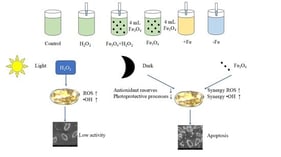
Light and antioxidant systems play a crucial role in the life activities of algal cells. This study investigates the algicidal efficacy of hydrogen peroxide (H2O2) against the harmful algal bloom (HAB)-forming dinoflagellate Prorocentrum donghaiense Lu, with a focus on the modulating roles of light conditions and iron ion environments. Within 180 min, dark-adapted cells showed 78% greater viability loss than light-exposed ones, and Fe3O4 nanoparticles synergistically enhanced H2O2 inhibition. Imaging and cytometry confirmed cell damage, including membrane rupture. Mechanistically, H2O2 penetrated cells, induced severe oxidative stress, suppressed photosynthesis, and compromised membrane integrity. Darkness likely exacerbated toxicity by depleting antioxidant reserves. This study elucidates an apoptosis-like pathway underlying H2O2-induced cell death and highlights the critical influence of ambient light on treatment efficiency. These findings reveal an apoptosis-like death pathway and highlight ambient light’s critical role, suggesting that optimized nighttime H2O2 application with nanomaterial synergists could improve HAB control strategies.

2 February 2026

The effect of H2O2 on cell viabilities of the algae under the different exposure conditions. Notes: Prorocentrum donghaiense Lu after a 7-day batch culture with normal f/2 medium, iron-excess treatment (+Fe) and iron-depleted treatment (−Fe), exposed to H2O2 (1 mM). For all exposure conditions, the initial algae content was 1.0 × 10⁴ cells/mL.

This research assesses a triphasic extraction technique for the sequential retrieval of C-phycocyanin (C-PC) and polyhydroxybutyrate (PHB) from a thermotolerant Potamosiphon sp. strain. A two-stage design-of-experiments methodology was employed (Minimum Run Resolution V factorial design involving six variables, followed by a central composite design (CCD)) to optimize the chosen region. In the factorial stage, PHB ranged from 109.396 to 168.995 mg/g, and the model was significant (F = 22.63, p < 0.0001). Freeze-milling and vortexing were identified as critical elements, underscoring the importance of the t-butanol × (NH4)2SO4 interaction for phase selectivity. The CCD concentrating on freeze-milling and vortex cycles yielded a robust quadratic model (F = 78.18, p < 0.0001), forecasting a peak PHB yield of 191.82 mg/g at six freeze-milling cycles and three vortex cycles (desirability 0.921), while maintaining t-butanol at 19.9 mL, t-butanol concentration at 94.7% (v/v), (NH4)2SO4 at 49.9% (w/v), and vortex duration at 1.2 min. Ten separate trials validated the model’s accuracy, yielding an observed PHB of 191.5 mg/g, which closely matched the model’s prediction. The platform facilitates an integrated downstream process in which C-PC is recovered under moderate conditions before triphasic partitioning. This enables the simultaneous valorization of pigment, lipophilic fraction, and biopolymer inside a unified cyanobacterial biorefinery process.

1 February 2026

Flowchart of the triphasic extraction system.

Heterotrophic nanoflagellates (HNANs) are central components of the microbial loop, transferring carbon from bacteria to higher trophic levels and facilitating nutrient recycling. While many HNANs are free-swimming, some exhibit enhanced feeding efficiency when attached to surfaces, including diatom frustules. Here, we describe the attachment behavior of a novel interception-feeding HNAN affiliated with the order Bicosoecida to centric diatoms common in North Carolina coastal waters. Using growth experiments, live observations, and time-lapse microscopy, we quantified attachment frequency and assessed its influence on diatom growth for three diatom species: Coscinodiscus sp., Odontella sp., and Rhizosolenia sp. HNAN attachment differed significantly among diatom taxa: Coscinodiscus sp. hosted the highest and most sustained numbers per frustule, whereas after normalizing for surface area, Rhizosolenia sp. exhibited the highest attachment efficiency. Diatom peak growth was 1.2 to 2.1-fold higher and occurred earlier in HNAN co-cultures than in controls, indicating microbial recycling by the HNAN stimulated growth. These findings highlight the nuanced ecological role attached HNANs might play as they exploit diatom-associated boundary layers to enhance bacterial encounter rates. The growth trajectories in our lab experiments suggests that attachment behavior in situ can play a role in driving diatom bloom dynamics and, therefore, play an important role for carbon cycling.

1 February 2026

(a) A HNAN cell at 60× (n = 1) from the original inoculation culture, (b) Odontella sp., (c) Cosinodiscus sp., and (d) Rhizosolenia sp. cultures on day 6 with an attached (n = 1) HNAN. The scale bars indicate 10 µm.

Microalgae and cyanobacteria represent promising, sustainable resources for agricultural applications, particularly as biofertilisers, biostimulants, and biological plant protection agents. Their biomass can improve nutrient use efficiency, support plant growth and yield, and enhance soil structure and microbial activity, while cyanobacteria additionally contribute through biological nitrogen fixation, reducing reliance on synthetic fertilisers. The integration of microalgal cultivation with closed-loop systems, such as wastewater treatment plants or biogas facilities, enables nutrient recovery, production of value-added biomass, and mitigation of greenhouse gas emissions. This review synthesises current knowledge on the biochemical composition, functional properties, and mechanisms of action of microalgal and cyanobacterial biomass in relation to these established agricultural applications. In addition, prevailing research trends, selected technological and organisational constraints, and implementation challenges are discussed. Particular attention is given to emerging application contexts, including bioregenerative life support systems (BLSS) for space agriculture, where microalgae and cyanobacteria can contribute to oxygen production, nutrient recycling, and edible biomass generation. Species such as Chlorella vulgaris, Arthrospira platensis, and Scenedesmus obliquus demonstrate tolerance to microgravity, radiation, and limited light conditions, supporting their potential use in closed, self-sufficient cultivation systems. Although numerous reviews have addressed individual agricultural applications of microalgae and cyanobacteria, a more integrative perspective that connects biological functionality with broader technological, regulatory, and implementation contexts remains valuable. The present review contributes to this perspective by consolidating established agronomic uses and extending the discussion toward selected emerging applications, thereby providing a structured framework for future research and development in sustainable terrestrial and extraterrestrial agriculture.

1 February 2026

Report from searches on (a) Google Scholar, (b) Scopus, (c) Scilit, and (d) Science Direct for the keywords “microalgae/cyanobacteria in agriculture”, “microalgae/cyanobacteria as biofertiliser”, “microalgae/cyanobacteria as biostimulant”, and “microalgae/cyanobacteria as biopesticides” between 2014 and 2024. Retrieved on 20 November 2025.

News & Conferences

Issues

Open for Submission

Editor's Choice

Get Alerted

Add your email address to receive forthcoming issues of this journal.

XFacebookLinkedIn
Phycology - ISSN 2673-9410