
Skip Content
You are currently on the new version of our website. Access the old version .

All Articles (224)

Vitamin D in Obesity: Mechanisms and Clinical Impact

  • Jitka Jirků,
  • Zuzana Kršáková and
  • Jarmila Křížová

Obesity is a major global health challenge that substantially affects vitamin D metabolism and status. Numerous studies have consistently demonstrated an inverse relationship between body fat and serum 25-hydroxyvitamin D [25(OH)D] concentrations. Emerging evidence suggests that lower serum 25(OH)D in obesity largely reflects altered distribution and metabolism rather than a uniform state of true functional deficiency. Adipose tissue functions both as a storage compartment and as a metabolically active organ capable of modulating vitamin D handling. Mechanisms include the sequestration of vitamin D in fat, volumetric dilution across a larger body mass, and the local expression of enzymes involved in vitamin D metabolism. As a result, obese individuals typically exhibit a blunted increase in serum 25(OH)D in response to supplementation, consistent with altered pharmacokinetics and increased distribution volume. Weight loss, particularly the reduction in visceral fat, is associated with modest increases in circulating 25(OH)D, further supporting a distribution-based mechanism. Although low 25(OH)D levels in obesity have been linked to insulin resistance, inflammation, and metabolic syndrome, randomized controlled trials have not consistently demonstrated that supplementation improves clinically relevant outcomes in this population. Meta-analyses confirm that the increase in serum 25(OH)D after supplementation is smaller in obese individuals, indicating that higher doses are often required to achieve comparable levels to those in normal-weight subjects. Obesity thus represents a major determinant of vitamin D deficiency, highlighting the need for individualized supplementation strategies alongside weight management. Understanding the mechanistic basis for low 25(OH)D in obesity is essential for distinguishing true deficiency from altered distribution, informing clinical decisions, and optimizing interventions to maintain adequate vitamin D status and support metabolic health.

6 February 2026
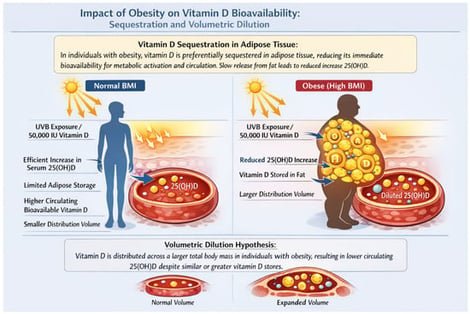
Schematic representation of the mechanisms underlying reduced vitamin D status in obesity. In individuals with obesity, vitamin D is sequestered in expanded adipose tissue and distributed across a larger body volume, leading to lower circulating 25(OH)D concentrations despite comparable UVB exposure or supplementation. Both adipose sequestration and volumetric dilution contribute to the attenuated serum vitamin D response.

Endoscopic sleeve gastroplasty (ESG) does not produce homogeneous results, with some patients showing little weight loss after the procedure. The aim of the present study was to evaluate the ability of pre-procedural psychometric questionnaires to predict insufficient weight loss after ESG in patients with obesity. Patient candidates for ESG were requested to complete the following psychometric questionnaires: Short Form-36 (SF-36), Symptom Checklist-90 Revised (SCL-90-R), Binge Eating Scale (BES), Yale Food Addiction Questionnaire (Y-FAS), Eating Attitude Test-26 (EAT-26), and Barratt Impulsiveness Scale-11 (BIS-11). The results of the psychometric scores were then compared with the ESG outcome, which was considered a therapeutic failure if the %EWL was less than 30% at 12 months after the follow-up. Thirty-five patients (8 males and 27 females, mean age 49 years, range 21–75 years) were included in this study. At the one-year follow-up, the mean %EWL was 40 ± 43%. Male sex and higher preoperative BMI were identified as risk factors for poor weight loss. A logistic regression analysis adjusted for sex and preoperative BMI showed that low scores on the SF-36 (Subscale Mental Health), high scores on the SCL_90-R, and an elevated BES score were predictors of therapeutic failure. The results of the present study seem to confirm the usefulness of the SF-36, SCL-90R, and BES questionnaires in the selection of patients eligible for ESG.

6 February 2026

Pediatric Use of Compounded GLP-1 Agents: Benefits, Risks, and Equity

  • Lisa Kelly,
  • Robert Siegel and
  • Elizabeth Lanphier

The American Academy of Pediatrics recently revised its guidelines on pediatric obesity treatment to recommend that primary care providers offer anti-obesity medications to patients based on age and body mass index. Anti-obesity medications like glucagon-like peptide-1 receptor agonists (GLP-1 RAs) are efficacious in lowering body mass index (BMI) and improving metabolic health, including in children. However, although the landscape for medication production and insurance coverage is rapidly evolving, these medications can be difficult to access due to cost, lack of insurance coverage, and supply chain issues. Compounded versions of GLP-1 RAs offer the benefits of providing lower cost and higher availability alternatives to FDA-approved versions. But they include risks associated with less regulated medications. This paper identifies the risks and benefits of compounded GLP-1 RA use in the pediatric population, particularly considering structural inequities in obesity burden and treatment, and offers recommendations for pediatricians to ethically and equitable address compounded GLP-1 RA use with their patients and their families.

5 February 2026

Nutritional deficiencies and metabolic alterations are common complications following bariatric surgery, requiring often lifelong monitoring and supplementation. The aim of this retrospective study is to investigate whether a structured follow-up can mitigate micronutrient deficiencies and metabolic changes. This study was conducted at Cannizaro Hospital (Catania, Italy), a national referral center accredited by SICOB (Italian Society for Bariatric and Metabolic Surgery). The cohort included patients who underwent bariatric surgery who completed one year follow-up between October 2022 and May 2024. Medical records such as anthropometric, clinical and laboratory data were collected for each patient at five different timepoints: baseline, 1-, 3-, 6- and 12-months post-surgery. Serum levels of iron, hemoglobin, vitamin D, folate, vitamin B12 and uric acid were analyzed to assess nutritional and metabolic status over time. One-year follow-up adherence of the patient cohort was equal to 97.5%. A significant increase in serum iron, vitamin D and folate levels was observed one year after surgery. Hemoglobin and vitamin B12 levels remained stable over time. Uric acid showed a significant rise at 1 month after surgery, followed by a progressive reduction by 12 months. This study highlights the importance of a structured follow-up program after bariatric surgery, contributing to the prevention of common postoperative complications.

3 February 2026

News & Conferences

Issues

Open for Submission

Editor's Choice

Get Alerted

Add your email address to receive forthcoming issues of this journal.

XFacebookLinkedIn
Obesities - ISSN 2673-4168