
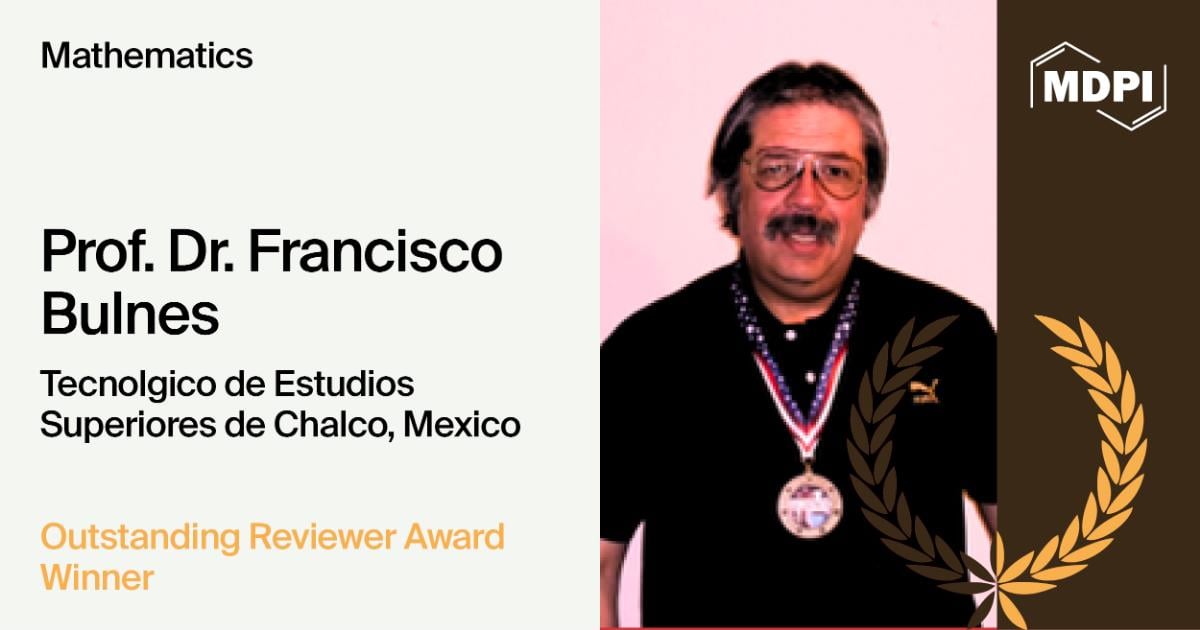
Interview with Prof. Dr. Francisco Bulnes—Winner of the Mathematics Outstanding Reviewer Award
The journal Mathematics (ISSN: 2227-7390) is proud to present the winner of the 2025 Mathematics Outstanding Reviewer Award, Prof. Dr. Francisco Bulnes! We would like to express our profound gratitude to Professor Francisco Bulnes for his invaluable contributions to the peer-review process of the journal Mathematics.
Name: Prof. Dr. Francisco Bulnes
Affiliation: IINAMEI, Research Department in Mathematics and Engineering, TESCHA
Research Interests: algebraic geometry; mathematical physics; infinite lie theory; motivic cohomology; integral transforms; global analysis.
Prof. Dr. Francisco Bulnes is a distinguished mathematician and researcher, holding a PhD in mathematical sciences from IM/UNAM, along with multiple postdoctoral appointments and numerous honorary doctorates, including Doctor H. C. and HonDSc distinctions. He is indexed in major academic databases such as zbMATH, Scopus, MathSci, and Mathematical Reviews. Since 2015, he has served as the IINAMEI Director at the Mathematics Research Center in Mexico. He is a pioneer in curvature energy theory, the formal theory of engineering, and the mathematical theory of nanotechnology. He has been the Editor-in-Chief of several mathematics journals in the USA and India since 2015. He is also a member of various international scientific committees and serves as a reviewer for British journals of mathematics and physics in Scopus. Furthermore, he is the Head of the Research Department at GI-TESCHA.
Dr. Bulnes has published more than 150 papers in mathematics and physics research journals and has written numerous books in these fields. His work has gained recognition in Eastern Europe, Asia, and the Arab world. Several theories, theorems, and mathematical objects bear his name, including Bulnes’s transforms related to quasi-relaxation processes in materials, as well as contributions to derived categories and moduli space identities. He has received various honors and awards, including multiple Doctorates Honoris Causa from universities, NGOs, and GOs. Among these distinctions is the Doctor Honoris Causa in Education Philosophy and his designation as a Peace Ambassador by ODAEE in Frankfurt, Germany. He is also a distinguished member of the Czech Republic Mathematics Society (JCFM) and has completed postdoctoral research in Cuba and Russia. His achievements are further reflected in over 70 international awards and badges, including those from Publons, Scopus, ZbMath, Thomson Reuters, MathSci, and ORCID, among others. His biography has been published in many volumes across the United Kingdom, India, China, Russia, Ukraine, the USA, Spain, and Mexico, and he has received various tributes from publishing houses in the United Kingdom and elsewhere. In addition, he has advanced research in fields such as electronics, micro-electronics, nanomedicine, and spintronics.
The following is a short interview with Prof. Dr. Francisco Bulnes:
1. Could you give a brief introduction of yourself to the readers? Could you introduce your current research direction and provide an update on your progress?
I am Prof. Dr. Francisco Bulnes, IINAMEI Director, where IINAMEI is a research center in advanced mathematics and engineering, and one of the most important in the State of Mexico, a province in the country of Mexico. My research interests in mathematics include the pure areas of algebraic geometry, mathematical physics, infinite Lie theory, and motivic cohomology, the applied parts of theoretical physics (quantum mechanics, QED, TFT, etcetera), and also engineering, including research on advanced sensors and transducers. This latter area is because I am actually a Full Professor in the electronics engineering program at TESCHA and direct some research projects on sensor research too. Some of my own theories are recognized by the mathematician and scientist communities, such as curvature energy theory, mathematical research and nanotechnology theories, and also many math objects, such as special spaces with certain algebraic and geometric structures, a pair of integral transforms used in material sciences on the quasi-relaxation phenomena, and important identities and theorems in derived categories, among others. Also, I am developing my own universe theory through integral geometry, supported by a comprehensive integral theory. I have many results with applications in field theory for many purposes, such as, for example, cures using radionics and nanomedicine, as well as electromagnetic propulsion. I think I have made great progress in my theories, and I consider that some of my theories are almost finished and can serve as frameworks of study in the sciences, in mathematics, or in physics.
2. Can you please share with us your sentiments upon winning the award?
This event has been wonderful, and my feelings have been of gratitude to the editorial house and the Editor-in-Chief of the journal Mathematics, who are giving value and public recognition to this work of academic peer review. I think that appreciating this work is important, because it is very important in the editor’s decision on the quality of a paper and its possible publication. I hope to still help with the reviewing work for the journal Mathematics.
3. Could you share some insights into your approach to reviewing manuscripts? How do you balance thoroughness with efficiency?
My idea is to have a very clear understanding of the author’s objectives, the scope they wish to achieve, and everything related to the topic, including frontier issues and inductions that could lead to interesting ideas not only for the readers but also for the author themself. Common boundaries with other areas of mathematics can establish other interesting directions for research. First, we check, at a basic level, that there are no errors regarding the research topic, considering the extensive literature on the subject.
We even check that the proposed topic and the resulting article are not simply recycled material or constitute plagiarism or self-plagiarism by the author. As a second step, we examine the author’s most innovative idea or most notable contribution. We study various approaches to their proposal and determine its viability. We review the calculations performed, if any. Then, we check the order of application of known results (the legitimate and genuine application of theorems, lemmas, and corollaries), always within the context defined by the author. In a third stage, once the author’s proposal has been accepted as innovative and not copied from any other work, we proceed to look for applications and relationships with other areas that enrich the paper’s context. Sometimes, as a fourth stage, and if I deem it necessary, I request classification tables, diagrams, or schematics that contribute to the clarity of the author's work.
4. What are the key factors and aspects that you consider most when reviewing a manuscript?
The proposal must be innovative, new, or an improvement of a method. The author must give clear clues as to what he wants to prove. Sometimes, only by reviewing the abstract, one can tell if the author has a clear understanding of what he is presenting or if it is a work adorned with completely sterile mathematical frameworks. The paper should attract the reader, not be flat, but have aspects that stand out and provoke in the reader the desire to delve deeper into the subject and even provide clues for possible future research on the topic. What is evaluated is the truth, the methodology—that is, the systematic construction of the proposed truth—the implications in mathematics and other areas of knowledge, the clarity and simplicity of the results obtained, always with due rigor and precision, always with the generality that mathematics demands for formulating a theorem or lemma, and the elegance of the conceptual unity that the author achieves in their exposition.
5. Based on your experience, which research topics do you think are of particular interest to the research community in the coming years?
I think that algebraic geometry and all aspects related to quantum field theory, as well as artificial intelligence in second-order logic (or even third-order logic), should be considered under mathematical models that incorporate the aspects of the “conscience” and “will”, allowing the development of mathematics toward greater interaction with the universe, including handling and engineering of fields, particles, waves, radiation, and energy. For this to happen, mathematics needs to continue developing in areas such as integrodifferential equations, a mathematical theory of nanotechnology, and advanced symplectic geometry, developing a super QED in continuum ambits, and possibly, integral geometry may contribute to the development of scanners of all types, detection of field anomalies in any body or even in the universe, recomposition of fields for medical use, etcetera.
To propose, from any perspective of knowledge, the study and development of mathematics and its applications is to lay the foundations for the rational and cognitive survival of man.