You are currently on the new version of our website. Access the old version .

Limnological Review

Limnological Review is an international, peer-reviewed, open access journal that covers all different subdisciplines of freshwater science, published quarterly online by MDPI (from Volume 22, Issue 1 - 2023).
The Polish Limnological Society is affiliated with Limnological Review and its members receive discounts on article processing charges.

All Articles (362)

Fish Communities and Management Challenges in Three Ageing Tropical Reservoirs in Southwestern Nigeria

  • Olumide Temitope Julius,
  • Francesco Zangaro and
  • Maurizio Pinna
  • + 10 authors

Three ageing reservoirs in Ekiti State, Nigeria (Ureje constructed in 1958, Egbe in 1982, and Ero in 1989), were comparatively assessed to evaluate fish assemblages and their conservation relevance. Despite the absence of formal fisheries governance, all three reservoirs supported temporally stable fish communities with low overall diversity. A core assemblage of six species dominated across sites, while species richness increased from seven species in the small urban Ureje reservoir to nine species in the larger and more rural Ero reservoir. Four native species that have become locally scarce in surrounding river systems (Heterotis niloticus, Parachanna obscura, Hepsetus odoe, and Hyperopisus bebe) persisted at low but consistent abundance. Aquatic environmental variables remained within suitable limits for freshwater fishes, and trophic structure appeared intact across the reservoirs. Catch density was substantially higher in the urban reservoir compared to the rural systems, reflecting spatial differences in fishing intensity. Overall, the findings demonstrate that small tropical reservoirs can function as important freshwater habitats that sustain fish biodiversity and fisheries production in modified landscapes.

4 January 2026

Map of the Study Sites created with QGIS showing the following: Position of Nigeria on the world map (I), position of Ekiti State in Nigeria (II); Position of the three lakes within Ekiti State (III); Ero lake, Ureje lake and Egbe lake. All measurements are given in Map units.

The ecological status of lakes based on ichthyofauna, as defined by the Water Framework Directive, is assessed using intercalibrated methods. However, the methods adopted (in Poland, the Lake Fish Index LFI-EN method, based on results of one-off fishing with multi-mesh gillnets) are labor-intensive and do not allow for frequent repeat testing. Therefore, the concept of a simple model describing changes in the relative number of single traces in the vertical profile (according to the TS target strength distribution) in a lake is presented, as well as an index (the sum of deviations from such a model), enabling quantification of the similarity of TS distributions in lakes with this model. Preliminary analyses were conducted on acoustic data collected in Lake Dejguny. This lake—the condition of which could be estimated based on historical data using the relationships between LFI and the degree of lake eutrophication (expressed by Carlson’s TSI)—was assessed as having a good status in 2006, whereas in 2021, (based on LFI-EN) it had a moderate status. The study tested the TS distribution model, calculated as the arithmetic mean of the relative number of single traces in 2 m-thick layers. It was also shown that the proposed indicator can effectively signal deterioration of ecological status—the sum of the absolute values of the TS distribution deviations in 2021 (moderate status) from the model was more than seven times greater than the sum of the deviations of the distributions from which the model was built (good status). The obtained results confirmed the hypothesis about the possibility of determining a characteristic distribution of single traces in the vertical profile when the lake was classified as being in good condition.

30 December 2025

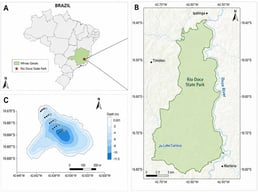
Bathymetric map of Lake Dejguny with marked boat routes during hydroacoustic surveys in November 2005, October 2008, and 2021 (according to Hutorowicz et al., [16]).

Urban streams are subjected to a variety of impacts from stormwater runoff, channelization, routing through culverts, and highly modified riparian zones, all of which can have negative effects on stream habitats and resident fish communities. Coldwater trout streams in urban areas may be especially impacted due to their normally low fish diversity and the higher intolerance of those species to such factors as stream temperature, dissolved oxygen concentrations, and water chemistry. Fish communities were examined at two sites in each of four coldwater trout streams in southeastern Minnesota USA: one site within the residential/commercial areas of a city and one site outside of the city limits in rural (agricultural) areas. Fish were surveyed (all fish counted and identified) in representative 150 to 200 m sections at each stream site with a backpack electrofisher. Data were used to produce Simpson and Shannon diversity indices, taxa richness values, a coldwater index of biotic integrity (IBI) score and rating for each site, and an NMDS plot using fish communities to compare between urban and rural stream sections. Overall, fish representing 17 different species and 11 families were found at the sites examined. Brown trout (Salmo trutta) comprised 65% of the total catch and was the only species collected at every site. Average fish species richness was nearly three times higher at urban sites than at rural sites, and Simpson and Shannon diversities were also significantly (four to five times) higher at urban compared to rural sites. However, coldwater IBI scores were significantly higher at rural (average = 93, good rating) than at urban (average score = 59, a fair rating) sites, indicating better coldwater biotic integrity in rural stream sections. A NMDS plot indicated that fish communities at urban sites were more similar to one another than they were to rural site communities; separation between urban and rural sites was largely influenced by species exclusive to urban sites. Reduced biotic integrity and altered fish community composition in urban streams likely resulted from a combination of factors including modified stream habitat and hydrology, warmer water temperatures, and urban runoff.

9 December 2025

Locations of rural (gold stars) and urban (white circles) fish sampling sites on each of four coldwater trout streams in and near Winona, MN, USA. Inset shows the location of the southeastern Minnesota study area (red triangle) within North America.

The problem of steroid hormones in the aquatic environment remains a current global research topic. These substances have a strong impact on biological processes, contributing to reductions in the populations of numerous fish and amphibian species. The impact of steroid hormones, especially the third-generation progestogens, on aquatic invertebrates is poorly understood. We aimed to determine whether desogestrel, progestogen of low androgenic activity, affects the reproduction and growth of the following freshwater invertebrates: snails of the species Melanoides tuberculata and the planarian Dugesia sp. We also tried to estimate the threshold concentrations of this substance at which significant changes in both the behavior and reproductive activity of the studied organisms are observed. In the mesocosm experiment, we performed three treatments with the following different concentrations of desogestrel: control 0 ng/L, medium 10 ng/L, and high 100 ng/L. The high hormone concentration significantly reduced the reproduction of both snails and planarians, despite their different life history strategies, compared to the control. Both planarians and snails showed a significantly lower abundance in the high concentration compared to the 10 ng/L treatment, indicating a threshold concentration > 10 ng/L. The impacts of steroid hormone pollution on aquatic organisms and the need for further research are discussed.

14 November 2025

The average number of the Melanoides tuberculata snails at different desogestrel concentrations. The error bars represent ±1SE. Different letters indicate statistical differences at a p-value of <0.001 (Tukey test, 100 ng/L and control p < 0.000001; 100 ng/L and 10 ng/L p = 0.0003, respectively).

News & Conferences

Issues

Open for Submission

Editor's Choice

Get Alerted

Add your email address to receive forthcoming issues of this journal.

XFacebookLinkedIn
Limnol. Rev. - ISSN 2300-7575