
Abstract
Urban streams are subjected to a variety of impacts from stormwater runoff, channelization, routing through culverts, and highly modified riparian zones, all of which can have negative effects on stream habitats and resident fish communities. Coldwater trout streams in urban areas may be especially impacted due to their normally low fish diversity and the higher intolerance of those species to such factors as stream temperature, dissolved oxygen concentrations, and water chemistry. Fish communities were examined at two sites in each of four coldwater trout streams in southeastern Minnesota USA: one site within the residential/commercial areas of a city and one site outside of the city limits in rural (agricultural) areas. Fish were surveyed (all fish counted and identified) in representative 150 to 200 m sections at each stream site with a backpack electrofisher. Data were used to produce Simpson and Shannon diversity indices, taxa richness values, a coldwater index of biotic integrity (IBI) score and rating for each site, and an NMDS plot using fish communities to compare between urban and rural stream sections. Overall, fish representing 17 different species and 11 families were found at the sites examined. Brown trout (Salmo trutta) comprised 65% of the total catch and was the only species collected at every site. Average fish species richness was nearly three times higher at urban sites than at rural sites, and Simpson and Shannon diversities were also significantly (four to five times) higher at urban compared to rural sites. However, coldwater IBI scores were significantly higher at rural (average = 93, good rating) than at urban (average score = 59, a fair rating) sites, indicating better coldwater biotic integrity in rural stream sections. A NMDS plot indicated that fish communities at urban sites were more similar to one another than they were to rural site communities; separation between urban and rural sites was largely influenced by species exclusive to urban sites. Reduced biotic integrity and altered fish community composition in urban streams likely resulted from a combination of factors including modified stream habitat and hydrology, warmer water temperatures, and urban runoff.
1. Introduction
Urban development can have significant impacts on watersheds and the streams and rivers that drain them [1,2,3,4,5]. As terrestrial habitats become changed and fragmented by urbanization, lotic riparian areas are damaged or lost [3,6] and impervious surface areas increase [7,8], altering watershed hydrology via reduced infiltration (or groundwater recharge) and increased storm runoff [7]. Streams in cities often experience increased peak flows, reduced baseflows, altered stream power, and increased sedimentation [5,7,9,10,11] compared to non-urban streams, which can lead to instream habitat degradation and the resultant impacts to aquatic communities [5,12].
Urbanization often has predictable effects on stream and river communities. As urbanization expands within a watershed, lotic fish and benthic macroinvertebrate communities lose taxa as sensitive or intolerant species disappear [13,14,15,16,17,18,19,20,21]. Pollution-tolerant and/or stressor-resistant taxa (which frequently are non-native omnivorous feeders [22]) often invade and/or increase to dominate communities [13,14,16,19,22,23,24]. Biotic functional diversity declines [18,22], aquatic communities become homogenized [17,25], and overall biotic integrity of both fish and macroinvertebrate communities diminishes [8,21,26] as lotic systems become altered hydrologically, physically, chemically, and thermally [5]. Urbanization effects on aquatic organisms may also influence evolutionary changes in some species [27]. In general, the effects of urbanization on stream communities are often considered more dramatic and severe than those impacts caused by various agricultural activities [26,28].
Aquatic communities in coldwater streams can differ from those in coolwater and warmwater systems [29]. While the same or similar macroinvertebrate taxa can occupy streams and rivers across a wide thermal range [30], fish communities in coldwater streams and rivers are usually much more limited and species-poor than those in warmer systems [31,32]. Because relatively few riverine fish species can complete their life cycles in waters that may remain below 19 °C for the entire year [29,33], undisturbed coldwater rivers and streams may contain as few as one or two species of fish and exhibit much poorer fish community diversity than warmer lotic systems nearby [29,32]. In response to disturbance or stress, coldwater systems may exhibit increased fish species richness and higher fish community diversity relative to the pre-disturbed community, especially if the stress results in altered thermal regimes [29,31,32,33].
Coldwater streams and rivers frequently flow through urban areas and become impacted by various stressors associated with urbanization [34,35,36,37,38,39,40]. Those coldwater lotic systems are home to various species of salmonids (trout, salmon, whitefish; Salmonidae), sculpin (Cottidae), suckers (Catostomidae), and dace (Leuciscidae) adapted to cold water [34,36,37,38]. Although several of these species are classified as sensitive or intolerant [31,32,41], some may remain and maintain sustainable populations even as watersheds surrounding them continue to urbanize [35,36,40].
In this study, I examined multiple spring-fed coldwater trout streams in rural and urban areas in southeastern Minnesota, USA, to explore how urbanization alters fish communities. I hypothesized that urbanization would lead to increased fish community diversity and taxa richness increase coincident with reduced biotic integrity. I also hypothesized that fish communities at urban stream sites would be more similar to those at other urban sites in different watersheds than they would be to those at rural sites within the same watershed due to homogenization of fish assemblages exposed to urbanization stressors.
2. Study Area
The study was conducted within the Driftless Area of southeastern Minnesota, USA [42]. The Driftless Area, a region bypassed by recent glaciation events, spans over 62,000 km2 across southeastern Minnesota, west-central Wisconsin, northeastern Iowa, and northwestern Illinois [43]. This region contains over 600 groundwater spring-fed streams and rivers (due to karst geology [42]) extending for over 9300 km and draining to the upper Mississippi River [43]. These coldwater streams support self-sustaining populations of native brook trout (Salvelinus fontinalis) and non-native brown trout (Salmo trutta), in addition to stocked rainbow trout (Oncorhynchus mykiss) and a variety of native, non-game species that includes slimy (Uranidea cognata) and mottled (Uranidea bairdii) sculpin, brook stickleback (Culaea inconstans), American brook lamprey (Lethenteron appendix), white sucker (Catostomus commersoni), longnose (Rhinichthys cataractae) and western blacknose (Rhinichthys obtusus) dace, creek chub (Semotilus atromaculatus), fantail darter (Etheostoma flabellare), and many others [44,45].
Streams flowing through the Driftless Area have been impacted by a variety of human activities. Historically, these coldwater streams were inhabited primarily by brook trout and sculpins but their populations likely were extirpated by overexploitation and degraded stream habitats caused by land abuses that accompanied agricultural development after 1850 [42,46,47]. After nearly a century of stocking, brown trout populations became naturally self-sustaining in most systems by the 1970s [46] and reintroductions of slimy sculpin began in many streams in 2003 [47]. Brook trout were also stocked and successfully reproduced in some of the coldest headwater streams and a few native brook trout populations have persisted as well [48].
Today, land use within the Driftless Area is a mix of agriculture (row crops, hay lands, and livestock grazing land), managed deciduous forest lands, and urban areas (residential, commercial, and industrial) [42]. Although agricultural activities often have strong effects on Driftless Area streams [44,45], the region also contains several small (populations of 25,000 to 110,000 people) urban areas that potentially can impact the coldwater trout streams that flow through them via municipal stormwater runoff, channelization, increased streamwater temperatures, and altered discharge patterns [49].
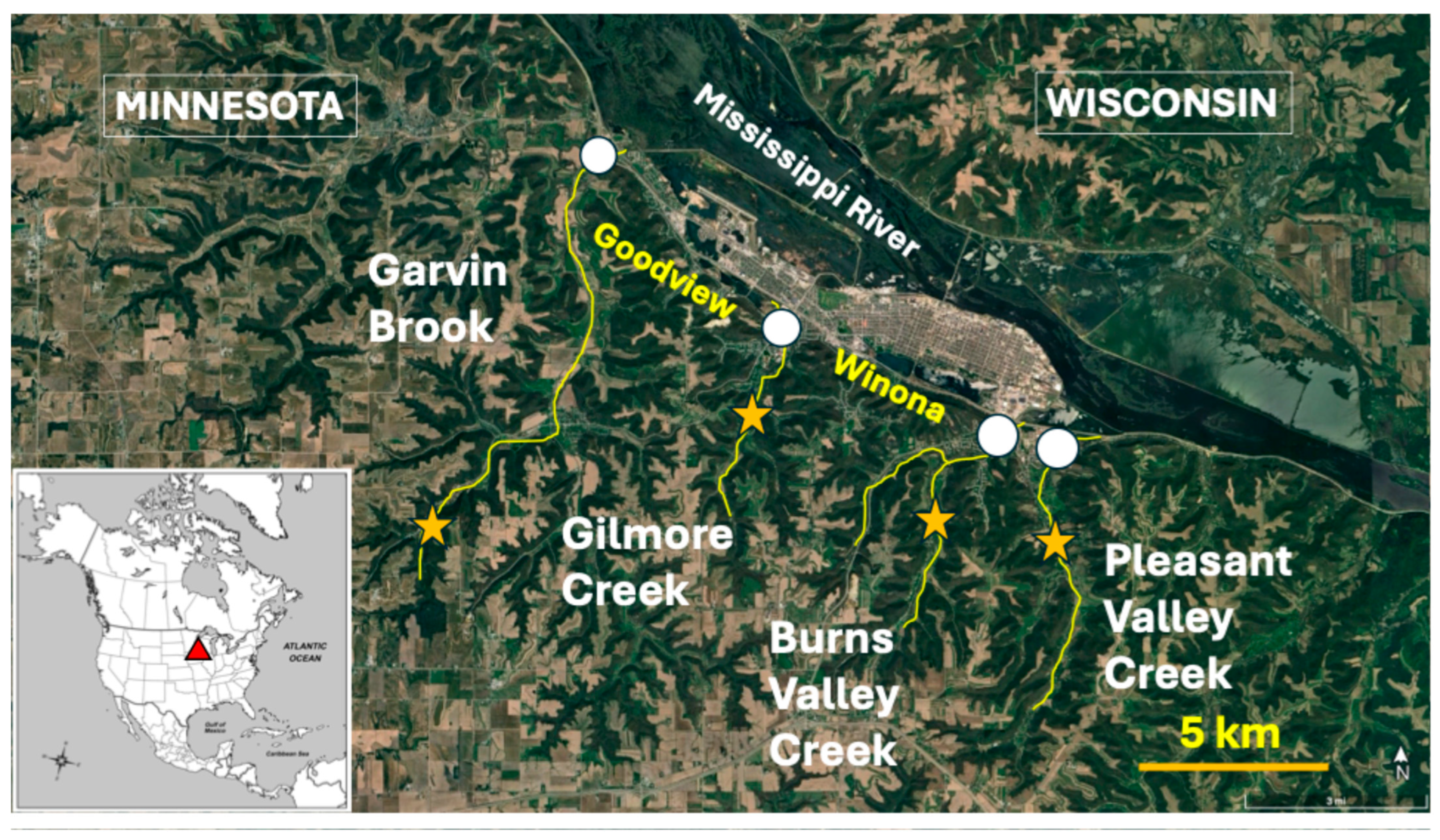
The Winona/Goodview, Minnesota, urban area (44°03′22″ N; 91°39′59″ W) is the fourth largest urban complex within the Driftless Area. Four coldwater streams flow through Winona/Goodview: Pleasant Valley Creek, Burns Valley Creek, Gilmore Creek, and Garvin Brook (Figure 1). All four streams originate from springs in forested rural areas south of Winona/Goodview, flowing first through agricultural areas and then through urbanized habitats before entering various backwaters of the Mississippi River. These streams range from 1st-order to 4th-order systems at my sampling locations and are designated as coldwater trout streams throughout their entire lengths [50].
Figure 1.
Locations of rural (gold stars) and urban (white circles) fish sampling sites on each of four coldwater trout streams in and near Winona, MN, USA. Inset shows the location of the southeastern Minnesota study area (red triangle) within North America.
3. Methods
3.1. Fieldwork
Single stream sites (150 m in length) were selected in both urban and rural sections on each of four coldwater trout streams (Figure 1). Site selection was based on both access (either public lands or with permission of private landowners) and representative nature of the stream reach for that stream and locality (urban or rural; based on professional judgment and resource familiarity). General stream site locality conditions (e.g., natural versus channelized channel, streambank condition, adjacent land use, stormwater inflow culverts, and so on) were observed and noted and basic stream physical conditions at baseflow (e.g., stream width, stream discharge, dominant bottom substrates) were assessed.
Historical (i.e., pre-urban development) fish community data are largely lacking for the study streams. The urban stream locations used in this study were already urbanizing by 1880 when Winona had a population of 10,000 people. The most intensively managed rural trout stream site (Garvin Brook) has survey data extending back into the 1950s (V. Snook, Minnesota Department of Natural Resources-Fisheries, Lanesboro, personal communication). Most survey data for all stream sites is more recent (past 30 years), long after urbanization encompassed the urban sites utilized in this study.
During summer 2016, fish communities at each stream site were surveyed via timed single-pass (downstream to upstream) electrofishing using one or more backpack electrofishing units (Smith-Root Type VII, 12-B POW, LR-24, or LR-20B) and dip nets. All fish collected were identified, counted, and returned alive back into the stream. Single-pass electrofishing is sufficient for documenting the fish community in small streams such as those in this study [51,52,53,54], and data collected with this protocol are used to calculate a regional coldwater fish index of biotic integrity [32].
3.2. Data Analyses
Various metrics were used to assess the fish communities present at each stream site. These metrics included simple taxa richness (number of species present), Shannon and Simpson community diversity indices [55], and a coldwater fish index of biotic integrity (Table 1 and Table 2) [32]. This index assesses 12 fish community characteristics and scores them compared to best possible conditions to evaluate the collective impact of a variety of stressors (e.g., urbanization, agricultural activities, logging, construction activities, natural disturbances, elevated water temperatures) to stream habitat and water quality [32]. Because small sample sizes (<five pairs of sites) precluded the use of common non-parametric statistics such as Wilcoxon’s signed rank test, each of these metrics was compared between urban and rural stream sites with a paired t test (VassarStats: vassarstats.net). Even though the very small sample sizes likely would not permit normality assumptions to be tested properly, t tests can be applied with caution for sample sizes less than five if the effect size is expected to be large and within-pair correlation is high [56]. Fish communities at urban and rural sites within each stream were also compared to each other with two community similarity indices (percentage of similarity index [sum of the lowest percentage for each species across the two communities being compared; 0% = no similarity, 100% = complete similarity] and Bray–Curtis [0 = no similarity, 1 = complete similarity] similarity index) using Quantan (Quantitative Analysis in Ecology) software [55]. Prior to statistical comparisons, taxa richness values were standardized across sites using electrofishing effort (taxa/1000 s electrofishing time). Sampling effort was variable among sites due to differences in stream area and habitat complexity. Similarly, individual species abundances were standardized (individuals/1000 s electrofishing time) prior to calculating diversity and similarity values.
Table 1.
Coldwater IBI metrics and scoring criteria, adapted from [32].
Table 2.
Coldwater IBI total scores, rating categories, and typical community characteristics. Adapted from [32].
I used non-metric multidimensional scaling (NMDS using Bray–Curtis dissimilarity; JMP Pro 19 software, JMP Statistical Discovery LLC, Cary, NC, USA) on the transformed fish count data (Hellinger transformation; square root of relative abundances at each site) [57] to create an ordination plot visualizing the level of community dissimilarity and potential site clustering among the eight urban and rural stream sites. I then used simple Spearman correlation coefficients (rs; JMP Pro 19) to compare each of the fish taxa individually to each dimension of the NMDS model [28], to assess which species were most related to the ordination space.
4. Results
Urban stream locations in general were distinctive in appearance from their rural counterparts (Table 3). Urban stream sites, due to their locations in the lower portions of their watersheds, typically were wider with greater discharge than were the upstream rural locations and usually were dominated by finer bottom sediments. Urban sites were surrounded by commercial and residential properties and two of them had been channelized within flood control levees, whereas rural sites were within forests and/or agricultural lands (Table 3). Three of the urban sites received direct stormwater runoff via culverts. Stream site water temperatures were not measured during sampling.
Table 3.
General stream and riparian characteristics at eight coldwater stream sites in and near Winona, MN, USA.
Overall, 17 different fish species representing 11 families were observed across the eight stream sites surveyed (Table 4). Brown trout was the only species collected at every site, accounting for 65% of total individuals captured. Within each stream, brown trout were four to 20 times more abundant at the rural site than at the urban site. Slimy sculpin comprised 12% of individuals collected and were observed at four sites, whereas the other 15 species (including brook trout) were collected at only one or two sites each.
Table 4.
Fish species abundances at rural (R) and urban (U) sites on four coldwater trout streams in and near Winona, MN, USA.
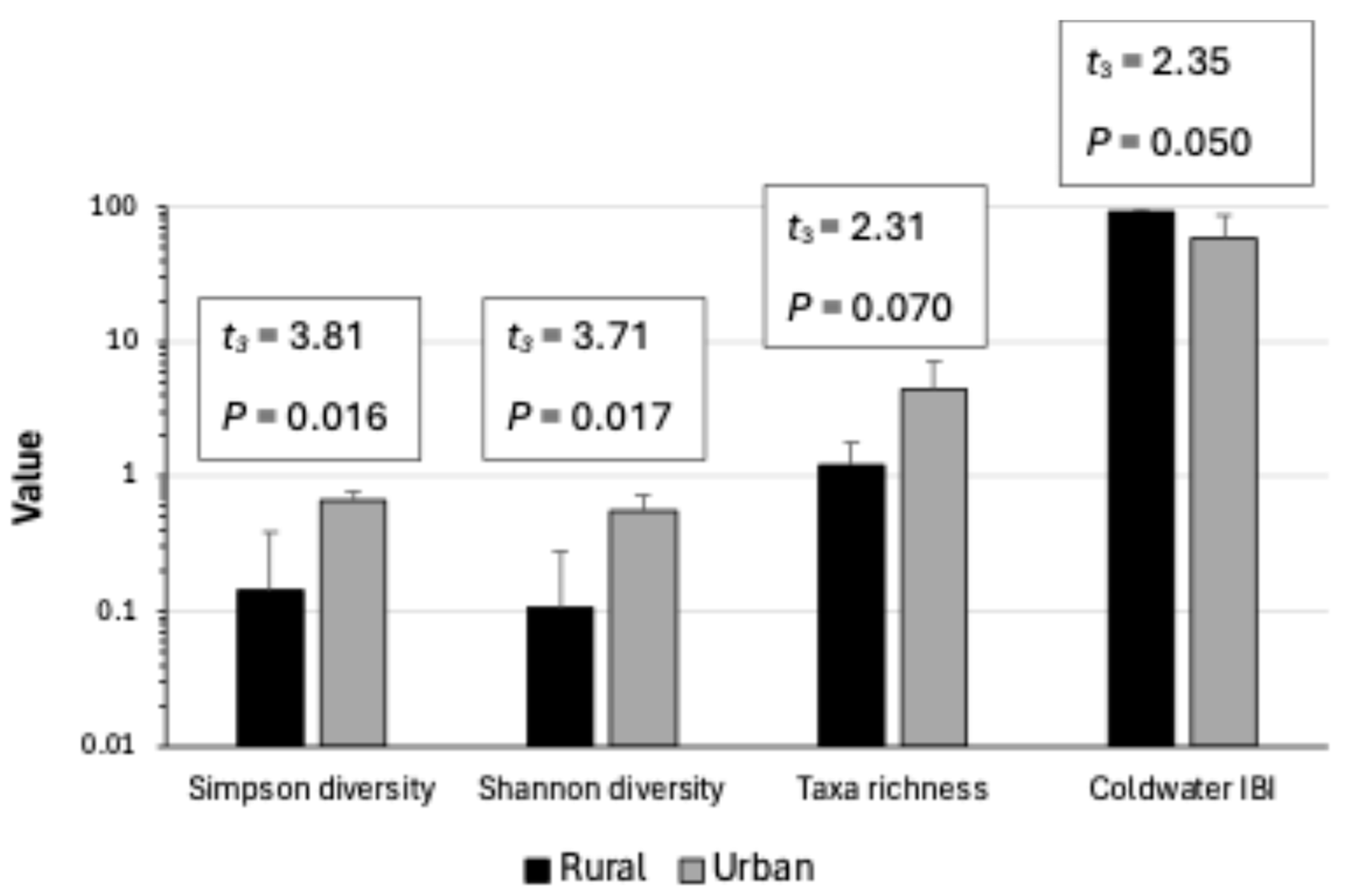
Fish communities displayed several differences between urban and rural stream sites. Urban sites averaged nearly three times more fish taxa (standardized by electrofishing effort) than at rural sites (4.34 versus 1.23 taxa/1000 s), although this difference was not significant. Both Simpson and Shannon fish community diversities were significantly higher at the urban sites (Figure 2). However, coldwater fish community IBI ratings were “good” at all rural sites but only “fair” at three of the urban sites (Burns Valley Creek urban site was rated “good”). Consequently, coldwater IBI scores were borderline significantly higher at rural sites versus urban sites (Figure 2). In general, urban sites scored lower than rural sites due to the presence of more fish taxa, fewer intolerant coldwater taxa and individuals, and more tolerant warmwater individuals.
Figure 2.
Mean (+95% confidence interval) Simpson and Shannon diversities, taxa richness (taxa/100 s), and coldwater IBI scores for fish communities at rural and urban sites on each of four streams in and near Winona, MI, USA. Numbers above bars are t test results comparing urban and rural site values for each metric. Note the log scale on the Y-axis.
When rural and urban site fish communities in the same stream were compared to each other, all four stream pairings displayed low similarity (Table 5). All site pairings showed 42% or lower similarity with the percentage of similarity index and <30% similarity with the Bray–Curtis index.
Table 5.
Community similarity index values comparing fish communities between rural and urban sites on each of four coldwater trout streams in and near Winona, MN, USA.
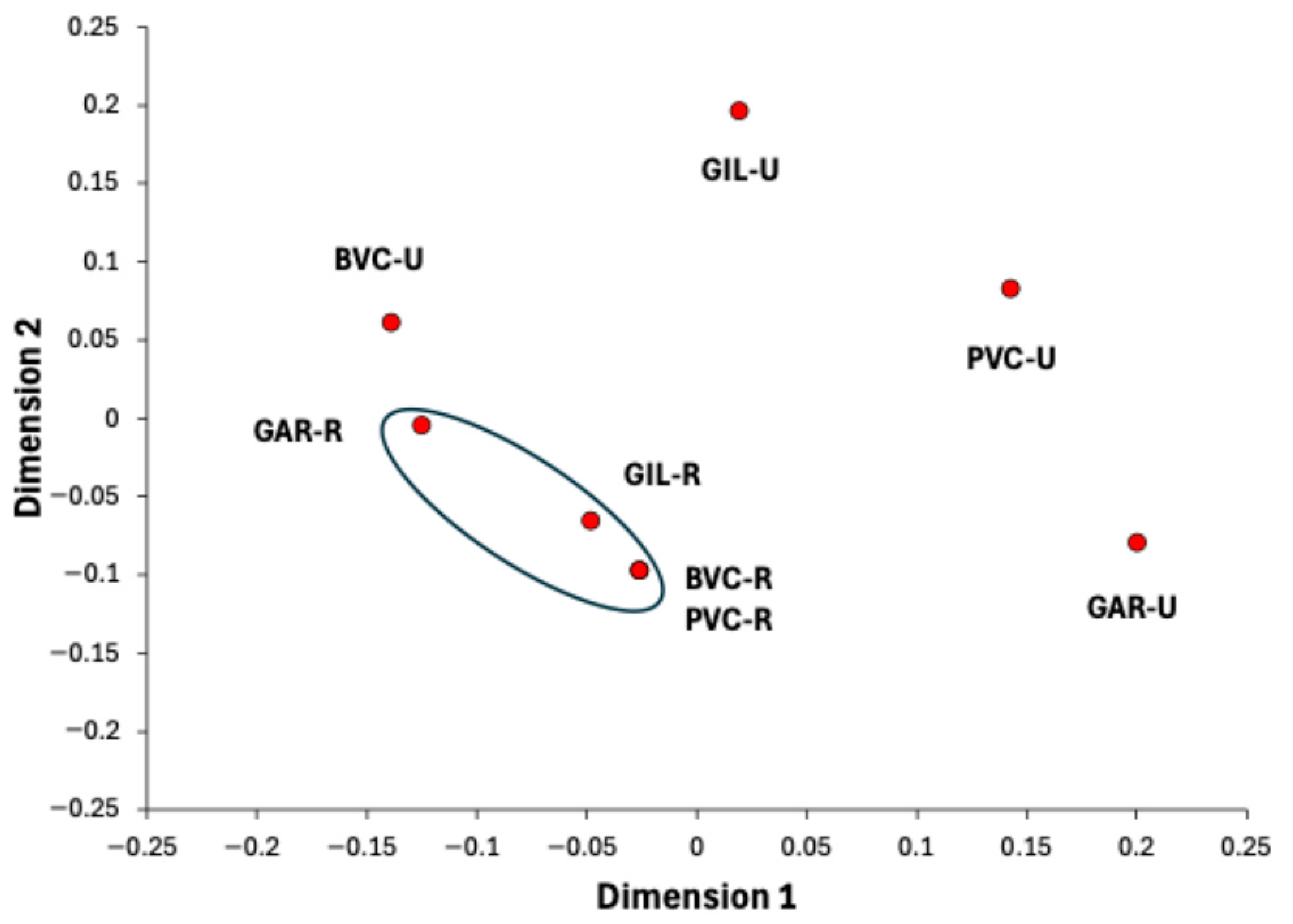
The NMDS plot based on transformed fish species abundances produced a close grouping for rural stream sites in the lower left quadrant of the ordination space but urban sites were scattered throughout the remainder of the ordination space (Figure 3). Rural and urban sites did not separate cleanly along either Dimension 1 or 2, with a fair stress level of 0.140 indicating that the plot adequately reflects the relationships among the site fish communities. Species that had the strongest influence on either of the dimensions of the ordination (slimy sculpin, white sucker, brook stickleback, central mudminnow, green sunfish) were mostly exclusive to urban sites, with only slimy sculpin observed at both urban and rural sites (Table 6).
Figure 3.
NMDS ordination plot based on fish communities at rural (R) and urban sites (U) on each of four coldwater trout streams in and near Winona, Minnesota. Ellipse drawn to highlight the rural site grouping. Stress = 0.140, R2 = 0.895. GIL = Gilmore Creek, GAR = Garvin Brook, BVC = Burns Valley Creek, and PVC = Pleasant Valley Creek.
Table 6.
Spearman rank correlation coefficients (rs) and probability values indicating the degree of fit between individual fish species abundances (transformed) and Dimensions 1 and 2 of the NMDS model for eight urban and rural stream sites based on fish communities. Significant correlations are highlighted in bold italic font.
5. Discussion
In response to stressors, most aquatic ecological communities exhibit declining species richness, reduced diversity, and a shift toward dominance by tolerant species [5,58,59,60]. These typical patterns of change occur as sensitive or intolerant species can no longer maintain themselves in a modified environment, leaving or dying as conditions become unsustainable [31,32,39]. Stressed macroinvertebrate communities in coldwater streams tend to follow this same pattern [44,45], but coldwater fish communities do not [31,32,39].
Coldwater fish communities exposed to environmental stressors may lose sensitive native species and/or exhibit declines in abundance in those species that remain [34,35,36,39]. However, stressed coldwater streams and rivers frequently are invaded by more tolerant fish species that were not present in the systems prior to stress onset [31,32,34,39], often resulting in increased taxa richness and community diversity compared to the unimpacted system [31]. Elevated stream water temperatures, a common characteristic of stressed coldwater streams, is a major driving force behind these invasions of new fish species [31,32,39]. Unfortunately, water temperature data were not available for my rural and urban stream sites, so I was unable to determine the role of water temperature in structuring fish communities. Future studies need to include water temperature monitoring, especially at the urban sites.
In my study, urban stream reaches displayed marginally higher fish taxa richness and significantly higher community diversity indices than were present in rural sections of the same streams. Urban sites averaged nearly three times more fish species than rural sites and abundances of brown trout were much reduced (i.e., this species was much less dominant) in urban reaches, producing greater evenness among species abundances and increased community diversity at urban sites. Since all our streams connect downstream to wetlands and backwaters of the Mississippi River, and these habitats contain most of the fish species that I collected at urban sites (N. Mundahl, unpublished data), these habitats serve as likely sources of fish species available to colonize my stressed urban stream reaches. Typically, downstream coolwater or warmwater stream and river reaches plus connected lakes and wetlands provide a regular source of fish species available to move into upstream coldwater stream reaches when stream temperatures rise in response to a variety of landscape changes, including urbanization [31,39]. Without these colonizer sources, stressed coldwater systems likely would exhibit only reduced abundances of some species and loss of others [36], the typical response of warmer stream fish communities to stress [61]. Several other regional trout streams (Latsch Creek, 15 km northwest of the study area; Miller Valley Creek and Buege Spring Creek, 18 and 19.5 km southeast of Winona, respectively) that flow into the Mississippi River without passing through an urban area contain coldwater fish communities dominated (85 to 100%) by brook trout, slimy sculpin, and brown trout even though they are within sight of the river or its backwaters (N. Mundahl, unpublished data). These observations suggest that these streams, which flow through a forested state park or private forest lands, have remained largely in their natural state, allowing for the continued dominance by intolerant coldwater fish species and inhibiting the immigration of more tolerant warmwater species from nearby warmwater habitats. Water temperature data from my study sites and these other, least disturbed streams would allow me to assess the influence of temperature on fish community structure.
Despite increased fish taxa richness and community diversity at my urban coldwater stream sites, the biotic integrity of those stream reaches was reduced relative to upstream rural sites. Minimally disturbed coldwater stream sites in the upper midwestern USA should be characterized by a species-poor fish community dominated by salmonids and cottids [31,32]. These systems are at their “healthiest” when only one to three coldwater-adapted species are present [31,32,39], with the addition of even small numbers of individuals of a single species (e.g., white sucker) indicative of degraded conditions and/or the presence of some environmental stress [32]. Even though all my urban stream sites still held brown trout and had coldwater IBI ratings of fair to good, the presence of 14 species (including white sucker at two sites) at urban (but not rural) sites was indicative of reduced coldwater biotic integrity.
I observed reduced abundances of brown trout at all urban sites relative to their rural counterparts. Whereas some studies of urban trout streams have also noted reduced abundance or biomass of salmonids [36,37], others [35,38,40] have observed high densities of trout and salmon in some urban streams, although high densities may have resulted from protective buffers and improved instream connectivity [35,38,40]. In addition, salmonid age class structures may differ between urban and non-urban streams, with some urban systems dominated by young fish [36] whereas others may support mostly older salmonids [37,38,40]. Although I did not measure sizes of trout at all sites during this study, general observations during collections suggest that younger brown trout (especially age 0 or young-of-year fish and yearlings) were more common and abundant at upstream rural sites, with mostly older trout (age 2 and older) present at downstream urban locations. I speculate that my upstream rural stream sites provided better brown trout spawning and nursery habitats than did the urban sites, whereas urban sites contained more potential forage fish species to support the growth of larger trout [62]. Upstream stream reaches may provide a continual source of young trout to colonize downstream urban reaches, where they forage and grow rapidly before migrating upstream to spawn [63,64].
NMDS ordination of my stream site fish communities did not cleanly separated urban and rural sites along either dimension. A previous investigation demonstrated that urban and non-urban fish communities cluster separately when examined with NMDS ordination [28]. In my study, clustering of rural stream sites and the scattering of urban sites within the ordination space was not significantly correlated to brown trout abundances, even though brown trout was the only species observed at every site. Instead, slimy sculpin and five species exclusive to urban sites were significantly correlated to either Dimension 1 or 2 of the ordination. Brown trout and slimy sculpin abundances have been found previously to separate less disturbed cold and taxa-poor stream site fish communities from warmer and more taxa-rich, stressed-site communities in southeastern Minnesota [44]. It is not surprising that all urban sites clustered more closely with other urban sites rather than with rural sites on the same stream, given the differing abundances of brown trout and the presence/absence of additional fish species. Urbanization leads to the homogenization of stream fish communities, driving assemblages away from unique or endemic species groupings and toward a common set of tolerant species [17,22,25]. Urban sites also shared similar instream and riparian habitat features (e.g., fine stream bottom sediments, poor or modified riparian buffers, limited riffle habitats) that are known to significantly and negatively influence coldwater fish communities within regional streams [8,31,39,44,45] and elsewhere [5,6,10,11,12,17].
Can anything be done to lessen or reverse the effects of urbanization on coldwater stream fish communities like those in Winona? Because of the near universal negative effects of urbanization on streams, many approaches have been used to protect, restore, or rehabilitate streams in urban areas to improve conditions for fish communities [20,35,37,38,40]. Retaining forested riparian buffers within urban settings (where possible) may help preserve natural fish communities by insulating them from many of the direct urban impacts (e.g., rapid stormwater or snowmelt runoff from nearby impervious surfaces) and protecting or sustaining recruitment of large wood structure in the stream channel to provide natural fish habitat [8,20,40,65,66]. Lack of instream habitat in urban streams limits both the abundance and distribution of brown trout [34].
Active restoration efforts in and along urban streams (including riparian reconstruction or tree planting/regrowth, channel reconstruction, stormwater pond construction or modification, removal of physical barriers such as dams and culverts, stormwater and flood management, or wetland creation) [4,8,19,20,24,35,38,40,65,66] may improve conditions enough relative to unimproved reaches so that stream fish communities can return to pre-restoration levels of abundance or taxa richness [35,65]. Whether or not my urban sites would benefit from any of these actions is unknown, as the true status of my urban stream habitats and riparian zones and their suitability for restorative actions would require much more extensive and detailed investigations than what I report here. Regardless, some urban stream restorations using similar techniques as those mentioned previously may not result in restored fish community diversity [67] or the recovery of sensitive species [21] or might require decades to drive significant fish community changes [38]. Apparently, urbanization imposes such a complex and variable set of stressors on stream environments [5,7,12] that it is difficult to assume that successful restoration efforts on one urban stream might also be successful on others [5,12]. I suggest that, if deemed appropriate after thorough instream and riparian assessments, some focused channel reconstruction (to improve habitat diversity, reduce erosion of stream banks, and better flush out fine sediments) and limited vegetation restoration efforts could improve brown trout abundance in my urban stream sites and help maintain cooler water temperatures to discourage immigration of non-coldwater species. Regardless, smart growth policies for future urban development, which maximize open space and minimize impervious surfaces, should limit impacts on urban fish communities and better maintain the ecological health of urban stream systems [4].
6. Conclusions
Urban coldwater streams in southeastern Minnesota displayed reduced biotic integrity but increased fish taxa richness and fish community diversity compared to rural sections of the same streams. The stressed urban streams likely gained non-coldwater fish species via upstream migration from connected lakes and river backwaters while exhibiting reduced abundances of brown trout and other coldwater-adapted species when compared to upstream rural sites. I propose that urbanization resulted in fish community homogenization at urban sites, making them more similar to those at other urban sites in different watersheds than to fish communities in rural sections of the same stream. A more thorough investigation of urban and rural coldwater stream fish communities, including reference non-urban stream sites located near the Mississippi River to better separate urbanization effects on fish communities from simple proximity to colonizers, will be needed to determine if the patterns observed in this pilot study are generalizable across the region. I encourage future efforts to first assess and then potentially restore instream and riparian habitats in my urban stream reaches and suggest that future urban developments should be planned with a focus on better protections for natural habitats (e.g., riparian forests, grasslands) and the streams that flow through them.
Funding
This research received no external funding.
Institutional Review Board Statement
Fish collections were carried out under special permit (Number 21057) from the Minnesota Department of Natural Resources, Division of Fish and Wildlife, Section of Fisheries. This research was approved by the Winona State University Institutional Animal Care and Use Committee (1317064-1, 1310072-2, 1310073-2) and complied with all current ethical standards.
Data Availability Statement
Data are available from the author upon reasonable request.
Acknowledgments
I thank the Winona State University ecology and environmental science students who assisted with field collections. Collecting permits were provided by the Minnesota Department of Natural Resources-Fisheries. Many thanks to the private landowners who granted me permission to access the streams on their property.
Conflicts of Interest
The author declares no competing interests.
References
- Allan, J.D.; Castillo, M.M.; Capps, K.A. Stream Ecology: Structure and Function of Running Waters, 3rd ed.; Springer Nature AG: Cham, Switzerland, 2021. [Google Scholar]
- Riley, A.L. Restoring Streams in Cities: A Guide for Planners, Policymakers, and Citizens; Island Press: Washington, DC, USA, 1998. [Google Scholar]
- Naiman, R.J.; Décamps, H.; McClain, M.E. Riparia: Ecology, Conservation, and Management of Streamside Communities; Elsevier Academic Press: Burlington, MA, USA, 2005. [Google Scholar]
- Kennen, J.G.; Chank, M.; Tracy, B.H. Effects of landscape change on fish assemblage structure in a rapidly growing metropolitan area in North Carolina, USA. Am. Fish. Soc. Symp. 2005, 47, 39–52. [Google Scholar]
- Paul, M.J.; Meyer, J.L. Streams in the urban landscape. Annu. Rev. Ecol. Syst. 2001, 32, 333–365. [Google Scholar] [CrossRef]
- Roy, A.H.; Freeman, B.J.; Freeman, M.C. Riparian influences on stream fish assemblage structure in urbanizing streams. Landscape Ecol. 2007, 22, 385–402. [Google Scholar] [CrossRef]
- O’Driscoll, M.; Clinton, S.; Jefferson, A.; McMillan, S. Urbanization effects on watershed hydrology and in-stream processes in the southern United States. Water 2010, 2, 605–648. [Google Scholar] [CrossRef]
- Wang, L.; Lyons, J.; Kanehl, P. Impacts of urbanization on stream habitat and fish across multiple spatial scales. Environ. Manag. 2001, 28, 255–266. [Google Scholar] [CrossRef] [PubMed]
- Waters, T.F. Sediment in Streams: Sources, Biological Effects and Control; American Fisheries Society Monograph 7; American Fisheries Society: Bethesda, MD, USA, 1995. [Google Scholar]
- MacKenzie, K.M.; Singh, K.; Binns, A.D.; Whiteley, H.R.; Gharabaghi, B. Effects of urbanization on stream flow, sediment, and phosphorous regime. J. Hydrol. 2022, 612, 128283. [Google Scholar] [CrossRef]
- Bertora, A.; Grosman, F.; Sanzano, P.; Rosso, J.J. Combined effects of urbanization and longitudinal disruptions in riparian and in-stream habitat on water quality of a prairie stream. Knowl. Manag. Aquat. Ecosyst. 2022, 423, 15. [Google Scholar] [CrossRef]
- Brown, L.R.; Cuffney, T.F.; Coles, J.F.; Fitzpatrick, F.; McMahon, G.; Steuer, J.; Bell, A.H.; May, J.T. Urban streams across the USA: Lessons learned from studies in 9 metropolitan areas. J. N. Am. Benthol. Soc. 2009, 28, 1051–1069. [Google Scholar] [CrossRef]
- Nguyen, H.H.; Venohr, M.; Gericke, A.; Sundermann, A.; Welti, E.A.R.; Haase, P. Dynamics in impervious urban and non-urban areas and their effects on run-off, nutrient emissions, and macroinvertebrate communities. Landsc. Urban Plan. 2023, 231, 104639. [Google Scholar] [CrossRef]
- Williams-Subiza, E.A.; Brand, C.; Miserendino, M.L. Compositional shifts in freshwater macroinvertebrate communities over 30 years of urbanization. Ecol. Eng. 2022, 183, 106738. [Google Scholar] [CrossRef]
- Bohus, A.; Gál, B.; Barta, B.; Szivák, I.; Karádi-Kovás, K.; Boda, P.; Padisák, J.; Schmera, D. Effects of urbanization-induced local alterations on the diversity and assemblage structure of macroinvertebrates in low-order streams. Hydrobiologia 2023, 850, 881–899. [Google Scholar] [CrossRef]
- Ortega, J.C.G.; Bacani, I.; Dorado-Rodrigues, T.F.; Strüssmann, C.; Fernandes, I.M.; Morales, J.; Mateus, L.; da Silva, H.P.; Penha, J. Effects of urbanization and environmental heterogeneity on fish assemblages in small streams. Neotrop. Ichthyol. 2021, 19, e210050. [Google Scholar] [CrossRef]
- Ferreira, F.S.; Solórzano, J.C.J.; Súarez, Y.R. Influence of urbanization on stream fish assemblages in three microbasins in the Upper Paranã River Basin. Brazilian J. Biol. 2023, 83, e247384. [Google Scholar] [CrossRef]
- Yang, B.; Qu, X.; Liu, H.; Yang, M.; Xin, W.; Wang, W.; Chen, Y. Urbanization reduces fish taxonomic and functional diversity while increases phylogenetic diversity in tropical rivers. Sci. Total Environ. 2024, 908, 168178. [Google Scholar] [CrossRef]
- Roy, A.H.; Freeman, M.C.; Freeman, B.J.; Wenger, S.J.; Ensign, W.E.; Meyer, J.L. Investigating hydrologic alteration as a mechanism of fish assemblage shifts in urbanizing streams. J. N. Am. Benthol. Soc. 2005, 24, 656–678. [Google Scholar] [CrossRef]
- Tóth, R.; Czeglédi, I.; Kern, B.; Erös, T. Land use effects in riverscapes: Diversity and environmental drivers of stream fish communities in protected, agricultural and urban landscapes. Ecol. Indic. 2019, 101, 742–748. [Google Scholar] [CrossRef]
- Morgan, R.P.; Cushman, S.F. Urbanization effects on stream fish assemblages in Maryland, USA. J. N. Am. Benthol. Soc. 2005, 24, 643–655. [Google Scholar] [CrossRef]
- Cunico, A.M.; Allan, J.D.; Agostinho, A.A. Functional convergence of fish assemblages in urban streams of Brazil and the United States. Ecol. Indic. 2011, 11, 1354–1359. [Google Scholar] [CrossRef]
- Del Puerto, J.M.P.; Paracampo, A.H.; García, I.D.; Maiztegui, T.; de Souza, J.R.G.; Maroñas, M.E.; Colautti, D.C. Fish assemblages and water quality in pampean streams (Argentina) along an urbanization gradient. Hydrobiologia 2021, 848, 4493–4510. [Google Scholar] [CrossRef]
- Bourassa, A.L.; Fraser, L.; Beisner, B.E. Benthic macroinvertebrate and fish metacommunity structure in temperate urban streams. J. Urban Ecol. 2017, 3, jux012. [Google Scholar] [CrossRef]
- Scott, M.C. Winners and losers among stream fishes in relation to land use legacies and urban development in the southeastern US. Biol. Conserv. 2006, 127, 301–309. [Google Scholar] [CrossRef]
- Wang, L.; Lyons, J.; Kanehl, P.; Bannerman, R.; Emmons, E. Watershed urbanization and changes in fish communities in southeastern Wisconsin streams. J. Am. Water Res. Assoc. 2000, 5, 1173–1189. [Google Scholar] [CrossRef]
- Kern, E.M.A.; Langerhans, R.B. Urbanization drives contemporary evolution in stream fish. Glob. Change Biol. 2018, 24, 3791–3803. [Google Scholar] [CrossRef]
- Helms, B.S.; Feminella, J.W.; Pan, S. Detection of biotic responses to urbanization using fish assemblages from small streams of western Georgia, USA. Urban Ecosyst. 2005, 8, 39–57. [Google Scholar] [CrossRef]
- Wehrly, K.E.; Wiley, M.J.; Seelbach, P.W. Classifying regional variation in thermal regime based on stream fish community patterns. Trans. Am. Fish. Soc. 2003, 132, 18–38. [Google Scholar] [CrossRef]
- Waters, T.F. Wildstream: A Natural History of the Free Flowing River; Riparian Press: Saint Paul, MN, USA, 2000. [Google Scholar]
- Lyons, J.; Wang, L.; Simonson, T.D. Development and validation of an index of biotic integrity for coldwater streams in Wisconsin. N. Am. J. Fish. Manag. 1996, 16, 241–256. [Google Scholar] [CrossRef]
- Mundahl, N.D.; Simon, T.P. Development and application of an index of biotic integrity for coldwater streams of the upper Midwestern United States. In Assessing the Sustainability and Biological Integrity of Water Resources Using Fish Communities; Simon, T.P., Ed.; CRC Press: Boca Raton, FL, USA, 1999; pp. 383–415. [Google Scholar]
- Rumschlag, S.L.; Gallagher, B.; Hill, R.; Schäfer, R.B.; Schmidt, T.S.; Woods, T.; Kopp, D.; Dumelle, M.; Rohr, J.R.; De Laender, F.; et al. Diverging fish biodiversity trends in cold and warm rivers and streams. Nature 2025, 647, 656–662. [Google Scholar] [CrossRef] [PubMed]
- Giddings, E.M.; Brown, L.R.; Short, T.M.; Meador, M.R. Relation of fish communities to environmental conditions in urban streams of the Wasatch Front, Utah. West. N. Amer. Nat. 2006, 66, 155–168. [Google Scholar] [CrossRef]
- Lavelle, A.M.; Chadwick, M.A.; Chadwick, D.D.A.; Pritchard, E.G.; Bury, N.R. Effects of habitat restoration on fish communities in urban streams. Water 2021, 13, 2170. [Google Scholar] [CrossRef]
- Scott, J.B.; Steward, C.R.; Stober, Q.J. Effects of urban development on fish population dynamics in Kelsey Creek, Washington. Trans. Am. Fish. Soc. 1986, 115, 555–567. [Google Scholar] [CrossRef]
- Favaro, C.; Moore, J.W. Fish assemblages and barriers in an urban stream network. Freshw. Sci. 2015, 34, 991–1005. [Google Scholar] [CrossRef]
- Favaro, C.; Moore, J.W.; Reynolds, J.D.; Beakes, M.P. Potential loss and rehabilitation of stream longitudinal connectivity: Fish populations in urban streams with culverts. Can. J. Fish. Aquat. Sci. 2014, 71, 1805–1816. [Google Scholar] [CrossRef]
- Wang, L.; Lyons, J.; Kanehl, P. Impacts of urban land cover on trout streams in Wisconsin and Minnesota. Trans. Am. Fish. Soc. 2003, 132, 825–839. [Google Scholar] [CrossRef]
- Kupilas, B.; Burdon, F.J.; Thaulow, J.; Mutinova, P.T.; Forio, M.A.E.; Witing, F.; Rîșnoveanu, G.; Goethals, P.; McKie, B.G.; Friberg, N. Forested riparian zones provide important habitat for fish in urban streams. Water 2021, 13, 877. [Google Scholar] [CrossRef]
- Logez, M.; Pont, D. Development of metrics based on fish body size and species traits to assess European coldwater streams. Ecol. Indic. 2011, 11, 1204–1215. [Google Scholar] [CrossRef]
- Waters, T.F. The Streams and Rivers of Minnesota; University of Minnesota Press: Minneapolis, MN, USA, 1977. [Google Scholar]
- Anderson, D. Economic Impact of Recreational Trout Angling in the Driftless Area; University of Wisconsin-La Crosse: La Crosse, WI, USA, 2016. [Google Scholar]
- Mundahl, N.D.; Mundahl, E.D. Aquatic community structure and stream habitat in a karst agricultural watershed. Ecol. Process. 2022, 11, 18. [Google Scholar] [CrossRef]
- Varela, W.L.; Mundahl, N.D.; Bergen, S.; Staples, D.F.; Cochran-Biederman, J.; Weaver, C. Physical and biological health in an agricultural watershed after 30+ years of targeted conservation practices. Water 2023, 15, 3475. [Google Scholar] [CrossRef]
- Thorn, W.C.; Anderson, C.S.; Lorenzen, W.E.; Hendrickson, D.L.; Wagner, J.S. A review of trout management in southeast Minnesota streams. N. Am. J. Fish. Manag. 1997, 17, 860–872. [Google Scholar] [CrossRef]
- Huff, D.D.; Miller, L.M.; Vondracek, B. Patterns of ancestry and genetic diversity in introduced populations of the slimy sculpin: Implications for conservation. Conserv. Genet. 2010, 11, 2379–2391. [Google Scholar] [CrossRef]
- Hoxmeier, R.J.H.; Dieterman, D.J.; Miller, L.M. Brook trout distribution, genetics, and population characteristics in the Driftless Area of Minnesota. N. Am. J. Fish. Manag. 2015, 35, 632–648. [Google Scholar] [CrossRef]
- Gaffield, S.J.; Rayne, T.W.; Wang, L.; Bradbury, K.R. Impacts of Land Use and Groundwater Flow on the Temperature of Wisconsin Trout Streams; Final Report to University of Wisconsin Resources Institute: Madison, WI, USA, 2003; Available online: https://www.researchgate.net/profile/Lizhu-Wang-2/publication/237502755_Impacts_of_Land_Use_and_Groundwater_Flow_on_the_Temperature_of_Wisconsin_Trout_Streams_Final_Report/links/0046353b74a14b4db9000000/Impacts-of-Land-Use-and-Groundwater-Flow-on-the-Temperature-of-Wisconsin-Trout-Streams-Final-Report.pdf (accessed on 11 October 2025).
- Minnesota Department of Natural Resources. Trout Angling Opportunities in Southern and Central Minnesota; Minnesota Department of Natural Resources: Saint Paul, MN, USA, 2023. [Google Scholar]
- Kruse, C.G.; Hubert, W.A.; Rahel, F.J. Single-pass electrofishing predicts trout abundance in mountain streams with spaese habitat. N. Am. J. Fish. Manag. 1998, 18, 940–946. [Google Scholar] [CrossRef]
- Meador, M.R.; McIntyre, J.P.; Pollock, K.H. Assessing the efficacy of single-pass backpack electrofishing to characterize fish community structure. Trans. Am. Fish. Soc. 2003, 132, 39–46. [Google Scholar] [CrossRef]
- Bertrand, K.N.; Gido, K.B.; Guy, C.S. An evaluation of single-pass versus multiple-pass backpack electrofishing to estimate trends in species abundance and richness in prairie streams. Trans. Kansas Acad. Sci. 2006, 109, 131–138. [Google Scholar] [CrossRef]
- Kauth, M.J.; Schumann, D.A.; Graeb, K.N.B.; Hoback, W.W. Suitability of single-pass backpack electrofishing to estimate fish abundance and describe assemblage structure in prairie streams. Prairie Nat. 2019, 51, 17–24. [Google Scholar]
- Brower, J.E.; Zar, J.H.; von Ende, C.N. Field and Laboratory Methods for General Ecology, 4th ed.; WCB McGraw-Hill: Boston, MA, USA, 1998. [Google Scholar]
- de Winter, J.C.F. Using the Student’s t-test with extremely small sample sizes. Pract. Assess. Res. Eval. 2013, 18, 10. [Google Scholar]
- Legendre, P.; Gallagher, E.D. Ecologically meaningful transformations for ordination of species data. Oecologia 2001, 129, 271–280. [Google Scholar] [CrossRef] [PubMed]
- Davis, W.S.; Simon, T.P. Biological Assessment and Criteria: Tools for Water Resource Planning and Decision Making; Lewis Publishers: Boca Raton, FL, USA, 1995. [Google Scholar]
- Simon, T.P. Assessing the Sustainability and Biological Integrity of Water Resources Using Fish Communities; CRC Press: Boca Raton, FL, USA, 1999. [Google Scholar]
- Simon, T.P. Biological Response Signatures: Indicator Patterns Using Aquatic Communities; CRC Press: Boca Raton, FL, USA, 2003. [Google Scholar]
- Karr, J.R.; Chu, E.W. Restoring Life in Running Waters: Better Biological Monitoring; Island Press: Washington, DC, USA, 1998. [Google Scholar]
- Varela, W.L.; Mundahl, N.D.; Staples, D.F.; Bergen, S.; Cochran-Biederman, J.; Weaver, C.R.; Thoms, M.C. Groundwater springs influence fish community distribution and trout condition across a longitudinal gradient in a coldwater catchment in southeastern Minnesota, USA. Water 2024, 16, 1961. [Google Scholar] [CrossRef]
- Aarestrup, K.; Jepsen, N.; Thorstad, E.B. Brown trout on the move—Migration ecology and methodology. In Brown Trout: Biology, Ecology and Management; Lobón-Cerviá, J., Sanz, N., Eds.; Wiley: Hoboken, NJ, USA, 2018; pp. 401–444. [Google Scholar]
- Budy, P.; Gaeta, J.W. Brown trout as an invader: A synthesis of problems and perspectives in North America. In Brown Trout: Biology, Ecology and Management; Lobón-Cerviá, J., Sanz, N., Eds.; Wiley: Hoboken, NJ, USA, 2018; pp. 525–543. [Google Scholar]
- Northington, R.M.; Hershey, A.E. Effects of stream restoration and wastewater treatment plant effluent on fish communities in urban streams. Freshw. Biol. 2006, 51, 1959–1973. [Google Scholar] [CrossRef]
- Leidy, R.A.; Cervantes-Yoshida, K.; Carlson, S.M. Persistence of native fishes in small streams of the urbanized San Francisco Estuary, California: Acknowledging the role or urban streams in native fish conservation. Aquat. Conserv. Mar. Freshw. Ecosyst. 2011, 21, 472–483. [Google Scholar] [CrossRef]
- Stranko, S.A.; Hilderbrand, R.H.; Palmer, M.A. Comparing the fish and benthic macroinvertebrate diversity of restored urban streams to reference streams. Restor. Ecol. 2011, 20, 747–755. [Google Scholar] [CrossRef]
Disclaimer/Publisher’s Note: The statements, opinions and data contained in all publications are solely those of the individual author(s) and contributor(s) and not of MDPI and/or the editor(s). MDPI and/or the editor(s) disclaim responsibility for any injury to people or property resulting from any ideas, methods, instructions or products referred to in the content. |
© 2025 by the author. Licensee MDPI, Basel, Switzerland. This article is an open access article distributed under the terms and conditions of the Creative Commons Attribution (CC BY) license (https://creativecommons.org/licenses/by/4.0/).