
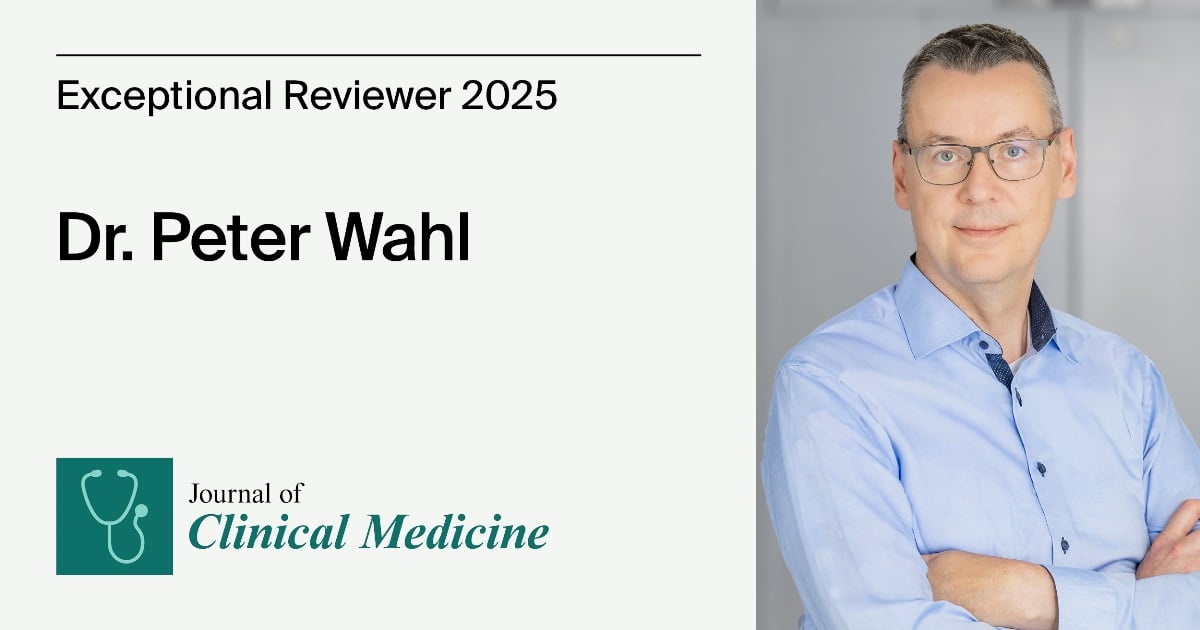
Interview with Dr. Peter Wahl—Journal of Clinical Medicine Exceptional Reviewer 2025
We are pleased to share an interview with Dr. Peter Wahl, who has been recognized as a JCM Exceptional Reviewer in 2025.
1. Could you briefly introduce yourself and tell us about your current research focus?
I am an orthopedic surgeon specialized in hip and pelvic surgery. I have always been passionate about teaching, as it forces one to truly understand and clearly explain fundamental principles, allowing to self-improve along the way. About half of my procedures have been performed in a teaching setting.
Teaching naturally raises questions for which answers are not always readily available, and this curiosity became the starting point of my scientific activity. Two decades later, I now dedicate part of my work time formally to research, focusing on revision hip arthroplasty. My earlier work centered on implant-related infection, while my current research focuses more on mechanical failure mechanisms.
I currently have the privilege of collaborating with an outstanding international group working on orthopedic polyethylene. It is a fascinating field, still full of unexpected findings, and I believe it will continue to generate important insights in the coming years.
2. What key aspects do you prioritize when reviewing a manuscript? How do you evaluate the validity and translational potential of a clinical study?
I usually begin by summarizing the manuscript in five sentences: one each for the introduction, methods, results, discussion, and overall relevance. This helps to assess whether the study is coherent, well structured, and relevant.
I then focus on the methodology, which must be transparent and reproducible. The conclusions drawn by the authors should be in adequacy to the methods. Beyond that, I evaluate key elements of scientific writing: a concise and engaging introduction, a clear and consistent presentation of methods and results, and a discussion that appropriately balances findings, limitations, and relevance. Ultimately, I aim to ensure that the manuscript is both scientifically sound and clearly communicated, allowing readers to understand and interpret the findings reliably.
3. How do you balance encouraging innovation with ensuring methodological rigor and ethical compliance? Could you share an example from your review experience?
A manuscript belongs to its authors. The reviewer’s role is to assess scientific soundness, consistency, and relevance, while respecting the authors’ creativity and perspective. In my experience, the review process is often highly technical. Methodological robustness is essential, as it forms the basis for any meaningful interpretation. At the same time, innovation should be encouraged, provided that ethical and scientific standards are met. If the data and methods are sound, the discussion about relevance and innovation becomes meaningful. If not, there is little foundation on which to build. Striking this balance is at the core of responsible peer review.
4. What advice would you give to early-career clinicians or researchers who are beginning to participate in peer review?
Be curious and benevolent. The goal of peer review is to assess whether a study is scientifically sound and relevant, not to rewrite the manuscript. Focus on methodology, structure, and reproducibility. Ensure that the study is clearly presented and that its conclusions are supported by the data. At the same time, avoid spending excessive effort on stylistic details, which remain the authors’ responsibility. A constructive and respectful approach benefits both authors and the scientific community.
5. Beyond correcting errors, what unique contribution do you think a strong peer review brings to clinical science and patient care?
Peer review provides authors with an independent and hopefully constructive evaluation of their work. If reviewers identify unclear points or inconsistencies, it is likely that readers would encounter similar difficulties. By addressing these issues, authors can improve the clarity and impact of their manuscript. More broadly, peer review serves as a safeguard for scientific quality, helping to ensure that published findings are reliable and appropriately interpreted. As many readers do not examine manuscripts in the same depth as reviewers, this responsibility is essential to prevent the dissemination of misleading conclusions.
6. Based on your review experience, which emerging topics or methodologies do you believe will be particularly influential in the coming years?
AI-based tools are increasingly used to filter the scientific literature, as reaching the necessary depth of understanding is becoming more challenging due to scientific knowledge expanding exponentially and research topics becoming increasingly specialized. However, their reliability is not yet sufficient to replace critical scientific judgment. Science is not driven by the most frequent opinion, but by accurate and verifiable findings. In the coming years, maintaining rigorous critical thinking alongside technological support will be essential.
7. JCM is an open access journal. How do you see open access shaping the dissemination and impact of clinical research?
Open access has profoundly reshaped scientific publishing, and its impact is multifaceted.
First, the transition from print to digital formats has removed many of the traditional constraints on publication volume. This has enabled a much broader and faster dissemination of research, reflecting the growing output of the scientific community.
Second, open access has often been associated with more efficient editorial and review processes. While not inherently linked, the evolution of digital platforms has facilitated faster communication, allowing research findings to become available in a more timely manner.
Third, the introduction of article processing charges has created new challenges. While open access improves accessibility for readers, it may also introduce barriers for authors with limited resources. This highlights the importance of maintaining a balance between accessibility, equity, and scientific quality.
Overall, open access represents a major step forward in knowledge dissemination, but continued attention is needed to ensure that it remains both inclusive and sustainable.
8. How do you manage your time between clinical duties, research, and peer review? What motivates you to continue contributing as a reviewer?
Balancing clinical work, research, and peer review is challenging. I contribute to peer review primarily because I value research and see it as a shared responsibility within the scientific community. Reviewing also provides an opportunity to think critically and remain engaged with methodology and scientific writing. It helps maintain analytical sharpness. In practice, I usually read each manuscript twice: once for an initial understanding, and a second time while writing the review. This process takes several hours per manuscript, particularly considering the time in between reading and writing, to think it through. Time is a limited resource, but I consider this contribution worthwhile. Reviewing just ends up as a task in addition to all my other activities, done in the evening or on days off.
9. How do you view the role of a reviewer in shaping the quality and integrity of published research?
Reviewers play a key role in safeguarding scientific quality. In my experience, many manuscripts benefit from improvements in structure, clarity, and methodological transparency. Simple aspects—such as a focused introduction, clearly described methods, and a well-structured presentation of results—can significantly enhance the impact of a study. At the same time, reviewers should remain constructive and avoid unnecessary delays. A balanced, curious, and benevolent approach is essential.
Many issues identified during peer review relate to basic aspects of scientific writing, such as structure, clarity, and consistency. Some of these elements could potentially be addressed earlier in the editorial process, helping to streamline peer review. This would allow reviewers to focus more on subject-specific evaluation, including innovation and clinical relevance. AI tools may increasingly support this process. However, peer review should continue to rely on human judgment to assess scientific quality and relevance. Maintaining this responsibility is essential for the integrity of scientific publishing.