

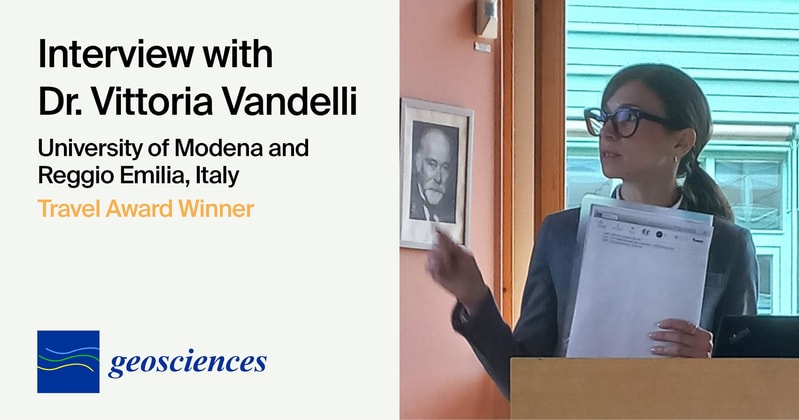
Interview with Dr. Vittoria Vandelli—Winner of the Geosciences Travel Award
We wish to congratulate Dr. Vittoria Vandelli on winning the Geosciences 2026 Travel Award. Dr. Vittoria Vandelli is a postdoctoral fellow at the University of Modena and Reggio Emilia, Italy. Her research is focused on different key topics in geomorphology.
Dr. Vittoria Vandelli is a postdoctoral researcher in geomorphology and lecturer of physical geography at the University of Modena and Reggio Emilia. She obtained her PhD in geomorphology in 2020 and has since developed an interdisciplinary research profile across various branches of geomorphology. Her research focuses on slope instability, coastal and mountain geomorphology, and georisk assessment in areas particularly sensitive to climate change. She has been involved in several international research collaborations and European projects addressing coastal hazards, risk assessment, and environmental change. She is also interested in geoeducation and geoscience outreach, contributing to innovative teaching approaches, including the use of Virtual Reality technologies in geomorphology.
The following is an interview with Dr. Vittoria Vandelli:
1. Can you briefly introduce yourself to our readers and tell us a little bit about your fields of interest?
I am geomorphologist interested in the study of landscape dynamics in various geomorphic environments.
2. What’s your current research and why did you choose this research field?
My current research activities focus on geomorphological hazards in mountainous and coastal areas. Both coastal and mountain environments are increasingly prone to the effects of weather- and climate-related processes, exacerbated by ongoing climate change. In this context, hazard and risk assessment is of crucial importance for guiding policy action and supporting disaster risk reduction strategies.
My research interests also include geoheritage management and promotion through geoeducation and geoscience outreach. I am actively involved in developing tools and methods for geoscience education using innovative and non-formal learning approaches, with the aim of contributing in the challenge to raise awareness of the importance of geoconservation.
3. Which research topics do you think are of particular interest to the research community in the coming years?
In the coming years, the integration of Artificial Intelligence (AI) into geomorphology is likely to become increasingly important. Machine learning and data-driven approaches can enhance geomorphic analysis, process modeling, and hazard prediction. Furthermore, the contribution of the geomorphology community will likely become of growing importance in tackling complex societal challenges. These challenges are particularly related to understanding landscape responses under conditions of increasing sensitivity, determined by intensified anthropogenic pressures and ongoing climate change. Increasing landscape sensitivity adds further complexity into research questions concerning the responses of geomorphic systems to the factors that drive landscape change. Understanding the mechanisms, thresholds, and geomorphological feedback that influence landscape responses is crucial, as these responses affect geosystems services, which are essential to present and future generations. Multidisciplinary and multi-technical approaches, together with close collaboration across different disciplines and sub-disciplines, will be fundamental for understanding, predicting, and managing ongoing and future landscape changes. Nevertheless, fieldwork and geomorphological mapping should not be overlooked.
4. If you have the opportunity, will you actively apply to attend academic conferences? What do you think you can learn from participating in conferences that is different from working in a lab?
I believe that actively participating in academic conferences is fundamental for scientific growth. As highlighted above, I think that interdisciplinary collaboration is essential to address the complex questions that geomorphology and, more generally, geosciences face today. Conferences provide a key platform for scientific exchange as they offer opportunities for direct discussion, constructive feedback, and the development of collaborative networks. Conferences are a vital component of scientific research and professional growth.
In this regard, I am particularly enthusiastic about the fact that the 12th IAG International Conference on Geomorphology will be held in Italy in 2030. I had the opportunity to collaborate in the preparation of the bid, and I sincerely hope to contribute actively and positively to its organization. I see this as an important occasion not only for scientific exchange, but also for further strengthening the international geomorphology community.
5. Why did you apply for this award? Would you like to share the story of your relationship with the journal?
I applied for the Geosciences Travel Award seeking support to participate in the 11th IAG International Conference on Geomorphology, held in Christchurch, New Zealand, from 2 to 6 February 2026. Attending this conference represented an important opportunity to present my research, interact with the international geomorphology community, and strengthen scientific collaborations.
My experience with Geosciences has been very positive. I published a paper in 2024 on the use of Virtual Reality for enhancing the understanding and experience of landforms, geohazards, and geoheritage (Towards Enhanced Understanding and Experience of Landforms, Geohazards, and Geoheritage through Virtual Reality Technologies in Education: Lessons from the GeoVT Project). The publication process was smooth and professionally managed. We received constructive feedback from the reviewers, which significantly improved the quality of the manuscript. Additionally, the editorial team handled the manuscript with thoroughness and efficiency throughout the review and production stages.
6. As the winner of this award, is there something you want to express, or someone you most want to thank?
I would like to sincerely thank Geosciences for supporting my participation in the 11th IAG International Conference on Geomorphology.
The Geosciences Travel Award represents not only personal recognition, but also a motivation to continue contributing actively to the geomorphological community and to collaborative scientific research at an international level.