You are currently viewing a new version of our website. To view the old version click .

Electronic Materials

Electronic Materials is an international, peer-reviewed, open access journal on fundamental science, engineering, and practical applications of electronic materials published quarterly online by MDPI.

All Articles (130)

To address the issues of insufficient responsivity and low imaging contrast of carbon-based HGFET high-sensitivity short-wave infrared (SWIR) detectors under low-light conditions, this paper proposes a high-sensitivity and high-contrast image enhancement algorithm for low-light detection, with FPGA-based hardware verification. The proposed algorithm establishes a multi-stage cooperative enhancement framework targeting key challenges such as low signal-to-noise ratio (SNR), high dark-state noise, and weak target extraction. Unlike traditional direct enhancement methods, the proposed approach first performs defective row-column correction and background noise separation based on dark-state data, which provides a clean foundation for signal reconstruction. Furthermore, an adaptive gamma correction mechanism based on image maximum value is introduced to avoid unnecessary nonlinear transformations in high-contrast regions. During the contrast enhancement stage, an exposure-constrained adaptive histogram equalization strategy is adopted to effectively suppress noise amplification and saturation in low-light scenes. Finally, an innovative dual-mode threshold selection method based on image variance is proposed, which can dynamically integrate the OTSU algorithm with statistical moment analysis to ensure robust background noise separation across both high- and low-contrast scenarios. Experimental results demonstrate that the proposed algorithm significantly improves target contrast in infrared images while preventing detail loss due to overexposure. Under microwatt-level laser power, background noise is effectively suppressed, and both imaging quality and weak target detection capability are substantially enhanced.

2 December 2025

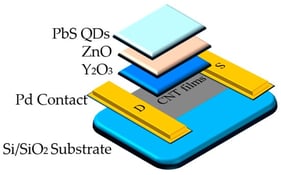
The structural configuration of the HGFET SWIR detector.

In this study, we explore the integration of a cost-effective triboelectric nanogenerator (TENG) with an large silicon PIN detector (diameter: 12 mm) for intelligent wireless recognition applications. Wireless communication eliminates the need for physical connections, enabling greater flexibility and scalability in deployment. It allows for seamless integration of AI systems into a wide range of environments without the constraints of wiring, reducing installation complexity and enhancing mobility. Additionally, we demonstrate the TENG’s functionality as an autonomous communication unit. The TENG is employed to convert various environmentally triggered signals into digital formats and to autonomously power optoelectronic devices, thus eliminating the need for an external power supply. By integrating optoelectronic components within the self-powered sensing system, the TENG can identify specific trigger information and reduce extraneous noise, thereby improving the accuracy of information transmission. Moreover wireless technology facilitates real-time data transmission and processing. This setup not only enhances the overall efficiency and adaptability of the system but also supports continuous operation in diverse and dynamic settings. This paper introduces a novel convolutional neural network-long short-term memory (CNN-LSTM) fusion neural network model. Utilizing the sensing system in combination with the CNN-LSTM neural network enables the collection and identification of variations in the flicker frequency and luminosity of optoelectronic devices. This capability allows for the recognition of environmental trigger signals generated by the TENG. The classification and recognition results of human body trigger signals indicate a recognition accuracy of 92.94%.

2 December 2025

(a) Schematic diagram of trigger signal detection process. (b) Diagram of the trigger signal detection system.

Comparative Study of Voltage Amplification in Cylindrical FE-FE-DE and FE-DE Heterostructures

  • Pratheeksha Suresh,
  • Bhaskar Awadhiya and
  • Vikash Mishra
  • + 3 authors

This work examines a cylindrical FE-DE heterostructure and compares its performance with that of a cylindrical FE-FE-DE heterostructure. It aims to maximize voltage amplification, increase capacitance, and attain a constant negative capacitance. First, the existence of negative capacitance is shown by analyzing isolated cylindrical ferroelectric capacitors. A cylindrical dielectric capacitor and a cylindrical ferroelectric capacitor are integrated in series to stabilize negative capacitance. Our results indicate that the capacitance of the FE-FE-DE stack, consisting of Si:HfO2 and Zr:HfO2, closely aligns with the dielectric capacitance. Consequently, enhanced performance is anticipated in comparison with the FE-DE arrangement. Additionally, the dynamic response of two distinct configurations was analyzed, yielding a comprehensive understanding of these heterostructures’ behavior.

1 December 2025

(a) Illustration of an isolated cylindrical ferroelectric capacitor; (b) charge versus voltage characteristics; (c) energy characteristic for a standalone cylindrical FE capacitor.

Multiferroic composites of xNi0.8Zn0.2Fe2O4/(1 − x)BaTiO3 (x = 0, 0.1, 0.3, 0.5, labeled NZFO/BTO) with ~100 nm particle size were synthesized via high-energy ball milling and thermal annealing. The X-ray diffraction shows a co-existence of the ferromagnetic phase of NZFO and the ferroelectric phase of BTO. Our observations indicate that saturation, remanence, and coercivity progressively increase with increasing NFO content, specifically from x = 0 to x = 0.5. At x = 0.1, the maximum electric polarization, remanent electric polarization, coercivity and electric power loss density reach their maximum values of ~0.057 µC/cm2, 0.018 µC/cm2, 3.25 kV/cm and 0.222 mJ/cm3, respectively, for an applied electric field less than 10 kV/cm. These multiferroic composites demonstrate excellent electromagnetic wave absorption capabilities from 2 to 18 GHz. With BTNF1 (x = 0.1) sample thickness of 2.5–3.5 mm, a minimum reflection loss of −41.51, −37, −28.72 dB corresponds to frequencies of 12.52 GHz, 11 GHz and 9.32 GHz. The effective absorption bandwidth for this sample is 11.5–16 GHz, indicating optimal impedance and attenuation matching and effective absorption of electromagnetic waves throughout the Ku bands. These outcomes reveal the capability for wideband absorption uses in radar invisibility technology and electromagnetic insulation.

24 November 2025

(a) XRD patterns and (b) Raman spectra of the powdered composites of xNZFO/(1 − x)BTO samples.

News & Conferences

Issues

Open for Submission

Editor's Choice

Get Alerted

Add your email address to receive forthcoming issues of this journal.

XFacebookLinkedIn
Electron. Mater. - ISSN 2673-3978