Skip Content
You are currently on the new version of our website. Access the old version .

Electronic Materials

Electronic Materials is an international, peer-reviewed, open access journal on fundamental science, engineering, and practical applications of electronic materials published quarterly online by MDPI.

All Articles (133)

We present a fresh perspective on the mixed halogen-ion effect (MHE) in lead silicate glasses containing a mixture of halogen ions with a correlative study of optical spectroscopy and halogen ion transport. PbO was partially substituted by either PbCl2 or PbF2 in the ternary glass system: (65 − x) − x(PbF2 or PbCl2)-35SiO2 (where 0 ≤ x ≤ 20 mol%) and by a mixture of PbF2 and PbCl2 in the quaternary glass series: 45PbO − xPbF2 − (20 − x)PbCl2–35SiO2 (where 0 ≤ x ≤ 20 mol%). A suite of improved characterization techniques, including 4-probe van der Pauw resistivity measurements, optical absorption spectroscopy, differential thermal analysis, etc., was employed to correlate composition with physical properties. Replacing PbO with small quantities of PbF2 or PbCl2 in binary 65PbO-35SiO2 glass resulted in a dramatic increase in conductivity by 3–4 orders of magnitude, confirming a shift from Pb2+-mediated to halide ion-mediated conduction and, within the mixed-halogen series, a profound MHE was observed. Contrary to previously reported data, the activation energy for conduction and the resistivity both exhibited maxima at the mixed halogen-ion ratio, MHR = (F/(F + Cl), of 0.5. The glass transition temperature (Tg) exhibited a non-monotonic trend, peaking at 506 °C for the MHR = 0.5 composition. Optical absorption measurements have revealed that the MHR = 0.5 glass has the broadest absorption edge and also exhibits certain features in the near IR region of the Urbach tail, which are suggestive of maximum electronic disorder.

5 February 2026
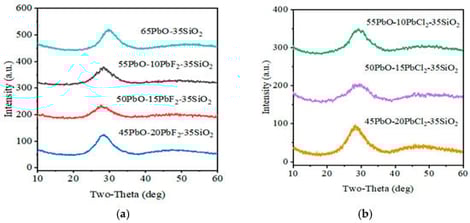
(a,b) XRD patterns of glasses (65−x)PbO-xPbF2-35SiO2 and (65−x)PbO-xPbCl2-35SiO2 showing their amorphous nature.

The increasing demand for next-generation rechargeable batteries that offer high energy density, a long lifespan, high safety, and low cost has led to a need for better electrode materials for lithium-ion batteries. This also involves developing alternative storage systems using common resources such as sodium-ion batteries, beryllium-ion batteries, or magnesium-ion batteries. Tin carbide (SnC) is highly promising as an anode material for lithium, sodium, beryllium, and magnesium ion batteries due to its ability to form nanoclusters like Sn(Li2)C, Sn(Na2)C, Sn(Be2)C, and Sn(Mg2)C. A detailed study was done using computational methods, including analysis of charge density differences, total density of states, and electron localization function for these hybrid clusters. This research suggests that SnC could be useful in multivalent-ion batteries using Be2+ ions because its properties can match or even exceed those of monovalent ions. The study also shows that the maximum capacity, stability energy, and ion movement in these materials can be understood by looking at atomic-level properties like the coordination between host atoms and ions. Recent findings on using tin carbide in these types of batteries and methods to improve their performance have been discussed.

1 January 2026

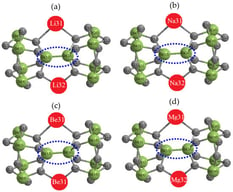
Adding Li, Na, Be and Mg to SnC nanoclusters leads to the formation of four different complexes: (a) Sn(Li2)C, (b) Sn(Na2)C, (c) Sn(Be2)C and (d) Sn(Mg2)C. These complexes show promise for energy storage in innovative batteries. The atoms of Sn(13) and Sn(28) in the blue frame are the most efficient electron donors in Sn(Li2)C, Sn(Na2)C, Sn(Be2)C, or Sn(Mg2)C complexes (Table 1).

Recent studies show that titanium (Ti)-based alloys combine established mechanical strength, corrosion resistance, and biocompatibility with emerging electrical and electrochemical properties relevant to bioelectronics. The main goal of the present manuscript is to give a wide-ranging overview on the use of Ti-alloys in electronics and biomedicine, focusing on a comprehensive analysis and synthesis of the existing literature to identify gaps and future directions. Concurrently, the identification of possible correlations between the effects of the manufacturing process, alloying elements, and other degrees of freedom influencing the material characteristics are put in evidence, aiming to establish a global view on efficient interdisciplinary efforts to realize high-added-value smart devices useful in the field of biomedicine, such as, for example, implantable apparatuses. This review mostly summarizes advances in surface modification approaches—including anodization, conductive coatings, and nanostructuring that improve conductivity while maintaining biological compatibility. Trends in applications demonstrate how these alloys support smart implants, biosensors, and neural interfaces by enabling reliable signal transmission and long-term integration with tissue. Key challenges remain in balancing electrical performance with biological response and in scaling laboratory modifications for clinical use. Perspectives for future work include optimizing alloy composition, refining surface treatments, and developing multifunctional designs that integrate mechanical, biological, and electronic requirements. Together, these directions highlight the potential of titanium alloys to serve as foundational materials for next-generation bioelectronic medical technologies.

1 January 2026

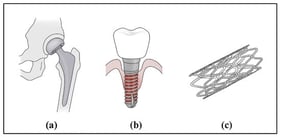
Representative biomedical applications of titanium alloys. (a) Hip implant. (b) Dental screw. (c) Stent.

To address the issues of insufficient responsivity and low imaging contrast of carbon-based HGFET high-sensitivity short-wave infrared (SWIR) detectors under low-light conditions, this paper proposes a high-sensitivity and high-contrast image enhancement algorithm for low-light detection, with FPGA-based hardware verification. The proposed algorithm establishes a multi-stage cooperative enhancement framework targeting key challenges such as low signal-to-noise ratio (SNR), high dark-state noise, and weak target extraction. Unlike traditional direct enhancement methods, the proposed approach first performs defective row-column correction and background noise separation based on dark-state data, which provides a clean foundation for signal reconstruction. Furthermore, an adaptive gamma correction mechanism based on image maximum value is introduced to avoid unnecessary nonlinear transformations in high-contrast regions. During the contrast enhancement stage, an exposure-constrained adaptive histogram equalization strategy is adopted to effectively suppress noise amplification and saturation in low-light scenes. Finally, an innovative dual-mode threshold selection method based on image variance is proposed, which can dynamically integrate the OTSU algorithm with statistical moment analysis to ensure robust background noise separation across both high- and low-contrast scenarios. Experimental results demonstrate that the proposed algorithm significantly improves target contrast in infrared images while preventing detail loss due to overexposure. Under microwatt-level laser power, background noise is effectively suppressed, and both imaging quality and weak target detection capability are substantially enhanced.

2 December 2025

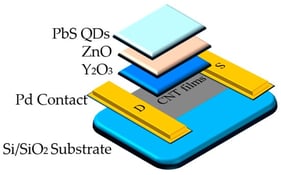
The structural configuration of the HGFET SWIR detector.

News & Conferences

Issues

Open for Submission

Editor's Choice

Get Alerted

Add your email address to receive forthcoming issues of this journal.

XFacebookLinkedIn
Electron. Mater. - ISSN 2673-3978