Skip to Content

Entropic and Disordered Matter

Entropic and Disordered Matter is an international, peer-reviewed, open access journal on materials with chaotic structures and compositions, which is published quarterly online by MDPI.
  • Open Access— free for readers, with article processing charges (APC) paid by authors or their institutions.
  • Rapid Publication: first decisions in 18 days; acceptance to publication in 7 days (median values for MDPI journals in the first half of 2026).
  • Recognition of Reviewers: Reviewers whose reports are timely and of high quality receive an APC discount voucher for a future publication in an MDPI journal. Become a reviewer.

Get Alerted

Add your email address to receive forthcoming issues of this journal.

All Articles (5)

  • Article
  • Open Access

This paper proposes an entropy–topological method for the analysis of multicomponent complex systems that accounts for the relative incompatibility of system parameters, in particular physical, chemical, and other mechanisms, with configurational, thermodynamic, and other system properties. The relevance of the study is determined by the insufficient formalization of existing approaches to the description of multicomponent complex systems and the need for a universal quantitative criterion characterizing their structural and functional organization. The scientific novelty of the proposed approach lies in the decomposition of the total entropy into a spectrum of interrelated constituents and in representing the system as a multilayer network structure augmented by its thermodynamic parameters. This representation makes it possible to investigate a wide range of mutually incommensurable properties of a complex system, including its structure, information content, functionality, physicochemical features, surface phenomena (including interfaces with a supersystem), the capacity for thermodynamic imbalance, and kinetic behavior, depending on the intrinsic nature of the system under consideration. The practical applicability of the method is demonstrated through an analysis of the functional properties of geopolymer materials produced from metallurgical waste, for which an aggregated quality index is introduced that links entropy-based parameters with operational performance characteristics. The obtained results extend the capabilities of thermodynamic and information-theoretic modeling of certain classes of complex systems.

Entropic Disord. Matter

1 September 2026
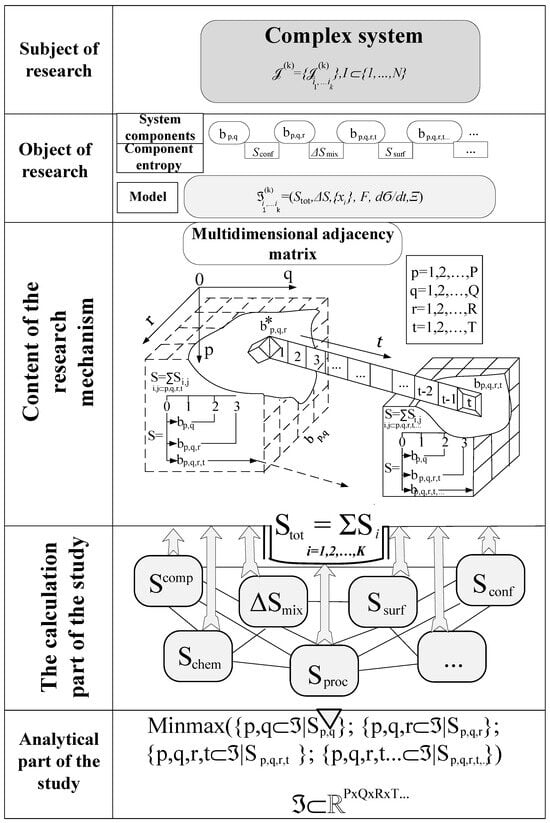
Model of a multicomponent complex system based on an entropy-structured multidimensional adjacency matrix.
  • Review
  • Open Access

Aluminum- and zirconium-based amorphous alloys occupy complementary positions in metallic glass research. This review compares these two alloy families within a common framework that links thermodynamic and kinetic glass-forming criteria, crystallization pathways, deformation mechanisms, and processing routes. Zr-based alloys generally combine lower critical cooling rates, wide supercooled liquid regions, and bulk castability, whereas Al-rich alloys offer low density and high specific strength but remain marginal glass formers that are commonly produced as ribbons or powders. The supercooled liquid region, ΔTx = Tx − Tg, is treated here as a kinetic processing window rather than a direct measure of ductility. Room-temperature plastic flow is discussed in terms of shear-transformation zones and shear-band initiation, propagation, multiplication, and arrest. Crystalline second phases may improve plasticity by redistributing stress and promoting the formation of multiple shear bands, but the outcome depends on their phase fraction, size, spacing, morphology, and loading mode. Recent original studies demonstrate the fabrication of dense, fully amorphous Zr-based components by laser powder bed fusion, as well as bulk Al-based glasses produced by copper mold casting or powder consolidation. The comparative analysis provides practical design guidance: combine a negative enthalpy of mixing and atomic-size mismatch with a low liquidus temperature; suppress oxygen contamination and heterogeneous nucleation; and select processing routes according to the attainable cooling rate and the stability of the supercooled liquid.

  • Review
  • Open Access

Machine learning is increasingly used to relate molecular descriptors, formulation variables, and biophysical measurements to aggregation, viscosity, solubility, and shelf-life outcomes. The evidence is promising but uneven. Most published datasets contain tens to a few hundred antibodies, use different assays and endpoint definitions, and rely mainly on internal validation. Direct evidence for bispecific antibodies, antibody–drug conjugates, mRNA–lipid nanoparticles, and viral vectors remains limited. This structured critical review evaluates what current models can support, how data and validation choices shape reported performance, and where claims exceed the available evidence. We searched PubMed through 30 June 2026 using predefined queries for machine learning, biopharmaceutical formulation, colloidal stability, advanced modalities, and shelf-life modelling. Studies were assessed by molecular diversity, formulation coverage, endpoint quality, split strategy, external validation, and decision relevance. The strongest current use cases are early antibody developability screening, high-concentration viscosity classification, formulation ranking within a defined experimental domain, and image-based particle classification. Long-term shelf-life prediction may benefit from hybrid kinetic and machine learning models, but real-time confirmation remains necessary. Progress will depend less on larger algorithms than on better labels, molecule-level validation, shared reference datasets, and clear uncertainty reporting.

  • Article
  • Open Access

We propose a three-dimensional (3D) integrated optical switch that leverages liquid crystal (LC) birefringence to achieve reconfigurable light routing for particular suitability for quantum optical communication. In our design, the large refractive index contrast between an LC’s ordinary (no) and extraordinary (ne) indices is exploited by using no as an effective cladding and ne as the core of voltage-controlled waveguides. This allows dynamic waveguide formation not only in-plane (horizontal routing on chip) but also vertically through stacked polymer layers, realizing a 3D switching architecture beyond traditional planar photonic circuits. A prototype multi-layer structure on a silicon substrate is described, incorporating alternating polymer cladding and core films with embedded LC cells that act as switchable waveguide segments. Simulations confirm that the LC switch can confine and direct light between different layers with low loss, enabling compact 3 × 3 and potentially up to 10 × 10 port-count switching matrices. The device is electrically driven (no moving parts) and can be operated at low voltages, ensuring compatibility with photonic integrated circuit fabrication. The simulated LC response time on ON/OFF is on the order of 1.1 ms/45 ms, which is slower than MEMS or electro-optic switches, but, however, sufficient for quantum key distribution and other quantum network applications where ultrafast switching is not required. Overall, this LC cell-based 3D optical switch offers a promising route toward scalable, low-loss photonic switching nodes for next-generation quantum communication networks.

Highly Accessed Articles

News & Conferences

Latest Issues

Open for Submission

Journal Sections

XFacebookLinkedIn
Entropic Disord. Matter - ISSN 3042-7592