Skip Content
You are currently on the new version of our website. Access the old version .

All Articles (263)

Environmental changes and anthropogenic pressures significantly influence both the tree layer and natural regeneration within forest ecosystems. Protected areas represent essential territories for the maintenance and conservation of species within forest communities. In this context, the present study aims to develop a methodological framework for the integrated application of diversity, evenness, and dominance indices in the study of forest plant communities. Analyses were conducted at both α- and β-diversity levels, providing a methodological basis for characterizing local diversity and community differentiation. Species diversity was estimated using the Shannon–Wiener (H′) and Simpson (D) indices, while evenness and dominance were assessed using the Pielou (J′) and Berger–Parker (d) indices. Differences among communities were quantified using the Bray–Curtis dissimilarity index and its components, turnover and nestedness, and structural convergence of forest communities was analyzed through the ICF. The results indicate that α-diversity, estimated by H′, ranges from low to moderate, suggesting a relatively uniform distribution of species abundance. In certain microhabitats, processes of diversification and oligodominance are observed. At the β-diversity level, the analyzed communities are characterized by high dissimilarity, mainly driven by species turnover and, to a lesser extent, by nestedness associated with species loss. The ICF highlights that these forest communities exhibit relatively high structural uniformity, characteristic of mature stands in ecological equilibrium.

5 February 2026
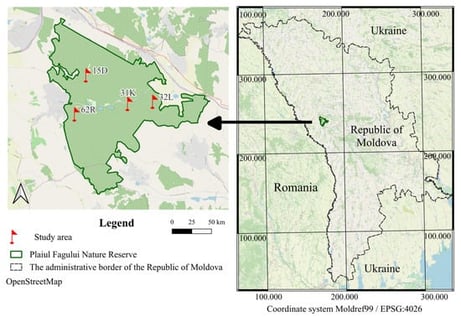
Location map of experimental plots within the Plaiul Fagului Nature Reserve.

Divergent Functional Responses of Reptiles and Amphibians in a Mediterranean Mountain System

  • Vassilis Kypraios-Skrekas,
  • Alexis Lazaris and
  • Sinos Giokas
  • + 2 authors

Understanding how environmental conditions shape the functional composition of ecological communities is a central goal in community ecology. In this study, we apply this framework to the reptile and amphibian assemblages within Greece’s Mount Chelmos protected area. Based on comprehensive field surveys (2018–2021) across 168 sampling stations, we compiled species trait databases and quantified functional diversity using a corrected Rao’s Q index. We modeled the response of functional diversity to climate, land cover, topography (altitude, slope, aspect), geographic location, and taxonomic diversity, using Generalized Additive Models (GAMs). Additionally, we examined traitspace structure via PCA and evaluated environmental drivers of trait composition with multivariate GAMs. For reptiles, functional diversity was significantly affected by altitude, climate, and aspect, with higher values predicted in water-associated marginal zones surrounding the mountain massif. Traitspace analysis revealed clear ecological structuring along axes related to locomotion, body size, reproductive mode, foraging strategy, and substrate use, shaped by distinct combinations of environmental filters. In amphibians, environmental effects on functional diversity were not statistically significant; however, traitspace showed discernible responses to land cover, climate, and aspect, suggesting weaker—though detectable—filtering processes. Collectively, our findings indicate that Mount Chelmos functions as a system that modulates diversity, with environmental filters operating at fine-to-medium spatial scales to shape the functional composition and diversity of its herpetofauna.

4 February 2026

The study area. Topographic map of Mount Chelmos within the Chelmos-Vouraikos National Park, showing the 568 km2 study boundary and the distribution of the 168 sampling stations across altitude. Inset map situating the study area within Greece (red polygon). Basemap provided by Esri [26].

Water Deficit Modulates Morphophysiological and Enzymatic Changes in Paubrasilia echinata Seedlings

  • Thayná Kelly Formiga de Medeiros,
  • Gleyse Lopes Fernandes de Souza and
  • Riselane de Lucena Alcântara Bruno
  • + 12 authors

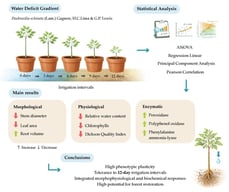
Water scarcity, intensified by climate change, limits the growth and survival of threatened tree species, such as Paubrasilia echinata (Lam.) Gagnon, H.C.Lima & G.P.Lewis. This study analyzed the effects of water availability in the soil on the morphophysiology and enzymatic activity of P. echinata seedlings under different irrigation intervals. The experiment consisted of five treatments (irrigation intervals: 0, 3, 6, 9, and 12 days) distributed in four randomized blocks, totaling 20 plots of five plants each. Variables analyzed included stem diameter, number of leaves and leaflets, leaf area, shoot and root length, root volume, dry matter mass, Dickson quality index, relative water content, leaf indices of chlorophyll, peroxidase, polyphenol oxidase, and phenylalanine ammonia-lyase. Water deficit reduced root dry matter mass by up to 27.78% and chlorophyll b by up to 29.56%, and increased peroxidase by up to 244.44%. Principal component analysis revealed correlated changes among biomass, chlorophyll, and Dickson index, with root volume and enzymatic activities varying oppositely, indicating an integrated regulatory response. P. echinata exhibits phenotypic plasticity under water deficit, reflected in stem diameter, root volume, leaf area, physiological traits, and enzymatic regulation, tolerating an irrigation interval of 12 days. P. echinata has establishment potential in areas subjected to water deficit.

3 February 2026

Mean daily values of air temperature and relative humidity recorded during the experimental period.

Several honeybee species can coexist within a given geographical region; however, their interactions and the extent to which their foraging niches overlap remain poorly understood. To address this gap, we assessed niche overlap among four honeybee species (Apis cerana, Apis dorsata, Apis florea and Apis mellifera) in West Bengal, India, using palynological analysis of corbicular pollen loads. The homogeneous composition of individual corbicular loads indicated flower constancy in all species. A wide range of pollen types was recorded for each species, confirming their polylectic foraging behaviour. Although the level of pollen diversity in their diet did not differ among species, it did vary seasonally. Vital pollen sources (including Acacia auriculiformis, Borassus flabellifer, Brassica juncea, Bridellia retusa, Cocos nucifera, Coriandrum sativum, Eucalyptus tereticornis, Lannea coromandelica and Sesamum indicum) were shared by all four species, and their pollen-foraging niches showed significant overlap in every season. Considering the floral traits of the plants visited, all honeybee species behaved as generalist flower visitors. This study quantifies foraging niche overlap among honeybee species and identifies common floral resources shared by the exotic Apis mellifera and native honeybees. Such insights will assist in honeybee management, biodiversity conservation, and the enhancement of ecosystem services and stability.

2 February 2026

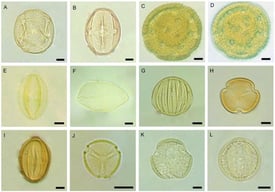
Microphotographs of some pollen types obtained from pollen loads of honeybees in West Bengal, India. (A,B) Azadirachta indica, (C,D) Boerhavia diffusa, (E) Coccinia grandis, (F) Cocos nucifera, (G) Hygrophila auriculata, (H,I) Leucaena leucocephala, (J) Neolamarckia cadamba, (K,L) Nigella sativa. Scale = 10 µm.

News & Conferences

Issues

Open for Submission

Editor's Choice

Get Alerted

Add your email address to receive forthcoming issues of this journal.

XFacebookLinkedIn
Ecologies - ISSN 2673-4133