
Skip to Content
You are currently on the new version of our website. Access the old version .
  • 1.0
    Impact Factor
  • 29 days
    Submission to First Decision
  • 7 days
    Acceptance to Publication

Craniomaxillofacial Trauma & Reconstruction

Craniomaxillofacial Trauma & Reconstruction (CMTR) is an international, peer-reviewed, open access journal that covers all types of research in surgery of the head, face and jaw, published quarterly online and a member of the Committee on Publication Ethics (COPE). It is the official journal of the AO Craniomaxillofacial Surgery (AO CMF). Foundation members receive discounts on the article processing charges. 
  • Open Access— free for readers, with article processing charges (APC) paid by authors or their institutions.
  • High Visibility: indexed within ESCI (Web of Science), PubMed, PMC, Embase, and other databases.
  • Rapid Publication: manuscripts are peer-reviewed and a first decision is provided to authors approximately 28.6 days after submission; acceptance to publication is undertaken in 6.5 days (median values for papers published in this journal in the first half of 2026).
  • Recognition of Reviewers: Reviewers whose reports are timely and of high quality receive an APC discount voucher for a future publication in an MDPI journal. Become a reviewer.

Get Alerted

Add your email address to receive forthcoming issues of this journal.

All Articles (895)

  • Systematic Review
  • Open Access

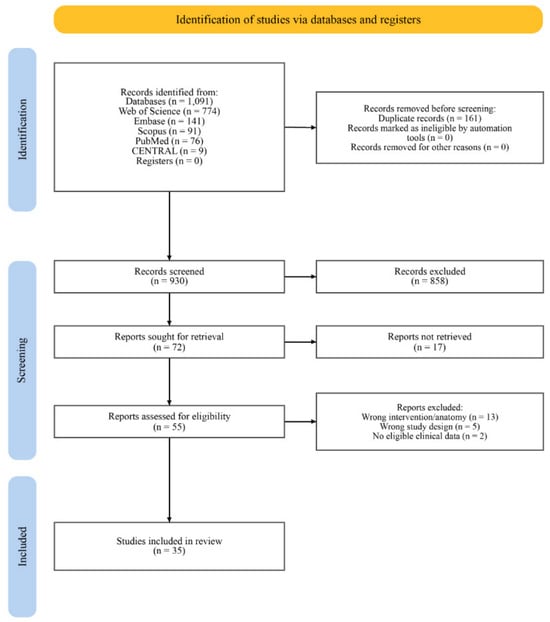
Background: The Converse scalping forehead flap has been used for eight decades in nasal and craniofacial reconstruction, yet its use and evolution have not been systematically synthesized. Methods: A systematic review was performed according to PRISMA 2020. PubMed, Embase, Scopus, Web of Science, and CENTRAL were searched for studies describing craniofacial reconstruction using a Converse scalping flap or direct modification. Results: Thirty-five studies describing 188 cases from 1959 to 2023 were included. The nose was the primary reconstructive site in 128 cases (68%). Other sites included the midface in 8 cases (4.3%), periorbital and other facial regions in 22 cases (12%), and cranium or cranial base in 30 cases (16%). Seven cases reported successful Converse flap use in previously compromised donor territory. Technical variations were reported in 26 cases (14%), including tissue expansion, split flap and single stage designs, prefabrication, and Raulo modification. Flap survival data was reported in 99 cases, of which 98 survived. Conclusions: The Converse scalping flap demonstrated reliability across diverse craniofacial applications, including salvage. Although its role has narrowed with modern forehead and free flap techniques, its evolution highlights enduring principles of regional tissue transfer, multilayer reconstruction, and adaptation to complex donor site and defect constraints.

PRISMA 2020 flow diagram [14].
  • Article
  • Open Access

Background: Epidemiological data on maxillofacial fractures in Chile are scarce and heterogeneous, and no prior study has applied the AO CMF Level 2 classification. Methods: This is a retrospective study of patients with maxillofacial fractures treated at a public referral hospital in Santiago, Chile (2020–2024). All fractures were confirmed on computed tomography and classified using AO CMF Level 2. Isolated nasal fractures managed exclusively by otolaryngology were excluded. Predictors of surgical treatment and of multifocal fractures were assessed by binary logistic regression. Results: A total of 479 patients sustained 1359 fracture sites (mean 2.84; 66.4% with ≥2 fracture sites). Males predominated (75.8%) and were younger than females (36 vs. 63 years; p < 0.001). Interpersonal violence was the leading etiology (44.1%), followed by falls (29.9%) and road traffic accidents (17.7%). Midface, skull base and cranial vault fractures comprised 85.0%, the intermediate central midface being most affected (17.4%). The surgical rate was 33.4%. Multifocal fractures (OR 3.28; 95% CI 2.03–5.28) and a non-linear age effect (peak 27–30 years; p < 0.001) were independently associated with surgical treatment; male sex was associated with multifocal fractures (OR 1.95; 95% CI 1.19–3.17), although this model explained little of the variance in fracture multiplicity. Conclusions: This first Chilean application of AO CMF Level 2 describes interpersonal violence predominance and an age–sex interaction in this cohort and provides a standardized single-center reference dataset for multicenter comparison.

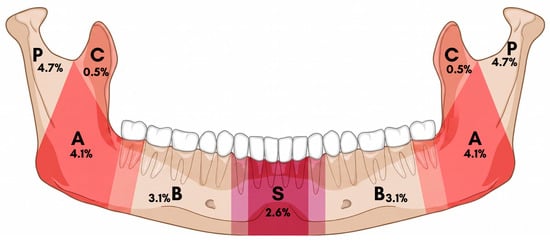
Mandibular fracture prevalence by the AO CMF Level 2 region (code 91). Values denote the proportion of all 1359 fractures involving each region. P, condylar process (4.7%); C, coronoid process (0.5%); A, angle/ramus (4.1%); B, body (3.1%); S, symphysis/parasymphysis (2.6%). Mandibular fractures represented 15.0% of all fractures. Anatomical diagram adapted from Cornelius et al. [16], © 2014 Thieme Medical Publishers. The region codes of the original illustration have been replaced, in the same positions, by the corresponding regional fracture prevalence values from the present study. Permission for reuse has been requested from the copyright holder.
  • Article
  • Open Access

Is Generative Artificial Intelligence (AI) Capable of Proposing Adequate Treatment Plans for Dentofacial Deformities?

  • Omar Alejandro Peña-Ruiz,
  • José Salvador Sifuentes-Cervantes and
  • José Rubén Herrera-Atoche
  • + 4 authors

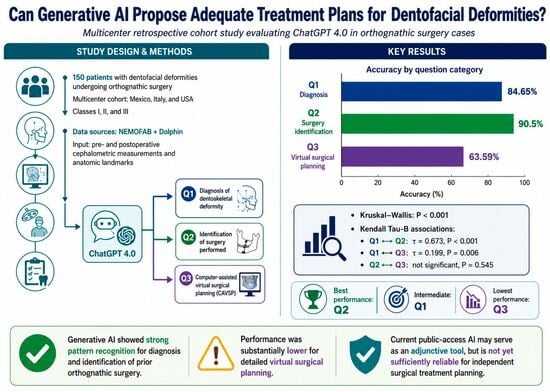
Background: The use of artificial intelligence remains limited in the field of Craniomaxillofacial Surgery. The purpose of this article is to determine whether public-access AI has the potential to accurately diagnose and propose treatment plans in patients with dentoskeletal deformities undergoing orthognathic surgery. Methods: This was a multicenter retrospective cohort study consisting of patients (n = 150) with a dentoskeletal deformity, divided into classes I, II, and III. NemoFab and Dolphin were used for data collection, and three queries were posed to ChatGPT (model version 4.0): Question 1 (Q1) was for diagnosis; Question 2 (Q2) was for surgery-type identification; and Question 3 (Q3) was for computer-assisted surgical planning. A Kruskal–Wallis test was used to analyze the statistical differences between queries and Kendall’s Tau-B test was used to identify associations. A p-value < 0.05 (95%CI) was considered statistically significant. Results: Q1 had an accuracy of 84.65%, Q2 was 90.5%, and Q3 was 63.59% accurate. The Kruskal–Wallis test was statistically significant (p < 0.0001). Kendall’s Tau-B showed statistically significant associations between Q1 and Q2 (p < 0.0001) and between Q1 and Q3 (p < 0.006), but not between Q2 and Q3 (p = 0.545). Conclusions: Public-access AI currently has the ability to recognize diagnostic patterns and identify previously performed surgical procedures; however, it remains insufficiently reliable for virtual surgical planning.

Prompts given to Chat GPT (4.0).
  • Article
  • Open Access

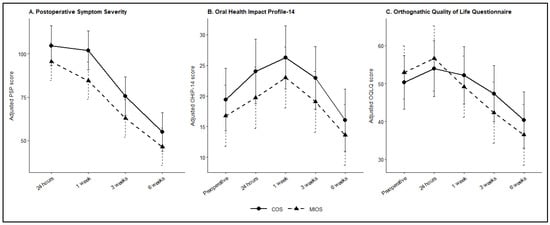
Minimally invasive orthognathic surgery (MIOS) aims to reduce surgical morbidity and improve postoperative recovery; however, its effect on patient-reported recovery and quality of life compared with conventional orthognathic surgery (COS) remains unclear. This prospective longitudinal cohort study included patients with dentofacial deformities undergoing bimaxillary orthognathic surgery between June 2025 and June 2026. Patient-reported outcomes were assessed using the Short-Term Expectations (STE), Postsurgical Perceptions (PSP), Orthognathic Quality of Life Questionnaire (OQLQ), and Oral Health Impact Profile-14 (OHIP-14). Longitudinal outcomes were evaluated using linear mixed-effects models. Forty-one patients were included (20 COS and 21 MIOS), with no losses to follow-up. PSP, OHIP-14, and OQLQ scores changed significantly over time (all p < 0.001), without significant differences in recovery trajectories between groups. The largest observed PSP difference occurred at 1 week (COS, 102.5 ± 30.1; MIOS, 84.5 ± 26.2; p = 0.082). Higher baseline STE scores were independently associated with higher postoperative PSP scores (β = 7.40; SE = 2.87; p = 0.014). Although differences between-group were not statistically significant, postoperative symptom scores were lower in the MIOS cohort throughout follow-up, with the greatest difference observed during early recovery. Larger studies are needed to determine whether these observed differences represent clinically meaningful patient-reported benefits of MIOS.

Patient-reported outcomes over time according to surgical approach: (A) PSP, (B) OHIP-14, and (C) OQLQ.

Highly Accessed Articles

News & Conferences

Latest Issues

Open for Submission

Journal Sections

XFacebookLinkedIn
Craniomaxillofac. Trauma Reconstr. - ISSN 1943-3883