Skip Content
You are currently on the new version of our website. Access the old version .

Current Issues in Molecular Biology

Current Issues in Molecular Biology is an international, scientific, peer-reviewed, open access journal on molecular biology, published monthly online by MDPI (from Volume 43, Issue 1 - 2021).

All Articles (3,756)

The importance of protein-based materials in agricultural pest control has received increasing attention in recent years. Herein, Plutella xylostella brush-border membrane vesicles (BBMVs) were used as a target to screen for human domain antibodies with insecticidal activity. Three rounds of panning of the phage display library yielded the domain antibody C4D, which competed with the Cry1Ac toxin to bind to P. xylostella BBMVs. Against P. xylostella larvae, the recombinant soluble C4D protein showed an LC50 of 1.57 μg/cm2 (95% fiducial limits: 0.83–2.54). Using pull-down assays and liquid chromatography–tandem mass spectrometry, we identified the C4D binding partner in P. xylostella midgut BBMVs to be a cadherin-like protein. Bio-Layer Interferometry assay revealed that the dissociation constant between soluble C4D and P. xylostella cadherin-like protein was 2.99 × 10⁻⁶ M. Thus, the present study explored strategies to generate insecticidal antibodies, and the human domain antibody C4D identified and characterized in this study can serve as a framework for generating novel insecticidal agents.

8 February 2026
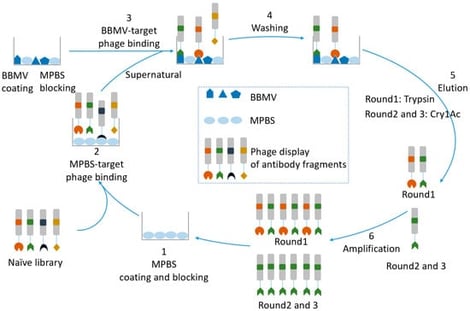
Schematic of the panning process for selecting BBMVs-targeted human domain antibodies. The procedure consisted of the following key steps: (1–2) Pre-clearance by removing phages binding to 5% (w/v) MPBS; (3–4) Washing to remove non-specifically bound phages; (5) Elution of phages specifically bound to BBMVs; (6) Amplification of the eluted phage pool for subsequent rounds of selection or analysis.

Refractory infections caused by multidrug-resistant bacteria have emerged as a substantial threat to public health, prompting renewed interest in phage therapy. Bacteria and phages are ubiquitous in diverse environments, engaging in continuous interaction and co-evolution. In response to phage infection, bacteria have developed an array of defense mechanisms. Current studies on bacteria–phage interactions predominantly focus on laboratory settings using artificial media, whereas the final goal of phage therapy—to combat antibiotic-resistant bacteria—lies in its clinical application. This review describes bacterial defense strategies against phage infection in the context of laboratory-based artificial media, animal experiments and clinical cases, aiming to deepen the understanding of bacteria–phage interactions and promote the advancement of effective phage therapy for clinical applications.

8 February 2026

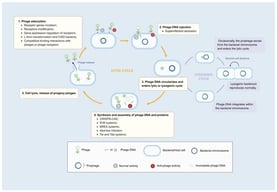
Phage life cycle and bacterial anti-phage defense strategies at each stage. Lytic phages, commonly employed in bacterial infection control, predominantly follow the lytic cycle (left circle). In contrast, temperate phages typically integrate their genetic material into the host genome upon infection, a process termed the lysogenic cycle (right circle). The documented anti-phage defense strategies primarily operate during the lytic cycle (defense systems that function at specific stages are listed in the box). Created in BioRender. Shao, Y. (2026) https://BioRender.com/8401770 (accessed on 4 February 2026).

Oxidative and nitrosative stress are key contributors to the development and progression of chronic inflammatory disorders, cancer and neurodegenerative diseases (viz., Alzheimer’s disease). Cholinergic dysfunction is a major hallmark of Alzheimer’s disease and is closely associated with these processes. Red seaweeds are rich in bioactive compounds that have been increasingly investigated for their potential to modulate these processes. This review aims to examine the role of major red seaweed-derived metabolites in regulating redox imbalance, immunomodulatory capacity and acetylcholinesterase activity, with emphasis on in vitro studies. An analysis of peer-reviewed literature was conducted, focusing on chemical, biochemical and cell-based assays. Studies assessed antioxidant activity, anti-inflammatory and immunostimulatory effects, and acetylcholinesterase inhibition of isolated compounds/fractions of red seaweed using established methods, including radical scavenging assays, Griess-based nitrite assay and enzyme inhibition assays. Sulfated polysaccharides, oligosaccharides, mycosporine-like amino acids (MAAs), phycoerythrin, bromophenols, phlorotannin and terpenoid-derived metabolites demonstrated antioxidant capacity through radical scavenging, metal chelation and modulation of endogenous antioxidants. They also modulated inflammatory mediators, including nitric oxide and pro-inflammatory cytokines, and inhibited acetylcholinesterase (AChE) activity. In vitro evidence supports red seaweed-derived compounds as promising modulators of redox homeostasis, inflammation and cholinergic function, highlighting their relevance as functional food ingredients, while underscoring the need for in vivo and clinical validation.

7 February 2026

Impact of red seaweed-derived MAAs on redox balance and disease risk. The scheme provides a simplified representation of the complex processes and mediators involved. Environmental stressors include α-particles emitted during radon (Rn) decay and Escherichia coli. Mitochondria, through electron transport chain (ETC), generate reactive oxygen species (ROS) as they reduce O2 to H2O while producing energy in the form of ATP [21,22]. Although mitochondria are a major source, ROS are also produced in peroxisomes and by cytoplasmatic enzymes like NOX. Environmental stressors further exacerbate ROS formation. Key ROS include the superoxide radical (O2•−), hydrogen peroxide (H2O2) and the hydroxyl radical (•OH). The latter is formed through the Haber–Weiss reaction (interaction of O2•− with H2O2) and the Fenton reaction mediated by heavy metals such as Fe2+ [23,24]. When endogenous enzymatic (e.g., superoxide dismutase (SOD), catalase (CAT), glutathione peroxidases (GPXs)) and non-enzymatic antioxidants (e.g., glutathione (GSH)) are supported with the neutralizing capacity of dietary antioxidants like MAAs, the capability of the organism to prevent oxidative stress increases [21,25,26]. As ROS and environmental stressors activate macrophages though the nuclear factor kappa B (NF-κB) signaling pathway, inflammation occurs [27]. NF-κB upregulates inducible nitric oxide synthase (iNOS), catalyzing the conversion of L-arginine into L-citrulline and releasing nitric oxide (NO). This process generates further reactive nitrogen species (RNS), such as peroxynitrite (ONOO−). Simultaneously, pro-inflammatory cytokines, including tumor necrosis factor-alpha (TNF-α) and interleukin-6 (IL-6) are secreted [6,27]. Macrophages also contribute to ROS production via NOX during respiratory bursts [20]. However, the broad arsenal of antioxidants can neutralize excessive levels of ROS and RNS through antioxidant and anti-inflammatory actions, thereby preventing chronic inflammation and the intertwined effects of oxidative and nitrosative stress, which would otherwise reinforce each other in a vicious cycle, leading to progressive damage to biomolecules [20,27,28,29,30]. Consequently, these compounds may ultimately contribute to a reduced risk of associated disease development and/or progression [21]. Abbreviations: ETC, electron transport chain; NOX, nicotinamide adenine dinucleotide phosphate oxidases; ATP, adenosine triphosphate; ROS, reactive oxygen species; O2•−, superoxide radical; H2O2, hydrogen peroxide; •OH, hydroxyl radical; SOD, superoxide dismutase; CAT, catalase; GPXs, glutathione peroxidases; MAAs, mycosporine-like amino acids; GSH, glutathione; NF-κB, nuclear factor kappa B; iNOS, inducible nitric oxide synthase; NO, nitric oxide; RNS, reactive nitrogen species; ONOO−, peroxynitrite; TNF-α, tumor necrosis factor-alpha; IL-6, interleukin-6.

Acute lung injury (ALI) is a severe inflammatory condition with high mortality rates, necessitating the development of effective therapeutic agents. Polydeoxyribonucleotide (PDRN), a DNA-derived compound known for its tissue repair and anti-inflammatory properties, has gained attention as a potential therapeutic agent. However, the efficacy of PDRN derived from marine sources, particularly Porphyra sp. (laver), remains unexplored in respiratory inflammation. In this study, we investigated the protective effects of Porphyra sp.-derived PDRN (Ps-PDRN) against LPS-induced ALI in mice through two administration routes: intranasal (IN) and oral (PO). Ps-PDRN treatment significantly attenuated fever, pulmonary edema, and histopathological changes in LPS-challenged mice. Both IN and PO administration of Ps-PDRN markedly reduced proinflammatory cytokines (TNF-α, IL-1β, and IL-6) and chemokines (MCP-1, RANTES, CXCL1, and MIP-2) in bronchoalveolar lavage fluid (BALF) and serum. Comparative analysis of the two administration routes revealed distinct efficacy profiles, with oral administration demonstrating superior chemokine inhibition, while intranasal delivery showed advantages in certain cytokine suppression. Histological examination revealed that Ps-PDRN preserved alveolar architecture and reduced inflammatory cell infiltration. Furthermore, in vitro studies using RAW 264.7 macrophages demonstrated that Ps-PDRN inhibited LPS-induced production of proinflammatory cytokines, such as TNF-α and IL-6, in a dose-dependent manner. These findings suggest that Ps-PDRN exerts potent anti-inflammatory effects against ALI through both local and systemic administration routes, highlighting its potential as a novel therapeutic agent for inflammatory lung diseases.

6 February 2026

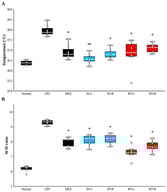
Ps-PDRN attenuates LPS-induced fever and pulmonary edema: (A) body temperature; (B) lung wet/dry (W/D) ratio. Data are presented as mean ± SD (n = 7). One-way ANOVA followed by Dunnett’s multiple-comparison test (each treatment vs. the LPS group) was used. * p < 0.05, ** p < 0.01 vs. LPS group.

News & Conferences

Issues

Open for Submission

Editor's Choice

Reprints of Collections

Current Advances in Oxytocin Research
Reprint

Current Advances in Oxytocin Research

Editors: Claudia Camerino
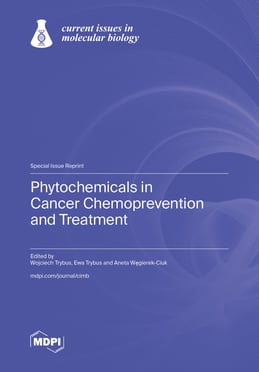
Phytochemicals in Cancer Chemoprevention and Treatment
Reprint

Phytochemicals in Cancer Chemoprevention and Treatment

Editors: Wojciech Trybus, Ewa Trybus, Aneta Wȩgierek-Ciuk

Get Alerted

Add your email address to receive forthcoming issues of this journal.

XFacebookLinkedIn
Curr. Issues Mol. Biol. - ISSN 1467-3045