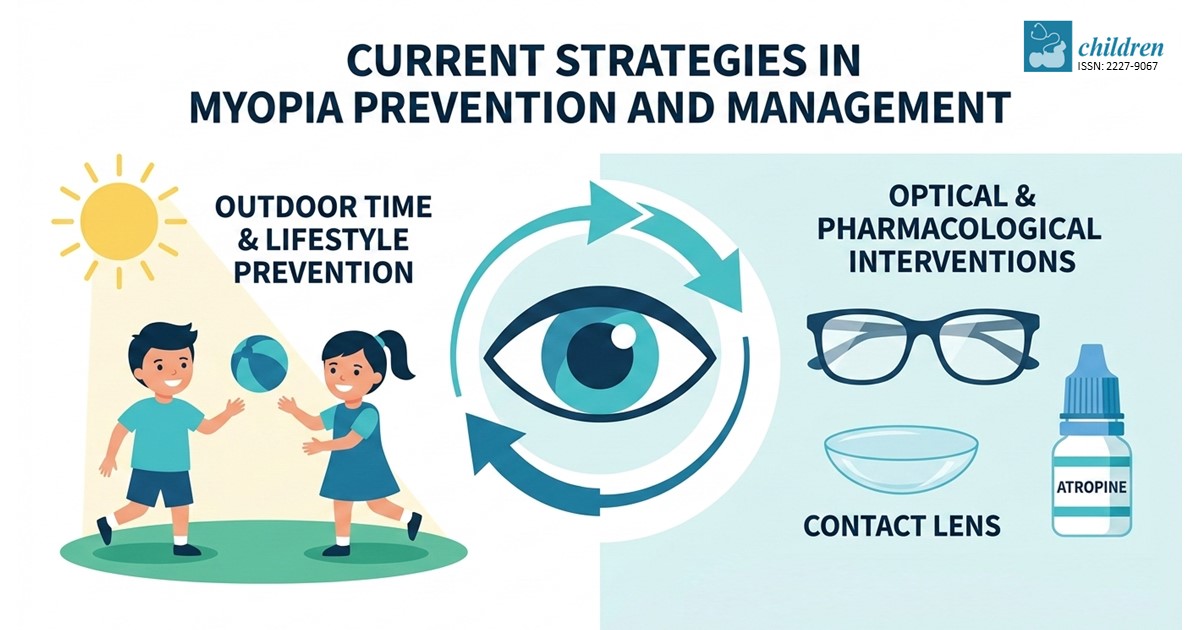
Current Strategies in Myopia Prevention and Management for Children and Adolescents

A special issue of Children (ISSN 2227-9067). This special issue belongs to the section "Pediatric Ophthalmology".

Deadline for manuscript submissions: 15 August 2026 | Viewed by 641

Editors


E-Mail Website
Guest Editor
Ocupharm Research Group, Department of Optometry and Vision, Faculty of Optics and Optometry, Complutense University of Madrid, 28037 Madrid, Spain
Interests: optometry; myopia; refractive errors

E-Mail Website
Guest Editor
1. Ocupharm Research Group, Department of Optometry and Vision, Faculty of Optics and Optometry, Complutense University of Madrid, 28037 Madrid, Spain
2. IOBA (Institute of Applied Ophthalmobiology), Universidad de Valladolid, Valladolid, Spain
Interests: optometry and vision; ophthalmology

E-Mail Website
Guest Editor
Ocupharm Research Group, Department of Optometry and Vision, Faculty of Optics and Optometry, Complutense University of Madrid, 28037 Madrid, Spain
Interests: optometry and vision; contact lenses; ocular surface; dry eye; irregular cornea; refraction
Special Issues, Collections and Topics in MDPI journals

Special Issue Information

Dear Colleagues,

Myopia in children and adolescents poses significant functional and social challenges, especially due to its global increase. Early onset and rapid progression are closely linked to severe complications, such as myopic maculopathy or glaucoma, in later life.

This Special Issue, “Current Strategies in Myopia Prevention and Management for Children and Adolescents,” aims to gather cutting-edge research on strategies to delay the onset and arrest the progression of myopia.

We are seeking original research articles and reviews that focus on innovative clinical interventions (e.g., low-dose atropine, contact lenses, orthokeratology, or ophthalmic lenses); the role of environmental factors such as outdoor exposure; and population-based screening programs. Our goal is to consolidate evidence that supports better clinical care and public health initiatives to protect the visual future of younger generations.

Dr. Laura Batres
Dr. Cristina Arroyo-del Arroyo
Dr. Maria Serramito-Blanco
Guest Editors

Manuscript Submission Information

Manuscripts should be submitted online at www.mdpi.com by registering and logging in to this website. Once you are registered, click here to go to the submission form. Manuscripts can be submitted until the deadline. All submissions that pass pre-check are peer-reviewed. Accepted papers will be published continuously in the journal (as soon as accepted) and will be listed together on the special issue website. Research articles, review articles as well as short communications are invited. For planned papers, a title and short abstract (about 250 words) can be sent to the Editorial Office for assessment.

Submitted manuscripts should not have been published previously, nor be under consideration for publication elsewhere (except conference proceedings papers). All manuscripts are thoroughly refereed through a single-anonymized peer-review process. A guide for authors and other relevant information for submission of manuscripts is available on the Instructions for Authors page. Children is an international peer-reviewed open access monthly journal published by MDPI.

Please visit the Instructions for Authors page before submitting a manuscript. The Article Processing Charge (APC) for publication in this open access journal is 2400 CHF (Swiss Francs). Submitted papers should be well formatted and use good English. Authors may use MDPI's English editing service prior to publication or during author revisions.

Keywords

  • visual impairment
  • orthokeratology
  • myopia progression
  • clinical interventions
  • defocus contact lenses
  • atropine
  • outdoor activity
  • vision screening
  • spectacles myopia control
  • public health
  • refractive errors

Benefits of Publishing in a Special Issue

  • Ease of navigation: Grouping papers by topic helps scholars navigate broad scope journals more efficiently.
  • Greater discoverability: Special Issues support the reach and impact of scientific research. Articles in Special Issues are more discoverable and cited more frequently.
  • Expansion of research network: Special Issues facilitate connections among authors, fostering scientific collaborations.
  • External promotion: Articles in Special Issues are often promoted through the journal's social media, increasing their visibility.
  • Reprint: MDPI Books provides the opportunity to republish successful Special Issues in book format, both online and in print.

Further information on MDPI's Special Issue policies can be found here.

Published Papers (1 paper)

Order results
Result details
Select all
Export citation of selected articles as:

Review

20 pages, 366 KB  
Review
Ocular Alignment and Strabismus-Related Findings Associated with Low-Dose Atropine for Myopia Control in Children: A Structured Narrative Review
by Yo Iwata, Tomoya Handa and Hitoshi Ishikawa
Children 2026, 13(6), 818; https://doi.org/10.3390/children13060818 - 14 Jun 2026
Viewed by 235
Abstract
Background/Objectives: Low-dose atropine eye drops are widely used to slow myopia progression in children, but by reducing accommodation they may affect near ocular alignment and binocular visual function. Evidence on ocular alignment and strabismus-related findings remains insufficiently synthesized. This review examined low-dose [...] Read more.
Background/Objectives: Low-dose atropine eye drops are widely used to slow myopia progression in children, but by reducing accommodation they may affect near ocular alignment and binocular visual function. Evidence on ocular alignment and strabismus-related findings remains insufficiently synthesized. This review examined low-dose atropine for pediatric myopia control in relation to ocular alignment and strabismus-related findings. Methods: PubMed/MEDLINE and Web of Science Core Collection were searched from inception to 16 April 2026. English-language studies addressing low-dose atropine, myopia control, ocular alignment, strabismus, binocular vision, accommodation, and vergence were screened. Of 247 records, 166 underwent screening after duplicate removal. Twenty-three database-derived and four manually identified full-text articles were reviewed. Eleven studies were included. Results: Of eleven included studies, six were clinical or interventional studies and five were case reports or case series. Case-based reports described near-predominant esodeviation, convergence excess-type deviation, elevated accommodative convergence/accommodation (AC/A) ratios, diplopia, reduced fusion, and acquired esotropia during fixed low-dose or escalating atropine use; most fixed low-dose cases improved after discontinuation or treatment modification. Clinical and interventional studies did not show consistent worsening of ocular alignment, near point of convergence (NPC), fusional vergence, or binocular vision. More consistent changes included pupil dilation, receded near point of accommodation (NPA), reduced accommodative amplitude and facility, selected fusional vergence changes, and short-term binocular or accommodative fluctuations. Conclusions: Low-dose atropine appears to be useful for pediatric myopia control and is generally well tolerated. However, selected cases may be temporally associated with ocular alignment abnormalities or strabismus-related findings. Careful monitoring may be warranted in children with unstable binocular systems and during dose escalation. Full article
Show Figures

Graphical abstract

Back to TopTop