From Catalyst Design to Sustainable Catalytic Processes: Advances in Reactor Engineering

A special issue of Catalysts (ISSN 2073-4344). This special issue belongs to the section "Catalytic Reaction Engineering".

Deadline for manuscript submissions: 31 May 2026 | Viewed by 3123

Special Issue Editors


E-Mail Website
Guest Editor
Laboratory of Catalytic Reactor Engineering Applied to Chemical and Biological Systems, Department of Process and Hydraulic Engineering, Universidad Autónoma Metropolitana-Iztapalapa, Mexico City 09340, Mexico
Interests: catalytic reactor engineering; reaction kinetics; multiscale analysis in catalytic systems; transport phenomena in catalytic reactors
Special Issues, Collections and Topics in MDPI journals

E-Mail Website
Guest Editor
Department of Chemical Engineering, Izmir Institute of Technology, Gülbahçe Campus, Urla, Izmir 35430, Turkey
Interests: computational fluid dynamics (CFD) of reactor and process design; reactor engineering; process intensification; energy-efficiency in reactor design for process intensification
Special Issues, Collections and Topics in MDPI journals

E-Mail Website
Guest Editor
Laboratory of Process Analysis, Energy Department, Universidad Autónoma Metropolitana-Azcapotzalco, Mexico City 02128, Mexico
Interests: catalysis applied to hydrotreatment reactions for the elimination of pollutant precursor compounds; production of biofuels via chemical reaction; adsorption of pollutants in air, soil, and water, or their degradation via photocatalysis

E-Mail Website
Guest Editor
Laboratory of Process Analysis, Energy Department, Universidad Autónoma Metropolitana-Azcapotzalco, Mexico City 02128, Mexico
Interests: biocatalysts; enzymes; bioreactions; metabolic pathways; bioprocess engineering

Special Issue Information

Dear Colleagues,

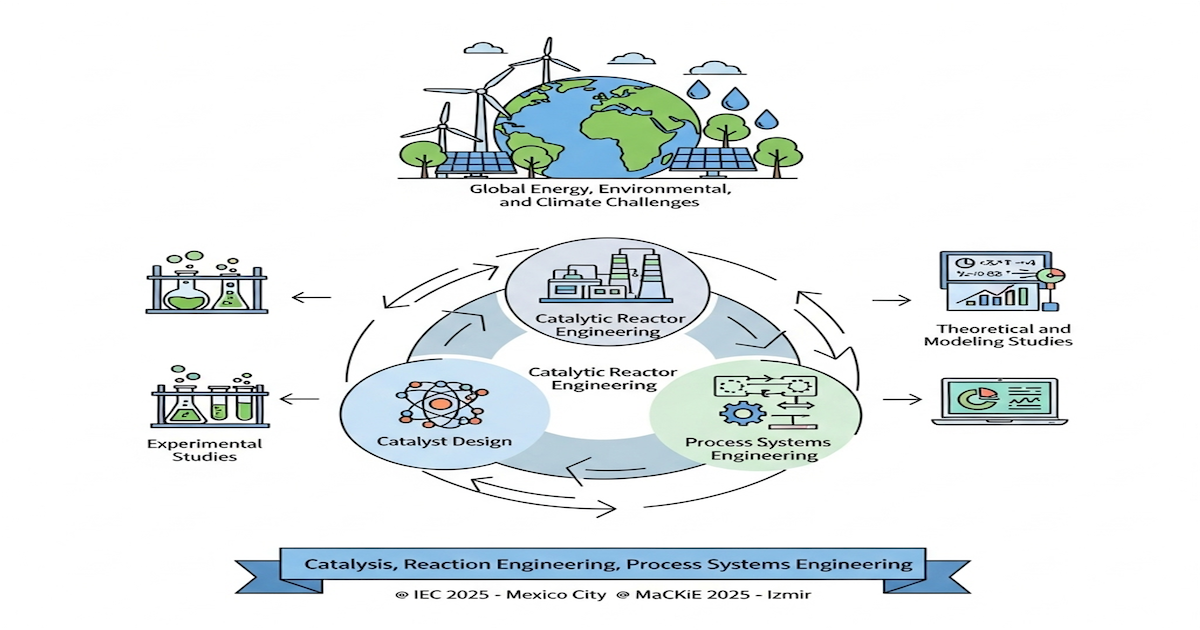
The transition to sustainable catalytic processes is essential to address global energy, environmental, and climate challenges. This Special Issue focuses on recent advances that bridge catalyst design with catalytic reactor engineering to develop sustainable chemical or biological processes. We welcome contributions that explore the full spectrum, from the design, development, and evaluation of catalysts to the scale-up of catalytic reactors. Both experimental and theoretical studies are encouraged. This Special Issue aims to provide a platform for cross-disciplinary research that combines catalysis, reaction engineering, and process system engineering to foster innovation in sustainble technologies.

The upcoming Special Issue will feature selected works presented at the International Energy Conference (IEC) 2025, to be held in Mexico City, Mexico, and the International Conference on Mathematics in (bio/food) Chemical Kinetics and Engineering (MaCKiE) 2025, to be held in Izmir, Turkey. This Special Issue will also welcome additional high-quality contributions in related fields, with a focus on innovative research at the intersection of sustainability, chemical engineering, biochemical engineering, food engineering, experimentation, and mathematical modeling.

Prof. Dr. Carlos Omar Castillo Araiza
Dr. Abhishek Dutta
Prof. Dr. José Antonio Colín-Luna
Prof. Dr. Margarita M. González-Brambila
Guest Editors

Manuscript Submission Information

Manuscripts should be submitted online at www.mdpi.com by registering and logging in to this website. Once you are registered, click here to go to the submission form. Manuscripts can be submitted until the deadline. All submissions that pass pre-check are peer-reviewed. Accepted papers will be published continuously in the journal (as soon as accepted) and will be listed together on the special issue website. Research articles, review articles as well as short communications are invited. For planned papers, a title and short abstract (about 250 words) can be sent to the Editorial Office for assessment.

Submitted manuscripts should not have been published previously, nor be under consideration for publication elsewhere (except conference proceedings papers). All manuscripts are thoroughly refereed through a single-blind peer-review process. A guide for authors and other relevant information for submission of manuscripts is available on the Instructions for Authors page. Catalysts is an international peer-reviewed open access monthly journal published by MDPI.

Please visit the Instructions for Authors page before submitting a manuscript. The Article Processing Charge (APC) for publication in this open access journal is 2200 CHF (Swiss Francs). Submitted papers should be well formatted and use good English. Authors may use MDPI's English editing service prior to publication or during author revisions.

Keywords

  • catalysis
  • catalytic reactor engineering
  • food engineering
  • chemical engineering
  • biochemical engineering
  • multiscale-based modeling

Benefits of Publishing in a Special Issue

  • Ease of navigation: Grouping papers by topic helps scholars navigate broad scope journals more efficiently.
  • Greater discoverability: Special Issues support the reach and impact of scientific research. Articles in Special Issues are more discoverable and cited more frequently.
  • Expansion of research network: Special Issues facilitate connections among authors, fostering scientific collaborations.
  • External promotion: Articles in Special Issues are often promoted through the journal's social media, increasing their visibility.
  • Reprint: MDPI Books provides the opportunity to republish successful Special Issues in book format, both online and in print.

Further information on MDPI's Special Issue policies can be found here.

Published Papers (3 papers)

Order results
Result details
Select all
Export citation of selected articles as:

Research

11 pages, 609 KB  
Article
Application of Wolkenstein’s Electronic Theory to Size Effects in CO Oxidation over ZnO Nanocatalysts
by Gulnara Kosmambetova, Nigora Turaeva, Olga Didenko and Peter Strizhak
Catalysts 2026, 16(3), 263; https://doi.org/10.3390/catal16030263 - 14 Mar 2026
Viewed by 501
Abstract
The volcano-shaped dependence of the catalytic activity of the magnesia-supported ZnO nanoparticles on their diameter in CO oxidation was considered in the framework of Wolkenstein’s electron theory of catalysis on semiconductors. By analyzing the diffuse reflectance UV-Vis spectra of the ZnO nanoparticles in [...] Read more.
The volcano-shaped dependence of the catalytic activity of the magnesia-supported ZnO nanoparticles on their diameter in CO oxidation was considered in the framework of Wolkenstein’s electron theory of catalysis on semiconductors. By analyzing the diffuse reflectance UV-Vis spectra of the ZnO nanoparticles in catalysts, we demonstrate that a narrow range of particle diameters (4.0–4.6 nm) leads to changes in the Fermi level due to quantum confinement of free electrons. As the diameter of the ZnO nanoparticles decreases, the Fermi level rises, resulting in an accelerated acceptor stage and a decelerated donor stage involving free electrons interacting with atomic oxygen and carbon dioxide on the catalyst surface, respectively. This opposing change in the rates of the donor and acceptor stages during the CO oxidation reaction, influenced by the diameter of the ZnO nanoparticles, gives rise to a volcano-shaped size dependence of the reaction rate. Furthermore, an optimal catalyst particle diameter is identified, at which the reaction rate reaches its maximum. Full article
Show Figures

Graphical abstract

24 pages, 4540 KB  
Article
Bioplastic Production in Circular Economy Paths with Glycerol and Whey
by Héctor H. León Santiesteban, Juan Aguirre Aguilar, Deyanira Ángeles Beltrán, José Luis Contreras Larios, Ricardo Reyes Chilpa, Julio C. García Martínez and Margarita M. González Brambila
Catalysts 2026, 16(2), 178; https://doi.org/10.3390/catal16020178 - 10 Feb 2026
Viewed by 805
Abstract
From 1950 to the present, plastic production and use have increased mainly because plastics possess qualities like stability, light weight, versatility, and decreasing production costs. However, most plastics are not biodegradable, and only a small portion is recycled worldwide. Bioplastics serve as an [...] Read more.
From 1950 to the present, plastic production and use have increased mainly because plastics possess qualities like stability, light weight, versatility, and decreasing production costs. However, most plastics are not biodegradable, and only a small portion is recycled worldwide. Bioplastics serve as an alternative if they are biodegradable and derived from residual materials, promoting a circular economy. PHB is a polymer with characteristics similar to some commercial plastics. It was discovered in the 1920s and has been examined by researchers and engineers since then due to its potential as a biodegradable bioplastic. Some microorganisms can produce PHB under controlled conditions. In this work, PHB production was analyzed using two strains, Bacillus subtilis and Bacillus megaterium, and two byproducts—whey and glycerol—as substrates and varying the culture media compositions. Both byproducts and both strains are suitable for PHB production; the absence of nitrogen and trace element sources enhances PHB yield. Additionally, bacterial growth, substrate uptake, and PHB production were modeled using logistic growth and the Luedeking–Piret models. Full article
Show Figures

Graphical abstract

23 pages, 4581 KB  
Article
Carbonate Inhibition in Au-Cu/γ-Al2O3 Catalysts for CO Oxidation
by Karla López, Gamaliel Che-Galicia, Rodolfo Zanella, Jesús F. Guayaquil-Sosa and Alvaro Sampieri
Catalysts 2025, 15(11), 1080; https://doi.org/10.3390/catal15111080 - 14 Nov 2025
Cited by 1 | Viewed by 1169
Abstract
Incorporating Cu into gold-based catalysts effectively reduced nanoparticle sintering and free carbonate accumulation, promoting long-term preservation of catalytic surface area over time. This study explores the catalytic activity of monometallic Au and bimetallic AuCu catalysts with varying Au:Cu atomic ratios (1:0.5, 1:1, and [...] Read more.
Incorporating Cu into gold-based catalysts effectively reduced nanoparticle sintering and free carbonate accumulation, promoting long-term preservation of catalytic surface area over time. This study explores the catalytic activity of monometallic Au and bimetallic AuCu catalysts with varying Au:Cu atomic ratios (1:0.5, 1:1, and 1:1.5) that were synthesized on γ-Al2O3 via sequential deposition–precipitation with urea. The catalysts were pretreated in either air or H2 and evaluated for CO oxidation activity and stability. A comprehensive characterization (EDS, BET, TEM, H2-TPR, O2-TPO, XPS, DRIFTS, and UV–Vis) was used to investigate particle size, metal oxidation states, and redox properties. Among all materials, the AuCu 1:1 catalyst exhibited the highest low-temperature CO conversion (>90% at 0 °C) and improved stability during 24 h tests, reflecting minimal nanoparticle sintering as confirmed by TEM analysis. In situ DRIFTS revealed that the presence of Cu+ and Cu2+ minimizes the accumulation of free carbonates (one of the main deactivation pathways in Au/γ-Al2O3) while promoting the formation of reactive intermediates that facilitate CO2 production. Notably, air pretreatment at moderate temperature proved as effective as H2 pretreatment in activating both monometallic and bimetallic catalysts. These findings highlight the role of Cu as a structural and electronic promoter of gold, offering practical guidelines for designing durable, cost-effective catalysts for low-temperature CO oxidation on non-reducible supports. Full article
Show Figures

Graphical abstract

Back to TopTop