1. Introduction
A volcano-shaped correlation between the rate of a heterogeneous catalytic reaction and the energy characteristics of the reagents and the catalyst is a consequence of the Sabatier principle, the fundamental principle of heterogeneous catalysis. According to this principle, the optimal interaction, neither too strong nor too weak, of adsorbed molecules with the catalyst surface is achieved by balancing the heats of adsorption of reagents and desorption of reaction products [
1]. The validity of this approach is confirmed by the appearance of a volcano-shaped dependence of the reaction rate on the particle size of the catalyst. This is generally observed for nanocatalysts with an active component size less than 10 nm, the catalytic activity of which is due to the manifestation of the electronic factor to a greater extent than the geometric one [
2]. Based on kinetic analysis, it was shown that the Gibbs energy of the formation of an activated complex also depends on the number of atoms on the faces, edges and corners of a nanoparticle, i.e., on its size, and thus reflects the relation between the influence of geometric and electronic effects on catalytic activity [
3,
4]. The appearance of theoretical interpretations of volcano-shaped plots using the main energetic quantities in the fields of heterogeneous catalysis is partly due to the development of the density functional theory (DFT) computations. It is especially valuable to use adsorption free energies calculated by DFT for describing the stages of heterogeneous catalysis [
5,
6]. The Wolkenstein’s electronic approach based on weak and strong chemisorption of reaction intermediates was also applied to explain the volcano-shaped size dependence of reaction rate [
7]. According to this approach, the position of the Fermi level is one of the main factors that determine the chemisorption strength of reagents on the catalyst surface and, consequently, the rate of the catalytic reaction. Using the example of oxide semiconductor systems (NiO, WO
3, Cr
2O
3, ZnO), it was shown how the rate of the catalytic reactions can be controlled by changing the position of the Fermi level at the crystal surface by introducing modifying impurities into the entire semiconductor volume [
8,
9]
One of the reasons for the limited use of Wolkenstein’s theory in heterogeneous catalysis concerns the complexity in determining the energy levels of the surface states formed by adsorbates on the catalyst. However, its use is possible for oxides of transition metals (WO
3, TiO
2, ZrO
2, V
2O
5, Nb
2O
5) that exhibited a relation between the surface Fermi level of the solid and its activity through the surface acidity [
10].
Zinc oxide is an n-type wide-band gap semiconductor that demonstrates the quantum confinement effect in a range of particle sizes less than 10 nm defined by a blue shift in the ultraviolet–visual (UV-Vis) absorption spectra [
11]. The quantum confinement effect has been observed in various applications of ZnO nanoparticles, such as photocatalysts, varistors, sensors, solar cells, transparent electrodes, and electroluminescent devices [
12,
13,
14].
In heterogeneous catalysis, zinc oxide is used as a support, an active component, a promoter, and a model system [
15,
16]. The high melting point of ZnO (1975 °C) promotes its application as a structural and textural modifier of multicomponent solid catalysts for organic synthesis, dehydration of hydrocarbons, and purification of technological and exhaust gases [
17,
18]. Zinc and its oxide do not exhibit high catalytic activity in the redox reactions due to the filled d-shell. The catalytic activity of zinc oxide in the oxidation reactions is associated with the presence of oxygen vacancies on its surface, which are centers of oxygen adsorption from the gas phase and at the same time active centers of reactions. The smaller the particle size, the greater the number of such centers on a catalyst surface. Using the X-ray photoelectron spectroscopy (XPS) technique, it was shown that the appearance of additional peaks in the photoelectron spectra of zinc oxide with a decrease in size of nanoparticles to less than 10 nm is due to the presence of oxygen vacancies on its surface [
19,
20]. We observed experimentally such a volcano-shaped size dependence of the surface-specific activity, i.e., the so-called turnover frequency (TOF), in CO oxidation over ZnO nanoparticles [
21].
In the present study, we apply the Wolkenstein’s electronic theory of catalysis to the CO oxidation reaction over zinc oxide nanoparticles in a narrow size range (4.0–4.6 nm) and compare the model with the experimental data on the size dependence of the reaction rate.
2. Results and Discussion
The ZnO/MgO samples with the different average diameters of ZnO nanoparticles in the narrow range of 4.0–4.6 nm were prepared by varying the conditions of the colloidal solution synthesis (reagent concentrations, aging temperature, and aging time). To eliminate the possible effects related to nanoparticle sintering, variations in active site distribution, and differences in metal loading, all ZnO/MgO samples were prepared with a constant ZnO content of 1 wt.%. This approach ensures that the total amount of ZnO and, consequently, the nominal density of active sites per gram of catalyst remain unchanged for all solids. Moreover, previous studies have shown that the applied preparation procedure does not induce significant changes in the textural properties of the MgO support, and the specific surface area remains essentially unaffected [
21]. The particle diameter distribution for ZnO/MgO solids was calculated assuming that ZnO nanoparticles are spherical and the optical absorption intensity (
A) in diluted system is determined by the number of nanoparticles with a certain diameter [
22]:
where
d is the particle diameter;
n(
d) is the particle diameter distribution, and
n(
d) = 0 when
d → ∞;
A(
d) is the optical absorption. The average diameter of ZnO nanoparticles was calculated as <
d> = Σ
n(
di)
di/Σ
n(
di), where
n(
di) is the number of particles with diameter
di.
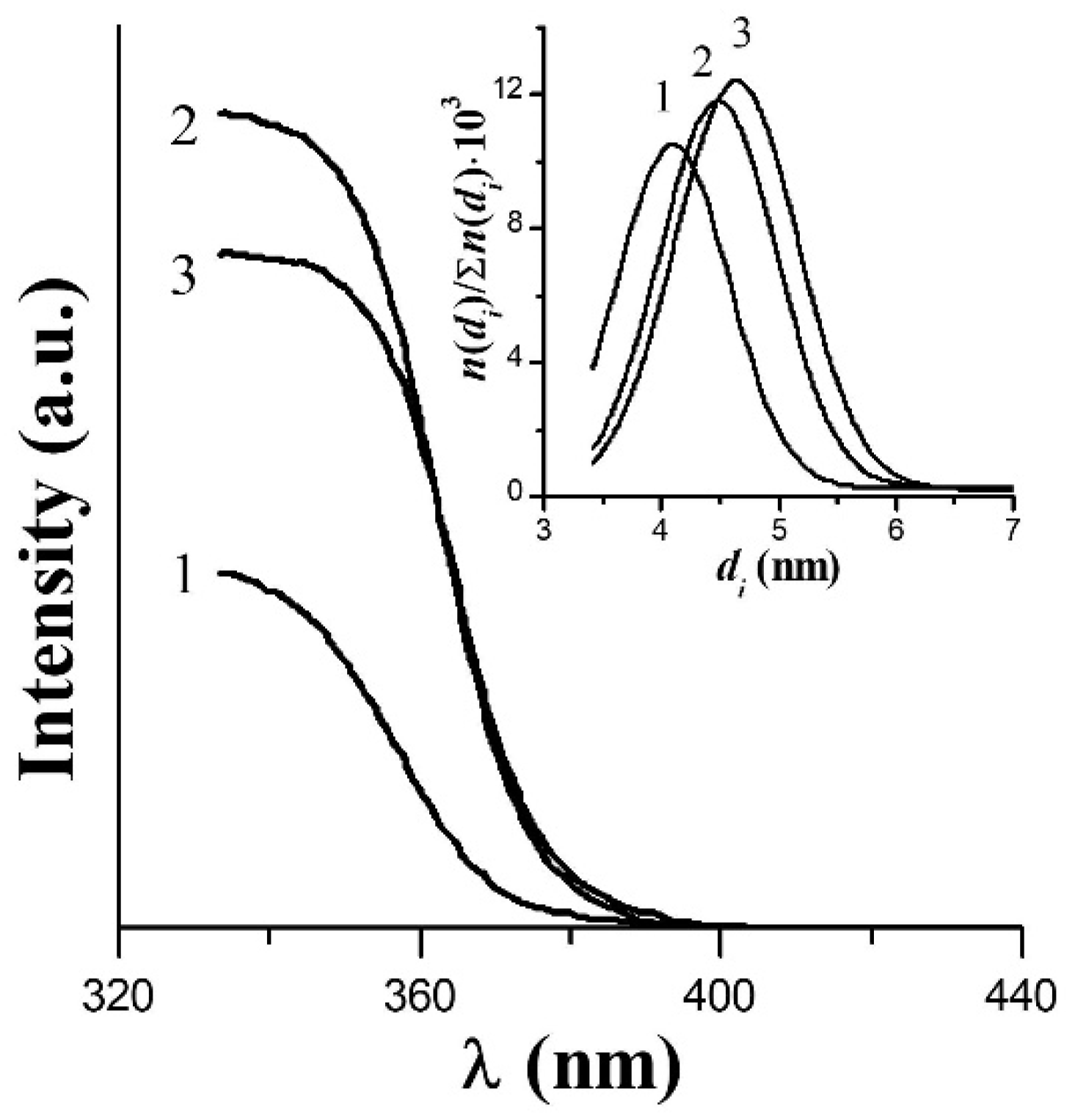
Typical UV-Vis DR spectra and the corresponding particle size distributions for ZnO/MgO solids with the different average diameters of ZnO nanoparticles are shown in
Figure 1. It is worth noting that the ZnO particle size distribution calculated using Equation (1) is in good agreement with the distribution derived from the TEM analysis, as demonstrated in Ref. [
21]. In contrast to Ref. [
21], where the nanoparticle radius was used as the characteristic size parameter, in the present work, we report and analyze the data in terms of nanoparticle diameter.
The measurements revealed that essentially all of the quantum size effects of an increased band gap for ZnO nanoparticles occur by a shift in the conduction band edge due to the electron confinement. The position of the conduction band is raised when the particle diameter decreases from 4.6 to 4.0 nm, while the valence band is almost constant regardless of the particle size.
The size-dependent band gap (
Eg, eV) for the spherical ZnO nanoparticles with diameter
d (m) was defined from the analysis of the UV-Vis DR spectra using the effective mass model as a sum of three terms [
23]:
where
is the bulk band gap (about 3.2 eV at room temperature for ZnO);
h is the Planck’s constant (6.626 × 10
−34 Js);
and
are the effective masses for electron and hole, respectively; for ZnO,
= 0.26
me and
= 0.59
me;
me is the free electron mass (9.11 × 10
−31 kg);
is the dielectric constant (8.5 for ZnO);
ε0 is the vacuum electric permittivity (8.854 × 10
−12 C
2N
−1m
−2);
e is the charge of a free electron (1.602 × 10
−19 C). Expression (2) shows that the confinement energy increases the band gap, while the Coulomb interaction lowers the energy. The 1/
d2 dependence is predominant in comparison with the 1/
d scale; therefore, the confinement effect defines the size dependence of the band gap. It causes the band gap shift, when the band gap is larger for small particles.
The catalytic activity of the ZnO/MgO samples with an average particle diameter of 4.0–4.6 nm was evaluated for CO oxidation by O
2 in the temperature range of 200–500 °C and estimated as TOF.
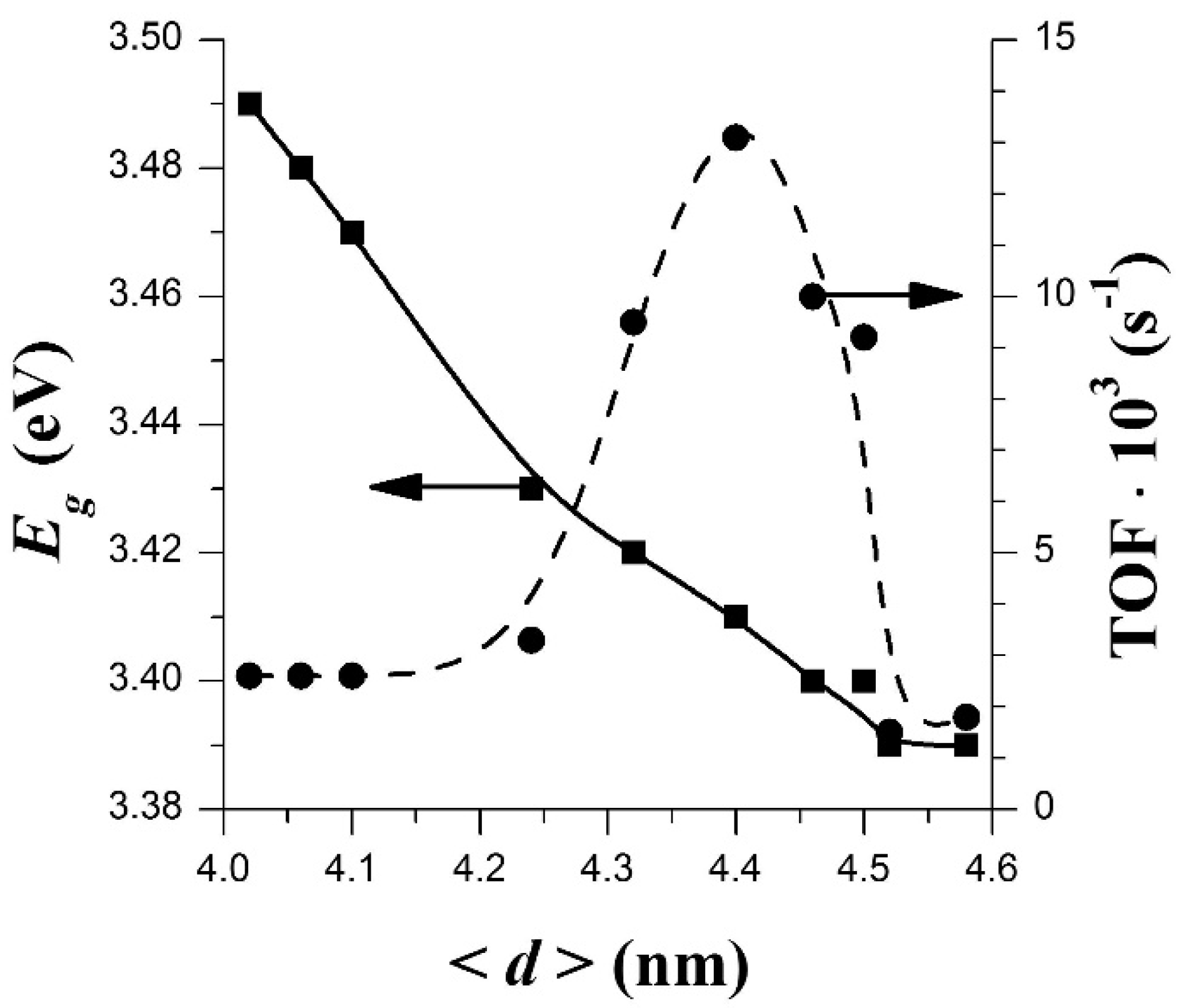
Figure 2 demonstrates the dependence of the band gap (left scale) and the CO oxidation rate, expressed as TOF at 320 °C (right scale), on the average diameter of ZnO nanoparticles in the ZnO/MgO solids. It shows that the band gap widens with decreasing nanoparticles size. For ZnO nanoparticles with a 4.6 nm diameter, the band gap difference is less than 0.2 eV compared to bulk ZnO (3.2 eV), and it increases up to 0.4 eV for the smallest particles (4.0 nm). The change in band gap is accompanied by a manifestation of volcano-shaped dependence of TOF on the average particle diameter of ZnO nanoparticles in solids. The ZnO/MgO solid containing ZnO nanoparticles of an average size of about 4.4 nm has maximum activity in CO oxidation. It should be noted that the catalysts obtained under different conditions but containing ZnO nanoparticles of the same size exhibit comparable activity in CO oxidation within the experimental error limit. Therefore, the volcano-shaped dependence of the ZnO/MgO solid activity on the band gap and average diameter of ZnO nanoparticles in the range of 4.0–4.6 nm may be attributed to the quantum confinement effect manifested by the electronic transition from the highest occupied molecular orbital (HOMO) to the lowest unoccupied molecular orbital (LUMO).
In a non-generate semiconductor, the Fermi level is inside the band gap. The ZnO bulk semiconductor is considered as n-type because of the presence of intrinsic vacancy defects in the structure [
15]. For the n-type ZnO, the Fermi level lies near the conduction band due to the presence of an excess of electrons that are located at an extra energy level [
24]. Thus, we suppose that, by decreasing the size, the Fermi level mostly changes due to the quantum confinement of electrons:
where
EFbulk is the Fermi level of bulk ZnO solid. Because the Fermi level represents the average work performed to remove an electron from the material (work function), to calculate the change in Fermi level, we used the value of the work function for bulk ZnO equal to 5.3 eV [
25].
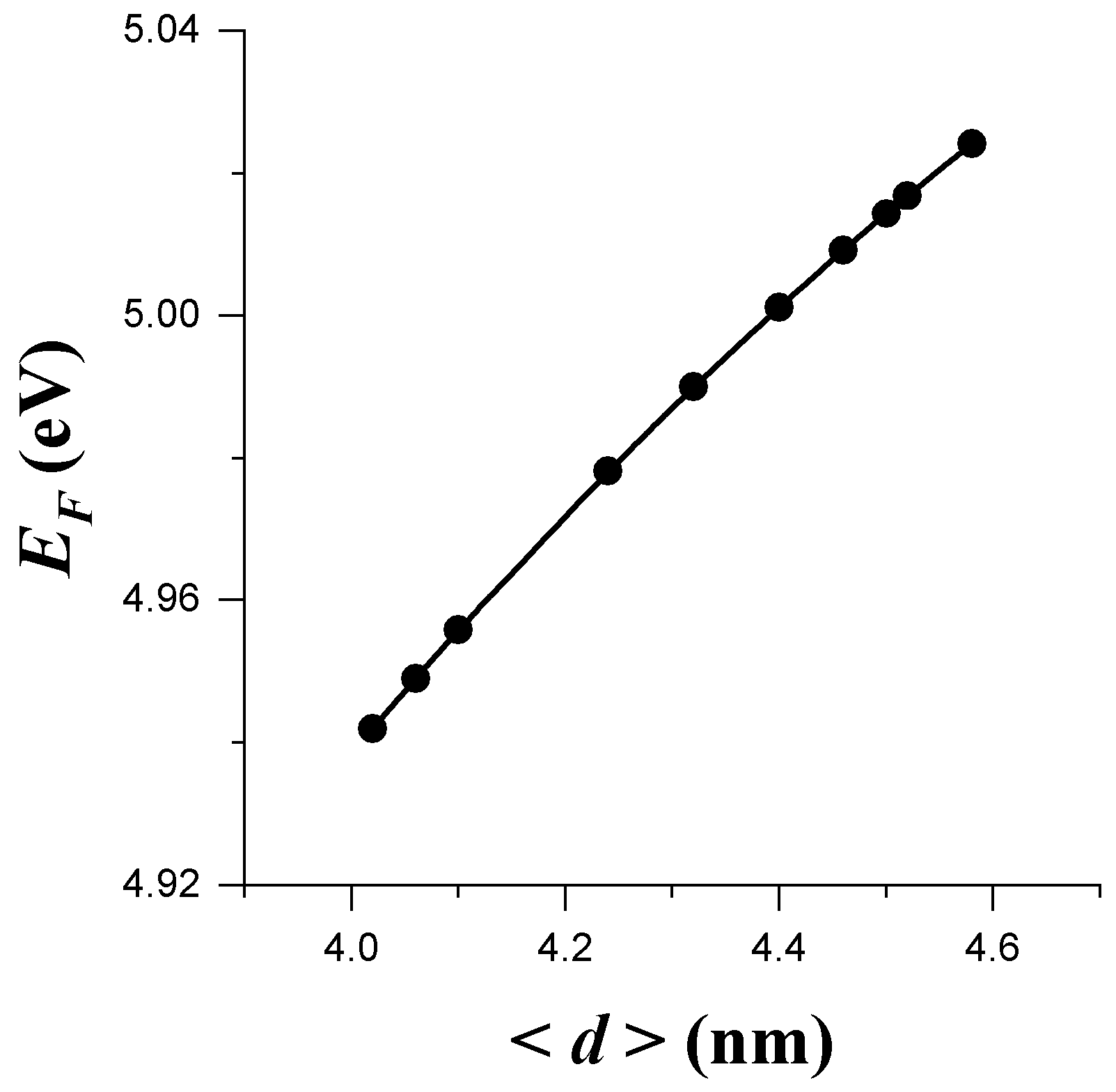
The extension of the band gap in the ZnO/MgO solids is accompanied by a shift in the Fermi level position calculated by Equation (3) and presented in
Figure 3.
The obtained volcano-shaped relation between the catalytic activity of the magnesia-supported ZnO nanoparticles and their size can be considered in the framework of Wolkenstein’s electronic theory that establishes a correlation between the catalytic activity and the electrical conductivity of semiconductors since both are related to the Fermi level [
8,
9]. The experimentally proven factors influencing the position of the Fermi level and, accordingly, the activity of catalysts were doping, illumination, the external electric field, and the structural defects of a surface. Wolkenstein foresaw that the dispersion of a material can also be a factor affecting the position of the Fermi level and the associated adsorption and catalytic properties. The results of our work show, due to the quantum confinement effect that occurs in ZnO nanoparticles smaller than 10 nm, size is also a decisive factor controlling the position of the Fermi level and the activity of the ZnO/MgO catalyst with respect to the CO oxidation reaction.
According to Wolkenstein’s theory, the heterogeneous catalytic reactions are divided into two classes based on the position of the Fermi level: reactions accelerated by electrons and their rate increases with an increase in the Fermi level (n-type acceptor reactions) and reactions accelerated by holes and their rate increases with a decrease in the Fermi level (p-type donor reactions). There are reactions whose mechanism includes both donor and acceptance stages. Wolkenstein considered a possible mechanism for such reactions using the example of CO oxidation on ZnO whose surface is completely covered with chemisorbed oxygen [
8,
9].
The Wolkenstein’s mechanism is in good agreement with the Eley–Rideal scheme of CO oxidation on ZnO in an excess of oxygen [
26,
27] which is given below:
In the above scheme of CO oxidation mechanism on ZnO, Z is the empty active site of the catalyst.
According to the proposed scheme, the mechanism of CO oxidation proceeds through dissociative adsorption of oxygen molecules onto the surface of the catalyst (1). Oxygen intermediates are activated by accepting electrons from the catalyst (2). In the ion-radical state, they react with CO molecules from the gas phase, and the ion-radicals of CO2− molecules are formed (3). CO2− intermediates are neutralized by donating electron to the catalyst (4), and then CO2 desorbs from the surface (5). Thus, the mechanism of CO oxidation on ZnO includes two stages: an acceptor stage, when the electron is transferred from the catalyst to the reactant (O2 and CO), and a donor stage, when the electron returns to the catalyst with the desorption of reaction product (CO2). The extremal dependence of ZnO activity explains that the ratio of the rates of the acceptor and donor stages of the CO oxidation reaction depends on the position of the Fermi level on the surface of the ZnO nanoparticle.
The reaction rate of CO oxidation through the dissociative adsorption of oxygen molecules and interaction of adsorbed atomic oxygen with gas-phase CO molecules is defined in the following way after taking into account the dependence of the fractions of atomic oxygen and CO
2 as a function of the Fermi level [
8]:
where
is the concentration of the adsorbed CO
2 in the neutral state corresponding to weak chemisorption;
EF is the Fermi level;
and
are the acceptor and donor energy levels of atomic oxygen and CO
2 on the catalyst surface, respectively;
kB is the Boltzmann constant;
T is the temperature;
P is the partial pressure of CO or O
2;
sO is the area of the catalyst surface occupied by one chemisorbed oxygen atom (the effective surface area of a single active site);
k1,
k3, and
k5 are the reaction rate constants of the appropriate stages (see the scheme above);
k−1 and
k−3 are the reverse rate constants of the appropriate stages. The substitution of Equation (3) into Equation (4) yields the following expression for the reaction rate as a function of the nanoparticle diameter (
d):
where
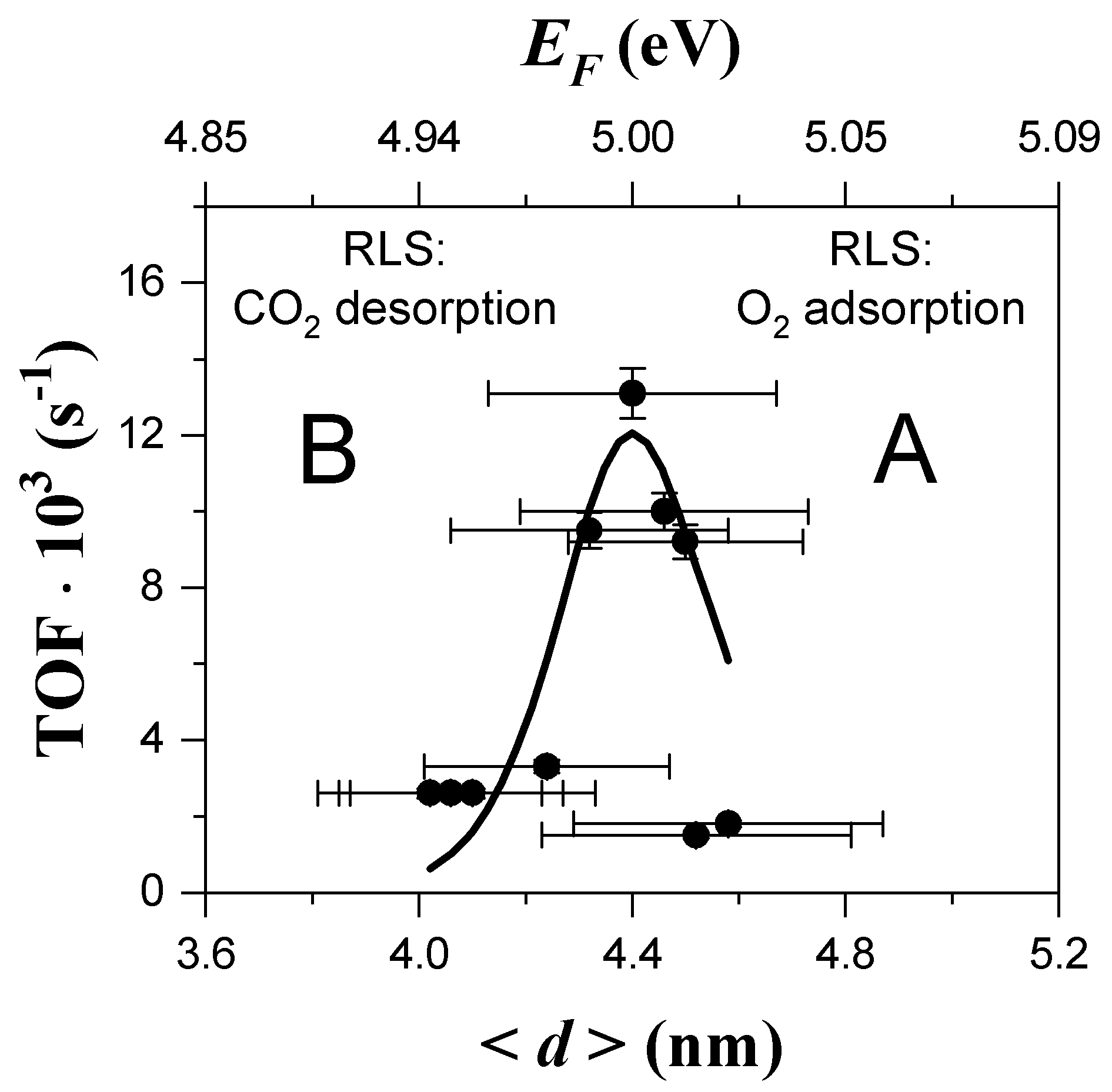
All four parameters (A, B, C, D) must be available for evaluation of the reaction rate using Equation (5), which is not always the case. However, Equations (4) and (5) allow one to make a qualitative analysis of the relation between the reaction rate and the energy of the Fermi level and the size of nanoparticles of the catalyst (
Figure 4). By solving the differential equation
, we can find the optimal size of ZnO nanoparticle diameter at which the reaction rate is maximum:
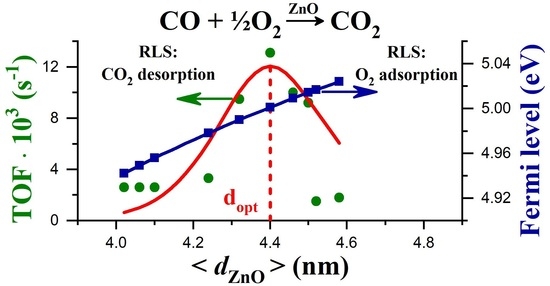
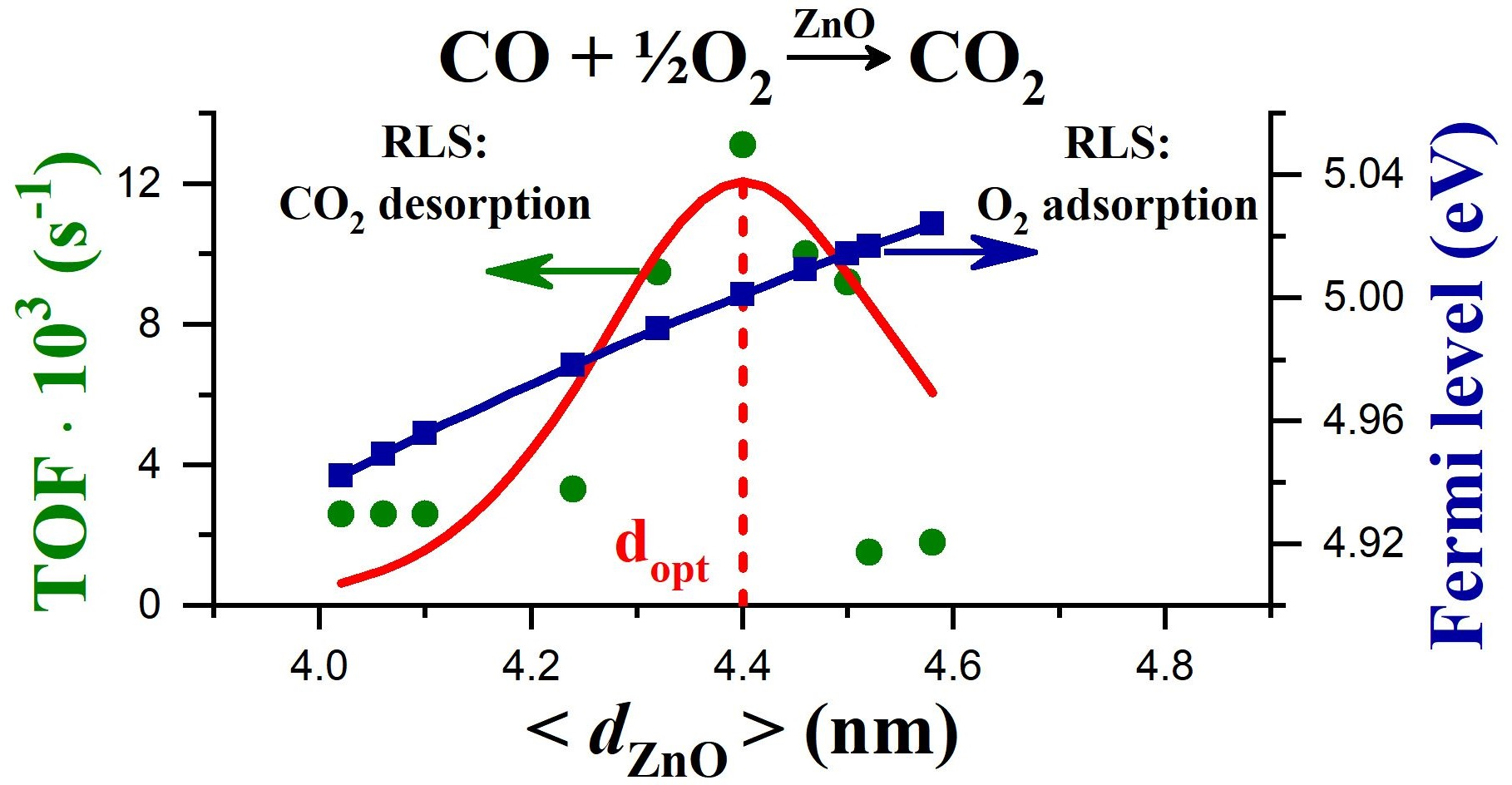
The application of Equations (4) and (5) to the CO oxidation over ZnO nanoparticles indicates that the value of the Fermi level decreases with a decrease in size of ZnO nanoparticles from 4.6 nm to 4.4 nm while the reaction rate increases, reaching a maximum value at 4.4 nm (
Figure 4, region A). In region A, the donor stage of electron transfer to the catalyst proceeds easily, but the acceptor stage of electron transfer from the catalyst is slower. Therefore, the rate-limiting stage is O
2 adsorption onto the catalyst surface. As the Fermi level rises with the decrease in size, the adsorption of the oxygen improves; as a result, the reaction rate increases and reaches its peak. With a further decrease in the ZnO nanoparticle size to smaller than 4.4 nm, the Fermi level decreases, and the reaction rate begins to decrease (
Figure 4, region B). Thus, in region B, the acceptor stage of electron transfer from the catalyst is facilitated, but the donor stage is hampered, i.e., the reaction rate is determined by CO
2 desorption from the catalyst surface. The observed “volcano” trend occurs within a narrow particle size window of approximately 0.4 nm, while the standard deviation of the ZnO particle size is about the same value. Despite this, the peak in catalytic activity remains well defined, indicating that the sharp increase in TOF is a genuine effect rather than an artifact of size variability or measurement uncertainty. Horizontal error bars in
Figure 4 represent the particle size standard deviation, and vertical bars reflect the reproducibility of TOF measurements, demonstrating the statistical reliability of the observed trend. This confirms that the catalytic activity is highly sensitive to particle size within this narrow range.
The idea of the relationship between the electron state in a solid and its catalytic properties was first expressed by L.V. Pisarzhevskii [
28]. Later, these ideas were developed in Wolkenstein’s works, who proposed the principles of a collective approach to explaining the catalytic properties of materials having a semiconductor nature [
8,
9]. Despite its popularity, the electronic theory has been criticized for not always finding experimental evidence. This was evidently due to the experimental possibilities of time, which did not always allow the accurate measurement of Fermi levels in semiconductors. An important consequence of the electronic theory is the prediction of the role of size factors on the catalytic properties of semiconductors. In one of his latest works, Wolkenstein noted that the high dispersity of a semiconductor material can have the same effect as impurities on the catalytic properties [
9]. In particular, it has been shown that, by changing the thickness of the oxide semiconductor film on the copper surface, it was possible to control the position of the Fermi level and, accordingly, the adsorption capacity, activity, and selectivity of copper [
8,
29]. Wolkenstein did not attribute this result to a manifestation of the quantum size effect, but pointed out that quantum mechanics gave chemistry physical content and thus revealed the physical nature of chemical forces [
8]. The relationship between the electronic properties and the thickness of the oxide film in VO
x, MoO
x, WO
x, and NbO
x deposited on alumina, zirconia, and magnesia was demonstrated in [
30]. For these oxides, which are two-dimensional film domains, the TOF value in the reactions of ethane and propane dehydrogenation increased monotonically with a decrease in the edge energy of the absorption band, which was determined from the blue shift in the electron diffuse reflectance spectra. Also, the unusually high activity and selectivity of nanosized gold is associated with the manifestation of quantum size effects [
31]. The bell-shaped dependence of the CO oxidation rate on the size of gold nanoparticles can be explained by a change in the electronic properties of two-layer gold nanoclusters stabilized on the support surface [
32]. The Fermi level shift towards lower values was detected for gold nanoparticles in the Au/TiO
2 nanocomposite: 0.02, 0.04, and 0.06 eV for Au nanoparticles with a diameter of 8, 5, and 3 nm, respectively. This effect was caused by the unusual property of Au nanoparticles to undergo quantized charging [
33]. It was shown that a promising way to control the catalytic activity of gold nanoparticles is tailoring the Fermi level of support [
34]. The correlations of the gold nanoparticles’ catalytic activity with the Fermi level of the support via electronic metal–support interactions were found in the oxidation reactions of CO and benzyl alcohol. For 4 mol % Cu/ZnO synthesized by four different methods, the influence of the preparation method on the position of the Fermi level and the selectivity of the synthesis gas conversion to higher alcohols was demonstrated. It was shown that the introduction of isolated Cu
2+ atoms into the ZnO structure contributes to a decrease in the Fermi level, an increase in the carbon chain, and the corresponding increase in the proportion of C
2-C
6 alcohols to 69.9% [
35].
Our results provide experimental evidence supporting Wolkenstein’s approaches to explaining the catalytic properties of semiconductor oxides. Specifically, we obtained the confirmation of the volcano-shaped dependence of the CO oxidation rate on ZnO, as predicted by Wolkenstein, based on the position of the Fermi level. Furthermore, we successfully demonstrated the validity of Wolkenstein’s prediction regarding the relationship between the dispersion of semiconductor material ZnO and its electronic characteristics. Our research revealed that the availability of electron energy states in the catalyst for participating in redox reactions strongly depends on its size, primarily due to the quantum confinement effect. Through the measurements of UV-Vis diffuse reflectance spectra, we examined the size-dependent band gap of ZnO nanoparticles within a narrow range of 4.0–4.6 nm. Our findings indicated that, as the particle size decreases, the Fermi level decreases due to the quantum confinement of free electrons, leading to changes in the conduction band edge. By leveraging the size dependence of the Fermi level and Wolkenstein’s electronic theory of catalysis, we established the existence of an optimal size for nanoparticles catalyzing a two-stage chemical reaction (acceptor and donor stages). At this specific size of ZnO nanoparticles (about 4.4 nm in diameter), we observed that the reaction rate reaches its maximum value.