
You are currently viewing a new version of our website. To view the old version click .
  • Tracked forImpact Factor
  • 3.4CiteScore
  • 23 daysTime to First Decision

BioMedInformatics

BioMedInformatics is an international, peer-reviewed, open access journal on all areas of biomedical informatics, as well as computational biology and medicine, published quarterly online by MDPI.

All Articles (333)

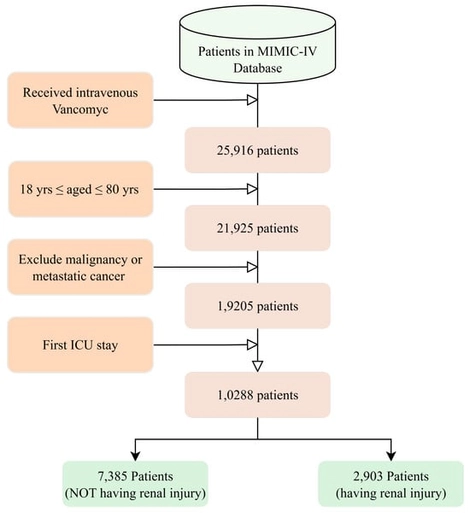
Vancomycin remains a cornerstone for severe Gram-positive infections in the ICU, yet creatinine elevation—a sensitive marker of early renal stress—occurs frequently and complicates therapy. We developed a machine learning model to predict vancomycin-associated creatinine elevation using routinely available clinical data, enabling preemptive risk stratification. In this retrospective MIMIC-IV cohort study ( ICU adults aged 18–80 receiving vancomycin), the primary outcome was creatinine elevation per KDIGO criteria (≥0.3 mg/dL within 48 h or ≥50% within 7 d). A two-stage feature selection (SelectKBest + Random Forest) identified 15 predictors from 30 candidates. Six algorithms were compared via 5-fold cross-validation. CatBoost was selected for final modeling; interpretability was assessed using SHAP values and Accumulated Local Effects (ALE) plots. Creatinine elevation occurred in 2903 patients (28.2%). CatBoost achieved AUROC 0.818 (95% CI: 0.801–0.834), sensitivity 0.800, specificity 0.681, and NPV 0.900. Top predictors were serum phosphate, total bilirubin, magnesium, Charlson Comorbidity Index, and APSIII score. SHAP analysis confirmed hyperphosphatemia as the strongest driver; ALE plots revealed non-linear, clinically plausible thresholds (e.g., phosphate >4.5 mg/dL sharply increased risk). This interpretable model accurately predicts vancomycin-associated creatinine elevation using standard ICU monitoring data. With high negative predictive value, it supports early exclusion of low-risk patients and targeted interventions (e.g., intensified TDM, nephrotoxin avoidance) in high-risk cases—facilitating precision antimicrobial stewardship in critical care.

10 December 2025

Cohort selectioneach figure appears in numerical order. process for vancomycin-associated renal injury analysis.

Advancements in natural language processing (NLP), particularly Large Language Models (LLMs), have greatly improved how we access knowledge. However, in critical domains like biomedicine, challenges like hallucinations—where language models generate information not grounded in data—can lead to dangerous misinformation. This paper presents a hybrid approach that combines LLMs with Knowledge Graphs (KGs) to improve the accuracy and reliability of question-answering systems in the biomedical field. Our method, implemented using the LangChain framework, includes a query-checking algorithm that checks and, where possible, corrects LLM-generated Cypher queries, which are then executed on the Knowledge Graph, grounding answers in the KG and reducing hallucinations in the evaluated cases. We evaluated several LLMs, including several GPT models and Llama 3.3:70b, on a custom benchmark dataset of 50 biomedical questions. GPT-4 Turbo achieved 90% query accuracy, outperforming most other models. We also evaluated prompt engineering, but found little statistically significant improvement compared to the standard prompt, except for Llama 3:70b, which improved with few-shot prompting. To enhance usability, we developed a web-based interface that allows users to input natural language queries, view generated and corrected Cypher queries, and inspect results for accuracy. This framework improves reliability and accessibility by accepting natural language questions and returning verifiable answers directly from the knowledge graph, enabling inspection and reproducibility. The source code for generating the results of this paper and for the user-interface can be found in our Git repository: https://git.zib.de/lpusch/cyphergenkg-gui, accessed on 1 November 2025.

9 December 2025

Example structure for 1-hop question.

Artificial intelligence (AI) is rapidly emerging as a transformative tool capable of addressing critical challenges and improving outcomes in tissue engineering and regenerative medicine. This paper demonstrates how machine learning and data fusion predict stem cell activity and potency, improve cellular characterization, and optimize therapeutic design. It also highlights important uses of AI in tissue engineering and cell-based therapeutics. By enabling accurate, non-invasive, and quantitative examination of living cells, AI also advances microscopy and imaging, facilitating better decision-making and real-time monitoring. Using search criteria including artificial intelligence, machine learning, deep learning, regenerative medicine, stem cells, and tissue engineering, the review was carried out using PubMed, Scopus, Web of Science, and Google Scholar. A total of 71 articles were screened; 8 non-peer-reviewed sources, 5 conference abstracts, and 4 duplicates were excluded. The final dataset included 7 clinical studies, 6 preclinical investigations, 18 original research articles, and 23 review papers. AI techniques, datasets, performance indicators, and regeneration results were compiled in the extracted data. To summarize, AI speeds up the development of tissue engineering, minimizes trial-and-error experimentation, lowers research expenses, forecasts tissue interactions, and enhances scaffold and biomaterial design. Consequently, AI integration enhances stem cell-based treatments and regenerative approaches, underscoring the necessity of interdisciplinary cooperation and ongoing technical development.

9 December 2025

Artificial intelligence (AI) plays a crucial role in regenerative medicine, particularly in cell therapy. This includes the use of mesenchymal stem cells (MSCs), hematopoietic stem cells (HSCs), and induced pluripotent stem cells (iPSCs). AI is also involved in tissue engineering, as well as the design of scaffolds and biomaterials. Various AI methods, such as machine learning (ML), deep learning (DL), clustering, and reinforcement learning (RL), are utilized in these processes.

Modern diagnostic systems face computational challenges when processing exponential disease-symptom combinations, with traditional approaches requiring up to 2n evaluations for n symptoms. This paper presents MARS (Matrix-Accelerated Reasoning System), a diagnostic framework combining Case-Based Reasoning with matrix representations and intelligent filtering to address these limitations. The approach encodes disease-symptom relationships as matrices enabling parallel processing, implements adaptive rule-based filtering to prioritize relevant cases, and features automatic rule generation with continuous learning through a dynamically updated Pertinence Matrix. MARS was evaluated on four diverse medical datasets (41 to 721 diseases) and compared against Decision Tree, Random Forest, k-Nearest Neighbors, Support Vector Classifier, Bayesian classifiers, and Neural Networks. On the most challenging dataset (721 diseases, 49,365 test cases), MARS achieved the highest accuracy (87.34%) with substantially reduced processing time. When considering differential diagnosis, accuracy reached 98.33% for top-5 suggestions. These results demonstrate that MARS effectively balances diagnostic accuracy, computational efficiency, and interpretability, three requirements critical for clinical deployment. The framework’s ability to provide ranked differential diagnoses and update incrementally positions it as a practical solution for diverse clinical settings.

2 December 2025

Steps in the droposed disease diagnosis approach.

News & Conferences

Issues

Open for Submission

Editor's Choice

Get Alerted

Add your email address to receive forthcoming issues of this journal.

XFacebookLinkedIn
BioMedInformatics - ISSN 2673-7426