Abstract
Artificial intelligence (AI) is rapidly emerging as a transformative tool capable of addressing critical challenges and improving outcomes in tissue engineering and regenerative medicine. This paper demonstrates how machine learning and data fusion predict stem cell activity and potency, improve cellular characterization, and optimize therapeutic design. It also highlights important uses of AI in tissue engineering and cell-based therapeutics. By enabling accurate, non-invasive, and quantitative examination of living cells, AI also advances microscopy and imaging, facilitating better decision-making and real-time monitoring. Using search criteria including artificial intelligence, machine learning, deep learning, regenerative medicine, stem cells, and tissue engineering, the review was carried out using PubMed, Scopus, Web of Science, and Google Scholar. A total of 71 articles were screened; 8 non-peer-reviewed sources, 5 conference abstracts, and 4 duplicates were excluded. The final dataset included 7 clinical studies, 6 preclinical investigations, 18 original research articles, and 23 review papers. AI techniques, datasets, performance indicators, and regeneration results were compiled in the extracted data. To summarize, AI speeds up the development of tissue engineering, minimizes trial-and-error experimentation, lowers research expenses, forecasts tissue interactions, and enhances scaffold and biomaterial design. Consequently, AI integration enhances stem cell-based treatments and regenerative approaches, underscoring the necessity of interdisciplinary cooperation and ongoing technical development.
1. Literature Review
Artificial intelligence (AI) was first defined in 1956 as the study of creating intelligent machines and computer programs. Since then, AI has developed across many scientific domains. It aims to perform tasks that require precise, goal-directed, and logical reasoning, often without human intervention. Machine learning, a crucial area of artificial intelligence, allows systems to process and evaluate enormous volumes of data without the need for explicit programming [1,2].
Text analysis, voice recognition, image classification, and—most importantly—medicine, are just a few of the domains where artificial intelligence (AI) has made rapid strides [3,4]. In healthcare, machine learning (ML) and deep learning (DL) enable the complex analysis of large medical datasets, improving the prediction of clinical outcomes, treatment accuracy, and diagnostic precision [5]. AI involves creating computer models that mimic human intelligence and can operate autonomously by learning from past data and experiences. Among the various AI techniques, ML and DL remain the most widely used algorithms in medical applications [6].
Recently, the attention has shifted toward regenerative medicine, including tissue engineering and cell therapy. Additionally, stem cell research and its derived products possess great potential to repair damaged and diseased tissues. The United States Food and Drug Administration (FDA) has approved the clinical use of stem cells derived from umbilical cord blood. Consequently, researchers are focusing on FDA-approved stem cell products, as well as safe and successful treatments for various diseases. AI technology is now being applied to scale up stem cell technology, integrating automation into industrial manufacturing systems for the production and generation of stem cells [2].
AI is now considered an emerging tool to be applied in different medical research disciplines, including computational modeling. Computational modeling enables researchers to gain deeper insights into the fundamental processes of tissue engineering and to understand how cells and tissue respond to different stimuli by using algorithms [7]. Additionally, AI can support personalized medical systems by leveraging patient-specific data, such as genetic information and medical history, to enhance treatment results and reduce the chance of rejection or other complications [8]. In the cell therapy context, AI can optimize the cell culture by analyzing experimental data from various cell culture studies by using algorithms, thereby identifying the ideal conditions for specific cell types [9]. In tissue engineering, AI can forecast the ideal structure, design, and composition of biomaterials to be applied in tissue engineering [10]. AI and tissue engineering together have enormous potential to advance the industry toward more individualized and efficient [11].
Main Algorithms in Machine Learning
Table 1 includes traditional methods such as logistic regression and K-nearest neighbors, ensemble techniques like random forests and gradient boosting, as well as advanced approaches including deep learning and reinforcement learning. The table emphasizes how each algorithm contributes to areas such as patient stratification, stem cell analysis, tissue imaging, and optimization of regenerative therapies, while also noting challenges like overfitting, data dependency, and interpretability.
Table 1.
A summary of the main machine learning algorithms in regenerative medicine.
Machine learning algorithms play a crucial role in advancing regenerative medicine by enhancing predictive modeling, cellular analysis, imaging interpretation, and therapy optimization. Various techniques are commonly used in the aforementioned applications, mainly traditional models such as logistic regression and K-nearest neighbors, ensemble methods like random forests and gradient boosting, and more advanced approaches like deep learning and reinforcement learning, as summarized in Table 1 [11].
Despite challenges such as overfitting in high-dimensional omics data, logistic regression is commonly used for binary clinical outcomes, such as patient classification and predicting stem cell differentiation potential. This is largely due to its ease of use and interpretability [4,11,12,13].
On the other hand, support vector machines (SVMs) leverage nonlinear kernel functions and demonstrate strong performance in tasks like biomarker identification, proteomics, and classifying stem cell subtypes. However, their accuracy can diminish when there is significant overlap between biological classes or when noise is present.
Despite issues like overfitting in high-dimensional omics data, logistic regression is still often employed for binary clinical outcomes like patient classification and stem cell differentiation potential prediction because of its ease of use and interpretability [4,11,12,13].
Support vector machines benefit from nonlinear kernel functions and offer strong performance in biomarker identification, proteomics, and stem cell subtype classification; nevertheless, their accuracy declines when biological classes overlap or noise is present [11,17]. K-means clustering is often utilized in single-cell RNA sequencing to identify heterogeneity among stem cells and to group samples based on shared characteristics. However, its sensitivity to outliers can impact the interpretation of results [11,14]. On the other hand, K-nearest neighbors is used for classification tasks in tissue imaging and differentiation prediction. While it is straightforward and resistant to noise, its effectiveness is heavily reliant on the quality of the data [11].
While decision trees and ensemble methods such as random forests and gradient boosting may suffer from overfitting and reduced interpretability, they significantly improve accuracy and assist in feature ranking for applications like tissue repair, gene prioritization, and graft rejection prediction [11,15]. Although interpretability and the necessity for large datasets remain significant challenges, deep learning offers scalable computing power for automated histopathology, 3D scaffold imaging, and multimodal data integration. This capability enables high-precision tissue characterization and predictive modeling [11,16].
Reinforcement learning plays a significant role in optimizing adaptive processes such as dosage regulation, bioreactor control, and real-time adjustments in regenerative therapy by learning from environmental feedback. However, it is less effective for simple, static tasks where conventional methods are typically more efficient [11,17]. Despite these limitations, the incorporation of machine learning into regenerative medicine is advancing therapeutic innovation rapidly. This progress highlights the importance of enhanced data quality, transparency in models, and standardized validation processes.
2. Methodology
A literature search was conducted using keywords including “artificial intelligence,” “machine learning,” “deep learning,” “regenerative medicine,” “stem cells,” and “tissue engineering” across databases such as PubMed, Scopus, Web of Science, and Google Scholar. Eligible studies comprised peer-reviewed research articles and reviews that applied AI in areas such as cell therapy, induced pluripotent stem cell (iPSC) reprogramming, biomaterials, or tissue engineering. 71 Articles were filtered based on title and abstract. 8 Non-peer-reviewed materials (non-Scopus index journals), 5 conference abstracts, and 4 duplicates were not included. The included articles were categorized as follows: 7 clinical studies; 6 preclinical studies, including animal, organ, and translational models; 18 original research articles, including experimental modeling, computational modeling, and AI development; and 23 review articles, systematic reviews, and book chapters. Data were retrieved to summarize AI techniques, datasets, performance indicators, and regenerative medicine outcomes.
3. Application of AI in Regenerative Medicine
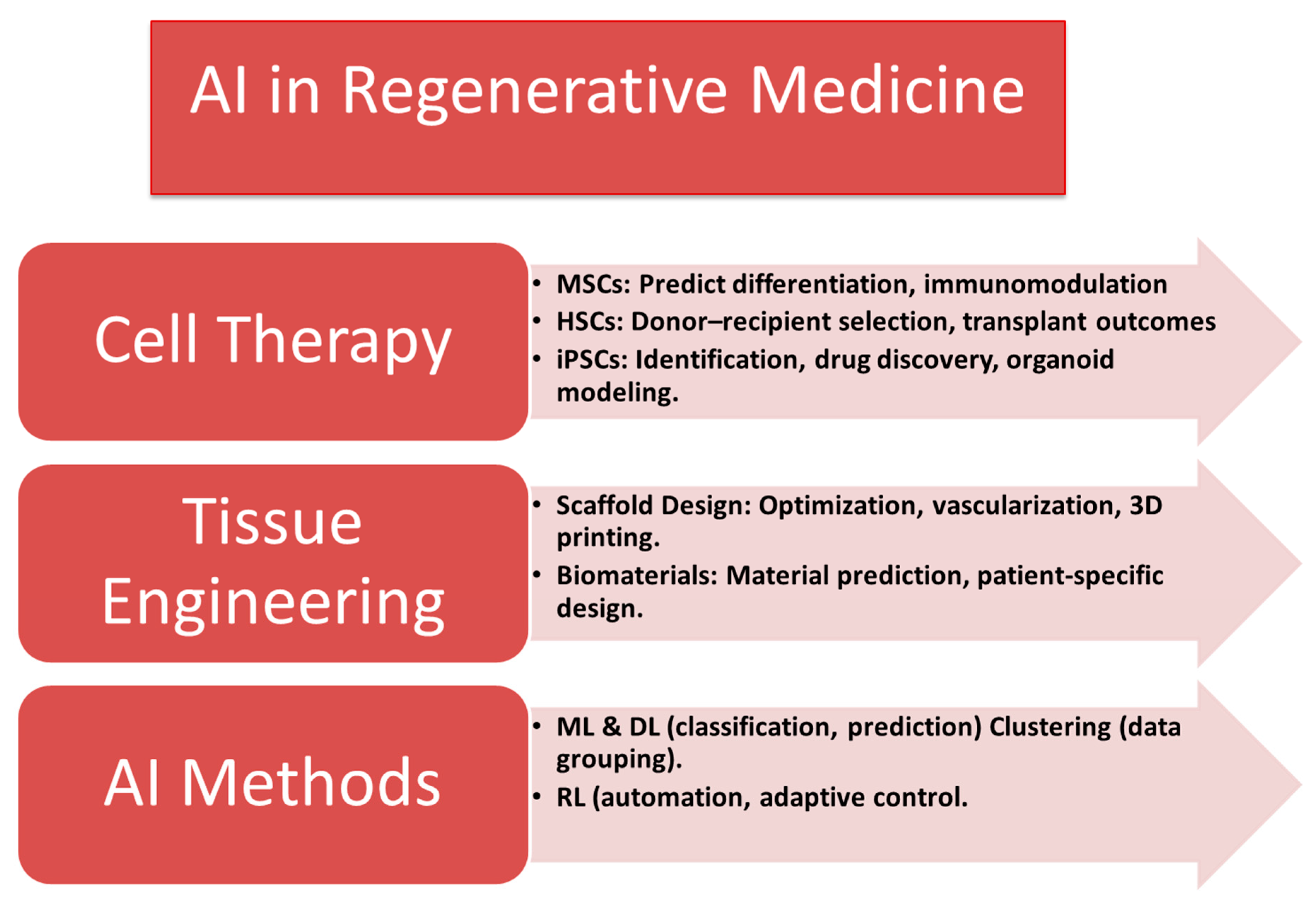
This review focuses on shedding light on the main applications of AI in regenerative medicine (Figure 1).
Figure 1.
Artificial intelligence (AI) plays a crucial role in regenerative medicine, particularly in cell therapy. This includes the use of mesenchymal stem cells (MSCs), hematopoietic stem cells (HSCs), and induced pluripotent stem cells (iPSCs). AI is also involved in tissue engineering, as well as the design of scaffolds and biomaterials. Various AI methods, such as machine learning (ML), deep learning (DL), clustering, and reinforcement learning (RL), are utilized in these processes.
3.1. Application of AI in Cell Therapy
Although cell therapy appears straightforward in theory, the variability and lack of homogeneity among cells make it challenging to precisely characterize all cell products. This complexity is further compounded by potential errors in testing techniques, which may exceed expected rates. To address these challenges, researchers have proposed leveraging AI-based approaches, including the methods previously discussed, to provide more accurate assessments and measurements, possibly optimizing the final formulation for cell therapy [18,19].
Regenerative medicine has recently focused on using cell therapy to treat different types of incurable diseases, such as cancer, diabetes, cardiovascular disease, bone-related diseases, and neurodegenerative disorders. Hence, AI has been introduced into the healthcare sector and regenerative medicine [19]. Table 2 summarizes the key role of AI and its contribution in cell therapy.
Table 2.
Summary of the main stem cell types and their main contributions in applications for cell therapy.
Applications of artificial intelligence in regenerative medicine have advanced past straightforward proof-of-concept research and now provide quantifiable gains in precision, scalability, and translational relevance. Deep learning-based image classifiers, for instance, have been demonstrated to perform better than manual and flow cytometry-based gating in MSC characterization when it comes to identifying minute morphological and phenotypic variations. This allows for high-throughput, label-free phenotyping of stem cell populations [20,21]. Comparably, AI-driven methods that integrate multi-omics data (genomic, transcriptomic, and proteomic) to predict engraftment success and reduce graft-versus-host disease have advanced HSC donor matching beyond traditional HLA-based algorithms, improving clinical outcomes [22,23]. To reduce experimental trial-and-error and speed up therapeutic development, machine learning models have been trained on transcriptomic and epigenomic datasets in the field of iPSC reprogramming to predict reprogramming efficiency and lineage-specific differentiation potential [24,25]. Lastly, artificial intelligence (AI) has been especially helpful in scaffold design and biomaterials, where generative adversarial networks (GANs) and topology optimization algorithms are used to predict and fabricate biomaterial architectures with enhanced cell-instructive properties, mechanical strength, and biocompatibility [26,27]. These developments demonstrate how AI’s translational potential in regenerative medicine is being greatly enhanced by its transition from descriptive applications to predictive, integrative, and design-oriented frameworks.
3.1.1. Mesenchymal Stem Cells (MSCs)
MSCs are known for their capability to renew themselves and their potency to differentiate into several tissue types. Therefore, hMSCs are currently being used in therapeutic applications in a variety of clinical situations through a large number of clinical trials. Despite the apparent potential for MSCs to go from the bench to the bedside, several early- or late-stage clinical trials have revealed serious limitations, which have resulted in the FDA disapproving various treatments [11]. The main reasons behind the failure of hMSCs in clinical trials can be summarized as follows: inconsistency in the characterization of hMSCs, in terms of their properties, as well as differentiation, self-renewal potency, heterogeneity, immune compatibility, and stability. In addition to the variation in their regenerative and immunomodulatory properties, all these challenges were responsible for the variation in the therapeutic responses of MSCs when used in clinical trials [28].
Therefore, the success of the clinical applications of MSCs and the superior production of both cells and their products on a large scale depend on the accuracy of the quality control of MSC functions. Nowadays, AI models and algorithms are used in morphological characterization to forecast the activity of MSC in in vitro cultures. These models are used to forecast the main characteristics of MSCs, such as differentiation potential, immunomodulatory ability, and communication with their surroundings. Scientists have created an end-to-end DL framework that can functionally screen MSC lines using the images of cells under the microscope [19].
Using straightforward light microscopic pictures, the refined DenseNet121 DL model efficiently separated stem cell lines with various MUSE cell markers into two groups based on the expression level of MUSE into high and low expression levels, enabling the isolation of hNTSC donors. Heterogeneous live MSC culture may be quantitatively and multi-markedly characterized using AI-based label-free microscopy [20]. An AI model can accurately forecast the level of expression for common markers. By training a DL model with images of phase contrast and fluorescent microscopes, the results showed that by providing more particulars to conventional analysis of cell morphology, AI image translation helps assess and enhance microscopy data [20]. AI image translation is an effective method for improving and assessing microscopic data [29].
3.1.2. Hematopoietic Stem Cells (HSC)
HSCs are stem cells derived from the bone marrow of the donor and then transplanted into the patient’s body. This procedure is known as bone marrow transplantation (BMT). It is mainly used in advanced treatment for blood cancer patients, such as leukemia, myeloma, and lymphoma. However, there are many limitations for this procedure due to the probability of stem cell transplantation failure, organ damage, infection, and infertility, in addition to the chance of having graft-versus-host-diseases (GVHDs) in the allogenic transplantation cases [29].
The prognosis of HSC transplantation (HSCT) recipients may be impacted by the difficult task of choosing donor-recipient combinations. Many studies have investigated how AI solutions could be able to help with this problem. By enhancing donor selection, an algorithm that makes use of ML and takes into account several variables, including recipient, donor, and transplant characteristics, seeks to increase the survival rate of HCT patients with secondary acute leukemia (AL). Despite the encouraging initial results of using ML in HCT, the algorithm has failed to pass validation studies. A previous study in Taiwan showed that AI has a great role in overcoming the post-transplant challenges in HSCT patients. By using the data of pre-transplant minimal residual disease (MRD), an AI diagnostic tool has been designed to predict allogeneic HCT outcomes in different types of blood diseases, including myelodysplastic syndrome (MDS) and acute myeloid leukemia (AML). The dataset, which included flow cytometry data from patients of the latter syndrome, which were collected from 2009 to 2017, was split into training and validation sets at random. The AI system was developed and optimized using the training set, and the blind validation set was used to assess the finished model. With training accuracy of 90.8% and 84.4%, respectively, the outcomes demonstrated that the AI method could successfully distinguish between normal and abnormal instances related to MDS or AML [30].
3.1.3. Induced Pluripotent Stem Cells (iPSCs)
Human pluripotent stem cells can be used to create 3D cell structures that mimic organ tissues. Their medical importance arises because they can provide researchers with a source of pluripotent stem cells that can differentiate into all three germ layers. Hence, sidestepping the ethical issues related to the use of embryonic stem cells and the possibility of transplant immune rejection [31]. However, a major obstacle to the use of these cells in clinical applications is the poor reprogramming and differentiation effectiveness of popular iPSC methods. Both ML and DL can help evaluate the reprogramming state and differentiation potencies of human iPSCs, thereby increasing the yield and efficiency of iPSC biological processes, even though the usage of iPSCs in clinical contexts may not be imminent [32].
The automated framework for evaluating iPSCs and other similar stem cells is offered by the artificial intelligence subfield of DL. The analysis of the medical images has made use of convolutional neural networks (CNNs), which are highly accurate at identifying iPSCs from microscopic images. By using CNNs to correct data characteristics, DL replaces traditional detection methods that depend on molecular labeling procedures and makes it possible to identify iPSCs through microscopic pictures with high accuracy. The clinical translation of iPSCs in stem cell-based treatments and research has greatly advanced as a result of this ground-breaking discovery. Previous studies have demonstrated that disease-specific iPSCs can faithfully mimic sick conditions to model diseases and develop novel treatments. However, there are several difficulties with using iPSCs for drug screening [33].
The phenotypic screening of cells’ images is critical for AI models applied in drug development, but it is also crucial in designing a system that speculates the pharmacological effects from the structural formulas of drugs. Convolutional neural network architectures help researchers analyze a variety of substances and can analyze datasets with a graph structure. The GCN model has been used to seek antibiotics based on their chemical structures. Hence, the algorithm has been trained on over 100 million compound datasets, identifying hit compounds using 1760 molecules with known phenotypes. Beyond image analysis, AI can be applied to drug research to forecast illnesses by using genome and RNA expression data. Additionally, AI can analyze chemical formulas and protein–protein interactions, allowing for in silico virtual screening to find possible compounds [34].
For iPSCs to be produced as efficiently as feasible, scalable cell production methodologies must be developed. This is because both functional differentiation and efficient self-renewal depend on these strategies. Traditional manual cell culture techniques are labor-intensive and unreliable, making them unsuitable for high-throughput applications. An automated system can rapidly and reliably generate billions of hiPSCs from disease-model cell lines and patients. Besides, all crucial phases of culture and differentiation of hiPSC can be prepared under defined culture conditions. According to Park et al., the production of kidney organoids prepared from human pluripotent stem cells (hPSCs) has shown promise in renal disease modeling, regenerative medicine, nephrotoxicity testing, and drug screening [35].
However, to obtain consistent and reliable results from experiments related to kidney organoid production, which is thought to be beneficial for their possible clinical use, a reliable technique for choosing highly mature kidney organoids is required. By using basic-contrast bright-field optical microscopy images, scientists have suggested that kidney organoids may be evaluated for differentiation status. Without the use of intrusive procedures, they have developed a deep learning-based strategy to quickly and precisely estimate the degree of differentiation of kidney organoids. Instead of using 2D confocal images as in prior work, our approach used the expression of mRNA levels to identify the differentiation stage of the organoid. The researchers used bright-field microscopy to identify 15 organoids with either poor or good morphology. qPCR and certain primers that target the podocyte, distal, and proximal tubule genes were used. CNN models were employed as feature extractors to forecast the mRNA expression of particular kidney biomarkers based on morphological information from bright-field images [19].
3.2. Tissue Engineering
3.2.1. Scaffold Design
The design of scaffolds in tissue engineering increasingly relies on AI. By integrating AI with machine learning (ML) techniques, researchers can model, predict, and optimize scaffold properties such as porosity, stiffness, biodegradability, and mechanical strength. These models learn from large datasets of material compositions and experimental outcomes, allowing rapid prediction of optimal scaffold architectures without extensive trial and error [36]. The development of novel scaffolds with the required mechanical properties is facilitated by using AI-assisted design approaches such as CAD models [11].
The optimization of the 3D printing procedure for tissue engineering scaffolds has been significantly advanced through the use of ML and AI technologies. By analyzing large volumes of data and identifying complex patterns, these tools can optimize printing parameters, reduce fabrication errors, and enhance the overall quality and reproducibility of printed scaffolds. Additionally, AI and ML simplify the prediction of scaffold designs and manufacturing techniques, enabling more efficient customization and optimization of tissue-engineered constructs [37]. This predictive process employs advanced algorithms such as decision trees and linear regression, taking into account multiple factors including success rate, fabrication complexity, and production cost. Additionally, AI is essential to the advancement of new materials that are incorporated into complex 3D geometries, pushing the limits of scaffold production [38].
AI and ML play a crucial role in forecasting the likelihood of vascularization in tissue engineering scaffolds, which is relevant to repair techniques. These technologies provide crucial insights into the probability of effective vascularization by carefully examining a variety of aspects, such as scaffold design, material qualities, and cell activity. This information informs and improves tissue restoration tactics. Another key application is correlating the physical and chemical properties of scaffolds with their behavior in in vitro cultures. ML algorithms can identify complex links and patterns through the study of large datasets. These insights are then applied to refine scaffold designs and enhance their functional performance [39].
There are many obstacles to overcome when integrating AI into tissue engineering scaffold design. One major obstacle is the complex mathematics involved, as scaffold designs are often highly intricate. This complexity can lead to errors or excessively large computational results that are difficult to model or interpret accurately. Second, the integration of AI is further complicated by the limitations of existing PC-based design tools. Traditional tissue engineering production methods often generate random, biomimetic porous structures, which are difficult for current computer-aided design (CAD) software to accurately represent. This makes it challenging to capture the essential three-dimensional information required for precise scaffold fabrication [19]. Thirdly, a significant challenge is the lack of available data. Access to large datasets for analysis and prediction is essential for the effective application of AI in tissue engineering, but this area is severely hampered by a lack of resources, which impedes the development of AI-driven scaffold design. Finally, the difficulties are exacerbated by the lengthy development cycle in tissue engineering. The creation of functional tissue-engineered scaffolds typically spans five years and involves multiple stages, including material selection, scaffold fabrication, in vitro testing, and preclinical validation. This extended timeline slows the integration of AI into the design process, as models require continuous updates with experimental data and iterative validation to remain accurate. Moreover, the protracted development period increases the resource demands and costs associated with implementing AI-driven optimization, making rapid translation from computational predictions to practical scaffold production particularly difficult [19].
The role of AI in scaffold design has been applied in several studies of tissue engineering. For example, one study used artificial intelligence (AI) to construct scaffolds for tissue engineering, specifically using 3D convolutional neural networks and virtual tomography. Based on virtual tomography data, the scaffold architecture was analyzed and optimized using AI algorithms. Another study has focused on the role of the ML in the development of scaffolds by 3D bioprinting technology. The study has shown how ML algorithms might enhance scaffold characteristics, material selection, and the printing process [40]. Additionally, another study created scaffolds for tissue engineering using 3D printing guided by ML. To forecast the scaffolds’ mechanical characteristics and improve the printing conditions, they used machine learning algorithms. Moreover, the breakdown rate of gelatin/genipin scaffolds was investigated using machine learning techniques, and porous 3D structures were created using varying amounts of polymers, genipin, and gelatin; then, the scaffolds’ weight changes were monitored over time. Based on the gathered data, the degradation rate was subsequently modeled using machine learning techniques [37].
3.2.2. Biomaterials
Tissue engineering (TE) and biomaterials are closely connected, and both can be significantly enhanced by artificial intelligence (AI), particularly through machine learning (ML). ML can be used to optimize procedures and forecast results, thus leading to a comprehensive evaluation of enormous amounts of data produced by TE applications. Complex relationships between material properties and input factors can be effectively identified using AI systems, enabling the optimization of tissue-engineered constructs and leading to improved structural integrity and performance [41,42]. Furthermore, the integration of generative artificial intelligence (GenAI) in biomaterials research offers new opportunities to accelerate innovation while ensuring responsible translation into clinical practice [43].
The ability of AI to predict material properties and behaviors represents a significant advancement in tissue engineering, as it reduces the need for extensive experimental iterations. By minimizing laboratory trials, AI accelerates research and development, saving time, costs, and resources while enhancing overall efficiency in the design and optimization of biomaterials. Furthermore, by examining patient-specific data, including genetic information and medical imaging, ML models allow for the customization and modification of biomaterials and tissue-engineered constructions. In the end, this individualized strategy improves patient outcomes by enabling customized treatments [43,44]. Table 3 summarizes the main applications of AI in regenerative medicine, highlighting the AI methods used, dataset size, performance metrics, and the key strengths and limitations of each application.
Table 3.
A Comparison of different applications in regenerative medicine.
Furthermore, by efficiently analyzing extensive datasets, finding patterns, and producing insights, AI speeds up the pace of research and development related to the combined biomaterials and tissue engineering fields. Thus, this enhances quick advances in the sector by accelerating the process of invention and discovery. Finally, AI algorithms can handle a variety of data formats, such as high-dimensional data, videos, and photos, which improves the ability to analyze data. Research in tissue engineering and biomaterials is greatly advanced by this thorough examination and interpretation of complicated data [45,46].
4. Challenges and Limitations
Overall, the use of AI in the production of biomaterials and tissue engineering materials has tremendous potential to advance research, streamline experimental processes, and ultimately improve patient outcomes. Challenges remain in implementing machine learning (ML) within tissue engineering applications. Obtaining high-quality, representative datasets and converting them into usable, standardized formats can be difficult. Moreover, careful consideration is required in the preparation and presentation of data derived from manual or experimental procedures to ensure consistency, accuracy, and reliability in AI model training and validation [47].
There are several significant challenges to overcome when integrating AI with biomaterials in tissue engineering. These challenges include handling diverse data formats, such as audio, video, high-dimensional data, and images, which may not be readily compatible with AI methods like machine learning. Furthermore, variability among researchers and laboratories makes the collection and standardization of data, such as experimental measurements, imaging data, biomarker assays, and procedural notes, a major challenge. Furthermore, personal intervention and thorough data analysis are necessary to efficiently extract pertinent information due to the difficulty of producing and representing data obtained from the applications of biomaterials in tissue engineering studies [11].
Despite showing promise, several obstacles restrict and regulate the use of AI techniques in this field, such as the absence of standardized data collection, the challenge of locating relevant datasets, and the need to convert sizable datasets into formats that are pertinent and easily accessible [48].
The lack of standardized frameworks for data collection, annotation, and sharing presents a significant challenge. Reproducibility and benchmarking suffer due to the use of varied datasets, inconsistent experimental techniques, and inadequate metadata. For example, mesenchymal stem cells (MSCs) cultured in different laboratories often show considerable variability in isolation techniques, passage numbers, surface markers, and differentiation assays. This variability leads to poor transferability of predictive models and limits external validation in clinical settings. To address these issues, it is essential to develop benchmarking platforms and adopt international standards, such as the FAIR principles (Findable, Accessible, Interoperable, and Reusable), to ensure consistency and comparability across institutions [49].
Incorporating machine learning operations (MLOps) into biological research pipelines is crucial. MLOps offers structured workflows that enhance the scalability, reproducibility, and continuous monitoring of AI models. For instance, in workflows involving automated organoid imaging and segmentation, model performance can decline when new imaging hardware or staining protocols are introduced. This decline highlights the need for automated retraining pipelines to maintain model robustness and avoid errors in clinical decision-making. Implementing strict version control, performance dashboards, and automated retraining using updated datasets ensures that models remain clinically relevant and adaptable as experimentation evolves [50].
The development of strong validation frameworks is another top objective. Clinical-grade validation pipelines, sandbox testing environments, and multi-center research may guarantee that AI models are evaluated in authentic settings. Approval and adoption will be accelerated by coordinating these validation procedures with global regulatory guidelines, such as the digital health frameworks of the European Medicines Agency (EMA) and the U.S. Food and Drug Administration (FDA) [51,52]. Lastly, ethical and translational issues must be addressed for implementation to be successful. Ensuring fairness, safety, and trust requires active engagement between physicians, data scientists, and regulators, transparent reporting, and equitable data representation across varied patient populations AI has the ability to advance beyond idealistic ideas and provide real, clinically verified solutions in regenerative medicine by fusing technical rigor with ethical governance [53].
5. Conclusions
Advancements in iPSC reprogramming, scaffold design, HSC donor matching, and MSC characterization have positioned artificial intelligence as a powerful catalyst in regenerative medicine. AI shows strong potential to surpass conventional methods by improving predictive accuracy for graft outcomes, accelerating biomaterial innovation, and enhancing performance in stem cell classification (often exceeding 90% accuracy). However, challenges such as data bias, limited interpretability, restricted generalizability, and insufficient clinical validation continue to limit translation into clinical practice. To fully realize AI’s potential in regenerative medicine, future efforts must focus on building high-quality, diverse datasets; improving model transparency; standardizing validation protocols; and integrating AI-driven tools into clinical workflows through multidisciplinary collaboration and regulatory alignment.
Author Contributions
Both authors contributed to writing and reviewing the manuscript. All authors have read and agreed to the published version of the manuscript.
Funding
This research received no external funding.
Institutional Review Board Statement
There is no ethical conflict.
Acknowledgments
We thank the Deanship of Scientific Research at the University of Petra.
Conflicts of Interest
The authors declare no conflicts of interest.
References
- Hole, K.J.; Ahmad, S. Biologically driven artificial intelligence. Computer 2019, 52, 72–75. [Google Scholar] [CrossRef]
- Srinivasan, M.; Thangaraj, S.R.; Ramasubramanian, K.; Thangaraj, P.P.; Ramasubramanian, K.V. Exploring the current trends of artificial intelligence in stem cell therapy: A systematic review. Cureus 2021, 13, e20083. [Google Scholar] [CrossRef]
- Ahuja, A.S. The impact of artificial intelligence in medicine on the future role of the physician. PeerJ 2019, 7, e7702. [Google Scholar] [CrossRef]
- Kha, Q.H.; Le, V.H.; Hung, T.N.K.; Le, N.Q.K. Development and Validation of an Efficient MRI Radiomics Signature for Improving the Predictive Performance of 1p/19q Co-Deletion in Lower-Grade Gliomas. Cancers 2021, 13, 5398. [Google Scholar] [CrossRef]
- Holmes, J.; Sacchi, L.; Bellazzi, R. Artificial intelligence in medicine. Ann. R. Coll. Surg. Engl. 2004, 86, 334–338. [Google Scholar]
- Bays, H.E.; Fitch, A.; Cuda, S.; Gonsahn-Bollie, S.; Rickey, E.; Hablutzel, J.; Coy, R.; Censani, M. Artificial intelligence and obesity management: An obesity medicine association (OMA) clinical practice statement (CPS) 2023. Obes. Pillars 2023, 6, 100065. [Google Scholar] [CrossRef]
- Azuaje, F. Computational discrete models of tissue growth and regeneration. Brief. Bioinform. 2011, 12, 64–77. [Google Scholar] [CrossRef]
- Blasiak, A.; Khong, J.; Kee, T. CURATE. AI: Optimizing personalized medicine with artificial intelligence. SLAS Technol. Transl. Life Sci. Innov. 2020, 25, 95–105. [Google Scholar]
- Hesami, M.; Jones, A.M.P. Application of artificial intelligence models and optimization algorithms in plant cell and tissue culture. Appl. Microbiol. Biotechnol. 2020, 104, 9449–9485. [Google Scholar] [CrossRef] [PubMed]
- Kerner, J.; Dogan, A.; von Recum, H. Machine learning and big data provide crucial insight for future biomaterials discovery and research. Acta Biomater. 2021, 130, 54–65. [Google Scholar] [CrossRef] [PubMed]
- Bagherpour, R.; Bagherpour, G.; Mohammadi, P. Application of Artificial Intelligence in tissue engineering. Tissue Eng. Part B Rev. 2024, 31, 31–43. [Google Scholar] [CrossRef]
- Sarker, I.H. Machine learning: Algorithms, real-world applications and research directions. SN Comput. Sci. 2021, 2, 160. [Google Scholar] [CrossRef] [PubMed]
- Jiang, B.; Si, J.; Luo, H.; Le, L. Single-Cell Omics Reveal the Mechanisms of Traditional Chinese Medicines. Phytomedicine 2025, 147, 157204. [Google Scholar] [CrossRef] [PubMed]
- Rokach, L. A survey of clustering algorithms. In Data Mining and Knowledge Discovery Handbook; Springer: New York, NY, USA, 2010; pp. 269–298. [Google Scholar]
- Ketkar, N.; Santana, E. Deep Learning with Python; Springer: Berlin/Heidelberg, Germany, 2017. [Google Scholar]
- Sarker, I.H.; Kayes, A.S.M.; Badsha, S.; Alqahtani, H.; Watters, P.; Ng, A. Cybersecurity data science: An overview from machine learning perspective. J. Big Data 2020, 7, 41. [Google Scholar] [CrossRef]
- Yan, Y.; Chow, A.H.; Ho, C.P.; Kuo, Y.-H.; Wu, Q.; Ying, C. Reinforcement learning for logistics and supply chain management: Methodologies, state of the art, and future opportunities. Transp. Res. Part E Logist. Transp. Rev. 2022, 162, 102712. [Google Scholar] [CrossRef]
- Kotsiantis, S.B.; Zaharakis, I.; Pintelas, P. Supervised machine learning: A review of classification techniques. Emerg. Artif. Intell. Appl. Comput. Eng. 2007, 160, 3–24. [Google Scholar]
- Chagahi, M.H.; Dashtaki, S.M.; Moshiri, B.; Piran, J. Cardiovascular disease detection using a novel stack-based ensemble classifier with aggregation layer, DOWA operator, and feature transformation. Comput. Biol. Med. 2024, 173, 108345. [Google Scholar] [CrossRef] [PubMed]
- Sarabi, P.A.; Shabanpouremam, M.; Eghtedari, A.R.; Barat, M.; Moshiri, B.; Zarrabi, A.; Vosough, M. AI-Based solutions for current challenges in regenerative medicine. Eur. J. Pharmacol. 2024, 984, 177067. [Google Scholar] [CrossRef]
- Kim, G.; Jeon, J.H.; Park, K.; Kim, S.W.; Kim, D.H.; Lee, S. High throughput screening of mesenchymal stem cell lines using deep learning. Sci. Rep. 2022, 12, 17507. [Google Scholar] [CrossRef]
- Imboden, S.; Liu, X.; Lee, B.S.; Payne, M.C.; Hsieh, C.-J.; Lin, N.Y.C. Investigating heterogeneities of live mesenchymal stromal cells using AI-based label-free imaging. Sci. Rep. 2021, 11, 6728. [Google Scholar] [CrossRef]
- Xiang, J.; Shi, M.; Fiala, M.A.; Gao, F.; Rettig, M.P.; Uy, G.L.; Schroeder, M.A.; Weilbaecher, K.N.; Stockerl-Goldstein, K.E.; Mollah, S.; et al. Machine learning–based scoring models to predict hematopoietic stem cell mobilization in allogeneic donors. Blood Adv. 2022, 6, 1991–2000. [Google Scholar] [CrossRef] [PubMed]
- Riva, E. Study of the Immunological Landscape in Myelodysplastic Syndromes: A Multi-Omics Approach. Ph.D. Thesis, University of Milano-Bicocca, Milan, Italy, 2024. [Google Scholar]
- Fan, K.; Zhang, S.; Zhang, Y.; Lu, J.; Holcombe, M.; Zhang, X. A machine learning assisted, label-free, non-invasive approach for somatic reprogramming in induced pluripotent stem cell colony formation detection and prediction. Sci. Rep. 2017, 7, 13496. [Google Scholar] [CrossRef] [PubMed]
- Choudhery, M.S.; Arif, T.; Mahmood, R. Applications of artificial intelligence in stem cell therapy. World J. Stem Cells 2025, 17, 106086. [Google Scholar] [CrossRef] [PubMed]
- Pugliese, R.; Badini, S.; Frontoni, E.; Regondi, S. Generative Artificial Intelligence for Advancing Discovery and Design in Biomateriomics. Intell. Comput. 2025, 4, 0117. [Google Scholar] [CrossRef]
- Omigbodun, F.T.; Oladapo, B.I. AI-optimized lattice structures for biomechanics scaffold design. Biomimetics 2025, 10, 88. [Google Scholar] [CrossRef]
- Zhou, T.; Yuan, Z.; Weng, J.; Pei, D.; Du, X.; He, C.; Lai, P. Challenges and advances in clinical applications of mesenchymal stromal cells. J. Hematol. Oncol. 2021, 14, 24. [Google Scholar] [CrossRef] [PubMed]
- Weber, L.; Lee, B.S.; Imboden, S.; Hsieh, C.-J.; Lin, N.Y. Phenotyping senescent mesenchymal stromal cells using AI image translation. Curr. Res. Biotechnol. 2023, 5, 100120. [Google Scholar] [CrossRef] [PubMed]
- Muhsen, I.N.; Elhassan, T.; Hashmi, S.K. Artificial intelligence approaches in hematopoietic cell transplantation: A review of the current status and future directions. Turk. J. Hematol. 2018, 35, 152. [Google Scholar] [CrossRef] [PubMed]
- Matsumoto, R.; Yamamoto, T.; Takahashi, Y. Complex organ construction from human pluripotent stem cells for biological research and disease modeling with new emerging techniques. Int. J. Mol. Sci. 2021, 22, 10184. [Google Scholar] [CrossRef]
- Coronnello, C.; Francipane, M.G. Moving towards induced pluripotent stem cell-based therapies with artificial intelligence and machine learning. Stem Cell Rev. Rep. 2022, 18, 559–569. [Google Scholar] [CrossRef]
- Serghini, A.; Portelli, S.; Ascher, D.B. AI-Driven Enhancements in Drug Screening and Optimization. In Computational Drug Discovery and Design; Springer: Berlin/Heidelberg, Germany, 2023; pp. 269–294. [Google Scholar]
- Wang, X.; Liu, J.; Zhang, C.; Wang, S. SSGraphCPI: A novel model for predicting compound-protein interactions based on deep learning. Int. J. Mol. Sci. 2022, 23, 3780. [Google Scholar] [CrossRef]
- Lee, J.Y.; Kim, J.; Kim, Y.K.; Kim, J.; Nam, S. Deep Learning Predicts the Differentiation of Kidney Organoids Derived from Human-Induced Pluripotent Stem Cells: FR-PO354. J. Am. Soc. Nephrol. 2022, 33, 420. [Google Scholar] [CrossRef]
- Bermejillo Barrera, M.D.; Franco-Martínez, F.; Díaz Lantada, A. Artificial intelligence aided design of tissue engineering scaffolds employing virtual tomography and 3D convolutional neural networks. Materials 2021, 14, 5278. [Google Scholar] [CrossRef]
- Conev, A.; Litsa, E.E.; Perez, M.R.; Diba, M.; Mikos, A.G.; Kavraki, L.E. Machine learning-guided three-dimensional printing of tissue engineering scaffolds. Tissue Eng. Part A 2020, 26, 1359–1368. [Google Scholar] [CrossRef]
- Pugliese, R.; Regondi, S. Artificial intelligence-empowered 3D and 4D printing technologies toward smarter biomedical materials and approaches. Polymers 2022, 14, 2794. [Google Scholar] [CrossRef]
- Sujeeun, L.Y.; Goonoo, N.; Ramphul, H.; Chummun, I.; Gimié, F.; Baichoo, S.; Bhaw-Luximon, A. Correlating in vitro performance with physico-chemical characteristics of nanofibrous scaffolds for skin tissue engineering using supervised machine learning algorithms. R. Soc. Open Sci. 2020, 7, 201293. [Google Scholar] [CrossRef]
- Shin, J.; Lee, Y.; Li, Z.; Hu, J.; Park, S.S.; Kim, K. Optimized 3D bioprinting technology based on machine learning: A review of recent trends and advances. Micromachines 2022, 13, 363. [Google Scholar] [CrossRef] [PubMed]
- Suwardi, A.; Wang, F.; Xue, K.; Han, M.; Teo, P.; Wang, P.; Wang, S.; Liu, Y.; Ye, E.; Li, Z.; et al. Machine learning-driven biomaterials evolution. Adv. Mater. 2022, 34, 2102703. [Google Scholar] [CrossRef] [PubMed]
- Bai, L.; Xia, Z.; Triffitt, J.T.; Su, J. Generation artificial intelligence (GenAI) and biomaterials translational: Steering innovation without misdirection. Biomater. Transl. 2024, 5, 1. [Google Scholar]
- Kim, J.; McKee, J.A.; Fontenot, J.J.; Jung, J.P. Engineering tissue fabrication with machine intelligence: Generating a blueprint for regeneration. Front. Bioeng. Biotechnol. 2020, 7, 443. [Google Scholar] [CrossRef]
- Bai, L.; Su, J. Converging technologies in biomaterial translational research. Biomater. Transl. 2023, 4, 197. [Google Scholar]
- Kosuri, S.; Borca, C.H.; Mugnier, H.; Tamasi, M.; Patel, R.A.; Perez, I.; Kumar, S.; Finkel, Z.; Schloss, R.; Cai, L.; et al. Machine-assisted discovery of Chondroitinase ABC complexes toward sustained neural regeneration. Adv. Healthc. Mater. 2022, 11, 2102101. [Google Scholar] [CrossRef]
- Yu, K.; Gao, Q.; Mi, Y.; Yao, Y.; Lin, Z.; Zhu, M.; Zhang, P.; Sing, S.L.; Lu, L. Computational investigation of a 3D-printed osteochondral interface scaffold with comprehensive interfacial mechanical properties. Int. J. Bioprinting 2025, 11, 353–369. [Google Scholar] [CrossRef]
- Hakimi, O.; Gelpi, J.L.; Krallinger, M.; Curi, F.; Repchevsky, D.; Ginebra, M. The devices, experimental scaffolds, and biomaterials ontology (DEB): A tool for mapping, annotation, and analysis of biomaterials data. Adv. Funct. Mater. 2020, 30, 1909910. [Google Scholar] [CrossRef]
- Esmaeili, Y.; Bidram, E.; Bigham, A.; Atari, M.; Azadani, R.N.; Tavakoli, M.; Salehi, S.; Mirhaj, M.; Basiri, A.; Mirzavandi, Z.; et al. Exploring the evolution of tissue engineering strategies over the past decade: From cell-based strategies to gene-activated matrix. Alex. Eng. J. 2023, 81, 137–169. [Google Scholar] [CrossRef]
- Testi, M. Machine Learning Operations (MLOps) in Healthcare. Ph.D. Thesis, Università Campus Bio-Medico di Roma, Rome, Italy, 2024. [Google Scholar]
- US Food & Drug Administration (FDA). Proposed Regulatory Framework for Modifications to Artificial Intelligence. Machine Learning (AI/ML)-Based Software as a Medical Device (SaMD)—Discussion Paper and Request for Feedback; US Food & Drug Administration (FDA): Silver Spring, MA, USA, 2019. [Google Scholar]
- Silva, I.; Gabrielli, G.; Burgos, J.G.; Moulon, I.; Rojas, G.C.; Jaeger, U.; Giuliani, R. A decade of collaboration in medicines regulation: Healthcare professionals engaging with the European Medicines Agency. Front. Med. 2024, 11, 1399947. [Google Scholar] [CrossRef] [PubMed]
- Char, D.S.; Shah, N.H.; Magnus, D. Implementing machine learning in health care—Addressing ethical challenges. N. Engl. J. Med. 2018, 378, 981. [Google Scholar] [CrossRef] [PubMed]
Disclaimer/Publisher’s Note: The statements, opinions and data contained in all publications are solely those of the individual author(s) and contributor(s) and not of MDPI and/or the editor(s). MDPI and/or the editor(s) disclaim responsibility for any injury to people or property resulting from any ideas, methods, instructions or products referred to in the content. |
© 2025 by the authors. Licensee MDPI, Basel, Switzerland. This article is an open access article distributed under the terms and conditions of the Creative Commons Attribution (CC BY) license (https://creativecommons.org/licenses/by/4.0/).