
applsci-logo

Journal Browser

Journal Browser

Application and Extraction of Bioactive Compounds and Antioxidants in Food and Plants

A special issue of Applied Sciences (ISSN 2076-3417). This special issue belongs to the section "Food Science and Technology".

Deadline for manuscript submissions: 20 March 2026 | Viewed by 2197

Special Issue Editors


E-Mail Website
Guest Editor
Department of Fruit, Vegetable and Plant Nutraceutical Technology, Wrocław University of Environmental and Life Sciences, Chełmońskiego 37, 51-630 Wrocław, Poland
Interests: fruits and vegetables; antioxidant activity; bioactive compounds: polyphenols, anthocyanins, carotenoids, sugar and organic acid; microencapsulation
Special Issues, Collections and Topics in MDPI journals

E-Mail Website
Guest Editor
Department of Functional Food Products Development, Wroclaw University of Environmental and Life Sciences, 50-375 Wrocław, Poland
Interests: new methods of food preservation; pulsed electric fields; microwave treatment; bioactive components; traditional and regional food; nutrigenomics and nutrigenetics; historical and modern eating habits
Special Issues, Collections and Topics in MDPI journals

Special Issue Information

Dear Colleagues,

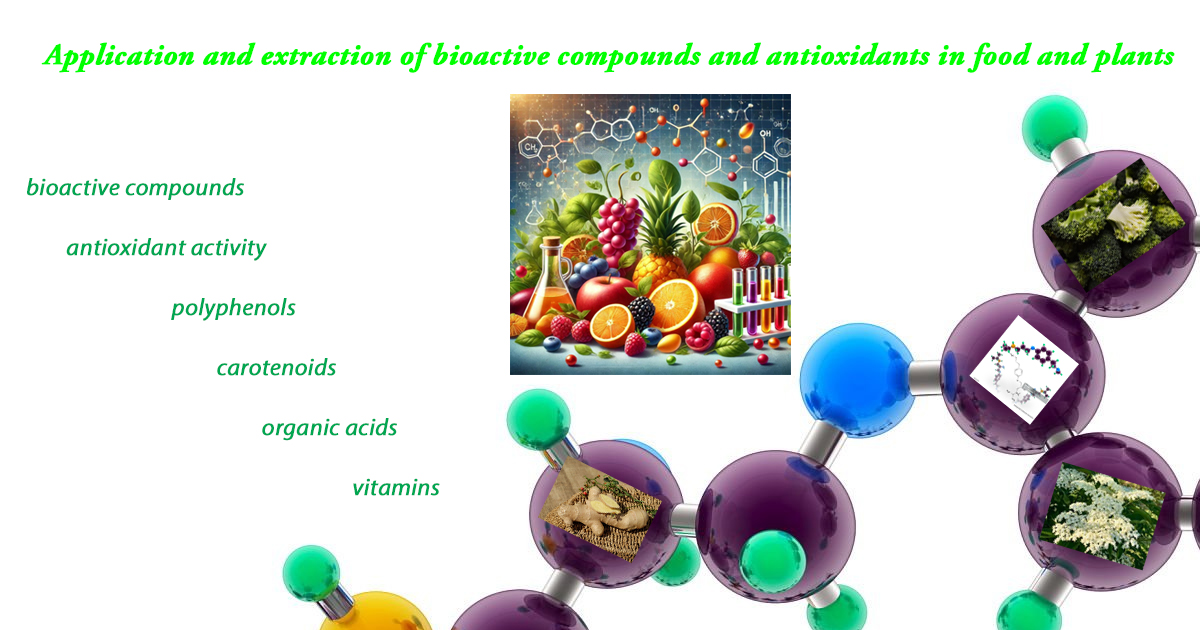
Bioactive compounds and antioxidant activity are very important factors determining the quality of food and characterizing vegetation. The content of compounds such as polyphenols, carotenoids, organic acids, and vitamins affects our development and well-being. Currently, consumers are more aware and want to know what components are in their food and what is hidden in edible plants. They want to be shown the content of bioactive compounds and antioxidant activity of their food. They also want to know what effect bioactive compounds and antioxidants have and how we can extract them. The articles of interest for this Special Issue concern the method of extraction and the possibilities of their use of bioactive compounds and antioxidant activity. Potential topics include, but are not limited to:

  • Comparison of bioactive compound content and antioxidant activity of different food products (plant and animal) with plant additives;
  • Use of plant extracts to enhance antioxidant activity;
  • Linking bioactive compound content with their antioxidant activity;
  • Impact of antioxidant activity of plant materials on human health.

Dr. Agnieszka Nawirska-Olszańska
Dr. Maciej Oziembłowski
Guest Editors

Manuscript Submission Information

Manuscripts should be submitted online at www.mdpi.com by registering and logging in to this website. Once you are registered, click here to go to the submission form. Manuscripts can be submitted until the deadline. All submissions that pass pre-check are peer-reviewed. Accepted papers will be published continuously in the journal (as soon as accepted) and will be listed together on the special issue website. Research articles, review articles as well as short communications are invited. For planned papers, a title and short abstract (about 250 words) can be sent to the Editorial Office for assessment.

Submitted manuscripts should not have been published previously, nor be under consideration for publication elsewhere (except conference proceedings papers). All manuscripts are thoroughly refereed through a single-blind peer-review process. A guide for authors and other relevant information for submission of manuscripts is available on the Instructions for Authors page. Applied Sciences is an international peer-reviewed open access semimonthly journal published by MDPI.

Please visit the Instructions for Authors page before submitting a manuscript. The Article Processing Charge (APC) for publication in this open access journal is 2400 CHF (Swiss Francs). Submitted papers should be well formatted and use good English. Authors may use MDPI's English editing service prior to publication or during author revisions.

Keywords

  • bioactive compounds
  • antioxidant activity
  • polyphenols
  • carotenoids
  • organic acids
  • vitamins

Benefits of Publishing in a Special Issue

  • Ease of navigation: Grouping papers by topic helps scholars navigate broad scope journals more efficiently.
  • Greater discoverability: Special Issues support the reach and impact of scientific research. Articles in Special Issues are more discoverable and cited more frequently.
  • Expansion of research network: Special Issues facilitate connections among authors, fostering scientific collaborations.
  • External promotion: Articles in Special Issues are often promoted through the journal's social media, increasing their visibility.
  • Reprint: MDPI Books provides the opportunity to republish successful Special Issues in book format, both online and in print.

Further information on MDPI's Special Issue policies can be found here.

Published Papers (4 papers)

Order results
Result details
Select all
Export citation of selected articles as:

Research

14 pages, 2089 KB  
Article
Pulsed Electric Field Treatment of Berry Fruit Seeds: Effect on Phenolic Compound Recovery
by Iga Piasecka-Lenartowicz, Stanisław Kalisz, Artur Wiktor and Agata Górska
Appl. Sci. 2025, 15(24), 13006; https://doi.org/10.3390/app152413006 - 10 Dec 2025
Abstract
Pulsed electric field (PEF) technology represents a promising non-thermal method for enhancing the extraction of bioactive compounds from plant matrices. This study investigated the influence of PEF treatment on the bioactive compounds composition of aqueous extracts obtained after processing blackcurrant, redcurrant, chokeberry, raspberry, [...] Read more.
Pulsed electric field (PEF) technology represents a promising non-thermal method for enhancing the extraction of bioactive compounds from plant matrices. This study investigated the influence of PEF treatment on the bioactive compounds composition of aqueous extracts obtained after processing blackcurrant, redcurrant, chokeberry, raspberry, and blackberry seeds. The seeds were treated at 8 kV or 10 kV electrode voltage, and 50 kJ/kg energy input, and the resulting extracts were analyzed for total polyphenol content (TPC), antioxidant capacity (ABTS and DPPH assays), anthocyanin composition (HPLC-DAD), and color parameters (L*, a*, b*). The PEF treatment significantly enhanced the release of polyphenols, anthocyanins, and antioxidant compounds, particularly in chokeberry, raspberry, and blackberry seed extracts. Extracts obtained after PEF treatment exhibited higher TPC, in a range between 0.57 and 3.00 mg GAE/g, and higher radical scavenging activity in a range 2.33–35.07 µmol TE/g in ABTS assay and 1.07–12.27 µmol TE/g in DPPH assay. Also, more intense red coloration was determined, confirming that electroporation facilitated pigment and phenolic migration into the aqueous phase. These findings demonstrate that PEF is an efficient and solvent-free intensification technique for the valorization of berry by-products, generating aqueous fractions rich in natural antioxidants and colorants that support circular and sustainable fruit-processing practices. Full article
Show Figures

Figure 1

28 pages, 1049 KB  
Article
Rowanberry Nectar—The Effect of Preparation Method, Sweetener Addition, and Storage Condition on Bioactive Compounds
by Marta Wilk, Mirosława Teleszko, Paulina Nowicka, Przemysław Seruga and Aneta Wojdyło
Appl. Sci. 2025, 15(23), 12674; https://doi.org/10.3390/app152312674 - 29 Nov 2025
Viewed by 248
Abstract
Rowanberries (Sorbus aucuparia) are valued for their high content of bioactive compounds. This study examined the effects of sweeteners (sucrose, xylitol, erythritol, steviol glycosides), fruit pulp preparation (fresh vs. steamed), and storage conditions (4 °C and 30 °C, 3 months) on [...] Read more.
Rowanberries (Sorbus aucuparia) are valued for their high content of bioactive compounds. This study examined the effects of sweeteners (sucrose, xylitol, erythritol, steviol glycosides), fruit pulp preparation (fresh vs. steamed), and storage conditions (4 °C and 30 °C, 3 months) on the composition of rowanberry nectars. Polyphenols were quantified using LC-PDA-QTOF/MS and UPLC-PDA-FL, and carotenoids, organic acids, antioxidant capacity (FRAP), and physicochemical properties were also determined. Steaming increased total polyphenol levels in nectars by 13–52%, with the highest values observed in formulations containing steviol glycosides (up to 1833 mg/100 mL). Changes in carotenoid content during storage varied depending on the sweetener type. In steamed nectars with erythritol stored at 4 °C, carotenoid levels remained close to those measured in the corresponding unsweetened steamed sample. Storage influenced turbidity and viscosity in all variants, with the largest viscosity increases recorded in stevia- and erythritol-sweetened nectars. Overall, the combined effects of fruit preparation, sweetener type, and storage determined the final composition and stability of rowanberry nectars. Full article
Show Figures

Figure 1

17 pages, 1060 KB  
Article
Impact of Purification Methods on the Antioxidant Properties of Tannin-Rich Extracts Obtained from Berry Fruit By-Products
by Agnieszka Hejduk, Michał Sójka and Robert Klewicki
Appl. Sci. 2025, 15(21), 11701; https://doi.org/10.3390/app152111701 - 1 Nov 2025
Cited by 1 | Viewed by 397
Abstract
This study evaluates how different purification methods influence the antioxidant properties of polyphenol-rich berry pomace extracts, taking into account both the source of the pomace and the purification strategy used. The extracts were obtained from raspberry, blackberry, strawberry, and wild strawberry pomaces derived [...] Read more.
This study evaluates how different purification methods influence the antioxidant properties of polyphenol-rich berry pomace extracts, taking into account both the source of the pomace and the purification strategy used. The extracts were obtained from raspberry, blackberry, strawberry, and wild strawberry pomaces derived from the production of unclarified juices and purées. The extracts were analyzed in three states: crude (CEX), purified using Amberlite XAD 1600N adsorbent resin (XAD), and purified via size-exclusion chromatography (SEC) on a gel filtration resin. Ellagitannins, flavanols, and anthocyanins were determined using HPLC-DAD-FD methods. Antioxidant properties were determined based on: total antioxidant compounds, DPPH radical scavenging activity, and Fe3+ ion reduction power. Purification significantly enhanced the concentration of antioxidant compounds, which increased 2-fold with the XAD method and more than 3-fold using SEC. The extracts exhibited strong DPPH radical scavenging activity, ranging from 65% to 90% for raspberry and blackberry extracts and from 34% to 95% for strawberry and wild strawberry extracts, depending on the degree of purification. Similarly, Fe3+-reducing power increased 2- to 6-fold in extracts purified using XAD and SEC compared to crude extracts. Purification via size-exclusion chromatography enabled the separation of tannin-rich and anthocyanin-rich extract fractions. Ellagitannins were the main class of polyphenols contributing to the enhanced antioxidant potential. Anthocyanins contributed significantly to antioxidant activity only in the case of blackberry extracts. Full article
Show Figures

Figure 1

16 pages, 1454 KB  
Article
Effect of Ultrasound-Assisted Convective Drying on the Content of Bioactive Compounds and Drying Rate of Strawberry Slices
by Jan Piecko, Monika Mieszczakowska-Frąc, Karolina Celejewska, Niall Dickinson and Justyna Szwejda-Grzybowska
Appl. Sci. 2025, 15(16), 8947; https://doi.org/10.3390/app15168947 - 13 Aug 2025
Viewed by 868
Abstract
The strawberry is the most widely consumed berry in Europe, with a high content of minerals and bioactive compounds. During drying, the bioactive compounds are concentrated, but also partially degraded due to the interaction of high temperature and oxygen, among other factors. In [...] Read more.
The strawberry is the most widely consumed berry in Europe, with a high content of minerals and bioactive compounds. During drying, the bioactive compounds are concentrated, but also partially degraded due to the interaction of high temperature and oxygen, among other factors. In this study, the effect of ultrasound support during the drying of strawberry slices of two cultivars, ‘Florence’ and ‘Alba’, was investigated. The effect of ultrasound application on the rate of drying, the retention of phenolic compounds and ascorbic acid, as well as the total colour difference, was measured. The time of ultrasonic-assisted drying was shorter than unassisted drying for the ‘Florence’ and ‘Alba’ cultivars, respectively, 35.7% and 34.6%. In addition, the dried product obtained with ultrasound had comparable antioxidant activity and polyphenol content. It was also shown that ultrasound can be successfully used in convective dryers without major equipment modifications. Full article
Show Figures

Figure 1

Back to TopTop