

- Review

Machine Learning for Reactive Structural Adhesive Design: A Framework for Chemistry, Formulation, and Optimization
- Florian Rothenhäusler and
- Holger Ruckdaeschel
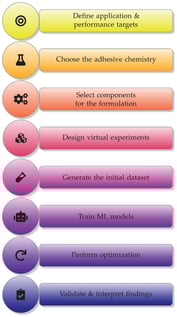
Reactive structural adhesives—epoxies, polyurethanes, and acrylics—are essential in high-performance applications, yet their development remains complex due to multiscale adhesion mechanisms, combinatorial formulation spaces, and stringent performance requirements. Traditional trial-and-error approaches are time- and resource-intensive. Machine learning (ML) provides a powerful framework to accelerate adhesive design by capturing nonlinear relationships between formulation, processing, and performance, while enabling predictive modeling, optimization, and experiment prioritization. This review presents a process-oriented guide for ML-assisted adhesive development, covering component selection, feature engineering, initial dataset design, model choice, and iterative workflows integrating classical design-of-experiments, active learning, and Bayesian optimization. Emphasis is placed on interpreting ML outputs through the lens of polymer chemistry, reaction kinetics, and fracture mechanics to extract mechanistic insights and guide rational formulation design. Key challenges—including small, noisy datasets, multi-component interactions, and multi-objective trade-offs—are discussed, along with emerging directions such as collaborative databases, automated knowledge extraction, and hybrid ML–chemistry approaches to further enhance structural adhesive development. The review underscores the potential of integrating ML into adhesive R&D to reduce experimental burden, improve formulation efficiency, and enable data-driven exploration of complex chemistries.
24 February 2026
![Overview of key adhesion mechanisms in biopolymer-based adhesives, showing (a) interfacial dehydration and wetting control, (b) covalent coupling, (c) metal coordination, (d) noncovalent interactions, (e) mechanical interlocking, (f) ionic crosslinking, and (g) interdiffusion. (b,d) were reproduced from [29] under the Creative Commons Attribution (CC-BY) license, Copyright 2017, Journal of the American Chemical Society. (c) was reproduced from [30] under the Creative Commons Attribution (CC-BY) license, Copyright 2013, Scientific Reports (created with BioRender.com).](https://mdpi-res.com/cdn-cgi/image/w=281,h=192/https://mdpi-res.com/adhesives/adhesives-02-00003/article_deploy/html/images/adhesives-02-00003-g001-550.jpg)