Article

From CT Imaging to 3D Representations: Digital Modelling of Fibre-Reinforced Adhesives with Image-Based FEM


Institute for Wind Energy Systems, Leibniz University Hannover, Appelstr. 9A, 30167 Hannover, Germany
*
Author to whom correspondence should be addressed.
Adhesives 2025, 1(4), 14; https://doi.org/10.3390/adhesives1040014
Submission received: 16 September 2025 / Revised: 3 November 2025 / Accepted: 10 November 2025 / Published: 3 December 2025

Abstract

Short fibre-reinforced adhesives (SFRAs) are increasingly used in wind turbine blades to enhance stiffness and fatigue resistance, yet their heterogeneous microstructure poses significant challenges for predictive modelling. This study presents a fully automated digital workflow that integrates micro-computed tomography (µCT), image processing, and finite element modelling (FEM) to investigate the mechanical response of SFRAs. Our aim is also to establish a computational foundation for data-driven modelling and future AI surrogates of adhesive joints in wind turbine blades. High-resolution µCT scans were denoised and segmented using a hybrid non-local means and Gaussian filtering pipeline combined with Otsu thresholding and convex hull separation, enabling robust fibre identification and orientation analysis. Two complementary modelling strategies were employed: (i) 2D slice-based FEM models to rapidly assess microstructural effects on stress localisation and (ii) 3D voxel-based FEM models to capture the full anisotropic fibre network. Linear elastic simulations were conducted under inhomogeneous uniaxial extension and torsional loading, revealing interfacial stress hotspots at fibre tips and narrow ligaments. Fibre clustering and alignment strongly influenced stress partitioning between fibres and the matrix, while isotropic regions exhibited diffuse, matrix-dominated load transfer. The results demonstrate that image-based FEM provides a powerful route for structure–property modelling of SFRAs and establish a scalable foundation for digital twin development, reliability assessment, and integration with physics-informed surrogate modelling frameworks.

1. Introduction

Adhesive joints are central to modern lightweight structures, offering uniform stress transfer, reduced stress concentrations, and improved fatigue resistance compared to mechanical fasteners such as bolts or rivets [1,2]. In wind turbine blades, short fibre-reinforced adhesives (SFRAs) are increasingly employed to bond structural components, providing enhanced stiffness and durability through fibre–matrix interactions [3,4,5]. Their heterogeneous nature, however, characterised by fibres of variable length, orientation, and dispersion, complicates predictive modelling and reliability assessment.
Conventional analytical and homogenised modelling approaches often fail to capture the local anisotropy and stress concentrations intrinsic to SFRA microstructures. To overcome these limitations, computed tomography (CT) has become a powerful non-destructive tool for characterising the three-dimensional fibre architecture, including volume fraction, orientation, and defect content [6,7].
In radiographic analysis of fibrous microstructures, reconstruction typically begins from greyscale 2D slices that are stacked into 3D volumes, from which fibres are traced and segmented. A range of reconstruction strategies have been developed over the past two decades to tackle this challenge. One widely used approach [8] introduced an automated fibre tracing procedure based on linking local vectors aligned with peak intensity gradients. While effective, this method is sensitive to noise and becomes unreliable in dense regions with frequent fibre cross-overs. To better handle intersections, the chord length transform was applied to adaptively segment crossing fibres, though distinguishing true separations from branching structures remained problematic [9]. Later works exploited subtle orientation changes to delineate fibres with irregular or complex cross-sections, but at the cost of requiring repeated tuning of structuring elements, which is computationally prohibitive for dense, tortuous networks [10].
Alternative strategies rely on morphological thinning to skeletonise fibres, thereby preserving connectivity while reducing diameter. These skeleton-based reconstructions allow merging or splitting at branch points according to predefined rules [11,12]. However, thinning inherently provides no direct estimate of how many fibres are intertwined within clustered regions, limiting its applicability to low-volume fraction composites. A different solution was introduced using a “heavy ball” algorithm, where virtual spheres were rolled through eroded–dilated images to separate fibres while preserving their original diameters [13]. Despite this, reliance on 2D morphological operations for initialising separations makes the method prone to errors in complex 3D networks. In addition, although commercial software packages exist with advanced visualisation tools, most offer limited flexibility for interacting with reconstruction algorithms and cannot reliably address anomalies such as fibre merging or loss of connectivity. This has motivated ongoing development of more adaptive, algorithmically transparent methods that balance automation with interpretability.
Recent advances in image processing and segmentation algorithms such as non-local means denoising, Otsu thresholding, convexity-based separation, and watershed segmentation have substantially improved the robustness of fibre identification in noisy tomographic datasets. In particular, denoising and thresholding strategies mitigate artefacts from beam hardening and ring effects, enabling a clearer separation of fibre and matrix phases. Convexity- and morphology-based separation further addresses the frequent problem of touching or overlapping fibres, which otherwise leads to erroneous volume fraction or aspect ratio estimation. Watershed-based techniques, often in combination with marker-controlled initialisation, enable the recovery of individual fibres even in dense clusters, improving orientation distribution measurements. Beyond classical algorithms, supervised machine learning approaches have also been introduced to enhance segmentation accuracy, particularly when distinguishing between fibres, pores, and resin-rich regions [14]. These methods leverage labelled data to correct systematic biases in automated thresholding and have been shown to reduce misclassification in composites with complex textures. Together, these advances in segmentation form a critical link between raw tomographic scans and quantitative microstructural descriptors, providing reliable inputs for subsequent reconstruction and FEM-based property prediction [15]. Combined with reconstruction strategies for stacking 2D slices into volumetric meshes, these developments now allow automated CT-to-FEM workflows that can bridge experimental characterisation and computational modelling. These digital reconstructions enable direct transition from imaging to simulation via image-based finite element modelling (FEM), providing microstructurally informed predictions of stress and strain fields under realistic loads [12,13,16].
Despite this progress, most CT-based FEM frameworks have been applied to fibre-reinforced plastics, cementitious composites, or structural laminates [6,15,16], while their extension to short fibre-reinforced adhesives in wind turbine blades remains largely unexplored. Adhesive joints differ from bulk composites in both microstructural scale and functional requirements: the short fibres are embedded within a thin bondline where local clustering, defects, and fibre–matrix debonding strongly influence performance. Yet systematic voxel-based digital modelling studies targeting adhesive joints—particularly in the context of wind energy—are absent from the literature. At the same time, workflows of this kind naturally traverse the canonical 3D representations that underpin both engineering and spatial computing: voxel grids (directly inherited from CT volumes), polygonal meshes (from contour extraction), point sets (as intermediate contour tracings), and implicit fields (as in watershed- or level set-based segmentation). This situates adhesive joint modelling within the broader representational space that also drives 3D computer vision, rendering, and AI foundation models. Notably, these voxel- and mesh-based workflows also mirror the data structures underlying volumetric rendering methods such as Neural Radiance Fields (NeRFs) and 3D Gaussian Splatting, suggesting broader relevance beyond mechanics in the context of spatial AI and synthetic 3D data generation.
This work addresses these gaps by presenting a unified digital modelling framework for SFRAs that integrates CT imaging, automated segmentation, and FEM simulation tailored to adhesive joints in wind turbine blades. Two complementary case studies are examined: (i) a 2D slice-based pipeline enabling efficient evaluation of microstructural effects with reduced computational effort and (ii) a full 3D voxel-based FEM reconstruction that captures the complexity of fibre networks with high fidelity. Through these approaches, we highlight the efficiency–accuracy trade-off and demonstrate the potential of CT-based modelling as a foundation for digital twins, reliability assessment, and data-driven surrogates in adhesive joint design. Beyond wind energy, the ability to generate paired imaging–simulation datasets also underscores how such pipelines can contribute to high-quality synthetic 3D data, relevant not only for engineering mechanics but also for the training and benchmarking of emerging spatial AI systems in robotics, AR/VR, and generative modelling. The aim of this study is therefore not the direct experimental characterisation of adhesives but rather the development of an automated image-to-simulation pipeline capable of generating reproducible stress–strain datasets from CT-derived microstructures. These datasets are intended to provide a foundation for training artificial intelligence surrogates and for the digital twin modelling of fibre-reinforced adhesive joints.

2. Materials

2.1. Specimens for 2D Analysis

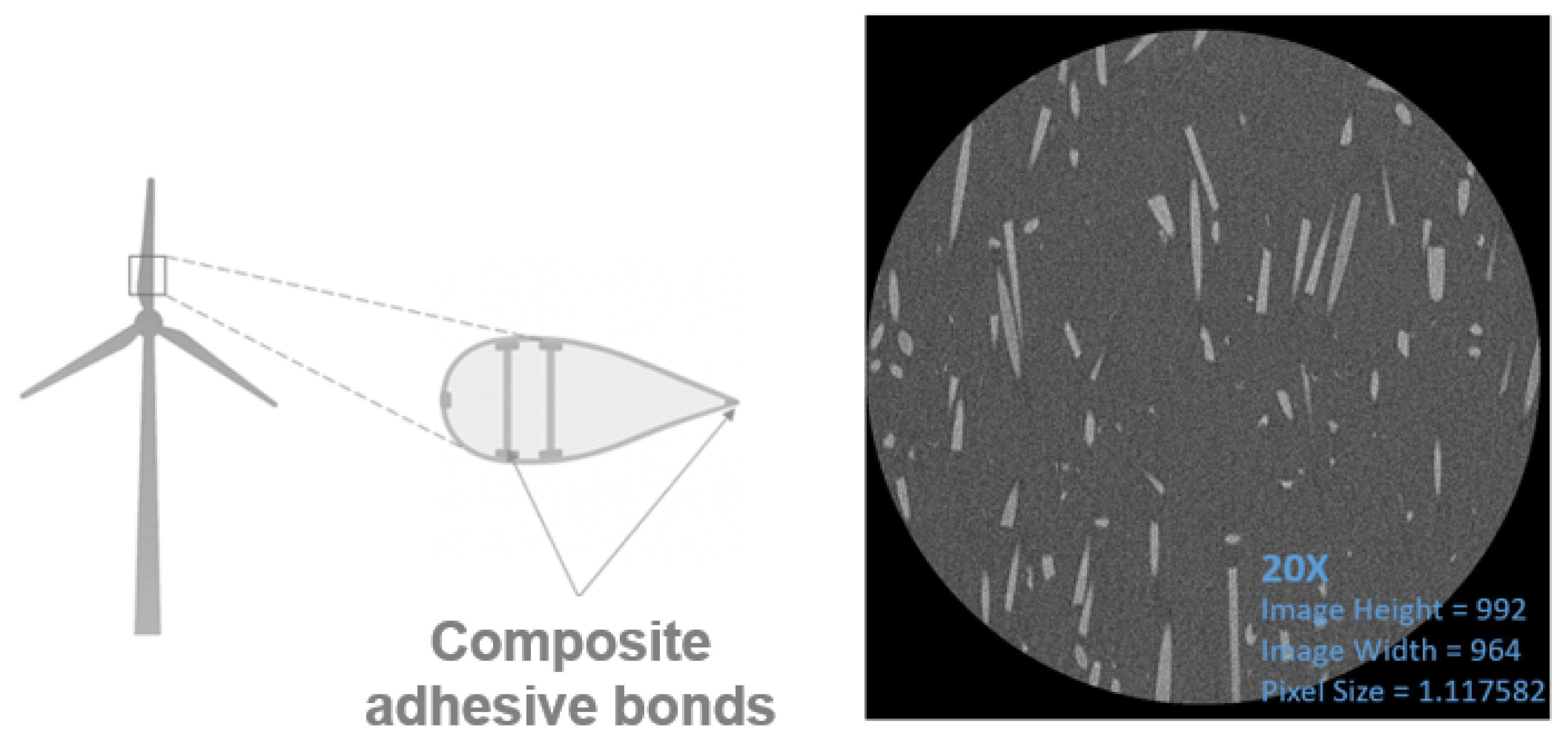
A cutout of a real adhesive bondline used in wind turbine blades was used for the 2D analysis; high-resolution X-ray computed tomography (CT) was performed using a Zeiss Xradia Versa 410, Carl Zeiss Microscopy GmbH, Jena, Germany. The adhesive material studied was a short fibre-reinforced epoxy system, scanned at a magnification of 20×, yielding a dataset of 970 slices with an in-plane resolution of 992 × 968 pixels and a pixel size of 1.1173 μm. Figure 1 illustrates where the adhesive bondlines are located within a rotor blade cross-section and shows the representative CT slice used for 2D microstructural modelling, with bright fibres embedded in the darker epoxy matrix. The reconstructed microstructure (Figure 1) revealed a fibre volume fraction in the range of 6–9%, with pronounced anisotropy in fibre orientation. This alignment reflects flow-induced effects during adhesive application, which are of particular interest for evaluating stress transfer mechanisms within thin bondlines. The resulting 2D CT datasets form the basis for 2D-based finite element modelling, enabling efficient evaluation of fibre distribution, clustering, and interfacial stress localisation in adhesive joints.

2.2. Specimens for 3D Analysis

The preparation and testing of adhesive specimens for the 3D analysis were carried out at the Institute of Structural Analysis, Leibniz University Hannover. A planetary centrifugal mixer was employed to ensure a homogeneous, pore-free mixture of the EPIKOTE™ resin MGSTM BPR 135G3 adhesive with the EPIKURE™ curing agent MGSTM BPH 137G. In this process, the resin and hardener were placed in a container rotating simultaneously around two inclined axes, producing a whirling motion that promotes rapid and uniform dispersion. The degassed mixture was subsequently injected into molds to produce adhesive plates with a nominal thickness of 4 mm, which were cured at 75 °C for four hours. Test specimens were extracted from the cured plates using precision water-jet cutting, with orientations either parallel or perpendicular to the injection direction in order to capture potential anisotropic effects [17].
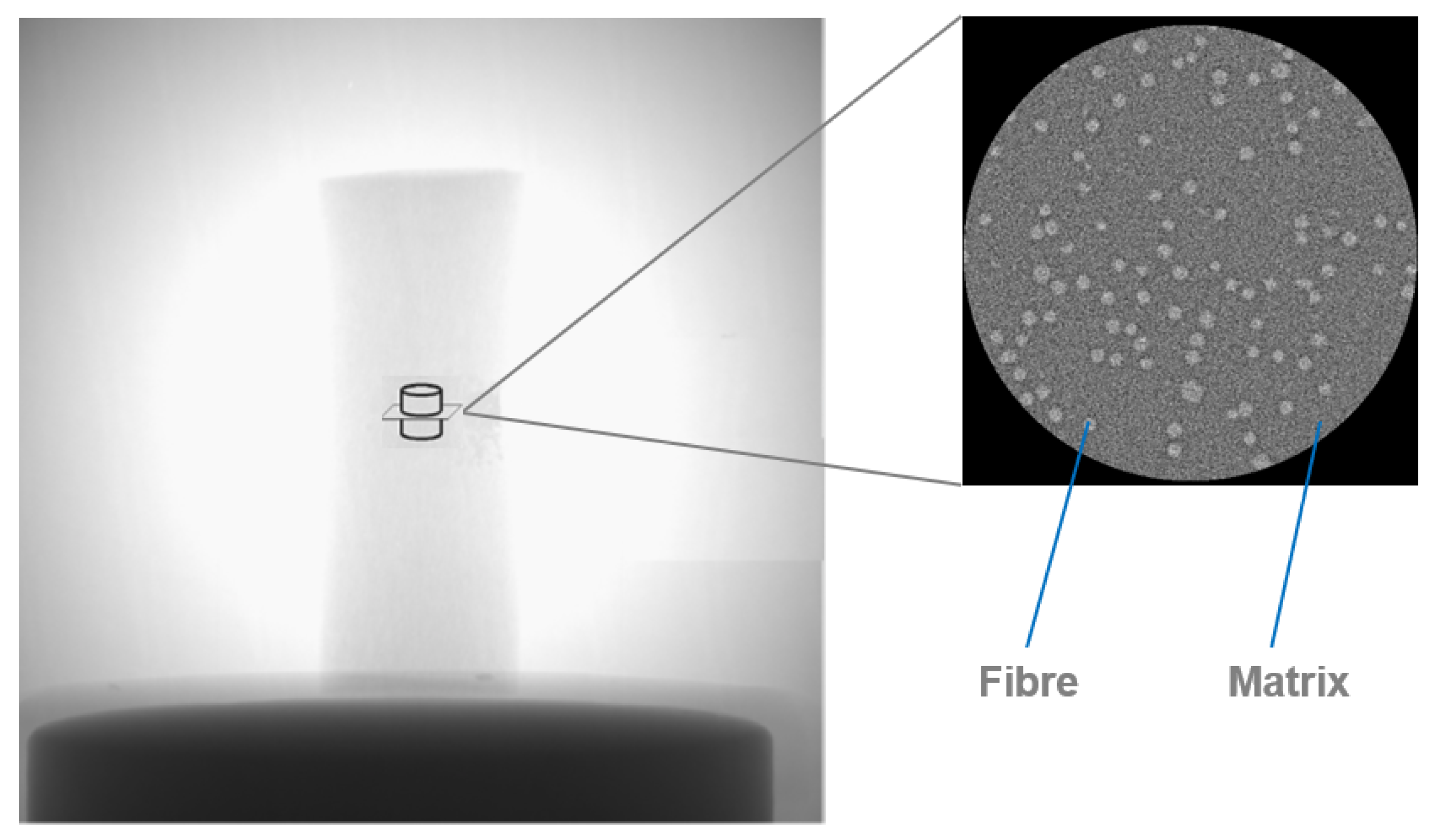
X-ray computed tomography (CT) was performed as part of the present study on one of these specimens (Figure 2) to characterise the fibre distribution within the adhesive system with a Zeiss Xradia Versa 410. A voxel size of 1.2379 μm was obtained with a field of view of 518.57 μm × 638.97 μm, enabling high-resolution imaging of fibre geometry and clustering effects. The system was operated at 80 kV with a power of 7.0 W , a source-to-detector distance of 219 mm , and a source-to-sample distance of 64.7 mm . A filter of 1.1 mm was applied to reduce beam-hardening artefacts. Image stacks were acquired with a binning factor of 4 and an exposure time of 5 s per frame, corresponding to a cone angle of 0.27 and a fan angle of 0.276 . These acquisition parameters ensured sufficient contrast between fibres and the matrix while maintaining a representative imaging volume for subsequent segmentation and finite element modelling.

3. Methods

3.1. CT Image Processing and Segmentation

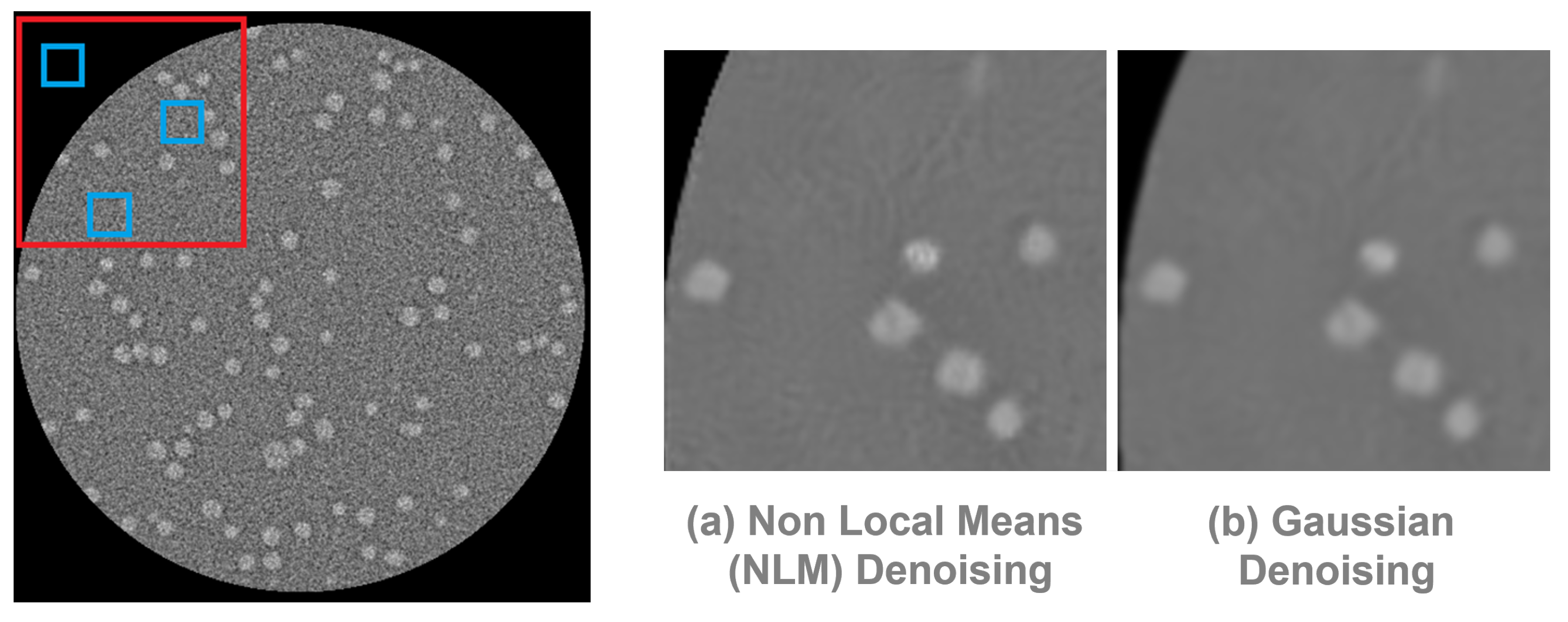
The raw CT images exhibited a considerable level of acquisition noise, which obscured fibre boundaries and complicated subsequent segmentation (Figure 3). To mitigate this, several denoising strategies were evaluated. A Gaussian filter [18] was first applied, performing a weighted local average of pixel intensities according to
I ( x , y ) = u , v I ( x u , y v ) G σ ( u , v ) ,
where I ( x , y ) is the input image, G σ ( u , v ) is a two-dimensional Gaussian kernel with standard deviation σ , and  I ( x , y ) is the smoothed output. While this effectively attenuates high-frequency noise, it also introduces blurring of fibre–matrix interfaces (Figure 3b).
To better preserve structural details, the non-local means (NLM) algorithm was implemented [19]. Unlike Gaussian filtering, which considers only spatial proximity, NLM exploits image redundancy by averaging intensities across patches of similar texture. The denoised intensity at a pixel x is computed as a weighted average of all pixels  y Ω :
I ( x ) = 1 C ( x ) y Ω w ( x , y ) I ( y ) ,
where I ( y ) is the grey-level intensity at location y, w ( x , y ) is the similarity weight between patches centred at x and y, and C ( x ) = y w ( x , y ) ensures normalisation. The similarity weight is defined by
w ( x , y ) = exp P ( x ) P ( y ) 2 2 h 2 .
Herein, P ( · ) denotes local patches, h is a filtering parameter controlling the decay of the weighting function, Ω is the search window, and  C ( x ) = y w ( x , y ) ensures normalisation. Smaller values of h preserve fine structural details but offer weaker noise suppression, whereas larger values yield stronger smoothing at the cost of reduced edge sharpness. This adaptive weighting enables the NLM algorithm to retain fibre–matrix interfaces while effectively attenuating random acquisition noise in the CT images. As illustrated in Figure 3, the red box represents the search window and the blue boxes indicate candidate comparison patches. The resulting denoised output (Figure 3a) successfully suppresses stochastic noise while preserving fibre contours, although faint moiré-like artefacts may occur in uniform regions.
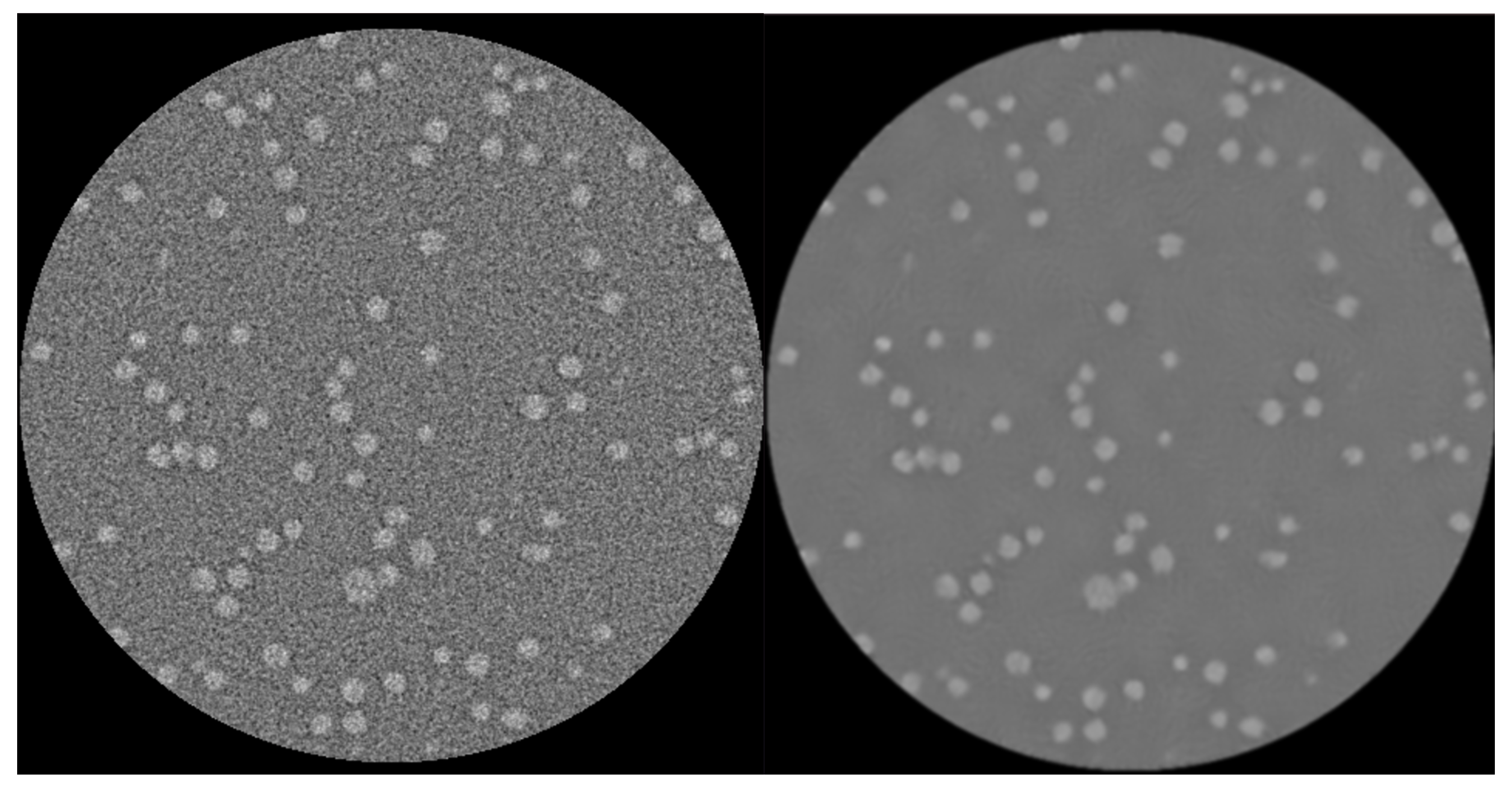
A hybrid scheme combining NLM with Gaussian smoothing was therefore adopted, leveraging the edge-preserving capacity of NLM with the global stability of Gaussian filtering. This provided a consistent preprocessing strategy across all slices, ensuring clear fibre–matrix contrast for segmentation, which is illustrated in Figure 4, confirming the hybrid denoising result, where the combined Gaussian–NLM filter yields sharp fibre–matrix contrast while removing grain noise.
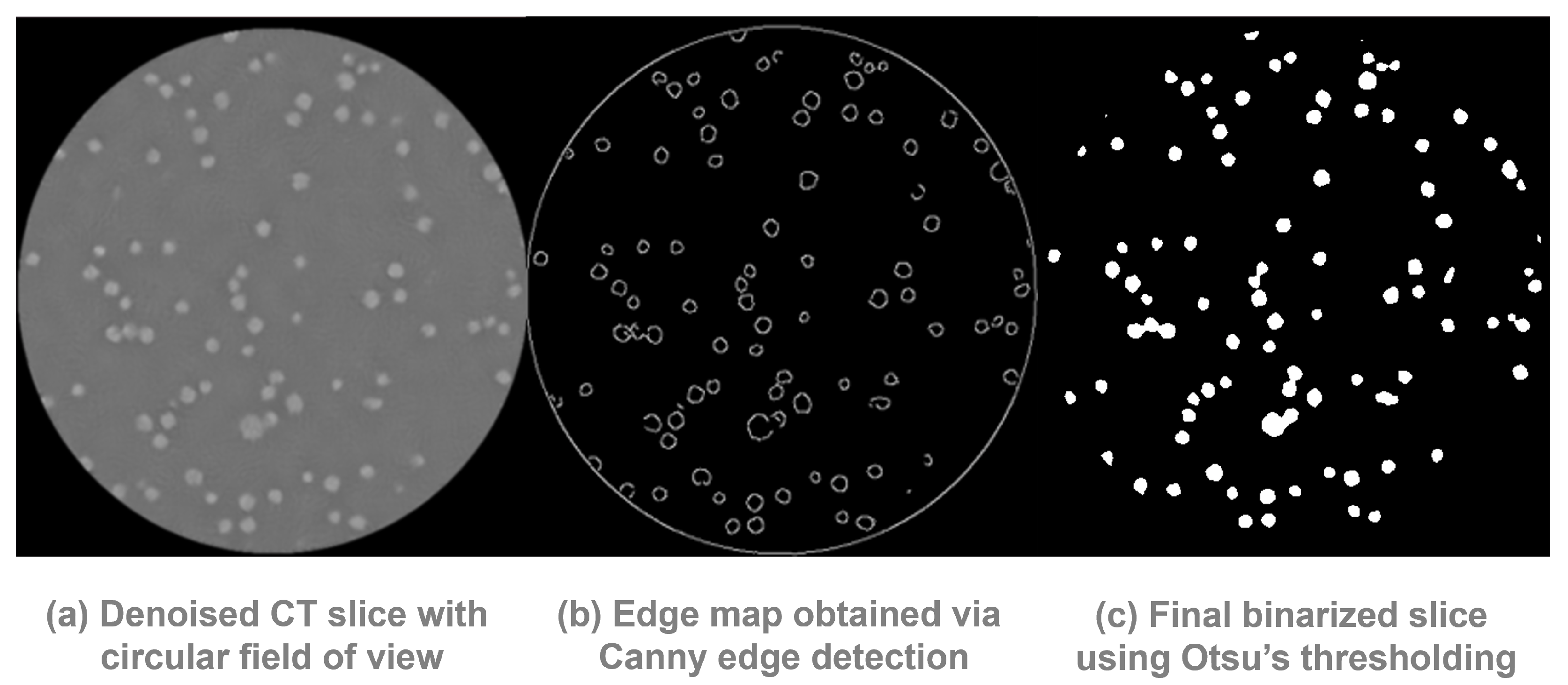
Following denoising, a sequence of methods was utilised to perform cross-section localisation and fibre segmentation; see Figure 5. The specimen cross-sections were localised using the Hough transform for circles [20], ensuring robust cropping of the adhesive region and exclusion of pixels outside the circular field of view. Edge maps required for circle detection were obtained using the Canny operator [21], which combines gradient-based filtering with non-maximum suppression and hysteresis thresholding to yield a clean contour representation of the specimen boundary. Peaks in the Hough accumulator space provided reliable estimates of circle centres and radii, enabling standardised cropping of each slice.
To separate fibres from the surrounding matrix without manual tuning, Otsu’s method [22] was employed to determine an optimal global threshold value  t * . The algorithm maximises the inter-class variance between the foreground (fibres) and background (matrix) pixel intensities, defined as
t * = arg max t ω 0 ( t ) ω 1 ( t ) μ 0 ( t ) μ 1 ( t ) 2 ,
where ω i ( t ) and μ i ( t ) denote, respectively, the probability and mean grey level of class i ( i = 0 for the matrix and i = 1 for the fibre phase). The product ω 0 ω 1 represents the relative weighting of both phases, while the squared difference μ 0 μ 1 2 quantifies their separability. The threshold t * therefore maximises the statistical contrast between phases in the greyscale histogram, yielding a robust, parameter-free segmentation that adapts automatically to variations in illumination or material contrast. This ensures consistent binarisation of all CT slices prior to subsequent fibre detection and meshing.
Segmentation of fibre cross-sections was performed on the binarised slices to isolate individual fibres from the adhesive matrix. A watershed approach was first evaluated, using the distance transform to identify internal maxima within each fibre cross-section as foreground markers. For a pixel x, the distance transform is defined as
D ( x ) = min y Ω 0 x y 2 ,
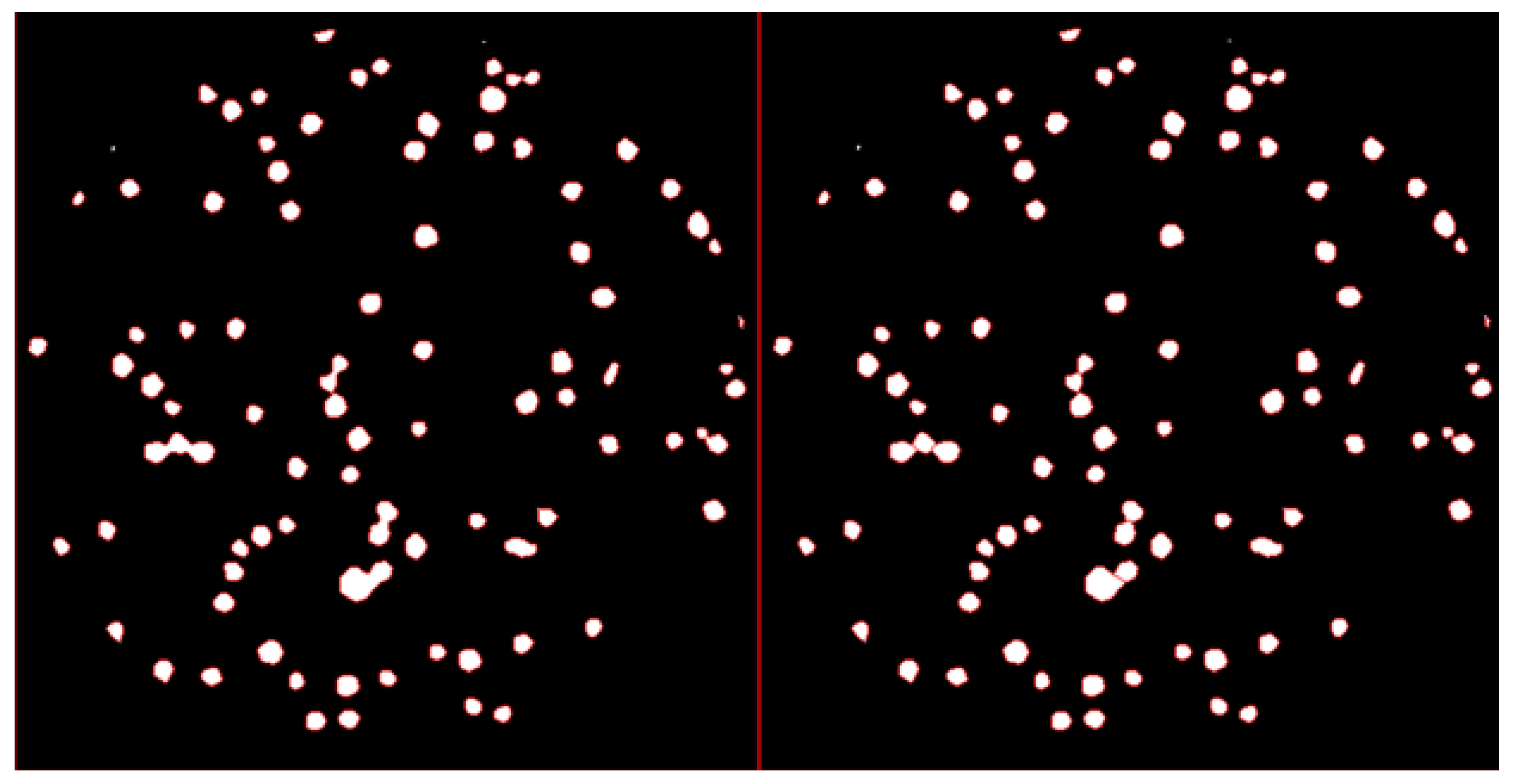
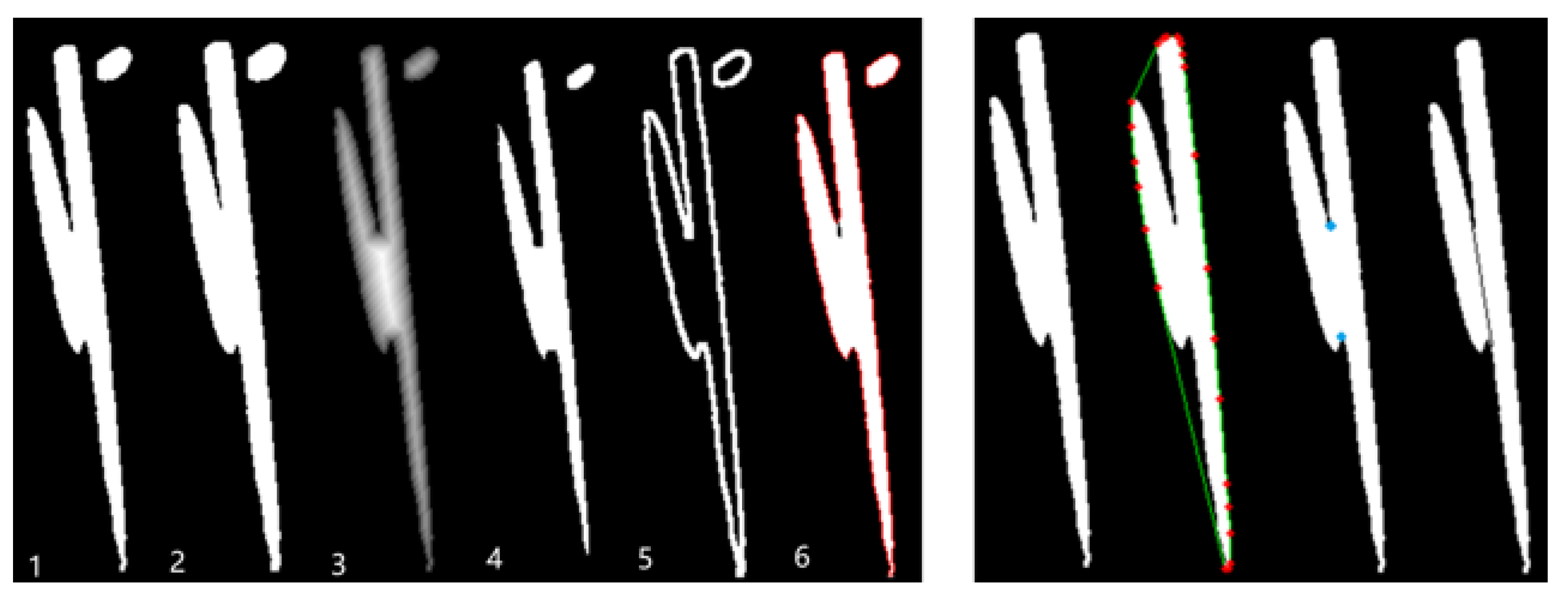
where Ω 0 denotes the background set. Ideally, the maxima of D ( x ) should occur near the medial axis of each fibre, allowing watershed flooding to separate touching fibres. However, in some cases and especially for elongated fibres in close proximity, the global maximum was often located at their junction rather than inside the individual fibres, resulting in erroneous splits, as illustrated on the left of Figure 6.
To address this limitation, a convex hull-based separation strategy was implemented (Figure 6, right). The contour points of each connected fibre region were first extracted, and the convex hull was computed. Concave regions between adjacent fibres were detected as deviations between the contour and its hull, and connecting these notch points produced separating lines. This method proved robust for elongated and nearly parallel fibres where watershed segmentation failed. A broader comparison on representative slices (Figure 7) further demonstrates that convex hull-based splitting ensures correct fibre isolation, particularly in dense regions where watershed segmentation merges neighbouring fibres.
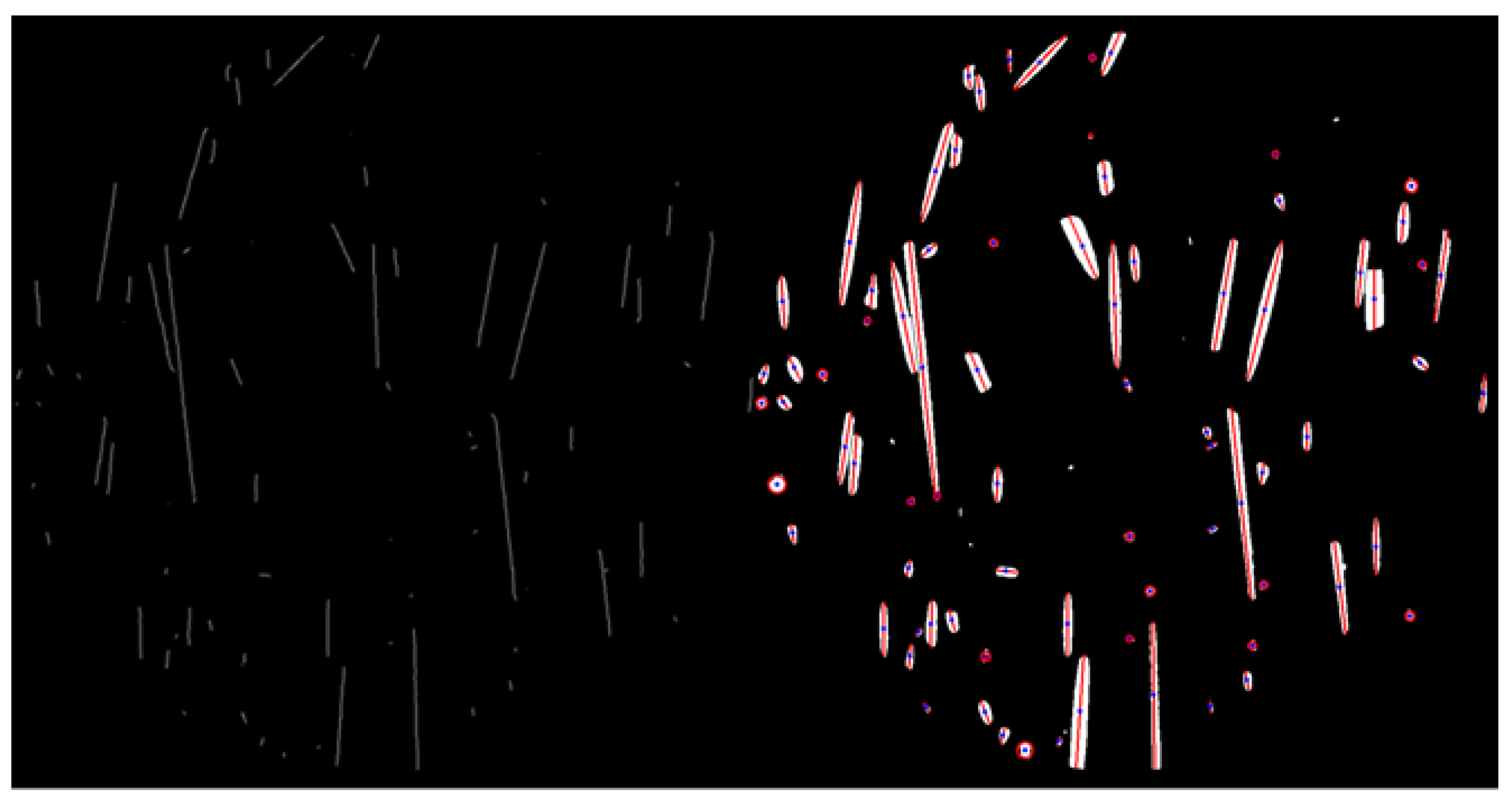
Each segmented object was subsequently skeletonised to obtain its medial axis, reducing the binary cross-section to a one-pixel-wide line (Figure 8). This representation provides a robust basis for measuring fibre orientation and connectivity, as it is less sensitive to local irregularities or residual noise.
Fibre directions were then estimated using the Hough transform for lines, expressed in normal form as
ρ = x cos θ + y sin θ ,
where peaks in the accumulator space ( ρ , θ ) correspond to dominant in-plane orientations. Once the orientation was determined, geometric descriptors were extracted from each fibre cross-section (Figure 8). These included the centroid position, cross-sectional area, equivalent diameter, defined by
d eq = 2 A π ,
and principal axes (major and minor). Figure 8 links segmentation to quantitative analysis: skeletonisation enables orientation measurement and geometric descriptors that feed directly into FEM meshing. From these data, the fibre orientation distribution function p ( θ ) was constructed as
p ( θ ) = 1 N i = 1 N δ ( θ θ i ) ,
where θ i denotes the measured orientation of the i-th fibre and δ is the Dirac delta function, later approximated by histogram binning.
The resulting descriptor set forms a per-slice database that enables both statistical evaluation of the microstructure such as fibre volume fraction and orientation distributions and serves as the foundation for subsequent three-dimensional fibre reconstruction across slices.

3.2. Meshing and Reconstruction

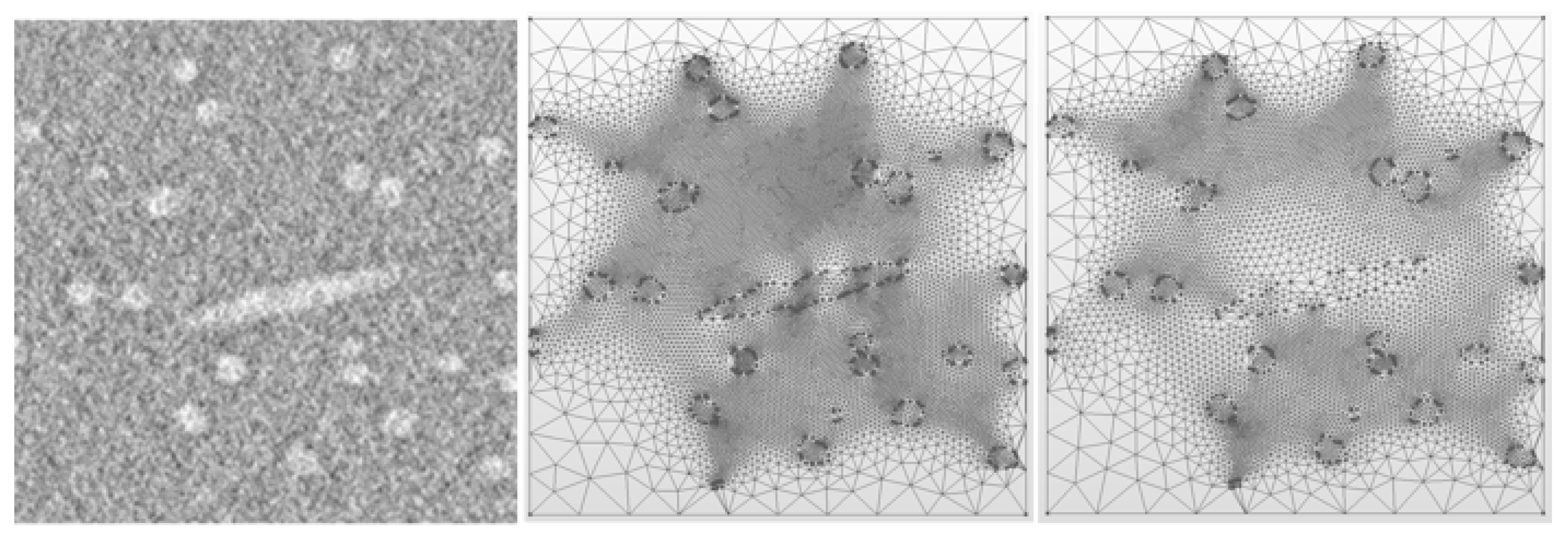
For the 2D specimens, the meshing workflow began with segmentation of CT slices, which enabled the separation of fibres from the adhesive matrix. At this stage, however, contours of adjacent fibres were frequently assigned the same label, preventing independent meshing of individual fibres. To address this, contours were re-extracted using the Suzuki algorithm [23], a robust border-following method that traces outer boundaries pixel by pixel. The resulting point sets delineated the contours of each fibre separately. Since directly meshing these pixel-level contours would have produced excessively large meshes, contour simplification was performed using the Ramer–Douglas–Peucker algorithm [24,25], which reduces the number of contour points while preserving geometric fidelity. The simplified contours were then imported and fibres were represented as polygons embedded in a rectangular adhesive matrix. Boolean operations were used to combine the two phases, followed by unstructured triangular meshing based on Delaunay triangulation [26,27]. This approach accommodates the random, irregular fibre arrangements more effectively than structured meshes and ensures conformity at fibre–matrix interfaces. The resulting 2D meshes provided a computationally efficient yet geometrically representative discretisation of fibre-reinforced adhesive microstructures for finite element analysis. An illustration of this process is shown in Figure 9, comparing the original CT slice, the non-simplified mesh, and the simplified mesh after Ramer–Douglas–Peucker reduction.
While the two-dimensional meshing workflow relied on explicit contour extraction and polygonal discretisation, the extension to three dimensions introduces additional complexity. Direct geometry-based meshing from reconstructed fibre trajectories would require smooth surface extraction (e.g., marching cubes) and subsequent tetrahedralisation, which is computationally demanding and sensitive to artefacts from segmentation errors. Instead, a voxel-based representation was adopted. Voxelisation provides a direct, automated mapping from the CT volume to the FEM domain, ensures that fibre volume fractions and connectivity are faithfully retained, and avoids manual intervention in surface reconstruction. The trade-off is the presence of staircase artefacts at curved fibre boundaries and larger element counts, but these limitations are acceptable for the purposes of elastic simulation of adhesive joints.
For the three-dimensional analysis, once two-dimensional fibre cross-sections were segmented and described, the next step was to reconstruct continuous three-dimensional trajectories. The central task is to decide which graph blocks in successive slices correspond to the same physical fibre. We assume (i) a fibre contributes at most one cross-sectional block per slice and (ii) blocks of the same fibre appear continuously across adjacent slices. Reconstruction proceeds slice-by-slice by maintaining a set of unfinished fibres and a dictionary that maps each fibre ID to its accumulated list of cross-sections. For a given fibre candidate C i ( k ) in slice k, characterised by its centroid c i ( k ) , in-plane orientation  θ i ( k ) , and equivalent diameter or major-axis length  d i , potential matches are sought within an adaptive neighbourhood  N i ( k + 1 ) in the next slice:
N i ( k + 1 ) = j | c j ( k + 1 ) c i ( k ) 2 r i , r i = η d i ,
where η [ 1.5 , 2.5 ] is a dimensionless scaling factor that defines the search radius relative to the local fibre size  d i . Each admissible pair ( i , j ) is then scored by a weighted cost function that balances three morphological similarities: centroid distance, orientation difference, and relative area change:
Δ i j = α c i ( k ) c j ( k + 1 ) 2 + β angdiff ( θ i ( k ) , θ j ( k + 1 ) ) + γ A i ( k ) A j ( k + 1 ) A i ( k ) ,
where A i ( k ) and A j ( k + 1 ) are the respective cross-sectional areas. The weighting coefficients α , β , and  γ control the relative influence of geometric proximity, directional consistency, and area preservation; for nearly circular sections, the orientation term is down-weighted ( β 0 ). The candidate  j that minimises the cost,
j = arg min j N i ( k + 1 ) Δ i j ,
is accepted as a valid continuation if Δ i j τ , with τ being a user-defined tolerance reflecting the allowable morphological deviation.
This greedy association scheme yields continuous centroid chains { c i ( 1 ) , c i ( 2 ) , , c i ( K ) } that represent individual fibre trajectories. By combining spatial proximity with morphological similarity, Equations (9) and (10) ensure that reconstructed fibres remain physically plausible and topologically consistent across successive CT slices.
Preliminary reconstruction can still fragment fibres due to discretisation or segmentation artefacts. A reunion step merges fragments p and q when they satisfy collinearity, proximity, and size consistency:
| angdiff ( θ ^ p , θ ^ q ) | < 10 ,
dist c q , L ( c p , θ ^ p ) < 2 r min , p ,
A q , near A p , near A p , near 0.25 ,
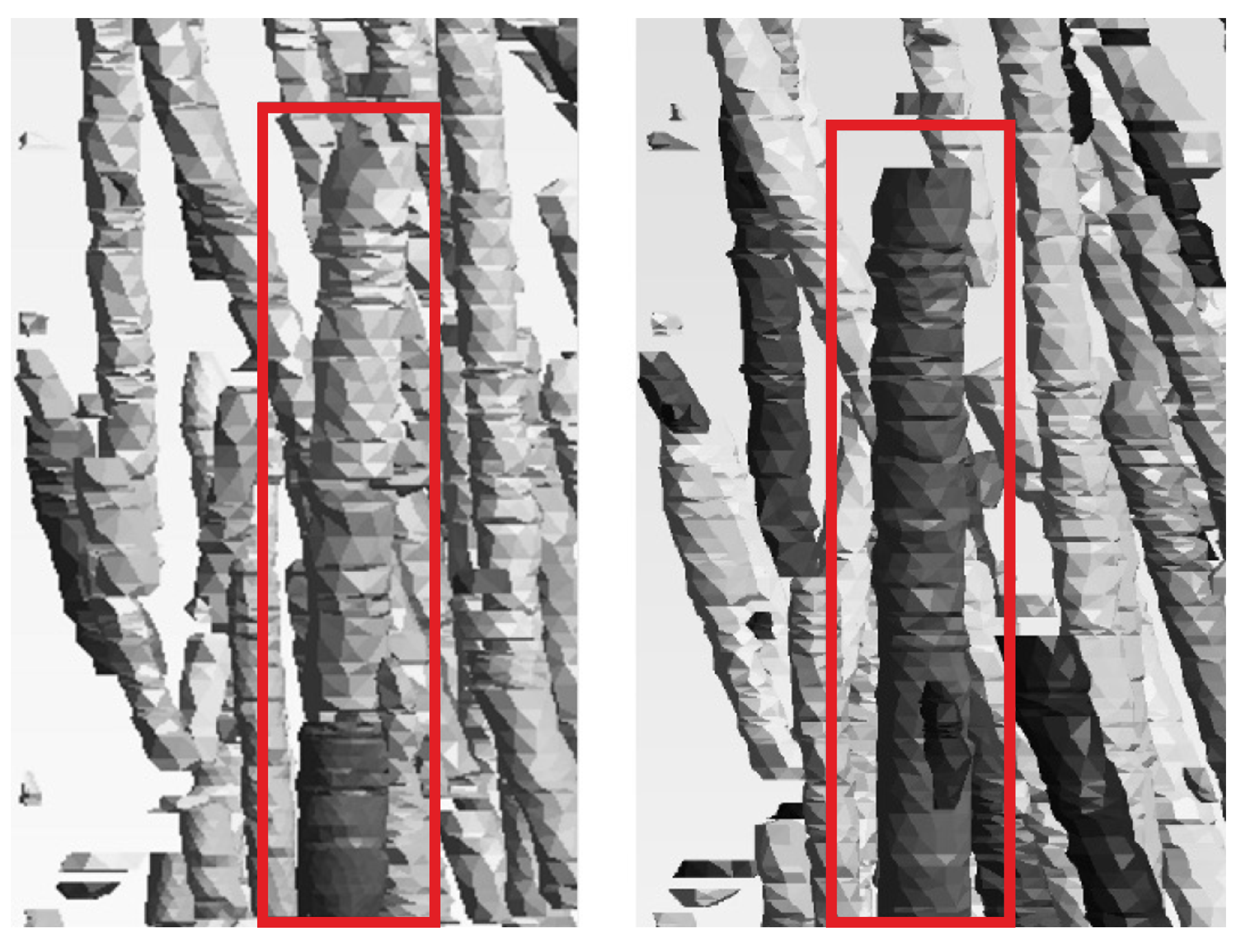
where θ ^ is the fibre direction estimated from centroid regression, r min , p the minor-axis length proxy, and  A · , near the end-section areas. Figure 10 shows an example where fragmented fibres (left) are successfully reconnected into continuous trajectories (right).
The reconstructed fibres were then embedded into a volumetric voxel model of the specimen. A voxel (volume pixel) represents the smallest unit cube of the discretised CT grid, formally expressed as
v i j k { 0 , 1 } , ( i , j , k ) Z 3 ,
with v i j k = 1 denoting fibre and v i j k = 0 denoting matrix. This binary field provides a digital twin of the CT scan, directly compatible with structured hexahedral finite element discretisations. Voxel-based modelling preserves geometric fidelity and enables automated, large-scale meshing, but it also introduces staircasing artefacts at curved fibre boundaries. To mitigate this, voxelisation was used here as an intermediate representation: it served both to track fibre connectivity and to provide a phase-separated volume for downstream remeshing into tetrahedral elements with smoother boundaries.
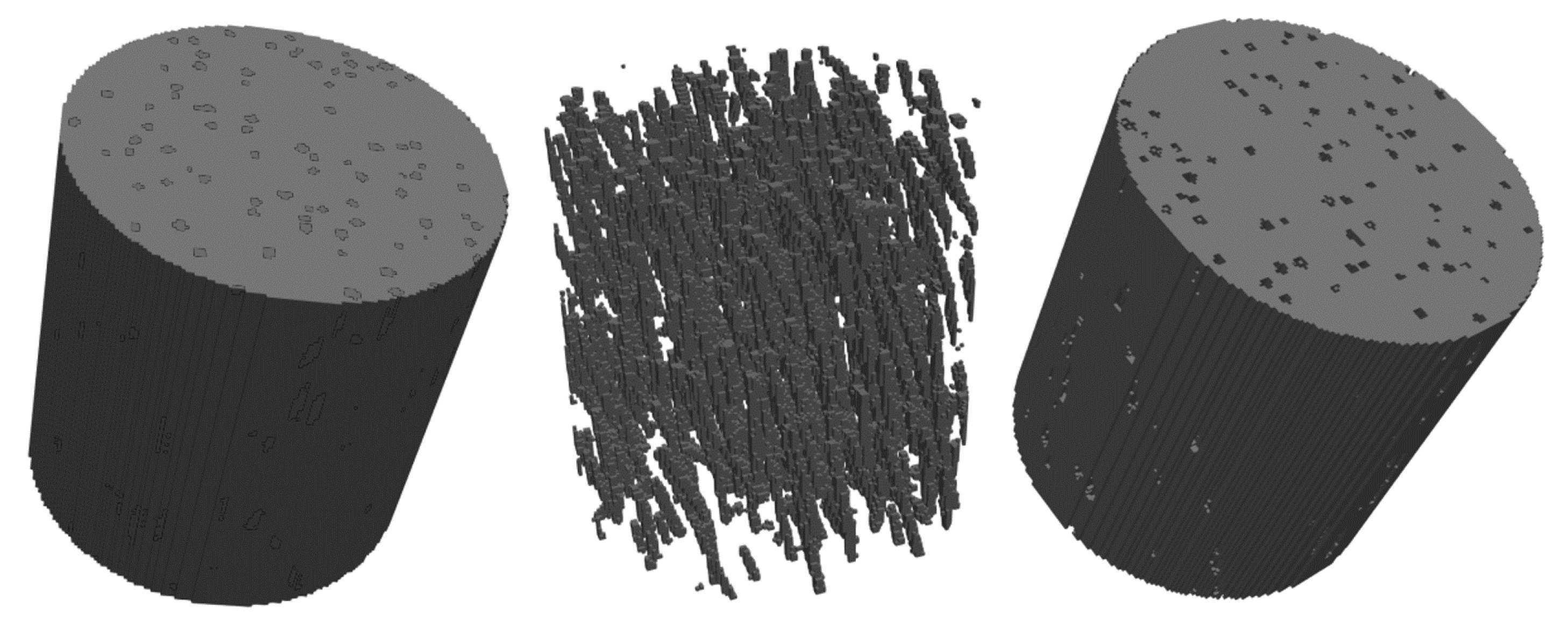
Figure 11 illustrates the complete workflow: the raw voxel reconstruction obtained by stacking segmented slices is shown on the left, the isolated fibre phase highlighting reconstructed trajectories in the centre, and a cleaned voxel geometry converted into a meshing-ready specimen on the right. This representation ensures that fibre–matrix morphology from CT data is faithfully retained in the finite element domain.
For the current 3D specimen, a structured voxel mesh was generated directly from the binary microstructure. Each voxel in the CT dataset was converted into a hexahedral element, preserving the spatial resolution of the scan. In the mesh model created for this work, a total of 1,389,336 elements were generated, corresponding to a reconstructed physical volume of approximately 1.6926 × 108 μm3. This results in a mesh density of 0.0082 elements per cubic micrometre. Increasing mesh density can significantly enhance the accuracy of finite element predictions, but it also imposes greater computational costs. This trade-off between fidelity and efficiency is a common consideration in image-based FEM, where finer meshes yield more precise local stress and strain fields at the expense of higher memory and runtime requirements.

3.3. Finite Element Model Setup

The meshed microstructures were imported into the open-source finite element framework FEniCSx 0.8.0 [28] for numerical simulation. Both the 2D polygonal meshes and the 3D voxel meshes were discretised with first-order Lagrange interpolation functions. In the 2D case, unstructured triangular elements were employed, while in the 3D case, each CT voxel was directly converted into a hexahedral element with tri-linear shape functions (Hex8 element). This choice ensured a consistent mapping between image resolution and the finite element domain.
Linear–elastic constitutive behaviour was assumed for both the fibre and the matrix phases of the composite. The relationship between stress and strain is given by the general tensorial form:
σ = C : ε ,
where σ denotes the Cauchy stress tensor, ε is the infinitesimal strain tensor, and C is the fourth-order elasticity (stiffness) tensor. Equation (16) represents the generalised Hooke’s law, relating stress to strain in a homogeneous, isotropic solid.
For an isotropic linear–elastic material, the stiffness tensor C is fully determined by the two independent elastic constants, Young’s modulus E, and Poisson’s ratio ν . In index notation, this relation can be written as
C i j k l = λ δ i j δ k l + μ ( δ i k δ j l + δ i l δ j k ) ,
where δ i j is the Kronecker delta, and  λ and μ are the Lamé parameters defined by
λ = E ν ( 1 + ν ) ( 1 2 ν ) , μ = E 2 ( 1 + ν ) .
Here, λ represents the material’s resistance to volumetric change, while μ (the shear modulus) quantifies its resistance to shape change. These parameters are derived directly from experimentally measured values of E and ν and are used throughout the finite element implementation.
In this work, the fibres were assigned an elastic modulus of E f = 79,050 MPa and a Poisson’s ratio of ν f = 0.22 , whereas the polymer matrix was characterised by E m = 2798 MPa and ν m = 0.40 [29]. Together, these values define the phase-specific stiffness matrices via Equations (17) and (18), enabling the computation of local stress and strain fields within the reconstructed microstructures.
Boundary conditions were applied to represent canonical loading cases. For tensile and compressive tests, the bottom face of the specimen was fixed in all degrees of freedom, while the top face was displaced in the vertical (z) direction to achieve a prescribed strain, with lateral faces left traction-free. For torsional loading, a rotational displacement was prescribed to the top surface while the bottom was fixed, replicating the boundary conditions of the experimental torsion tests. These conditions enabled evaluation of stress and strain localisation within the fibre–matrix microstructure under representative loading states.
The resulting systems of equations were solved using the PETSc backend within FEniCSx 0.8.0, with conjugate gradient solvers and algebraic multigrid preconditioners to ensure scalability for large voxel-based models. Output fields (displacement, stress, von Mises equivalent stress) were written in pvd format for subsequent post-processing and visualisation.
Following the finite element simulations, displacement fields and stress tensors were exported in pvd format and processed using the ParaView 5.10.0 visualisation platform [30]. The primary focus was on von Mises stress distributions, which provide an effective measure of stress localisation within the fibre–matrix microstructure. For 2D models, stress contours were directly overlaid on the meshed CT slices to highlight interfacial concentrations at fibre boundaries. For 3D voxel-based models, volume renderings and cross-sectional slices were employed to reveal clustering effects and anisotropic stress pathways within the adhesive bondline.
In addition to visualisation, quantitative descriptors were extracted using custom Python 3.0 scripts. These included histograms of stress intensity within the fibre and matrix phases, average strain–stress curves obtained from reaction forces on boundary surfaces, and maps of displacement fields to identify dominant load-transfer paths. The use of voxel-based meshes facilitated a one-to-one mapping between image voxels and finite elements, enabling microstructural descriptors such as fibre volume fraction, orientation distribution, and clustering metrics to be correlated directly with mechanical response.
Together, these post-processing steps provided both qualitative and quantitative insight into the role of fibre architecture on adhesive performance. ParaView served as the primary tool for interactive exploration of results, while automated Python-based routines ensured reproducibility of statistical measures across large datasets.

4. Results

In this section, the results by means of fibre orientations, stress calculations in 2D slices, and stress calculations in 3D voxel models are presented.

4.1. Fibre Orientation Analysis

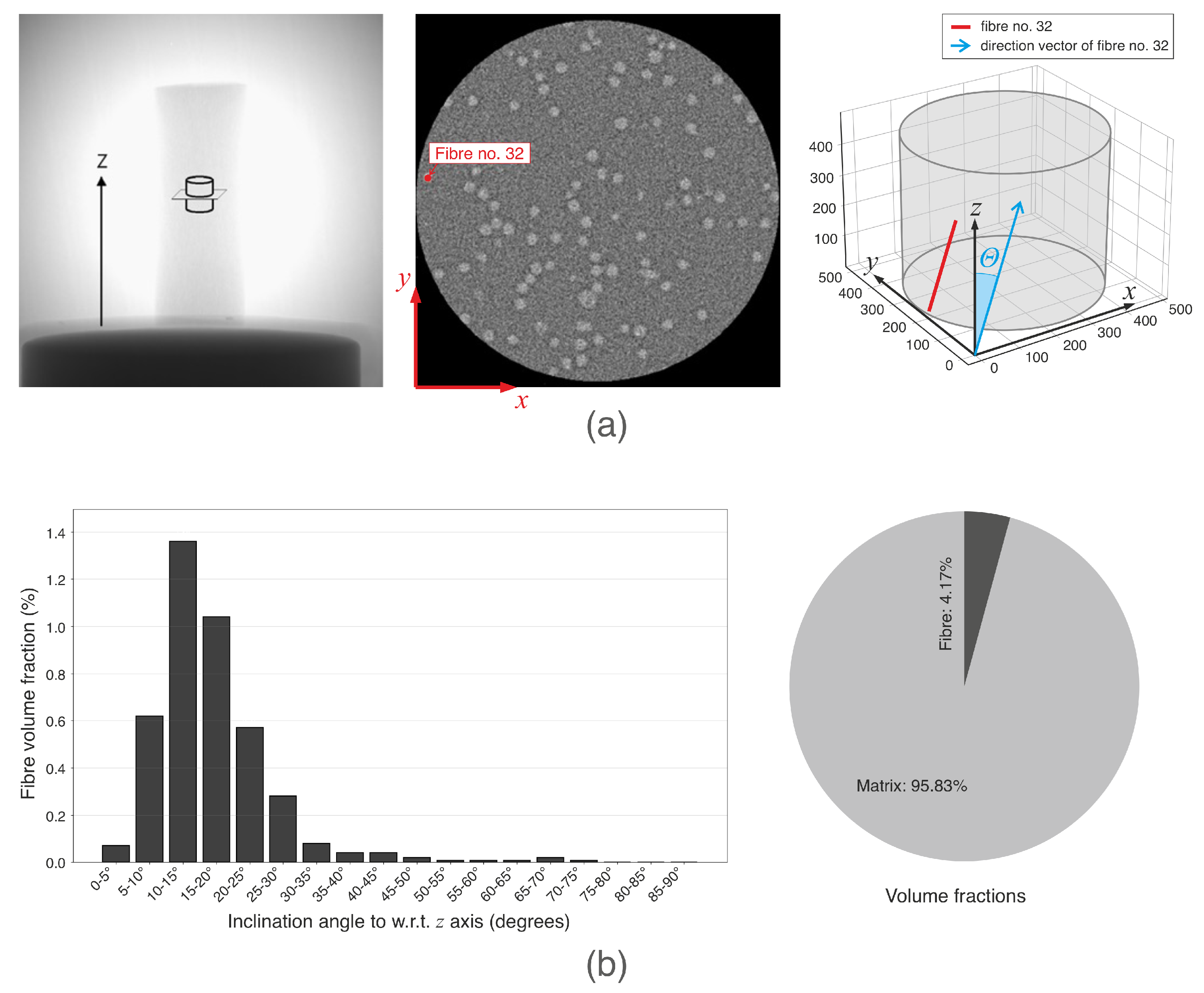
The inclination angle θ of each fibre is defined as the angle between its 3D direction vector and the specimen’s vertical axis; see Figure 12 (top). For illustration, the sketch shows a single fibre with θ 11 and the corresponding direction vector.
Figure 12 (bottom) reports the orientation histogram for all reconstructed fibres, using 5° bins from 0 to 90 . The ordinate gives the fibre volume fraction for each bin as a percentage of the entire specimen volume (i.e., the bars sum to the total fibre volume fraction). The distribution is sharply concentrated at small angles: the modal bin is 10– 15 (1.36%), followed by 15– 20 (1.04%) and 5– 10 (0.62%). Summing the first four bins yields 3.09% of the specimen volume, which corresponds to ≈74% of the fibre phase ( 3.09 / 4.17 ). Extending to 0– 25 gives 3.66% (≈88% of the fibre phase), and 0– 30 captures 3.94% (≈95% of the fibre phase). Angles > 30 account for only 0.23% of the specimen volume (≈5.5% of the fibre phase), indicating a long, low-magnitude tail.
The strong bias toward small θ evidences process-induced alignment along the specimen axis, which increases axial stiffness and channels load transfer along the bondline, while potentially raising interface stresses in clustered regions. The μCT analysis further reveals that the manufacturing process induces a preferred fibre orientation across the plate’s thickness, with most fibres primarily aligned in the flow direction. This anisotropy is consistent with flow-dominated bondline morphologies and has important implications for the mechanical behaviour of short fibre-reinforced adhesive joints in service.

4.2. Two-Dimensional FEM Models from CT Slices

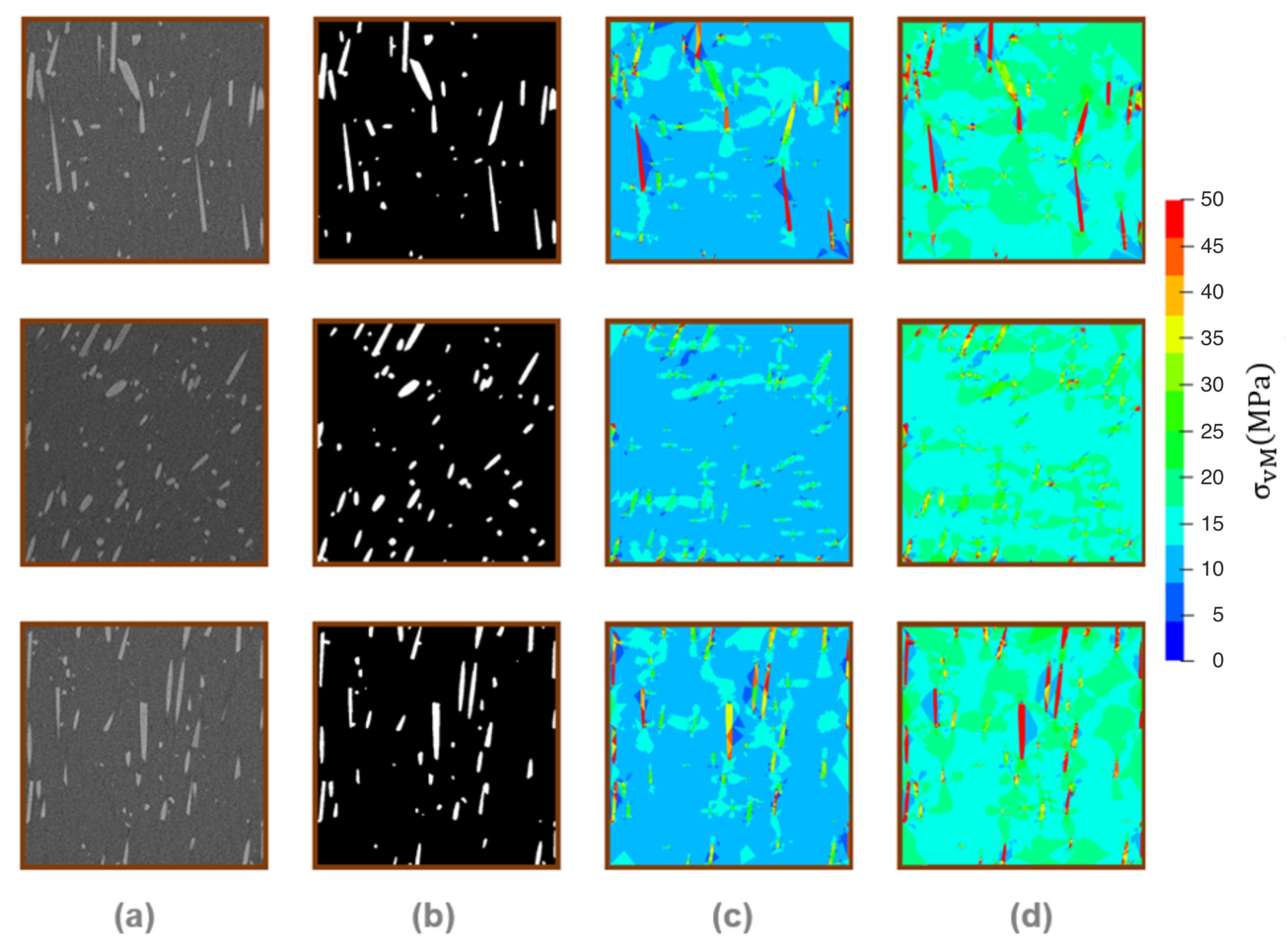
To complement the fibre orientation analysis, two-dimensional finite element (FEM) models were constructed directly from segmented CT slices of the adhesive bondline. Figure 13 illustrates the full workflow for three representative slices. The raw CT images (a) were denoised and binarised to separate fibres from the matrix (b). Fibre contours were extracted with the Suzuki algorithm, simplified using the Ramer–Douglas–Peucker scheme, and meshed with unstructured Delaunay triangulation to preserve interfacial fidelity while maintaining computational efficiency.
Material properties were assigned as in Section 3.3, with glass fibres ( E f = 79,050 MPa, ν f = 0.22 ) embedded in an epoxy matrix ( E m = 2798 MPa, ν m = 0.40 ). Two homogeneous uniaxial extension cases were simulated: a prescribed horizontal strain of 0.35% (c) and 0.5% (d), implemented by displacing the right-hand edge in the x-direction while fixing the left-hand edge; the top and bottom boundaries remained traction-free. These values were chosen to ensure that the microstructural response remained in the linear–elastic regime, while still providing sufficiently strong stress fields for numerical averaging. Very small strain levels (e.g., < 0.1 % ) may suffer from numerical round-off or noise when averaging stresses over heterogeneous RVEs, whereas larger strains risk introducing nonlinear effects. The selected strain amplitudes therefore reflect a common compromise in micromechanics homogenisation studies, where values in the range of 0.1 0.5 % are typically used to balance accuracy and robustness.
The resulting von Mises stress fields σ vM reveal strong interfacial localisation. At 0.35% strain, hotspots concentrate at fibre tips and narrow matrix ligaments, with peaks approaching 40–50 MPa. At 0.5% strain, stress intensities exceed 50 MPa and broaden in extent, indicating strain-dependent amplification of interfacial stresses. Clear microstructural differences are visible across the three slices: the first and third rows, dominated by flow-aligned fibres and clustering, exhibit continuous stiff loading paths with higher fibre stresses; the second-row slice shows more isotropic fibre orientations and weaker clustering, leading to diffuse matrix-dominated load transfer and correspondingly lower fibre stresses. These findings underline the crucial role of orientation and clustering in governing stress partitioning between fibres and matrix.
The apparent in-plane modulus E ˜ 2 D extracted from FEM simulations was verified to remain between the classical Voigt and Reuss bounds derived from the measured phase fractions. This consistency provides an additional verification of the meshing and boundary conditions’ implementation.

4.3. Three-Dimensional Voxel-Based FEM Models

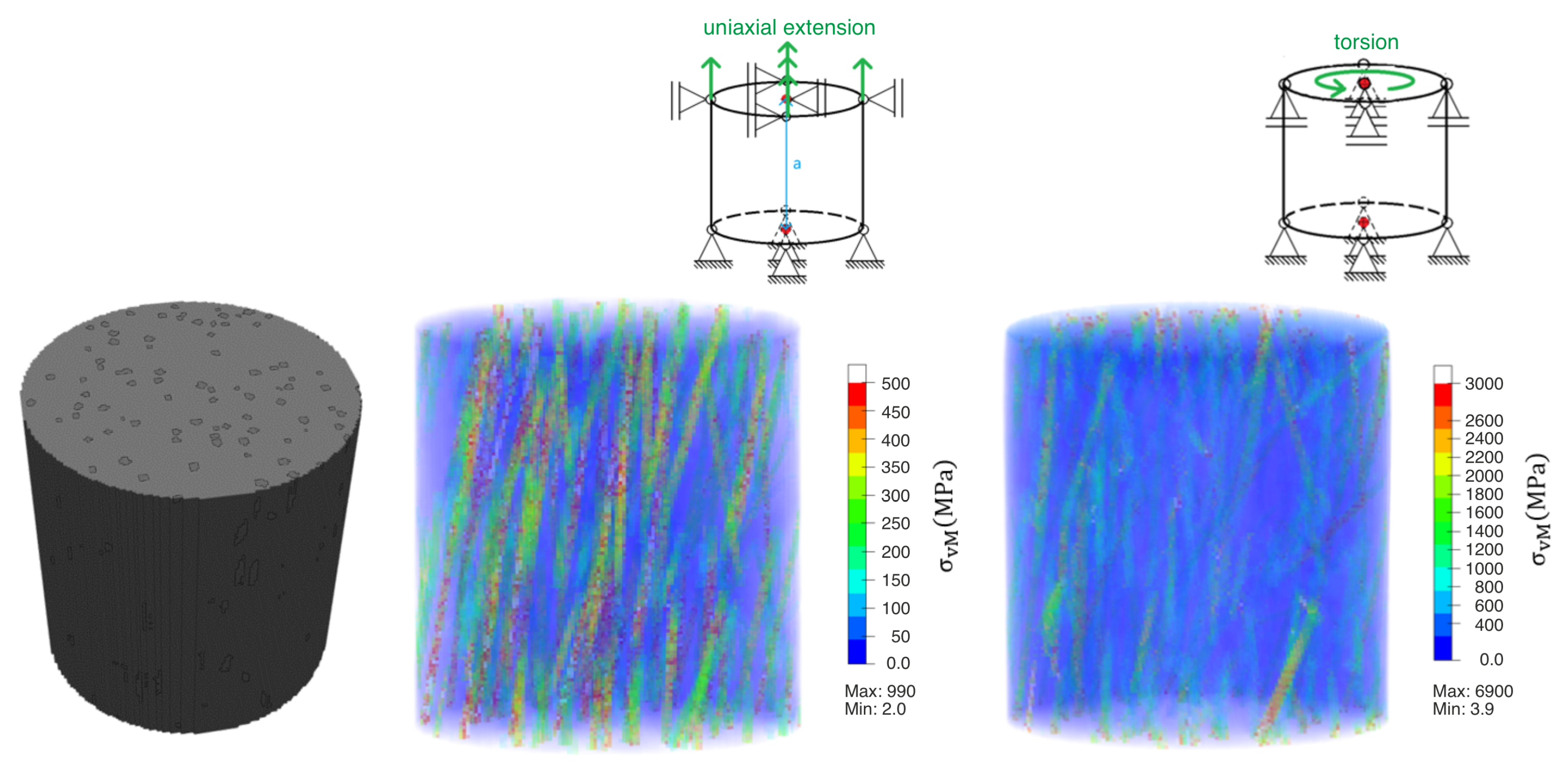
To extend beyond two-dimensional slices, a full three-dimensional voxel-based FEM model was generated from the CT reconstruction of the adhesive specimen, as described earlier. The voxel mesh contained approximately 1.39 × 10 6 hexahedral elements, representing a physical specimen volume of 1.69 × 10 8 μ m 3 . Fibre and matrix voxels were assigned linear–elastic properties as in Section 3.3 ( E f = 79,050 MPa, ν f = 0.22 ; E m = 2798 MPa, ν m = 0.40 ). Two boundary conditions were investigated: inhomogeneous uniaxial extension and clockwise inhomogeneous torsion at 15 .
A non-uniform displacement was prescribed on the loaded x = L x face while fixing the opposite face at x = 0 ; the top and bottom remained traction-free. This generated a lateral strain gradient, mimicking load introduction in adhesive joints. The stress–strain response was linear up to ε ¯ x = 0.5 % , with average stresses consistent with expectations for fibre volume fraction v f = 4.17 % . The von Mises stress field (Figure 14, left) shows strong interfacial hotspots at fibre tips and narrow ligaments close to the loaded boundary, with local maxima exceeding 50 MPa. Load paths threaded through clustered fibres, forming continuous stiff bridges, while more isotropic sub-volumes exhibited diffuse shear in the matrix. These trends mirror the 2D results, particularly the difference between fibre-aligned and isotropic regions (cf. Figure 13).
A clockwise torsional rotation of 15 was applied to the x = L x face, while the x = 0 face was fixed. This boundary condition induced coupled shear and bending modes in the fibres. The resulting stress fields (Figure 14, right) highlight pronounced shear bands cutting across fibre clusters and amplified matrix shear near fibre ends. Von Mises stresses with an asymmetric distribution reflecting the heterogeneous fibre orientation: regions with fibres aligned parallel to the shear plane carried higher stresses, while isotropic domains were matrix-dominated. Compared with extension, torsion broadened the high-stress corridors and shifted hotspots away from the loaded boundary into the specimen’s interior.

4.4. Computational Performance and Reproducibility

To assess the efficiency and scalability of the proposed workflow, benchmark tests were performed for both two-dimensional (2D) and three-dimensional (3D) simulations on representative hardware platforms. The 2D analyses (Table 1) were executed on an Intel i7-1065G7 CPU (1.3 GHz, 4 cores), while the 3D analyses were carried out on a Xeon Gold 6130 CPU (2.1 GHz, 10 cores, 640 GB RAM).
For the 3D implementation, the full pipeline required approximately four hours per dataset on the Xeon Gold workstation, utilising up to 620 GB of memory. The major computational cost arose during voxel mesh generation and finite-element assembly. These results demonstrate that the pipeline achieves rapid automated dataset generation for large CT stacks while maintaining manageable computational resources.
All scripts were written in Python 3.0 employing OpenCV 4.5.4, Gmsh Python API 4.12.1, FEniCSx 0.8.0, and ParaView 5.10.0. The complete source code and configuration files are archived within the institute’s internal repository and can be made available upon request to enable full reproducibility of the presented results.

5. Discussion, Limitations, and Future Work

While voxel-based modelling provides a direct digital twin of CT data, it remains resolution-limited and subject to staircasing artefacts at curved fibre boundaries. A promising extension is the use of neural implicit representations, such as Neural Radiance Fields (NeRFs) [31,32] and occupancy networks, to represent fibre–matrix morphology continuously. In this framework, the voxelised CT stack would serve as training data for a neural field:
F θ : R 3 [ 0 , 1 ] ,
which maps spatial coordinates to fibre occupancy probability. Such models are resolution-independent, enable super-resolved reconstructions beyond native CT resolution, and yield smooth surfaces that can be extracted into FEM-ready meshes. Recent advances in implicit neural volume representations [33], medical imaging NeRFs [34], and attenuation-aware CT reconstruction [35] demonstrate the feasibility of integrating these methods into materials science workflows. Also, NeRF-based view synthesis presents an opportunity to extend beyond reconstruction into interactive visualisation. Instead of only reconstructing fibre geometries, models could be trained to render the specimen from arbitrary viewpoints, generating virtual radiographs or synthetic CT projections. This capability would enhance non-destructive evaluation workflows and enable real-time inspection of fibre networks in virtual environments, aligning with industrial demands for advanced digital twin and visualisation pipelines.
Beyond implicit neural reconstruction, a promising avenue is the integration of physical constraints directly into the learning process. Physics-informed neural networks (PINNs) and related approaches allow governing equations, such as elasticity or equilibrium conditions, to be embedded into the loss function of the reconstruction model. In the context of fibre-reinforced adhesive systems, such constraints could enforce admissible fibre curvatures, prevent non-physical bifurcations, or penalise reconstructions that yield unrealistic porosity connectivity. This would ensure that reconstructed geometries are not only faithful to the CT data but also consistent with underlying mechanical principles, improving their suitability for finite element analysis. A complementary direction is the extension from static reconstruction to deformation-aware digital twins. Using in situ CT under mechanical loading, one can capture the evolution of fibre orientations, crack initiation, and matrix–fibre debonding. Neural implicit models could then be trained not only on geometry but also on temporal sequences, providing a continuous representation of microstructural changes under stress. Such models would enable interpolation and prediction of fibre network evolution beyond the measured states, opening pathways to AI-driven lifetime prediction and fatigue analysis.
While the present study establishes a robust CT-to-FEM pipeline for digital modelling of short fibre-reinforced adhesives, several limitations must be acknowledged. First, the simulations employed a purely linear elastic constitutive law for both the fibres and matrix. This neglects nonlinear phenomena such as plasticity, viscoelastic creep, fibre–matrix debonding, and damage evolution, all of which are known to influence adhesive joint performance under cyclic or high-load conditions. Future work should therefore incorporate more advanced material models, e.g., cohesive zone formulations for fibre–matrix interfaces, damage-plasticity models for the matrix, or multi-scale homogenisation schemes that better capture progressive failure mechanisms. Second, no direct validation against experimental mechanical tests was performed in this study. Tensile, compressive, and torsional testing of CT-scanned specimens combined with digital volume correlation for strain mapping would provide critical validation data. Such efforts are reserved for future work. The present study focused on establishing a robust CT-to-FEM workflow for short fibre-reinforced adhesives, with emphasis on segmentation, reconstruction, and finite element implementation. The aforementioned validation is beyond the scope of the present contribution, which is primarily intended as a methodological framework.
Together, these extensions highlight a broader research agenda that integrates implicit neural representations, view synthesis, validation and engineering knowledge, advancing towards scalable and industry-ready digital twin frameworks for composite materials.

6. Conclusions

This work presented an integrated CT-to-FEM framework for digital modelling of short fibre-reinforced adhesives, tailored to wind turbine blade applications. The key findings are
  • High-resolution µCT imaging combined with automated denoising, segmentation, and convexity-based fibre separation enabled accurate quantification of fibre volume fraction, orientation, and clustering.
  • Two-dimensional slice-based FEM provided computationally efficient insights into fibre orientation effects, capturing interfacial stress amplification and the influence of clustering on matrix hotspot formation.
  • Three-dimensional voxel-based FEM simulations under inhomogeneous uniaxial extension and clockwise torsion at 15 reproduced anisotropic stiffness behaviour and revealed shear-dominated load paths, with local von Mises stresses up to 70 MPa.
  • Fibre alignment along the loading axis enhanced stiffness and fibre load sharing, whereas isotropic regions carried reduced fibre stress and exhibited matrix-dominated shear, underscoring the role of microstructural heterogeneity.
Overall, the results confirm that image-based FEM can be employed to bridge microstructural characterisation and mechanical property prediction in fibre-reinforced adhesives. Beyond serving as a validation tool for adhesive joint design, this workflow lays the groundwork for digital twin frameworks and AI-driven surrogate models that can accelerate reliability assessment and performance optimisation of wind turbine blade joints.

Author Contributions

A.W.K. was responsible for the conceptualisation, methodology, data acquisition (specimens for 3D analysis), formal analysis, and original draft preparation. K.X. contributed to software development, data curation, and visualisation. N.M. prepared the CT scans of the specimens for 2D analysis. C.B. contributed to ideation, supervision, project administration, funding acquisition, and review and editing of the manuscript. All authors have read and agreed to the published version of the manuscript.

Funding

This research was carried out as part of the coordinated research projects ReliaBlade (project ID 0324335B) and Add2ReliaBlade (project ID 0324335C), both funded by the Federal Ministry for Economic Affairs and Energy (BMWE) of Germany. The microCT scanning was funded by the Deutsche Forschungsgemeinschaft (DFG, German Research Foundation)—Project number 313795268.

Data Availability Statement

The data supporting the findings of this study are not publicly available at present due to project restrictions. Data may be made available by the authors upon reasonable request.

Conflicts of Interest

The authors declare no conflict of interest. The funders had no role in the design of the study; in the collection, analyses, or interpretation of data; in the writing of the manuscript, or in the decision to publish the results.

References

  1. Adams, R.D.; Comyn, J.; Wake, W.C. Structural Adhesive Joints in Engineering; Chapman & Hall: London, UK, 1997. [Google Scholar]
  2. Da Silva, L.F.; Öchsner, A.; Adams, R.D. Handbook of Adhesion Technology; Springer: Berlin/Heidelberg, Germany, 2011. [Google Scholar]
  3. Kuhn, M.; Manousides, N.; Antoniou, A.; Balzani, C. Fatigue properties of a structural rotor blade adhesive under axial and torsional loading. Fatigue Fract. Eng. Mater. Struct. 2023, 46, 1121–1139. [Google Scholar] [CrossRef]
  4. Cassano, A.G.; Dev, S.; Maiaru, M.; Hansen, C.J.; Stapleton, S.E. Cure simulations of thick adhesive bondlines for wind energy applications. J. Appl. Polym. Sci. 2021, 138, 49989. [Google Scholar] [CrossRef]
  5. Subrahmanian, K.; Dubouloz, F. Adhesives for bonding wind turbine blades. Reinf. Plast. 2009, 53, 26–29. [Google Scholar] [CrossRef]
  6. Gao, Y.; Hu, W.; Xin, S.; Sun, L. A review of applications of CT imaging on fiber reinforced composites. J. Compos. Mater. 2022, 56, 133–164. [Google Scholar] [CrossRef]
  7. Tamta, N. Advanced Characterization Techniques for Polymer Composites. In Advances in Polymer Composite Research; CRC Press: Boca Raton, FL, USA, 2025; pp. 116–140. [Google Scholar]
  8. Eberhardt, C.; Clarke, A. Automated reconstruction of curvilinear fibres from 3D datasets acquired by X-ray microtomography. J. Microsc. 2002, 206, 41–53. [Google Scholar] [CrossRef]
  9. Sandau, K.; Ohser, J. The chord length transform and the segmentation of crossing fibres. J. Microsc. 2007, 226, 43–53. [Google Scholar] [CrossRef] [PubMed]
  10. Viguié, J.; Latil, P.; Orgéas, L.; Dumont, P.; Du Roscoat, S.R.; Bloch, J.F.; Marulier, C.; Guiraud, O. Finding fibres and their contacts within 3D images of disordered fibrous media. Compos. Sci. Technol. 2013, 89, 202–210. [Google Scholar] [CrossRef]
  11. Wang, Q.; Huang, X.; Zhou, W.; Li, J. Three-dimensional reconstruction and morphologic characteristics of porous metal fiber sintered sheet. Mater. Charact. 2013, 86, 49–58. [Google Scholar] [CrossRef]
  12. Tsarouchas, D.; Markaki, A. Extraction of fibre network architecture by X-ray tomography and prediction of elastic properties using an affine analytical model. Acta Mater. 2011, 59, 6989–7002. [Google Scholar] [CrossRef]
  13. Martin-Herrero, J.; Germain, C. Microstructure reconstruction of fibrous C/C composites from X-ray microtomography. Carbon 2007, 45, 1242–1253. [Google Scholar] [CrossRef]
  14. Agyei, R.F.; Sangid, M.D. A supervised iterative approach to 3D microstructure reconstruction from acquired tomographic data of heterogeneous fibrous systems. Compos. Struct. 2018, 206, 234–246. [Google Scholar] [CrossRef]
  15. Bostanabad, R.; Zhang, Y.; Li, X.; Kearney, T.; Brinson, L.C.; Apley, D.W.; Liu, W.K.; Chen, W. Computational microstructure characterization and reconstruction: Review of the state-of-the-art techniques. Prog. Mater. Sci. 2018, 95, 1–41. [Google Scholar] [CrossRef]
  16. Mishurova, T.; Rachmatulin, N.; Fontana, P.; Oesch, T.; Bruno, G.; Radi, E.; Sevostianov, I. Evaluation of the probability density of inhomogeneous fiber orientations by computed tomography and its application to the calculation of the effective properties of a fiber-reinforced composite. Int. J. Eng. Sci. 2018, 122, 14–29. [Google Scholar] [CrossRef]
  17. Hematipour, M.; Dean, A.; Tariq, M.; Scheffler, S.; Rolfes, R. Experimental and numerical investigation of the mechanical behaviour of short fibre reinforced adhesives. In Proceedings of the 2024 ECCOMAS Congress, Lisboa, Portugal, 3–7 June 2024. [Google Scholar] [CrossRef]
  18. Gonzalez, R.C. Digital Image Processing; Pearson Education India: New Delhi, India, 2009. [Google Scholar]
  19. Buades, A.; Coll, B.; Morel, J.M. A non-local algorithm for image denoising. In Proceedings of the 2005 IEEE Computer Society Conference on Computer Vision and Pattern Recognition (CVPR’05), IEEE, San Diego, CA, USA, 20–25 June 2005; Volume 2, pp. 60–65. [Google Scholar]
  20. Cantoni, V.; Mattia, E. Hough transform. In Encyclopedia of Systems Biology; Springer: Berlin/Heidelberg, Germany, 2013; pp. 917–918. [Google Scholar]
  21. Canny, J. A computational approach to edge detection. IEEE Trans. Pattern Anal. Mach. Intell. 2009, 6, 679–698. [Google Scholar]
  22. Xu, X.; Xu, S.; Jin, L.; Song, E. Characteristic analysis of Otsu threshold and its applications. Pattern Recognit. Lett. 2011, 32, 956–961. [Google Scholar] [CrossRef]
  23. Suzuki, S. Topological structural analysis of digitized binary images by border following. Comput. Vision Graph. Image Process. 1985, 30, 32–46. [Google Scholar] [CrossRef]
  24. Douglas, D.H.; Peucker, T.K. Algorithms for the reduction of the number of points required to represent a digitized line or its caricature. Cartogr. Int. J. Geogr. Inf. Geovis. 1973, 10, 112–122. [Google Scholar] [CrossRef]
  25. Snoeyink, J. Speeding up the Douglas-Peucker Line-Simplification Algorithm. Available online: https://www.uni-trier.de/fileadmin/fb4/prof/INF/DEA/Seminar0708/Hershberger-Snoeyink1.pdf (accessed on 15 September 2025).
  26. Delaunay, B. Sur la Sphère Vide. A la méMoire de Georges Voronoï; Bulletin de l’Académie des Sciences de l’Union des Républiques Soviétiques Socialistes. VII série; Classe des Sciences mathéMatiques et Naturelles: Moscow, Russia, 1934; Volume 6, pp. 793–800. Available online: https://www.mathnet.ru/links/463e52ef797da0634e88879812e91fe1/im4937.pdf (accessed on 16 September 2025).
  27. Lee, D.T.; Schachter, B.J. Two algorithms for constructing a Delaunay triangulation. Int. J. Comput. Inf. Sci. 1980, 9, 219–242. [Google Scholar] [CrossRef]
  28. Alnæs, M.; Blechta, J.; Hake, J.; Johansson, A.; Kehlet, B.; Logg, A.; Richardson, C.; Ring, J.; Rognes, M.E.; Wells, G.N. The FEniCS project version 1.5. Arch. Numer. Softw. 2015, 3, 9–23. [Google Scholar]
  29. Holst, T.; Antoniou, A.; Englisch, N.; Manousides, N.; Balzani, C. On the estimation of short fiber orientation in a filled epoxy adhesive and its effect on the tensile strength. In Proceedings of the AIAA SCITECH 2023 Forum, National Harbor, MD, USA, 23–27 January 2023; p. 1922. [Google Scholar]
  30. Squillacote, A.H.; Ahrens, J.; Law, C.; Geveci, B.; Moreland, K.; King, B. The Paraview Guide; Kitware: Clifton Park, NY, USA, 2007; Volume 366. [Google Scholar]
  31. Mildenhall, B.; Srinivasan, P.P.; Tancik, M.; Barron, J.T.; Ramamoorthi, R.; Ng, R. Nerf: Representing scenes as neural radiance fields for view synthesis. Commun. ACM 2021, 65, 99–106. [Google Scholar] [CrossRef]
  32. Gao, K.; Gao, Y.; He, H.; Lu, D.; Xu, L.; Li, J. Nerf: Neural radiance field in 3d vision, a comprehensive review. arXiv 2022, arXiv:2210.00379. [Google Scholar]
  33. Sheibanifard, A.; Yu, H. A novel implicit neural representation for volume data. Appl. Sci. 2023, 13, 3242. [Google Scholar] [CrossRef]
  34. Matiunina, D. NeRF Applications in Medical Imaging. Available online: https://collab.dvb.bayern/spaces/TUMdlma/pages/73379831/NeRF+Applications+in+Medical+Imaging (accessed on 15 September 2025).
  35. Zhou, L.; Fang, C.; Morovati, B.; Liu, Y.; Han, S.; Xu, Y.; Yu, H. ρ-NeRF: Leveraging attenuation priors in neural radiance field for 3D computed tomography reconstruction. In Proceedings of the 2025 IEEE International Conference on Image Processing (ICIP), IEEE, Anchorage, AK, USA, 14–18 September 2025; pp. 1636–1641. [Google Scholar]
Figure 1. Specimens for 2D analysis. (Left): Schematic illustration of a wind turbine blade highlighting the location of composite adhesive bondlines investigated in this study. (Right): Representative µCT slice of the short fibre-reinforced adhesive (20× magnification, image size 992 × 964 pixels, pixel size 1.1176 µm), showing glass fibres as bright inclusions within the darker epoxy matrix.
Adhesives 01 00014 g001
Figure 2. CT specimen and representative cross-section. (Left): Scanned cylindrical adhesive specimen prepared for imaging. (Right): Enlarged axial slice showing glass fibres as bright inclusions embedded within the darker adhesive matrix. This slice serves as the basis for subsequent denoising, segmentation, and 3D reconstruction.
Adhesives 01 00014 g002
Figure 3. Illustration of non-local means (NLM) denoising. (Left): schematic of the NLM principle; the red box denotes the search window, while blue boxes mark candidate comparison patches. (Right): (a) CT slice after NLM filtering, showing strong noise suppression while preserving fibre boundaries. (b) CT slice after Gaussian filtering, which reduces noise but introduces edge blurring.
Adhesives 01 00014 g003
Figure 4. Noise reduction applied to CT scans of short fibre-reinforced adhesive. (Left): Original slice exhibiting strong grainy noise, obscuring fibre boundaries. (Right): Denoised slice after application of the hybrid non-local means and Gaussian filtering, yielding clearer fibre–matrix contrast while preserving fibre edges.
Adhesives 01 00014 g004
Figure 5. Preprocessing pipeline for CT microstructures. (a): Denoised CT slice after hybrid non-local means and Gaussian filtering, showing the circular field of view. (b): Edge map obtained via Canny edge detection, used in the Hough transform to localise the specimen boundary. (c): Final binarised slice using Otsu’s thresholding, clearly separating fibres (white) from the matrix (black).
Adhesives 01 00014 g005
Figure 6. Segmentation of the fibres. (Left): Watershed segmentation fails for touching fibres due to distance-transform maxima occurring at fibre junctions. (Right): Convex hull method correctly separates fibres by exploiting concave contour regions.
Adhesives 01 00014 g006
Figure 7. Comparison on a 20× slice: (Left): Watershed segmentation merges fibres. (1) Binarised fibre cross-sections. (2) Background mask from contour extraction. (3) Distance transform showing intensity maxima. (4) Foreground markers. (5) Contour boundaries. (6) Final incorrect segmentation after watershed (contour of fibre segmentation depicted in red). (Right): Convex hull splitting successfully isolates individual fibres. Red markers indicate contour vertices, while the green line shows the convex hull edge bridging the concavity between adjacent fibres. The blue dots indicate the loci for the convex hull separation between two adjacent fibres. This approach correctly identifies the splitting boundary where watershed segmentation fails, enabling accurate isolation of elongated fibres.
Adhesives 01 00014 g007
Figure 8. Post-segmentation analysis. (Left): Skeletonisation reduces fibres to medial axes, facilitating orientation extraction. (Right): Fibre descriptors obtained from contour fitting, including centroid (blue dots), principal axes of elongated fibres (red lines), and circular fits for near-isotropic sections.
Adhesives 01 00014 g008
Figure 9. The 2D meshing workflow. (Left): Original CT scan slice. (Centre): Direct mesh generation without contour simplification, resulting in an overly dense discretisation. (Right): Mesh after applying the Ramer–Douglas–Peucker algorithm, reducing mesh complexity while retaining the geometric fidelity of fibre boundaries.
Adhesives 01 00014 g009
Figure 10. Reconstruction optimisation. Each fibre has a different shade of grey. The red boxes highlight the considered fibre. (Left): preliminary results where a single fibre is split into segments. (Right): after the reunion step, segments are merged into a continuous fibre trajectory.
Adhesives 01 00014 g010
Figure 11. From reconstruction to meshing. (Left): raw voxel reconstruction of fibres in matrix. (Centre): isolated fibre phase emphasising 3D trajectories. (Right): processed geometry prepared for finite element meshing, suitable for subsequent linear-elastic simulations.
Adhesives 01 00014 g011
Figure 12. Fibre orientation analysis from μCT data. (a) From left to right: (i) radiographic overview of the specimen showing the global Z-axis; (ii) representative μCT cross-section with in-plane axes ( X , Y ) and an indexed fibre (#32); (iii) 3D schematic defining the inclination angle θ between a fibre direction vector and the vertical axis Z (the grey cylinder indicates the field of view of the CT scan; in this example θ 11 ). (b) (Left): Orientation histogram of all reconstructed fibres (5° bins, 0– 90 ) reported as the volume fraction per bin relative to the whole specimen; the distribution is strongly biased to small angles, peaking at 10– 15 (1.36%), with ∼95% of the fibre phase within 30 of Z. (Right): Phase fractions by volume (matrix 95.83%, fibres 4.17%). The bars in (b (left)) sum to 4.17%, consistent with the pie chart.
Adhesives 01 00014 g012
Figure 13. Two-dimensional FEM analysis on three representative CT slices of the short-fibre adhesive. Columns: (a) raw CT slices; (b) binarised segmentation distinguishing fibres (white) and matrix (black); (c) von Mises stress σ vM under 0.35% homogeneous uniaxial extension; (d) von Mises stress σ vM under 0.5% homogeneous uniaxial extension. Hotspots are concentrated at fibre–matrix interfaces and clustered regions, with peak stresses rising from ∼40 MPa at 0.35% strain to over 50 MPa at 0.5%.
Adhesives 01 00014 g013
Figure 14. Three-dimensional FEM simulations of the adhesive microstructure under inhomogeneous loading. (Left): von Mises stress σ vM under inhomogeneous uniaxial extension ( ε ¯ x = 0.5 % ), showing fibre-bridging corridors and interfacial hotspots near the loaded face. (Right): σ vM under clockwise inhomogeneous torsion at 15 , highlighting shear bands across fibre clusters and amplified matrix hotspots.
Adhesives 01 00014 g014
Table 1. Average runtime and memory consumption for each stage of the 2D workflow.
Processing StepTime [s]Memory [MB]
Raw CT Image → Binary Image0.37183
Binary Image → Mesh3.16263
Mesh → FEM Results (0.35% and 0.5%)9.87512
Results → Visualisation6.73410
Visualisation → Dataset Format8.81200
Disclaimer/Publisher’s Note: The statements, opinions and data contained in all publications are solely those of the individual author(s) and contributor(s) and not of MDPI and/or the editor(s). MDPI and/or the editor(s) disclaim responsibility for any injury to people or property resulting from any ideas, methods, instructions or products referred to in the content.