
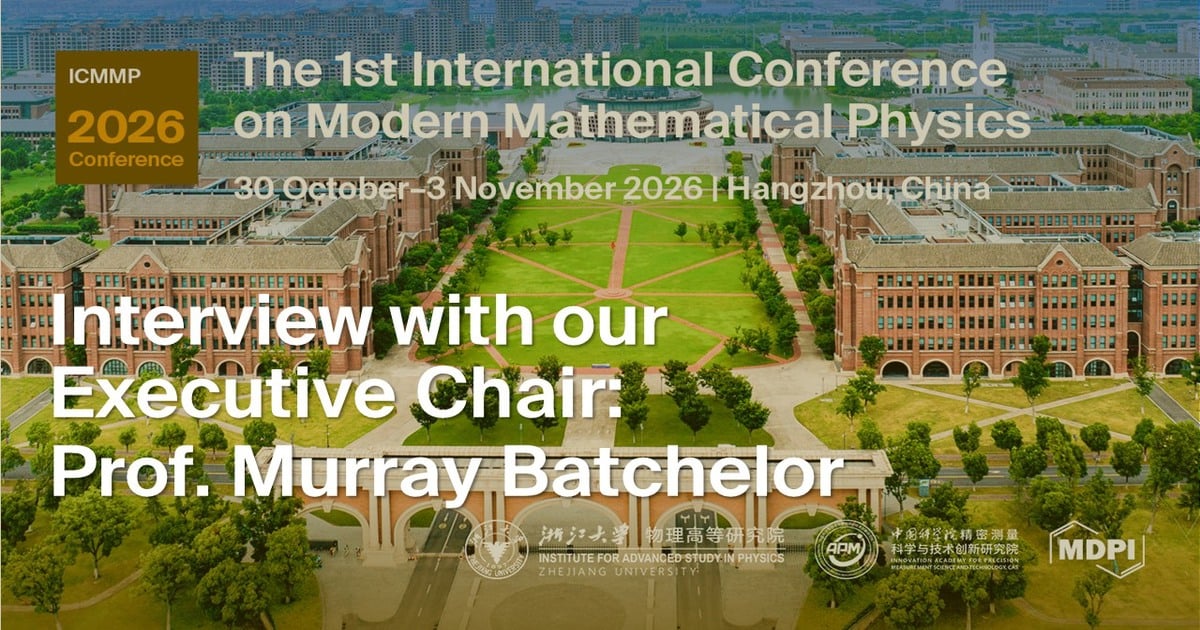
Interview with Prof. Murray Batchelor—Executive Chair of the 1st International Conference on Modern Mathematical Physics (ICMMP 2026)
Exactly solved models have long played a central role in revealing the hidden mathematical structures behind complex physical systems. From quantum spin chains and integrable models to ultracold atomic gases and quantum many-body physics, they offer insights that go far beyond the limits of numerical approximations alone.
Few approaches illustrate the power of mathematical physics more clearly than integrability and the Bethe Ansatz. Drawing on the tradition of exactly solved models associated with Rodney Baxter and the Australian school, Prof. Murray Batchelor has made significant contributions to the study of integrable systems, quantum spin models, and statistical mechanics, exploring the deep connections between mathematical structures and physical phenomena.
As an Executive Chair of the 1st International Conference on Modern Mathematical Physics (ICMMP 2026) and a Keynote Speaker in Session 3: Quantum Information and Quantum Metrology, Prof. Batchelor will join researchers from around the world in Hangzhou, China, from 30 October to 3 November 2026, to exchange ideas on mathematical physics and its related fields.
Ahead of the conference, we invited Prof. Batchelor to reflect on the enduring significance of integrability, emerging developments in quantum many-body physics, the growing interplay between mathematical theory and experiments, and the opportunities that international collaboration offers to the next generation of researchers.
Introduction:

Name: Prof. Murray Batchelor
Affiliation: Australian National University, Canberra, Australia
Prof. Murray Batchelor is Emeritus Professor of Mathematical Physics at The Australian National University. His research is centred on exactly solvable models in statistical mechanics and quantum many-body physics, with particular interests in integrable quantum systems, quantum spin chains, Bethe Ansatz, parafermions, and quantum Rabi models. He was awarded the Australian Academy of Science Pawsey Medal and the Australian Mathematical Society Medal. His recent work explores exact structures in quantum many-body systems and their connections with quantum information.
Prof. Batchelor is a keynote speaker in Session 3: Quantum Information and Quantum Metrology, and the title of his presentation is “Exact Many-Body Structures, Goldstone Modes and Quantum Entanglement”.
The following is an interview with Prof. Murray Batchelor:
1. Could you please start by introducing yourself and your academic background?I am a mathematical physicist, and most of my career has been devoted to exactly solved models in statistical mechanics and quantum many-body physics. I was fortunate to develop as a researcher in the tradition associated with Rodney Baxter and the Australian school of exactly solved models, and that has had a lasting influence on the way I think about mathematical physics.
2. Your research has covered a wide range of topics, including exactly solved models, Bethe Ansatz, quantum spin systems, and mathematical models of growth and form. Could you share with us some of the key research questions that have particularly inspired your work and some recent developments that you find especially exciting?I have always been attracted to problems where a complicated interacting system reveals enough hidden structure that something exact can be said about it. The Bethe Ansatz and related methods are wonderful examples. Apparently formidable many-body problems can sometimes be reduced to remarkably elegant mathematics. This idea has led me through quantum spin chains and lattice models, ultracold atomic systems, and light–matter interaction problems such as the quantum Rabi model. More recently, I have become particularly interested in free parafermions, new forms of integrability, and non-Hermitian many-body physics, including exceptional points.
3. Your research has often connected fundamental mathematical structures with physical systems such as quantum magnetism and ultracold atomic gases. How do you see the role of mathematical theory in advancing our understanding of complex physical phenomena?Mathematics can reveal structure that is very difficult to see from numerical or experimental observations alone. Exact results are particularly valuable because they provide benchmarks for approximation methods, computation and experiments, but they can do more than that. Sometimes the mathematics predicts entirely unexpected physical phenomena. One of the pleasures of mathematical physics is precisely this two-way interaction. The physics motivates new mathematics, while the mathematics in turn tells us something new about the physics.
4. Integrable models have played an important role in connecting mathematical structures with physical phenomena. In your view, what makes integrability such a powerful concept in modern physics?For me, one of the remarkable features of integrability is that it allows us to understand strongly interacting systems without first making them weakly interacting. Behind an exact solution, one usually discovers a rich collection of structures, including conservation laws, algebraic symmetries, Bethe equations, functional relations, and sometimes completely unexpected connections between different models. Baxter’s work is perhaps the outstanding example of how powerful this point of view can be. Integrable models are also valuable as reference points, in the sense that by understanding them exactly, we can ask much sharper questions about what changes when integrability is broken.
5. Mathematical physics continues to evolve through connections with emerging fields such as quantum information, quantum computing, and complex systems. What directions do you think will be particularly important for the future development of mathematical physics?I expect the interaction between integrability, quantum information, and many-body physics to remain especially productive. Entanglement, non-equilibrium dynamics, light–matter interaction, non-Hermitian systems, exceptional points, and the transition between integrable and chaotic behaviour are already bringing together ideas that developed in quite different communities.
Another remarkable development is that experimental technology has advanced to the point where models once regarded mainly as idealized theoretical problems can now be realized or simulated in the laboratory. Ultracold atomic gases, optical lattices, superconducting circuits, and other quantum platforms are allowing us to explore Hamiltonians that mathematical physicists have studied for decades. The quantum Rabi model is just one example. This gives old models a new life and also changes the questions we ask.
I think there is still much to learn by returning to classical exactly solved models with new questions. The importance of a particular model is not always apparent when it first appears. As we have clearly seen, sometimes the real significance only becomes clear decades later, when new mathematics, new physics, or new experimental capabilities bring it back into view.
6. As one of the Executive Chairs of ICMMP 2026, what are the main goals and expectations you have for the conference? With its broad scope covering different areas of modern mathematical physics, how do you hope ICMMP 2026 will encourage interdisciplinary exchange and inspire new collaborations?One of our main aims with ICMMP 2026 is to bring together researchers who may work with quite different mathematical techniques, but who are often concerned with closely related physical questions. Mathematical physics is now extremely broad, and there is considerable value in creating opportunities for people to look beyond the boundaries of their own specialities. I hope that the programme in Hangzhou will encourage precisely this kind of exchange. If people leave the conference with new questions, new collaborators, or simply a different way of looking at an old problem, that would be an excellent outcome.
7. With researchers from around the world gathering in Hangzhou, what role do you think international academic exchanges play in advancing mathematical physics?International exchange has always been fundamental to mathematical physics. I still have very fond memories of conferences I attended as a young researcher. They gave me the opportunity to meet leading figures in the field, but equally importantly to meet other young researchers who went on to become colleagues and friends over many decades.
Different countries and research groups develop their own traditions and ways of approaching problems, and bringing these together can be extremely fruitful. Some of the most valuable parts of a conference are not necessarily the formal talks but the discussions that take place afterwards, when an unfinished idea is passed from one person to another. I hope younger researchers attending ICMMP 2026 will have some of those same experiences.
8. What advice would you like to share with early career researchers who are pursuing research in mathematical physics and related fields?I would encourage young researchers to learn the fundamentals very well and, at the same time, to remain curious about subjects outside their immediate area. Do not be too quick to abandon a difficult problem simply because the first approaches fail. Sometimes an important problem has to be looked at many times before the right formulation becomes apparent.
I would also encourage them to value exact results, simple examples, and special cases. They often contain much more information than initially expected. And, perhaps most importantly, work on problems that you genuinely find interesting. Curiosity remains one of the best guides in research.
Meet Prof. Murray Batchelor at ICMMP 2026

Join us in Hangzhou this October to explore the latest developments in quantum metrology, entanglement theory, and modern mathematical physics together with leading researchers from around the world.
Conference location: Hangzhou, China
Conference date: 30 October–3 November 2026
Registration still open: https://sciforum.net/registration/ICMMP2026/tickets.
Conference website: https://sciforum.net/event/ICMMP2026.
For any inquiries, please contact us at icmmp2026@mdpi.com.