

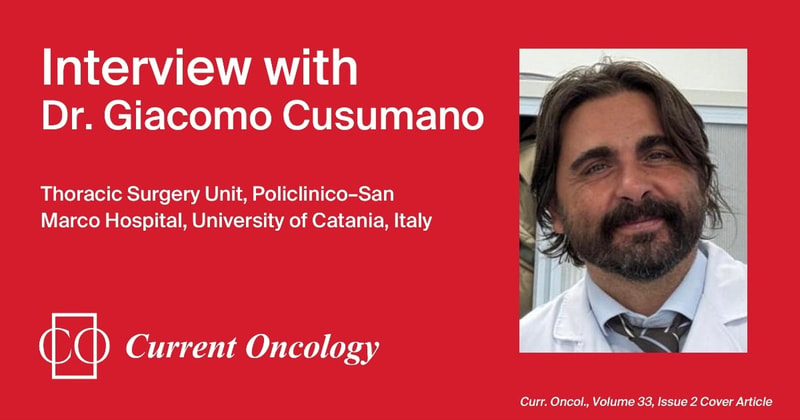
Current Oncology | Interview with One of the Issue Cover Authors—Dr. Giacomo Cusumano
We had the pleasure of speaking with Dr. Giacomo Cusumano, who is the corresponding author of the cover article published in Volume 33, Issue 2 of Current Oncology (ISSN 1718-7729). Here, he shares insights into his academic journey, research focus, and the motivation behind his recent work.
“Immune Checkpoint Inhibitors in Malignant Pleural Mesothelioma: Efficacy, Real-World Outcomes, and the Search for Predictive Biomarkers”
by Giusi Bondì, Serafina Martella, Dimitrios Stylianakis, Alberto Terminella, Filippo Lococo, Alessia Ciarrocchi, Alfonso Fiorelli and Giacomo Cusumano
Curr. Oncol. 2026, 33(2), 93; https://doi.org/10.3390/curroncol33020093
Available online: https://www.mdpi.com/1718-7729/33/2/93
Dr. Giacomo Cusumano is a thoracic surgeon and Associate Professor of Thoracic Surgery at the University of Catania, Italy. He practices at the Thoracic Surgery Unit of the Policlinico “G. Rodolico–San Marco” University Hospital. He completed his specialization in thoracic surgery in 2009 and earned a PhD in organ transplantation from the Catholic University of Rome in 2013. He also received advanced training in robotic and minimally invasive thoracic surgery at the University of Pisa. His international training includes fellowships in Paris in 2007 and Shanghai in 2026, which further expanded his experience in advanced thoracic surgical techniques. His clinical and research interests include thoracic oncology, malignant pleural mesothelioma, thymic and airway diseases, minimally invasive and robotic surgery, and the application of artificial intelligence to clinical decision-making. He currently serves as principal investigator for a funded research study dedicated to malignant pleural mesothelioma and has authored several scientific articles in the fields of thoracic surgery and thoracic oncology. He is a member of several national and international scientific societies and actively participates in clinical and translational research collaborations.
The following is an interview with Dr. Cusumano:
1. Could you briefly introduce your published review and highlight its key messages?
Our review critically examines the role of immune checkpoint inhibitors in malignant pleural mesothelioma by bringing together three levels of evidence: clinical trial findings, real-world data, and the latest knowledge regarding potential predictive biomarkers.
Immunotherapy is deeply changing the therapeutic landscape of this disease, which had remained largely unchanged for many years. However, its benefits are not uniform and vary according to histological subtype and individual patient characteristics. The combination of nivolumab and ipilimumab has demonstrated a survival benefit primarily in non-epithelioid mesothelioma, whereas the benefit appears more limited in epithelioid disease. Moreover, real-world studies generally report less favorable outcomes and greater toxicity than registrational trials, particularly among elderly, frail, or unselected patients.
One of the central aspects of our review is the tumor microenvironment. Mesothelioma may exhibit abundant infiltration of immune-cells, but this does not necessarily translate into an effective antitumor response. T cells frequently display an exhausted phenotype, while tumor-associated macrophages, myeloid-derived suppressor cells, and regulatory T cells contribute to maintaining a highly immunosuppressive environment. These mechanisms are further influenced by epigenetic alterations, a low tumor mutational burden, and the immunological effects of the major genomic alterations associated with the disease.
Compared with lung cancer, the relationship between the tumor microenvironment and response to immunotherapy in mesothelioma remains less clearly defined and cannot be adequately captured by individual biomarkers such as PD-L1 expression or tumor mutational burden. Sensitivity to immunotherapy appears driven, rather, by a complex interplay among histology, clinical characteristics, the tumor genomic profile, and the composition of the immune microenvironment.
BAP1 and NF2 alterations appear to be associated with a more inflamed and immunologically active microenvironment, whereas CDKN2A deletion may characterize immunologically “cold” tumors with reduced lymphocyte recruitment. However, the available evidence remains largely exploratory and does not yet support the use of these alterations to guide treatment decisions in routine clinical practice.
The main message is therefore that immunotherapy represents an important advance, but it should not be considered a universal strategy. Looking ahead, progress will most likely come not from a single biomarker but from integrated models capable of combining clinical, genomic, and immunological information.
2. What role do you think comprehensive reviews play in helping researchers and clinicians navigate a rapidly evolving field such as malignant pleural mesothelioma?
A review provides both a critical and comprehensive perspective on a specific topic. It offers a valuable vantage point from which evidence from clinical trials, registries, real-world studies, and translational research can be brought together, allowing us to see the broader picture without losing sight of the more specific aspects of the problem.
This approach is particularly useful in malignant pleural mesothelioma, a rare disease for which the available evidence is often fragmented and derived from very different patient populations. A review can, for example, compare the efficacy of immunotherapy demonstrated in clinical trials with the often less favorable outcomes observed in routine clinical practice, particularly among elderly or frail patients. It also makes it possible to examine more specific questions, such as differences among histological subtypes and the potential role of biomarkers, while distinguishing prognostic associations from factors that can genuinely predict treatment response.
The value of a review therefore lies not only in summarizing what has been published but, above all, in interpreting it by highlighting established findings, potential inconsistencies, and areas where knowledge remains insufficient. In this way, it can help clinicians make more informed decisions and guide researchers towards the most relevant questions to be addressed in future studies.
3. What initially motivated you to conduct a review on this particular topic?
Several factors motivated us to conduct this review. The starting point was a multicenter research project on the multi-omic characterization of mesothelioma that we are carrying out with other Italian centers. The review recently published in Current Oncology was developed together with colleagues involved in this project and grew naturally out of our shared research and scientific discussions. Our aim was to place the genomic, molecular, and immunological findings emerging from translational research within the broader context of the clinical evidence currently available.
The motivation also came directly from clinical practice. Despite recent therapeutic advances, responses remain highly heterogeneous: some patients achieve a meaningful benefit, whereas in others the same treatment strategies have limited efficacy or cause significant toxicity. Understanding the reasons for this variability and identifying the factors that may influence response to immunotherapy remain major clinical and research challenges.
Finally, mesothelioma has a profound human and social impact. It is an aggressive and often fatal disease that remains closely linked to occupational asbestos exposure and may develop decades after the initial exposure. People who know they have been exposed to asbestos are often familiar with the consequences of this disease and may live for years with the fear of developing it. This places an additional emotional burden on individuals, families, and entire communities. Sharing information about emerging treatments and new directions in research cannot remove this uncertainty, but it may offer a source of realistic hope and comfort. This is another important reason why we remain committed to studying mesothelioma and developing more effective and personalized treatment strategies.
4. Could you tell us a little bit about your current research and research interests?
Medicine is undergoing a profound transformation, as clinical, molecular, and technological knowledge becomes increasingly interconnected. This is why a translational approach guides my research: I start with the problems we encounter in daily clinical practice, investigate their biological mechanisms, and seek to bring new knowledge back to patient care.
My main area of interest is thoracic oncology, particularly lung cancer, thymic tumors, and mesothelioma. I also study benign airway diseases, including the development and evaluation of minimally invasive and robotic surgical techniques.
More recently, I have been working on the application of artificial intelligence to diagnostic and clinical decision-making processes in both lung cancer and airway diseases. I see this as another aspect of translational medicine. By integrating and analyzing large amounts of clinical, imaging, and molecular data, AI may help us better predict how a disease will evolve and guide more personalized treatment decisions.
5. Looking ahead, what do you see as the next major trends or emerging directions in lung cancer research?
I believe the idea of a treatment based solely on histology and applied equally to every patient is now outdated. Lung cancer is not a single disease: tumors that look similar under the microscope can have very different molecular characteristics and clinical behavior. To tailor treatment to each patient, we need to understand not only the alterations within the tumor but also the genetic and clinical characteristics of the person living with it. This is true of lung cancer, but the same principle can be extended to every form of cancer.
This is where I see the greatest potential of the omics sciences. Studying the genome is essential, but it does not tell the whole story. We also need to understand how genes are expressed, what happens after transcription, and how these processes affect proteins and the tumor microenvironment. Integrating this information with clinical, pathological, and imaging data is an enormously complex challenge. Today, however, we have technologies that can help us address that complexity, improve our ability to predict treatment response, and identify the most appropriate strategy for each patient.
After many years in which the results of cancer treatments were often disappointing, the growing ability to personalize care opens up new possibilities. My hope is that a deeper understanding of the disease will translate into tangible benefits for the people we care for.
6. What motivated you to choose Current Oncology as a platform for publishing your work, and how was your experience with the journal?
I have published in MDPI journals for several years, and open access was an important factor in choosing Current Oncology for this review. Making research freely available helps it reach clinicians and researchers who might otherwise be unable to read it. More broadly, I believe that wider access to scientific knowledge has clear benefits.
Current Oncology was an appropriate journal for the topic and audience of our review. My experience with the journal was professional, and the editorial process allowed us to present our work to a broad readership.
7. Finally, as a researcher, how do you balance your research with your personal life, and what helps keep you motivated along the way?
Before we are researchers, we are human beings. Our lives find meaning in the people we love, our personal experiences, and the values we hold. For me, finding a balance means keeping these things in view, even when work demands a great deal of time and energy.
Being a doctor brings me into contact every day with people going through difficult times. Listening to them and looking for a clinical solution means valuing their lives and hoping to make those lives less painful. That is my first source of motivation. The second is curiosity: research means asking questions, seeking answers, and exploring what we do not yet understand.
I am Italian, and I often think of a line by Dante Alighieri, our greatest poet, in his Divina Commedia: “fatti non foste a viver come bruti, ma per seguir virtute e canoscenza”—“you were not made to live like brutes, but to pursue virtue and knowledge”. It reminds me that the pursuit of knowledge has meaning when it remains connected to our values and to the people we work for. That, to me, is what makes the journey worthwhile.
We thank Dr. Cusumano for sharing his perspectives on his research journey, the role of comprehensive reviews, and the future of thoracic malignancies research. We hope that his insights will be of interest to the Current Oncology community.