

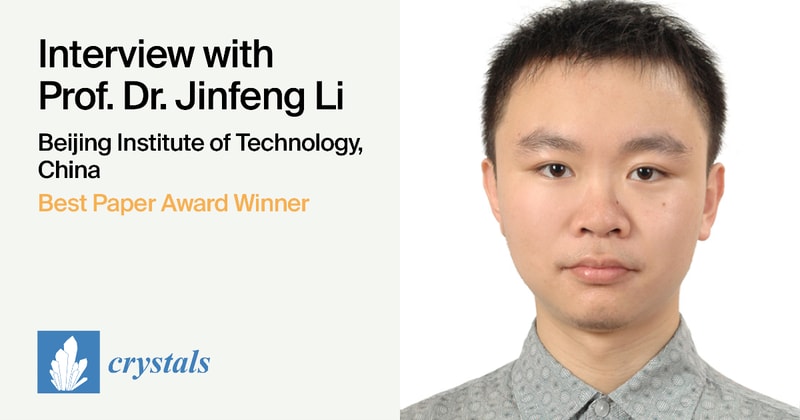
Interview with Prof. Dr. Jinfeng Li—Winner of the Crystals Best Paper Award
We are honored to announce that Prof. Dr. Jinfeng Li has been selected as the winner of the Crystals Best Paper Award 2024.
“Modeling 0.3 THz Coaxial Single-Mode Phase Shifter Designs in Liquid Crystals with Constitutive Loss Quantifications”
by Jinfeng Li and Haorong Li
Crystals 2024, 14(4), 364; https://doi.org/10.3390/cryst14040364
The following is an interview with Prof. Dr. Jinfeng Li:
1. Congratulations on winning the Crystals 2024 Best Paper Award! Could you briefly introduce yourself and your research background?
Thank you—I’m truly honored and grateful for this recognition.
I’m a microwave engineer with a deep fascination for pushing the boundaries of what’s possible at high frequencies. My research career has been driven by a single, persistent question: how can we build better, more reconfigurable devices for the wireless world of tomorrow? That question has led me on quite an adventure over the past twelve years.
My formal training started with a BEng in electrical and electronics engineering from Huazhong University of Science & Technology and the University of Birmingham, UK, followed by my PhD at the University of Cambridge, UK, focusing on liquid crystals for microwave and millimeter-wave electronics, where I found my true calling. I became captivated by the elegant physics of liquid crystals—their ability to continuously tune and reconfigure—and how we could harness that for next-generation communication systems like 5G and 6G.
What I love about my work is its interdisciplinary nature. While my core expertise lies in liquid crystal-based tunable devices for phase shifting and beam steering, I’ve had the privilege of exploring so many adjacent fields. From motor drives of multilevel multicell inverters for fuel economy and sustainable cities, wireless sensors for LNG tank monitoring and nuclear thermal hydraulics instrumentation development, to big data analytics for stock market forecasting and even COVID-19 health informatics, each project taught me something new and enriched my perspective as an engineer. It’s this diversity of experience that I believe makes me a more creative problem-solver.
Outside the lab, I’m also a concert pianist and composer, with over 20 recitals across China and the UK. Music has been a lifelong passion, and I’ve been incredibly fortunate to share it with over a million followers online. Interestingly, I find that my scientific and musical minds are deeply connected—the patterns, rhythms, and structures in music often inspire new ways of thinking about electromagnetic waves and device design. It’s a beautiful symbiosis.
I’m also passionate about teaching and currently mentor undergraduate students at Beijing Institute of Technology through modules on liquid crystal technology, electronic engineering frontiers, and even piano performance. Seeing the spark of curiosity in young minds is one of the greatest joys of my academic life. And of course, I’m constantly learning from my students and peers, which keeps this journey endlessly exciting.
2. Could you briefly introduce the main focus of your research and the key findings of your award-winning paper? What initially inspired this work?
Our award-winning paper focuses on a critical challenge for next-generation 6G communications: designing high-performance, low-loss phase shifters that can operate at 0.3 THz. The core innovation is using liquid crystals as the tunable dielectric material inside a classic coaxial transmission line.
The key findings are twofold. First, we designed two specific 50 Ω coaxial geometries—based on impedance matching baselines at diverse tuning states of liquid crystals—that effectively suppress the first higher-order (TE11) mode, which is a major source of signal loss and interference. Second, and most importantly, our constitutive power loss analysis revealed the primary performance bottleneck: at 0.3 THz, the dielectric loss from the LC itself becomes the dominant factor, consuming up to 63.5% of the input power. This loss is significantly more pronounced than conductor losses and much greater than at lower frequencies like 60 GHz, where we had previously developed similar devices.
This work was inspired by the natural progression of our research. Having successfully demonstrated liquid-crystal-based phase shifters at 60 GHz, we wanted to explore the feasibility of this technology at the next frontier—the THz band. This frequency range holds immense promise for ultra-high-bandwidth 6G communications and advanced radar, but presents new physics challenges. This study was the crucial first step to analytically and numerically investigate those challenges, particularly the issue of loss, to determine if the coaxial-liquid-crystal approach is viable and what its fundamental limitations might be.
3. Preparing a high-quality manuscript often requires multiple rounds of revision. What were the main challenges you encountered during the preparation of this paper, and how did you overcome them to clearly present your methodology and findings?
The primary challenge was the complexity of the subject for an audience from diverse technical backgrounds—electromagnetics, material science, and device physics. We were dealing with a novel concept—liquid-crystal-filled coaxial phase shifters at THz frequencies—which required explaining new analytical models and a wealth of simulation data. A key difficulty was ensuring the methodology for our constitutive power analysis was crystal clear. This method, which breaks down the total power loss into individual components like liquid crystal dielectric loss, core line metallic loss, and housing (grounding) loss, is a unique contribution, and we had to present it in a way that was both rigorous and accessible to readers.
To overcome this, we structured the paper to first establish the analytical models for the TE11 mode suppression, then present the two specific designs, and only then introduce the constitutive loss analysis. This created a logical flow from the problem definition to our proposed solution and its in-depth evaluation. We relied heavily on clear figures and schematics (like Figure 4 for the cross-section and Figure 7 for the mesh) to complement the mathematical descriptions. The radar charts (spider plots) in Figure 22 were particularly useful for visually comparing the loss contributions between our 0.3 THz designs and previous 60 GHz work.
Finally, we didn’t just present our own results in isolation. We benchmarked them against our previously established 60 GHz design. This direct comparison was vital for highlighting the key finding about the escalating role of LC dielectric loss at higher frequencies (the 35.76% variation compared to 13.5%). This context helps readers immediately grasp the significance of our results.
4. What advice would you give to early career researchers who aspire to conduct impactful research and publish in high-quality journals?
My advice is to build your research on strong analytical foundations and always focus on solving tangible, real-world problems. While powerful, don’t rely solely on full-wave simulations and artificial intelligence as a “black box”. As we did by deriving the equations for TE11 cutoff frequency and impedance matching, developing your own analytical models gives you deeper physical insight into your design. It also provides a solid, understandable baseline to explain your work, which is crucial for a high-quality manuscript. Beyond the technical foundations, a good paper doesn’t just report results—it tells a story about why the work matters. The most impactful research solves a problem. In our paper, we identified that the escalating dielectric loss of liquid crystals at THz frequencies is a critical bottleneck for low-loss operation. Our work didn’t just propose a new device but explicitly quantified this fundamental limitation, shaping the direction for future work.
I also believe in the power of deep focus. My own research path is a good example of this. I concentrated deeply on a single, challenging area—liquid-crystal-based microwave and millimeter-wave devices. Over time, I built a unique body of work that established my expertise, leading to recognition like the Crystals Best Paper Award and being named on the World’s Top 2% Scientists List. Developing this depth of knowledge in a niche allows you to make truly meaningful contributions. Finally, when it comes to publishing, be persistent and receptive to feedback. High-quality journals demand rigorous peer review, and each round of revision is an opportunity to strengthen your work. Embrace the process, respond thoughtfully to reviewers, and never lose sight of the core contribution your research makes to the field.
5. Publishing in an open access journal enhances visibility and accessibility. How do you think the open access model of Crystals will support the dissemination and impact of your research?
The open access model of Crystals is fundamentally important for disseminating our findings, particularly within a fast-moving, globally competitive field like THz technology. By removing the paywall, our paper is immediately accessible to anyone with an internet connection—not just researchers at well-funded universities, but also engineers in industry, scientists in developing nations, and even independent researchers.
This unrestricted access is vital because the problem of developing low-loss THz components is a global challenge. Our detailed loss analysis provides critical data for the entire engineering community, regardless of their institution’s budget. It allows a researcher at a small company or a university with limited journal subscriptions to read, understand, and potentially build upon our work. This accelerates the pace of innovation and helps avoid duplicating efforts, which is essential for rapidly advancing the 6G communications field. The visibility gained from open access also aligns perfectly with our goal of sharing the knowledge gained from this underpinning study to benefit the broadest possible audience.
6. As a Best Paper Award winner, what suggestions do you have for Crystals to further improve its services or expand its academic impact?
Thank you for this honor. Crystals is already an excellent journal with a growing reputation, but there are always opportunities to build on that success. I have a forward-looking suggestion that I believe could further enhance its services and impact.
The Best Paper Award is a wonderful recognition. As an extension, the journal could invite winners to write a short “Perspective” or “Vision” article a year or two after their award. This piece would not summarize the original paper but would instead discuss how the field has evolved since, the key research questions that have emerged, and a personal vision for the future of that specific research area. This would solidify the connection between the journal and its most impactful contributors and provide a unique, forward-looking resource for the community, further expanding Crystals’ role as a thought leader in the field.