

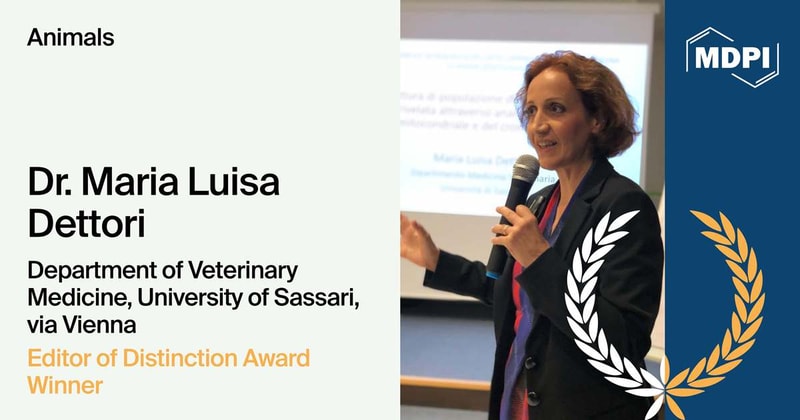
Interview with Dr. Maria Luisa Dettori—Winner of the Animals Editor of Distinction Award
We are pleased to announce that Dr. Maria Luisa Dettori is one of the winners of the Animals 2025 Editor of Distinction Award. The Animals Editor of Distinction Award is presented annually to recognize Editorial Board Members who contribute their time to editing papers and display thoroughness, professionalism, and timeliness while doing so.
1. Could you please briefly introduce yourself to our readers and give an overview of your current research?
I am an Associate Professor at the University of Sassari, Sardinia, Italy.
I work in livestock science. Together with my research group, we conduct association studies on livestock, primarily sheep and goats, which are extensively reared in Sardinia, and also on cattle, pigs, and horses. We are currently analyzing the methylation profile of native DNA in animal tissues to identify genes that are activated or deactivated in response to environmental variations.
2. What led you to serve as an Editor for Animals? How did you hear about the journal?
I became involved with Animals through my research activities, as my colleagues and I were used to consulting articles from the journal, and later we happened to publish in Animals. So, I was already familiar with the journal and its reputation for publishing high-quality interdisciplinary research in animal science and related fields. Over the years, I had the opportunity to read and cite several articles published in Animals, which gave me a strong appreciation for its standards, broad international reach, and speed of publication. When I was invited to serve as an Editor, I saw it as an opportunity to contribute to the scientific community beyond my own research. It was a really great experience.
3. As a journal Editorial Board Member, what do you believe is the most critical step in maintaining the journal’s academic standards? Is it the evaluation of innovation during the precheck stage, the precise selection of reviewers, or the final decision for controversial manuscripts?
All the stages of the editorial process are essential and closely interconnected. A thorough pre-check helps ensure that manuscripts meet the journal scope and basic quality standards; then, careful editorial decisions are crucial, particularly when reviews are conflicting or controversial. However, if I had to identify the single most critical step, I would choose the selection of appropriate reviewers. High-quality, independent, knowledgeable reviewers provide the foundation for a fair and constructive peer review process.
Usually, most papers are reviewed by at least three reviewers, so they sometimes give very different opinions; you have different points of view and different suggestions from each reviewer. This is very interesting and improves the manuscript in the end. Editors have to take into account the information from authors and reviewers and try to synthesize all these views.
4. In your opinion, what key qualities should an excellent manuscript have? From what perspectives will you help authors improve the quality of their papers?
An excellent manuscript should combine scientific novelty with methodological rigor, clarity, and fundamental and practical relevance. Novel findings are important, but they should be supported by a robust study design, appropriate data analysis, and conclusions that are fully supported by the results. Clarity and well-constructed writing are equally important, as they allow readers to understand the research and appreciate the contribution.
5. We hope that the Editor of Distinction Award will open new opportunities for you. How does an award like this help to support the career of a researcher such as yourself?
Receiving an Editor of Distinction Award has been a surprise. It is a great honor and a meaningful recognition of the editorial work I carried out over the years, thanks to Animals.
More importantly, serving as an Editor has been an invaluable learning experience that has significantly contributed to my growth as a researcher. Handling manuscripts from a wide range of topics, evaluating different scientific approaches, and working closely with reviewers and authors have strengthened my critical thinking and broadened my perspective on what defines high-quality research. This experience has also influenced the way I design, conduct, and communicate my own research, making me a more rigorous and thoughtful scientist.
6. What advice would you give to aspiring researchers looking to make a meaningful impact in their fields? What qualities do you think young scientists need?
My advice to young researchers is to remain curious and always let scientific questions guide their work. It is important to pursue innovative ideas, but also to remember that meaningful research is built on rigorous methodology, critical thinking, and intellectual honesty, the most important values in writing scientific papers. I also encourage early career scientists to be open to collaboration and to view the peer review process as an opportunity to grow rather than simply an evaluation.
7. As AI technology is increasingly applied in academic writing and peer review, what is your view on its impact on the traditional peer review process as an Editorial Board Member? How should the journal maintain oversight in terms of technical ethics?
Artificial intelligence is already transforming many aspects of scientific research, including academic writing and peer review. I believe AI can be a valuable tool when used responsibly. It can help improve language, identify inconsistencies, support literature searches, and reduce some of the administrative workload associated with the editorial process. This application can make the review process more efficient without compromising quality. However, AI should never replace human scientific judgment. Assessing the originality of a research question, the soundness of the methodology, the biological relevance of the findings, or the significance of the manuscript requires expertise, critical thinking, and an understanding of the broader scientific context. These are responsibilities that remain firmly within authors, reviewers, and editors. We can use artificial intelligence, but we do not have to give up our real work to it. We need to be the owners of our work, of our process, and of our thinking. Artificial intelligence is a great tool—fantastic—but it is a tool. It does not have to substitute our minds.
8. Animals is an open access journal. How do you think open access publishing benefits authors and the broader research community?
I believe that open access publishing plays a fundamental role in accelerating scientific progress by making research immediately and freely available to anyone, anywhere in the world. This benefits not only researchers who can access and build upon the latest findings without barriers, but also practitioners, policymakers, educators and other stakeholders who rely on scientific evidence to make informed decisions. As regards animal science, open access is particularly valuable because research findings often have direct implications for livestock production, animal welfare, biodiversity conservation and sustainable management. Ensuring that this knowledge is widely accessible helps bridge the gap between research and practice, allowing scientific discovery to reach those who can apply it in real-world settings.