

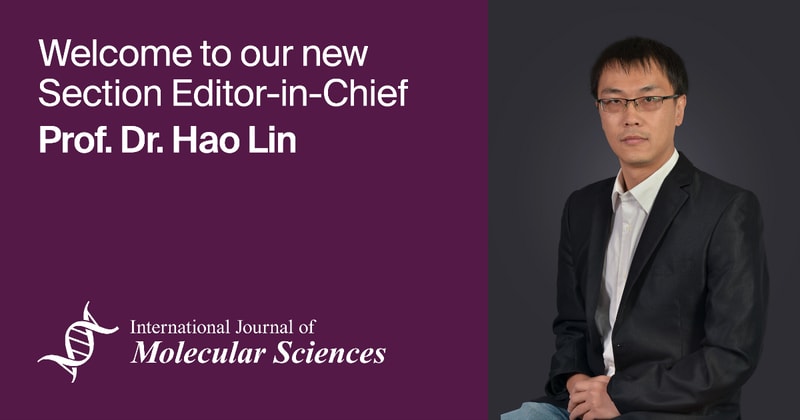
Prof. Dr. Hao Lin Appointed Section Editor-in-Chief of Section “Molecular Informatics” in the International Journal of Molecular Sciences
We are pleased to announce that Prof. Dr. Hao Lin has been appointed Editor-in-Chief of the Section “Molecular Informatics” of the International Journal of Molecular Sciences (IJMS, ISSN 1422-0067), and he will be working alongside the current Section Editor-in-Chief, Prof. Dr. Antonio Rescifina of the University of Catania, to jointly lead the development of the Section and journal.
Prof. Dr. Lin received his PhD in biophysics in 2007 from Inner Mongolia University (Supervisor: Qian-Zhong Li). His research field is bioinformatics and systems biology. Facing the frontier of life medicine science, aiming at the key problem of high noise and insufficient feature extraction of biomedical data, a variety of feature extraction and optimization algorithms have been developed, and some research results have been achieved in the fields of sorting and sequence representation of biological macromolecular data, clinical data analysis and disease risk prediction.
Prof. Dr. Lin was recognized as a 2018 Highly Cited Researcher by Clarivate, a 2020 Highly Cited Chinese Researcher from Elsevier and one of the World’s Top 2% Scientists 2021 from Stanford University. He also obtained Outstanding Young Scientific and Technological Talents in Sichuan Province (2019) and the Science and Technology Progress Awards of Sichuan (2012) and Hebei (2015). He is a member of the Center for Informational Biology and the Key Laboratory for NeuroInformation of the Ministry of Education at UESTC. He is also a member of the Special Committee on Bioinformatics in CCF and a member of ACM.
Prof. Dr. Lin was supported by grants from the National Natural Science Foundation of China, the Sichuan Provincial Science Fund for Distinguished Young Scholars and the Scientific Research Foundation of Sichuan Province. Now he serves as the editor of some journals including Current Bioinformatics, iMeta and Cancer Medicine. He often serves as a reviewer for over 100 international journals.
The following is an interview with Prof. Dr. Hao Lin:
1. What appealed to you about the journal that made you want to take the role as its Section Editor-in-Chief?
What attracts me to this journal, first and foremost, is its strong alignment with my research interests and long-term academic work. In recent years, artificial intelligence, big data, and computational methods have been profoundly transforming molecular biology research, and I believe the journal has significant potential for development at this interdisciplinary interface.
I would like to serve as Editor-in-Chief not simply to participate in the journal’s academic management, but also to work with the Editorial Board, editorial team, and research community to further enhance the journal’s academic influence and international recognition, while providing a more open, efficient, and professional platform for high-quality research.
2. What are your expectations and suggestions for the future development of the journal?
I hope the journal can further clarify and strengthen its academic positioning, highlighting its strengths in artificial intelligence, bioinformatics, computational biology, and the intersection of AI and life sciences and medicine.
In the future, I believe we should focus on several areas. First, we should increase the proportion of high-quality original research and authoritative reviews, while also publishing more commentaries and perspective-oriented articles, such as editorials and perspectives, so that the journal can participate more actively in academic discussions and help shape emerging research directions. Second, we should further expand the participation of international authors, reviewers, and editorial board members to enhance the journal’s international profile.
At the same time, while maintaining rigorous academic standards, I hope the journal can further improve the efficiency of peer review and publication and provide authors with a more professional, transparent, and efficient publishing experience.
3. What does the future of this field of research look like?
I believe the deep integration of artificial intelligence with life sciences and medicine will be one of the most important directions for future research.
Future research will move beyond using machine learning simply to classify or predict individual types of data, toward the integrated analysis of multi-omics, multimodal, and multiscale data. For example, genomic, transcriptomic, proteomic, single-cell, spatial omics, and clinical electronic health record data can be integrated, with deep learning and large language models used to develop more comprehensive models for understanding and predicting diseases.
At the same time, AI will gradually evolve from a traditional “auxiliary analytical tool” into an important tool for scientific discovery, contributing to biomarker discovery, disease-mechanism research, clinical decision-making, molecular drug design, and drug development. In particular, AI has the potential to substantially improve the efficiency of drug discovery through molecular structure generation, virtual screening, protein structure prediction, drug-target interaction prediction, and candidate-drug optimization. However, I believe the real challenge is not simply applying AI to drug design, but integrating AI deeply with knowledge from chemistry, biology, and medicine to establish intelligent research systems capable of generating scientifically testable hypotheses.
4. Do you have any suggestions for young researchers in this field?
I believe young researchers should first build a solid foundation rather than simply follow the latest algorithms or technologies.
AI is developing extremely rapidly, but research with lasting value must still address meaningful biomedical questions. I therefore encourage young researchers to develop interdisciplinary expertise across biology, medicine, and computational science. They should master AI and data-analysis methods while also developing a genuine understanding of the biological questions they are studying.
More importantly, I hope young researchers will maintain genuine interest and curiosity about scientific questions and conduct research because they are interested in discovering something new, rather than simply pursuing publications or following trends. They should also be able to distinguish clearly between science and technology: technology is primarily concerned with “how to do something,” whereas science is more fundamentally concerned with “what” and “why.” AI is a powerful technology, but using the latest model does not automatically create a scientific question or constitute a scientific discovery.
In the long term, I believe it is more valuable to formulate important questions, generate reliable evidence, and explain the underlying scientific mechanisms than simply to pursue better model performance.
5. What do you think of the development of open access in the publishing field?
I believe open access has become an important trend in academic publishing. It lowers barriers to the dissemination of research and allows scientific findings to be accessed and used more rapidly and widely by researchers around the world.
This is particularly important in rapidly developing fields such as AI and biomedicine, where timely dissemination of research can accelerate scientific progress.
At the same time, open access must go hand in hand with rigorous peer review and publication ethics. Open access should never mean lower academic standards. In particular, when authors are required to pay article processing charges, authors, reviewers, and editors all have a responsibility to uphold scientific standards, and commercial considerations must not influence academic decisions. I also believe that the scholarly labor of reviewers deserves greater recognition. Where feasible, journals should explore appropriate forms of reviewer incentives and compensation, together with mechanisms for evaluating and monitoring review quality. This would help encourage high-quality peer review while protecting its independence and fairness.