
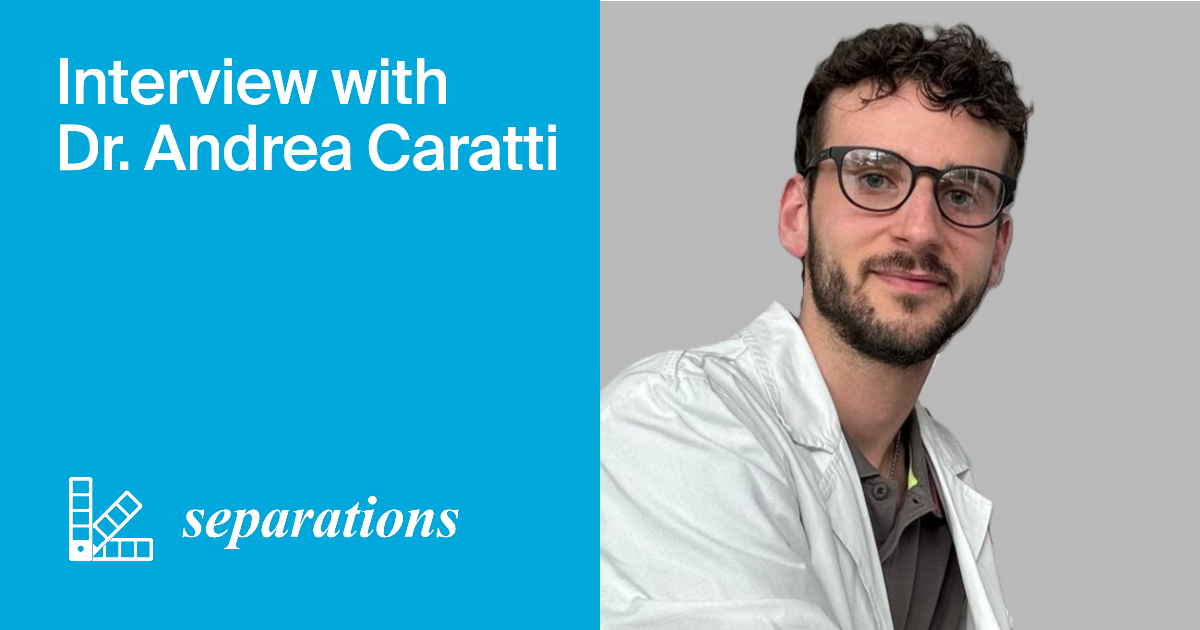
Interview with Dr. Andrea Caratti—Winner of the Best Oral Presentation Award at the 44th International Symposium on Capillary Chromatography and 21st GC×GC Symposium
We are pleased to share an interview with Dr. Andrea Caratti from Università degli Studi di Torino, who received the Best Oral Presentation Award at the 44th International Symposium on Capillary Chromatography and 21st GC×GC Symposium (https://iscc44.chromaleont.it/).
1. Could you briefly introduce yourself to the readers? Also, can you introduce your current research direction and provide an update on your progress?
I am currently an Assistant Professor in food chemistry at the Department of Drug Science and Technology, University of Turin. My research journey in food chemistry started during my PhD and continued through a postdoctoral fellowship, leading to my current position as a researcher.
My research focuses on foodomics, particularly food metabolomics and volatilomics, with a strong emphasis on the development of advanced gas chromatography-based analytical strategies. I mainly work with comprehensive two-dimensional gas chromatography (GC×GC), fast GC approaches, and their coupling with high-resolution mass spectrometry to improve the characterization of complex food matrices. Currently, my research is particularly focused on improving data interpretation in volatilomics through advanced computational approaches, including artificial intelligence-based strategies. I strongly believe that making analytical methodologies more accessible and reliable is essential to expand their application in food science and beyond. These activities are supported by fruitful international collaborations, which are fundamental for driving methodological innovation.
2. As the winner of this award, would you like to take a moment to share your thoughts with our readers or express gratitude towards those who have played a significant role in your research accomplishments?
Receiving this award is a great honor and represents both an important milestone and a strong motivation to continue pursuing innovative research in food analytical chemistry. I would like to express my sincere gratitude to my supervisor, Prof. Chiara Cordero, for her continuous guidance, support, and commitment throughout these years, as well as to all the members of our research group for their dedication and valuable contributions. This recognition reflects the collective efforts, enthusiasm, and collaboration that have accompanied our research journey in food science, and I am truly grateful to share this achievement with all those who have contributed to it.
3. How did you hear about this award, and how supportive this kind of award might be for researchers?
I learned about this award through the conference call for applications and through Separations, and I would like to sincerely thank the journal for supporting this initiative. Awards of this kind are extremely valuable for researchers, as they provide recognition and visibility to innovative ideas and emerging methodologies. Beyond the personal motivation that comes from receiving such an acknowledgment, these opportunities encourage researchers to continue developing new approaches and sharing their results with the scientific community. In this case, the award represents an important recognition of the novelty and potential impact of our methodological developments in food analytical chemistry.
4. When and how did you first become aware of the open access Separations journal? How do you think open access impacts scholars like yourself?
I first became aware of Separations during my PhD, when I started to explore scientific literature and become more familiar with the world of research publications. Since then, I have regularly followed and read articles from the journal, particularly those related to separation sciences and analytical methodologies. I strongly believe that open access plays a fundamental role in modern science by promoting the broader dissemination of knowledge and making scientific advances accessible to a wider community of researchers. This approach facilitates collaboration, accelerates the exchange of ideas, and helps reduce barriers that may limit the progress of research.
5. Do you have any suggestions for how our journal could further support young researchers and the academic community?
I believe Separations is already making a valuable contribution to the scientific community through initiatives such as awards for young researchers. Continuing to invest in these opportunities is an excellent way to recognize emerging talent and encourage early career scientists. Another valuable initiative could be dedicated Special Issues highlighting the work of young researchers, while maintaining the journal’s high scientific and peer-review standards. Providing visibility to innovative ideas and supporting the next generation of scientists will ultimately strengthen both the research community and the future of separation science.
6. Which research topics do you think are of particular interest to the research community in the coming years?
I believe that, in the coming years, one of the most relevant research directions will be the integration of advanced separation techniques with artificial intelligence and robust data-processing strategies. Modern analytical platforms, such as GC×GC coupled with high-resolution mass spectrometry, generate an extraordinary amount of information, making efficient and reliable data interpretation increasingly important. At the same time, I expect growing interest in automated analytical workflows, faster methodologies, and minimal sample preparation, enabling more sustainable and high-throughput analyses. The real challenge will not only be generating high-quality data but also transforming it into meaningful and accessible knowledge that can drive scientific discovery across different research fields.