

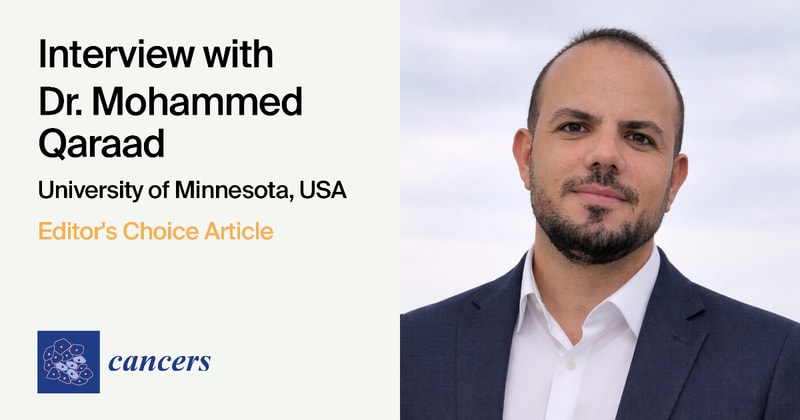
Cancers | Interview with the Author of the Editor’s Choice Article—Dr. Mohammed Qaraad
We had the pleasure of speaking with Dr. Mohammed Qaraad, first author of the Editor’s Choice Article in Cancers (ISSN 2072-6694). Below, he shares insights into his research, paper, challenges, and advice.
“miRNA-Based Breast Cancer Subtyping Using AHALA Multi-Stage Classification Approach”
by Mohammed Qaraad, Eric P. Rahrmann and David Guinovart
Cancers 2026, 18(4), 586; https://doi.org/10.3390/cancers18040586
Available online: https://www.mdpi.com/2072-6694/18/4/586
The following is an interview with Dr. Mohammed Qaraad.
1. Could you briefly introduce yourself and describe your main research focus?
I am Dr. Mohammed Qaraad, a Bioinformatics & Data Science Specialist and Postdoctoral Research Associate at The Hormel Institute, University of Minnesota. I also serve as an IEEE Senior Member. My core research expertise sits at the intersection of artificial intelligence, metaheuristic optimization, and computational oncology.
With a background rooted in AI and computer science, my research focuses on designing advanced machine learning pipelines and multi-omics integration frameworks (such as our recent MOOBI and INTEGRATE-CD systems). By developing novel optimization algorithms to navigate high-dimensional biological data, my ultimate goal is to uncover highly accurate biomarker signatures that can be directly translated into clinical decision-support tools for precision cancer care.
Background and Affiliation: I hold a Ph.D. in Artificial Intelligence and am currently leading bioinformatics and data science initiatives at The Hormel Institute, University of Minnesota.
Research Focus: My work centers on developing smart, bio-inspired metaheuristic optimization frameworks tailored to address complex biomedical challenges.
The Big Picture: High-throughput biological data is notoriously massive and noisy. I design algorithms—ranging from quantum-inspired frameworks like the Schrödinger Optimizer to gradient-inspired tools—to filter out the noise, select optimal features, and build highly accurate diagnostic models for heterogeneous malignancies like breast cancer, non-small cell lung cancer (NSCLC), and Wilms' tumor.
2. In your own words, what are the key findings or main messages of your Editor’s Choice paper?
The Core Innovation: We introduced a novel, multi-stage hybrid framework powered by the Adaptive Hill Climbing Artificial Lemming Algorithm (AHALA) to solve the challenging problem of multi-class breast cancer subtyping.
High-Precision Classification: By coupling AHALA with deep neural networks, our approach achieved an outstanding mean classification accuracy of 95.74% and an AUC of 0.9682 across the major breast cancer subtypes (Luminal A, Luminal B, HER2-enriched, and Basal-like).
Biomarker Discovery: Beyond raw computational performance, the framework successfully extracted a highly specialized panel of subtype-specific miRNA signatures (such as hsa-miR-190b, hsa-miR-429, and hsa-miR-935), mapping them directly to critical functional pathways involved in tumor progression.
3. What were the biggest challenges you encountered during this study, and how did you overcome them?
The Curse of Dimensionality: MicroRNA expression datasets contain thousands of features alongside a relatively small sample size, creating an extreme risk of overfitting and causing standard optimization algorithms to get trapped in local optima.
A Multi-Stage Solution: We tackled this by designing a rigorous preprocessing and feature selection pipeline. First, we used Differential Gene Expression (DGE) analysis via the limma package to narrow down the search space from 588 to 208 highly informative miRNAs.
Algorithmic Synergy: We then hybridized the global exploration capabilities of the Artificial Lemming Algorithm with an Adaptive Hill Climbing local search. This mathematical harmony allowed the model to dynamically escape local traps and select the most biologically relevant features without sacrificing computational efficiency.
4. How do you see this research evolving or influencing future studies in the field?
Transition to Multi-Omics Integration: While this paper demonstrates the strength of AHALA on miRNA profiles, the logical next step is scaling this architecture up to handle true multi-omics integration (transcriptomics, proteomics, and epigenomics), building on the foundations of our standalone integration frameworks like MOOBI.
Broader Clinical Application: The optimization mechanics behind AHALA are highly versatile. We are already expanding these hybrid intelligent frameworks to improve diagnostic classification models for other complex conditions, such as primary Sjögren's syndrome, NSCLC, and digital pathology imaging (e.g., our automated cervical cytology and skin cancer frameworks).
Open Decision Support: We aim to see these algorithmic frameworks integrated into open-source clinical pipelines, allowing pathologists to input patient expression data and receive instantaneous, highly reliable molecular stratification.
5. What advice would you give to early-career researchers who aim to publish impactful work in oncology?
Bridge the Gap Between Math and Medicine: In computational oncology, high cross-validation accuracy is only half the battle. Never treat biology as a black box; ensure that your machine learning models are backed by rigorous biological validation, functional pathway analysis, and clinical relevance.
Focus on Reproducibility: Develop clean, scalable, and open-source workflows. The impact of your work multiplies when other teams can seamlessly adopt your optimization algorithms or classification pipelines for their own datasets.
Collaborate across Domains: Reach out beyond your comfort zone. The most impactful breakthroughs occur when machine learning specialists, wet-lab biologists, and clinical oncologists work hand-in-hand to validate computational predictions.
6. Why did you choose Cancers for this publication, and how was your experience with the journal?
Perfect Interdisciplinary Alignment: Cancers is widely recognized for publishing high-impact research that successfully bridges the gap between sophisticated computational frameworks and translational oncology. It was the ideal home for a paper that is as much about advanced machine learning as it is about clinical oncology.
Global Accessibility: As proponents of open science, the open-access model of Cancers ensures that our AHALA framework and identified biomarker panels are immediately accessible to researchers and clinicians worldwide without barriers.
Rigorous and Rapid Peer Review: Our experience with the editorial board was stellar. The peer-review process was exceptionally swift, yet highly thorough. The constructive feedback from the reviewers significantly helped us refine the biological validation metrics of our model, elevating the overall quality of the final manuscript.