
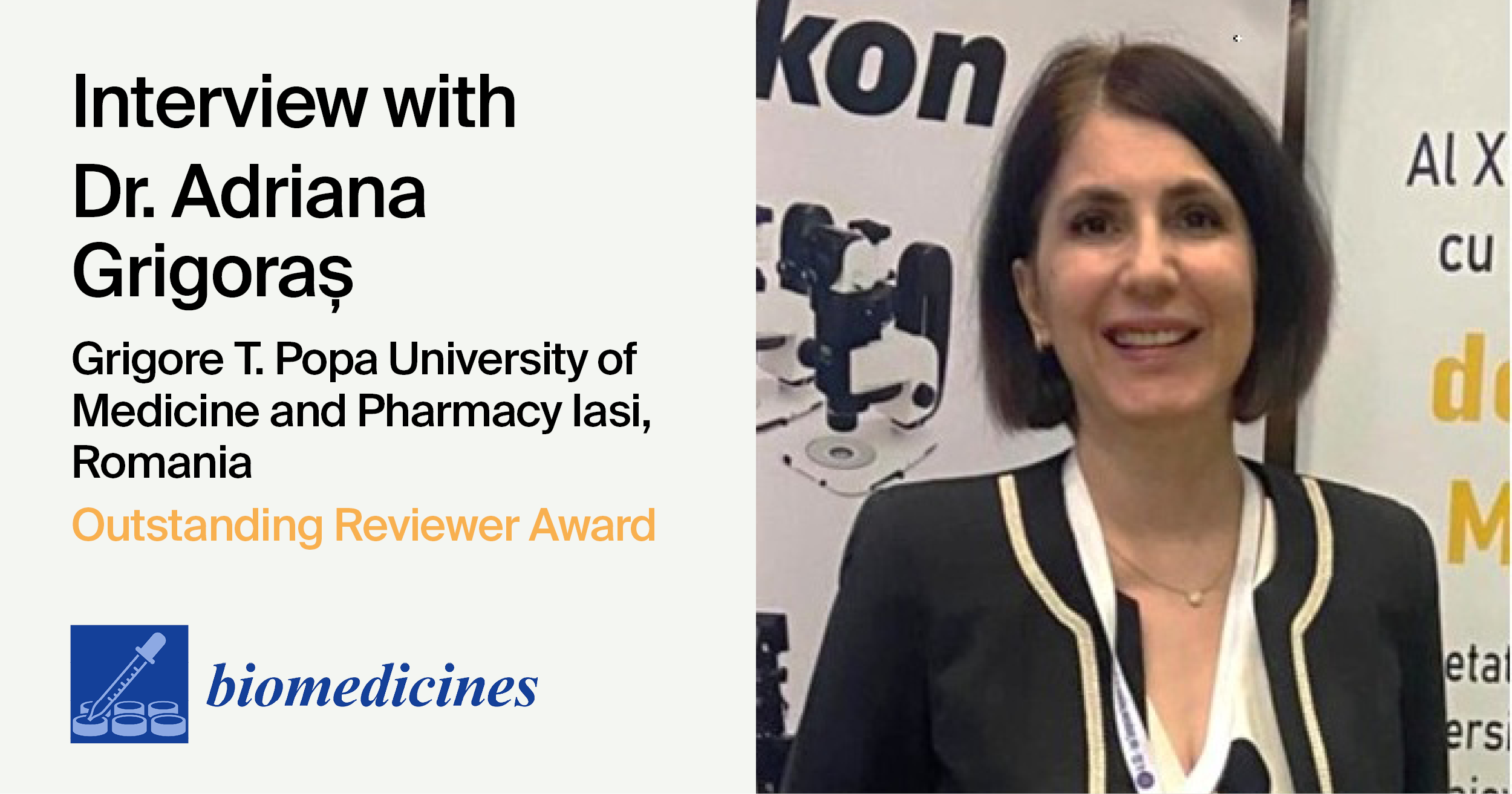
Interview with Dr. Adriana Grigoraș—Winner of the Biomedicines Outstanding Reviewer Award
Dr. Adriana Grigoraș is one of the winners of the Outstanding Reviewer Award.
Dr. Adriana Grigoraș currently serves as an Associate Professor in the Morphofunctional Sciences Department I at the “Grigore T Popa University of Medicine Iasi”, Romania. Her research over the past five years has focused on adipose tissue physiology, with particular emphasis on obesity-related diseases and their role in carcinogenesis. She also investigates tumor pathology, including the tumor microenvironment and cancer stem cell biology, with the aim of identifying novel biomarkers and therapeutic targets. Her work integrates clinical insight, experimental models, and translational approaches, addressing key challenges in cancer and metabolic disease research.
The following is a short interview with Dr. Adriana Grigoraș:
1. Can you share your current research direction and latest progress?
My research interests remain focused on molecular diagnostics and therapeutic strategies in cancer, with a particular focus on colorectal cancer and salivary gland malignancies. A central focus of my research also targets the role of adipose tissue in carcinogenesis, as well as in other obesity-associated comorbidities, including cardiovascular disease and depression.
2. Could you share with us your feelings about winning the award? What does this award mean to your academic career?
I am deeply honored to receive this award, which recognizes my contributions as a reviewer for academic publications. This is my first such recognition and is both unexpected and greatly appreciated. I believe it underscores the value of peer review as a meaningful form of academic contribution and will positively support my continued professional development. I am also deeply grateful for the support and shared joy of my family in this achievement.
3. What role do you think reviewers play in the process of paper publication?
Reviewers should provide constructive feedback designed to improve the clarity, coherence, and scientific impact of a manuscript. Their role is not only to evaluate but also to support the development of the work, recognizing that research is shaped by different perspectives and that no study is infallible. A respectful and constructive approach is also particularly important for early-career researchers, who benefit from guidance on the scientific content, methodology, and organization of manuscripts, as well as encouragement during the review. I believe that through this process, the reviewers contribute both to maintaining the integrity of the scientific record and to the constructive development of academic research.
4. How do you balance the comprehensiveness and efficiency of review?
In my reviewer practice, I adopt a constructive and supportive approach, aiming to understand the authors’ intentions and to help improve the clarity and coherence of their manuscript. I highlight sections that raise questions and focus on how the manuscript can be strengthened, often suggesting a clearer structure, including the use of figures and tables to facilitate clearer communication of information to readers. I usually start with a general assessment of the abstract, introduction and conclusions, followed by a more detailed assessment of the methodology, results and statistical analysis. My assessment is guided by criteria such as originality, methodological rigor, validity, clarity and scientific relevance, with specific and evidence-based comments. Overall, I aim to provide a fair and balanced review, distinguishing between major and minor issues and offering practical and constructive suggestions, while maintaining a respectful and supportive tone.
5. In your opinion, what key qualities should an excellent manuscript have? From what perspectives will you help authors improve the quality of their papers?
This is a very good question. An excellent manuscript is, in my view, one that is coherent, logically structured, concise, and easy to understand, with a clear focus on its scientific message. For reviewing articles, I particularly value a well-balanced synthesis of current evidence, the identification of emerging research trends, and the effective use of clear tables and figures that enhance the readability and accessibility of the content. In original research papers, methodological rigor is essential, including clearly defined inclusion and exclusion criteria, transparent and appropriate statistical analysis, and robust data interpretation. Equally important are well-argued conclusions that accurately reflect the findings, as well as a critical and honest discussion of the study’s limitations.
These elements, in my opinion, represent key criteria for defining a high-quality manuscript and also serve as fundamental guiding principles for supporting authors in improving the clarity, rigor, and overall impact of their work.
6. How do you hope that journals and publishers can further support reviewers’ work?
I believe that MDPI is already a well-organized publisher that offers numerous advantages to reviewers, including flexibility in managing the time required to complete review reports after acceptance, as well as visibility of their contributions through platforms such as Web of Science. These aspects are highly appreciated, both by myself and by fellow reviewers. In addition, I believe that constructive feedback from editors on the quality of reviews further contributes to enhancing the standards and coherence of the peer review process.
7. Please briefly describe your experience with our services and journals so far.
My experience with your services, both as an author and as a reviewer, has been truly excellent. Whenever I needed support, I have been met with kindness, prompt and thoughtful responses, and a high level of professionalism. I particularly appreciate the flexibility shown in accommodating my specific needs in both roles.