
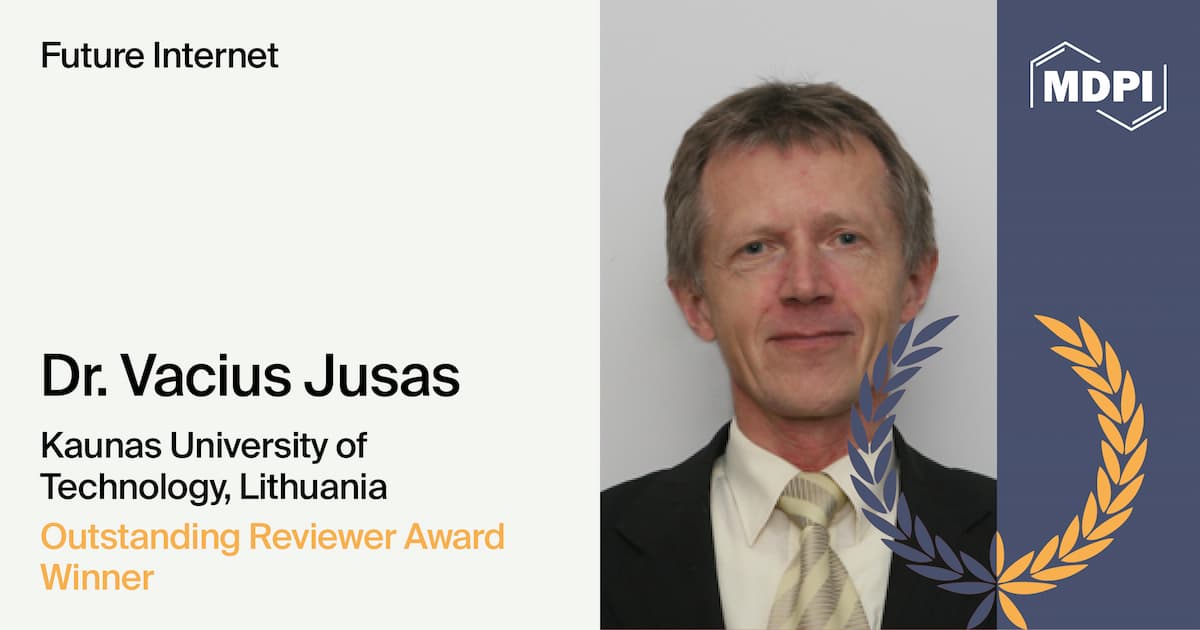
Interview with Dr. Vacius Jusas—Winner of the Future Internet Outstanding Reviewer Award
Name: Dr. Vacius Jusas
Affiliation: Department of Computer Science, Kaunas University of Technology, LT-51390 Kaunas, Lithuania
Research interests: brain-computer interface, cybersecurity, and blockchain
1. Can you briefly introduce yourself to our readers and tell us a little bit about your fields of interest?
I have been a professor at Kaunas University of Technology since 2006. My fields of interest are concentrated around two quite different areas: brain–computer interface (BCI) and cybersecurity. I, along with my PhD students, conduct research in the field of BCI. However, the research projects, which have been assigned funds from various agencies, are not run in this field at our university. Nevertheless, I have a close professor who invites my team and me to join the research projects on cybersecurity. Such projects are running one after another. These two fields have one method in common: machine learning. This method is universal. It is applicable in many different areas.
2. When reviewing manuscripts, what aspects do you typically focus on? (e.g., originality, methodological rigor, logical structure, ethical compliance, etc.)
During my academic career, I have read many papers. Some papers were written well; some papers were not so good. So, I have a clear picture of what a well-written paper should look like. Next, I worked for more than ten years as editor of a research journal. I know in detail the formal requirements for the manuscripts that bring value to the journal itself. Having such a broad background, I come to the review of the manuscript from two perspectives: the quality of the manuscript and the value of the manuscript for the journal. Therefore, firstly, I focus on the structure of the manuscript, on the style of writing, and on the citing of literature. Then I study the detailed language of the manuscript and pay attention to the visualization of the material. Finally, I read the conclusions of the manuscript.
3. How was your experience reviewing for Future Internet, and what motivated you to participate actively in the peer review process?
My experience of reviewing for the Future Internet is great. I like reviewing, since every manuscript presents a new challenge. I’m motivated by many motives. I’m myself a researcher. I’m writing papers. Someone has to review my papers. So, I have to review the papers of others. I’ve been in the research field for many years. I have written many papers. I have read many more papers. I enjoy the papers that are written in a qualitative way. I wish that every paper would be written in a great way. So, I want to share my experience by reviewing papers. Finally, I got a voucher. This is a motivation as well.
4. Which research topics do you think will be of particular interest to the research community in the coming years?
I’m not an oracle, but I suppose it should be applications of artificial intelligence, cybersecurity, and quantum computing. Artificial intelligence (AI) shows great success in areas where a novice in the field, but not an expert in the field, wants to gain knowledge. However, for the expert in the field, AI behaves like a stupid assistant. So, the research is needed to provide assistance for the expert in the field. Cybersecurity is more critical than ever due to the surge of sophisticated AI-driven threats, the ubiquity of Internet of Things devices, and the widespread adoption of remote work. Data leaks are no longer just an IT problem; they pose significant financial, legal, and reputational risks to individuals and organizations. So, cybersecurity will remain a hot topic in the coming years. Quantum computing is a new emerging field of computing able to solve problems that are far beyond the capabilities of today’s classical supercomputers. Therefore, the field of quantum computing should attract more attention in the coming years.
5. Based on your experience reviewing manuscripts, what advice would you give to authors?
My favorite C++ expert, Danny Kalev, more than ten years ago was writing in his blog, “Read much more than you write, and stick to high-quality material”. This advice was given to the C++ programmers. However, this advice is very appropriate for the writers of research papers. Using the advice of Danny Kalev and my own experience, I give the following advice. Read a lot of papers. Discern among them the well-written papers and follow their way of writing. At the beginning of a research career, it can be not easy to distinguish which papers are written better than others. The first feature to distinguish is a very simple one. The papers published in the journals are written better than the papers published in the conference proceedings because the requirements for publishing papers in the journals are higher than those for publishing papers in the conference proceedings. Next, choose the journals that are included in the WoS DB. Again, the requirements for the journals to be included in the WoS DB are high. The same principles apply to the papers published in the journals included in the WoS DB. Finally, after reading dozens of papers, you will be able to distinguish the well-written papers.