


Abstract
Parenting is a complex, emotionally fraught life task shaped by many influences, including social norms. Historically, parenting norms were transmitted through family, religion, and parenting experts, notably pediatricians. But now, social norms are also being transmitted online. Mom influencers and parenting experts on social media dispense highly curated advice and tips designed to shape the beliefs and behaviors of parents. Many include sharented content (images and information about their own children), which increases their relatability and authenticity. Sharenting is a widespread phenomenon, despite serious concerns about this practice. The current exploratory study was designed to determine whether sharenting-related content on TikTok from high-reach influencers and creators specifically addressing the topic reflects the full scope of documented risks to children. The study examined three samples of TikTok videos either by sharenters or about sharenting to determine which—if any—of 10 identified risks of sharenting were discussed. Results revealed that top influencers tend not to address this topic in their most liked videos and are still sharenting themselves. Videos specifically about sharenting mention only a few of the many reasons why sharenting can be risky and those that are in support of sharenting appear to minimize the risks and/or misunderstand child development. Findings have implications for changing social norms via parent education, content moderation, and clinical practice.
2. Materials and Methods
2.1. Selection of TikTok Videos
All selected videos featured an English-speaking adult. The specific country of origin was unknown but appeared to be predominantly English-speaking countries such as the United States, England, and Canada.
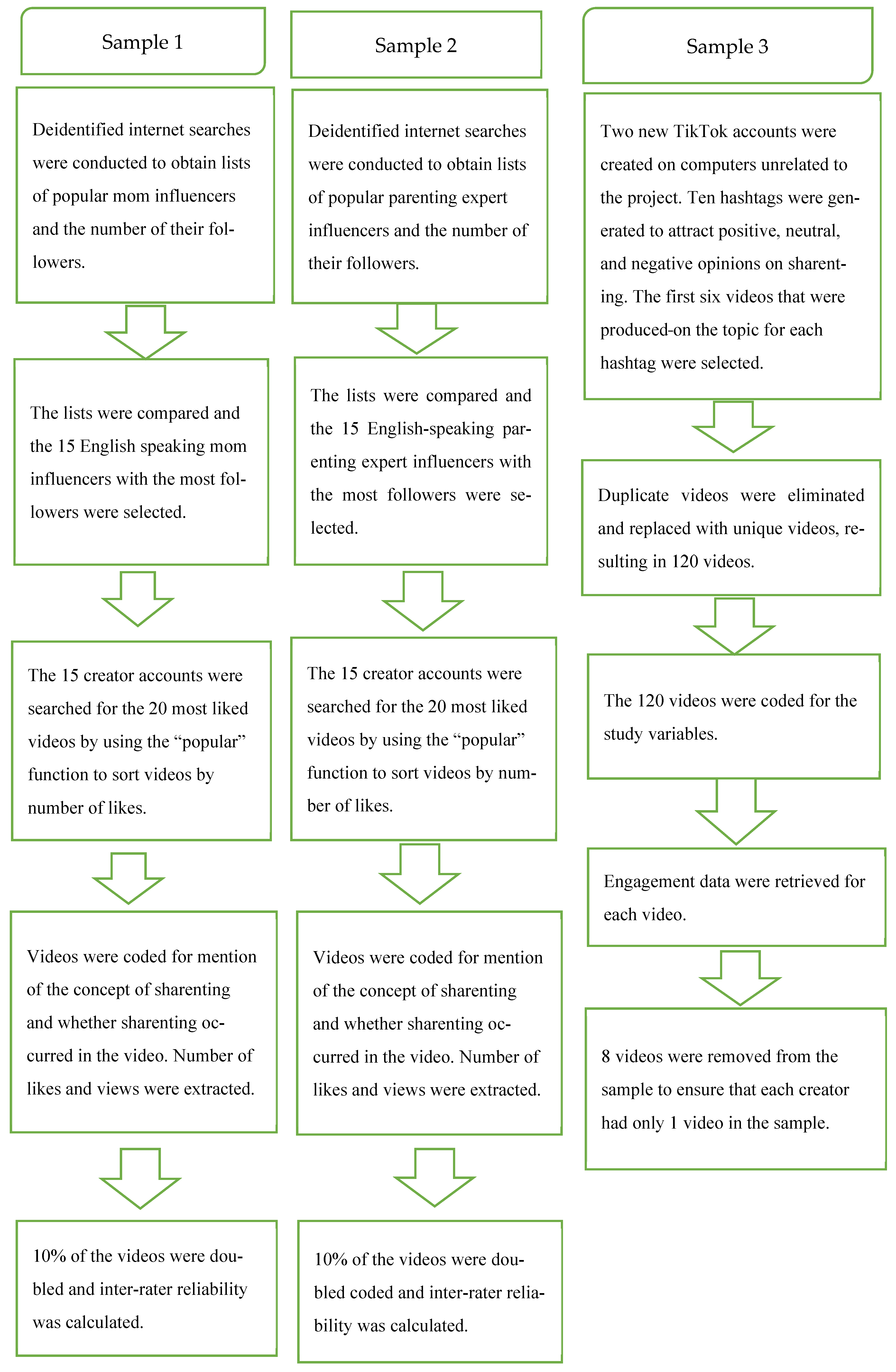
Sample 1 (300 videos): Two researchers used the de-identified internet search engine DuckDuckGo in December, 2025 to search for “Top mom influencers on TikTok.” The first two search engine results were BuzzVoice and FeedSpot, each of which provides curated lists of popular TikTok creators. Each researcher then went to these sites and compiled a list of the first 15 names and the number of their followers. The two researchers compared their lists and selected the 15 across both lists who were English speakers with the greatest number of followers.
The TikTok accounts for these 15 creators were visited. The “popular” option was selected for viewing videos. This allowed for the identification of the 20 most liked videos from each creator. This strategy is similar to that used by Zou et al. (2020) to examine the social media content with the greatest reach. However, we obtained a larger sample than prior studies in this emerging field (i.e., Alruwaily et al., 2020). In total, these 300 videos received over eight billion views (mean views were 27 million) and had a sum of one billion likes (mean likes were over three million). Supplemental Table S1 presents the creators (by ID), which list they were on, and the number of their followers.
Sample 2 (300 videos): The same method as above was used to identify the 20 most liked videos of each of the top 15 parenting expert influencers from the first two search results (MoDash and FeedSpot). These videos received over 970 million views (mean views were over three million) and 127 million likes (mean likes were 426 thousand). Their level of professional expertise varied from licensed mental health professionals and certified parenting coaches to self-proclaimed parenting experts with lived experience. Supplemental Table S1 presents the creators (by ID), which list they were on, and the number of their followers.
Sample 3 (112 videos): Two researchers each created a TikTok account on a computer owned by individuals who did not have TikTok accounts and were unrelated to the study. Both searches were conducted on computers located in New York City. They each searched on these newly created TikTok accounts using the following 10 hashtags: #sharenting, #postyourchildren, #stopsharentingyourkids, #whyIpostmychildren, #dangersofsharenting, #responsiblekidsonline, #sharentingdebate, #sharentingisok, #stoppostingyourkids, and #itsoktoputyourkidsonTikTok. The order was balanced between positive and negative perspectives. For each of the searches, the first six videos that appeared on the TikTok page were selected. The resulting 120 videos were screened for duplicates and replaced using the same search terms on the same TikTok accounts on the same computers to seek non-duplicate videos. Eight videos were removed to ensure that each creator only had one video in the sample, resulting in 112 videos. The sampling strategy was designed to situate the study within the norms in the field. The Teachers College, Columbia University IRB determined that this research was approved as exempt from review (TC IRB # 27-025). Data collection occurred online through public TikTok pages and public account-ranking/search sources. A team member identified eligible videos, recorded publicly displayed engagement metrics, and uploaded selected public videos to an access-restricted Teachers College Google Drive folder. A de-identified coding file was created that had the URL and handles removed, and a 5-digit code was used for identification of each video.
2.2. Coding Sample 1 and Sample 2 Videos
The combined 600 videos in Samples 1 and 2 were coded for (1) whether the issue of sharenting was discussed (No = 0, Yes = 1) and (2) whether the video itself contained sharented content based on at least a partial visual image of the child’s face being in the video (No = 0, Yes = 1). Twelve videos were double coded (Krippendorff’s alpha 0.89 across both variables, 0.84 for sharenting and 1.00 for mention of sharenting).
2.3. Coding Sample 3
The identification of variables to code regarding reasons not to sharent was based on a deductive approach drawn directly from and informed by the research literature (Fife & Gossner, 2024). Our intention was to determine whether the risks identified in the research literature were being discussed in the online social ecology. Reasons to sharent were coded according to variables identified inductively from viewing related videos. The team met on a weekly basis over several months. A codebook was created that explained the criteria and decision-making for coding each of the variables. Test videos were identified and reviewed to help identify areas where further clarification was needed.
2.4. Background Information (4 Variables)
(1) Whether the creator was an adult was coded based on verbal and visual cues such as referencing being married, having a career, being out of school, having a home and/or based an internet search (No = 0, Yes = 1); (2) perceived gender of creator (male, female, do not know) inferred from visual and verbal cues; (3) whether the creator was a parent based on referencing a child, discussing being a parent, and/or having the word “mom” or “dad” in their handle or creator profile (No = 0, Yes = 1); and (4) does the creator sharent, based on at least a partial image of the child in any of their thumbnails or profile picture (No = 0, Yes = 1). Krippendorff’s alpha was calculated for 10 test cases with each variable coded on a binary 0/1 scale and was found to be 0.95 (range = 0.76 to 1.0). Supplemental Table S2 presents reliability data for each variable.
2.5. Engagement Information (2 Variables)
(1) Number of views, and (2) number of likes.
2.6. Reasons Not to Sharent (11 Variables), Each Coded (No = 0, Yes = 1)
If arguments against sharenting were made, they were coded in the following categories based on the topics identified in the literature review: (1) personally identifiable information can be misused; (2) images can be misused; (3) a negative digital footprint could cause problems for job and college applications; (4) could lead to bullying/teasing; (5) the child might want information kept private; (6) it could involve psychological maltreatment; (7) the process of the images taken and posted could feel uncomfortable or painful for the child; (8) it is wrong to exploit children for money or attention; (9) children cannot consent; (10) it can rob children of authenticity; and (11) other. Prior to coding, inter-rater reliability was established. Krippendorff’s alpha was calculated for seven test cases with variables coded on a binary 0/1 scale and was found to be 0.75 (range = 0.65 to 1.0). Supplemental Table S2 presents reliability data for each variable.
2.7. Reasons to Sharent (10 Variables) Each Coded (No = 0, Yes = 1)
If arguments were made for sharenting, they were coded based on the categories identified in the literature review and inductively from preliminary viewing of comparable videos: (1) it is fun for the parent; (2) it keeps friends and family involved; (3) children enjoy having photos taken and posted; (4) it is harmless; (5) it might be harmful, but parent knows how it can be done safely; (6) parent has the right to do it; (7) it helps others dealing with particular parenting issue; (8) to create community; (9) to show child that parents loves them, and (10) other.
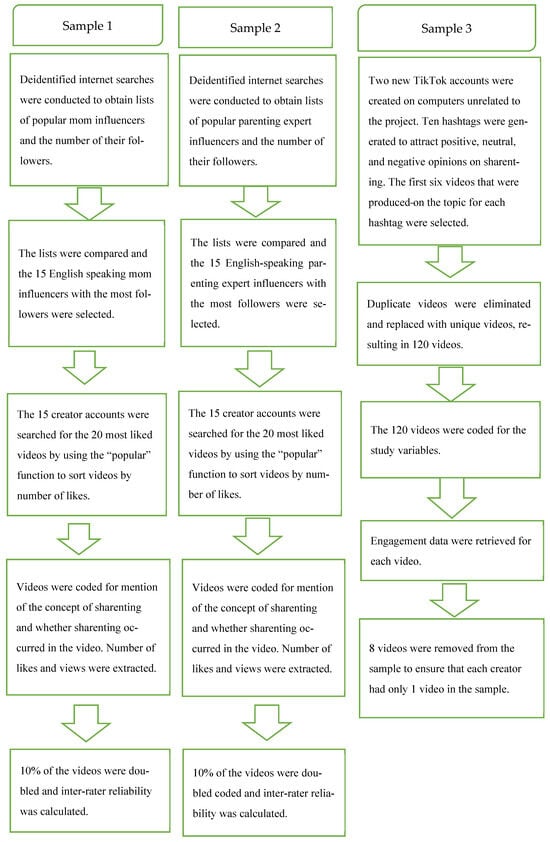
Prior to coding, inter-rater reliability was established. Krippendorff’s alpha was calculated for seven test cases with variables coded on a binary 0/1 scale and was found to be 0.79 (range = 0.71 to 1.0). All coding discrepancies were resolved through discussion and consensus after calculation of agreement. Supplemental Table S2 presents reliability data for each variable. Figure 1 presents a summary chart of video retrieval and coding.
Figure 1.
Sampling strategy.
3. Results
3.1. Sample 1 and Sample 2: Are Parent Influencers and Parenting Experts Influencers Discussing Sharenting and Engaging in Sharenting?
Of the 300 videos from Sample 1, four (1.3%) mentioned the issue of sharenting and 158 (52.7%) sharented in the video. Of the 300 videos from Sample 2, two (0.7%) mentioned sharenting while 109 (36.3%) sharented themselves. Looking at the data by creator (see Supplemental Table S3), all but one Sample 1 creator (n = 14, 93.3%) sharented, while only 3 (20%) discussed the topic. Of the 15 parenting expert influencers, 13 (86.7%) engaged in sharenting while only 1 (6.7%) discussed it.
3.2. Sample 3: Background Information on Creators
All creators were adults. Of the 112 creators, 101 (90.2%) were perceived to be female, 9 (8.0%) were perceived to be male and 2 (1.8%) could not be confidently coded for gender. With respect to whether the creator was a parent, 104 (92.9%) were parents and 8 (7.1%) were not identified as such. Most of the creators, 79 (70.5%), engaged in sharenting in the selected video and/or in the thumbnails across their profile, while 33 (29.5%) did not.
3.3. Sample 3: Attitude Towards Sharenting
With respect to their attitudes towards sharenting, almost half (n = 53, 47.3%) were completely against sharenting. This was exemplified by one person’s statement that there is no good reason to do that to a child and 42.0% (n = 47) held mixed views. They were often very clear about why they did not want to sharent but also made strong statements about not wanting to be judgmental or “mom shame” those who did. Only 10.7% (n = 12) were completely in favor of sharenting, making statements that parents do all sorts of fun things with their child and sharenting should be seen in that light. Some affirmed their right to make that choice as the parent. Twenty creators (17.9%) mentioned ways to reduce risk, which primarily involved blurring or blocking the children’s face and/or having strict privacy settings.
3.4. Sample 3: Reasons Not to Sharent
For those who were against or mixed towards sharenting (n = 100), the number and proportion mentioning each of the 11 reasons not to sharent is presented in Table 1. The most commonly mentioned reason (n = 39, 39.0%) was that the child’s image could be used for pornography. Many parents made passionate statements imploring other parents not to risk their child’s images being obtained by “evil” pedophiles. The second most commonly mentioned reason not to sharent (n = 24, 24.0%) was that it is wrong to exploit children for money and attention, with some comparing it to pimping children. The third most common reason offered to not sharent (n = 22, 22.0%) was that it created a negative digital footprint. One parent noted that she did not want her child to feel embarrassed later because of something she posted when he was a child. Next was the fact that children cannot consent (n = 19, 19%), followed by misuse of personally identifiable information (n = 16, 16.0%), and children might want information or images to be private (n = 16, 16.0%).
Table 1.
Frequency and percentage of videos endorsing each reason not to sharent for those against or mixed about sharenting (n = 100).
The remaining four reasons were each mentioned by fewer than 10% of the sample of mixed/against parents (n = 100), including that it could lead to bullying/teasing (n = 6, 6.0%), it can rob children of authenticity (n = 4, 4.0%), the process could feel bad for the child (n = 2, 2.0%), and it could involve psychological maltreatment (n = 1, 1.0%). With respect to the 39 “other/unspecified” category, 16 made vague comments about the internet being “weird” or “creepy.” Six creators did not explicitly state why they were opposed to sharenting. A few (n = 4) mentioned “parasocial relationships” in which followers became too attached or invested in their child. Three mentioned that they did not want people criticizing their child’s appearance or their parenting, and two mentioned that other people owned the data. The remaining eight people made miscellaneous comments such as saying that their child does not like being sharented or that sharenting makes life difficult without elaborating.
A summary score was created of the number of reasons offered by each creator, with a mean of 1.3 (SD = 1.4).
3.5. Reasons to Sharent
The proportion of the sample that endorsed each of the 10 reasons to sharent is presented in Table 2, including views of both the pro-sharenting creators and those mixed about sharenting (N = 59 in total). As can be seen, very few of these pro/mixed creators endorsed any of the possible reasons to sharent. Ten percent (n = 6) said that their child enjoyed being in TikTok videos. The remainder of the reasons were mentioned by fewer than that, including parents know how to do it safely, the parent has the right to sharent, it keeps friends and family involved, to create community, it is fun, it helps others dealing with specific issues, and to show the child they are loved. Of the “other” reasons provided, creators mentioned liking to be able to brag about their child’s accomplishments, wanting to make money, and believing that the child is learning new skills.
Table 2.
Frequency and percentage of videos endorsing each reason to sharent for those in favor of sharenting and those who are mixed (n = 59).
4. Discussion
This study used TikTok to conduct a descriptive and comparative content audit of sharenting practices and views among two groups of influencers in the Anglophone parenting space, along with a sample of popular English-language videos on sharenting. This study was designed to audit the information presented to current and future parents on TikTok about the practice of sharenting. Our goal was to better understand the social ecology of the online conversation shaping parents’ behaviors and the degree to which that conversation informs them about the potential harms. The videos were collected at a particular point in time, so the findings represent a snapshot of posts circulating on TikTok during that period.
5. Limitations
To interpret our findings, it is important to understand the limitations of the design and the digital environment in which data were collected. First, there is no fixed universe of videos on TikTok. This limits the claims that can be made about the findings. The algorithm is highly personalized, and results of TikTok searches change over time. Therefore, it is not possible to determine the representativeness of the sample. Nonetheless, we believe the sample has face validity because we limited the algorithmic influence by using a de-identified search engine to identify the top influencers for Samples 1 and 2 and set up new accounts to identify videos for Sample 3. Second, we audited videos from top influencers with high levels of user endorsement in the form of likes. While “liking” a video is not the same as endorsing every aspect of the video, the videos with the most likes may be the videos seen first and/or the ones taken most seriously by viewers. Therefore, they have the potential to be the most impactful. It is possible that there are other videos in their account that address sharenting and other top influencers with other highly liked and viewed videos. Likewise, we chose to focus on “mom influencers” as they have such high engagement numbers on TikTok, but it would certainly be of interest to replicate the study with “dad influencers.” In addition, there are other platforms for parents and parenting influencers, such as Instagram, where other perspectives might be expressed. Second, our sample was limited to TikTok and Anglophone influencers. We cannot generalize our findings to other platforms or influencers using languages other than English on TikTok. Third, a larger sample might have allowed for differentiation of Sample 3 into three distinct groups: in favor, mixed, and against. This would have provided more insight into ways in which those with mixed views differ from those with more definitive views. Finally, our findings help identify current social norms around sharenting and show the extent to which Anglophone influencers articulate potential risks. Although it is theoretically plausible—and likely—that mom and parenting influencers shape social norms and parental decision-making about sharenting, these data capture only the current moment and cannot determine longer-term influence or causal effects. With these caveats in mind, several notable findings emerge from our data.
6. Major Findings
First, leading mom influencers and parenting expert influencers are not addressing the issue of sharenting in a way that is breaking through to their audiences, indicated by the fact that only six of their 600 most liked videos mentioned the topic. These 600 videos were watched by billions and liked by millions of viewers. Moreover, almost all engaged in sharenting themselves and over half of the influencers’ videos included sharented content. Research has demonstrated that social media creates and reinforces social norms around the fundamental role of parenting (Chee et al., 2023). These norms can have a profound impact on sharenting behavior, with parents being more likely to engage in sharenting themselves when their social network supports such behavior (Ranzini et al., 2020). This is because people look to social media influencers in part to learn what it means to be a parent in the digital age (Beuckels & De Wolf, 2025; Mertens et al., 2024). To the extent that these highly viewed and liked videos set an example, influencers may be creating and reinforcing a social norm in which sharenting is endorsed. It is also possible that viewers are influencing creators’ behavior by responding so positively to sharented content. In one video, a parent bemoaned that viewership as well as sales were lower when their child was not in the video. More research needs to be done to determine the nature of the mutually reinforcing influence of creators and viewers.
Second, about half of the sample of 112 videos specifically on the topic of sharenting were completely against the practice, while 42% were mixed, and the remaining 10.7% were consistently in favor of it. However, these 112 videos received far fewer views and likes than the videos posted by top influencers, with a median of only 92 likes per video. Thus, the videos specifically on the topic of sharenting generally lack an audience large enough to shape TikTok sharenting norms and attitudes towards the practice. Future research could develop and test viewer response to a range of messages about the risks of sharenting. These messages would need to be nuanced and go beyond a simple “sharenting is bad” perspective to address the many real and perceived benefits to sharenting and parents’ desire to do so safely (Cino & Ruiz-Gomez, 2026).
A third notable finding was that many potential reasons offered against sharenting were rarely mentioned. The creators of the videos discussing their opposition to sharenting presumably intend to influence people’s decisions regarding sharenting. Yet they are missing important opportunities to be effective influencers, as they are consistently focusing only on misuse of images by pedophiles while overlooking other potentially compelling concerns. For example, while many in the digital sphere were outraged by a mom influencer who accidentally filmed herself manipulating her child to cry harder for a video, this incident was not taken up as a more general problem of exploitation and lack of authenticity (Praveen & M, 2025). According to Clark and Jno-Charles (2025), the exploitation of some sharented children is unambiguously harmful and yet uniquely challenging to discuss and regulate given that it occurs at the cross-section of public work and private family life. Parent education efforts may be the most practical avenue for raising awareness about this concern.
The potential for exploitation underscores the importance of considering consent or assent, the technically correct term when referring to minors. This topic was rarely mentioned in the videos. In fact, some of the pro/mixed sharenting creators explicitly promoted the idea that young children have the capacity to consent. For example, one mother explained that her four-year-old is old enough to consent, demonstrating a misunderstanding of child development and the power imbalance in that relationship. While preschoolers are rarely able to provide informed assent, developmental frameworks recognize that children’s agency and capacity for informed decision-making increase over time. Research ethics offers a useful model through the assent process: children are gradually included in decisions that affect them, and their involvement expands as their judgment and sense of autonomy develop. Communication privacy management offers a nicely fitting model for how a developmental approach to assent forefronts the inherent family tensions around privacy and offers guidance on navigating the issue (Petronio, 2010). Parents should treat assent as an ongoing conversation rather than a one-time permission. Good practice requires parents, as developmentally appropriate, to discuss information-sharing rules with children, seek assent when appropriate, and accept refusals as meaningful.
And, finally, many reasons offered as to why sharenting is acceptable do not address concerns raised about the potential harms of the practice. Those in favor of the practice mentioned that it felt good to share their children’s accomplishments, teach their child new skills, and connect to other people dealing with similar parenting issues. Some mentioned that children expressed enthusiasm for being sharented. While all these may be true, these parents may be failing to consider whether sharenting’s potential harms outweigh the benefits. There may be ways for parents to achieve these important and meaningful goals outside of sharenting.
Implications for Family Sciences Practice and Policy
Our descriptive content audit shows what was present in the sampled videos; it does not directly demonstrate that influencers created or reinforced social norms, that low-engagement videos were unable to influence attitudes, or that proposed educational and regulatory interventions would be effective. However, drawing on social norms theory and research, there are a number of potential implications for policy and practice.
Parent education. Given the lack of sufficient information available online about potential risks of sharenting, there appears to be a need for clearer social norms and better guidance in this area. One policy initiative could be the creation of informational material from credible sources, including family science, cybersecurity, mental health, parenting, child development, and child rights. This information could be developed and made available to parents and professionals, consistent with the recommendation of Praveen and M (2025), who call for the “need to educate parents about healthy digital media practices surrounding children to protect their rights, privacy, and security in a digital world” (p. 209). Messages could be developed with input from stakeholders including influencers, sharenting parents, and experts in content moderation, with special attention to people most likely to be resistant to the message (Ghio et al., 2021), such as those who are aware that sharenting poses potential violations of children’s rights to privacy but sharent in risky ways anyway (Beuckels et al., 2025). As sharenting risk exists on a continuum, the PAUSE tool (privacy, audience, unchangeable, safety, emotion) might be used to educate families about the impact of sharenting and to assess and mitigate risks (Mitchell et al., 2026). Hamilton’s (2023) list of sharenting content that should not be posted (e.g., puberty milestones, nudity, discipline interactions) could be included in such material. The voices of youth themselves might be incorporated into these efforts to respect their agency, draw on their unique insights, and lend authenticity to the work.
One possible model for developing evidence-based public health messaging on sharenting is offered by Hudders et al. (2025), in which stakeholders were consulted to launch a social media campaign in Belgium especially focused on sharenting by influencers. A similar model could be developed for English-speaking parents engaged in sharenting. This material could include all the reasons why sharenting can be harmful as well as the limitations of some risk mitigation strategies. Researchers could experimentally evaluate the effectiveness of different messages for changing attitudes and intentions around sharenting.
Ideally, information about the risks of sharenting could be delivered in person by trusted messengers, including family practitioners, pediatricians, early childhood teachers, etc. The clinical assessment model developed by A. J. L. Baker et al. (2025a; see also Mitchell et al., 2026) could be used by clinicians to raise awareness and educate parents. Online, the best messengers may be the top mom and parenting expert influencers who already have a large viewership around issues of parenting, lending them credibility (Merchant et al., 2021). Social media creators, especially those with large viewership, are already functioning as an informal social norm messaging system. Most people who post on TikTok want to reach a large and diverse audience to gain attention (and possibly money) as well as influence other people’s behaviors and choices. As of now, top influencers are either not talking about the issue or are not doing so in a way that appeals to their viewers. Many are sharenting themselves in ways that may be unsafe. In some cases, the pro-sharenting messages were inaccurate. Moreover, the creators of the videos against sharenting were often passionate, but the messages were incomplete in that most only mentioned a few reasons, and some reasons were never or only rarely mentioned. Parents watching these and similar videos would not have access to the full set of risks and concerns.
While formal parent education has the potential to reach a broad swath of families, parenting programs may not focus on this specific issue, given that they were developed decades ago before sharenting was a concern. Updating these programs represents another potential mechanism for educating parents. A first step in the process should involve a systematic audit of the curricula of evidence-based family intervention and parenting programs (both universal and for at-risk parents) to ascertain how—if at all—the topic of sharenting is addressed. If a need is identified, the next step would involve the development of a stand-alone module on the topic of sharenting (including definitions, facts, examples, reasons why people do it, and potential harms) that can be field-tested for appeal and effectiveness. This module could then be made available to existing professionals and their organizations, consistent with a model for promoting a change in social norms (Hornik, 2002).
Platform Governance. There is also a role for family scientists to play at a societal policy level to address this issue. Affiliation groups can bring their clout and credibility to bear in shaping corporate policy. Family science professional organizations could begin by reviewing the state of knowledge about sharenting. If there is a consensus regarding the existence of risk, a coordinated action plan could be developed. That might involve pressuring corporate entities and legislators to mitigate the risks of sharenting by promoting specific safety innovations within the structures of the social media platforms. These platforms have made some efforts to integrate safety features to protect minors (Information Commissioner’s Office, 2022) but may need to be pressured to do more. For example, AI technology could be used to automatically detect and blur the faces of minors (Vincent, 2021) or protect images from public “tagging” of locations, background clues, or reverse image searches (Hays & Efros, 2015). Advocacy efforts could also focus on having platforms implement pop-up warnings about the potential harms of posting images of children online, similar to their “take a break” reminders (Weatherbed, 2025).
Legal Protections. Another avenue for change is at the legal level, with two notable international developments. Some countries are now limiting what parents can post about their children, and some are allowing children to take control of their digital footprint at age 18. For example, France implemented a law that limits sharenting in co-parenting disputes (Niestadt, 2025) and allows children to request the erasure of their online presence (Edney, 2022). Poland and China have both introduced legislation that prevents posts that defame children and sets up guidelines for removal (Shui & Jiang, 2025; Sury et al., 2024). These countries provide models for what can be done to protect all children from some known sharenting harms. There are also calls for modification of child labor laws to protect children whose parents earn money from sharented content (e.g., Abrams, 2023).
7. Conclusions
The phenomenon of sharenting connects with broader social norms regarding family relationships and privacy boundaries, child safety, child development, identity development, child protection, cybersecurity, and potential trauma or psychological harm exposure. Given this, society needs to develop and promulgate a new set of social norms around the practice of sharenting. This should involve development of social media messaging, changes in the policies of social networking sites, and development of protective legislation. In addition, the topic of sharenting could be incorporated into the work of all professionals who work with children and families as part of intake forms, diagnostic assessments, casework services, care plans, psychiatric, psychological, and psychosocial evaluations. Taken as a whole, clinicians, family educators, and anyone interested in protecting children must take advantage of opportunities to offer guidance to parents in a culturally relevant and sensitive, non-judgmental manner on harmful sharenting practices.
Supplementary Materials
The following supporting information can be downloaded at: https://www.mdpi.com/article/10.3390/famsci2040028/s1, Table S1: Sample 1 and Sample 2 Influencers; Table S2: Krippendorf’s Alpha for All Variables; Table S3: Number and Proportion of Sample 1 and Sample 2 Influencers Who Mentioned Sharenting and Sharented.
Author Contributions
Conceptualization, A.J.L.B., M.R.B., A.M., A.F., L.A.L., N.R., M.D., M.H. and A.N.M.; Methodology, A.J.L.B., M.R.B., A.M., A.F., L.A.L., N.R., M.D., M.H. and A.N.M.; Formal analysis, A.J.L.B.; Resources, A.N.M. and M.R.B.; Data curation, A.J.L.B., A.M., A.F., L.A.L., N.R., M.D. and M.H.; Writing—original draft, A.J.L.B., M.R.B., A.M., A.F., L.A.L., N.R., M.D. and M.H.; Writing—review & editing, A.J.L.B., M.R.B., A.M., A.F., L.A.L., N.R., M.H. and A.N.M.; Project administration, A.J.L.B. and M.R.B. All authors have read and agreed to the published version of the manuscript.
Funding
This research received no external funding.
Institutional Review Board Statement
The Teachers College, Columbia University IRB determined that this research was not Human Subjects Research (TC #27-025) and exempt from Committee Review on 29 September 2026.
Informed Consent Statement
Informed consent was not obtained from the creators of these videos as the videos are uploaded by the creators themselves to a public platform where there is no presumption of privacy. In addition, no personally identifiable information was used in the study.
Data Availability Statement
The original contributions presented in this study are included in the article/supplementary material. De-identified data presented in this study are available on request from the corresponding author. The videos coded cannot be shared per IRB guidelines.
Conflicts of Interest
The authors declare no conflicts of interest.
References
- Abidin, C. (2015). Micro-microcelebrity: Branding babies on the internet. M/C Journal, 18(5). [Google Scholar] [CrossRef] [Scilit]
- Abidin, C. (2017). #familygoals: Family influencers, calibrated amateurism, and justifying young digital labor. Social Media + Society, 3(2), 1–15. [Google Scholar] [CrossRef] [Scilit]
- Abrams, R. C. (2023). Family influencing in the best interests of the child. Chicago Journal of International Law Online, 2(2), 97–113. [Google Scholar]
- Ajzen, I. (1988). Attitudes, personality, and behavior. Dorsey Press. [Google Scholar]
- Alaimo, K. (2024). Over the influence: Why social media is toxic for women and girls and how we can take it back. Alcove Press. [Google Scholar]
- Al-Khazraji, S. H., Saleh, H. H., Khalid, A. L., & Mishkhal, I. A. (2023). Impact of deepfake technology on social media: Detection, misinformation and societal implications. The Eurasia Proceedings of Science, Technology, Engineering & Mathematics, 23, 429–441. [Google Scholar] [CrossRef] [Scilit]
- Allen, K., & Rainie, L. (2002). Parents online. Pew Research Center. [Google Scholar]
- Alruwaily, A., Mangold, C., Greene, T., Arshonsky, J., Cassidy, O., Pomeranz, J. L., & Bragg, M. (2020). Child social media influencers and unhealthy food product placement. Pediatrics, 146(5), e20194057. [Google Scholar] [CrossRef] [Scilit] [PubMed]
- Amon, M. J., Kartvelishvili, N., Bertenthal, B. I., Hugenberg, K., & Kapadia, A. (2022). Sharenting and children’s privacy in the United States: Parenting style, practices, and perspectives on sharing young children’s photos on social media. Proceedings of the ACM on Human-Computer Interaction, 6(CSCW1), 1–30. [Google Scholar] [CrossRef] [Scilit]
- Autenrieth, U. (2018). Family photography in a networked age. Anti-sharenting as a reaction to risk assessment and behaviour adaption. In G. Mascheroni, C. Ponte, & A. Jorge (Eds.), Digital parenting. The challenges for families in the digital age (pp. 219–231). Nordicom. [Google Scholar]
- Auxier, B., & Anderson, M. (2021). Social media use in 2021. Pew Research Center. Available online: https://www.pewresearch.org/internet/2021/04/07/social-media-use-in-2021/ (accessed on 10 October 2021).
- Baker, A. J. L., Brassard, M., Chandler-Ofuya, N., Kagan, J., Fischman, T. K., Amber, K., & Marsh, A. (2025a). User comments to parents engaging in psychologically maltreating behaviors on TikTok: Implication for child protection. Journal of Public Child Welfare. [Google Scholar] [CrossRef] [Scilit]
- Baker, A. J. L., Brassard, M. R., Balin, T., Boyd, D., Chandler-Ofuya, N., & Kagan, J. (2025b). What psychological maltreatment behaviors towards children are posted on TikTok and why? Journal of Family Violence. [Google Scholar] [CrossRef] [Scilit]
- Baker, A. J. L., Brassard, M. R., Fischman, T. K., Amber, K., Chandler-Ofuya, N., & Marsh, A. (2025c). Growing up online: Young adults’ experiences with sharenting, psychological harm, and the right to privacy. Child Welfare, 103(3), 95–124. Available online: https://www.jstor.org/stable/48850404 (accessed on 24 June 2026).
- Baker, S., Sanders, M., & Morawska, A. (2016). Who uses online parenting support? A cross-sectional survey exploring Australian parents’ internet use for parenting. Journal of Child and Family Studies, 26(3), 916–927. [Google Scholar] [CrossRef] [Scilit]
- Bartels, J. S. (2015). Parents’ growing pains on social media: Modeling authenticity. Character and Social Media, 1, 51–70. [Google Scholar]
- Bartholomew, M. K., Schoppe-Sullivan, S. J., Glassman, M., Kamp Dush, C. M., & Sullivan, J. M. (2012). New parents’ Facebook use at the transition to parenthood. Family Relations, 61(3), 455–469. [Google Scholar] [CrossRef] [Scilit] [PubMed]
- Baxter, K., & Czarnecka, B. (2025). Sharing images of children on social media: British motherhood influencers and the privacy paradox. PLoS ONE, 20, e0314472. [Google Scholar] [CrossRef] [Scilit] [PubMed]
- Berkelaar, B. L. (2017). Different ways new information technologies influence conventional organizational practices and employment relationships: The case of cybervetting for personnel selection. Human Relations, 70(9), 1115–1140. [Google Scholar] [CrossRef] [Scilit]
- Beuckels, E., & De Wolf, R. (2025). Social media influencers as new agents on parenthood? A systematic literature review of parent influencer research and a future research agenda. Information, Communication, and Society, 28(4), 744–762. [Google Scholar] [CrossRef] [Scilit]
- Beuckels, E., Hudders, L., Vanwesenbeeck, I., & Van den Abeele, E. (2025). Work it baby! A survey study to investigate the role of underaged children and privacy management strategies within parent influencer content. New Media + Society, 27(6), 3081–3101. [Google Scholar] [CrossRef] [Scilit]
- Canadian Centre for Child Protection. (2017). Survivors’ survey. Available online: https://content.c3p.ca/pdfs/C3P_SurvivorsSurveyExecutiveSummary2017_en.pdf (accessed on 10 October 2021).
- Chee, R. M., Capper, T. S., & Muurlink, O. T. (2023). The impact of social media influencers on pregnancy, birth, and early parenting experiences: A systematic review. Midwifery, 120, 103623. [Google Scholar] [CrossRef] [Scilit] [PubMed]
- Cino, D., & Ruiz-Gomez, A. (2026). Sharenting as a multifaceted digital practice: Comparing privacy considerations based on parental motivations. In G. F. Lendvai, A. Viccaino-Verdu, A. Velicu, & A. Koltay (Eds.), Transdisciplinary perspectives on sharenting: Parenting, privacy and consent (pp. 3–16). Routledge Advances in Science. [Google Scholar]
- Clark, D. R., & Jno-Charles, A. B. (2025). The child labor in social media: Kidfluencers, ethics of care, and exploitation. Journal of Business Ethics, 201, 35–62. [Google Scholar] [CrossRef] [Scilit]
- Croft, J., & Watts, A. (2019). YouTube mom pleads not guilty to abusing children. CNN. Available online: https://edition.cnn.com/2019/03/09/us/youtube-mom-hobson-abuse-claims-pleads-guilty (accessed on 10 October 2021).
- Damkjaer, M. S., & Soerensen, S. M. (2026). Adolescents navigating sharenting: Autonomy, intimacy, and care in the mediatized family. In G. F. Lendvai, A. Viccaino-Verdu, A. Velicu, & A. Koltay (Eds.), Transdisciplinary perspectives on sharenting: Parenting, privacy and consent (pp. 97–114). Routledge Advances in Science. [Google Scholar]
- De Wolf, R. (2020). Contextualizing how teens manage personal and interpersonal privacy on social media. New Media & Society, 22(6), 1058–1075. [Google Scholar] [CrossRef] [Scilit]
- Duggan, M., Lenhart, A., Lampe, C., & Ellison, N. B. (2015). Parents and social media. Pew Research Center. Available online: http://www.pewinternet.org/2015/07/16/parents-and-social-media/ (accessed on 22 December 2022).
- Dworkin, J., Connell, J., & Doty, J. (2013). A literature review of parents’ online behavior. Cyberpsychology: Journal of Psychosocial Research on Cyberspace, 7(2), 2. [Google Scholar] [CrossRef] [Scilit]
- Edney, A. (2022). “I don’t work for free”: The unpaid labor of child media stars. University of Florida Journal of Law & Public, 32(3), 547–572. Available online: https://scholarship.law.ufl.edu/jlpp/vol32/iss3/5 (accessed on 23 April 2024).
- Erikson, E. (1980). Identity and the life cycle. W.W. Norton. [Google Scholar]
- Ferrara, P., Cammisa, I., Corsello, G., Giardino, I., Vural, M., Pop, T. L., Pettoello-Mantovami, C., Indrio, F., & Pettoello-Mantovani, M. (2023). Online sharenting: The dangers of posting sensitive information about children on social media. The Journal of Pediatrics, 257, 113322. [Google Scholar] [CrossRef] [Scilit] [PubMed]
- Fife, S., & Gossner, J. D. (2024). Deductive qualitative analysis: Evaluating, expanding, and refining theory. International Journal of Qualitative Methods, 23, 1–12. [Google Scholar] [CrossRef] [Scilit]
- Franke, S. (2026). The house of my mother. Simon and Schuster. [Google Scholar]
- Frew, P., & Petrino, G. (2021). Parents’ social media habits. Security.org. Available online: https://www.security.org/digital-safety/parenting-social-media-report/ (accessed on 23 April 2024).
- Ghio, D., Lawes-Wickwar, S., Tang, M. Y., Epton, T., Howlett, L., Jenkinson, E., Stanescu, S., Westbrook, J., Kassianos, A. P., Watson, D., Sutherland, L., Stanulewicz, N., Guest, E., Scanlan, D., Carr, N., Chater, A., Hotham, S., Thorneloe, R., Armitage, C., … Keyworth, C. (2021). What influences people’s responses to public health messages for managing risks and preventing infectious diseases? A rapid systematic review of the evidence and recommendations. BMJ Open, 11, e048750. [Google Scholar] [CrossRef] [Scilit] [PubMed]
- Goffman, I. (1959). The presentation of self in everyday life. Vintage. [Google Scholar]
- Hamilton, B. E. (2023). Anything for views parenting: Framing privacy, ethics, and norms for children of influencers on YouTube [Master’s thesis, Department of Bioethics and Science Policy in the Graduate School of Duke University]. [Google Scholar]
- Hays, J., & Efros, A. A. (2015). Large-scale image geolocalization. In J. Choi, & G. Friedland (Eds.), Multimodal location estimation of videos and images (pp. 41–72). Springer International Publishing. Available online: https://faculty.cc.gatech.edu/~hays/papers/im2gps_chapter.pdf (accessed on 23 April 2024).
- Hornik, R. C. (2002). Evidence for behavior change: Public health communication. Lawrence Erlbaum Associates Publishers. [Google Scholar] [CrossRef] [Scilit]
- Hudders, L., Beuckels, E., Van den Abeele, E., de Brabandere, M., De Jans, S., & Vanwesenbeeck, I. (2025). Protecting children on social media: Developing an intervention for influencer sharenting. Tudschrift Voor Communicatiewetschap, 53(3), 222–256. [Google Scholar] [CrossRef] [Scilit]
- Information Commissioner’s Office. (2022). Age appropriate design: A code of practice for online services. Available online: https://ico.org.uk/for-organisations/uk-gdpr-guidance-and-resources/childrens-information/childrens-code-guidance-and-resources/age-appropriate-design-a-code-of-practice-for-online-services/ (accessed on 23 April 2024).
- Irshad, S., & Soomro, R. T. (2018). Identity theft and social media. IJCSNS International Journal of Computer Science and Network Security, 18(1), 43–55. Available online: http://paper.ijcsns.org/07_book/201801/20180106.pdf (accessed on 10 October 2021).
- Jorge, A., Porfirio, F., Maropo, L., & Dias, P. (2026). Moral and affective economies of sharenting by influencers and ordinary parents. In G. F. Lendvai, A. Viccaino-Verdu, A. Velicu, & A. Koltay (Eds.), Transdisciplinary perspectives on sharenting: Parenting, privacy and consent (pp. 17–30). Routledge Advances in Science. [Google Scholar]
- Jurecic, Q. (2016). Sextortion, online harassment, and violence against women. LAWFARE. Available online: https://perma.cc/SZ9Q-EBQ6 (accessed on 10 October 2021).
- Katz, E. (2022). Coercive control in children’s and mothers’ lives. Oxford University Press. [Google Scholar]
- Keskin, D. A. (2026). Insights into the consequences of sharenting syndrome: Protecting children’s futures. In G. F. Lendvai, A. Viccaino-Verdu, A. Velicu, & A. Koltay (Eds.), Transdisciplinary perspectives on sharenting: Parenting, privacy and consent (pp. 173–186). Routledge Advances in Science. [Google Scholar]
- Keskin, D. A., Kaytez, N., Damar, M., Elibol, F., & Aral, N. (2023). Sharenting syndrome: An appropriate use of social media? Healthcare, 11(10), 1359. [Google Scholar] [CrossRef] [Scilit] [PubMed]
- Kloess, J. A., Beech, A. R., & Harkins, L. (2014). Online child sexual exploitation: Prevalence, process, and offender characteristics. Trauma, Violence, & Abuse, 15(2), 126–139. [Google Scholar] [CrossRef] [Scilit] [PubMed]
- Kuczynski, L., & De Mol, J. (2015). Dialectical models of socialization. In M. E. Lamb (Ed.), Handbook of child psychology and developmental science (7th ed., pp. 1–46). [Google Scholar] [CrossRef] [Scilit]
- Lendvai, G. F. (2024). Sharenting as a regulatory paradox: A comprehensive overview of the conceptualization and regulation of sharenting. International Journal of Law, Policy, and the Family, 38(1), ebae013. [Google Scholar] [CrossRef] [Scilit]
- Lendvai, G. F., Vizcaino-Verdu, A., Velicu, A., & Koltay, A. (Eds.). (2026). Transdisciplinary perspectives on sharenting: Parenting, privacy and consent. Routledge Advances in Science. [Google Scholar]
- Lievens, E., Livingstone, S., McLaughlin, S., O’Neill, B., & Verdoodt, V. (2018). Children’s rights and digital technologies. In U. Kilkelly, & T. Liefaard (Eds.), International human rights of children. international human rights (pp. 1–27). Springer. [Google Scholar] [CrossRef] [Scilit]
- Lupton, D., Pedersen, S., & Thomas, G. M. (2016). Parenting and digital media: From the early web to contemporary digital society. Sociology Compass, 10(8), 730–743. [Google Scholar] [CrossRef] [Scilit]
- Madge, C., & O’Connor, H. (2006). Parenting gone wired: Empowerment of new mothers on the internet. Social & Cultural Geography, 7(2), 199–220. [Google Scholar] [CrossRef] [Scilit]
- Magid, L. (2010). Study: 92% of U.S. 2-year-olds have online record. CNet. Available online: https://www.cnet.com/news/privacy/study-92-of-u-s-2-year-olds-have-online-record/ (accessed on 10 October 2021).
- Martin, F., Petty, T., Wang, C., Wang, W., & Wilkins, P. (2018). Middle school students’ social media use. Educational Technology & Society, 21(1), 213–234. Available online: https://www.jstor.org/stable/26273881 (accessed on 2 February 2026). [CrossRef] [Scilit]
- Merchant, R. M., South, E., & Lurie, N. (2021). Public health messaging in an era of social media. Journal of the American Medical Association, 325(3), 223–224. [Google Scholar] [CrossRef] [Scilit] [PubMed]
- Mertens, E., Ye, G., Beuckels, E., & Hudders, L. (2024). Parenting information on social media: Systemic literature review. JMIR Pediatrics and Parenting, 7, e55372. [Google Scholar] [CrossRef] [Scilit] [PubMed]
- Mickelwait, L. (2024). Takedown: Inside the fight to shut down Pornhub for child abuse, rape, and sex trafficking. Thesis Publishers. [Google Scholar]
- Minkin, R., & Horowitz, J. (2023). Parenting in America today. Pew Research Center. Available online: https://www.pewresearch.org/social-trends/2023/01/24/parenting-in-America-today/ (accessed on 23 April 2024).
- Mitchell, A., Marsh, A., Baker, A. J. L., & Brassard, M. R. (2026). Unanticipated effects of parental social media use: Guidance for clinicians. Psychiatric Services, 77, 887–890. [Google Scholar] [CrossRef] [Scilit] [PubMed]
- Moon, R. Y., Mathews, A., Oden, R., & Carlin, R. (2019). Mothers’ perceptions of the internet and social media as sources of parenting and health information: Qualitative study. Journal of Medical Internet Research, 21(7), e14289. [Google Scholar] [CrossRef] [Scilit] [PubMed]
- Motevalli, S., Razak, R., Bailey, R. P., Madihie, A. B., Mehdinezhadnouri, K., & Pan, Y. (2025). Parents’ sharenting behavior: A systematic review of motivations, attitudes, perceptions, and impression management perspectives. F1000Research, 14, 448. [Google Scholar] [CrossRef] [Scilit] [PubMed]
- Myers-Walls, J. A., & Dworkin, J. (2016). Parenting education without borders: Web-based outreach. In J. J. Ponzetti (Ed.), Evidence-based parenting education. A global perspective (pp. 123–139). Routledge. [Google Scholar]
- National Center for Missing and Exploited Children. (2023). Cyber tipline report 2023. Available online: https://www.missingkids.org/content/dam/missingkids/pdfs/2023-CyberTipline-Report.pdf (accessed on 23 April 2024).
- Niestadt, M. (2025). Protecting children online: Selected EU, national and regional laws and initiatives, EPRS: European Parliamentary Research Service. Belgium. PE 769.570–April 2025. Available online: https://www.europarl.europa.eu/RegData/etudes/BRIE/2025/769570/EPRS_BRI(2025)769570_EN.pdf (accessed on 23 April 2024).
- Nieuwboer, C. C., Fukkink, R. G., & Hermanns, J. M. A. (2013). Online programs as tools to improve parenting: A meta-analytic review. Children and Youth Services Review, 35(11), 1823–1829. [Google Scholar] [CrossRef] [Scilit]
- Nominet. (2015). Today’s children will feature in almost 1000 online photos by the time they reach five. Nominet. Available online: https://nominet.uk/news/Todays-children-will-feature-in-almost-1000-online-photos/ (accessed on 10 October 2021).
- Ouvrein, G., & Verswijvel, K. (2019). Sharenting: Parental adoration or public humiliation? A focus group study on adolescents’ experiences with sharenting against the background of their own impression management. Children and Youth Services Review, 99, 319–327. [Google Scholar] [CrossRef] [Scilit]
- Pangrazio, L., & Selwyn, N. (2021). Towards a school-based ‘critical data education’. Pedagogy, Culture & Society, 29(3), 431–448. [Google Scholar] [CrossRef] [Scilit]
- Pascale, E. (2023). Deeply dehumanizing, degrading, and violating: Deepfake pornography and the path to legal recourse. Syracuse Law Journal, 73, 336–366. [Google Scholar]
- Peleg, O., Hadar-Shoval, D., & Hadar, E. (2025). To share or not to share: Adolescents’ experiences with sharenting. Children & Society, 39, 950–951. [Google Scholar] [CrossRef] [Scilit]
- Petronio, S. (2010). Communication privacy management theory: What do we know about family privacy regulation? Journal of Family Theory & Review, 2, 175–196. [Google Scholar] [CrossRef] [Scilit]
- Praveen, S. M., & M, D. (2025). Navigating the digital sphere: A systematic review of the impact of parenting-based social media influencers on maternal mental health and child commercialization. Journal of Indian Association for Child and Adolescent Mental Health, 21(3), 208–219. [Google Scholar] [CrossRef] [Scilit]
- Radey, M., & Randolph, K. A. (2009). Parenting sources: How do parents differ in their efforts to learn about parenting? Family Relations, 58(5), 536–548. [Google Scholar] [CrossRef] [Scilit]
- Ranzini, G., Newlands, G., & Lutz, C. (2020). Sharenting, peer influence, and privacy concerns: A study on the Instagram-sharing behaviors of parents in the United Kingdom. Social Media + Society, 6(4). [Google Scholar] [CrossRef] [Scilit]
- Sagvari, B. (2026). Beyond the family album: Motivations and meanings behind sharenting. In G. F. Lendvai, A. Viccaino-Verdu, A. Velicu, & A. Koltay (Eds.), Transdisciplinary perspectives on sharenting: Parenting, privacy and consent (pp. 58–80). Routledge Advances in Science. [Google Scholar]
- Schmidt, E.-M., Decieux, F., Zartler, U., & Schnor, C. (2022). What makes a good mother? Two decades of research reflecting social norms of motherhood. Journal of Family Theory & Review, 15, 57–77. [Google Scholar] [CrossRef] [Scilit] [PubMed]
- Schmidt, F., Varese, F., Larkin, A., & Bucci, S. (2023). The mental health and social implications of non-consensual sharing of intimate images on youth: A systematic review. Trauma, Violence, & Abuse, 25(3), 2158–2172. [Google Scholar] [CrossRef] [Scilit] [PubMed]
- Shui, B., & Jiang, Y. (2025). Safeguarding child viewers: Legal strategies for commercial sharenting on social media in China. International Journal of Legal Information, 53(1), 40–51. [Google Scholar] [CrossRef] [Scilit]
- Siibak, A., & Traks, K. (2019). The dark side of sharenting. Catalan Journal of Communication & Cultural Studies, 11(1), 115–121. [Google Scholar] [CrossRef] [Scilit] [PubMed]
- Soenens, B., & Vansteenkiste, M. (2010). A theoretical upgrade of the concept of parental psychological control: Proposing new insights on the basis of self-determination theory. Developmental Review, 30(1), 74–99. [Google Scholar] [CrossRef] [Scilit]
- Sorbring, E., & Kuczynski, L. (2018). Children’s agency in the family, in school and in society: Implications for health and well-being. International Journal of Qualitative Studies on Health and Well-being, 13, 1634414. [Google Scholar] [CrossRef] [Scilit] [PubMed]
- Stark, E. (2007). Coercive control: How men entrap women in personal life. Oxford University Press. [Google Scholar]
- Stormer, B., Chandler-Ofuya, N., Baker, A. J. L., Balin, T., Brassard, M. R., Kagan, J., & Rosenzweig, J. (2024). Caregiver psychological maltreatment behaviors towards children on TikTok. Child Maltreatment, 29(4), 587–600. [Google Scholar] [CrossRef] [Scilit] [PubMed]
- Strehlke, E., Bromme, R., & Kartner, J. (2025). Whom to ask? Whom to trust? Parents’ preferences for sources of advice on social emotional parenting issues. Counseling Psychology Quarterly, 38(1), 1–20. [Google Scholar] [CrossRef] [Scilit]
- Sury, Z., Zygmuntowicz, S., & Dziubla, E. (2024). The representation of the child on social media: Interpretive content analysis of parental trolling TikTok videos. Polska Myśl Pedagogiczna, 10, 219–239. [Google Scholar] [CrossRef] [Scilit]
- Taylor, C. A., Hamvas, L., Rice, J., Newman, D. L., & DeJong, W. (2011). Perceived social norms, expectations, and attitudes toward corporal punishment among an urban community sample of parents. Journal of Urban Health, 88, 254–269. [Google Scholar] [CrossRef] [Scilit] [PubMed]
- Tosuntas, S. B., & Griffiths, M. (2024). Sharenting: A systematic review of the empirical literature. Journal of Family Theory and Review, 16, 525–562. [Google Scholar] [CrossRef] [Scilit]
- Türker, N., & Üngüren, E. (2025). Digital footprints and recruitment: An experimental study on the impact of social media content on hiring decisions. Frontiers in Psychology, 16, 1693850. [Google Scholar] [CrossRef] [Scilit] [PubMed]
- UNICEF. (n.d.). What you need to know about sharenting. Available online: https://www.unicef.org/parenting/child-care/sharenting (accessed on 23 April 2024).
- Valkenburg, P. M., & Piotrowski, J. T. (2017). Plugged in: How media attract and affect youth. Yale University Press. [Google Scholar]
- Van Kessel, P., Toor, S., & Smith, A. (2019). A week in the life of popular YouTube channels. Pew Research Center. Available online: https://www.pewresearch.org/internet/2019/07/25/a-week-in-the-life-of-popular-youtube-channels/ (accessed on 10 October 2021).
- Velicu, A., & Tokes, G. E. (2025). Understanding sharenting as a risk factor for three forms of cybervictimization in children: Evidence from Romania. Computers in Human Behavior Reports, 20, 100871. [Google Scholar] [CrossRef] [Scilit]
- Vincent, J. (2021). Instagram tests automatic blurring of teens’ faces. The Verge. Available online: https://www.theverge.com/2022/6/23/23179752/instagram-age-verification-ai-social-vouching-methods (accessed on 23 April 2024).
- Walrave, M., Vanwesenbeeck, I., & Chhangur, R. (2024). Parenting in the digital age: Motives for sharenting and the consequences for children and adolescents. In M. Walrave, L. Hudders, I. Vanwesenbeeck, & E. Beuckels (Eds.), Sharenting practices, consequences and protective measures (pp. 17–40). Palgrave Macmillan. [Google Scholar]
- Walrave, M., Verswijvel, K., Ouvrein, G., Staes, L., Hallam, L., & Hardies, K. (2022). The limits of sharenting: Exploring parents’ and adolescents’ sharenting boundaries through the lens of Communication Privacy Management Theory. Frontiers in Education, 7, 803393. [Google Scholar] [CrossRef] [Scilit]
- Weatherbed, J. (2025, April 8). Teen restrictions expand on Instagram, Facebook, and Messenger. The Verge. Available online: https://www.theverge.com/news/645068/instagram-teen-account-facebook-messenger-protections (accessed on 15 December 2025).
- WeProtect Global Alliance. (2025). Global threat assessment 2025. Available online: https://www.weprotect.org/wp-content/uploads/GTA-2025_EN.pdf (accessed on 16 February 2026).
- Zou, W., Zhang, W. J., & Tang, L. (2020). What do social media influencers say about health? A theory-driven content analysis of top ten health influencers’ posts on Sina Weibo. Journal of Health Communication, 26(1), 1–11. [Google Scholar] [CrossRef] [Scilit] [PubMed]

Disclaimer/Publisher’s Note: The statements, opinions and data contained in all publications are solely those of the individual author(s) and contributor(s) and not of MDPI and/or the editor(s). MDPI and/or the editor(s) disclaim responsibility for any injury to people or property resulting from any ideas, methods, instructions or products referred to in the content. |
© 2026 by the authors. Licensee MDPI, Basel, Switzerland. This article is an open access article distributed under the terms and conditions of the Creative Commons Attribution (CC BY) license.