


Abstract
This study investigates the adsorption of the textile dye Direct Blue BR 200 from aqueous solutions onto waste chicken eggshells, evaluated as a low-cost biosorbent, and the commercial activated carbon Sorbotech LGCO 100, used as a reference sorbent. Adsorption equilibrium was determined experimentally and interpreted using the Henry, Langmuir, Freundlich, Sips and modified BET isotherms. Among these models, the Sips isotherm provided the best fit for both adsorbents, indicating surface heterogeneity and a finite sorption capacity. The equilibrium data showed that eggshells exhibit higher dye uptake than activated carbon across the investigated concentration range. Kinetic studies were performed in a continuous-flow fixed-bed system at flow rates: 1.72, 2.31 and 2.90 cm3/s. Apparent effective diffusion coefficient (Ds) was determined using the analytical solution to Fick’s unsteady-state diffusion equation. The Ds values obtained for eggshells—2.55 × 10⁻¹¹ m2/s, 4.59 × 10⁻¹¹ m2/s, and 1.92 × 10⁻¹⁰ m2/s—consistently exceeded those for activated carbon. The combined equilibrium and kinetic analyses, supported by the calculated diffusion coefficients, demonstrate that waste eggshells outperform the activated carbon Sorbotech LGCO 100 in their ability to adsorb Direct Blue BR 200 from water. The results provide quantitative parameters for modeling adsorption processes and highlight the potential of eggshell-based biosorbents in water treatment applications.
1. Introduction
The contamination of aquatic environments with synthetic dyes represents a major challenge in contemporary environmental engineering. The principal source of groundwater contamination by dyes is the intensive development of the textile industry. Approximately 80% of the dyes produced are consumed within this industrial sector [1]. Nevertheless, they may also originate from the cosmetics, food, paper, pharmaceutical or tannery industries. It is estimated that more than 10,000 different dyes are used in industrial applications, with global annual production reaching approximately 0.7 million tons [2,3]. Dyes are considered one of the most hazardous pollutants of the natural environment [4]. This is due to their toxic effects on living organisms, including potential mutagenicity and carcinogenicity. Even low concentrations can lead to a significant deterioration in water quality, reduced light penetration and adverse impacts on aquatic organisms [5,6]. For this reason, an exponential increase in scientific publications devoted to dye removal methods has been observed over the years [7].
Among the available methods for removing dyes from industrial wastewater, biological, chemical and physicochemical processes can be distinguished [2,8]. Preliminary physical treatment technologies for the removal of dyes include screening, filtration, gravity settling chambers, coagulation and flocculation [4,6]. Of particular importance are ultrafiltration and nanofiltration, which enable the effective removal of many types of dyes. The limitations of these methods include high capital costs and frequent membrane fouling [4]. The use of coagulation or flocculation requires appropriate waste management. The advantages of biological treatment methods include low operating costs and the possibility of transforming pollutants into non-toxic products. Despite numerous advantages, biological methods also have significant limitations, such as incomplete degradation of certain dyes, long process times, large spatial requirements and limited efficiency under continuous-flow conditions. Chemical methods also constitute an important group of technologies used for dye removal from wastewater, employing strong oxidizing agents such as chlorine, ozone, hydrogen peroxide or the Fenton reagent. These methods are characterized by relatively short reaction times and high decolorization efficiency. However, their effectiveness depends on process conditions such as pH and the presence of catalysts. These methods also have significant limitations, including high costs, the formation of reaction by-products (including halogenated organic compounds) and sludge generation, which restricts their widespread application and requires further optimization [3].
In general, adsorption can be considered a favorable method for treating dye-containing wastewater compared with other methods [7,9,10,11]. This is due to its operational simplicity, relatively low cost, high removal efficiency, potential for adsorbent regeneration and effectiveness in eliminating persistent dye compounds across a wide range of applications [10,12]. The efficiency of the method depends on both the properties of the adsorbate and the adsorbent.
The most commonly used adsorbent in water purification processes is activated carbon, which, owing to its well-developed porous structure and large specific surface area, exhibits very high sorption capacity [7,13]. Its properties can be modified through the selection of the raw material and activation conditions, which allows it to be tailored to specific applications. For this reason, the use of both commercial activated carbon and activated carbon derived from waste materials (e.g., lemongrass leaf, rice husks, orange peel, spent tea leaves or coconut leaves) for the removal of dyes from aqueous solutions has been the subject of numerous scientific studies [7,14]. Despite its numerous advantages, the use of activated carbon is still associated with relatively high production and regeneration costs, which encourages the search for cost savings through the use of alternative materials such as agricultural and industrial waste products [11].
In recent years, there has been growing interest in so-called biosorbents, i.e., materials of natural or waste origin that may constitute an effective and low-cost alternative to conventional adsorbents. This group includes, among others, agricultural and industrial wastes such as raw maize cob [10], exhausted coffee ground powder [15], waste tea leaves [16], sawdust [17], nut shells [12,18,19], tree bark [20], pineapple leaf powder [9], and pine tree leaves [21]. Their utilization aligns with the concept of a circular economy and sustainable development. Unfortunately, despite the very low costs of these waste-derived adsorbents, they exhibit relatively low adsorption efficiency [8,11]. For this reason, the search for new biosorbents and the optimization of their operating conditions constitute a key research direction, essential for increasing the efficiency of adsorption processes and for the development of sustainable water treatment technologies.
The aim of this study is to evaluate the efficiency of removing the textile dye Direct Blue BR 200 from aqueous solutions via adsorption onto waste chicken eggshells, treated as an alternative to conventional adsorbents such as activated carbon. Within the scope of the study, equilibrium investigations were conducted using a static method, as well as adsorption kinetics studies in a continuous-flow fixed-bed system. An additional objective of the study is the determination of key mass transfer parameters, including the molecular diffusion coefficient of the dye in water and the effective diffusion coefficient of the dye in adsorbent grains. The effective diffusion coefficient is calculated as a function of process operating conditions, in particular the flow rate of the liquid phase. The results obtained are intended to enable a comparison of the adsorption properties of the eggshell biosorbent and activated carbon, as well as to provide data necessary for the design and modeling of water treatment processes.
Eggshell-based biosorbents have been previously widely examined for dye removal; however, earlier studies have focused mainly on adsorption equilibrium, kinetic measurements and physicochemical characterization of eggshells. None of these studies provide quantitative mass-transfer parameters describing diffusion in eggshell grains. Importantly, effective diffusion coefficients (Ds) for dye adsorption in eggshells have not been reported in the literature, despite the key role of diffusion in adsorbent grains in controlling adsorption kinetics. The present study addresses this gap by determining Ds values for Direct Blue BR 200 dye using experimental kinetic data and the analytical solution to Fick’s unsteady-state diffusion equation. Furthermore, the novelty of this work lies in the direct comparison between chicken eggshells and commercial activated carbon Sorbotech LGCO 100, providing new insight into the relative mass-transfer performance of eggshells as a low-cost sorbent for the removal of an anionic azo dye (Direct Blue BR 200) from water.
2. Materials and Methods
2.1. Characteristics of the Adsorbate and Adsorbent
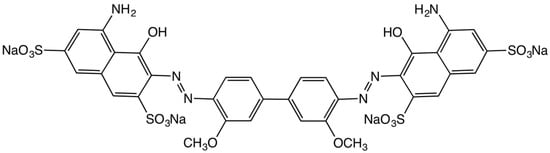
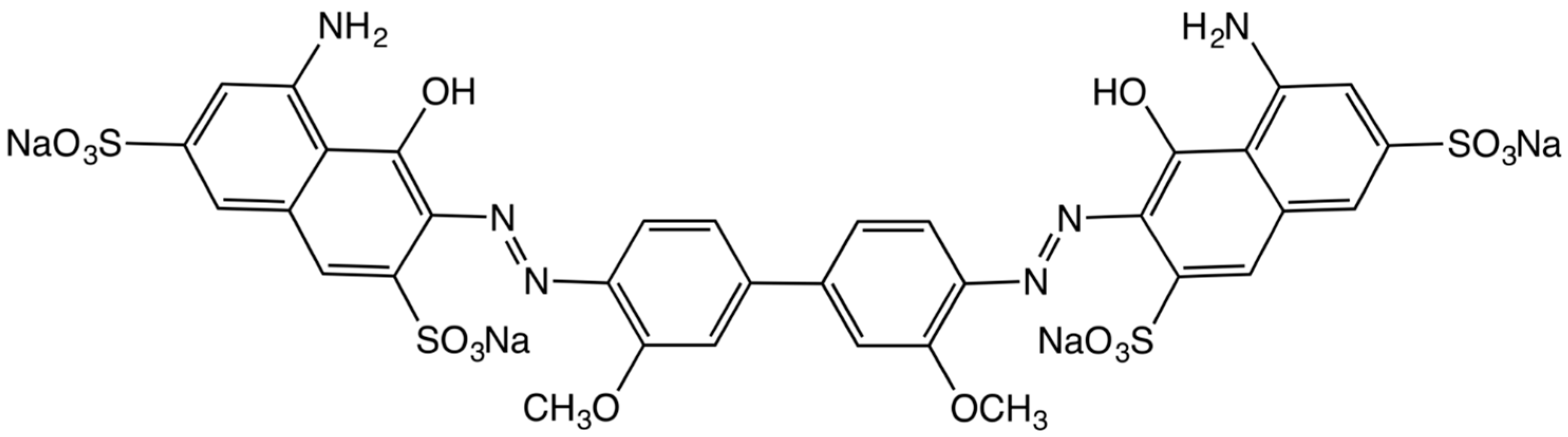
The dye investigated in this study was Direct Blue BR 200 supplied by Argus (Radziszow, Poland). The chemical structure of the dye is shown in Figure 1. It was selected as the model adsorbate due to its high industrial relevance and environmental significance. This compound is widely used in industrial textile dyeing processes. It belongs to the azo dye class, which constitutes approximately 60–70% of all dyes used in textile processing [22], particularly in cotton and cellulose fiber dyeing. Azo dyes are characterized by high water solubility, chemical stability and resistance to biodegradation, making them persistent contaminants in textile wastewater and difficult to remove using conventional treatment methods. The molecular structure of Direct Blue BR 200 contains multiple sulfonate groups, which increase its solubility in water and make it a representative anionic dye commonly encountered in textile effluents [23]. Moreover, Direct Blue BR 200 dye has been reported to exhibit toxic effects on aquatic organisms [23]. These features justify its selection as a relevant pollutant for evaluating adsorption performance of the waste eggshell biosorbent.
Figure 1.
Chemical structure of Direct Blue BR 200 dye (Poland) [24].
Chicken eggshells were used as the biosorbent in this study. The raw material was a waste product from a local pastry shop (Southern Poland). The eggshells were chosen for the studies since they are reported in the literature to be a potential biosorbent for dye removal [25,26,27,28,29,30]. The chicken eggshell consists of three layers: an outer mineral shell and two inner protein membranes [25,29,30]. It contains mainly calcium carbonate (94–97% by weight) but also magnesium carbonate (1%), calcium phosphate (1%) and organic matter (4%—protein membrane). One eggshell contains up to 17,000 pores [28]. The pore diameters are reported to vary from 13 nm to 1000 nm [29,31]. The BET specific surface area of boiled eggshells is about 1–3 m2/g [25,30,31,32,33]. The relatively low specific surface area is the reason why it has been postulated that sorption capacities of eggshells result from surface interactions rather than from diffusion through their pores [31].
The steps of preparing the waste eggshells used in the studies were as follows:
- (1)
- removing the inner membrane,
- (2)
- washing with distilled water,
- (3)
- boiling for 5 min in distilled water at 100 °C,
- (4)
- crushing manually into pieces,
- (5)
- sieving, dividing into samples and placing in weighing bottles,
- (6)
- drying overnight to constant mass in a laboratory dryer at 50 °C.
The inner membrane of the eggshells was removed to prevent protein degradation during equilibrium studies and ensure reliable concentration measurements. The eggshells were boiled because, according to the literature [32], boiling can enhance the specific surface area of eggshells and therefore it is a beneficial operation for adsorption. Moreover, it improved hygienic conditions when working with this biological material.
The average shell thickness was 0.3 mm. The shells were crushed into irregular pieces suitable for placement in the adsorber as a loosely packed bed. The size of the prepared pieces at their widest edge ranged from 5 mm to 8 mm. The smallest grains generated during crushing were discarded. Fragments smaller than 0.63 mm were removed by sieving. The aim was to ensure that the shells remained on the supporting grid of the adsorption column and were separated from the liquid solution flowing through the adsorbent bed. Moreover, using relatively large grains and avoiding grinding—commonly applied in studies on eggshell biosorbents—was intended to ensure a low pressure drop in the column packing, which is an important factor from an engineering perspective.
The commercial activated carbon Sorbotech LGCO 100 (Argus, Gdynia, Poland) was used in this study for comparison purposes. It was selected due to its favorable adsorption properties for the purification of water from organic substances declared by the manufacturer, its good mechanical performance when applied as column packing, wide commercial availability, and relatively low cost. This activated carbon is intended for drinking water treatment, where it removes undesirable color, taste, and odor, and it is also applicable in wastewater and process water purification, reducing organic impurities to trace levels. Sorbotech LGCO 100 is produced from coconut shells through carbonization and activation processes, resulting in a predominantly microporous structure. Its specific surface area, determined using the BET method, is 1000 m2/g. The grains have irregular shapes, with sizes ranging from 0.6 mm to 2.36 mm. The material exhibits high mechanical hardness (98%), which is advantageous for its application as packing in adsorption columns.
The activated carbon used in this study is a granulated material with irregular but compact grain geometry. In contrast, the eggshells, due to their intrinsic layered and flat structure, cannot be fragmented into granular particles similar in shape to activated carbon. The mass of samples was the constant parameter in the equilibrium and kinetic studies. Because of the fundamental geometric differences, matching the shape and particle size ranges of both adsorbents was not feasible. Therefore, for the purpose of comparing mass-transfer behavior, the equivalent radius of grains (Rp) is used in this work as the characteristic dimension in diffusion calculations.
2.2. Adsorption Equilibrium: Measurements and Equations
The adsorption isotherm was determined experimentally using the static method. For liquid solutions, this method involves measuring the amount of substance adsorbed on the surface of a solid at constant temperature, after equilibrium has been established between the adsorbed phase and the bulk phase. The difference between the dye solution concentrations before the onset of the adsorption process and after the establishment of adsorption equilibrium was measured.
Dye solutions of volume 100 cm3 were prepared. To each of the prepared solutions, 5 g of adsorbent was added. The dye concentrations for eggshells were 10 mg/dm3, 20 mg/dm3, 30 mg/dm3, 40 mg/dm3, 50 mg/dm3, 60 mg/dm3, 70 mg/dm3 and 80 mg/dm3. For activated carbon the concentrations were as follows: 10 mg/dm3, 20 mg/dm3, 30 mg/dm3, 40 mg/dm3, 50 mg/dm3, 60 mg/dm3 and 70 mg/dm3. Such values were chosen to model a high degree of Direct Blue BR 200 pollution in water, as suggested in the literature [23]. The dye concentration, solution volume and adsorbent mass were selected to obtain adsorbate concentrations in water in ranges consistent with the maximum permissible value (35 mg/dm3), in general compliance with Polish law [34]. Prior to introducing the adsorbent into the samples, it was degassed and rinsed with distilled water to eliminate residual dust.
The samples containing the solution and adsorbent grains were agitated using a laboratory shaker and thermostated at 21 °C. The absorbance of the solutions was then monitored using a spectrophotometer and the measurements were repeated until three consecutive readings showed no significant change, indicating that equilibrium between the adsorbate and the adsorbent had been reached. Equilibrium was achieved after 96 h for activated carbon and 48 h for eggshells. The equilibrium measurements were repeated three times and the results were averaged.
The UV–Vis measurement wavelength for Direct Blue BR 200 dye was 584 nm. The sample path length inside the cuvette was 100 mm. The calibration function was as follows: Absorbance = 0.0363·C + 0.0066 with R2 = 0.9979, where C is the dye concentration in the liquid phase.
In this study, pH was not adjusted but the initial and final values were measured. The pH of the aqueous dye solution, i.e., the initial pH, was 5. The final pH at the end of equilibrium measurements for eggshells was 8.
To analyze the adsorption equilibrium results, several different adsorption isotherms were applied. An adsorption isotherm is understood as the relationship between the amount of adsorbate retained in the solid phase and its equilibrium concentration in the solution, determined at constant temperature. The equations used are presented in Table 1. Based on the literature analysis [1,7,17], the isotherms most commonly used to describe adsorption equilibrium for aqueous dye solutions were selected. According to adsorption theory, for the low adsorbate concentration range, the linear Henry isotherm should provide the best fit. The Langmuir isotherm describes monolayer adsorption on an ideal flat homogeneous adsorbent surface; there are no interactions between adsorbate molecules. Surface heterogeneity is accounted for in the Freundlich isotherm, which has been proposed based on numerous experimental studies. It is a multilayer adsorption isotherm [35] and does not have a finite saturation limit. A combination of the Langmuir and Freundlich isotherm characteristics leads to the Sips isotherm, which is most commonly referred to as the Langmuir–Freundlich isotherm. The Sips isotherm [35] is a modification of the Freundlich equation and is intended to provide the right finite limits for high liquid-phase concentrations.
In its classical form, the Brunauer–Emmett–Teller (BET) theory was developed for gas-phase physisorption. The following assumptions apply [35]: (i) the adsorbent surface is flat, (ii) there is no limit to the number of layers that may adsorb on the surface, (iii) the surface is energetically homogeneous, and (iv) there are no interactions between adsorbed molecules. For liquid-phase adsorption, several modified BET formulations have been proposed [36,37], in which the relative pressure term is replaced by solute concentration and the BET constants are redefined to reflect solute–solvent interactions rather than vapor–liquid equilibrium. The modified BET equation provides a phenomenological description of multilayer adsorption in aqueous solutions and is reported in the literature as applicable to water-phase adsorption of organic contaminants [37]. These modified BET equations have been successfully applied to describe S-shaped (type II) isotherms in aqueous systems [37]. In the present study, the modified BET isotherm [36,37] was selected because the experimental isotherm for eggshells exhibits a sigmoidal shape and multilayer adsorption cannot be excluded.
The isotherm equations used in this work are presented in Table 1. In the case of Henry’s equation, the linear regression was used to obtain the equilibrium constant K. Nonlinear regression of the Langmuir, Freundlich, Sips and modified BET isotherms was performed in Open Matlab Online using the nlinfit function, which applies the Levenberg–Marquardt algorithm for nonlinear least-squares optimization. The quality of fit was evaluated using the sum of squared residuals (SSR) between the experimental and model concentrations in the solid phase. Also, the coefficient of determination (R2) was calculated from (1):
where ASR is the squared deviation between the average experimental and model-predicted concentration :
Table 1.
Adsorption isotherm equations and definitions of model parameters. qeq—equilibrium adsorbate concentration in the solid phase, i.e., within the adsorbent grains [mg/g]; Ceq—equilibrium adsorbate concentration in the liquid phase [mg/dm3].
2.3. Adsorption Kinetics: Measurements and Equations
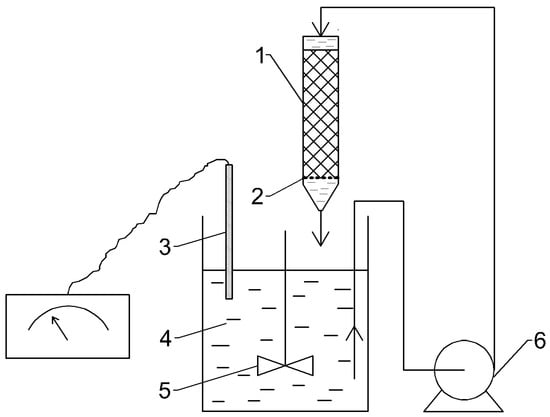
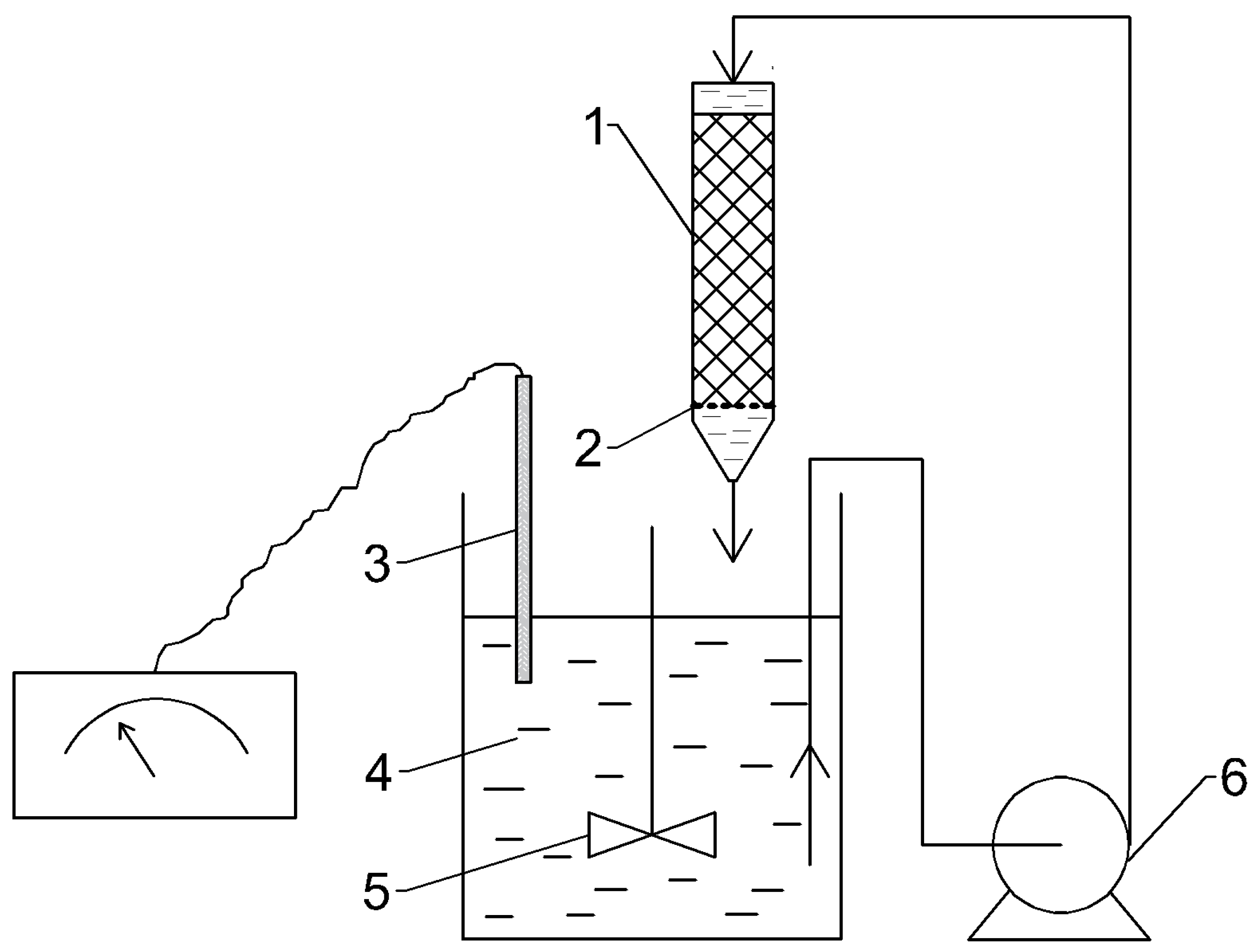
The adsorption experiments were conducted in a recirculating system consisting of 100 cm3 of solution placed in a beaker positioned on a magnetic stirrer. The initial dye concentration in the solution was 30 mg/dm3. The temperature during all experiments was maintained at 21 °C. Using a peristaltic pump, the solution was continuously transported from the beaker to a glass adsorption column packed with different adsorbents, namely waste chicken eggshells and activated carbon. The adsorbent grains were placed on a stainless-steel supporting grid. The column had an internal diameter of 12.5 mm. The mass of each adsorbent sample used as packing in the column was 2.58 g. After passing through the adsorbent bed, the liquid returned to the beaker, forming a closed-loop circulation system.
The main operating parameter varied during the experiments was the volumetric flow rate through the adsorption column (Qv), investigated at: 1.72 cm3/s, 2.31 cm3/s and 2.9 cm3/s. To monitor adsorption progress, solution samples were analyzed spectrophotometrically. The total experiment duration was 60 min with the final measurement taken at the end of this period. Dye concentrations C were determined from absorbance values using the calibration function: Absorbance = 0.0031 × C − 0.0009 with R2 = 0.9699. The sample path length inside the cuvette was 10 mm. The final pH was measured and found to be 8.
A schematic representation of the experimental setup is presented in Figure 2.
Figure 2.
Schematic representation of the experimental setup used for adsorption kinetics studies: 1—adsorbent grains in an adsorber column, 2—supporting grid, 3—sampling for dye concentration analysis, 4—liquid solution containing the adsorbate, 5—laboratory stirrer, 6—peristaltic pump.
Adsorption kinetics was analyzed based on time-dependent changes in adsorbate concentration in both the liquid and solid phases. The adsorbate concentration in the grains q was calculated on the basis of its concentration in the liquid phase C. The following mass balance equation was used [38]:
where V—solution volume [dm3]; C0—initial concentration of adsorbate in the liquid phase [mg/dm3]; C—current concentration of adsorbate in the liquid phase [mg/dm3]; ma—mass of an adsorbent sample [g].
External and Internal Diffusion
In this work, adsorption of an adsorbate in porous adsorbent grains from a mixture with an inert solvent is considered. The stages of such a process are as follows [39]:
- (1)
- transport of adsorbate molecules from the bulk of the liquid to the external surface of the adsorbent grain including transport through the film of molecules around the grain (external diffusion),
- (2)
- transport of the adsorbate into the interior of the adsorbent grain (internal diffusion in adsorbent pores),
- (3)
- the actual adsorption of the adsorbate on the adsorbent surface.
The rate of adsorption is limited by the slowest stage of this process. The adsorption step itself (stage 3) is typically fast. Therefore, the overall rate is primarily determined by mass transfer during external and/or internal diffusion [40]. However, the finite rate of adsorption is most often due to diffusional resistance within the adsorbent grain [35].
The molecular diffusion coefficient in the liquid phase (external diffusion) can be calculated using the Wilke–Chang correlation, commonly applied for dilute aqueous systems [41]:
where DAB—molecular diffusion coefficient [cm2/s]; MB—molecular mass of solvent B [g/mol]; ηB—dynamic viscosity coefficient of solvent B [cP]; T—temperature [K]; ϕ—association coefficient of solvent B [-]; VA—molar volume of substance A [cm3/mol].
Internal transport phenomena may be evaluated using the diffusion model for spherical grains [42]. The diffusion equation for a sphere can be used to provide an approximate description of diffusion in irregularly shaped grains [40]. The radius of a sphere having the same volume as the grain is adopted as the characteristic dimension of the grain. The following relationship applies [42,43]:
where q—concentration of adsorbate in the grain after time t [mg/g], qb—concentration of adsorbate on the grain surface [mg/g], Ds—effective diffusion coefficient based on the component concentration in the grain [m2/s], Rp—equivalent grain radius [m].
Equation (10) is the solution to Fick’s unsteady-state diffusion equation. It applies to the case where the grain initially does not contain the diffusing component and the concentration of the adsorbed component at the grain surface remains constant throughout the process.
The equivalent radius Rp is defined as the radius of a sphere with the same volume as the grain:
Vj is the volume of the grain:
where ma—mass of the grain sample [g], N—number of grains in the sample [-], ρp—apparent density of grains [kg/m3].
Equation (10) contains an infinite sum, which complicates calculations. Some simplifications are known for specific cases. When q/qb < 0.25, Formula (10) transforms to the form [39]:
However, when q/qb > 0.7, it is sufficient to consider only the first term of the sum (n = 1) in the exact Equation (10), which yields:
A simplified solution to the diffusion equation based on the so-called Linear Driving Force (LDF) is also known [42]. For a sphere, the LDF relationship takes the form:
It is convenient to introduce some dimensionless variables. The dimensionless concentration in the grain Y:
The dimensionless adsorption time:
After these variables are introduced, Equations (10) and (13)–(15) take simpler forms, respectively:
- -
- exact solution
- -
- approximate solution for low concentrations (Y < 0.25)
- -
- approximate solution for high concentrations (Y > 0.7)
- -
- approximate LDF relationship
Y = 1 − exp(−15τ),
Using Formulas (10)–(21), one can calculate the effective diffusion coefficient Ds for the adsorbate in the grain.
It should be emphasized that the analytical solution of Fick’s Equation (10) assumes spherical grains, constant diffusivity, diffusion-controlled adsorption and a constant adsorbate concentration at the grain surface. In the present system, the irregular geometry and heterogeneity of eggshell and activated carbon grains and the decrease in liquid-phase concentration during adsorption introduce deviations from these ideal conditions. As a result, the calculated Ds values represent apparent effective diffusion coefficients, which are model parameters influenced not only by intraparticle mass transfer but also by external mass-transfer resistance. A true intraparticle diffusion coefficient is an intrinsic material property and does not depend on the hydrodynamic conditions in the fluid around the grains. Therefore, the Ds values obtained in this work should be treated as comparative evaluation measures of mass-transfer performance between eggshells and activated carbon, rather than as intrinsic material properties.
3. Results and Discussion
3.1. Adsorption Equilibrium: Results of Measurements and Calculations
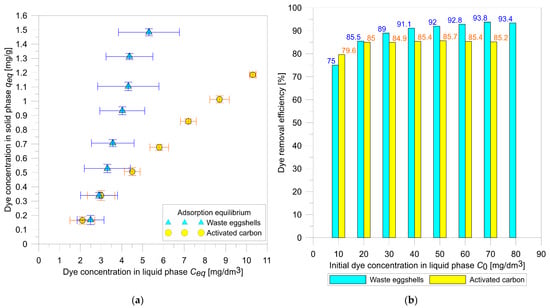
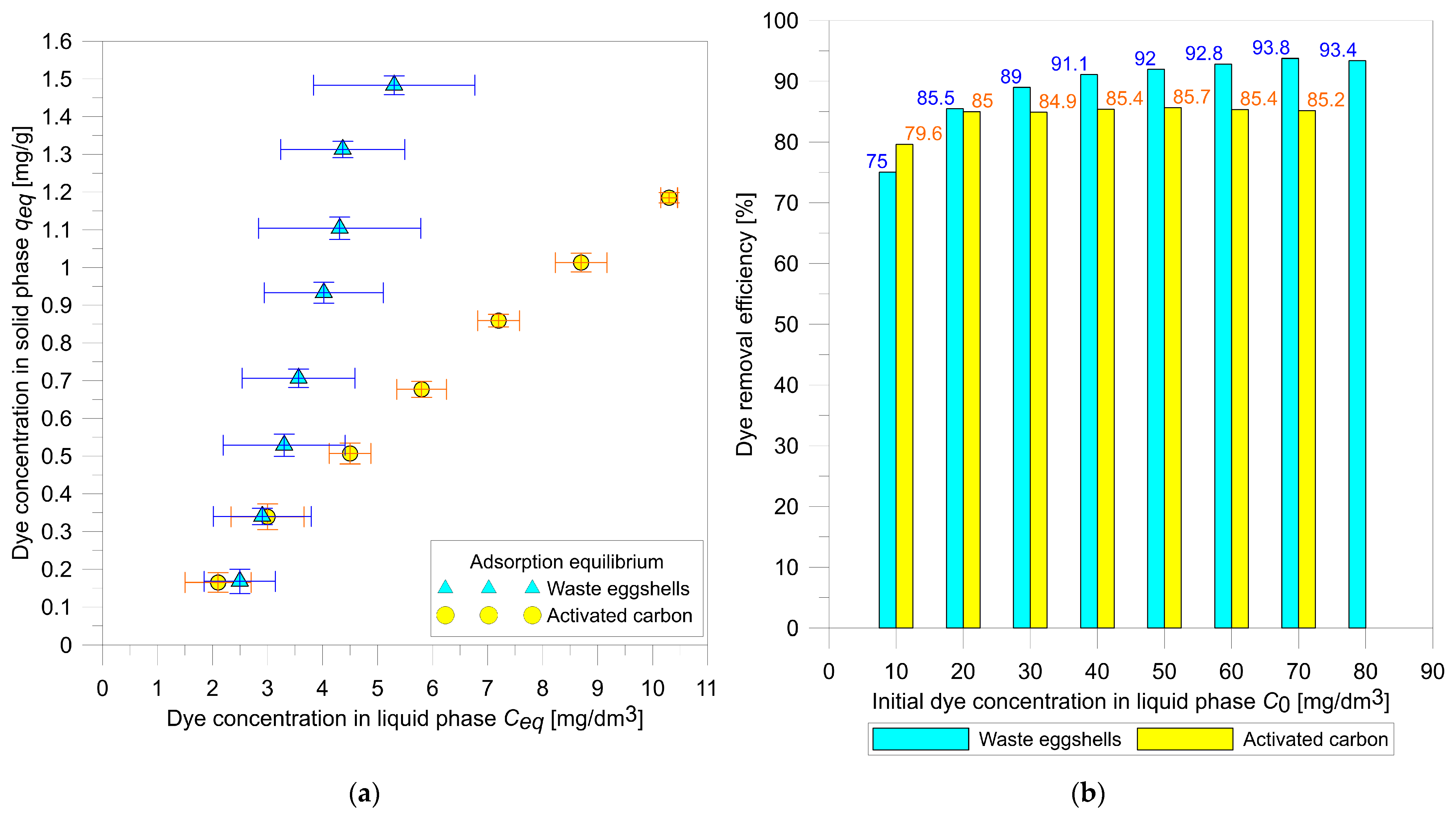
Figure 3 presents the experimental equilibrium data for the tested systems at 21 °C. Figure 3a shows the adsorption isotherms, where the horizontal axis corresponds to the equilibrium dye concentration in the liquid phase Ceq, and the vertical axis represents the equilibrium concentration in the solid phase qeq. The blue points refer to the results for eggshells, while the yellow points refer to activated carbon Sorbotech LGCO 100. The error bars present the standard error of the mean. For both eggshells and activated carbon, an increase in the amount of adsorbed substance qeq is observed with increasing concentration in the liquid phase Ceq. This behavior is consistent with the trends reported in the literature [44]. Eggshells exhibit a higher adsorption capacity than activated carbon across almost the entire analyzed concentration range, except at the lowest initial concentration. This higher capacity is reflected in the steeper increase in the adsorption isotherm qeq = f(Ceq) for eggshells compared with activated carbon. However, there is an absence of a saturation plateau for both adsorbents in Figure 3a. The maximum adsorption capacities (1.50 mg/g for eggshells at an initial dye concentration 80 mg/dm3 and 1.19 mg/g for activated carbon at an initial dye concentration of 70 mg/dm3) are valid only within the investigated concentration range. Therefore, this study is of a comparative nature. The primary objective of the equilibrium analysis is to evaluate the relative performance of eggshells versus activated carbon, rather than to determine absolute saturation capacities. It should be emphasized that extended equilibrium experiments at higher dye concentrations will be conducted in future work to fully characterize the saturation behavior of the eggshell biosorbent and to determine its absolute maximum adsorption capacity.
Figure 3.
Experimental results at 21 °C for adsorption of Direct Blue BR 200 dye (Argus, Poland) onto waste chicken eggshells (Poland) and activated carbon LGCO 100 (Sorbotech, Gdynia, Poland); sorbent dosage: 50 g/dm3; initial dye concentrations: 10–80 mg/dm3 for eggshells and 10–70 mg/dm3 for activated carbon; initial pH of the solution: pH = 5; final pH = 8 for eggshells. (a) adsorption isotherms, (b) dye removal efficiency.
Figure 3b presents the relative adsorption efficiency for Direct Blue BR 200 on both adsorbents. It was calculated as the ratio of the concentration decrease (initial minus equilibrium) to the initial concentration. As shown in Figure 3b, both adsorbents exhibit high efficiency. However, eggshells outperform activated carbon at most initial concentrations, except at the lowest concentration, where activated carbon shows slightly higher efficiency.
Although activated carbon possesses a much higher specific surface area than waste eggshells, the adsorption capacity (Figure 3a) and adsorption efficiency (Figure 3b) for Direct Blue BR 200 were higher for eggshells at most initial concentrations. This behavior can be attributed to the surface chemistry of calcium carbonate, which is the main component of this biosorbent. Direct Blue BR 200 is an anionic dye containing multiple sulfonic groups (–SO3H). Sulfonic groups exhibit strong affinity toward Ca2+ ions [44,45] present on the CaCO3 surface. Therefore, higher adsorption of Direct Blue BR 200 on eggshells likely results from the dominance of surface-level mechanisms, which do not require extensive microporosity. Moreover, in the case of activated carbon, the high degree of microporosity may limit pore accessibility for large dye molecules.
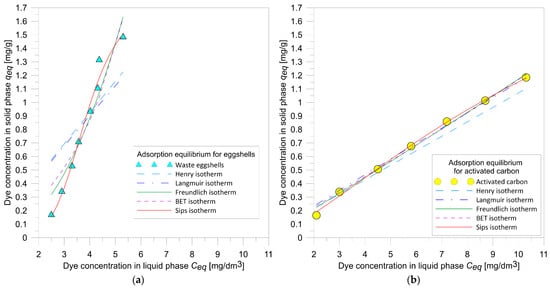
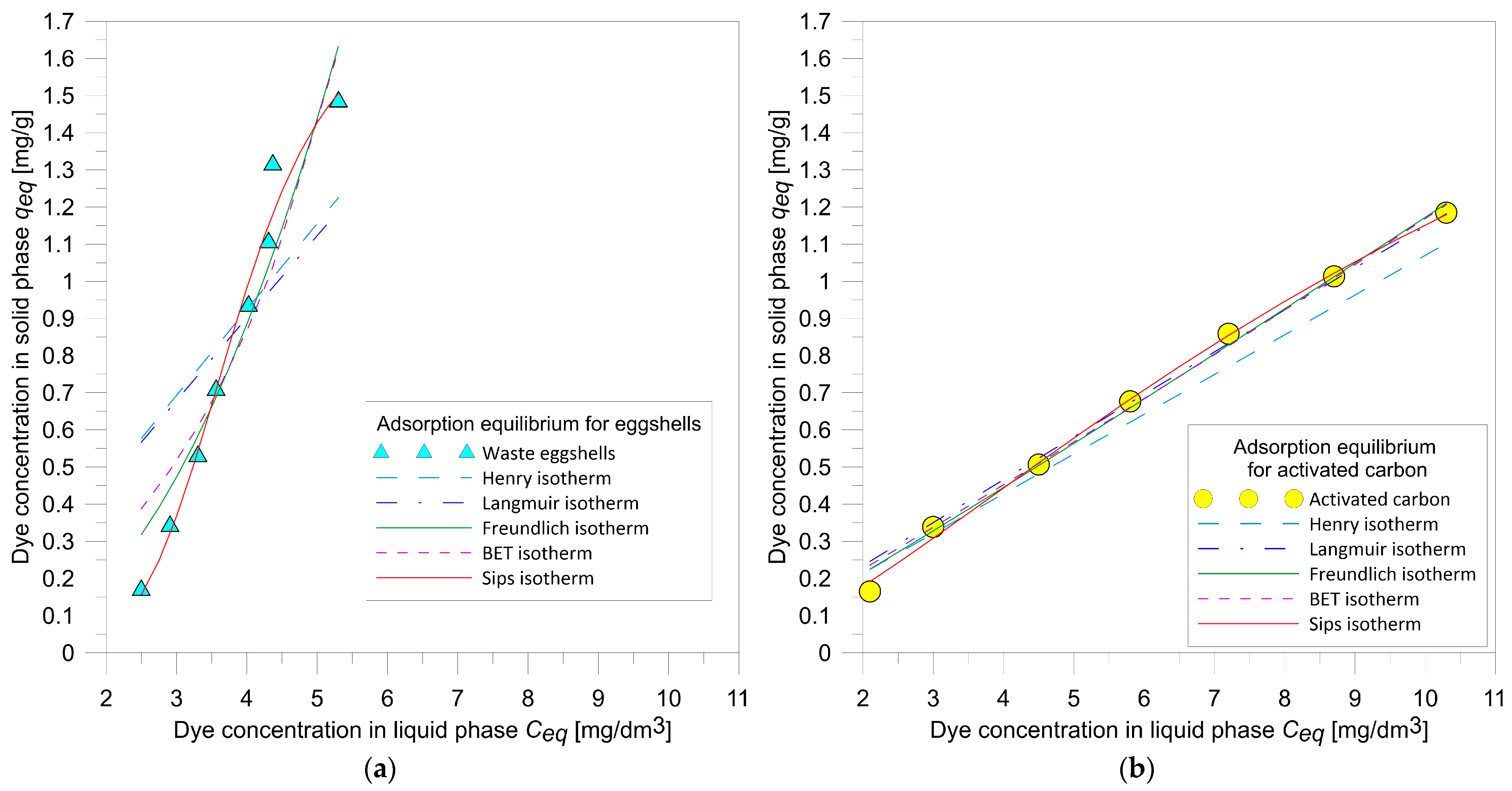
Figure 4 and Table 2 show the results of fitting the adsorption isotherm models to the experimental data. The basis for assessing model fit is the sum of squared residuals (SSR) and the determination coefficient (R2). The lower SSR and the higher R2, the better the agreement between the model predictions and the experimental data. Since the equilibrium data presented in this work refer only to the investigated concentration range of the dye in aqueous solutions (see Figure 3a), the constants presented in Table 2 should be used only within the appropriate concentration ranges.
Figure 4.
Adsorption isotherm model fits for: (a) waste chicken eggshells (Poland), (b) activated carbon LGCO 100 (Sorbotech, Poland).
Table 2.
Isotherm constants, sum of squared residuals SSR and coefficient of determination R2 for adsorption of Direct Blue BR 200 dye (Argus, Poland) on waste chicken eggshells (Poland) and activated carbon LGCO 100 (Sorbotech, Poland).
For eggshells it can be concluded on the basis of Figure 4a and Table 2 that the Henry and Langmuir models give the poorest fit to experimental data. The relatively poor fit of the Henry equation predictions to the experimental data indicates that the adsorption equilibrium of the dye–eggshell system is not linear. The Langmuir model also does not adequately describe the data. Non-Langmuir behavior may arise from multilayer adsorption, surface heterogeneity, cooperative adsorption effects or other nonideal phenomena occurring on complex biosorbent surfaces. It can be supposed that a multilayer of adsorbate molecules is formed on the adsorbent surface. This conclusion can be confirmed by the good fit of the BET model and the very good fit of the Freundlich model. However, the fit of the Langmuir–Freundlich (Sips) model is even better than the BET and Freundlich models, which indicates the limited sorption capacity of the investigated sorbent. Moreover, the Sips isotherm takes the surface heterogeneity into account. It is also worth noting that, in this case, the Sips isotherm exhibits a sigmoidal (S-shaped) form.
For activated carbon, Figure 4b and Table 2 show that all the considered isotherm models provide a good fit to the experimental data. However, the quality of the fit differs among the models. For the Henry model the SSR value is the highest and the R2 is the lowest when compared with other models presented in Table 2. Therefore, it is recommended that equations which take the isotherm nonlinearity into account should be used to describe the considered dye-activated carbon equilibrium. Freundlich and BET models have similar SSR and R2 values, i.e., comparable agreement with the experimental data. As with eggshells, the Langmuir–Freundlich (Sips) model provides the best fit to the experimental data. In the Langmuir, BET, and Sips models, the parameter qeq∞ is interpreted as the monolayer adsorbate concentration [mg/g]. The values of qeq∞ obtained from the BET (qeq∞ = 3.33 mg/g) and Sips models (qeq∞ = 2.61 mg/g) are consistent with each other. The value given by the Langmuir model of qeq∞ = 46.4 mg/g is much greater. The Langmuir model has the poorest fit among all the considered nonlinear isotherms. This indicates that the predictions of the BET and Sips models should be preferred over the estimates of the Langmuir isotherm. The poor fit of the Langmuir model and the satisfactory fit of the Freundlich, BET and Sips models can be interpreted as the result of multilayer adsorption and surface heterogeneity. The fact that the Sips model provides the best fit indicates that activated carbon Sorbotech LGCO 100 has a finite sorption capacity.
3.2. Adsorption Kinetics: Results of Measurements
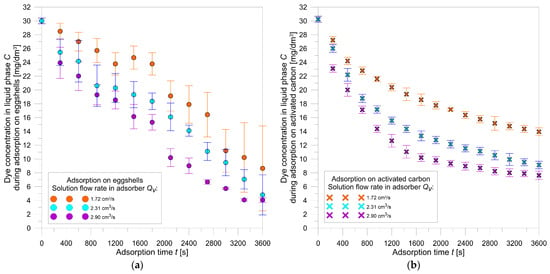
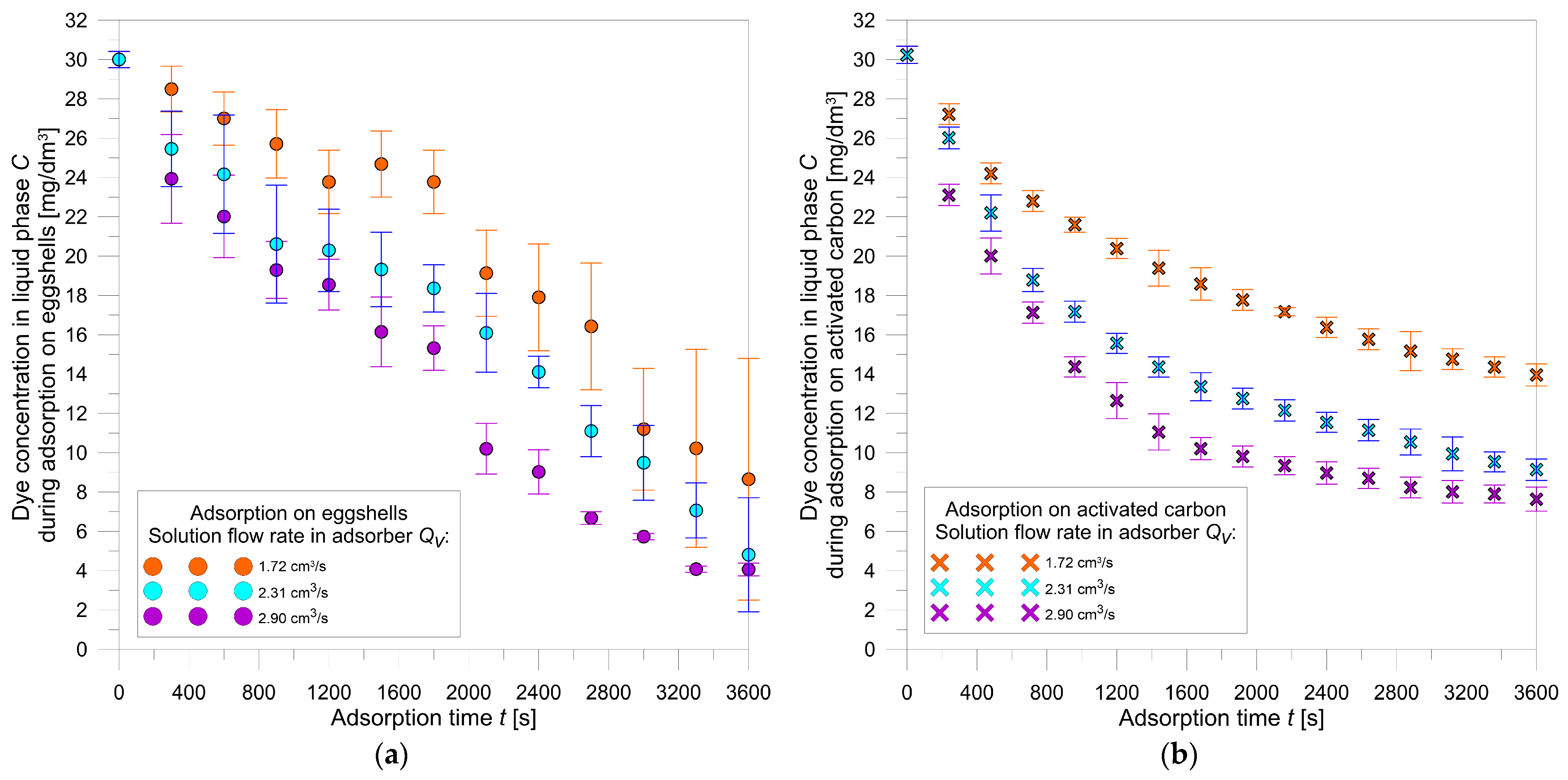
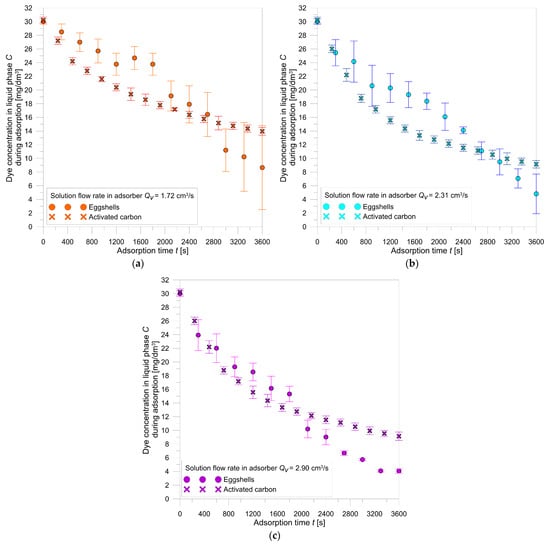
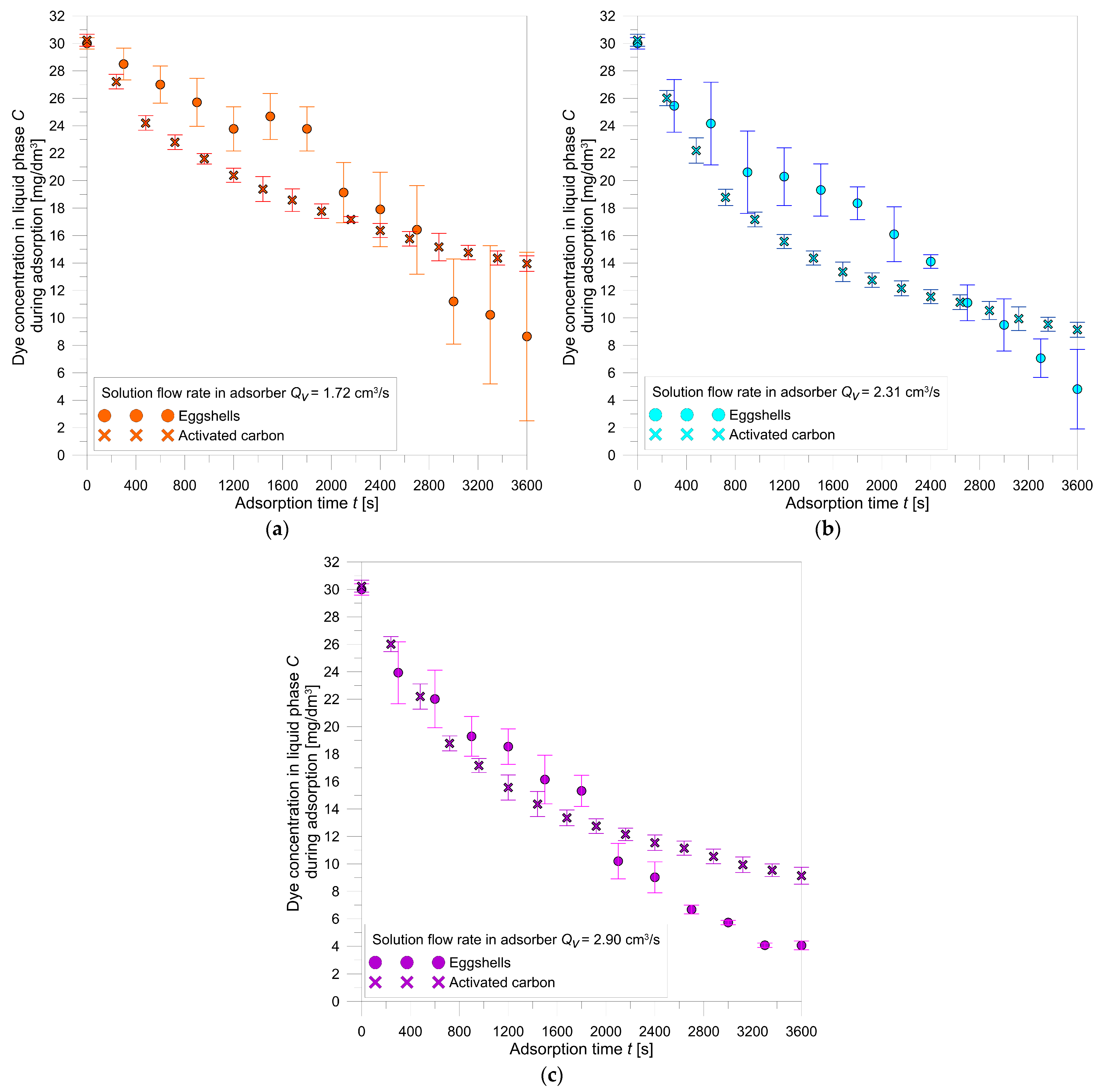
Figure 5 and Figure 6 present the experimental kinetic curves for adsorption of Direct Blue BR 200 dye onto eggshells and activated carbon Sorbotech LGCO 100 at three volumetric flow rates: 1.72 cm3/s, 2.31 cm3/s and 2.90 cm3/s. The plots show the temporal changes in dye concentration in the liquid phase. The error bars represent the standard error of the mean.
Figure 5.
Concentration of Direct Blue BR 200 dye (Argus, Poland) in water solutions vs. time for adsorption at 21 °C on: (a) waste chicken eggshells (Poland), initial pH of the solution: pH = 5, final pH = 8; (b) activated carbon LGCO 100 (Sorbotech, Poland).
Figure 6.
Concentration of Direct Blue BR 200 dye (Argus, Poland) in water solutions vs. adsorption time for waste chicken eggshells (Poland) and activated carbon LGCO 100 (Sorbotech, Poland) at 21 °C for different flow rates of liquid in the adsorber: (a) Qv = 1.72 cm3/s, (b) Qv = 2.31 cm3/s, (c) Qv = 2.90 cm3/s.
For both adsorbents, the dye concentration decreases over time. The kinetic curves for activated carbon (Figure 5b) exhibit the typical behavior of liquid–solid adsorption systems: an initial rapid decrease in dye concentration followed by a gradual approach to equilibrium. This reflects the decreasing driving force, defined as the difference between the actual dye concentration in the liquid phase and the equilibrium concentration corresponding to the instantaneous solid-phase loading.
The kinetic curves for eggshells (Figure 5a) differ from those for activated carbon. At the initial stage, the dye concentration in the liquid phase is higher for eggshells, but the curves intersect at later times. This indicates that activated carbon approaches saturation more quickly, whereas eggshells retain a higher adsorption potential over time. This observation is consistent with the equilibrium data, which show that for the initial dye concentration used in the kinetic studies (C0 = 30 mg/dm3), the equilibrium liquid-phase concentration is lower for eggshells than for activated carbon.
The influence of flow rate is evident for both adsorbents: higher Qv results in lower dye concentration at a given time, indicating faster adsorption. Increasing the flow rate reduces the thickness of the external liquid film at the grain surface, thereby decreasing external mass-transfer resistance and accelerating the process.
The curves obtained for eggshells are less smooth than those for activated carbon, which may result from the heterogeneity of the eggshell biosorbent and the presence of fine suspended particles in the solution, originating from fragmentation of eggshell grains during liquid flow through the packed bed. The smoothness of the concentration curves is lowest at the lowest flow rate. This is due to the thicker liquid film and higher external mass-transfer resistance, which slow down dye transport to the grain surface and make the curves more sensitive to small measurement fluctuations. At higher flow rates, the external film becomes thinner, external resistance decreases, the adsorption rate increases, and the concentration profiles become smoother.
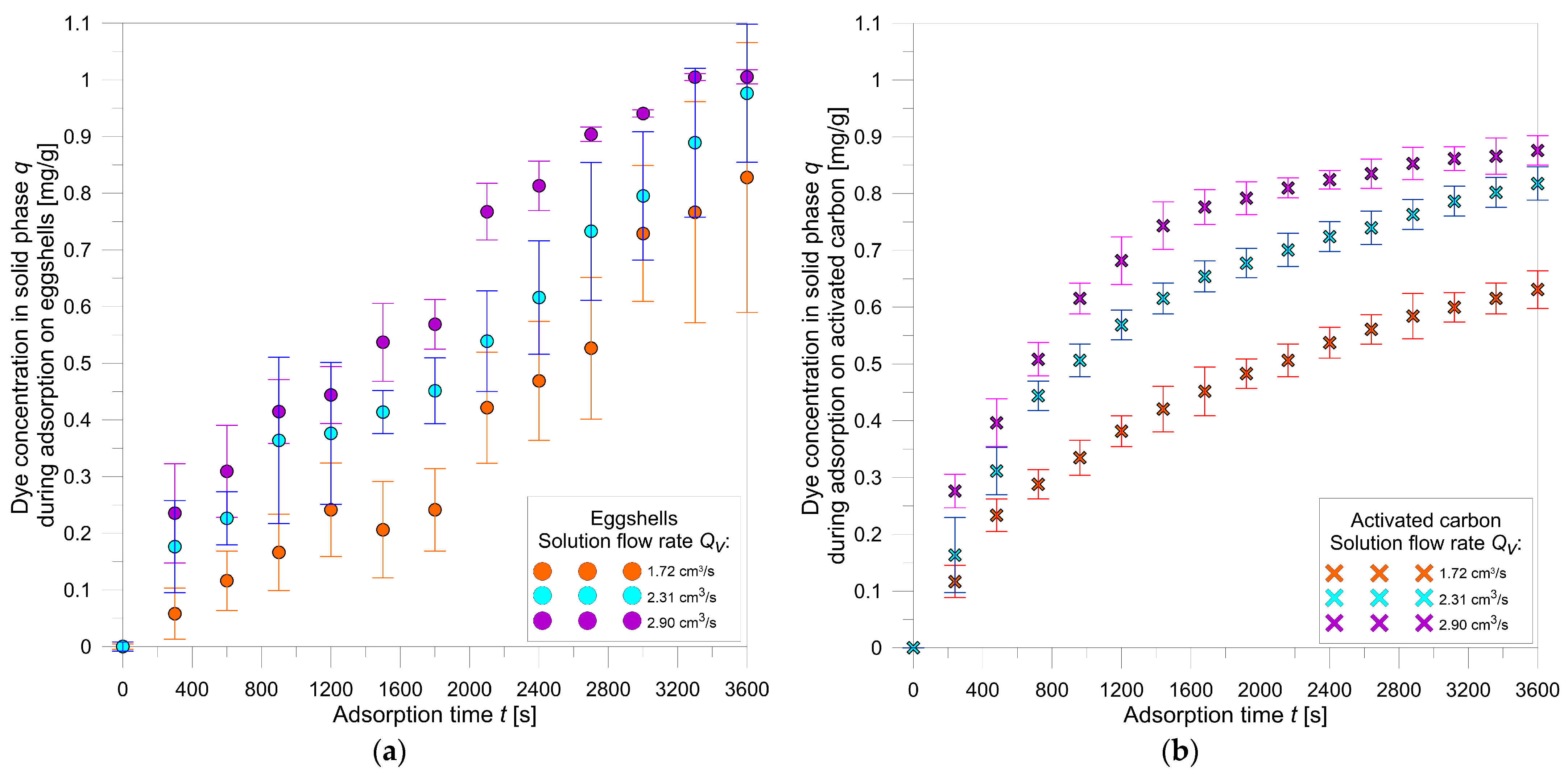
Figure 7 shows the temporal changes in dye concentration in adsorbent grains q for the eggshells and activated carbon Sorbotech LGCO 100. The adsorbed amount, q, was calculated from the balance Equation (8). The solution flow rate is used as the parameter in Figure 7. It can be seen that for both adsorbents, the amount of dye adsorbed in the grains q increases with adsorption time t. Moreover, the analysis of Figure 7 indicates that the higher the solution flow rate, the greater the q value at a given adsorption time t (for example at 2000 s).
Figure 7.
Concentration of Direct Blue BR 200 dye (Argus, Poland) in adsorbent grains vs. adsorption time at 21 °C for different flow rates of liquid in the adsorber for: (a) waste chicken eggshells (Poland), initial pH = 5, final pH = 8, (b) activated carbon LGCO 100 (Sorbotech, Poland).
A distinct flattening of the curves for activated carbon (Figure 7b) can be observed—that is, the curves clearly tend toward the equilibrium concentration value. From the equilibrium data presented in this work it may be concluded that the equilibrium concentration qeq for the activated carbon is lower than the respective value for the eggshells. The curves for the eggshells (Figure 7a) exhibit a steep profile, indicating a rapid change in concentration within the grains over the entire adsorption time range. This is caused by the system being far from equilibrium and results from the eggshells’ good sorption properties toward the dye under investigation.
It seems interesting to compare the values of q for eggshells and activated carbon at the end, i.e., after 60 min of the process. These concentrations are indicated by the points at 3600 s in Figure 7a and Figure 7b, respectively. These values represent the final uptakes obtained in the kinetic studies. It may be concluded that the application of the eggshells resulted in a higher final uptake of the dye than that of the reference activated carbon. This conclusion is valid for all the considered solution flow rates. This fact confirms the very good sorption properties of the eggshells.
3.3. Comparison of Dye Adsorption Capacities for Different Biosorbents
Table 3 provides a comparative overview of sorption capacities reported for various biosorbents applied in dye removal from aqueous solutions, enabling a contextual assessment of the performance of waste chicken eggshells toward the Direct Blue BR 200 dye. It is important to emphasize that adsorption capacity is not an intrinsic material property but an operational parameter that depends strongly on the initial dye concentration, solution volume, sorbent dosage, contact time, temperature and pH. Because these parameters differ among the studies summarized in Table 3, the comparison of sorption capacities cannot be interpreted quantitatively. The purpose of this comparison is therefore strictly qualitative and aims only to illustrate the relative adsorption potential of eggshell-based biosorbents within the broader context of dye removal materials.
Under the equilibrium conditions investigated in this work, eggshells exhibited a maximum adsorption capacity of 1.50 mg/g at the initial dye concentration of 80 mg/dm3. For the reference activated carbon Sorbotech LGCO 100, the maximum capacity reached 1.19 mg/g at 70 mg/dm3. Under identical experimental conditions (70 mg/dm3), eggshells achieved a capacity of 1.31 mg/g, confirming their superior adsorption performance relative to the reference activated carbon.
When compared with other eggshell-based sorbents reported in the literature [24,25], the capacity obtained in this work exceeds the values documented for raw eggshells used for Methylene Blue removal (<1.0 mg/g), yet remains lower than that reported for ground eggshell waste applied to Direct Blue 78 (13 mg/g). Significantly higher capacities have been reported for eggshell sorbents in the removal of other dyes—approximately 50 mg/g for Acid Red 1 and 70 mg/g for Crystal Violet—although these studies involved pH adjustment. As shown in Table 3 and supported by literature data [26,30,45,46,47,48,49], both dye type and solution pH exert a substantial influence on adsorption capacity. Furthermore, adsorption capacity increases with initial dye concentration. The concentration range applied in this study (10–80 mg/dm3) is relatively low compared with values reported in other works (up to 750 mg/dm3 [45]). However, industrial sources indicate that the concentrations used in this work correspond to a high degree of Direct Blue BR 200 contamination in water [23].
Modified eggshell sorbents, such as FeSO4-treated materials, can achieve markedly higher capacities (e.g., 138 mg/g for Crystal Violet and 124 mg/g for Acid Red 1), but their preparation requires additional processing, increasing operational complexity and cost.
In comparison with other non-eggshell biosorbents listed in Table 3, the capacity obtained in this study is comparable to that of hemp biowaste (2.44 mg/g for Remazol Brilliant Blue R), yet lower than the values reported for orange peel (10.72–21.05 mg/g for different dyes), spent coffee residue (20 mg/g for Acid Red 44), banana peel (22.11 mg/g for Methylene Blue), and substantially lower than that of raw date pits (105 mg/g for Remazol Brilliant Blue R).
Overall, the results summarized in Table 3 indicate that waste chicken eggshells can constitute a promising low-cost sorbent for the removal of Direct Blue BR 200. At the same time, they highlight the potential for further enhancement of adsorption performance. In particular, future studies should examine an extended range of initial dye concentrations and the effect of solution pH on dye–eggshell interactions, as literature evidence suggests that pH adjustment may significantly increase the sorption capacity of eggshell-based materials.
Table 3.
Adsorption capacities of sorbents for dye removal from water.
3.4. Calculations for External and Internal Diffusion
3.4.1. Molecular Diffusion Coefficient of Dye in Water Solution
The Wilke and Chang Equation (9) was applied in order to calculate the diffusion coefficient DAB of Direct Blue BR 200 dye in water. The details of the calculations are available in a previous publication by the authors [24]. The following values were substituted into Formula (9): MB = 18 g/mol, ηB = 1024 cP, T = 294.15 K, ϕ = 2.6, VA = 1.106 × 10⁻³ m3/mol. The resulting value obtained was DAB = 2.21 × 10⁻¹⁰ m2/s.
3.4.2. Effective Diffusion Coefficient for Dye in Eggshells and Activated Carbon
The results of equilibrium and kinetic studies were used to calculate the effective diffusion coefficient Ds for dye transport in the pores of waste chicken eggshell grains as well as activated carbon Sorbotech LGCO 100 grains.
The following calculation scheme was applied to determine the Ds coefficient:
- Calculate the average volume of the cylindrical grains using Equation (12) and then their equivalent radius Rp using Equation (11).
- For the dye concentration in solution C at a given adsorption time t, calculate the concentration of the adsorbate in the adsorbent grains q using the mass balance relationship (8) and the equilibrium concentration qeq using the appropriate equilibrium relationship from Table 1. Equilibrium concentrations in the solid phase should be treated as concentrations on the outer surface of the grain qeq = qb.
- Calculate Y using Equation (16).
- Determine the value of τ from the rearranged Equations (19), (20) or (21) depending on the value of Y.
- Calculate Ds from Equation (17).
The results of calculations for the effective diffusion coefficient Ds are presented in Table 4 and Table 5. The apparent particle density (Table 4) of eggshells was determined using a liquid pycnometry method, whereas the corresponding value for activated carbon was taken from the manufacturer’s specification. To calculate the equilibrium concentrations in the solid phase qeq = qb, the Sips isotherm was used for eggshells and activated carbon. It was selected based on its very good agreement with the experimental results. The symbol u in Table 5 denotes the apparent velocity of the solution in the adsorber [m/s]:
where Qv—volumetric flow rate of the liquid in the adsorber [m3/s]; S = πd2/4—cross-sectional area of the adsorber [m2], which diameter is d = 12.5 × 10⁻³ [m].
Table 4.
Equivalent grain radius Rp calculations.
Table 5.
Effective diffusion coefficient Ds calculations.
The values of Ds in Table 5 represent average diffusion coefficients calculated for successive adsorption times during the kinetic measurements. The equilibrium concentrations qeq corresponding to each measured liquid-phase concentration C were used in the calculation procedure for Ds estimation. At short adsorption times, however, the actual concentrations C obtained from the kinetic experiments fell outside the equilibrium concentration range shown in Figure 3a. Therefore, the diffusion coefficients presented in Table 5 should be interpreted as values applicable primarily to long adsorption times. Broader equilibrium measurements at higher dye concentrations that will be conducted in future studies will allow us to extend the calculation range and to reduce the uncertainty introduced into the obtained diffusion coefficients.
According to Table 5, a systematic increase in Ds with increasing flow rate Qv was observed for both adsorbents. Moreover, the results in Table 5 consistently show that the effective diffusion coefficient in eggshell grains is higher than in activated carbon under all tested conditions, which is consistent with the kinetic and equilibrium results demonstrating superior dye uptake by eggshells.
It may also be seen in Table 4 that the equivalent radius for activated carbon is smaller than for eggshells. Taking into account the fact that the smaller the grains, the lower the internal diffusion resistance, one may conclude that there is a possibility of further enhancing the sorption capacity of the eggshells by the fragmentation of their grains. This would make the Ds values for the eggshells even greater than those presented in Table 5. However, a comprehensive assessment of the influence of particle size requires broader studies that also consider the magnitude of flow resistance through the packed bed.
4. Conclusions
This study presents the results of equilibrium and kinetic investigations of the adsorption of the textile dye Direct Blue BR 200 onto waste chicken eggshells. Both the equilibrium and kinetic measurements show that eggshells exhibit higher adsorption capacity than the activated carbon Sorbotech LGCO 100 across the entire dye concentration range analyzed.
The equilibrium analysis revealed that the linear Henry isotherm does not adequately describe the dye–eggshell system, indicating nonlinear adsorption behavior. The Langmuir model also fails to represent the equilibrium data. Non-Langmuir behavior may arise from multilayer adsorption, surface heterogeneity, cooperative adsorption effects or other nonideal phenomena occurring on complex biosorbent surfaces. In contrast, both the Freundlich and modified BET models provide a satisfactory description, indicating multilayer adsorption. The best agreement with the experimental data was obtained using the Langmuir–Freundlich (Sips) isotherm, which captures both surface heterogeneity and finite sorption capacity. For activated carbon, all considered isotherm models fitted the data, but the Sips equation again provided the most accurate representation of equilibrium behavior.
The scope of this work also covers the calculation of key mass-transfer parameters. The molecular diffusion coefficient of the dye in water, calculated using the Wilke–Chang correlation (DAB = 2.21 × 10⁻¹⁰ m2/s), provides a reference for evaluating transport resistance in the liquid phase. The effective diffusion coefficients were determined on the basis of kinetic and equilibrium measurements and the analytical solution to Fick’s unsteady-state diffusion equation. The obtained values of the effective diffusion coefficient Ds for eggshells were 2.55 × 10⁻¹¹ m2/s, 4.59 × 10⁻¹¹ m2/s and 1.92 × 10⁻¹⁰ m2/s for flow rates of 1.72 cm3/s, 2.31 cm3/s and 2.90 cm3/s, respectively. For all investigated flow rates, the apparent effective diffusion coefficient for eggshells is higher than that for activated carbon, confirming the favorable transport properties of the biosorbent. Moreover, for both sorbents, the value of Ds increases with the liquid flow rate, reflecting enhanced mass transfer under intensified hydrodynamic conditions.
The aforementioned Ds values for eggshells refer to the equivalent grain radius Rp = 0.00146 m. The Ds value can be increased by reducing Rp, i.e., by further fragmentation of eggshell grains, which opens possibilities for improving sorption performance. Another promising direction for enhancing adsorption on eggshells lies in pH adjustment, since pH plays an important role in the mechanism of dye adsorption onto biosorbents.
It should be emphasized that the comparison between eggshells and activated carbon presented in this study applies strictly to the specific experimental conditions investigated, including the use of one commercial activated carbon type (Sorbotech LGCO 100), one anionic dye (Direct Blue BR 200), the examined concentration ranges and the grain sizes of both adsorbents. The observed higher adsorption capacity and apparent effective diffusion coefficients for eggshells should not be generalized beyond these conditions.
Author Contributions
Conceptualization, M.G.; methodology, M.G., D.B.; validation, M.G., D.B.; formal analysis, M.G., D.B.; investigation, A.M., M.R.; calculations, M.G., A.M., M.R.; resources, M.G., D.B., A.M., M.R.; data curation, M.G., A.M., M.R.; writing—original draft preparation, M.G., D.B.; writing—review and editing, M.G., D.B., A.M., M.R.; visualization, M.G., D.B.; supervision, M.G. All authors have read and agreed to the published version of the manuscript.
Funding
This research received no external funding.
Institutional Review Board Statement
Not applicable.
Informed Consent Statement
Not applicable.
Data Availability Statement
The original data presented in the study are openly available in Zenodo.org at https://doi.org/10.5281/zenodo.21084073.
Conflicts of Interest
The authors declare no conflicts of interest.
References
- Pai, S.; Kini, M.S.; Selvaraj, R. A review on adsorptive removal of dyes from wastewater by hydroxyapatite nanocomposites. Environ. Sci. Pollut. Res. 2021, 28, 11835–11849. [Google Scholar] [CrossRef] [Scilit] [PubMed]
- Crini, G. Non-conventional low-cost adsorbents for dye removal: A review. Bioresour. Technol. 2006, 97, 1061–1085. [Google Scholar] [CrossRef] [Scilit] [PubMed]
- Zhou, Y.; Lu, J.; Zhou, Y.; Liu, Y. Recent advances for dyes removal using novel adsorbents: A review. Environ. Pollut. 2019, 252, 352–365. [Google Scholar] [CrossRef] [Scilit] [PubMed]
- Kumar, P.S.; Joshiba, G.J.; Femina, C.C.; Varshini, P.; Priyadharshini, S.; Karthick, M.S.; Jothirani, R. A critical review on recent developments in the low-cost adsorption of dyes from wastewater. Desalin. Water Treat. 2019, 172, 395–416. [Google Scholar] [CrossRef] [Scilit]
- Alsukaibi, A.K.D. Various approaches for the detoxification of toxic dyes in wastewater. Processes 2022, 10, 1968. [Google Scholar] [CrossRef] [Scilit]
- Valli Nachiyar, C.; Rakshi, A.D.; Sandhya, S.; Britlin Deva Jebasta, N.; Nellore, J. Developments in treatment technologies of dye-containing effluent: A review. Case Stud. Chem. Environ. Eng. 2023, 7, 100339. [Google Scholar] [CrossRef] [Scilit]
- Dutta, S.; Gupta, B.; Srivastava, S.K.; Gupta, A.K. Recent advances on the removal of dyes from wastewater using various adsorbents: A critical review. Mater. Adv. 2021, 2, 4497–4531. [Google Scholar] [CrossRef] [Scilit]
- Gupta, V.K.; Suhas. Application of low-cost adsorbents for dye removal—A review. J. Environ. Manag. 2009, 90, 2313–2342. [Google Scholar] [CrossRef] [Scilit] [PubMed]
- Weng, C.-H.; Lin, Y.-T.; Tzeng, T.-W. Removal of methylene blue from aqueous solution by adsorption onto pineapple leaf powder. J. Hazard. Mater. 2009, 170, 417–424. [Google Scholar] [CrossRef] [Scilit] [PubMed]
- Farnane, M.; Tounsadi, H.; Machrouhi, A.; Elhalil, A.; Mahjoubi, F.Z.; Sadiq, M.; Abdennouri, M.; Qourzal, S.; Barka, N. Dye removal from aqueous solution by raw maize corncob and H3PO4 activated maize corncob. J. Water Reuse Desalin. 2018, 8, 214–224. [Google Scholar] [CrossRef] [Scilit]
- Gkika, D.A.; Kyzas, G.Z. Reusability of spent adsorbents for a circular materials economy in the sustainable chemical industry. RSC Sustain. 2026, 4, 1023. [Google Scholar] [CrossRef] [Scilit]
- Shkliarenko, Y.; Halysh, V.; Nesterenko, A. Adsorptive performance of walnut shells modified with urea and surfactant for cationic dye removal. Water 2023, 15, 1536. [Google Scholar] [CrossRef] [Scilit]
- Mezohegyi, G.; van der Zee, F.P.; Font, J.; Fortuny, A.; Fabregat, A. Towards advanced aqueous dye removal processes: A short review on the versatile role of activated carbon. J. Environ. Manag. 2012, 102, 148–164. [Google Scholar] [CrossRef] [Scilit] [PubMed]
- Gayathiri, M.; Pulingam, T.; Lee, K.T.; Sudesh, K. Activated carbon from biomass waste precursors: Factors affecting production and adsorption mechanism. Chemosphere 2022, 294, 133764. [Google Scholar] [CrossRef] [Scilit] [PubMed]
- Shen, K.; Gondal, M.A. Removal of hazardous Rhodamine dye from water by adsorption onto exhausted coffee ground. J. Saudi Chem. Soc. 2017, 21, S120–S127. [Google Scholar] [CrossRef] [Scilit]
- Khosla, E.; Kaur, S.; Dave, P.N. Tea waste as adsorbent for ionic dyes. Desalin. Water Treat. 2013, 51, 6552–6561. [Google Scholar] [CrossRef] [Scilit]
- Sahmoune, M.N.; Yeddou, A.R. Potential of sawdust materials for the removal of dyes and heavy metals: Examination of isotherms and kinetics. Desalin. Water Treat. 2016, 57, 24019–24034. [Google Scholar] [CrossRef] [Scilit]
- Doulati Ardejani, F.; Badii, K.; Yousefi Limaee, N.; Shafaei, S.Z.; Mirhabibi, A.R. Adsorption of Direct Red 80 dye from aqueous solution onto almond shells: Effect of pH, initial concentration and shell type. J. Hazard. Mater. 2008, 151, 730–737. [Google Scholar] [CrossRef] [Scilit] [PubMed]
- do Nascimento, G.E.; Duarte, M.M.; Campos, N.F.; da Rocha, O.R.; da Silva, V.L. Adsorption of azo dyes using peanut hull and orange peel: A comparative study. Environ. Technol. 2014, 35, 1436–1453. [Google Scholar] [CrossRef] [Scilit] [PubMed]
- Srivastava, R.; Rupainwar, D.C. Eucalyptus bark powder as an effective adsorbent: Evaluation of adsorptive characteristics for various dyes. Desalin. Water Treat. 2009, 11, 302–313. [Google Scholar] [CrossRef] [Scilit]
- Sen, T.K. Adsorptive removal of dye (methylene blue) organic pollutant from water by pine tree leaf biomass adsorbent. Processes 2023, 11, 1877. [Google Scholar] [CrossRef] [Scilit]
- Oyelere, T.; Narimannejad, S.; Biswas, N.; Taylor, K.E. Decolourization of Azo Dyes Reactive Black 5, Acid Orange 7 and Acid Orange 20 from Synthetic Textile Effluent Using Soybean Peroxidase: Optimization and Kinetic Study. Appl. Sci. 2026, 16, 1932. [Google Scholar] [CrossRef] [Scilit]
- Rizzi, V.; Prasetyanto, E.A.; Chen, P.; Gubitosa, J.; Fini, P.; Agostiano, A.; De Cola, L.; Cosma, P. Amino grafted MCM-41 as highly efficient and reversible ecofriendly adsorbent material for the Direct Blue removal from wastewater. J. Mol. Liq. 2019, 273, 435–446. [Google Scholar] [CrossRef] [Scilit]
- Gwadera, M.; Brzoskwinia, P.; Hnatyk, S.; Kazberuk, G. Mass transfer resistance considerations for dye adsorption on activated carbon. Purification 2025, 1, 4. [Google Scholar] [CrossRef] [Scilit]
- Tsai, W.T.; Yang, J.M.; Lai, C.W.; Cheng, Y.H.; Lin, C.C.; Yeh, C.W. Characterization and adsorption properties of eggshells and eggshell membrane. Bioresour. Technol. 2006, 97, 488–493. [Google Scholar] [CrossRef] [Scilit] [PubMed]
- Murcia-Salvador, A.; Pellicer, J.A.; Rodríguez-López, M.A.; Gómez-López, V.M.; Núñez-Delicado, E.; Gabaldón, J.A. Egg byproducts as a tool to remove Direct Blue 78 dye from wastewater: Kinetic, equilibrium modeling, thermodynamics and desorption properties. Materials 2020, 13, 1262. [Google Scholar] [CrossRef] [Scilit] [PubMed]
- Podstawczyk, D.; Witek-Krowiak, A.; Chojnacka, K.W.; Sadowski, Z. Biosorption of malachite green by eggshells mechanism identification and process optimization. Bioresour. Technol. 2014, 160, 161–165. [Google Scholar] [CrossRef] [Scilit] [PubMed]
- Kinayturk, N.K.; Tunali, B.; Altug, D.T. Eggshell as a biomaterial can have a sorption capability on its surface: A spectroscopic research. R. Soc. Open Sci. 2021, 8, 210100. [Google Scholar] [CrossRef] [Scilit] [PubMed]
- Kalayci, T.; Altug, D.T.; Kinayturk, N.K.; Tunali, B. Characterization and potential usage of selected eggshell species. Sci. Rep. 2025, 15, 6241. [Google Scholar] [CrossRef] [Scilit] [PubMed]
- Azeem, A.A.; Khalek, M.A.A.; Hamid, E.M.A. A novel approach to modifying eggshell-based adsorbent for the removal of acid red 1 and crystal violet dyes: Kinetics, isotherm, and thermodynamics study. Sci. Rep. 2026, 16, 8721. [Google Scholar] [CrossRef] [Scilit] [PubMed]
- Harripersadth, C.; Musonge, P.; Isa, Y.M.; Morales, M.G.; Sayago, A. The application of eggshells and sugarcane bagasse as potential biomaterials in the removal of heavy metals from aqueous solutions. S. Afr. J. Chem. Eng. 2020, 34, 142–150. [Google Scholar] [CrossRef] [Scilit]
- Awogbemi, O.; Inambao, F.; Onuh, E.I. Modification and characterization of chicken eggshell for possible catalytic applications. Heliyon 2020, 6, e05283. [Google Scholar] [CrossRef] [Scilit] [PubMed]
- Hamid, A.; Hajar, S. Preparation and Characterization of Waste Eggshell as Potential New Biosorbent. Final Year Dissertation, Universiti Teknologi Petronas, Seri Iskandar, Malaysia, 2014. [Google Scholar]
- Regulation of the Minister of Maritime Economy and Inland Navigation (Poland) of 12 July 2019 on Substances Particularly Harmful to the Aquatic Environment and on the Conditions to Be Met When Discharging Wastewater into Water or into the Ground, as well as When Discharging Stormwater or Meltwater into Water or into Water Facilities. Journal of Laws Item 1311, 2019. (In Polish). Available online: https://isap.sejm.gov.pl/isap.nsf/DocDetails.xsp?id=WDU20190001311 (accessed on 1 June 2026).
- Do, D.D. Adsorption Analysis: Equilibria and Kinetics, 1st ed.; Imperial College Press: London, UK, 1998. [Google Scholar]
- Wang, J.; Huang, C.P.; Allen, H.E.; Cha, D.K.; Kim, D.-W. Adsorption characteristics of dye onto sludge particulates. J. Colloid Interface Sci. 1998, 208, 518–528. [Google Scholar] [CrossRef] [Scilit] [PubMed]
- de Vargas Briao, G.; da Silva, M.G.C.; Vieira, M.G.A.; Chu, K.H. Correlation of type II adsorption isotherms of water contaminants using modified BET equations. Colloids Interface Sci. Commun. 2022, 46, 100557. [Google Scholar] [CrossRef] [Scilit]
- Najdanović, S.M.; Kostić, M.M.; Petrović, M.M.; Radović Vučić, M.D.; Mitrović, J.Z.; Bojić, A.L. Effect of electrochemical synthesis parameters on the morphology, crystal and chemical structure, and sorption efficiency of basic bismuth nitrates. Molecules 2025, 30, 1020. [Google Scholar] [CrossRef] [Scilit] [PubMed]
- Paderewski, M.L. Adsorption Processes in Chemical Engineering, 1st ed.; WNT: Warsaw, Poland, 1999. (In Polish) [Google Scholar]
- Ruthven, D.M. Principles of Adsorption and Adsorption Processes, 1st ed.; John Wiley & Sons, Inc.: Hoboken, NJ, USA, 1984. [Google Scholar]
- Poling, B.; Prausnitz, J.; O’Connell, J. The Properties of Gases and Liquids, 5th ed.; McGraw Hill: Columbus, OH, USA, 2004. [Google Scholar]
- Kupiec, K. Kinetic Problems in Adsorber Modeling, 1st ed.; Cracow University of Technology Press: Krakow, Poland, 1998. [Google Scholar]
- Tanaka, S.; Fujita, K.; Miyake, Y.; Miyamoto, M.; Hasegawa, Y.; Makino, T.; Van der Perre, S.; Remi, J.C.S.; Van Assche, T.; Baron, G.V.; et al. Adsorption and Diffusion Phenomena in Crystal Size Engineered ZIF-8 MOF. J. Phys. Chem. C 2015, 119, 28430–28439. [Google Scholar] [CrossRef] [Scilit]
- Filipović, K.N.; Najdanović, S.M.; Radović Vučić, M.D.; Velinov Georgiev, N.D.; Rančev, S.A.; Bojić, A.L.; Kostić, M.M. Nanocrystalline zinc–manganese ferrite carbonate sorbent: A high-performance material for sustainable and efficient removal of athraquinone dye from wastewater. Appl. Sci. 2026, 16, 7709. [Google Scholar] [CrossRef] [Scilit]
- Correa-Munoz, E.; Butto-Miranda, N.; Parra-Muoz, N.; Diaz-Soler, F.; Yazdani-Pedram, M.; Neira-Carrilo, A. Nanoscale control of CaCO3 crystallization by sulfonated polyetherimide nanoparticles investigated via automatic potentiometric titration. J. Environ. Chem. Eng. 2026, 14, 122084. [Google Scholar] [CrossRef] [Scilit]
- Heraldy, E.; Santosa, S.J.; Triyono; Wijaya, K. Anionic and Cationic Dyes Removal from Aqueous Solutions by Adsorption onto Synthetic Mg/Al Hydrotalcite-Like Compound. Indones. J. Chem. 2015, 15, 234–241. [Google Scholar] [CrossRef] [Scilit]
- Tonk, S.; Rápó, E. Sustainable dye removal using thermally treated ostrich eggshell as a high-performance adsorbent. J. Hazard. Mater. Adv. 2026, 21, 101086. [Google Scholar] [CrossRef] [Scilit]
- Thiam, A.; Tanji, O.; Assila, O.; Zouheir, M.; Haounati, R.; Arrahli, A.; Abeid, A.; Lairini, S.; Bouslamti, R.; Zerouq, F.; et al. Valorization of date pits as an effective biosorbent for remazol brilliant blue adsorption from aqueous solution. J. Chem. 2020, 2020, 4173152. [Google Scholar] [CrossRef] [Scilit]
- Roh, J.; Umh, H.N.; Yoo, C.M.; Rengaraj, S.; Lee, B.; Kim, Y. Waste coffee-grounds as potential biosorbents for removal of acid dye 44 from aqueous solution. Korean J. Chem. Eng. 2012, 29, 903–907. [Google Scholar] [CrossRef] [Scilit]
- Arami, M.; Limaee, N.Y.; Mahmoodi, N.M.; Tabrizi, N.S. Removal of dyes from colored textile wastewater by orange peel adsorbent: Equilibrium and kinetic studies. J. Colloid Interface Sci. 2005, 288, 371–376. [Google Scholar] [CrossRef] [Scilit] [PubMed]
- Yhon, J.; Mendoza, J.; Osorio, E.; Paz Dominguez, M. Continuous Removal of Dyes from Wastewater Using Banana-Peel Bioadsorbent: A Low-Cost Alternative for Wastewater Treatment. Sustainability 2023, 15, 9870. [Google Scholar] [CrossRef] [Scilit]

Disclaimer/Publisher’s Note: The statements, opinions and data contained in all publications are solely those of the individual author(s) and contributor(s) and not of MDPI and/or the editor(s). MDPI and/or the editor(s) disclaim responsibility for any injury to people or property resulting from any ideas, methods, instructions or products referred to in the content. |
© 2026 by the authors. Licensee MDPI, Basel, Switzerland. This article is an open access article distributed under the terms and conditions of the Creative Commons Attribution (CC BY) license.