


Abstract
Renewable methanol is commonly proposed either as biomethanol from biomass or biomethane reforming, or as e-methanol from CO2 hydrogenation using electrolytic hydrogen. This work proposes a third concept: CO2-self-sufficient biomethanol from biomethane, where biohydrogen and biogenic CO2 are internally produced through biomethane reforming with carbon capture and utilisation. Four process routes are assessed for Spain, combining conventional CO/H2 methanol synthesis and CO2/H2 hydrogenation. The proposed routes use biohydrogen rather than electrolytic hydrogen. In route 1 (baseline case), fossil methane and CO2 in conventional methanol production are replaced by renewable alternatives. Route 2 produces hydrogen and CO2 through steam biomethane reforming with carbon capture and utilisation, generating a CO2 surplus. Route 3 uses a fraction of biomethane to produce CO2 and biohydrogen, supplying the CO2 required by route 1 and yielding excess hydrogen. Finally, route 4 integrates routes 1 and 2, using the CO2 surplus from route 2 as feedstock for route 1. Routes 1 and 4 produce exclusively methanol and achieve the highest yields (108.6 t and 102.7 t per GWh-HHV of biomethane, respectively). All routes except route 1 are CO2 self-sufficient. A detailed techno-economic assessment of routes 1 and 4 gives methanol costs of 403–817 €/t and 496–933 €/t, respectively.
1. Introduction
1.1. Current Production of Methanol
Methanol (MeOH) is a key building block in the chemical industry. Around 70% of global production is used to manufacture essential chemicals, including olefins, formaldehyde, acetic acid, and methyl tert-butyl ether (MTBE), while the remaining 30% is mainly used in road transport [1]. In 2023, global methanol production reached 110 Mt [2], with China as the largest producer. Production is expected to grow further, to about 500 Mt by 2050 [2]. These projections underline the role of methanol not only as an essential feedstock in the chemical industry but also as an emerging fuel, particularly in sectors such as maritime transport.
Currently, most methanol is produced from natural gas and coal via the synthesis gas (CO/H2) route [1]. For natural gas, methane is reformed to produce synthesis gas; for coal, synthesis gas is obtained through gasification. These fossil-based methanol routes lead to significant CO2 emissions, ranging from 0.5 kg CO2/kg MeOH for natural gas to 2.6–3.8 kg CO2/kg MeOH for coal [1]. Life-cycle emissions from current methanol production and use are estimated at around 0.3 Gt CO2 per year. If production grows as projected and demand is met using fossil-based methanol, annual emissions could increase to 1.5 Gt CO2 per year by 2050 [3].
1.2. Renewable Methanol
There are two main categories of low-emission methanol: biomethanol and e-methanol. Biomethanol is obtained from biological feedstocks, such as solid biomass (using a process similar to coal gasification) or biomethane (with a treatment similar to natural gas reforming). E-methanol, on the other hand, is produced by catalytic CO2 hydrogenation (CO2/H2) using CO2 captured from biogenic sources, from unabated industrial emissions, or directly from air, together with renewable hydrogen obtained via electrolysis powered by renewable electricity [1].
The costs of biomethanol and e-methanol remain uncertain due to the current low level of deployment, but they are primarily driven by feedstock prices, investment costs, and process efficiency. The main barrier to the adoption of low-emission methanol is its high cost compared with fossil methanol. The production cost of fossil (conventional) methanol is approximately 250 $/t (Currency has been left as in the original reference (dollars or euros). When conversion has been necessary (i.e., in the economic model), an equivalence of 1 $ = 0.85 € has been applied), although it varies with raw material prices, production methods, plant size, and other factors [3]. In contrast, the cost of e-methanol is highly sensitive to the prices of CO2 and H2: using biogenic CO2, current costs lie in the range 800–1600 $/t, while with direct air capture (DAC) they increase to 1200–2400 $/t [1]. For biomethanol produced from biomass by gasification, costs range between 450 and 750 $/t. When biomethane is used, its cost depends strongly on the feedstock, with reported values in the range 410–425 $/t [1].
The increasing demand for low-carbon methanol has prompted a substantial rise in research on new synthesis routes. Numerous recent studies have investigated different feedstocks—both fossil and renewable—and various process configurations aimed at reducing environmental impacts. A large body of work evaluates the levelised cost of methanol (LCOM) and its main cost components across a range of technologies and raw materials and can be summarised as follows.
1.3. Methanol from Syngas
Some studies examine routes that utilise syngas from reforming technologies using natural gas as feedstock. For instance, Ren et al. [4] obtain cost-effective methanol (around 100 $/t) by integrating CO2 captured from power plant flue gases into the synthesis process, thus achieving a significant reduction in emissions. Lim et al. [5] incorporate renewable hydrogen from different electrolyser types into a natural gas tri-reforming process; the resulting cost is higher and strongly dependent on the electrolyser technology. Arnaiz del Pozo et al. [6] compare several natural gas reforming routes with an alternative process based on hydrogenating captured CO2 using electrolytic hydrogen and project e-methanol costs to 2050 to assess their potential future competitiveness against conventional processes.
Other studies evaluate biomethanol production via syngas routes using reforming processes. Rinaldi et al. [7] focus on converting biogas from municipal solid waste (MSW) and explore three configurations for CO2 separation: before reforming, after reforming, and during post-synthesis purification. The configuration that separates CO2 prior to reforming is identified as the most favourable, with the associated costs reported by the authors. In contrast, Kgwedi et al. [8] investigate biomethanol from glycerol, a by-product of biodiesel synthesis, finding production costs in the range of 850–981 €/t.
A further group of studies addresses biomethanol production via biomass gasification. De Fournas and Wei [9] analyse two California biorefineries producing marine fuel and compare a configuration with carbon capture and storage (CCS) against a hybrid configuration with proton exchange membrane electrolysis, including the role of carbon credits. Lombardelli et al. [10] compare five smaller-scale European configurations that differ in gasification pressure and in their use of CO2 capture technologies or green hydrogen, identifying options that minimise methanol cost and net CO2 emissions. Wang et al. [11] investigate the feasibility of producing biomethanol from corn straw in China. Tariq et al. [12] propose an integrated process combining biomass gasification with hydrogenation of CO2 captured from synthesis gas using renewable electrolytic hydrogen; their life-cycle assessment shows nearly complete CO2 emission abatement. Reported costs for green methanol (biomethanol+ e-methanol) range from 413 to 813 €/t, depending mainly on biomass prices, electricity costs, and investment assumptions.
Niu et al. [13] compare three pathways for methanol production—natural gas steam reforming, biomass gasification, and steam reforming of biogas derived from agricultural residues—using energy, exergy, economic, and environmental indicators. Their results indicate that natural gas reforming is currently the most cost-effective option, followed by biogas reforming and biomass gasification, while the latter two routes show greater long-term potential as the costs of renewable feedstocks decrease. Chen et al. [14] compare two methanol production pathways from distillers’ grains: (i) direct gasification and (ii) an integrated approach combining anaerobic digestion with digestate gasification. In the integrated route, both biogas and process-derived gas are reformed into synthesis gas for methanol production. Although this integrated approach improves conversion efficiency, it also increases process complexity compared to direct gasification. The reported production costs are 264.73 $/t for direct gasification and 292.59 $/t for the integrated route. Marques da Cunha et al. [15] propose a system that uses a Carnot battery to produce methanol from biogas via bi- and tri-reforming processes, using renewable electricity to meet thermal and electrical demands. Their model indicates that production costs may increase from a baseline of 170–260 $/t to 300–600 $/t, while achieving CO2 emission reductions of up to 84%, with tri-reforming identified as the most efficient method.
In a recent study, Enayati et al. [16] evaluate the yields and exergy efficiencies of two innovative methods for converting biogas into biomethanol. The first method involves directly steam reforming raw biogas, followed by methanol synthesis, whereas the second upgrades biogas to biomethane and then reforms it to methanol. The findings indicate that the first pathway maximises methanol production, while the second offers better environmental performance by achieving greater emission reductions. However, the study does not include an economic assessment. The reviewed studies on methanol synthesis via the syngas route are summarised in Table 1.
Table 1.
Summary of reviewed studies on methanol synthesis via the syngas route.
1.4. E-Methanol
Recent literature shows strong interest in e-methanol via CO2 hydrogenation using electrolytic green hydrogen. Among the reviewed works, this is the most widely studied low-carbon methanol technology, although LCOM varies widely (520–4510 €/t). Several studies rely on CO2 captured from different thermoelectric power plants: in Battaglia et al. [17] CO2 is captured from a coal-fired power plant, in Sollai et al. [18] it is captured from a fossil-fuel thermal plant, in Wei et al. [19] from a conventional power plant, and in Han et al. [20] from an oxy-fuel combined-cycle facility. In all cases, hydrogen is produced from renewable electricity, including hydropower, surplus renewable energy, or solar– wind hybrid systems. In Nizami et al. [21] and Gu et al. [22], CO2 comes from industrial processes: in Nizami’s work, from natural gas field processing, with PV-grid and PV-battery power supply options compared. The findings indicate that while PV-grid is currently the more affordable option, anticipated future cost reductions in photovoltaics, battery storage, and electrolysis could enhance the competitiveness of PV-battery systems, potentially achieving near-zero emissions. In Gu’s study, CO2 is derived from coal-based methanol production. Cormos [23] analyses different CO2 sources and also considers synthetic natural gas production. On a larger spatial scale, Rodríguez-Pastor [24] performs a techno-economic and geographic assessment across Europe, identifying over 3000 potential “green methanol valleys” that could couple CO2 from energy-intensive industries with green hydrogen under future cost reductions for electrolysers and CO2 capture.
Additionally, Siskos et al. [25] provide an integrated techno-economic and environmental assessment of a carbon capture and utilisation (CCU) plant converting CO2 from a cement facility into methanol, identifying green hydrogen as the main economic hotspot. Gelten et al. [26] evaluate a decentralised system in which CO2 released during biogas upgrading is converted back into methanol using electrolytic hydrogen and find that renewable hydrogen operational costs dominate capital expenditures. Bos et al. [27] examine direct air capture as a CO2 source combined with wind-based hydrogen. Wang et al. [28] describe an integrated off-grid system that combines wind and solar power, diesel backup, and pumped storage for hydrogen production. This configuration enables the conversion of CO2 into methanol, thereby enhancing both process stability and economic viability. A techno-economic analysis reveals that, if the price of renewable electricity drops to 0.012 €/kWh (cost reported in CNY in the reference; for comparison, the equivalent value in € was calculated using an average exchange rate of 1 CNY = 0.12 €) [29], the methanol production cost could decrease to 312 €/t, making it competitive with coal-based methods. Zhou et al. [30] evaluate a comprehensive system for converting municipal solid waste into green methanol. This process includes waste incineration, CO2 capture, electrolysis powered by renewable electricity, methanol synthesis, and waste heat recovery through an organic Rankine cycle. Notably, this system also generates surplus electricity. The estimated levelised cost of methanol production is 596.26 €/t (cost reported in $ in the reference; for comparison, the equivalent value in € was calculated using an average exchange rate of 1 $ = 0.85 €).
Akbary et al. [31] present a system for seasonal energy storage and e-methanol production from biomass. The system generates biogas for electricity production during periods of low renewable energy supply and captures CO2 for reuse. Hydrogen is produced via solid oxide electrolysis using surplus electricity. The estimated methanol cost is 900 €/t in 2023, potentially decreasing to 500 €/t by 2040. With CO2 taxes, this system may become competitive with fossil-based methanol. Galinova et al. [32] proposed a method for identifying optimal locations for e-methanol production by analysing the transport of CO2, H2, and electricity. Their findings indicate that transporting CO2 to regions with access to renewable electricity is the most cost-effective solution. Alternative options for transporting H2 or electricity are projected to be 3–13% more expensive by 2030 and 5–15% more expensive by 2050, when economic, logistical, and social factors are considered in site selection. Table 2 presents a summary of the literature review on methanol synthesis via CO2 hydrogenation.
Table 2.
Summary of reviewed studies on methanol synthesis via CO2 hydrogenation.
1.5. New Uses of Methanol
Beyond these techno-economic assessments of new low-carbon or renewable methanol routes, other works examine emerging uses of methanol as an energy carrier and fuel. Methanol is attracting increasing attention because it is liquid under ambient conditions, can be stored and transported using comparatively mature infrastructure, and can serve either as a final fuel or as an intermediate hydrogen carrier. Zhao [33] and Liu [34] study methanol as a vector for hydrogen production, evaluating solar-assisted methanol steam reforming and proposing optimisation strategies. In the transport sector, methanol is also being considered as a promising alternative fuel for maritime applications, where fuel storage, bunkering infrastructure and compatibility with dual-fuel engines are key deployment factors. Körberg [35] compares several marine fuels across ship types and concludes that methanol is the lowest-cost option. These emerging applications strengthen the case for scalable renewable methanol production routes that are not only low-carbon but also compatible with existing fuel logistics and future demand growth.
1.6. Research Gap
Taken together, this literature shows a broad portfolio of fossil-, biomass-, and electricity-based routes to low-carbon methanol, as well as a wide range of potential CO2 sources. However, most studies focus on specific combinations of feedstock, CO2 source and plant configuration, often at the scale of individual projects, and typically treat biomethanol and e-methanol routes separately. In particular, CO2/H2 synthesis is mainly associated with e-methanol production using electrolytic hydrogen, whereas its integration into biomethanol routes using biohydrogen from biomethane reforming has received limited attention. This is especially relevant because syngas-based biomethanol production also requires an external biogenic CO2 supply.
Only a few works systematically compare alternative biomethanol pathways that use biomethane as the central feedstock, and even fewer analyse how such routes perform in terms of efficiency, CO2 self-sufficiency and cost under realistic national biomethane potential. In particular, the role of biomethane as a sole carbon and hydrogen source, and the extent to which methanol production can be decoupled from dedicated biogenic CO2 supply chains, remain insufficiently explored.
This study addresses this gap by proposing and evaluating four biomethanol production routes that combine conventional CO/H2 methanol synthesis with CO2/H2 synthesis. The novelty of this work lies not only in the use of biomethane as feedstock, which has been previously analysed, but in the design of CO2-self-sufficient routes in which biohydrogen is produced internally through steam biomethane reforming with carbon capture and utilisation. Unlike e-methanol pathways, the proposed CO2/H2 synthesis does not require electrolytic hydrogen. Unlike conventional biomethanol pathways, the proposed routes can avoid external biogenic CO2 supply chains by reusing the captured biogenic CO2 internally as methanol feedstock.
The first route, used as the baseline, mirrors the conventional methane-based process (syngas route) but replaces fossil methane and CO2 with renewable counterparts, requiring an external biogenic CO2 supply. The other three novel routes explicitly address the CO2 supply constraint and achieve CO2 self-sufficiency. This is extremely important because the CO2 required for renewable methanol should be biogenic, which may create logistical challenges associated with CO2 collection, purification, compression, and transport. By combining the two conventional methanol synthesis pathways (CO2/H2 and CO/H2) in different configurations, the proposed routes rely solely on biomethane as both a carbon and a hydrogen source, thereby overcoming constraints associated with biogenic CO2 availability and providing a structured framework to assess biomethane-based biomethanol at the scale of a national system.
Within this context, recent contributions by Rinaldi et al. [7] and Niu et al. [13] on biogas reforming are particularly relevant but remain limited to single residue streams and do not provide a comparative techno-economic assessment across multiple feedstocks and reforming configurations. To the best of the authors’ knowledge, this is the first study to directly compare the techno-economic performance of biomethanol production from several waste-derived biomethane streams, while also assessing alternative biomethane-based routes in terms of efficiency, CO2 self-sufficiency, and LCOM.
The present study fills this gap by assessing four biomethane-reforming pathways and their overall techno-economic performance. The analysis first evaluates the methanol production efficiency of each pathway to identify the most effective process configurations, explicitly accounting for feedstock availability. An economic assessment is then carried out to estimate the LCOM under different scenarios, focusing on the two most efficient routes and on various combinations of biomethane feedstocks. Key cost drivers are included, such as capital investment, feedstock supply costs, operating and maintenance expenses and other relevant economic factors. This provides a comprehensive evaluation of the economic feasibility and deployment potential of producing CO2 self-sufficient biomethanol using the proposed routes.
2. Methods
The classical methanol production from natural gas (syngas route) is based on the CO/H2 synthesis described by Equation (1) [1]. Hydrogen and carbon monoxide are obtained from natural gas (methane) via steam methane reforming (SMR), as shown in Equation (2), followed by a reverse water–gas shift (RWGS) reaction, Equation (3), to achieve the stoichiometry required by Equation (1). When natural gas is replaced by biomethane and biogenic CO2 is used, the product is biomethanol. This process is referred to as route 1 in this study and is taken as the baseline.
The proposed route 2 follows the CO2/H2 synthesis (CO2 hydrogenation) given in Equation (4), currently employed to produce e-methanol [1]. Hydrogen and carbon dioxide are obtained from SMR of biomethane (Equation (2)), followed by a water–gas shift reaction (WGS), Equation (5). Carbon capture and utilisation (CCU) is applied after the SMR process to separate CO2 and H2. All the hydrogen produced is consumed on site, so the main products are biomethanol and biogenic CO2. The separated CO2 can either be commercialised or stored, with the latter option leading to negative emissions.
Routes 3 and 4 are combinations of the two previous ones. Since route 1 requires biogenic CO2, route 3 generates this CO2 from biomethane via SMR + WGS + CCU, with hydrogen obtained as a by-product. Route 4 combines route 1 and 2: the biogenic CO2 produced and captured in route 2 is used as the CO2 feed for route 1. In summary, only route 1 requires external CO2 as feedstock; in the other routes, CO2 is self-produced. As for by-products, route 2 yields biogenic CO2 whereas route 3 yields biohydrogen. Table 3 summarises the main characteristics of the four routes. As can be seen, route 1 corresponds to the conventional pathway currently used for methanol production from natural gas, with biomethane replacing natural gas in the present analysis. Route 2 is a variation of the current approach for producing green methanol as a renewable fuel of non-biological origin (RFNBO), based on hydrogen from renewable electrolysis (e-H2) and captured CO2. In the present study, e-H2 is replaced by biohydrogen produced through biomethane reforming, while the biogenic CO2 generated during the process is captured and utilised. Thus, both pathways are based on well-stablished technologies in which biomethane is introduced as a renewable feedstock. The main novelty of this work lies in routes 3 and 4, both of which incorporate route 1 and rely on CO2 internally supplied through biomethane reforming. In route 3, reforming is used solely for hydrogen production in combination with CCS, whereas route 4 integrates a complete methanol production facility based on route 2.
Table 3.
Main characteristics of the four routes.
The CO2 captured at selected stages of the process is assumed to reach the purity required for its subsequent use in methanol synthesis. A similar approach is commonly applied in the production of other chemicals, such as urea [36].
Biomethane is produced by upgrading cleaned biogas. Biogas is a renewable gas generated through the anaerobic digestion of organic waste, including the organic fraction of municipal solid waste, wastewater treatment plant sludge, agri-food waste, agricultural waste, intermediate crops, and manure. Raw biogas consists mainly of methane and carbon dioxide, together with a range of impurities that are removed during the cleaning stage. The resulting cleaned biogas is therefore composed primarily of methane and carbon dioxide. Although cleaned biogas may be used directly for local combustion, it can also be upgraded by removing CO2 to produce biomethane of sufficient quality for injection into the natural gas grid. The separated CO2 is itself a valuable by-product, as its biogenic origin allows it to be used as a feedstock for the production of renewable fuels. Detailed descriptions of biogas cleaning and upgrading technologies, together with their associated costs, can be found in [37]. As reported in previous studies [7,11,15], biogas, and more specifically biomethane, can be used as a substitute for natural gas in methanol production, thereby enabling the transition from fossil-based methanol to biomethanol.
The LCOM has been assessed, including investment, operation, maintenance and feedstock costs, according to Equations (6)–(9), where the subscript “x” stands for either CH4 or CO2. The capital recovery factor (CRF) is given by Equation (10). The weighted average capital cost (wacc) has been set to 7.5%, the project lifetime (N) to 25 years, and the operation and maintenance factor (fom) to 5% [1].
The nominal plant capacity is set to 200,000 t MeOH per year [1]. Investment costs for route 1 (Equation (11)) and for CO2/H2 methanol synthesis (Equation (12)) have been derived from [1], whereas the costs for SMR + WGS + CCU (Equation (13)) have been determined based on Yagüe et al. [38].
Costs for biogas production, upgrading and injection into the natural gas grid have been taken from Flotats and Feliu [37]. The biomethane potential is based on data from [39]. The cost of biogenic CO2 () is assumed to be 125 €/t, sourced from the biogas upgrading process [38]. The CO2 is transported by pipeline from the biomethane upgrading facilities. Transport costs are based on the FECM/NETL CO2 Transport Cost Model (CO2_T_COM), a tool developed by the U.S. Department of Energy’s Office of Fossil Energy and Carbon Management (FECM) [40]. For the present study, the specific transport cost is extrapolated from [41], where the model was applied to the Spanish context, obtaining a value of 71 €/t CO2 for a total mass flow rate of 68 kt CO2/year, corresponding to the requirements of a methanol plant with an annual production capacity of 200 kt/year.
Regarding feedstock, four combinations of substrates have been considered for biomethane production, as shown in Table 4, where OFMSW stands for the organic fraction of municipal solid waste and WWTP refers to wastewater treatment plant. Combination A represents the projected composition of the future biomethane mix in the grid, based on Sedigas’ forecasts [39]. This combination results in a cost similar to expected market values. The remaining combinations aim to reduce biomethane costs by using the cheapest substrates—landfill gas and OFMSW. Specifically, combination B includes both substrates, whereas combinations C and D consider each one individually. Biomethane potential and feedstock costs for all combinations have been also included in Table 4.
Table 4.
Combinations of substrates considered in the biomethane production [38,39].
The availability of biogenic CO2 for route 1 has been assessed based on the CO2 released during the biomethane upgrading process. Assuming a CO2 composition of 35% to 45% in clean biogas, it is estimated that 1 GWh-HHV of biogas produces between 95.81 and 145.57 t CO2. Although this amount is sufficient to meet the CO2 demand for methanol production, as shown in Table 5, its supply poses a significant logistical challenge because biomethane production is geographically dispersed. Consequently, the development of a CO2 transport network would be required, and sufficiently large flow rates would be needed to keep transport costs within reasonable limits. In the present study, a transport cost of 71 €/t CO2 is adopted, corresponding to the CO2 demand of a 200 kt/year methanol plant, i.e., approximately 68 kt CO2/year. However, [41] reports transport costs exceeding 745 €/t CO2 for flow rates below 9.4 kt CO2/year. The present work addresses this limitation by internally producing the required CO2, thereby avoiding the need for the construction and operation of a dedicated CO2 transport network. To quantify the degree of CO2 self-sufficiency of each route, a CO2 self-sufficiency ratio, , has been defined (Equation (14)) as the ratio between the internally available biogenic CO2 stream suitable for methanol synthesis and the CO2 required by the methanol synthesis step. It should be noted that the internally available CO2 includes only the fraction captured at the assumed capture efficiency (90%) and at process locations where it can be suitably recovered [42]. A value of indicates full dependence on external CO2 supply, indicates exact CO2 self-sufficiency, and indicates a surplus of internally generated biogenic CO2. This ratio is intended solely to assess the extent to which the CO2 demand of the methanol synthesis process can be met internally and should not be interpreted as a carbon balance for the overall process.
Table 5.
Balance of feedstocks and products for each route.
3. Results
3.1. Mass Balance
Route 1 uses SMR (Equation (2)) and an RWGS reaction (Equation (3)) to obtain the H2/CO ratio of 2:1 required for the methanol synthesis reaction. Taking the reforming reaction as the basis, the RGWS reaction is adjusted accordingly. In order to maintain the thermal conditions in the reformer, an additional amount of methane must be burned. Assuming an SMR efficiency of 75.9% on a lower heating value basis [42], the combustion equation is adjusted. Finally, the resulting H2 and CO feed the CO/H2 methanol synthesis, for which an efficiency of 100% has been assumed, according to Kuczynski et al. [43] and Stahl et al. [44].
In route 2, SMR with CCU provides the H2 and CO2 required by the CO2/H2 methanol synthesis. Again, the reforming reaction is taken as the basis, followed by the WGS reaction. Additional methane is combusted to maintain the required thermal conditions, assuming an efficiency of 69.1%, based on the lower heating value, due to the carbon capture process [39]. Assuming a CCU efficiency of 90% [39], the captured CO2 is split into three streams, as the hydrogen is taken as the limiting reactant. Part of this captured CO2 and all of the H2 are sent to the CO2/H2 synthesis, for which an efficiency of 100% has been assumed, in accordance with Vaquerizo et al. [45]. Overall, 187.51 kg of H2 from the SMR + WGS + CCU plant are required to produce 1 t of MeOH.
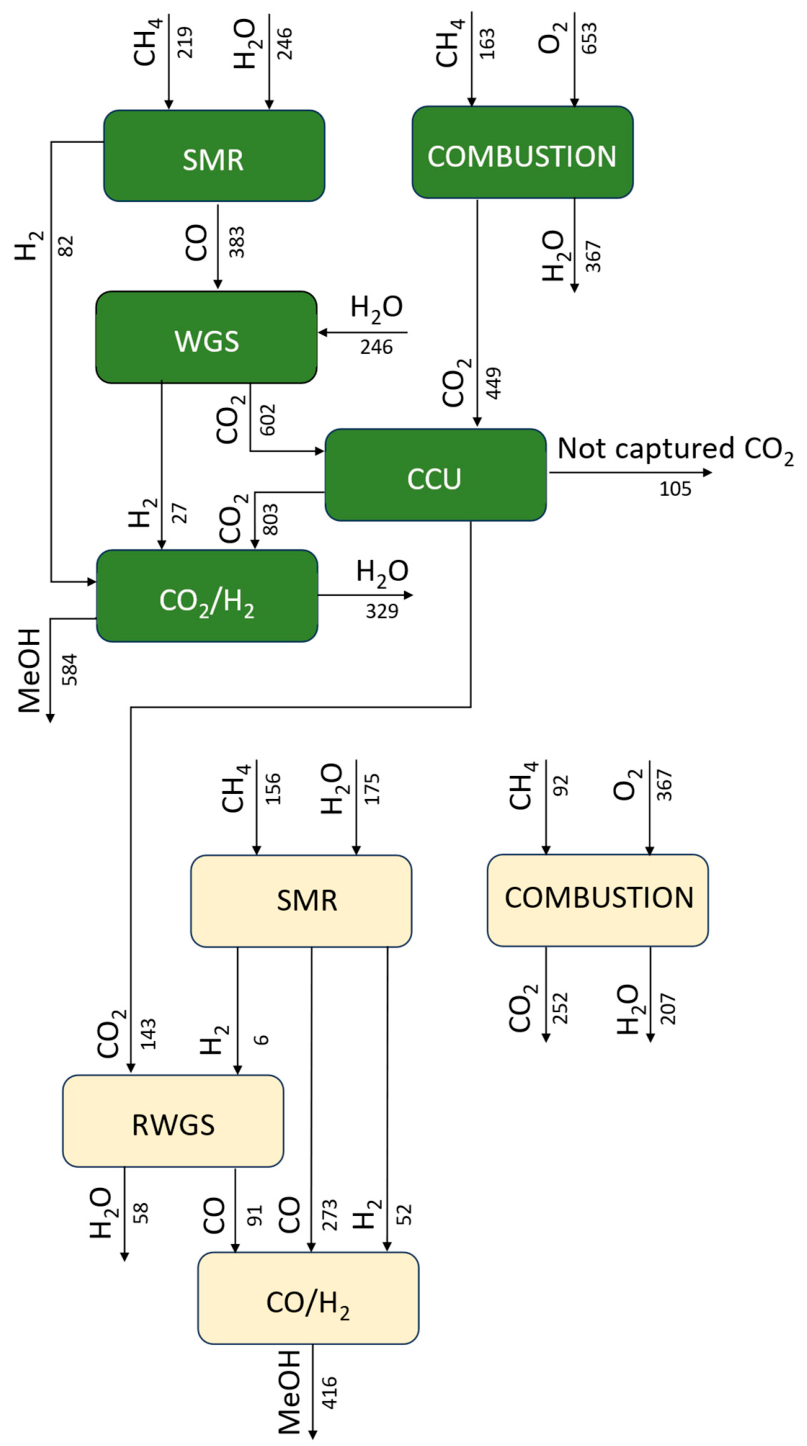
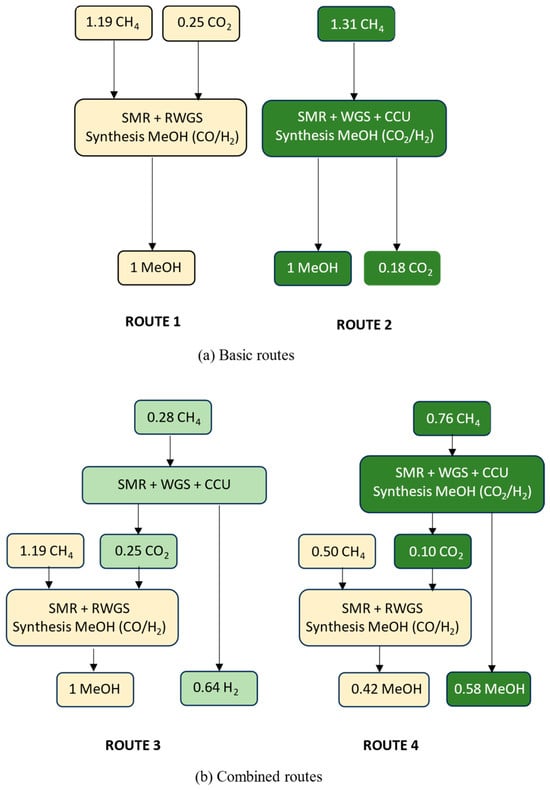
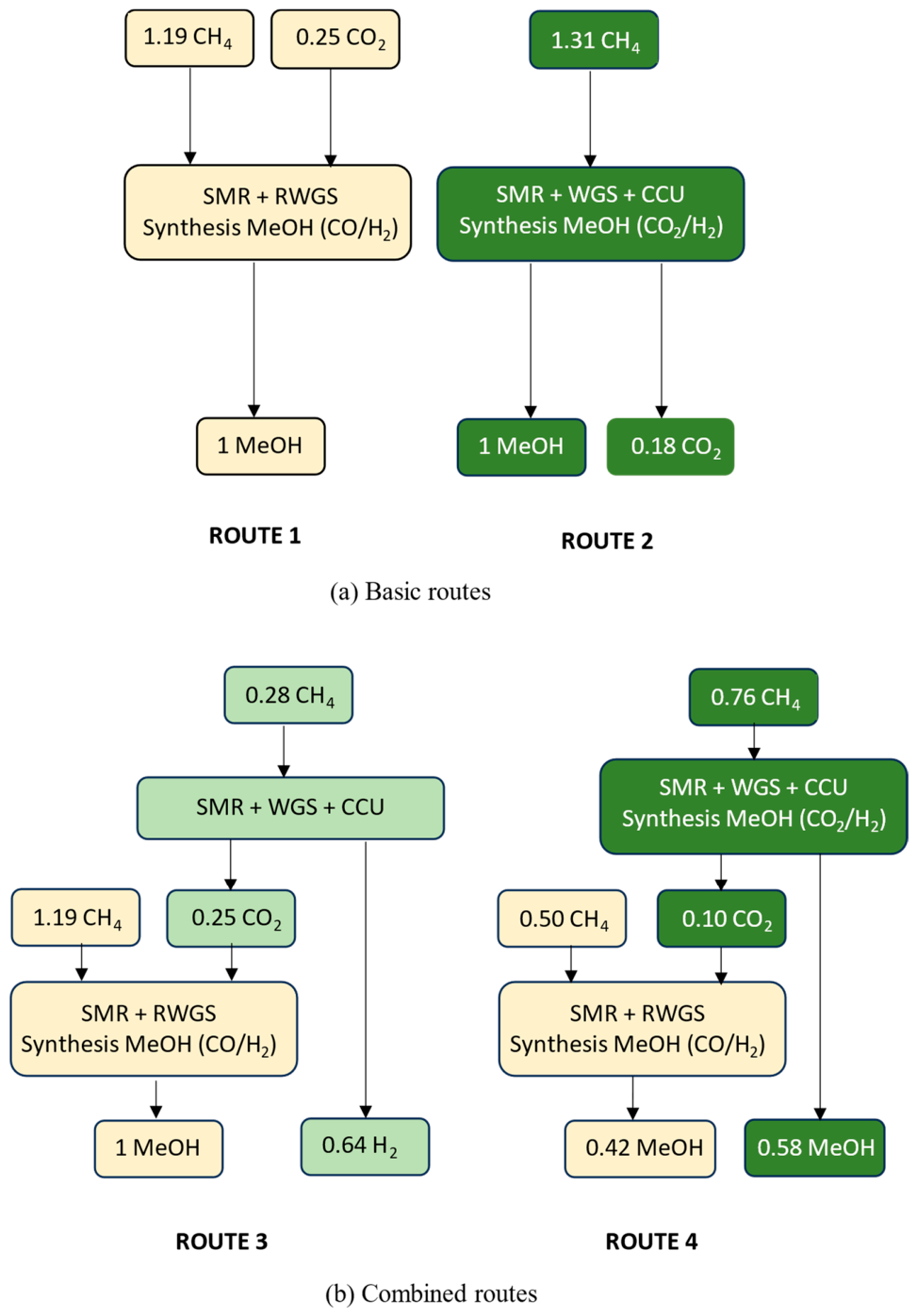
In route 3, the SMR + WGS + CCU process is used to supply the CO2 needed by route 1. The SMR reaction from route 1 is taken as the basis, and the SMR + WGS + CCU reactions are adjusted to provide the CO2 required in route 1 (1/3 CO2 per 4/3 MeOH). In this case, only 39.8 kg H2 are produced as a by-product per tonne of methanol. Route 4 combines routes 2 and 1 by using the CO2 surplus from route 2 to feed route 1. Figure 1 shows the interconnection between routes and the molar basis mass balance, using 1 mol of MeOH as the reference. Table A1 and Figure A1, Figure A2, Figure A3 and Figure A4 in Appendix A summarises the processes and reactions involved in each route.
Figure 1.
Mass balance (in molar basis) of the routes proposed.
According to Figure 1, the balance between feedstock and products for the different routes is summarised in Table 5, along with the evaluation of the CO2 self-sufficiency ratio. Route 1 is identified as the most efficient option to produce methanol, with a biomethane consumption of 9.21 MWh-HHV/t MeOH (108.6 t MeOH/GWh-HHV of biomethane), but it requires 344 kg CO2 per tonne of methanol produced. Considering that at least 95.81 t CO2 are removed from biogas to obtain 1 GWh-HHV of biomethane [38], the CO2 available from the upgrading process to produce 1 tonne of methanol via route 1 is at least 882 kg CO2, that is, more than twice the required amount. Thus, the limiting factor for biomethanol production through route 1 is the availability of biomethane, rather than biogenic CO2. In practice, however, the lack of infrastructure to transport CO2 from biomethane production units to methanol plants is a challenge, which is addressed by the other three routes. As shown in Table 5, the most efficient of the three CO2 self-sufficient options is route 4, with a biomethane consumption of 9.74 MWh-HHV/t MeOH (102.7 t MeOH/GWh-HHV of biomethane). Consequently, routes 1 and 4 have been chosen for the cost and production potential comparison in Spain.
3.2. Levelised Cost of Methanol
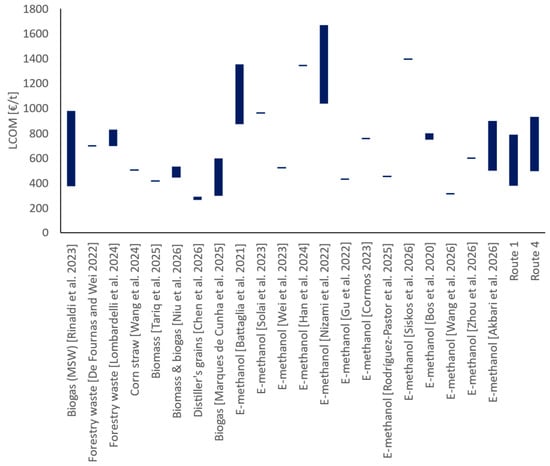
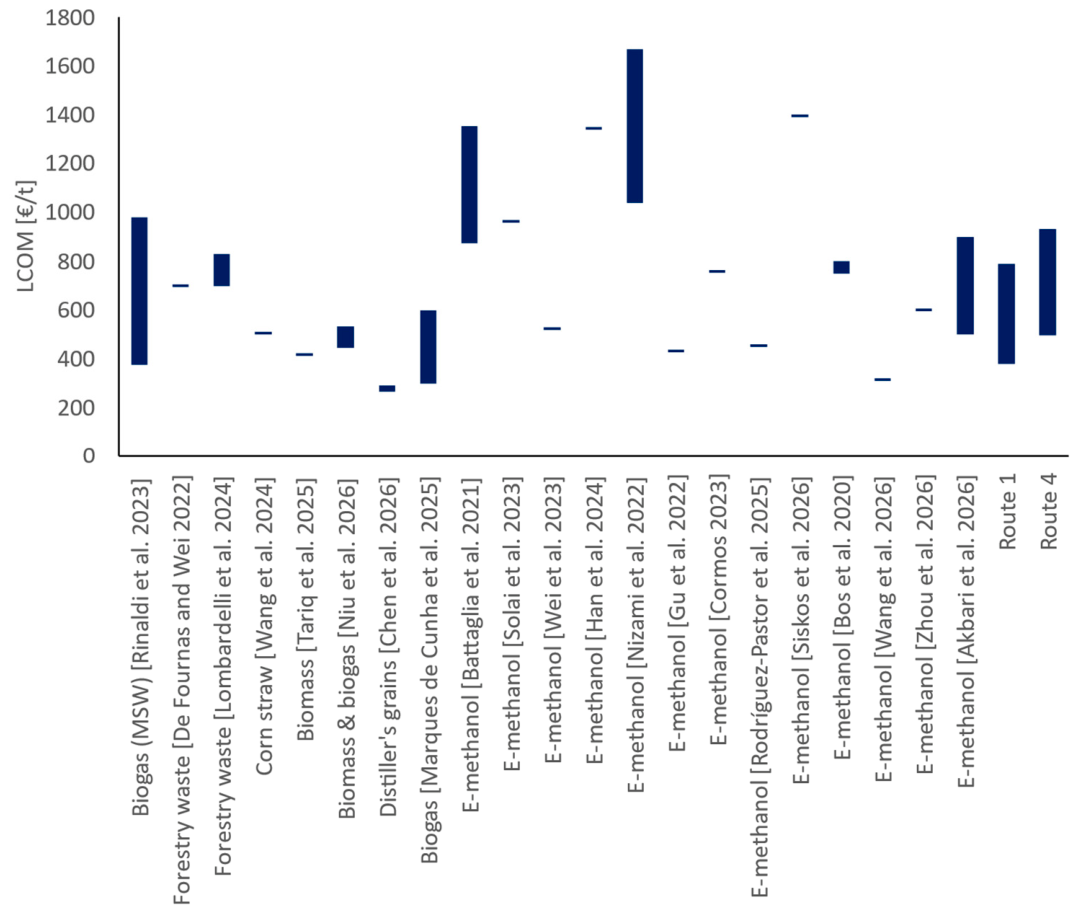
Table 6 presents the breakdown of LCOM for routes 1 and 4, including investment, maintenance and feedstock costs as a function of the substrate mix used to produce biomethane. It is observed that the costs for route 4 (self-produced CO2) are 14 to 23% higher than those for route 1 (baseline). In any case, methanol costs are strongly influenced by feedstock, which accounts for 47% to 72% of total LCOM; in route 1, the cost of biogenic CO2 contributes a further 8% to 17%. These values are consistent with those reported in [1], which reports biomethanol costs of 400–800 $/t for 2020–2025, decreasing to 300–650 $/t in 2035–2040 for biomethanol from MSW-derived biogas (substrates B and C). Figure 2 compares the LCOM results from this study with literature data. The reviewed studies span different technologies, feedstocks, plant scales, and LCOM calculation methods, which explains the wide spread of reported costs. The articles included in Figure 2 cover several production routes: biogas reforming [7,13,15], biomass gasification [9,10,11,12,13,14], and e-methanol production in the remaining works. The LCOM values obtained here for both biomethane reforming routes are consistent with those reported by Rinaldi et al. [7], where biomethanol is also produced from biogas. Literature LCOM values for biomethanol from biomass gasification fall within the range of routes 1 and 4. In contrast, e-methanol shows larger cost dispersion and generally higher LCOM, mainly due to the high cost of renewable hydrogen.
Table 6.
Comparison between routes 1 and 4 in Spain.
Figure 2.
Comparison of methanol production costs for routes 1 and 4 with literature data [7,9,10,11,12,13,14,15,17,18,19,20,21,22,23,24,25,27,28,30,31].
Table 6 also summarises the biomethanol potential and the LCOM of routes 1 and 4 as a function of substrate composition, determining the number of 200 kt/year methanol plants that could be installed in Spain if the entire biomethane potential were exploited. Substrate composition A exhibits, by far, the highest potential (supporting more than 70 plants in route 1 and 69 in route 4), but it also has the highest LCOM due to the logistical challenge of using diverse substrates. Conversely, the lowest-cost substrate (100% landfill gas) offers the smallest potential, supporting only 4 plants. A good compromise between potential and cost is achieved with composition B (biomethane from municipal solid waste and landfill gas), which in route 4 yields about 1.6 Mt/year of biomethanol at a cost of 608 €/t. A substantial difference can be observed between the potential number of plants associated with substrate A and those associated with the other substrates. Since the methanol production capacity is fixed at 200 kt/year for all plants, this difference is mainly attributable to the considerably greater potential of substrate A (more than 135 TWh) compared with that of the other substrates (8 to 17 TWh).
In Table 6, the CAPEX of route 4 is broken down into the contributions associated with routes 1 and 2. The contribution corresponding to route 1 is similar to that of route 1 operated independently, when normalised by the amount of methanol produced. In contrast, the route 2 contribution is considerably more CAPEX-intensive. The resulting additional cost, estimated at 148 €/t of methanol when both CAPEX and O&M costs are considered, is not offset by the 67 €/t saving associated with CO2 self-sufficiency.
The main limitation of this study is the current state of development of the biomethane sector, since route 4 requires 1.95 TWh of biomethane per 200 kt/year methanol plant. At present, biomethane production in Spain is about 528 GWh/year [46], whereas the technical potential is estimated at 163 TWh/year [39]. Thus, the biomethanol production levels projected in this work are therefore only attainable in the medium term, once biomethane plants have been widely deployed. In addition, route 4 requires carbon capture in the SMR.
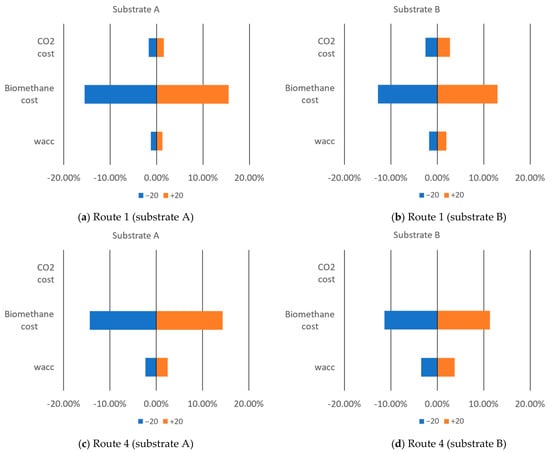
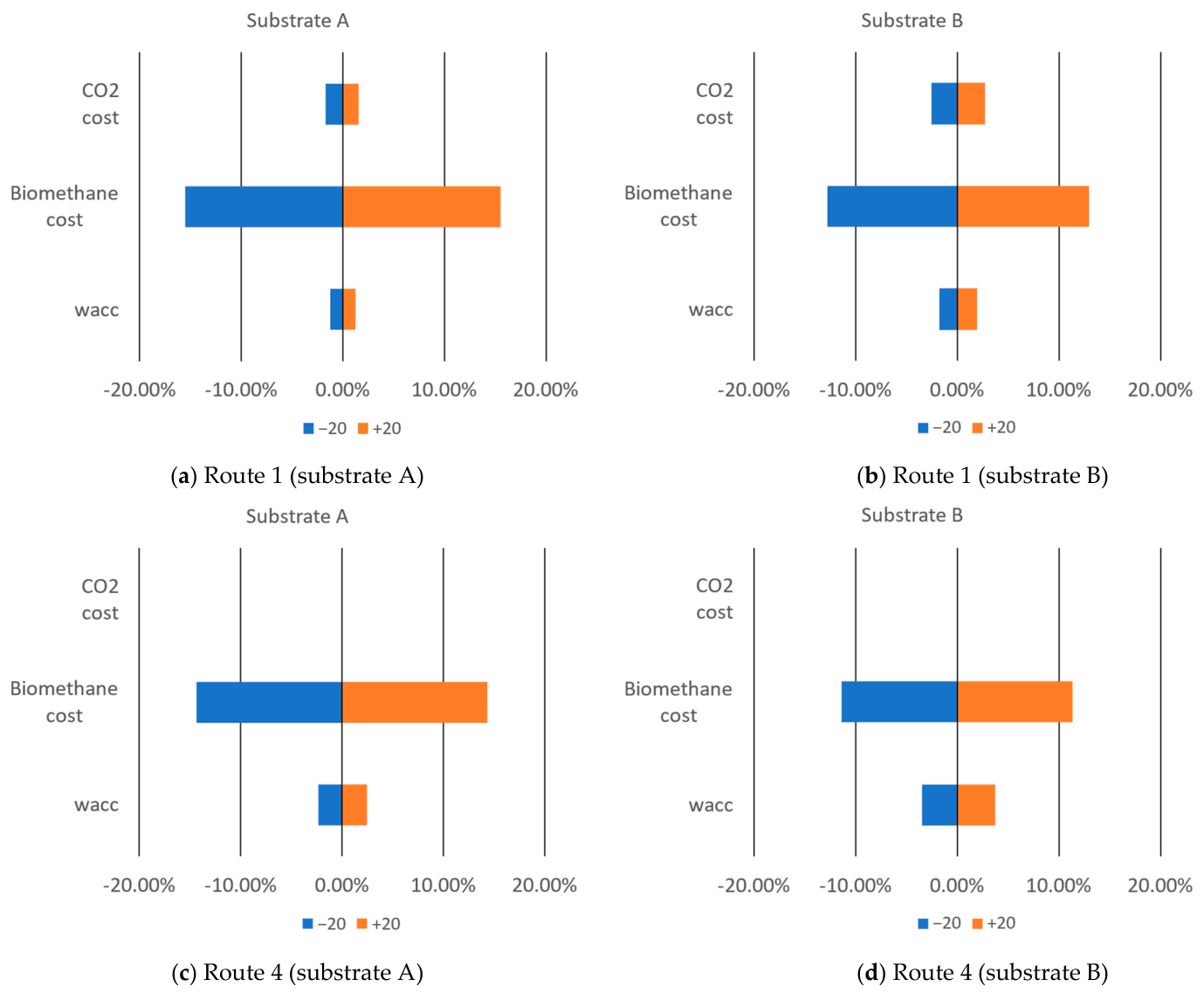
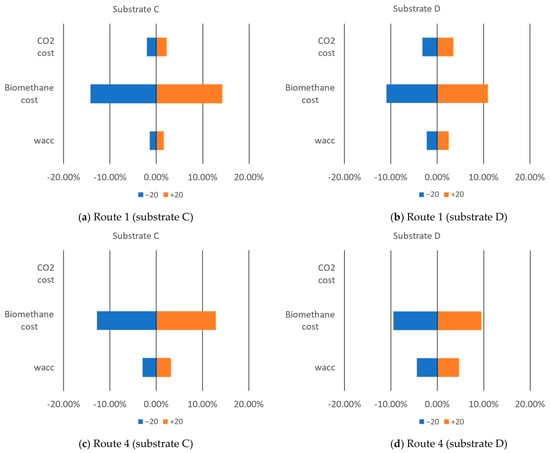
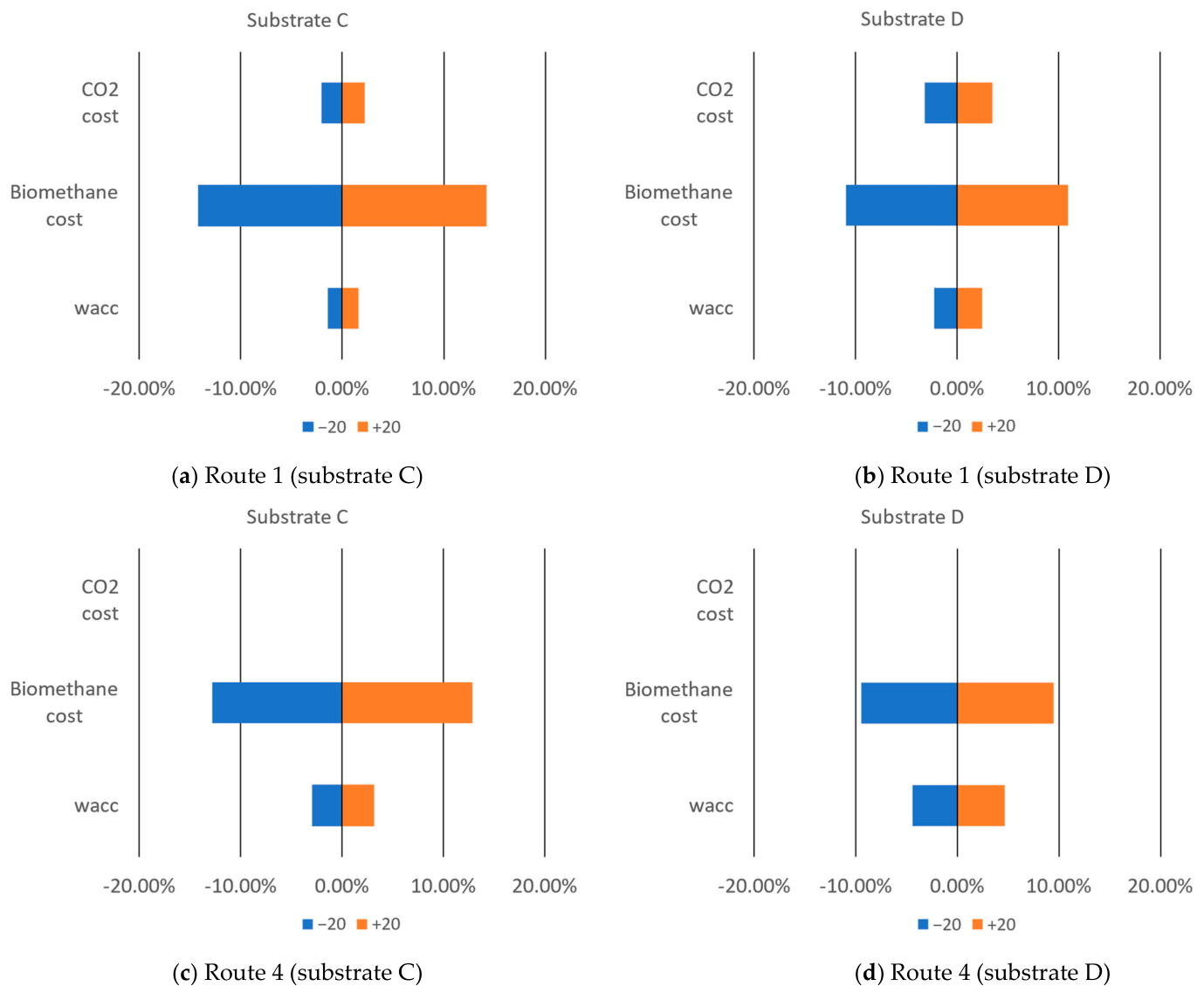
Table 6 shows that biomethane cost is the largest contributor to the LCOM. However, route 4 exhibits a substantially higher CAPEX than route 1, making its LCOM more sensitive to the wacc. In route 1, CO2-related costs, including both acquisition and transport, also make a significant contribution. Figure 3 and Figure 4 present a sensitivity analysis of these parameters. The results show that, in route 1, the LCOM is more sensitive to CO2 costs than to wacc. By contrast, in route 4, the greater influence of wacc reduces the relative contribution of biomethane cost to the overall sensitivity, although biomethane remains the main cost driver in both routes.
Figure 3.
Sensitivity analysis of the LCOM to feedstock costs (biomethane and CO2) and CAPEX (wacc) for substrates A and B in routes 1 and 4.
Figure 4.
Sensitivity analysis of the LCOM to feedstock costs (biomethane and CO2) and CAPEX (wacc) for substrates C and D in routes 1 and 4.
4. Discussion
Methanol is a key building block for chemical products and a promising alternative fuel for shipping. However, its conventional production from fossil fuels is a major source of CO2 emissions. This study has examined four routes to produce biomethanol from biomethane in Spain, with the aim of identifying process configurations that are both efficient and compatible with realistic biomethane potentials. Although the classical route (route 1) achieves the highest conversion efficiency, with 108.6 t MeOH per GWh-HHV of biomethane, it relies on an external supply of biogenic CO2 and is therefore constrained by the availability and logistics of separate CO2 streams.
To address this limitation, three alternative routes were proposed, all of which internally produce biogenic CO2 through biomethane reforming and carbon capture. Among these, route 4 offers the best compromise between efficiency and process integration, achieving 102.7 t MeOH per GWh-HHV of biomethane while remaining fully CO2 self-sufficient. For biomethane derived from a mixture of municipal solid waste and landfill gas, route 4 yields an LCOM of 608 €/t and could support up to eight 200 kt/year plants in Spain. This configuration relies on mature technologies—steam methane reforming, conventional methanol synthesis and post-combustion carbon capture—and reuses the captured CO2 within the process. Although this integration increases the LCOM by 14–23% compared with route 1, the premium can be interpreted as the price of CO2 feedstock self-sufficiency: route 4 internally produces and reuses the biogenic CO2 required for methanol synthesis, thereby eliminating the need for external CO2 supply from geographically dispersed biogas-upgrading plants and avoiding dedicated CO2 collection, purification, compression, and transport infrastructure.
The economic analysis confirms that feedstock cost is the dominant driver of LCOM for both the baseline and self-sufficient routes. The sensitivity analysis shows a greater influence of the wacc in route 4, owing to the higher share of CAPEX in this route compared with route 1. Nevertheless, feedstock cost remains the main driver, especially in route 1, where both biomethane and CO2 contribute significantly to the LCOM. While route 1 remains the most efficient in energetic terms, route 4 demonstrates that a biomethane-only concept, in which biomethane is the sole carbon and hydrogen source, can deliver biomethanol at costs that are competitive with other renewable methanol options reported in the literature, especially when low-cost waste-derived biomethane is available. In this sense, the proposed framework shows that waste streams such as MSW-derived biogas and landfill gas can underpin a scalable biomethanol supply, contributing simultaneously to waste management, renewable fuel production, and industrial decarbonisation.
At the system level, the results suggest that Spain could, in the medium term, develop a portfolio of biomethanol plants based on the most favourable combinations of waste-derived biomethane, with route 4 as a robust reference configuration. Such plants could supply a non-negligible fraction of future methanol demand for the chemical and maritime sectors while remaining anchored in domestic resources. However, the main limitation of the present study is biomethane availability: scaling biomethanol production to the levels identified here will require a substantial expansion of biomethane production, upgrading, and injection infrastructure, together with policy instruments that prioritise waste-based feedstocks. Overall, this study provides a structured techno-economic basis for designing and scaling biomethane-based biomethanol production in Spain and offers a transferable methodology that can be applied to other countries with significant untapped biomethane potentials.
A natural next step in this research would be to include a comprehensive life cycle analysis (LCA) to evaluate not only the carbon footprint, but also other environmental impacts. Similar analyses have been carried out by other authors, such as Tariq et al. [12] and Gholizadeh et al. [47]. The former analysed biomethanol production via biomass gasification, whereas the latter investigated an integrated system combining biomethanol and biomethane production with high-temperature electrolysis, showing that the overall environmental impact strongly depends on the renewable electricity source considered. However, these results cannot be directly extrapolated to the routes proposed in the present study. A tailored LCA would therefore be required to assess their overall environmental performance, although such an analysis lies beyond the scope of the present work.
Author Contributions
Conceptualization, J.I.L. and A.M.S.-M.; methodology, J.I.L., A.M.S.-M., and E.A.; software, J.I.L. and A.R.; validation, A.M.S.-M. and E.A.; formal analysis, E.A.; investigation, A.R.; resources, J.I.L. and E.A.; writing—original draft preparation, A.R.; writing—review and editing, J.I.L., A.M.S.-M. and E.A.; visualization, A.R. and E.A.; supervision, J.I.L., A.M.S.-M., and E.A.; project administration, J.I.L.; funding acquisition, E.A. All authors have read and agreed to the published version of the manuscript.
Funding
This research received no external funding.
Data Availability Statement
The original contributions presented in this study are included in the article. Further inquiries can be directed to the corresponding author(s).
Acknowledgments
The authors acknowledge the Rafael Mariño Chair on New Energy Technologies and the Repsol Foundation Chair in Energy Transition at Comillas Pontifical University for their support.
Conflicts of Interest
The authors declare no conflicts of interest.
Abbreviations
The following abbreviations are used in this manuscript:
| Abbreviations | ||
| AD | Anaerobic digestion | |
| ATR | Autothermal reforming | |
| CCU | Carbon capture and utilisation | |
| DAC | Direct air capture | |
| e-H2 | Hydrogen from electrolysis | |
| FECM | Fossil Energy and Carbon Management | |
| GSR | Gas switching reformer | |
| HHV | Higher heating value | |
| HTER | Heat transfer exchanger reformer | |
| LCA | Life cycle analysis | |
| LCOM | Levelised cost of methanol | |
| MeOH | Methanol | |
| MSW | Municipal solid waste | |
| MTBE | Methyl tert-butyl ether | |
| OFMSW | Organic fraction of municipal solid waste | |
| OM | Operation and maintenance | |
| PV | Photovoltaic energy | |
| RFNBO | Renewable fuel of non-biological origin | |
| RWGS | Reversed water–gas shift | |
| SMR | Steam methane reforming | |
| WGS | Water–gas shift | |
| WWTP | Wastewater treatment plant | |
| Symbols | ||
| Symbol | Concept | Unit |
| CAPEX | Capital expenditure of methanol | €/t |
| CRF | Capital recovery factor | 1/year |
| Specific consumption of x-th feedstock | t x/t MeOH | |
| Maintenance factor | p.u. | |
| H | Annual hydrogen production | t |
| Investment required by route 1 | € | |
| Investment required by route 2 | € | |
| LCOM | Levelised cost of methanol | €/t |
| M | Annual methanol production | t |
| N | Project lifetime | years |
| x-th operational expenditure of methanol | €/t | |
| Operational expenditure of maintenance | €/t | |
| CO2 self-sufficiency ratio | p.u. | |
| Tariff of x-th feedstock | €/t | |
| wacc | Weighted average capital cost | p.u. |
Appendix A
Table A1.
Reactions involved in the proposed routes.
Figure A1.
Mass balance (kg) of route 1.
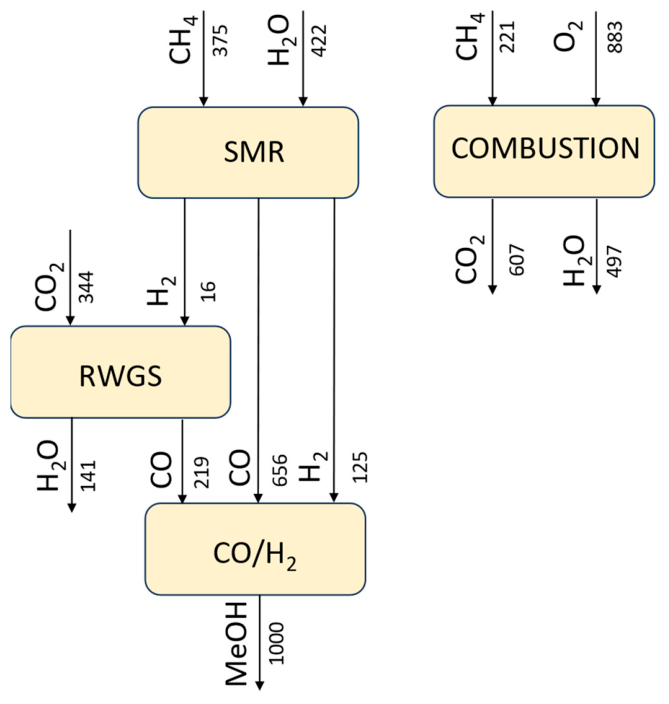
Figure A2.
Mass balance (kg) of route 2.
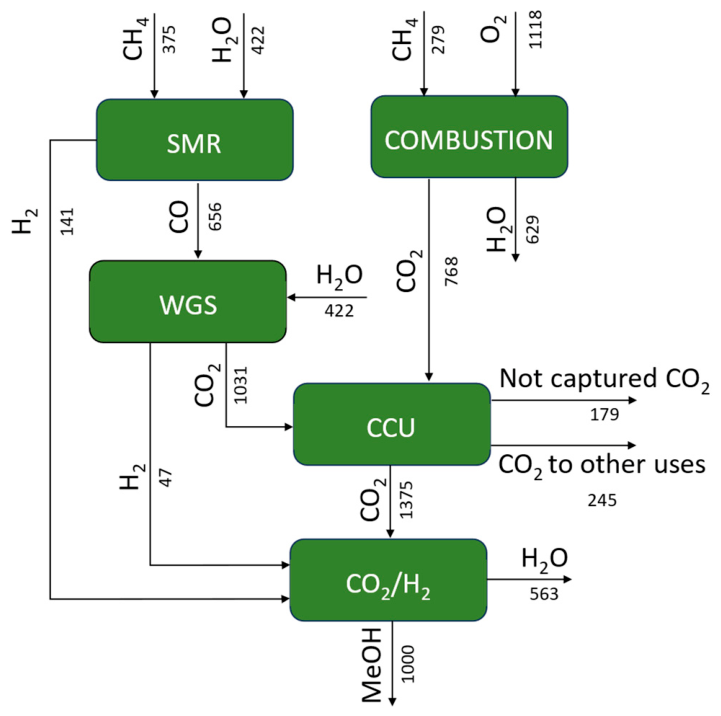
Figure A3.
Mass balance (kg) of route 3.
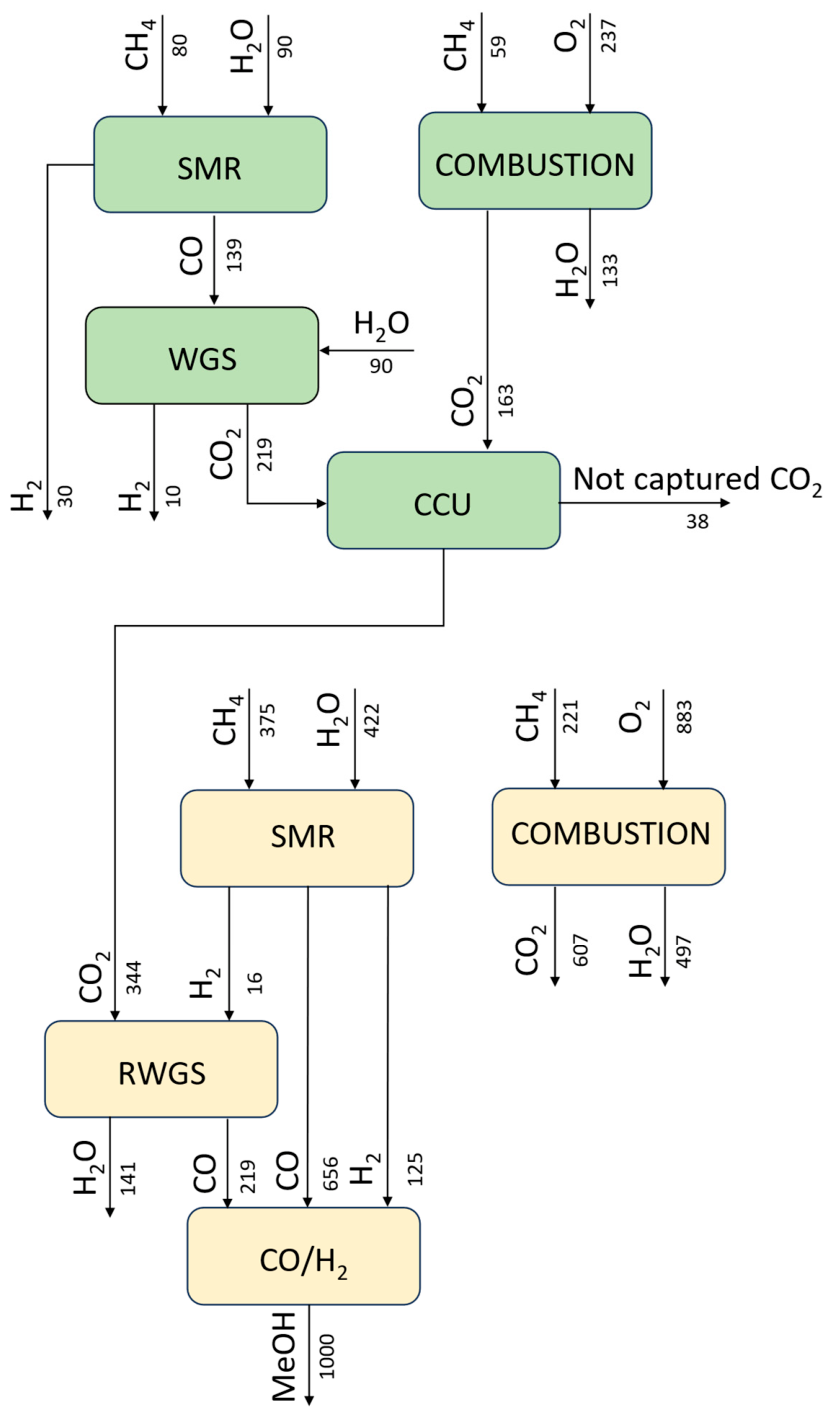
Figure A4.
Mass balance (kg) of route 4.
References
- Irena and Methanol Institute. Innovation Outlook: Renewable Methanol, International Renewable Energy Agency, Abu Dhabi. 2021. Available online: http://www.methanol.org/wp-content/uploads/2020/04/IRENA_Innovation_Renewable_Methanol_2021.pdf (accessed on 9 January 2025).
- Methanol Institute. Methanol Price and Supply/Demand. 2025. Available online: https://www.methanol.org/methanol-price-supply-demand/ (accessed on 9 January 2025).
- Tabibian, S.S.; Sharifzadeh, M. Statistical and analytical investigation of methanol applications, production technologies, value-chain and economy with a special focus on renewable methanol. Renew. Sustain. Energy Rev. 2023, 179, 113281. [Google Scholar] [CrossRef] [Scilit]
- Ren, B.P.; Xu, Y.P.; Huang, Y.W.; She, C.; Sun, B. Methanol production from natural gas reforming and CO2 capturing process, simulation, design, and technical-economic analysis. Energy 2023, 263, 125879. [Google Scholar] [CrossRef] [Scilit]
- Lim, D.; Lee, B.; Lee, H.; Byun, M.; Lim, H. Projected cost analysis of hybrid methanol production from tri-reforming of methane integrated with various water electrolysis systems: Technical and economic assessment. Renew. Sustain. Energy Rev. 2022, 155, 111876. [Google Scholar] [CrossRef] [Scilit]
- Arnaiz del Pozo, C.; Cloete, S.; Jiménez Álvaro, Á. Techno-economic assessment of long-term methanol production from natural gas and renewables. Energy Convers. Manag. 2022, 266, 115785. [Google Scholar] [CrossRef] [Scilit]
- Rinaldi, R.; Lombardelli, G.; Gatti, M.; Visconti, C.G.; Romano, M.C. Techno-economic analysis of a biogas-to-methanol process: Study of different process configurations and conditions. J. Clean. Prod. 2023, 393, 136259. [Google Scholar] [CrossRef] [Scilit]
- Kgwedi, P.C.; Seedat, N.; Fajimi, L.I.; Patel, B.; Oboirien, B.O. Techno-economic analysis of methanol synthesis from syngas derived from steam reforming of crude glycerol. Biomass Convers. Biorefin. 2023, 13, 16179–16196. [Google Scholar] [CrossRef] [Scilit]
- De Fournas, N.; Wei, M. Techno-economic assessment of renewable methanol from biomass gasification and PEM electrolysis for decarbonization of the maritime sector in California. Energy Convers. Manag. 2022, 257, 115440. [Google Scholar] [CrossRef] [Scilit]
- Lombardelli, G.; Scaccabarozzi, R.; Conversano, A.; Gatti, M. Bio-methanol with negative CO2 emissions from residual forestry biomass gasification: Modelling and techno-economic assessment of different process configurations. Biomass Bioenergy 2024, 188, 107315. [Google Scholar] [CrossRef] [Scilit]
- Wang, S.; Li, C.; Hu, Y.J.; Wang, H.; Xu, G.; Zhao, G.; Wang, S. Assessing the prospect of bio-methanol fuel in China from a life cycle perspective. Fuel 2024, 358, 130255. [Google Scholar] [CrossRef] [Scilit]
- Tariq, G.; Chen, Z.; Zhao, M. Techno-economic and life cycle assessment of integrated bio- and e-methanol production from biomass with carbon capture and utilization. Chem. Eng. J. 2025, 515, 163850. [Google Scholar] [CrossRef] [Scilit]
- Niu, B.; Yao, J.; Chen, G.; Yan, B.; Cheng, Z.; Yi, W.; Li, J.; Tai, L.; Farobie, O.; De Filippis, P.; et al. Comparative study on green methanol production: Energy, exergy, economy and environment. Renew. Energy 2026, 261, 125286. [Google Scholar] [CrossRef] [Scilit]
- Chen, G.; Cai, J.; Du, W.; Li, J.; Yan, B.; Rajput, M.I.; Tao, J.; Wang, Z.; Gong, S.; Ge, B.; et al. Biomass to green methanol via anaerobic digestion-gasification coupling process: A comprehensive investigation. Energy 2026, 344, 139830. [Google Scholar] [CrossRef] [Scilit]
- Marques da Cunha, M.; Petrollese, M.; Farinelli, E.; Morea, D.; Leonzio, G. Performance analysis of bio-methanol production through bi and tri-reforming processes integrated into a Carnot Battery. Energy 2025, 335, 138104. [Google Scholar] [CrossRef] [Scilit]
- Enayati, M.; di Maria, F. Exploring novel biogas-to-bio methanol conversion: Exergy-driven hybrid pathways for enhanced methanol yield. Energy Convers. Manag. 2026, 349, 120886. [Google Scholar] [CrossRef] [Scilit]
- Battaglia, P.; Buffo, G.; Ferrero, D.; Santarelli, M.; Lanzini, A. Methanol synthesis through CO2 capture and hydrogenation: Thermal integration, energy performance and techno-economic assessment. J. CO2 Util. 2021, 44, 101407. [Google Scholar] [CrossRef] [Scilit]
- Sollai, S.; Porcu, A.; Tola, V.; Ferrara, F.; Pettinau, A. Renewable methanol production from green hydrogen and captured CO2: A techno-economic assessment. J. CO2 Util. 2023, 68, 102345. [Google Scholar] [CrossRef] [Scilit]
- Wei, H.; Su, C.; Dai, J.; Albdeiri, M.S.; Alsenani, T.R.; Elattar, S.; Abed, A.M.; Hua, Y. Towards a sustainable, and economic production future: Proposing a new process for methanol production based on renewable hydrogen. J. Clean. Prod. 2023, 389, 135976. [Google Scholar] [CrossRef] [Scilit]
- Han, Y.; Liao, Y.; Ma, X.; Guo, X. Simulation study of a novel methanol production process based on an off-grid Wind/Solar/Oxy-fuel power generation system. Energy Convers. Manag. 2024, 314, 118672. [Google Scholar] [CrossRef] [Scilit]
- Nizami, M.; Slamet Purwanto, W.W. Solar PV based power-To-methanol via direct CO2 hydrogenation and H2O electrolysis: Techno-economic and environmental assessment. J. CO2 Util. 2022, 65, 102253. [Google Scholar] [CrossRef] [Scilit]
- Gu, Y.; Wang, D.; Chen, Q.; Tang, Z. Techno-economic analysis of green methanol plant with optimal design of renewable hydrogen production: A case study in China. Int. J. Hydrogen Energy 2022, 47, 5085–5100. [Google Scholar] [CrossRef] [Scilit]
- Cormos, C.C. Deployment of integrated Power-to-X and CO2 utilization systems: Techno-economic assessment of synthetic natural gas and methanol cases. Appl. Therm. Eng. 2023, 231, 120943. [Google Scholar] [CrossRef] [Scilit]
- Rodriguez-Pastor, D.A.; Soltero, V.M.; Chacartegui, R. Green methanol production from photovoltaics in Europe. Renew. Energy 2025, 254, 123751. [Google Scholar] [CrossRef] [Scilit]
- Siskos, C.; Manakas, P.; Karaoglanoglou, L.; Vlysidis, A. Techno-economic and environmental analysis of methanol production from cement carbon dioxide emissions. Renew. Energy 2026, 256, 124109. [Google Scholar] [CrossRef] [Scilit]
- Gelten, H.; Hajimolana, Y.; de Jong, W.; Heesink, B.; Nami, H.; Aalderink, B.; van Leeuwen, R. Power-to-methanol: Techno-economic analysis of a regional, decentral case-study. Fuel 2026, 405, 136528. [Google Scholar] [CrossRef] [Scilit]
- Bos, M.J.; Kersten, S.R.A.; Brilman, D.W.F. Wind power to methanol: Renewable methanol production using electricity, electrolysis of water and CO2 air capture. Appl. Energy 2020, 264, 114672. [Google Scholar] [CrossRef] [Scilit]
- Wang, S.; Yang, L.; Pei, Y.; Jian, X.; Yan, J.; Qin, M. Techno-economic assessment of off-grid renewable hydrogen production for sustainable methanol synthesis. Appl. Therm. Eng. 2026, 287, 129509. [Google Scholar] [CrossRef] [Scilit]
- European Central Bank. Available online: https://www.ecb.europa.eu/stats/policy_and_exchange_rates/euro_reference_exchange_rates/html/eurofxref-graph-cny.en.html (accessed on 9 September 2026).
- Zhou, G.; Yin, S.; Li, M.; Zhu, Y.; Ma, W.; He, T.; Lu, Y. Thermodynamic and 4E analysis of an integrated waste-to-methanol system. Appl. Therm. Eng. 2026, 291, 130245. [Google Scholar] [CrossRef] [Scilit]
- Akbari, S.; Nogueira Nakashima, R.; Hakkaki-Fard, A.; Behshad Shafii, M.; Vang Hendriksen, P.; Lund Frandsen, H. Seasonal storage and grid balancing through power-to-methanol and a “Biomass Battery”. Appl. Therm. Eng. 2026, 285, 129269. [Google Scholar] [CrossRef] [Scilit]
- Galinova, T.; Karjunen, H.; Lassila, J.; Satymov, R.; Breyer, C. Techno-economic analysis of e-methanol infrastructure choice for the case of Finland. Energy 2025, 334, 137531. [Google Scholar] [CrossRef] [Scilit]
- Zhao, N.; Wang, J.; Yang, J.; Yuan, F. Comprehensive evaluation and optimization strategy of solar-driven methanol steam reforming for hydrogen production. Renew. Energy 2024, 232, 121120. [Google Scholar] [CrossRef] [Scilit]
- Liu, S.; Wang, W.; Xu, C.; Du, X. Study on stable hydrogen production by indirectly solar thermal methanol steam reforming. Renew. Energy 2025, 251, 123451. [Google Scholar] [CrossRef] [Scilit]
- Korberg, A.D.; Brynolf, S.; Grahn, M.; Skov, I.R. Techno-economic assessment of advanced fuels and propulsion systems in future fossil-free ships. Renew. Sustain. Energy Rev. 2021, 142, 110861. [Google Scholar] [CrossRef] [Scilit]
- Aghdami, G.; Hosseinifard, F.; Ebadollahi, M.; Amidpour, M. A hybrid CCUS–bioenergy pathway for low-carbon ammonia and urea production using blue hydrogen. Int. J. Hydrogen Energy 2026, 266, 156881. [Google Scholar] [CrossRef] [Scilit]
- Flotats, X.; Feliu, A. Renewable Gases. An Emerging Energy Carrier. Naturgy Foundation. 2019. Available online: https://www.fundacionnaturgy.org/en/producto/renewable-gases-an-emerging-energy-carrier/ (accessed on 29 January 2024).
- Yagüe, L.; Linares, J.I.; Arenas, E.; Romero, J.C. Levelized Cost of Biohydrogen from Steam Reforming of Biomethane with Carbon Capture and Storage (Golden Hydrogen)—Application to Spain. Energies 2024, 17, 1134. [Google Scholar] [CrossRef] [Scilit]
- SEDIGAS. A Study of Biomethane Production Capacity in Spain, 2023. Available online: https://biometano.sedigas.es/wp-content/uploads/2023/03/sedigas-report-potential-biomethane-2023.pdf (accessed on 29 January 2024).
- National Energy Technology Laboratory. FECM/NETL CO2 Transport Cost Model (2024), National Energy Technology Laboratory, Last Update: Aug 2024 (Version 5). Available online: https://netl.doe.gov/energy-analysis/search?search=CO2TransportCostModel (accessed on 9 September 2026).
- Yagüe, L.; Linares, J.I.; Arenas, E.; Romero, J.C. Decarbonising grey hydrogen via bio-hydrogen and carbon capture and storage: A case study in Spain. Int. J. Hydrogen Energy 2026, 239, 155447. [Google Scholar] [CrossRef] [Scilit]
- Baltac, S.; Wilson, M.; O’Sullivan, C.; Leguijt, C.; Beeftink, M.; Nieuwenhuijse, I.; Mattos, A.; Jaspers, D. Low-Carbon Hydrogen from Natural Gas: Global Roadmap; IEA Greenhouse Gas R&D Programme: Cheltenham, UK, 2022. [Google Scholar] [CrossRef] [Scilit]
- Kuczynski, M.; Oyevaar, M.H.; Pieters, R.T.; Westerterp, K.R. Methanol synthesis in a countercurrent gas–solid–solid trickle flow reactor. An experimental study. Chem. Eng. Sci. 1987, 42, 1887–1898. [Google Scholar] [CrossRef] [Scilit]
- Stahl, S.; Wessel, N.; Vorholt, A.J.; Leitner, W. Liquid-phase hydrogenation of carbon monoxide to methanol using a recyclable manganese-based catalytic system. Green Chem. 2024, 26, 7799–7805. [Google Scholar] [CrossRef] [Scilit]
- Vaquerizo, L.; Kiss, A.A. Thermally self-sufficient process for cleaner production of e-methanol by CO2 hydrogenation. J. Clean. Prod. 2023, 433, 139845. [Google Scholar] [CrossRef] [Scilit]
- EBA Statistical Report. 2025. Available online: https://www.europeanbiogas.eu/news/eba-statistical-report-2025/ (accessed on 16 December 2025).
- Gholizadeh, T.; Ghiasirad, H.; Skorek-Osikowska, A. Life cycle and techno-economic analyses of biofuels production via anaerobic digestion and amine scrubbing CO2 capture. Energy Convers. Manag. 2024, 321, 119066. [Google Scholar] [CrossRef] [Scilit]

Disclaimer/Publisher’s Note: The statements, opinions and data contained in all publications are solely those of the individual author(s) and contributor(s) and not of MDPI and/or the editor(s). MDPI and/or the editor(s) disclaim responsibility for any injury to people or property resulting from any ideas, methods, instructions or products referred to in the content. |
© 2026 by the authors. Licensee MDPI, Basel, Switzerland. This article is an open access article distributed under the terms and conditions of the Creative Commons Attribution (CC BY) license.