Skip Content
You are currently on the new version of our website. Access the old version .

Clinical Bioenergetics

Clinical Bioenergetics is an international, peer-reviewed, open access journal on bioenergetics in health and disease, published quarterly online by MDPI.

All Articles (13)

Role of ACTN3 R577X Polymorphism in Mitochondrial Myokines After Endurance Exercise

  • Leticia Aparecida da Silva Manoel,
  • Antônio Alves de Fontes-Júnior and
  • Maria Fernanda Cury-Boaventura
  • + 7 authors

Objective: Resistance exercise can induce muscle damage that impairs sports performance and cellular repair. Myokines, particularly mitochondrial myokines, play an important role in regulating energy metabolism and muscle recovery. The ACTN3 R577X polymorphism, which alters the expression of α-actinin-3 in muscle fibers, may influence myokine responses by modulating exercise adaptation and recovery. Methods: Seventy-five amateur runners (30–55 years) from the São Paulo International Marathon were evaluated. Plasma levels of mitochondrial myokines (BDNF, FGF-21, FSTL, IL-6, apelin, IL-15, musclin, and myostatin) were measured before and after the race and correlated with ACTN3 R577X genotypes. Results: In this study, the genotypic frequencies of the ACTN3 R577X polymorphism were 36% (RR), 39% (RX), and 14% (XX). Plasma concentrations of BDNF, FSTL, FGF-21, and IL-6 increased immediately after running across all genotypes, with no significant differences observed between genotypes. In contrast, plasma levels of myostatin, musclin, IL-15, and apelin decreased during the recovery period only among runners carrying the R allele. Conclusions: Mitochondrial myokine responses to resistance exercise were not substantially different among genotypes of the ACTN3 R577X polymorphism. However, myokines associated with protein breakdown and bioenergetic adaptation were reduced during the recovery period in runners carrying the R allele, which may impact muscle repair and bioenergetic adaptation.

26 January 2026
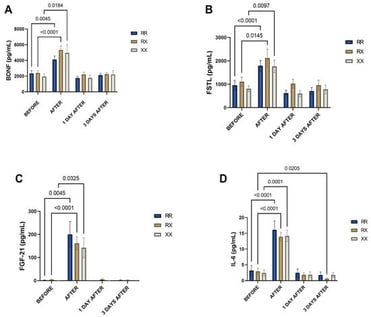
Plasma concentrations of BDNF (A), FSTL (B), FGF-21 (C), and IL-6 (D) in runners with RR, RX, and XX genotypes. The values are presented as mean and standard error of the mean of 27 runners with RR genotype, 37 with RX genotype, and 11 with XX genotype before and after the race and during the recovery period (1 and 3 days after the race). Plasma concentrations were measured using the MILLIPLEX® human myokine magnetic panel (HCYTOMAG-56K, EMD Millipore Corporation, MA, USA).

Therapy-Induced Mitochondrial Dysfunction and Metabolic Plasticity in Myeloid Malignancies

  • Eunseuk Lee,
  • Franklyn Vega Batista and
  • Dana Al-Assi
  • + 2 authors

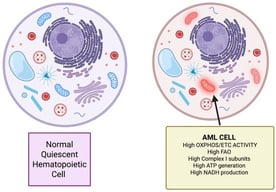
Myeloid malignancies exhibit profound metabolic dependence on mitochondrial oxidative phosphorylation (OXPHOS) for survival and proliferation. Antileukemic therapies such as Venetoclax combined with Azacitidine or cytarabine induce rapid mitochondrial collapse, disrupting electron transport, NADH oxidation, and ATP synthesis, followed by a selective rebound of fatty-acid oxidation (FAO) and redox-buffering programs that sustain minimal residual disease. This review integrates current mechanistic and clinical insights into therapy-induced mitochondrial suppression, delineates the regulatory circuitry that enables metabolic recovery, and frames these events as a reversible model of clinical energy deficiency. By linking mitochondrial stress signaling, lipid oxidation, and adaptive redox metabolism, we outline how bioenergetic reprogramming drives therapeutic resistance and propose interventions that target this adaptive axis in acute myeloid leukemia (AML), myelodysplastic syndromes (MDS), and related myeloid neoplasms.

20 January 2026

Schematic comparison of normal hematopoietic stem cells (HSCs) and leukemic stem cells (LSCs). HSCs display low mitochondrial activity and glycolytic quiescence, whereas AML cells exhibit high OXPHOS, active fatty-acid oxidation, complex I engagement, increased ATP generation, and elevated NADH production.
  • Communication
  • Open Access

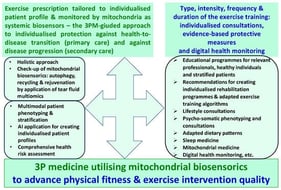
A constantly increasing incidence of chronic diseases is a challenge for healthcare worldwide, being directly associated with physical inactivity, which is considered an important cause of most chronic diseases. In contrast, physical exercise has been proven as a powerful instrument of healthcare to protect individuals against health-to-disease transition and against disease progression. Nonetheless, a number of studies warn against inappropriate high-intensity and/or unaccustomed exercise that exceeds an individual’s physical capacity. Indeed, extensive cardiac activity during prolonged exercise leads to significantly increased cardiac dimensions, triggering cardiac complications that may result in arrhythmogenic sudden cardiac death. The remarkable plasticity of mitochondria allows these organelles to sense and adapt to a variety of stressors and respond to stimuli by molecular signalling, regulating bioenergetics and cellular homeostasis, decisive for repair processes, proliferation, apoptosis, and tissue regeneration to combat degeneration, with whole body outcomes. Mitochondria act as biosensors in the human body; they are reactive to stimuli and protective against health-to-disease transition. To perform this life-important function throughout life, mitochondria need supportive measures, including physical activity, considered an essential pillar of mitochondrial medicine. This article highlights reciprocity between the quality of mitochondrial health and homeostasis on one hand and physical fitness and exercise intervention on the other hand. The proposed novelty relates to the monitoring of mitochondrial homeostasis, which is strongly recommended for creating individualised training programmes, and monitoring exercise efficacy during and after the programme is completed. To this end, a patient-friendly non-invasive approach is already established, utilising tear fluid multi-omics, mitochondria as the vital biosensors, and AI-based multi-professional data interpretation.

18 December 2025

The 3PM-guided innovation utilising high-quality mitochondrial biosensorics to advance the overall management of health-supportive physical activities; protective measures are tailored to individualised patient profiles.

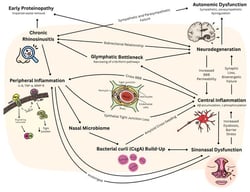
Background: Chronic rhinosinusitis (CRS) affects nearly 9% of the global population with a rising incidence over recent decades. Neurodegenerative diseases such as Alzheimer’s and Parkinson’s disease pose significant global burden, and emerging evidence suggests pathophysiological links through shared bioenergetic dysfunction, peripheral-to-central inflammatory signaling, and altered nasal microbiota. This review evaluates the evidence for CRS as a potentially modifiable peripheral contributor to neurodegenerative disease progression. Methods: A systematic review was conducted using PubMed, Cochrane, Web of Science, Embase, and CENTRAL from January 2000 to July 2025. Search terms included “Chronic Rhinosinusitis,” “Neurodegeneration,” “Mild Cognitive Impairment,” “Alzheimer’s Disease,” “Parkinson’s Disease,” “Bioenergetics,” and “Microbiome.” Clinical and experimental studies exploring epidemiological links, mechanistic pathways, biomarkers, and therapeutic targets were included. Results: Twenty-one studies involving over 100,000 participants met the inclusion criteria. Existing meta-analytic evidence demonstrated significant associations between CRS and cognitive impairment, with patients scoring approximately 9% lower on global cognitive measures than controls. However, other large-scale cohort studies did not pinpoint an increased dementia incidence, suggesting CRS may contribute to early, potentially reversible cognitive decline without directly driving dementia onset. Neuroimaging studies revealed altered frontoparietal connectivity and orbitofrontal hyperactivity in CRS patients. Mechanistic studies support peripheral inflammatory cytokines disrupting the blood–brain barrier, autonomic dysfunction impairing mucociliary clearance, microbiome-driven amyloid cross-seeding, and compromised cerebrospinal fluid clearance via olfactory–cribriform pathways. Discussion: Evidence supports complex, bidirectional relationships between CRS and neurodegeneration characterized by convergent inflammatory, autonomic, and bioenergetic pathways. Therapeutic strategies targeting sinonasal inflammation, microbiome dysbiosis, and mitochondrial dysfunction represent promising intervention avenues. Recognizing CRS as a treatable factor in neurodegenerative risk stratification may enable earlier diagnosis and prevention strategies.

5 December 2025

Proposed link between CRS and neurodegeneration, and the possible interactions between physiological pathways. Legend. IL-6: interleukin-6; TNF-α: tumor necrosis factor-alpha; MMP-9: matrix metalloproteinase-9; STAT3: signal transducer and activator of transcription 3; BBB: blood–brain barrier; Aβ: amyloid-beta; τ: tau; CsgA: Curli subunit A.

News & Conferences

Issues

Open for Submission

Editor's Choice

Get Alerted

Add your email address to receive forthcoming issues of this journal.

XFacebookLinkedIn
Clin. Bioenerg. - ISSN 3042-5158